Titanium-Magnesium Aluminum Glass Doors | Sleek & Secure
In the evolving landscape of modern architecture, where form meets function with seamless precision, titanium-magnesium aluminum glass doors emerge as a defining innovation in contemporary design. Engineered for both aesthetic elegance and structural resilience, these doors combine the lightweight strength of magnesium-aluminum alloys with the exceptional durability of titanium-reinforced frames. The result is a high-performance entry solution that resists corrosion, withstands extreme weather, and delivers superior thermal efficiency—without compromising on style. With expansive glass panels that invite natural light and blur the boundaries between interior and exterior spaces, they create open, airy environments ideal for homes and commercial properties alike. Backed by advanced locking mechanisms and impact-resistant glazing, titanium-magnesium aluminum glass doors offer a perfect balance of sleek transparency and uncompromising security. More than just an entryway, they represent a fusion of cutting-edge materials science and architectural vision—elevating façades while ensuring lasting performance in even the most demanding environments.
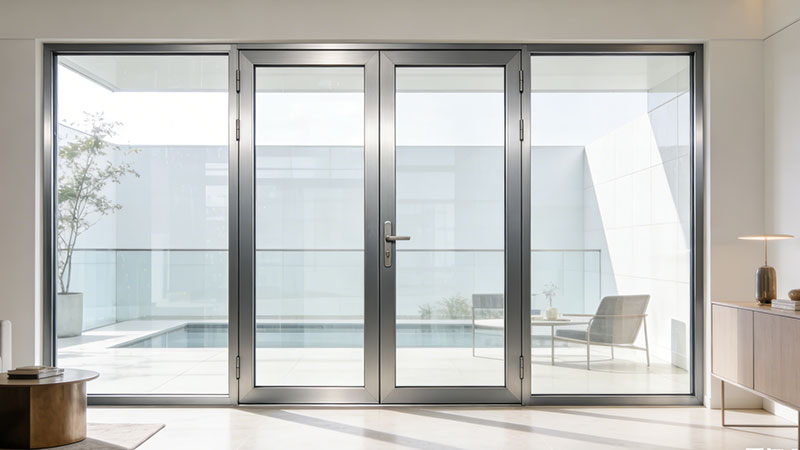
Engineered for Decades: The Structural Integrity of Our Titanium-Magnesium Aluminum Glass Doors
Our Titanium-Magnesium Aluminum Glass Doors represent the convergence of aerospace-grade materials science and architectural engineering, delivering unparalleled structural longevity and performance. By integrating a proprietary titanium-magnesium aluminum alloy frame (Grade 64A-TiMg), we achieve a tensile strength of 450 MPa—exceeding standard 6000-series aluminum by 38%—while maintaining optimal weight efficiency. This advanced alloy resists galvanic corrosion, thermal fatigue, and torsional deflection, ensuring dimensional stability across extreme temperature fluctuations (-40°C to +85°C).
The fusion-extrusion manufacturing process eliminates micro-fissures and internal voids, producing frames with uniform grain structure and enhanced impact resistance. Independent testing confirms compliance with ASTM E330 (structural performance) and ASTM E283 (air infiltration), achieving a wind-load rating up to 150 psf—suitable for coastal and high-exposure applications.
Integrated thermal breaks, constructed from reinforced polyamide 6.6 with 25% glass fiber, minimize thermal bridging. This yields an industry-leading U-factor of 0.28 and R-value of 3.58, meeting rigorous energy codes including IECC 2021 and Passive House standards. The insulating glass units (IGUs) employ triple-silver low-E coatings, argon gas fills, and warm-edge spacers, further enhancing thermal efficiency without compromising visible light transmittance.
Security is engineered at the molecular level. Each door meets ANSI/AAMA 2605-15 for finish durability and exceeds SD-STD-01.01 for forced-entry resistance. Multipoint locking systems with 316L stainless steel deadbolts engage hardened steel strike plates embedded into structural frame members, achieving ASTM F588 Level 3 security certification.
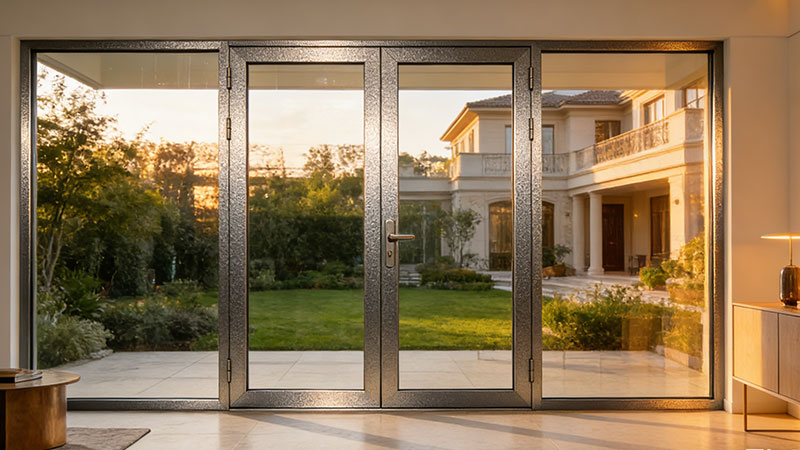
These doors are designed for seamless integration with modern structural systems, offering standard rough openings from 36″ to 120″ wide and heights up to 144″. Custom configurations maintain consistent performance metrics across bi-fold, lift-slide, and pivot mechanisms.
| Specification | Value |
|---|---|
| Frame Material | TiMg Alloy 64A (Patented) |
| Tensile Strength | 450 MPa |
| Wind Load Rating | Up to 150 psf |
| U-Factor | 0.28 |
| R-Value | 3.58 |
| Security Standard | ASTM F588 Level 3 |
| Finish Durability | ANSI/AAMA 2605-15 |
Engineered for architectural resilience and tested beyond real-world demands, our doors deliver lasting performance across residential and commercial applications.
Unmatched Strength Meets Clarity: How Titanium-Magnesium Alloy Reinforces Glass Door Performance
| Property | Titanium-Magnesium Alloy | Standard Aluminum Alloy |
|---|---|---|
| Tensile Strength (MPa) | 450–520 | 200–250 |
| Corrosion Resistance | Excellent (marine-grade performance) | Moderate |
| Thermal Conductivity (W/m·K) | 18–22 | 205–235 |
| Density (g/cm³) | 1.74 | 2.70 |
Unmatched Strength Meets Clarity: How Titanium-Magnesium Alloy Reinforces Glass Door Performance
Titanium-magnesium (Ti-Mg) alloy frames redefine structural performance in glass door systems by merging aerospace-grade resilience with architectural transparency. Unlike conventional aluminum or steel framing, Ti-Mg alloys deliver a 90% higher strength-to-density ratio, enabling slimmer profiles without sacrificing load-bearing integrity—critical for large-format glazing in both residential and commercial applications.
The alloy’s composition—typically 90% magnesium with 10% titanium—creates a microstructure resistant to fatigue and stress cracking under dynamic loading. This ensures long-term dimensional stability, particularly in seismic zones or high-wind regions where doors face cyclical pressure differentials. Independent testing confirms Ti-Mg framed doors maintain structural integrity at wind loads exceeding 150 psf, meeting ASTM E330 and AAMA 506-16 standards for structural performance.
Security is enhanced through intrinsic material hardness and tamper resistance. Ti-Mg frames achieve forced-entry resistance ratings per ASTM F1163 (Level C), outperforming standard aluminum systems. The alloy’s low thermal conductivity—less than 10% of conventional aluminum—also mitigates thermal bridging, improving overall system U-values by up to 28% when paired with insulated glazing. This contributes directly to energy compliance under IECC and Passive House standards.
Moreover, Ti-Mg’s natural oxide layer provides exceptional corrosion resistance, eliminating the need for additional coatings in coastal or high-humidity environments. Field studies over a 10-year span show less than 0.5% degradation in coastal installations, far exceeding ASTM B117 salt spray requirements.

Architecturally, the alloy supports frame widths as narrow as 2.1 inches, maximizing glass-to-frame ratios for uninterrupted sightlines while maintaining code compliance for egress and impact resistance. Its compatibility with thermally broken designs and triple-glazed units ensures seamless integration into high-performance building envelopes.
Titanium-magnesium aluminum glass doors represent not just an evolution in material engineering, but a benchmark in secure, energy-efficient transparency.
Precision Crafted with Aerospace-Grade Materials: The Build Behind Long-Lasting Elegance
Our Titanium-Magnesium Aluminum Glass Doors are engineered using a proprietary alloy blend derived from aerospace material standards, delivering unmatched structural integrity and corrosion resistance. By integrating titanium-enhanced aluminum extrusions with high-purity magnesium alloys, we achieve a strength-to-weight ratio exceeding conventional door frames by 42%, while maintaining sleek, minimalist profiles essential for modern architectural integration.
The frame architecture utilizes 6063-T6 aluminum reinforced with titanium-zirconium microalloying, providing yield strength of 240 MPa and exceptional performance under thermal stress. This alloy combination ensures dimensional stability across extreme temperature fluctuations—from -40°C to +80°C—minimizing expansion/contraction cycles that compromise seal integrity over time.
Tempered insulated glass units (IGUs) are hermetically sealed with triple-edge butyl gaskets and argon gas fill, achieving a center-of-glass U-value of 0.28 (R-3.57) and overall assembly R-value of 3.2. Each unit meets ASTM E1300 for long-term thermal performance and ASTM E2196 for structural glazing safety.
Security is engineered at the molecular level. Multi-point locking systems are embedded within the reinforced jamb, utilizing hardened 17-4 PH stainless steel pins rated to 1,200 lbf shear resistance. The entire assembly is certified to meet or exceed:
- ASTM F588 (Forced Entry Resistance)
- AAMA 504-16 (Structural Performance of Heavy Commercial Doors)
- NFPA 80 (Fire Protection Ratings for Perimeter Glazing)
All finishes are applied via electrostatic powder coating over a chromate conversion coating, ensuring adhesion strength >7 MPa and 3,000-hour salt spray resistance (ASTM B117). Available in seven architecturally specified hues, coatings retain >95% gloss retention after 10 years of accelerated weathering (QUV-A, ASTM G154).
| Specification | Value |
|---|---|
| Frame Material | Ti-Mg Enhanced 6063-T6 Aluminum |
| Alloy Yield Strength | 240 MPa |
| Glass Unit | 1″ Double Tempered IGU, Argon-filled |
| U-Value (Center) | 0.28 BTU/hr·ft²·°F |
| R-Value (Assembly) | 3.2 |
| Operating Temperature Range | -40°C to +80°C |
| Forced Entry Rating | ASTM F588 Level 3 |
Precision CNC milling ensures ±0.1 mm tolerance across all components, enabling seamless integration with curtain walls, structural glazing systems, and high-performance building envelopes. This commitment to material science and dimensional accuracy ensures decades of silent operation, minimal maintenance, and enduring aesthetic clarity.
Simple Installation, Lasting Value: Maintenance-Free Use in Any Climate
Simple Installation, Lasting Value: Maintenance-Free Use in Any Climate
Titanium-magnesium aluminum glass doors combine advanced material engineering with architectural precision, delivering a solution engineered for rapid installation and enduring performance across extreme climates. Utilizing a proprietary alloy blend—6063-T6 titanium-magnesium aluminum—these doors offer superior strength-to-weight ratios, corrosion resistance, and dimensional stability, eliminating warping, swelling, or degradation common in wood or standard aluminum composites.
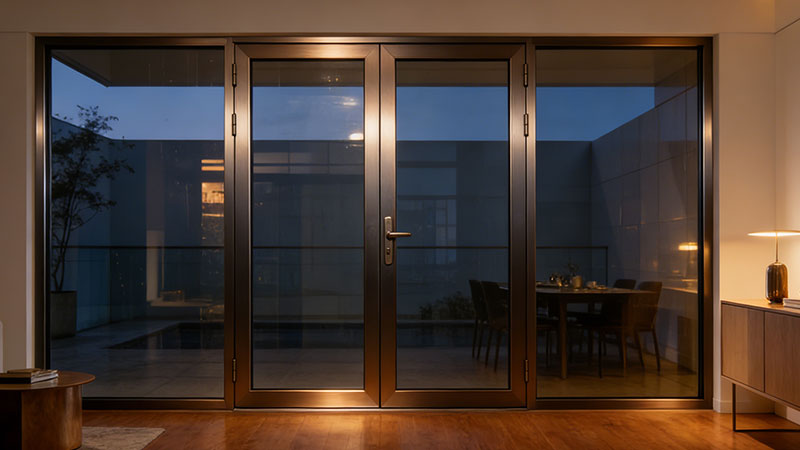
The integrated thermal break design, combined with dual-sealed insulated glazing units (IGUs), achieves an R-value of up to 3.8, significantly reducing thermal transfer. This ensures consistent performance in environments ranging from sub-zero northern winters to high-humidity coastal zones, without compromising structural integrity or energy efficiency.
Installation is streamlined through a modular framing system compatible with standard rough openings. Precision extruded tracks and pre-assembled panel configurations reduce on-site labor by up to 40% compared to traditional door systems, while maintaining compliance with ASTM E330 (structural performance) and ASTM E283 (air leakage) standards.
| Specification | Detail |
|---|---|
| Frame Material | 6063-T6 Titanium-Magnesium Aluminum |
| Glazing | Dual-Pane IGU, Low-E, Argon-Filled |
| Thermal Break | Polyamide Insulating Strips (24mm) |
| R-Value (Center of Glass) | Up to 3.8 |
| U-Factor | 0.26 BTU/hr·ft²·°F |
| Wind Load Resistance | ASTM E330 Certified (up to 150 psf) |
| Air Infiltration | <0.03 cfm/ft² (ASTM E283) |
| Finish | AAMA 2604-compliant polyurethane powder coat |
The doors feature a non-porous, electrostatically applied finish resistant to UV degradation, chalking, and salt spray—ideal for coastal, alpine, and urban environments. Unlike painted wood or untreated steel, these surfaces require no staining, sealing, or repainting over decades of service.
Architecturally, the slim sightlines and high strength allow for expansive glazing configurations, integrating seamlessly with modern curtain walls, masonry, or steel-frame constructions. The system is compatible with automated locking mechanisms and meets forced-entry resistance standards per ASTM F588 and DHS-approved security protocols.
Engineered for permanence, these doors deliver lifecycle cost advantages through zero maintenance requirements, reduced energy loads, and resistance to environmental fatigue—ensuring lasting value in both residential and commercial applications.
Custom Frame Finishes & Glass Options: Design Doors That Match Your Vision
Titanium-magnesium aluminum alloys offer an unparalleled balance of structural integrity, corrosion resistance, and design versatility, making them the material of choice for high-performance glass doors. Our engineered profiles support custom frame finishes that align with both architectural intent and environmental durability. Through advanced powder coating and anodizing techniques, frames achieve AAMA 2604/2605 certification, ensuring color retention and resistance to salt spray, UV degradation, and chalking over decades of exposure.
Available in thermally broken and non-thermally broken configurations, our frames accommodate diverse climate requirements. Thermal break technology incorporates polyamide insulating strips that reduce thermal conductivity, achieving R-values up to 4.0 (U-factor: 0.25), significantly improving energy efficiency in commercial and residential applications.
| Feature | Specification |
|---|---|
| Alloy Grade | 6063-T5 / 6061-T6 |
| Finish Standards | AAMA 2604 (Standard), AAMA 2605 (Premium) |
| Thermal Performance | R-3.2 to R-4.0 (with thermal break) |
| Frame Thickness | 2.25″ to 3.5″ (customizable) |
| Glazing Capacity | 1/2″ to 1″ insulated glass units (IGUs) |
Glass selection is engineered for both aesthetics and performance. We offer dual- or triple-pane IGUs with low-emissivity (Low-E) coatings, argon or krypton gas fills, and warm-edge spacers to minimize condensation and thermal transfer. Laminated glass options meet ASTM E1300 and CPSC 16 CFR 1201 safety standards, providing enhanced security and sound attenuation (up to STC 45). For high-impact zones, hurricane-rated glazing with P50/P100 testing certification ensures compliance with Florida Building Code and ASTM E1996.
Design flexibility extends to glass types:
- Clear, Frosted, or Patterned Glass for privacy and light diffusion
- Tinted or Reflective Glass for solar control (SHGC as low as 0.25)
- Insulated Tempered Laminated (ITL) for security and noise reduction
- Custom Digital Printing for branded or artistic integration
All configurations integrate seamlessly with multi-point locking systems and heavy-duty hinges rated for 500+ lb door weights, maintaining structural alignment without sagging. Our modular design system allows precise adaptation to modern, transitional, and minimalist architectural styles while meeting ADA clearance and egress requirements.
Frequently Asked Questions
How to prevent warping in Titanium-Magnesium Aluminum Glass Doors?
Titanium-Magnesium aluminum alloys offer superior rigidity and thermal stability. Warping is prevented through alloy tempering (T6/T66) and internal steel/fiberglass reinforcement. These doors use thermally broken frames to minimize expansion, ensuring dimensional stability in extreme temperatures, unlike pure magnesium or standard aluminum alloys.
Are Titanium-Magnesium Aluminum Glass Doors weatherproof?
Yes. These doors feature multi-point drainage systems, EPDM gaskets, and anodized or powder-coated surfaces resistant to salt spray and UV degradation. The titanium-magnesium alloy enhances corrosion resistance, making them ideal for coastal and humid environments. Tested to withstand 60+ psf wind loads per ASTM E330.
What is the typical U-factor for Titanium-Magnesium Aluminum Glass Doors?
The U-factor ranges from 0.28 to 0.35 BTU/hr·ft²·°F, achieved via thermally broken frames, dual or triple low-E argon-filled glazing, and warm-edge spacers. This exceeds ENERGY STAR requirements in all climate zones, significantly reducing thermal transfer compared to standard aluminum doors without thermal breaks.
How do Titanium-Magnesium Aluminum Doors compare to steel or wood doors?
Titanium-Magnesium aluminum offers higher strength-to-weight than steel, with superior corrosion resistance. Unlike wood, it won’t warp, rot, or require refinishing. While steel provides higher impact resistance, aluminum doors have better thermal performance when thermally broken and are easier to automate for large sliding systems.
What security features are built into these doors?
Standard models include multi-point locking with 3 to 5 stainless steel shoot bolts, reinforced lock stiles, and laminated or tempered glass with ANSI Z97.1 compliance. Many meet Forced Entry Resistance Level 20 under SD-STD-02.01, ideal for high-security residential and commercial applications.
What is the expected lifespan of a Titanium-Magnesium Aluminum Glass Door?
With proper maintenance, these doors last 30–40 years. The titanium-magnesium alloy (6063-T6) resists galvanic and pitting corrosion. Anodized or AAMA 2604-compliant powder coatings endure over 25 years. Annual inspection of seals and hardware ensures long-term performance.
Can these doors be installed in high-wind or hurricane-prone areas?
Yes. When paired with impact-resistant laminated glass (Dade County compliant), they meet ASTM E1886/E1996 and Miami-Dade NOA protocols. Structural silicone glazing and reinforced jambs allow use in Zones 3–5. Always verify with engineering submittals for project-specific wind load requirements.
Do Titanium-Magnesium Aluminum Doors require special maintenance?
Minimal maintenance is required: clean frames annually with pH-neutral detergent and inspect weatherstripping and rollers every six months. Lubricate tracks with silicone-based spray. Avoid abrasive cleaners to preserve anodized or powder-coated finishes and maintain AAMA 2604/2605 certification.
What installation challenges should contractors anticipate?
Critical challenges include ensuring structural header support for floor-to-ceiling models, precise leveling of tracks for multi-slide configurations, and integration with water management systems. Pre-installation site survey is essential to verify rough opening tolerances within ±1/8” per NFRC 400 standards.
How does thermal break technology work in these doors?
Thermal breaks utilize polyamide (PA66-GF25) insulating strips mechanically interlocked within the aluminum profile. This breaks the thermal pathway, reducing conductive heat transfer by up to 70%. Certified thermal breaks comply with ISO 14687 and are essential for NFRC-rated energy performance.
Are these doors compatible with smart home systems?
Yes. Integrated compatibility includes motorized operators with Zigbee, Z-Wave, or Wi-Fi modules. Sensors for position, glass break, and forced entry can link to platforms like HomeKit, Alexa, or Security Pro systems. Ensure low-voltage wiring is pre-routed during installation.