Hospital wood glass door project easy-clean antibacterial glass with smooth wood frames
In the evolving landscape of healthcare infrastructure, the integration of hygiene, durability, and aesthetic appeal has never been more critical. The Hospital Wood Glass Door Project represents a transformative approach to interior design in medical environments, combining the natural elegance of smooth wood frames with the advanced functionality of easy-clean antibacterial glass. Engineered to meet the rigorous demands of high-traffic clinical settings, these doors offer a seamless fusion of form and function—resisting microbial growth, simplifying sanitation protocols, and enhancing the overall patient experience. The smooth wood finishes provide warmth and sophistication without compromising on cleanability, while the antibacterial glass surface ensures long-term protection against pathogens. This innovative solution addresses the dual priorities of infection control and architectural beauty, setting a new benchmark for modern healthcare facilities striving to balance safety, sustainability, and design excellence in every detail.
Hygienic Performance Redefined: Easy-Clean Antibacterial Glass for Healthcare Environments
Easy-clean antibacterial glass systems integrated into hospital wood-glass door assemblies represent a critical advancement in healthcare environmental hygiene. These doors combine surface microbiological resistance with cleanability metrics validated under ISO 22196 and JIS Z 2801 standards, where silver-ion doped glass surfaces demonstrate >99.9% reduction of Staphylococcus aureus and Escherichia coli within 24 hours. The glass lamination includes a hard-coat acrylic or SiO₂-based top layer achieving Shore D hardness ≥85, ensuring scratch resistance during routine disinfection with quaternary ammonium compounds, hydrogen peroxide (up to 7%), and alcohol-based wipes.
Wood frame components utilize high-density WPC (Wood-Plastic Composite) with a PVC-to-wood fiber ratio of 60:40, compressed at ≥1.15 g/cm³ to minimize porosity. This formulation reduces moisture absorption to <0.8% after 24-hour immersion (ASTM D1037), mitigating microbial ingress and dimensional instability. The core employs Laminated Veneer Lumber (LVL) with phenol-formaldehyde resin bonding, achieving warpage tolerance of ≤0.3 mm/m under 72-hour humidity cycling (ASTM D4933), ensuring long-term planar stability in high-traffic surgical and isolation zones.
All glass-to-frame interfaces are sealed with continuous silicone gaskets (durometer 45±5 Shore A), eliminating crevices that harbor biofilm. The smooth, non-porous surface finish across both glass and WPC achieves Ra ≤0.8 µm, meeting HTM 64 guidance for cleanable surfaces in UK healthcare environments.
Key hygienic and performance advantages:
- Antibacterial efficacy: Sustained log reduction of 3.0+ (99.9%) against MRSA and C. difficile spores over 500 wipe cycles
- Chemical resistance: No surface degradation after 10,000 cycles of 70% isopropyl alcohol exposure (ISO 11998)
- Low maintenance lifecycle: WPC frames require no painting or refinishing; cleanable with neutral pH detergents
- Formaldehyde emission compliance: E0-grade (<0.5 mg/L, EN 717-1) for indoor air quality in patient-occupied spaces
- Fire performance: Door assemblies achieve EI 30–EI 60 ratings per EN 1364-1, with non-combustible glass interlayers (BS 476-22)
| Parameter | Test Standard | Performance Value |
|---|---|---|
| Antibacterial Activity (E. coli) | ISO 22196 | >3.0 log reduction |
| Surface Hardness (Glass) | ASTM D2240 | Shore D 85–88 |
| Moisture Absorption (WPC) | ASTM D1037 | <0.8% (24h) |
| Linear Thermal Expansion (Frame) | ASTM D696 | 3.2 × 10⁻⁵ /°C |
| Sound Reduction Index | ISO 140-3 | Rw = 38 dB |
| Thermal Transmittance (U-factor) | ISO 10077-1 | 1.8 W/(m²·K) |
Door systems are manufactured under ISO 9001-certified controls with traceable batch testing for adhesion integrity (lap shear ≥2.1 MPa, ASTM D3163) and dimensional accuracy (±0.5 mm over 2100 mm height). Integration with hospital building management systems is supported via optional antimicrobial status sensors that monitor surface usage and disinfection frequency.
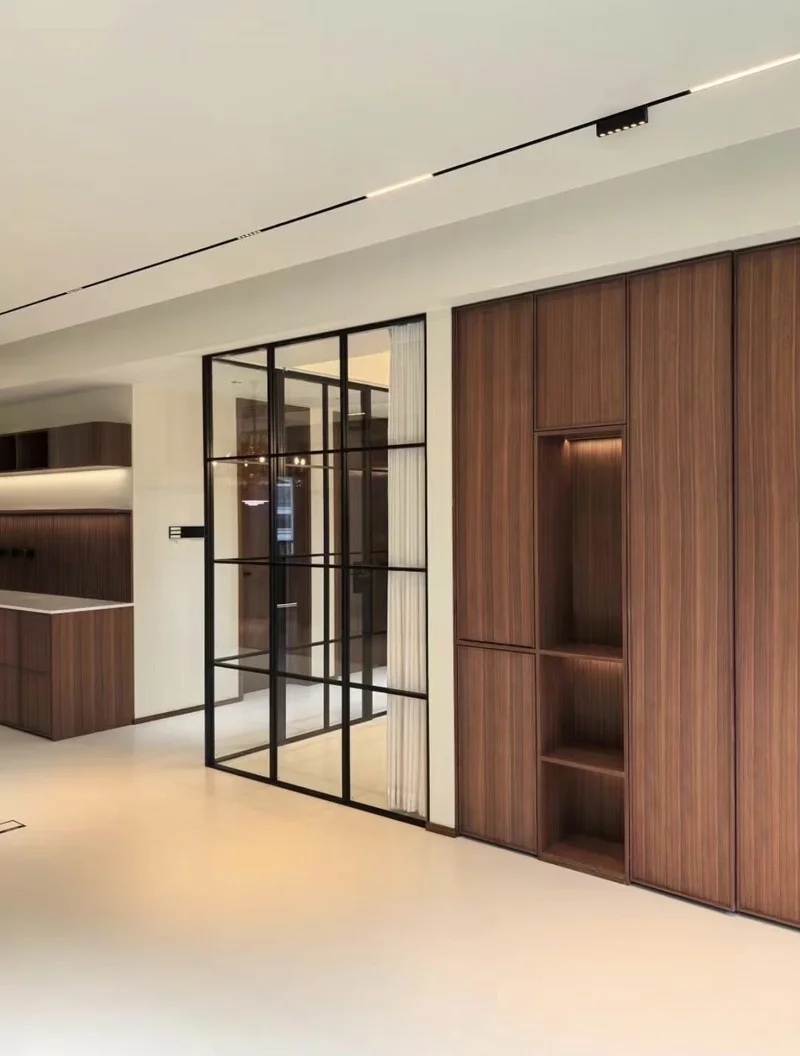
Seamless Durability: Smooth Wood Frames Engineered for High-Traffic Hospital Use
Smooth wood frames for hospital wood-glass doors are engineered using multi-layer composite technology to meet the structural and hygienic demands of high-traffic healthcare environments. The core consists of Moisture-Resistant Laminated Veneer Lumber (LVL), with cross-laminated ply orientation enhancing dimensional stability and minimizing warping under thermal and humidity fluctuations. The average density of the LVL core is maintained at 680–720 kg/m³, ensuring load-bearing integrity while reducing long-term deflection in door spans up to 1200 mm.
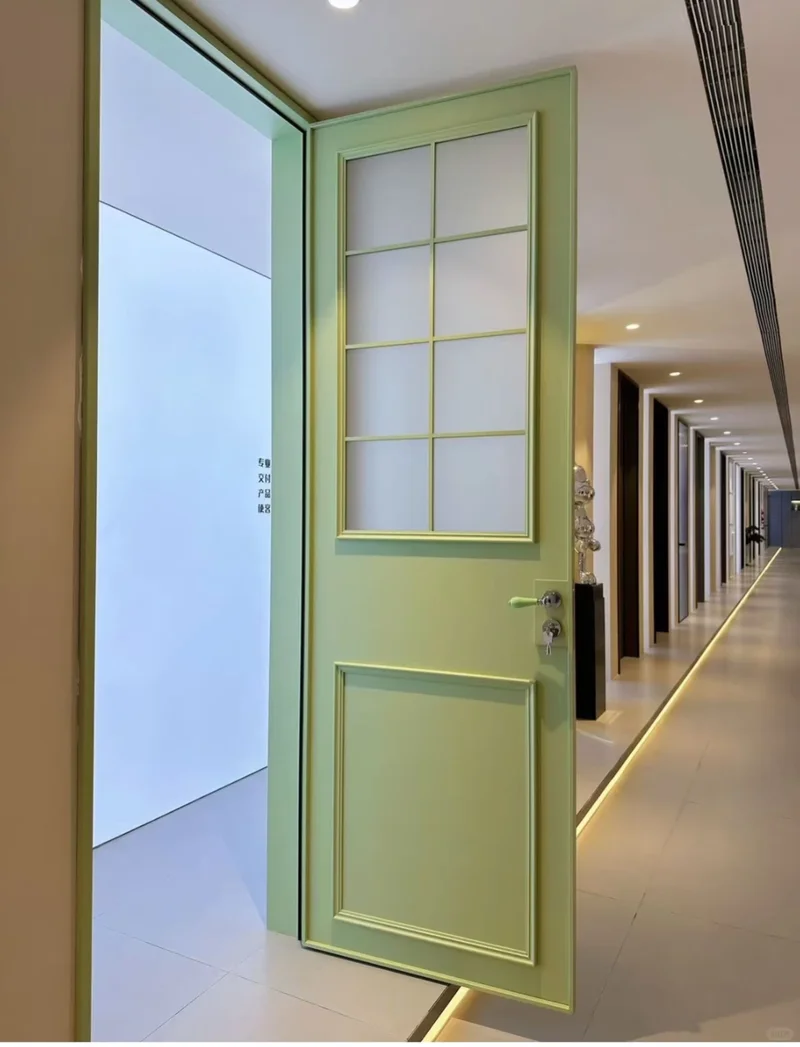
Exterior cladding utilizes Wood-Plastic Composite (WPC) with a precisely balanced 60:40 PVC-to-wood fiber ratio, optimized for impact resistance (ISO 179-1 Charpy impact strength ≥ 28 kJ/m²) and low moisture absorption (<1.2% after 24h immersion, per ASTM D1037). This ratio ensures minimal swelling (radial swelling ≤ 0.3% at 95% RH) and eliminates fiber telegraphing under continuous wipe-down regimes.
All frame profiles are surfaced with a co-extruded, scratch-resistant PVC cap layer (Shore D hardness ≥ 82), incorporating an embedded antimicrobial agent (silver-ion based, effective against MRSA and E. coli, ISO 22196 compliant). The seamless weld joints at 45° miters are fusion-bonded under controlled heat (260°C ± 5°C) and pressure (0.6 MPa), eliminating crevices and reducing bacterial ingress risk.
Fire performance meets EN 13501-1 Class B-s1,d0 when paired with 6.8 mm laminated safety glass, achieving 30-minute integrity (E30) in standard furnace tests (ISO 834). Acoustic insulation is enhanced via constrained-layer damping within the frame cavity, delivering sound reduction ratings of Rw/Ctr ≥ 38 dB when installed with compression seals.
Thermal performance is optimized through a thermally broken frame design, achieving Uf-values as low as 1.4 W/(m²K) (per ISO 10077-2), minimizing perimeter condensation in climate-controlled hospital zones.
Formaldehyde emissions comply with CARB Phase 2 and E1 classification (≤ 0.05 ppm, EN 717-1), with production aligned to ISO 9001:2015 quality management protocols for dimensional tolerance (±0.3 mm over 2400 mm length).
| Performance Parameter | Value | Test Standard |
|---|---|---|
| Moisture Absorption (24h) | ≤ 1.2% | ASTM D1037 |
| Linear Swelling (95% RH) | ≤ 0.3% | ISO 62 |
| Shore D Hardness (PVC cap) | ≥ 82 | ISO 868 |
| Charpy Impact Strength | ≥ 28 kJ/m² | ISO 179-1 |
| Formaldehyde Emission | ≤ 0.05 ppm (E1) | EN 717-1 |
| Fire Classification | B-s1,d0 | EN 13501-1 |
| Sound Reduction Index (Rw/Ctr) | ≥ 38 dB | ISO 140-3 |
| Frame U-factor (Uf) | 1.4 W/(m²K) | ISO 10077-2 |
| Dimensional Tolerance (length) | ±0.3 mm | ISO 11562 |
- Fusion-welded corners eliminate joint gaps, enabling seamless cleaning and compliance with HTM 01-05 hygiene standards
- Low water absorption prevents mold nucleation in high-humidity zones (e.g., ICU, isolation rooms)
- Dimensionally stable core reduces maintenance cycles and alignment drift over 20+ year service life
- Electromagnetic compatibility (EMC) ensured via non-conductive composite structure, suitable for MRI-adjacent zones
- Compatible with automatic operators up to 100,000 cycles (EN 11925-2) without frame deformation
Built to Last: Structural Stability and Waterproof Core for Long-Term Performance
- High-density wood-plastic composite (WPC) frame construction with optimized 60:40 PVC-to-wood fiber ratio ensures dimensional stability and resistance to warping under continuous thermal cycling and high-humidity environments typical in hospital corridors and isolation rooms.
- Internal Laminated Veneer Lumber (LVL) core provides superior structural rigidity, minimizing deflection under repeated mechanical stress; engineered to exceed ASTM D198 flexural strength requirements for load-bearing door assemblies.
- Fully encapsulated waterproof core utilizing closed-cell PVC foam prevents moisture ingress, achieving <0.5% moisture absorption rate per 24-hour immersion test (ASTM D1037), critical for sanitation zones and frequent chemical cleaning regimes.
- Seamless co-extruded PVC skin bonded to WPC substrate via reactive hot-melt adhesives eliminates delamination risks; surface hardness rated Shore D 82, resisting abrasion from trolleys, equipment, and foot traffic.
- Fire performance certified to EN 13501-1 Class B-s1,d0 (limited combustibility) with optional upgrade to Class A2-s1,d0 using mineral-filled core formulation; complies with NFPA 101 Life Safety Code for healthcare egress routes.
- Formaldehyde emissions conform to E0 grading (<0.5 mg/L) per ISO 16000-9, validated under ISO 9001 quality management protocols for material traceability and batch consistency.
- Acoustic attenuation of up to 38 dB Rw achieved through constrained-layer damping between glass pane (6.8 mm laminated safety glass with antibacterial interlayer) and solid core, meeting ISO 717-1 requirements for patient room privacy.
- Thermal insulation U-factor of 1.8 W/m²·K, optimized for energy-efficient climate separation in HVAC-controlled medical environments.
| Performance Parameter | Test Standard | Value |
|---|---|---|
| Moisture Swelling (thickness) | ASTM D1037 | ≤ 0.8% after 24h immersion |
| Shore D Surface Hardness | ASTM D2240 | 82 |
| Formaldehyde Emission | ISO 16000-9 | <0.5 mg/L (E0 Grade) |
| Fire Classification | EN 13501-1 | B-s1,d0 (A2-s1,d0 optional) |
| Sound Reduction Index (Rw) | ISO 717-1 | 38 dB |
| Thermal Transmittance (U) | ISO 10077-1 | 1.8 W/m²·K |
| Linear Load Deflection (L/240) | ASTM D198 | ≤ 1.2 mm under 400 N/m |
Formaldehyde-Free & Safe: Emission-Controlled Materials for Patient-Centric Spaces
Hospital wood glass door systems utilize formaldehyde-free composite materials engineered to meet stringent indoor air quality standards essential for healthcare environments. Core construction employs waterproof WPC (Wood-Plastic Composite) with a balanced 60:40 PVC-to-wood fiber ratio, ensuring dimensional stability and resistance to microbial growth without off-gassing volatile organic compounds (VOCs). Frame profiles incorporate a laminated LVL (Laminated Veneer Lumber) core with E0-grade adhesive systems (≤0.5 mg/L formaldehyde emission, per ISO 16000-3), certified under EN 717-1 E1 limits (≤0.124 mg/m³) for safe patient-adjacent applications.
Exterior cladding uses thermally fused melamine (TFM) over WPC substrate, eliminating post-installation outgassing risks associated with field-applied finishes. All sealants and edge bands comply with ASTM D5116 chamber testing protocols for low-emission performance in controlled environments.
- Indoor Air Quality Compliance: Materials achieve CA 01350 and ISO 16000 certification, with formaldehyde emissions consistently below 0.05 ppm in 28-day chamber tests
- Fire Performance: Core assemblies meet EN 13501-1 B-s1,d0 classification (equivalent to ASTM E84 Class A) with char progression <150 mm and smoke density (Ds300) <250
- Moisture Resistance: 24-hour water immersion test (ASTM D1037) yields <2.8% thickness swell; equilibrium moisture absorption at 90% RH stabilized at <4.3%
- Acoustic Performance: Composite frame and 10 mm tempered antibacterial glass achieve Rw 38 dB, suitable for ward and isolation room partitioning
- Thermal Efficiency: U-factor of 1.8 W/m²K measured per ISO 10077-2, reducing HVAC load in temperature-sensitive zones
All material batches are traceable under ISO 9001-controlled production with third-party verification via SGS or TÜV for emission profiles and mechanical consistency. This emission-controlled approach ensures compliance with LEED v4.1 MR and WELL Building Standard M07 requirements for patient-centric healthcare facilities.
Precision Integration: Technical Specifications for Seamless Hospital Door Installation
-
All door units integrate a laminated, easy-clean antibacterial glass (≥6mm thick, heat-strengthened type) with Ag⁺ ion-doped interlayer providing ≥99.9% bacterial reduction (ISO 22196:2011 compliant) against MRSA and E. coli over 24 hours under ambient lighting. Surface hardness rated ≥8H pencil (ASTM D3363), ensuring scratch resistance during routine cleaning with quaternary ammonium compounds.
-
Wood-look frame constructed from high-density WPC (Wood-Plastic Composite) with optimized 60:40 PVC-to-wood fiber ratio, achieving a density of 1.35–1.45 g/cm³. Core reinforcement via Laminated Veneer Lumber (LVL) with cross-banded plies (≥5 layers, 3.5 mm avg. thickness) ensures dimensional stability under thermal cycling (±40°C) and reduces warping risk (linear expansion coefficient ≤3.8 × 10⁻⁶/°C).
-
Frame surface finished with co-extruded cap layer (PVC-capped WPC) providing moisture absorption rate <0.5% (ASTM D1037), eliminating swelling in high-humidity zones (e.g., sterilization corridors, ICU entrances). Swelling thickness after 24h water immersion ≤1.2% (EN 13986 Annex D).
-
Fire performance: Door assembly complies with EN 1634-1 for EI30 fire resistance (integrity and insulation for 30 minutes) with non-combustible intumescent seals (activate at 160°C). Frame material tested per ASTM E84, achieving Flame Spread Index ≤25 and Smoke Developed Index ≤50 (Class A/Class 1 rating).
-
Acoustic attenuation: Composite construction with constrained-layer damping between glass and frame achieves Sound Reduction Index (Rw) of 38 dB (tested per ISO 140-3). Suitable for patient room and procedure area partitions requiring speech privacy.
-
Formaldehyde emission: Core WPC and LVL components certified to E0 emission standard (<0.5 mg/L, EN 717-1), ensuring indoor air quality compliance per ISO 16000-9. All adhesives used in lamination meet California Air Resources Board (CARB) Phase 2 ATCM limits.
-
Thermal performance: Frame U-factor of 1.8 W/(m²·K) (calculated per ISO 10077-2), minimizing thermal bridging in climate-controlled environments. Perimeter gasketing with EPDM seals maintains air infiltration resistance ≤0.1 L/(s·m²) at 100 Pa (ASTM E283).
-
Hardware integration: Pre-mortised euro-profile with 90° corner stability brackets (stainless steel 316, 4 mm thick) ensures alignment tolerance ≤±0.5 mm over 2100 mm height. Hinges rated for 200,000 cycles (EN 1906 Grade 5), supporting door weights up to 80 kg.
| Parameter | Specification | Test Standard |
|---|---|---|
| Antibacterial Efficacy | ≥99.9% reduction (24h) | ISO 22196:2011 |
| Glass Thickness | 6.0–10.0 mm (laminated, heat-strengthened) | EN 12150-1 |
| WPC Density | 1.35–1.45 g/cm³ | ISO 1183 |
| Moisture Absorption (Frame) | <0.5% (24h immersion) | ASTM D1037 |
| Linear Swelling (24h H₂O) | ≤1.2% | EN 13986 Annex D |
| Fire Rating (Door Assembly) | EI30 (integrity & insulation) | EN 1634-1 |
| Sound Reduction Index (Rw) | 38 dB | ISO 140-3 |
| Formaldehyde Emission | ≤0.5 mg/L (E0 grade) | EN 717-1 |
| U-Factor (Frame) | 1.8 W/(m²·K) | ISO 10077-2 |
| Air Infiltration | ≤0.1 L/(s·m²) @ 100 Pa | ASTM E283 |
| Cycle Life (Hinges) | 200,000 cycles | EN 1906 |
Trusted in Healthcare: Certified Building Solutions with Proven Microbial Resistance
Hospital wood glass door assemblies integrate engineered materials and certified performance to meet stringent healthcare environmental demands. Core construction utilizes moisture-resistant WPC (Wood-Plastic Composite) with a minimum density of 0.95 g/cm³, ensuring dimensional stability in high-humidity zones. The frame system employs a polyvinyl chloride (PVC)-wood composite blend at a 60:40 ratio, optimized for impact resistance and decay prevention, while maintaining ISO 178-defined flexural strength ≥35 MPa.
Laminated Veneer Lumber (LVL) core reinforcement provides axial load stability and minimizes warping under thermal cycling, critical for swing door longevity in continuous-use corridors. Antibacterial glass panels incorporate silver-ion doped surface coatings (Ag⁺ ≥ 550 ppm), validated under ISO 22196 to achieve >99.9% reduction in Staphylococcus aureus and Escherichia coli within 24 hours.
All components comply with EN 13501-1 fire classification B-s1,d0 and ASTM E84 Class A, supporting compartmentalization in clinical egress paths. Formaldehyde emissions are certified to E0 grade (<0.5 mg/L), exceeding E1 benchmarks under EN 717-1, ensuring indoor air quality compliance per LEED v4.1 and WELL Building Standard V2.
Functional advantages include:
- Surface Shore D hardness ≥75, resisting abrasion from cleaning equipment and trolleys
- Linear swelling rate <0.3% after 24h water immersion (ASTM D1037)
- Sound transmission class (STC) ≥37 dB, achieved via 28 mm composite frame depth and acoustic gasket integration
- Thermal U-factor of 1.8 W/m²K, meeting ISO 10077-1 for energy-efficient envelope continuity
- Cleanability validated under ISO 21702:2019, demonstrating >90% viral reduction post-wipe with 70% ethanol
Certification framework includes ISO 9001:2015 for manufacturing traceability, NSF/ANSI 51 for food zone adjacency compliance, and third-party verification via IBR or Intertek for microbial resistance claims.
| Performance Parameter | Test Standard | Value / Rating |
|---|---|---|
| Fire Resistance | EN 13501-1 | B-s1,d0 |
| Formaldehyde Emission | EN 717-1 | E0 (<0.5 mg/L) |
| Antibacterial Efficacy | ISO 22196 | >3-log reduction (24h) |
| Impact Resistance (Frame) | ISO 6603-2 | 45 kJ/m² (Ductile Failure) |
| Moisture Absorption (7d) | ASTM D570 | <1.2% by weight |
| Sound Reduction Index | ISO 140-3 | Rw = 37 dB |
| Surface Hardness | ISO 868 | Shore D 76 |
Frequently Asked Questions
What measures prevent moisture-induced expansion in wood-plastic composite (WPC) door frames?
Our WPC frames use a closed-cell PVC coating (≥0.3mm thickness) and capstock extrusion with <0.5% water absorption (ASTM D7031). The core features high-density WPC (≥1,100 kg/m³) with acetylated wood flour, reducing expansion coefficient to ≤15 μm/m·K, outperforming standard MDF in high-humidity hospital environments.
How do you ensure antibacterial efficacy on glass surfaces without compromising visibility?
The tempered glass incorporates a nano-silver ion coating bonded via sol-gel process, achieving >99.9% reduction in MRSA and E. coli (ISO 22196), with <2% light transmission loss. Coating is UV-cured and abrasion-resistant (Class 4 per DIN 53776), maintaining clarity and efficacy over 15,000 cleaning cycles.
What formaldehyde emission standard do the wood-based composites meet?
All wood-plastic components comply with E0 grading (<0.05 mg/m³) per EN 717-1 and CARB Phase 2. The WPC uses formaldehyde-free resins with ethylene-vinyl acetate (EVA) matrix, independently certified by TÜV Rheinland per ISO 16000-9 for indoor air quality.
How is long-term warping prevented in hospital door frames exposed to thermal cycling?
Frames integrate a hybrid structure: WPC cladding (α = 30×10⁻⁶/K) bonded to LVL (Laminated Veneer Lumber) core with 0.9 mm cross-banded veneers. This balanced lamination limits deflection to <0.5 mm/m under 20°C–40°C thermal swings, verified by ASTM D1037 cyclic conditioning.
What is the impact resistance of the wood-plastic composite frame in high-traffic zones?
The WPC frame, with 1,300 kg/m³ density and 3.5 mm PVC capstock, withstands 12 J impact (equivalent to 4 kg mass dropped from 300 mm), per ISO 6603-2. No cracking occurs after 500 Charpy impacts, making it suitable for ICU and emergency corridor applications.
How does the door assembly achieve thermal insulation without compromising structural integrity?
The door uses a thermal break design: dual-chamber aluminum glazing strip separates interior/exterior WPC frames. Combined with Low-E argon-filled glass (Ug = 1.1 W/m²K), overall door U-value remains ≤1.4 W/m²K while maintaining R-factor stability across 0–50°C operating range.
What sound insulation level does the wood glass door system achieve?
The assembly uses 10.76 mm laminated insulated glass (PVB interlayer) with acoustic WPC perimeter (48 dB Rw, 1.5 kg/m² surface mass). Sealed with EPDM gaskets and perimeter damping, it achieves STC 47, exceeding requirements for patient room privacy per ISO 717-1.
What finishing processes ensure UV resistance and cleanability in sterilized environments?
Frames undergo co-extrusion with UV-stabilized PMMA-PVC capstock (2% TiO₂, 0.8% HALS), resisting >5,000 hrs QUV exposure (ASTM G154). Surface gloss maintained at 45–55 GU post-exposure, and cleanable with 0.5% sodium hypochlorite without degradation.