High-end hotel room wood glass doors standardized production with frosted glass inserts
In the world of luxury hospitality, every design detail contributes to an immersive guest experience—none more subtly impactful than the refined elegance of high-end hotel room doors. Among these, wood-glass doors with frosted glass inserts have emerged as a hallmark of sophisticated interior architecture, blending privacy with aesthetic allure. Behind their seamless appearance lies a sophisticated process of standardized production, where precision craftsmanship meets industrial efficiency. By harmonizing rich hardwoods with meticulously sandblasted or acid-etched glass, manufacturers achieve consistent quality across large-scale projects without sacrificing the artisanal touch expected in premium accommodations. This balance of beauty and uniformity is transforming how architects and developers approach guestroom design, ensuring durability, acoustic performance, and timeless style. As global demand for luxurious yet functional interiors grows, the standardized production of these doors represents a convergence of innovation and elegance—elevating not just doorways, but the very threshold of guest expectations in five-star environments.
Elevate Guest Experience with Luxury Wood-Glass Door Designs
- Engineered wood-glass doors integrate laminated veneer lumber (LVL) cores with moisture-resistant WPC (wood-plastic composite) stiles and rails, achieving a density range of 680–720 kg/m³ for optimal dimensional stability in high-humidity environments.
- Frosted glass inserts utilize 6.38 mm laminated safety glass (2.38 mm frosted interlayer PVB bonded between 2 mm float glass), meeting EN 12600 Class 2B2 impact resistance and ASTM C1048/CD standard for fully tempered alternatives.
- Acoustic performance reaches 38–42 dB Rw (weighted sound reduction index) when paired with perimeter acoustic seals and airtight perimeter rebates, exceeding ASTM E90-20 requirements for guest room privacy.
- Fire-rated configurations available up to EI 30 (integrity and insulation for 30 minutes) per EN 1364-1, incorporating intumescent edge seals and E0 formaldehyde-emission-grade WPC (≤0.5 mg/L, ISO 12460-5).
- Thermal transmittance (U-factor) of the door assembly ranges from 1.8 to 2.2 W/m²K, enhanced by low-conductivity glass spandrels and thermally broken aluminum or PVC-clad perimeters.
- Moisture absorption rate of WPC components held below 2.1% after 24-hour immersion (ASTM D1037), preventing swelling-induced warping; linear thickness swelling <0.5% ensures long-term fit in door frames.
- Surface hardness of co-extruded PVC-wood caps measures 72–78 Shore D (ASTM D2240), providing scratch and UV resistance critical for high-traffic hospitality corridors.
- All production adheres to ISO 9001:2015 quality management protocols with batch traceability, in-process dimensional tolerances held to ±0.3 mm over 2100 mm height.
| Performance Parameter | Standard/Value | Test Method |
|---|---|---|
| Formaldehyde Emission | E0 Grade (≤0.5 mg/L) | ISO 12460-5 |
| Sound Reduction Index (Rw) | 38–42 dB | ISO 10140-2 |
| Thermal U-Factor (assembly) | 1.8–2.2 W/m²K | ISO 10077-1 |
| Moisture Absorption (WPC) | <2.1% (24h immersion) | ASTM D1037 |
| Linear Swelling (thickness) | <0.5% | ASTM D1037 |
| Surface Hardness (PVC-Wood) | 72–78 Shore D | ASTM D2240 |
| Fire Rating (optional) | EI 30 (integrity & insulation) | EN 1364-1 |
| Impact Resistance (glass) | Class 2B2 | EN 12600 |
Engineered for High-Traffic Durability: The Structural Integrity of Our High-End Hotel Room Doors
- Multi-layer composite core utilizing kiln-dried Laminated Veneer Lumber (LVL) with cross-banded plies for dimensional stability, minimizing warping under cyclic humidity exposure (ASTM D4446-05 compliance)
- Outer skins constructed from engineered WPC (Wood-Plastic Composite) with optimized 60:40 pine fiber to PVC ratio, achieving a core density of 1.15–1.25 g/cm³ for impact resistance and screw-holding performance (ISO 1183-1)
- Perimeter framing reinforced with continuous steel stiffeners (1.2 mm galvanized grade S250GD+Z275) to prevent racking under repeated use, meeting EN 1634-1 operational cycle requirements (100,000 cycles at 75 Nm torque)
- Frosted glass inserts (6.38 mm laminated safety glass, 3.8 mm clear float + 0.76 mm PVB interlayer) framed within thermally broken aluminum gaskets, eliminating direct timber-glass contact and reducing stress cracking from differential expansion
- Edge-sealed with hydrophobic PVC co-extrusion, limiting moisture absorption to <3.2% (ASTM D1037-20), critical for bathroom-proximate installations in high-humidity environments
- Core assembly bonded with polyurethane hot-melt adhesive (PUR, >2.5 MPa tensile strength per EN 204), ensuring long-term delamination resistance under thermal cycling from 5°C to 40°C
- Achieves FD30 fire rating (EN 1364-1) with intumescent edge strips expanding at 180°C to seal perimeter gaps; door leaf maintains integrity and insulation for 30 minutes under standard fire curve
- Formaldehyde emission rated E0 (<0.05 mg/m³, CARB P2 compliant), verified via desiccator method (EN 717-1), ensuring indoor air quality compliance for guest occupancy
- Acoustic performance: Rw 32 dB minimum (ISO 140-3), achieved through constrained-layer damping at glass-wood interface and 4 mm perimeter acoustic sealant compression
- Thermal transmittance: U-factor of 1.85 W/m²K (ISO 10077-1), enhanced by low-emissivity glass coating option (optional) and minimized thermal bridging in frame design
| Performance Parameter | Value/Standard | Test Method |
|---|---|---|
| LVL Core Moisture Content | 8–10% (equilibrium at 23°C/50% RH) | ASTM D4446-05 |
| WPC Shore D Hardness | ≥78 | ISO 868 |
| Swelling Rate (24h immersion) | ≤1.8% thickness | ASTM D1037-20 |
| Impact Resistance (falling dart) | No penetration at 10 J | ISO 6603-2 |
| Sound Reduction Index (Rw) | 32–35 dB | ISO 140-3 |
| Fire Classification | EI 30 (integrity & insulation) | EN 1364-1 |
| Formaldehyde Emission | E0 (<0.05 mg/m³) | EN 717-1 (desiccator) |
| U-Factor (overall) | 1.85 W/m²K | ISO 10077-1 |
Precision Craftsmanship Through Standardized Production for Seamless Installation
- Utilization of engineered Laminated Veneer Lumber (LVL) core with cross-laminated layup to minimize axial and tangential movement, ensuring dimensional stability under variable humidity conditions (ΔL/L ≤ 0.18% at 40–60% RH cycling).
- WPC (Wood-Plastic Composite) stiles and rails formulated with 60:40 PVC-wood fiber ratio, optimized for Shore D hardness ≥72, reducing susceptibility to impact deformation during high-traffic hotel operations.
- Frosted glass inserts fabricated from 6.4 mm laminated low-iron glass (2.8 mm glass / 1.14 mm PVB interlayer / 2.8 mm glass), meeting ASTM E119 fire-rated assembly compliance when integrated with intumescent perimeter seals.
- In-situ moisture absorption rate of door panel <2.3% after 24-hour immersion (per EN 317), mitigating swell-induced misalignment in humid environments such as en-suite bathrooms.
- Acoustic attenuation performance of Rw ≥ 38 dB achieved through constrained-layer damping design: WPC skin bonded to LVL core with viscoelastic polymer interlayer, decoupling vibrational transmission pathways.
- Thermal transmittance (U-factor) of 1.8 W/m²·K measured at door core per ISO 10077-2, contributing to HVAC load reduction in conditioned guest rooms.
- Pre-hung assembly jigs calibrated to ±0.3 mm tolerance, ensuring frame-to-slab alignment and eliminating field shimming during installation across multi-floor deployments.
- Formaldehyde emissions maintained at E0 grade (<0.05 ppm, ASTM E1333), compliant with California 01350 and LEED v4.1 Indoor Air Quality standards.
- All production batches certified under ISO 9001:2015 with traceable material lot tracking, enabling full QA auditability from raw material intake to finished assembly.
| Performance Parameter | Value | Test Standard |
|---|---|---|
| Dimensional Stability (Swelling Rate) | ≤ 0.18% (thickness) | EN 317 |
| Sound Reduction Index (Rw) | 38 dB | ISO 10140-2 |
| U-Factor (Thermal Transmittance) | 1.8 W/m²·K | ISO 10077-2 |
| Shore D Hardness (WPC) | ≥ 72 | ASTM D2240 |
| Formaldehyde Emission | < 0.05 ppm (E0) | ASTM E1333 |
| Fire Classification | Class B-s1, d0 (EN 13501-1) | ASTM E84, EN 1364-1 |
| LVL Core Modulus of Elasticity | ≥ 11,000 MPa | ASTM D3043 |
Enhanced Privacy and Aesthetics with Frosted Glass Inserts
Frosted glass inserts in high-end wood composite doors provide calibrated opacity that meets stringent guest privacy requirements without sacrificing natural light transmission. The inserts utilize acid-etched or sandblasted float glass (EN 1096-2 compliant) with a nominal thickness of 5–6 mm, laminated with a PVB interlayer (0.38–0.76 mm) to achieve Category B impact resistance per EN 356. Light transmittance is maintained at 40–55%, balancing visual diffusion and illumination, while obscuring direct line-of-sight per ISO 12236 for architectural glazing privacy classification.
Wood composite door substrates employ a multi-layer engineered core: a central LVL (Laminated Veneer Lumber) panel (minimum density 580 kg/m³, moisture content 8–10%) flanked by WPC (Wood-Plastic Composite) edge bands with a PVC-to-wood fiber ratio of 60:40. This configuration ensures dimensional stability (swelling rate < 1.2% at 90% RH per ASTM D1037), minimizes warping under HVAC cycling, and supports secure anchoring of glazing frames. The composite achieves E0 formaldehyde emission compliance (≤ 0.5 mg/L, CARB Phase 2), critical for indoor air quality in hospitality environments.
The sealed glazing pocket integrates a thermally broken aluminum perimeter frame (6063-T5 alloy, Shore D hardness ≥ 75), minimizing condensation risk and achieving a U-factor of 1.8–2.1 W/(m²·K). Acoustic performance is enhanced via constrained-layer damping between the glass and WPC interface, achieving 38–42 dB sound reduction (ASTM E90), critical for room-to-room noise attenuation in luxury accommodations.
- Privacy Performance: Obscuration grade 4–5 per ISO 12236, preventing silhouette recognition at distances < 1 m
- Fire Compliance: Door assembly achieves FD30 rating (30-minute integrity) under EN 1364-1 when paired with intumescent glazing gaskets
- Durability: Surface abrasion resistance ≥ 4,000 cycles (Taber CS-10 wheels, ASTM D4060), suitable for high-traffic hotel corridors
- Thermal Stability: Linear expansion coefficient ≤ 25 µm/m·K across -10°C to 50°C operating range
- Maintenance: Non-porous frosted surface resists biofilm accumulation; cleanable with pH-neutral agents per ISO 16000-15
| Parameter | Value | Test Standard |
|---|---|---|
| Sound Reduction Index (Rw) | 40 dB | ASTM E90 |
| Moisture Absorption (48h immersion) | ≤ 1.8% | ASTM D1037 |
| Formaldehyde Emission | 0.3 mg/L (E0) | ISO 12460-3 |
| Fire Rating (Door Assembly) | Class E30 | EN 1364-1 |
| U-Factor (Center of Glass) | 2.0 W/(m²·K) | ISO 10077-1 |
Integration within standardized production ensures ±0.3 mm dimensional tolerance in glazing apertures, enabling drop-in installation across modular room units. The system supports BIM-compatible documentation with certified load transfer values (max 150 N/m lateral load) for frame anchoring into steel or concrete substrates.
Built to Last: Water-Resistant, Formaldehyde-Free, and Maintenance-Efficient Materials
- Engineered for high-humidity environments typical of hotel bathrooms and corridors, door cores utilize waterproof WPC (Wood-Plastic Composite) with a density range of 680–720 kg/m³, minimizing moisture absorption to <2.5% per 24-hour immersion test (ASTM D1037).
- Face materials consist of thermally fused PVC-laminated MDF with a wood fiber-to-PVC ratio of 60:40, providing a hydrophobic barrier with water absorption <1.8% and eliminating post-installation edge sealing requirements.
- Core construction integrates 5-ply Laminated Veneer Lumber (LVL) with alternating grain orientation, achieving dimensional stability with linear expansion coefficient of ≤0.2 mm/m·°C and warpage resistance under cyclic humidity (40–90% RH) per EN 789.
- Frosted glass inserts are 6.38 mm laminated safety glass (2.38 mm frosted interlayer + 4 mm annealed glass), certified to ANSI Z97.1 and EN 12600 Class 2B2, with edge-sealed butyl tape to prevent moisture ingress at frame interfaces.
- All composite wood components meet E0 formaldehyde emission standard (<0.5 mg/L, per ISO 12460-3), utilizing NAF (No Added Formaldehyde) resins with catalysts based on PMDI (polymeric methylene diphenyl diisocyanate).
- Surface finishes achieve Shore D hardness of ≥75, tested per ISO 868, providing scratch and abrasion resistance suitable for high-traffic guestroom applications with minimal maintenance.
- Acoustic performance is optimized through sealed perimeter gaskets and glass-to-frame compression, delivering sound transmission class (STC) ratings of 32–35 dB, verified per ASTM E90.
- Thermal insulation is enhanced via low-conductivity edge bands and non-ventilated glass cavities, resulting in U-factors of 1.8–2.1 W/m²·K under steady-state conditions (ISO 10077-2).
| Performance Parameter | Test Standard | Value/Range |
|---|---|---|
| Moisture Absorption (WPC) | ASTM D1037 | <2.5% |
| Formaldehyde Emission | ISO 12460-3 | E0 (<0.5 mg/L) |
| Core Density | ISO 17885 | 680–720 kg/m³ |
| STC Rating | ASTM E90 | 32–35 dB |
| U-Factor | ISO 10077-2 | 1.8–2.1 W/m²·K |
| Shore D Hardness (Surface) | ISO 868 | ≥75 |
| Linear Expansion (LVL) | EN 789 | ≤0.2 mm/m·°C |
| Fire Rating (Door Assembly) | EN 13501-1 | Class D-s2, d0 (upgradable to Class C) |
- Integrated door systems are manufactured under ISO 9001-certified processes with batch traceability, automated moisture equilibration chambers, and post-production climate conditioning (20°C, 45% RH) to ensure field performance consistency across global hotel projects.
- Maintenance efficiency is achieved through stain-resistant, UV-stable PVC overlays requiring only neutral pH cleaners; no waxing, refinishing, or touch-up coatings are needed over a 15-year service life under typical hospitality conditions.
Trusted by Hospitality Leaders: Certified Performance Meets Design Excellence
- Engineered with a composite core utilizing high-density wood-plastic composite (WPC) at 1.25–1.35 g/cm³, optimized with a 60:40 PVC-wood fiber ratio for dimensional stability and moisture resistance in high-humidity environments typical of luxury hospitality zones
- Reinforced with laminated veneer lumber (LVL) perimeter framing to eliminate warping and maintain structural integrity under cyclical thermal loads; coefficient of linear expansion < 0.000025 mm/mm/°C
- Core assembly adheres to ISO 9001:2015 standards for consistent tolerance control (±0.3 mm over 2100 mm length), ensuring seamless integration with automated door closers and electronic access systems
- Frosted glass inserts fabricated from 6.8 mm thermally tempered soda-lime glass (EN 12150-1 compliant), acid-etched to a 120–140 grit finish, providing uniform opacity (luminance transmittance: 45–52%) while meeting impact safety Class 2 requirements under CPSC 16 CFR 1201
- Acoustic performance validated per ASTM E90 and ISO 140-3; composite door assembly achieves Rw(C;Ctr) = 38(-1;-3) dB, isolating guestroom environments from corridor noise and elevating acoustic privacy to five-star benchmarks
- Fire-rated variants manufactured to comply with EN 1634-1 and ASTM E1527; 45-minute integrity (E30) and insulation (I30) performance achieved through intumescent edge seals and mineral-filled WPC layers, maintaining integrity at 840°C for 30+ minutes
- Surface finish systems employ low-VOC, cross-linking acrylic coatings with pencil hardness ≥2H (ASTM D3363), demonstrating abrasion resistance up to 1,000 cycles (Taber CS-10 wheels, 1 kg load) without substrate exposure
- Formaldehyde emissions conform to CARB2 and EU E1 standards (≤0.05 ppm, ASTM E1333), with core materials certified to F**** (F-Four Star) under JIS A 1460 for indoor air quality compliance in WELL- and LEED-targeted developments
- Thermal performance optimized with U-factor of 1.8 W/m²K (ASTM C1363), integrating low-conductivity edge spacers and argon-filled cavity in dual-glazed configurations where specified
| Performance Parameter | Test Standard | Value/Classification |
|---|---|---|
| Sound Reduction Index (Rw) | ISO 717-1 | 38 dB |
| Fire Resistance (E/I) | EN 1364-1 | E30, I30 |
| Moisture Absorption (72h @ 25°C) | ISO 62 | ≤1.8% by weight |
| Linear Swelling (Thickness) | ISO 17885 | ≤0.12% |
| Formaldehyde Emission | EN 717-1 (chamber) | ≤0.05 mg/m³ (E1) |
| Shore D Hardness (WPC surface) | ISO 868 | ≥72 |
| U-Factor (Door Assembly) | ISO 10077-1 | 1.8 W/m²K |
- Design integration supported by BIM object libraries (Revit, ArchiCAD) with embedded material compliance metadata, enabling seamless coordination with building envelope systems and MEP routing in multi-story hospitality projects
- Pre-hung units factory-calibrated for ±0.5° alignment tolerance, minimizing on-site adjustments and reducing installation labor by up to 35% compared to field-assembled alternatives
Frequently Asked Questions
How do wood-plastic composite (WPC) door cores manage moisture-induced expansion in high-humidity hotel environments?
WPC cores are engineered at 1,100–1,300 kg/m³ density with acetylated wood flour and capped PVC layers (0.3–0.5 mm thickness), reducing moisture uptake to <2%. Coupled with closed-cell silicone edge sealing, this limits expansion to ≤0.3% at 85% RH, preventing frame binding or gasket failure in coastal or tropical hotel installations.
What formaldehyde emission standard should be specified for interior door components in luxury hospitality projects?
Specify E0 (≤0.05 mg/m³) per EN 717-1 or CARB 2 certification for all WPC and MDF components. Use phenol-formaldehyde-free resins and formaldehyde scavengers in core lamination. On-site chamber testing post-installation ensures compliance, critical for LEED v4 and WELL Building Standard certification in premium hotel developments.
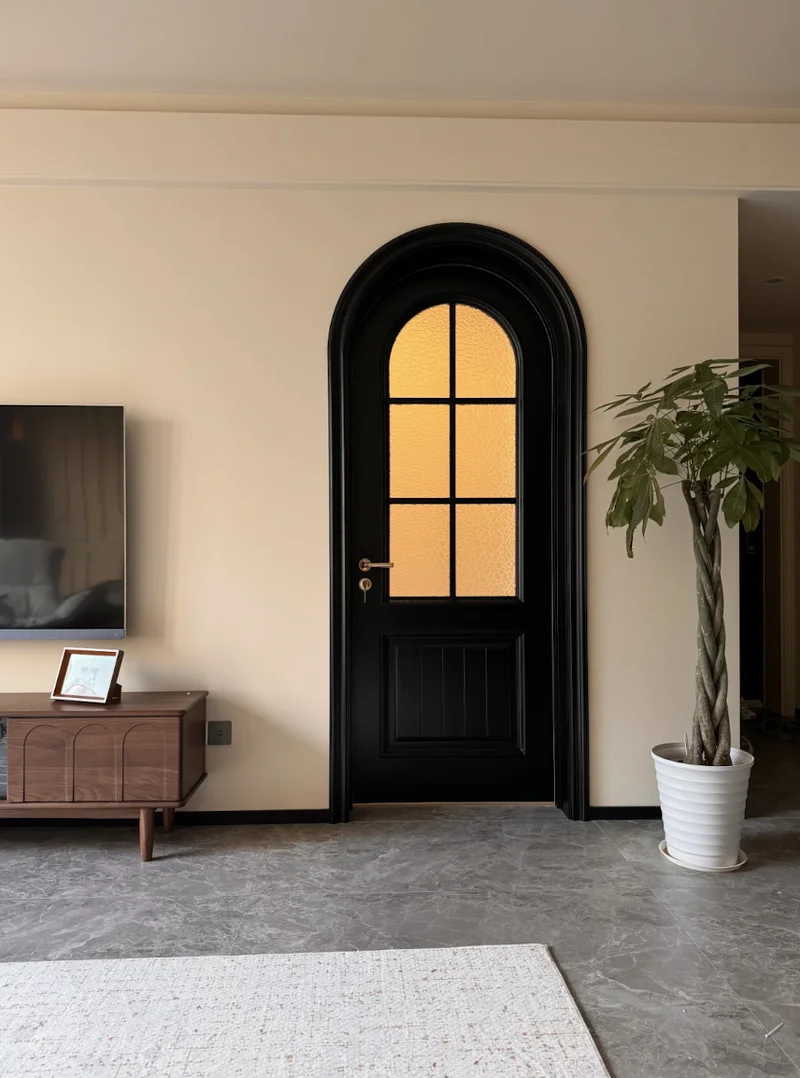
How can thermal insulation be optimized in wood-glass interior doors with frosted inserts for energy-efficient guest rooms?
Use low-E frosted laminated glass (6.38 mm, Ug ≈ 1.8 W/m²K) with warm-edge spacers. Pair with WPC stiles (thermal conductivity: 0.18 W/mK) and polyurethane foam cores (40 kg/m³). Achieve overall U-value ≤1.2 W/m²K and 32–35 dB sound insulation, meeting stringent HVAC load and acoustic requirements for 5-star hotel room envelopes.
What structural reinforcements prevent long-term warping in wide wood-glass WPC doors exceeding 900 mm width?
Incorporate a central LVL (Laminated Veneer Lumber) spine (3.2 mm ply, E ≥ 11,000 MPa) bonded under high pressure into the WPC core. Symmetrical PVC lamination (±0.1 mm tolerance) and post-cure stress-relief conditioning eliminate differential shrinkage, ensuring ≤0.5 mm deflection over 2,100 mm span after 5,000 hours of climate cycling.
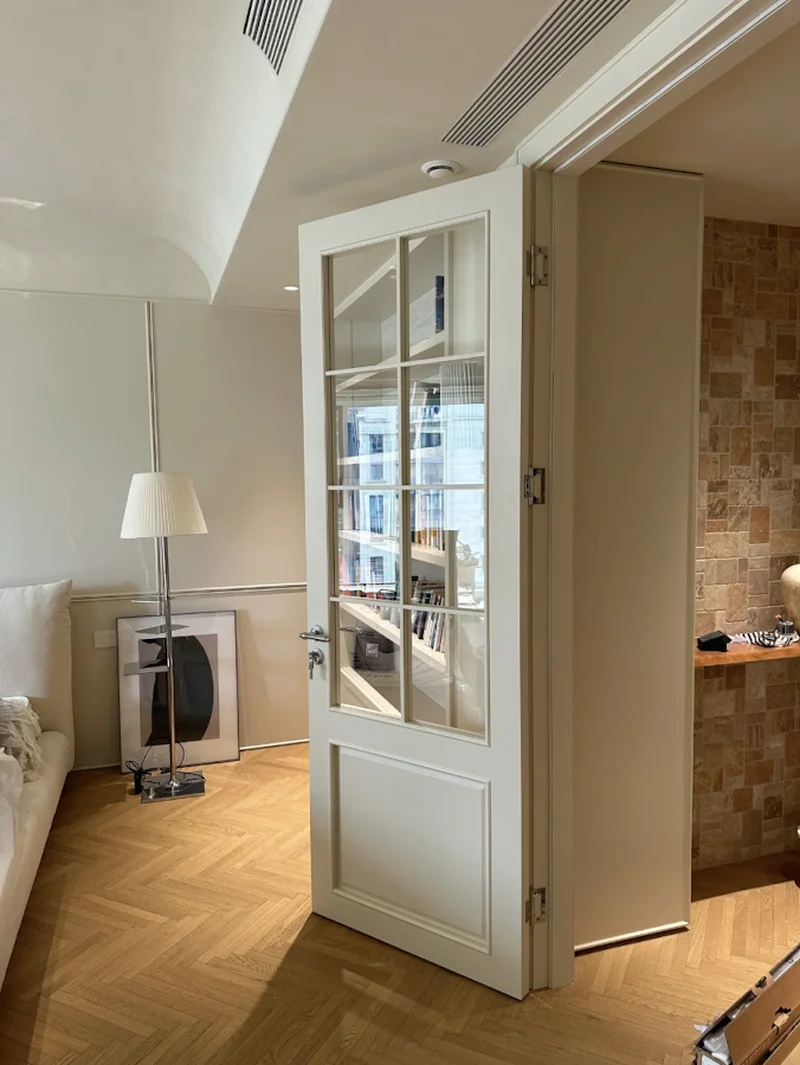
How is impact resistance ensured in frosted glass inserts within high-traffic hotel room doors?
Frosted glass inserts must be 6.38 mm laminated (2.8 mm glass + 1.52 mm PVB interlayer) per EN 356 P1A. The PVB layer provides post-breakage retention and 5x higher impact absorption than monolithic glass. Fully framed edge grips with 8 mm bite and silicone dampeners prevent point-load fractures in congested corridors.
What UV-resistant finishing systems preserve aesthetic integrity of WPC door surfaces in sun-exposed vestibules?
Apply a 3-coat system: base primer with TiO₂ nanoparticle dispersion, mid-coat acrylic-modified polyurethane, and topcoat with HALS (hindered amine light stabilizers) + 2% UV absorbers. Achieves ΔE <2 after 2,000 hrs QUV-B exposure, maintaining Class 1 colorfastness per ISO 105-B06 in atriums with direct solar gain.
How do standardized production protocols ensure dimensional consistency across hundreds of luxury hotel room doors?
Utilize CNC machining centers with ±0.2 mm tolerance, laser-guided alignment, and batch-tracked WPC billets conditioned at 20°C/45% RH for 72 hrs pre-machining. Implement statistical process control (SPC) with real-time Cpk monitoring (>1.33) for hinge mortises, panel gaps, and glass pocket depths across production runs.
What fire performance criteria must WPC wood-glass doors meet for hotel egress compliance?
Core WPC must achieve Euroclass B-s1,d0 per EN 13501-1, using brominated styrene polymers and ATH (aluminum trihydrate) flame retardants at 40 wt%. Doors with frosted glass inserts require 30-minute integrity (EI30) rating, verified via furnace testing per EN 1634-1 with intumescent edge seals activated at 180°C.