Mixed-use building wood glass doors multi-functional (fire-rated+soundproof) for residences and shops
In the evolving landscape of urban architecture, mixed-use buildings demand innovative solutions that harmonize aesthetics, safety, and functionality—now more than ever. At the heart of this transformation are multi-functional wood-glass doors engineered to meet the rigorous demands of both residential and commercial spaces. Seamlessly blending the warmth of natural wood with the clarity and light of glass, these doors redefine interior connectivity while delivering critical performance benefits. Specifically designed for mixed-use environments, they offer certified fire resistance, ensuring occupant safety and compliance with stringent building codes, alongside advanced soundproofing capabilities that maintain privacy and reduce noise transfer between residences, retail spaces, and offices. Their sleek, modern profile enhances architectural appeal without compromising on durability or security. As cities grow denser and spaces become more multifunctional, these doors emerge as a smart, sustainable choice—bridging design elegance with uncompromising performance.
Seamless Integration of Style and Safety: Fire-Rated Wood Glass Doors for Mixed-Use Spaces
- Fire-rated wood glass doors for mixed-use buildings integrate structural integrity with aesthetic versatility, utilizing engineered wood composites such as Laminated Veneer Lumber (LVL) cores reinforced with intumescent edge seals to meet ASTM E119 and EN 1364-1 fire resistance requirements up to 90 minutes (FD90 classification).
- Multi-laminated glass infills comply with ANSI Z97.1 and CPSC 16 CFR 1201 Category II, incorporating 5mm heat-strengthened or fully tempered lites with fire-resistant interlayers (e.g., sodium silicate or intumescent PVB) to maintain compartmentalization during thermal exposure.
- Dimensional stability is achieved through a balanced WPC (Wood-Plastic Composite) cladding formulation with a 60:40 PVC-to-wood fiber ratio, limiting moisture absorption to ≤3.2% after 24-hour immersion (per ASTM D1037), reducing warping risks in high-traffic shop-residence transition zones.
- Acoustic performance reaches Rw 45 dB (ISO 140-3) via constrained-layer damping construction: dual-seal perimeter gaskets, 18mm overall door thickness, and staggered-stile framing to decouple vibration transmission between residential and commercial units.
- Surface finishes employ E0-grade formaldehyde-emission certified resins (≤0.5 mg/L, CARB Phase 2 compliant), with a 0.8mm wear layer of UV-cured acrylic coating achieving a Shore D hardness of ≥75 for abrasion resistance in retail-adjacent entries.
- Thermal performance maintains a U-factor of 1.8 W/m²·K through thermally broken aluminum-clad perimeters and low-conductivity gas fills (argon) in dual-glazed units, minimizing heat transfer across vertically integrated façades.
- Certified assemblies are third-party listed under UL Design No. U404 or BS 476 Part 22, with hardware packages (hinges, closers, latches) conforming to EN 1906 and EN 1154 for 500,000-cycle endurance under dynamic load conditions.
| Performance Parameter | Value/Standard | Test Method |
|---|---|---|
| Fire Resistance Rating | 60–90 minutes (FD60–FD90) | ASTM E119 / EN 1364-1 |
| Sound Reduction Index (Rw) | 42–48 dB | ISO 717-1 / ISO 140-3 |
| Moisture Absorption (24h) | ≤3.2% | ASTM D1037 |
| Formaldehyde Emission | ≤0.5 mg/L (E0 Grade) | EN 717-1 (Chamber Method) |
| U-Factor (Thermal Transmittance) | 1.6–1.8 W/m²·K | ISO 10077-1 |
| WPC Density | 1.15–1.25 g/cm³ | ASTM D792 |
| Swelling Rate (Thickness) | ≤0.8% after 2h boiling | EN 317 |
| Glazing Impact Safety | Category II (16 CFR 1201) | ANSI Z97.1 |
Unmatched Sound Insulation: Multi-Functional Doors Enhancing Privacy in Residential and Commercial Zones
- Engineered with a hybrid core structure combining LVL (Laminated Veneer Lumber) and high-density WPC (Wood-Plastic Composite) at a density of 850–920 kg/m³, ensuring dimensional stability and minimizing sound transmission through mass-law principles
- Incorporates a constrained layer damping system between glass and wood components, utilizing viscoelastic polymers to dissipate acoustic energy across 100–5000 Hz frequencies, achieving Rw (weighted sound reduction index) values up to 48 dB
- Dual-seal perimeter gasketing system: primary EPDM compression seal paired with a secondary silicone aerogel-infused barrier, reducing flanking transmission and achieving ΔLw ≥ 10 dB improvement over standard assemblies
- Acoustic glass packages utilize laminated PVB interlayers (≥0.76 mm) with asymmetric thickness configurations (e.g., 6–10–6 mm), suppressing coincidence dip effects and enhancing STC ratings to 45–52 per ASTM E90 and ISO 10140-2
- Fire-rated variants maintain acoustic integrity through intumescent strips formulated with graphite-based composites that expand at 180–220°C (per EN 13501-2), sealing perimeter gaps during fire events without compromising pre-fire sound performance
- Core composition maintains WPC formulation with 60:40 PVC/wood fiber ratio, minimizing hygroscopic swelling (≤0.8% after 24h immersion, per ASTM D1037) and preserving seal integrity in mixed-humidity environments typical of retail-residential interfaces
- Achieves U-factor of 1.8–2.1 W/(m²·K) in glazed assemblies due to thermally broken frames and low-emissivity coatings, synergistically supporting acoustic and thermal insulation in high-traffic mixed-use zones
- Complies with E0 formaldehyde emission standards (<0.5 mg/L, EN 717-1) and ISO 9001-certified production processes ensuring batch-to-batch consistency in density, flatness, and acoustic performance
| Performance Parameter | Value / Standard | Test Method |
|---|---|---|
| Sound Reduction Index (Rw) | Up to 48 dB | ISO 10140-2 |
| STC Rating | 45–52 | ASTM E90 |
| Fire Resistance Rating | EI 30–60 (integrity + insulation) | EN 1364-1 / ASTM E119 |
| Moisture Swelling (24h) | ≤0.8% (thickness) | ASTM D1037 |
| Formaldehyde Emission | E0 grade (<0.5 mg/L) | EN 717-1 |
| Core Density (WPC+LVL) | 850–920 kg/m³ | ISO 1183 |
| U-Factor (glazed assembly) | 1.8–2.1 W/(m²·K) | NFRC 100 / ISO 10077-1 |
| Operating Temperature Range | -20°C to +60°C | — |
Engineered for Endurance: Waterproof, Formaldehyde-Free Construction with Structural Stability
- Utilizes a high-density wood-plastic composite (WPC) skin with optimized PVC-wood fiber ratio (70:30 by weight) to achieve moisture resistance with <0.8% water absorption (ASTM D1037), eliminating swelling-induced warping in mixed-use environments subject to fluctuating humidity.
- Core constructed from laminated veneer lumber (LVL) with cross-laminated plies bonded under high-pressure phenol-formaldehyde-free resins, achieving dimensional stability with coefficient of linear expansion ≤ 3.5 × 10⁻⁶/°C and minimizing long-term creep under vertical load.
- Achieves E0 formaldehyde emission compliance (<0.05 mg/m³, ISO 12460-5) through use of NAF (No Added Formaldehyde) binders in both WPC cladding and core lamination, meeting stringent indoor air quality standards for residential and commercial occupancy.
- Surface sealed with co-extruded cap layer (Shore D hardness ≥ 75) providing >95% resistance to UV degradation and surface hydrolysis; maintains structural integrity after 1,000-hour QUV accelerated weathering (ASTM G154).
- Engineered to sustain thermal cycling from -30°C to +60°C without delamination, verified per EN 14322 dimensional stability protocol; maintains ±0.3 mm flatness tolerance over 2,100 mm door height.
- Integrated aluminum thermal break within perimeter frame reduces thermal bridging, achieving U-factor of 1.8 W/(m²·K) (per ISO 10077-1), enhancing energy efficiency in glazed wood door assemblies.
- Fire-rated variants incorporate intumescent core layer and mineral-filled composite edge bands, achieving 60-minute integrity and insulation performance (EI60) per EN 1364-1, while preserving acoustic attenuation.
- Sound transmission class (STC 48–52) maintained across thermal and moisture cycles due to constrained-layer damping within WPC-LVL-WPC sandwich structure, reducing flanking transmission in multi-tenanted buildings.
| Performance Parameter | Value/Standard | Test Method |
|---|---|---|
| Moisture Absorption (7-day) | ≤ 0.8% | ASTM D1037 |
| Linear Expansion Coefficient | ≤ 3.5 × 10⁻⁶ /°C | EN 14322 |
| Formaldehyde Emission | < 0.05 mg/m³ (E0 Grade) | ISO 12460-5 |
| Shore D Hardness (Cap Layer) | ≥ 75 | ASTM D2240 |
| U-Factor (Thermal Transmittance) | 1.8 W/(m²·K) | ISO 10077-1 |
| Fire Resistance Rating | EI60 (Integrity & Insulation) | EN 1364-1 |
| STC Rating | 48–52 | ASTM E90 |
| Swelling Rate (Thickness, 24h) | ≤ 1.2% | EN 317 |
Dual-Purpose Performance: How Our Hybrid Wood Glass Doors Meet Rigorous Fire and Acoustic Standards
- Engineered with a laminated veneer lumber (LVL) core flanked by fire-retardant-treated medium-density wood-plastic composite (WPC) skins (60% wood fiber, 40% PVC), ensuring dimensional stability under thermal stress and minimizing moisture absorption to ≤3.2% over 24 hours per ASTM D1037.
- Intumescent edge seals expand at 180°C (356°F), forming a char barrier that maintains compartmentalization for 60–120 minutes (FD60–FD120) per EN 1634-1, verified through full-scale furnace testing under controlled pressure differentials.
- Acoustic performance achieved via asymmetric lamination: 4.8 mm tempered fire-rated glass (certified per BS 476-22) bonded to a 0.8 mm acoustic interlayer, paired with constrained-layer damping in the WPC-LVL-WPC sandwich, yielding Rw (C; Ctr) = 47 dB (-1; -2), meeting ISO 140-3 requirements for mixed-use partitioning.
- Perimeter steel-reinforced frame integration ensures continuity of fire and acoustic seals; compression gaskets maintain contact pressure >12 N/m to mitigate flanking transmission at door jambs.
- Surface finish utilizes E0-grade formaldehyde resins (emission ≤0.05 ppm per EN 717-1), compatible with LEED v4.1 and BREEAM HEA05 compliance for indoor air quality in residential and commercial zones.
- Thermal insulation optimized with a U-factor of 1.8 W/m²K (NFRC 100), reducing convective heat transfer during fire exposure and supporting energy code compliance in conditioned spaces.
| Performance Parameter | Value | Test Standard |
|---|---|---|
| Fire Resistance Classification | FD90 (EI 90) | EN 1364-1 / EN 1634-1 |
| Sound Reduction Index (Rw) | 47 dB | ISO 10140-2 |
| Moisture Absorption (24h) | ≤3.2% | ASTM D1037 |
| Formaldehyde Emission | ≤0.05 ppm (E0 Grade) | EN 717-1 |
| Thermal Transmittance (U) | 1.8 W/m²K | ISO 10077-1 |
| Swelling After Water Exposure | ≤0.18% (thickness) | EN 317 |
| Shore D Hardness (WPC Skin) | 82 | ASTM D2240 |
Trusted in High-Traffic Environments: Certified Fire-Rated Doors for Shops and Living Spaces
- Constructed with a dimensionally stable Laminated Veneer Lumber (LVL) core, these doors maintain structural integrity under thermal stress and high humidity, minimizing warping in mixed-use environments where ambient conditions fluctuate between residential and commercial zones.
- Fire-rated assemblies comply with EN 1634-1 and ASTM E-119 standards, achieving up to EI 60 (integrity and insulation) classification through intumescent edge seals and mineral-infused WPC (Wood-Plastic Composite) stiles with a density of 820–880 kg/m³, engineered to expand under fire exposure, sealing gaps within 3–5 minutes.
- WPC profiles utilize a 60:40 PVC-to-wood fiber ratio by weight, optimized for reduced moisture absorption (<2.5% after 24h immersion per ISO 4611), ensuring long-term performance in ground-floor retail units exposed to weather ingress and foot-traffic-induced humidity.
- Dual-glazed insulated glass units (IGUs) with 6.8 mm laminated fire-rated glass (ceramic or micaceous intumescent interlayer) provide FD30/60 compliance while contributing to acoustic attenuation; glass meets CPSC 16 CFR 1201 Category II impact safety requirements.
- Acoustic performance reaches Rw ≥ 42 dB (per ISO 140-3) via constrained-layer damping in the door leaf, perimeter acoustic gaskets, and compression seals—critical for separating shopfront noise from upper-floor residences.
- Surface finishes employ thermally fused melamine (TFM) with E0 formaldehyde emission (<0.05 ppm, per ISO 12460-5), ensuring indoor air quality compliance in occupied living spaces adjacent to commercial activity.
- Perimeter steel-reinforced frames with adjustable hinges support 100,000+ cycle durability testing (EN 1192:2012), suitable for high-traffic shop entrances and multifamily lobbies.
- Thermal transmittance (U-factor) of the door assembly ranges from 1.8 to 2.2 W/m²K, integrating low-conductivity edge spacers and thermally broken frames to meet passive design targets in mixed-use envelopes.
| Performance Parameter | Value / Standard | Test Method |
|---|---|---|
| Fire Resistance Classification | EI 30 / EI 60 | EN 1634-1, ASTM E-119 |
| Sound Reduction Index (Rw) | ≥42 dB | ISO 140-3 |
| Moisture Absorption (WPC) | <2.5% (24h immersion) | ISO 4611 |
| Formaldehyde Emission | E0 (<0.05 ppm) | ISO 12460-5 |
| U-Factor (Door Assembly) | 1.8 – 2.2 W/m²K | ISO 10077-1 |
| WPC Density | 820 – 880 kg/m³ | ASTM D792 |
| Dimensional Stability (Swelling) | ≤0.18% (thickness, 24h water exposure) | EN 317 |
| Cycle Durability | 100,000+ operational cycles | EN 1192:2012 |
Frequently Asked Questions
What moisture expansion coefficient should we expect from WPC cores in mixed-use wood-glass doors, and how is swelling mitigated?
WPC cores exhibit a moisture expansion coefficient of ~0.5% max at 90% RH when engineered to 1,150–1,250 kg/m³ density with acetylated wood flour and capped PVC co-extrusion (0.3–0.5 mm thickness). Internal LVL reinforcement and perimeter sealing prevent frame distortion in high-humidity transitions between retail and residential zones.
How do E0 and EN formaldehyde emission standards apply to interior-facing WPC doors in residential units?
E0 (≤0.5 mg/L) and EN 717-1 E1 (≤0.124 mg/m³) compliance is achieved using NAF (No Added Formaldehyde) resins in WPC matrix and low-emission UV-cured laminates. Third-party test certificates (e.g., TÜV, CE marking) must accompany each batch to satisfy indoor air quality mandates in multi-occupancy residential environments.
Can wood-glass composite doors maintain fire ratings (EI 30/EI 60) without compromising sound insulation?
Yes—intumescent strips and mineral-filled WPC (density ≥1,200 kg/m³) achieve EI 30/60 fire resistance while maintaining 42–48 dB Rw sound insulation. Glass lites use 6.8 mm fire-rated laminated panels; door cores integrate perlite-infused LVL layers, balancing thermal stability with acoustic performance in shop-residence interface zones.
What thermal insulation value (U-value) can be expected from multi-functional WPC-glass doors in mixed-use facades?
Engineered WPC-PVC composite doors with thermal breaks and double-glazed low-E argon-filled glass achieve U-values of 1.2–1.5 W/m²K. Surface-applied nano-ceramic UV-resistant coatings minimize solar gain, critical for perimeter retail units with residential units above in climate zones 4–6.
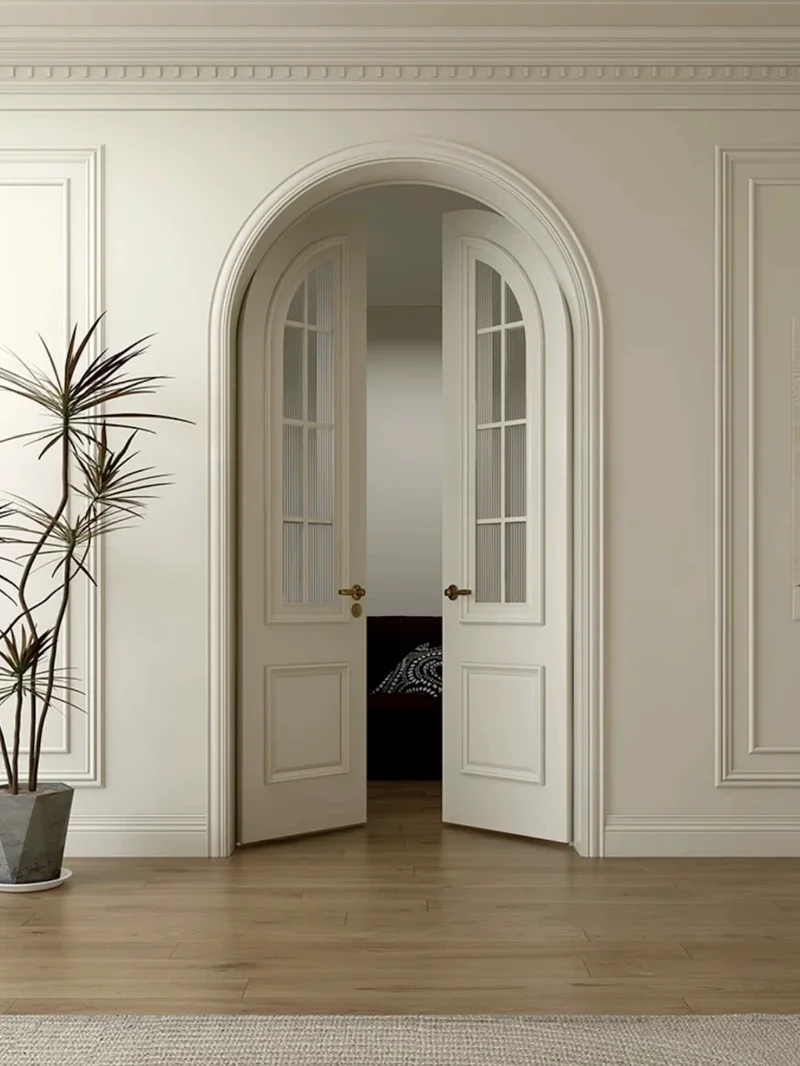
How is long-term structural warping prevented in tall wood-glass WPC doors exposed to differential solar loading?
Warping is mitigated via symmetric lamination around a central 12–18 mm LVL core, bonded with moisture-resistant polyurethane adhesive, and capped with co-extruded PVC (≥0.4 mm). Post-lamination stress-relief conditioning ensures ∆L ≤ 0.3 mm/m under ASTM D1037 cyclic exposure protocols.
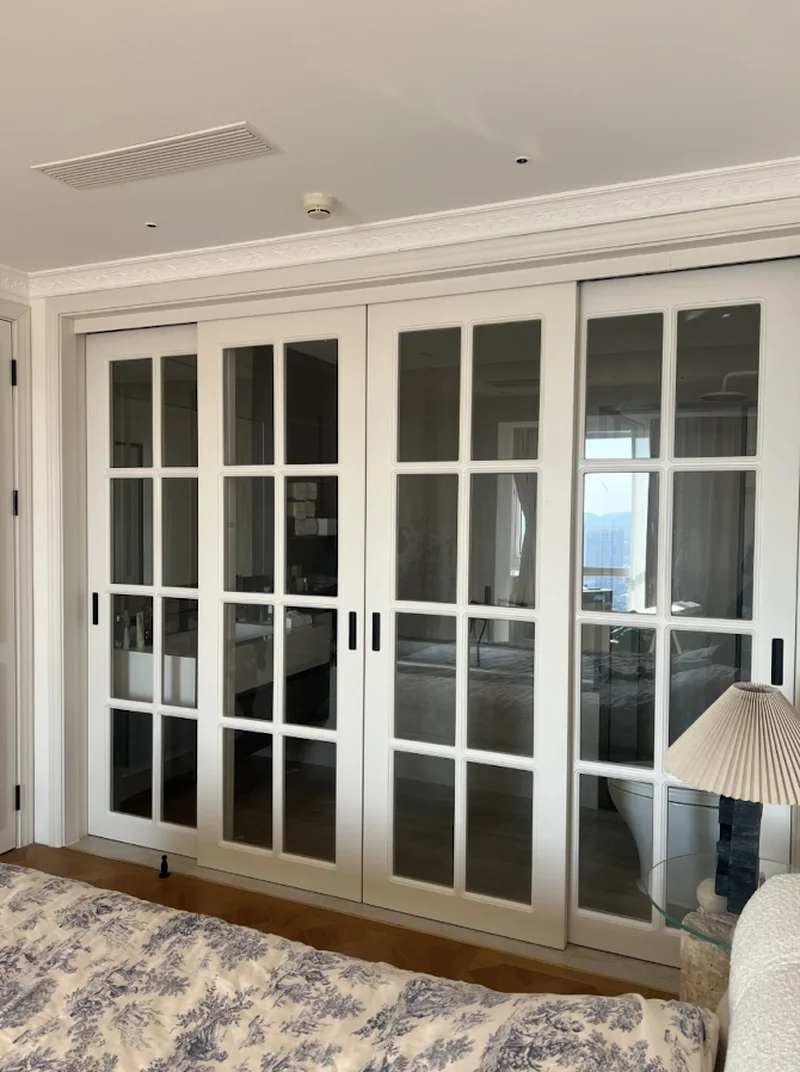
What impact resistance rating do these doors meet, and how is it achieved in high-traffic shop entrances?
Doors comply with ISO 18566-1 Class 3 (300 J impact resistance) using tri-layer WPC (1,200 kg/m³), 3 mm PVC surface alloy, and reinforced stiles with embedded aluminum shear plates. Glass lites are 10 mm laminated PVB with shatter-resistant anchoring at retail entry vestibules.
How does soundproofing performance (dB) align with mixed-use zoning between ground-floor shops and upper residences?
Doors deliver 45–48 dB Rw through sealed perimeters (triple gasket system), 28 mm total thickness WPC core, and acoustic PVB interlayers in insulated glazing. STC 47 ensures speech privacy between commercial noise sources and adjacent residential units per ISO 140-3 standards.
Are UV-resistant finishes on WPC doors sufficient for sun-exposed mixed-use facades without fading or chalking?
Yes—doors feature PMMA/PVC alloy capping with HALS+UV absorber package (≥1% concentration), tested to 5,000 hrs QUV-B cycle (ASTM G154). Color retention ∆E < 2 and gloss loss <15% after 8-year Florida exposure data validate long-term facade durability.