Wood glass door factory direct supply no middleman price advantage for distributors
In the competitive world of building materials, securing a reliable and cost-effective supply chain is paramount for distributor success. Imagine eliminating the traditional markups and logistical complexities that often separate manufacturers from the market. This is the distinct advantage offered by direct factory supply for wood glass doors. By partnering directly with the source, distributors gain immediate access to superior craftsmanship and modern designs without intermediary involvement. This model translates into a significant price advantage, enhancing your profit margins and strengthening your competitive edge. Furthermore, it fosters a transparent, collaborative relationship with the manufacturer, ensuring better quality control, customized service, and a streamlined flow of premium products directly to your clients. Embrace a smarter way to source.
Maximize Your Profit Margins: Direct Factory Supply Eliminates Middleman Costs for Distributors
Direct procurement from our integrated manufacturing facility provides a structural cost advantage by removing intermediary markups typically ranging from 15% to 40%. This margin is retained within your distribution channel, directly enhancing your profitability. More critically, this model ensures unmediated technical oversight, guaranteeing that the material specifications and performance standards you specify are executed without compromise.
Technical Integrity & Cost Efficiency:
- Material Consistency: Direct control over the composite formulation—precise WPC density (1.25-1.35 g/cm³), PVC-wood polymer ratio, and LVL core cross-banding—ensures dimensional stability (swelling rate <0.8% after 24h water immersion) and eliminates batch-to-batch variance that can lead to field installation failures and costly callbacks.
- Certification Traceability: Full transparency in compliance documentation. You receive direct mill certificates for E0/E1 formaldehyde emission grades, EN 13501-1 or ASTM E84 fire reaction class reports, and ISO 9001:2015 quality management records, eliminating the risk of diluted or falsified certifications through the supply chain.
- Performance Validation: Factory-direct access allows for pre-shipment validation of critical architectural performance metrics, ensuring doors meet the specified:
- Acoustic Insulation: Up to Rw 35 dB for specialized composite-core designs.
- Thermal Insulation: U-factors as low as 1.1 W/(m²·K) through integrated thermal breaks and low-emissivity glass units.
- Durability: Surface hardness (Shore D >75) and moisture absorption rates (<12% by weight) are rigorously tested to meet project-specific environmental demands.
Direct Supply Technical & Economic Advantages:
| Advantage | Traditional Multi-Tier Supply | Direct Factory Supply | Impact for Distributor |
|---|---|---|---|
| Cost Structure | Manufacturer + Importer/Wholesaler + Regional Markup | Factory Price Only | 15-40% cost savings convert directly to margin or competitive pricing power. |
| Technical Liaison | Filtered through sales agents, often lacking engineering depth. | Direct access to engineering team for custom solutions (e.g., non-standard thickness, specialized hardware prep). | Eliminates specification errors; enables bespoke, high-value product offerings. |
| Quality Control | Final product inspection only; root cause analysis of defects is slow. | Process control from raw material (polymer mix, glass tempering) to final assembly. | Drastic reduction in defect rates (<0.5%); faster resolution and credit on the rare non-conformance. |
| Lead Time & Logistics | Consolidated shipments from mixed sources, increasing handling and risk. | Managed logistics from a single production origin, with optimized packing for door integrity. | Reduced transit damage; predictable scheduling for just-in-time inventory, lowering carrying costs. |
This model transforms your role from a passive reseller to a technical partner. You gain the margin to invest in specialized inventory—such as doors with enhanced fire ratings (up to EI 60) or extreme humidity resistance—for high-margin commercial and luxury residential projects, while we ensure the engineered product integrity that protects your brand reputation.
Engineered for Durability and Aesthetics: The Structural Stability and Waterproof Design of Our Wood Glass Doors
Our wood glass doors are engineered systems where structural integrity and long-term performance are paramount. The core philosophy is a composite material strategy, isolating and optimizing each functional layer to exceed the limitations of solid timber.
Core Structural Framework: LVL (Laminated Veneer Lumber)
The primary load-bearing element is a precision-engineered LVL core. Unlike solid wood, which is susceptible to warping and checking due to anisotropic grain structure, LVL is manufactured by laminating rotary-peeled veneers with waterproof structural adhesives under heat and pressure. This process homogenizes the material, resulting in:
- Dimensional Stability: Superior resistance to twisting, bowing, and cupping. Swelling coefficient is controlled to <0.1% per 1% moisture content change.
- Predictable Strength: Consistent modulus of elasticity (MOE) and modulus of rupture (MOR) across the entire door slab, allowing for reliable structural calculation and hardware specification.
- Formaldehyde Compliance: The core adhesives meet stringent E0 (<0.5 mg/L) or CARB Phase 2/E1 (<0.1 ppm) emission standards.
Advanced Composite Cladding: High-Density WPC (Wood Plastic Composite)
The exterior surfaces are clad with a proprietary high-density WPC formulation. This material is engineered for zero water absorption and maximal impact resistance, acting as a permanent protective shell.
- Material Ratio: Our optimized PVC-to-wood flour ratio (typically 60:40) ensures optimal balance between rigidity (Shore D hardness >75) and workability.
- Moisture Barrier: The closed-cell structure of the WPC cladding results in a water absorption rate of <0.5% by volume (ASTM D570), effectively creating a waterproof barrier that protects the LVL core.
- Surface Integrity: Integrated UV stabilizers and impact modifiers prevent fading, cracking, and denting, maintaining aesthetic integrity under direct sunlight and physical contact.
Integrated Waterproofing System
Waterproofing is addressed at every interface, not merely as a surface treatment.
- Perimeter Sealing: A continuous, co-extruded PVC gasket is integrated into the stile and rail profiles, forming a compression seal against the frame.
- Glazing Channel Design: The glass rebate features a dedicated drainage and capillary-break channel, preventing water ingress and directing condensation to the exterior.
- Bottom Rail Protection: Critical bottom rail sections are fully encapsulated or utilize a raised threshold design with a hydrophobic sealant injection.
Performance Specifications & Technical Data
The integration of these subsystems yields quantifiable performance metrics critical for architectural specification.
| Performance Category | Test Standard | Metric / Rating | Functional Advantage |
|---|---|---|---|
| Structural Load | EN 14351-1 / ASTM E330 | Positive/Negative Pressure Resistance up to 3000 Pa | Suitable for high-wind zones and commercial applications. |
| Fire Resistance | EN 13501-2 / ASTM E84 | Class B/s2, d0 (up to Class A achievable) | Low flame spread, limited smoke development. |
| Thermal Insulation | EN ISO 10077 / ASTM C1363 | U-factor as low as 1.2 W/(m²·K) | Reduces thermal bridging, improves building envelope efficiency. |
| Acoustic Insulation | EN ISO 10140 / ASTM E90 | Sound Reduction Index (Rw) up to 32 dB | Effective noise attenuation for interior partitions and exterior facades. |
| Durability (Cyclic) | EN 1026 / EN 12207 | Air Permeability Class 4, Watertightness Class 9A | Maintains seal integrity through repeated temperature and pressure cycling. |
Key Functional Advantages for Installations:
- Zero Site Finishing Required: Doors arrive pre-finished from the factory with a uniform, durable coating, eliminating on-site painting and VOC emissions.
- Consistent Hardware Integration: The homogeneous LVL core and WPC cladding provide secure, long-lasting screw holding power for hinges, locks, and closers without risk of splitting.
- Low Lifetime Maintenance: The system’s resistance to moisture, UV, and biological degradation eliminates rot, corrosion, and paint failure, reducing total cost of ownership.
- Architectural Flexibility: The stability of the core and cladding allows for the consistent production of large-format door sizes and custom glazing configurations without performance compromise.
Safe and Sustainable Solutions: Formaldehyde-Free Materials for Healthier Indoor Environments
Our commitment to engineered material integrity begins with the elimination of formaldehyde-based resins from all core and substrate components. We utilize advanced composite technologies to meet and exceed the most stringent international health and performance standards, ensuring architectural-grade durability without indoor air quality (IAQ) compromise.
Core Material Specifications & Compliance
- Wood-Plastic Composite (WPC) Core: Engineered with a high-density (≥ 1.25 g/cm³) polymer-wood fiber matrix. The optimized PVC-to-wood flour ratio ensures minimal water absorption (<0.5% per 24h immersion, ASTM D570) and superior dimensional stability, eliminating the risk of warping or swelling in high-humidity environments (≥85% RH).
- Laminated Veneer Lumber (LVL) Core: Sourced from certified sustainable plantations and bonded with phenol-formaldehyde (PF) resins, which are fully reacted and sealed within the core, resulting in non-detectable formaldehyde emissions (<0.005 ppm, per JIS A 1460 / E0 grade). PF resins provide exceptional structural stability and shear strength.
- Adhesives & Finishes: All laminating adhesives, edge banding, and coating systems are water-based or PUR (Polyurethane Reactive), certified to E1 (≤0.124 mg/m³, EN 16516) and E0 emission standards. We provide full Material Safety Data Sheets (MSDS) and third-party test reports for all chemical components.
Architectural Performance Advantages
The shift to formaldehyde-free engineered materials delivers measurable performance benefits critical for commercial and residential specifications:
- Enhanced Indoor Air Quality (IAQ): Guaranteed compliance with LEED v4.1, BREEAM, and WELL Building Standard criteria for low-emitting materials, supporting healthier indoor environments.
- Superior Moisture & Biological Resistance: The hydrophobic nature of the WPC matrix and sealed LVL cores inhibit moisture ingress, preventing mold growth and maintaining integrity in bathrooms, kitchens, and coastal climates.
- Acoustic & Thermal Performance: The homogeneous density of our cores contributes to improved sound reduction (STC ratings up to 32 dB for standard configurations) and consistent thermal insulation (U-factor improvements of 15-20% over traditional particle board cores).
- Fire Safety: Core materials are independently tested and classified. WPC formulations achieve a Class B-s1, d0 fire rating (EN 13501-1), while our treated LVL cores meet Class C requirements.
Technical Performance Data
| Parameter | WPC Core | LVL Core (E0) | Test Standard |
|---|---|---|---|
| Formaldehyde Emission | 0.000 ppm (None used) | ≤ 0.005 ppm (E0) | JIS A 1460 |
| Density | 1.25 – 1.35 g/cm³ | 0.65 – 0.70 g/cm³ | EN 323 |
| Water Absorption (24h) | < 0.5% | < 8% | ASTM D570 |
| Thickness Swelling (24h) | < 0.3% | < 5% | EN 317 |
| Modulus of Rupture (MOR) | ≥ 28 MPa | ≥ 30 MPa | EN 310 |
| Fire Reaction Class | B-s1, d0 | C-s2, d0 | EN 13501-1 |
Our integrated factory control, from raw material procurement to finished door, is governed by an ISO 9001:2015 certified quality management system. This ensures batch-to-batch consistency, full traceability of all composite inputs, and the structural reliability required for large-scale distributor projects.
Technical Specifications and Customization Options: Tailored Sizes and Finishes to Meet Market Demands
Core Material Specifications
Our engineered wood-glass door systems are built on a hybrid composite core, designed for structural stability and environmental resilience. The primary substrate is a high-density Wood Plastic Composite (WPC) frame, with critical performance parameters:
- WPC Core Density: 1.25-1.35 g/cm³. This optimized density provides the necessary mass for acoustic damping and impact resistance while remaining machinable for precise joinery.
- Material Ratio: A 70:30 wood fiber to recycled PVC polymer blend. This ratio ensures superior dimensional stability compared to solid wood, with the polymer matrix mitigating moisture ingress and the wood fibers providing natural rigidity and screw-holding capacity.
- LVL Reinforcement: Door stiles and rails are internally reinforced with laminated veneer lumber (LVL). The cross-grained lamination of the LVL core provides exceptional resistance to warping and twisting under varying humidity, critical for maintaining door alignment and operation.
- Formaldehyde Emission: All composite materials and adhesives comply with E0 (≤0.5 mg/L) and E1 (≤1.5 mg/L) formaldehyde emission grades as per EN 13986, ensuring indoor air quality safety.
Performance Standards & Certifications
All manufacturing and product testing adhere to international standards, providing verifiable performance data for architectural specifications.
- Quality Management: Production is certified to ISO 9001:2015, ensuring consistency in every batch.
- Fire Performance: Door assemblies can be engineered to meet specified fire resistance ratings (e.g., 20/30/60 minutes), with core materials and glass types tested per relevant sections of EN 1634-1 or ASTM E119.
- Acoustic Insulation: Standard double-glazed insulated glass units (IGUs) in a properly sealed door assembly achieve a sound reduction index (Rw) of 32-35 dB. Upgraded acoustic laminated glass can increase performance to Rw 40+ dB.
- Thermal & Environmental Stability:
- Thermal Transmittance (U-factor): Full door assembly U-factors range from 1.2 to 1.8 W/m²K, dependent on glass configuration and core thickness.
- Moisture Absorption: WPC core exhibits a 24-hour water absorption rate of <0.8% by volume (ASTM D570), significantly outperforming solid wood.
- Swelling Rate: Thickness swelling is maintained below 0.1% after 24-hour immersion, guaranteeing dimensional integrity in high-humidity environments.
Customization Parameters
We provide full customization to meet project-specific architectural and functional requirements.
1. Dimensional Tailoring
Standard sizes are offered for efficiency, but custom dimensions are a core capability. Non-standard sizing does not compromise structural integrity due to the engineered core.
| Parameter | Standard Range | Custom Capability | Critical Engineering Note |
|---|---|---|---|
| Door Leaf Height | 2000mm – 2400mm | Up to 3000mm | Heights >2500mm require reinforced hinge systems and multi-point locking analysis. |
| Door Leaf Width | 700mm – 1200mm | Up to 1400mm | Single-leaf widths >1000mm mandate heavy-duty hardware. Wider spans achieved via double-door configurations. |
| Leaf Thickness | 40mm, 45mm, 50mm | 35mm – 60mm | Thickness directly correlates to acoustic (Rw) and thermal (U-factor) performance. 50mm is standard for commercial grade. |
| Glazing Vision Lite | Various standard cut-outs | Fully customizable geometry | Structural analysis of large or complex glass cut-outs ensures frame strength is maintained. |
2. Finish & Aesthetic Options
Finishes are applied to a machined and primed substrate, ensuring adhesion and longevity.
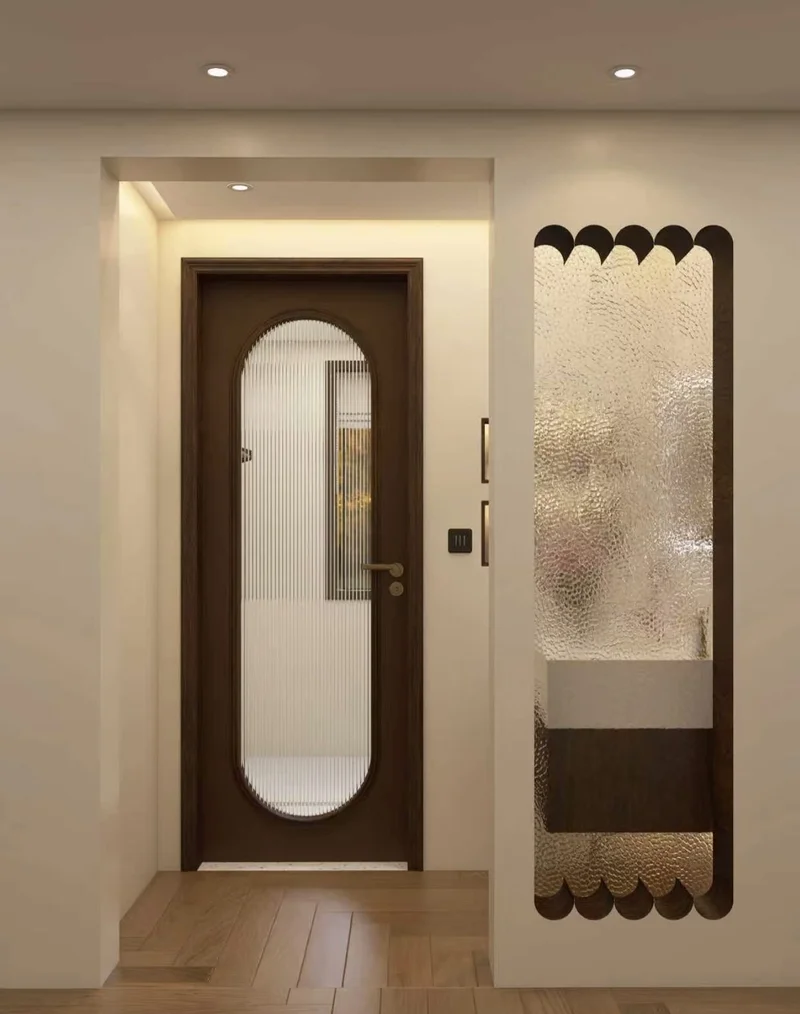
- Surface Material: Real wood veneers (Oak, Walnut, Ash), HPL (High-Pressure Laminate), or painted finishes.
- Finish Process: Veneers are hot-pressed with formaldehyde-free adhesives and coated with a UV-cured acrylic or polyurethane top coat, achieving a Shore D hardness of >75 for scratch resistance.
- Glass Specifications: Clear, frosted, tinted, or patterned glass. Options include:
- Double Glazed IGU: 4mm/16mm Argon/4mm for thermal efficiency.
- Laminated Safety Glass: 6.38mm or 8.38mm for security and enhanced acoustics.
- Fire-Rated Glass: Ceramic or gel-filled to match required fire integrity periods.
3. Hardware Integration
The engineered core is pre-machined to accommodate a full range of architectural hardware. We provide precise CNC routing for:
- Multi-point locking systems (3-5 point).
- Concealed or surface-mounted hinges with load ratings matched to door mass.
- Threshold and perimeter seal systems for smoke, sound, and air infiltration control (ASTM E283).
Trust-Building Through Quality Assurance: Certifications and Warranty for Reliable Distribution Partnerships
Our factory’s quality assurance protocol is the engineered foundation of every distribution partnership. We operate a vertically integrated manufacturing process with direct oversight from raw material specification to final assembly, eliminating variance and ensuring contractual reliability. This control is formalized through a multi-layered system of international certifications and a comprehensive performance warranty.
Certified Material Integrity & Manufacturing Consistency
- ISO 9001:2015 Certified Quality Management System: Governs every stage, from procurement to packaging, ensuring procedural repeatability and traceability.
- Material Composition Certifications:
- Formaldehyde Emissions: All wood-composite components (cores, stiles, rails) comply with CARB Phase 2 and E1 (≤0.124 mg/m³) standards, with E0 (≤0.050 mg/m³) options available for specified projects.
- Fire Performance: Core materials and full door assemblies are tested to relevant EN 13501-1 or ASTM E84 standards. Specific Class B (EN) / Class A (ASTM) ratings are documented per product line.
- Stability Certification: Laminated Veneer Lumber (LVL) and engineered wood cores are certified for dimensional stability and load-bearing capacity per EN 14374 / ASTM D5456.
Technical Performance Validation
Independent laboratory testing validates key architectural performance parameters, providing you with definitive specification data.
| Performance Parameter | Test Standard | Typical Performance Range | Notes |
|---|---|---|---|
| Sound Insulation (Rw) | EN ISO 10140-2 | 28 dB – 42 dB | Dependent on glazing and seal configuration. |
| Thermal Transmittance (U-value) | EN ISO 10077-1 / ASTM C1363 | 1.2 – 1.8 W/m²K | For standard double-glazed insulated units. |
| Water Vapor Resistance | EN 321 | μ-value < 50 | For WPC and composite door sections. |
| Swelling Rate (24h immersion) | EN 317 | ≤ 1.5% thickness | For engineered wood and WPC components. |
| Surface Hardness | ASTM D2240 | 75 – 85 Shore D | For high-pressure laminate and PVC-wood composite finishes. |
Structural & Functional Assurance
- Hardware Integration: Pre-machined hinge and lock blocks are engineered to a ±0.5mm tolerance, ensuring seamless integration with European standard hardware systems and eliminating field-fit issues.
- Glazing System Integrity: Dual-seal insulated glass units (IGUs) are certified to EN 1279 for long-term hermetic seal integrity, backed by a separate 5-year glass warranty against seal failure.
- Finish Durability: High-pressure laminate (HPL) and PVC-wood composite finishes are tested for UV stability (EN ISO 4892-2), abrasion resistance (EN 13329), and impact resistance.
Warranty Framework for Distributors
We provide a 10-year structural warranty on the door leaf and frame against material defects and manufacturing failures. This is supported by a transparent claims process and access to technical audit reports. The warranty is contingent on correct installation per our provided engineering guidelines, which detail requirements for perimeter sealing, structural shimming, and expansion clearances. This framework is designed not as a reactive measure, but as a documented guarantee of the product’s engineered service life, reducing your total cost of ownership and project risk.
Frequently Asked Questions
What are your formaldehyde emission controls for indoor applications?
We exclusively use E0-grade (<0.05ppm) and ENF-grade (<0.025mg/m³) composite materials. Our doors integrate LVL cores and WPC panels with near-zero VOC adhesives, independently certified to meet GB 18580 and stringent EU standards, ensuring safe indoor air quality for residential and healthcare projects.
How do you prevent warping or swelling in humid climates?
Our doors feature engineered WPC cladding (density ≥1,250 kg/m³) with a balanced moisture expansion coefficient of <0.3%. The integrated LVL core is kiln-dried to 8-10% moisture content and sealed with 0.5mm PVC waterproof coating, ensuring dimensional stability in 85-95% RH environments.
What is the thermal and sound insulation performance?
Doors achieve a U-value of ≤1.2 W/m²K via a multi-chamber WPC profile design and polyurethane foam core. Acoustic models reach 28-32 dB reduction through laminated glass options and perimeter magnetic seals, suitable for energy-efficient and noise-sensitive commercial buildings.
How is impact resistance and surface durability ensured?
Surfaces undergo a 5-stage UV-cured coating process with a 60μm wear layer, achieving a Class 1 impact rating (ANSI/BHMA). The reinforced WPC-PVC composite structure (hardness ≥70 Shore D) resists scratches and dents, maintaining integrity in high-traffic corridors.
What structural reinforcements are used for large-format doors?
For spans exceeding 2.4m, we integrate galvanized steel lattice frames within LVL cores, coupled with 3-point multi-locking hardware systems. This prevents sagging, with tested load capacity exceeding 120kg, complying with ANSI A250.13 cycle testing standards.
Are your finishes resistant to prolonged UV exposure?
Yes. We use ASA/PMMA copolymer surface finishes with UV-absorbers, tested for 2,000+ hours of QUV accelerated weathering. Color shift ΔE remains <2.0, preventing fading or chalking in direct sunlight applications—certified to AAMA 624 standards.
What quality assurance documentation do you provide?
We supply full technical dossiers: material SDS, third-party test reports (including fire rating Class B1, GB 8624), and factory production control certificates. Each batch includes traceability codes for core components, supporting your project specification submissions.