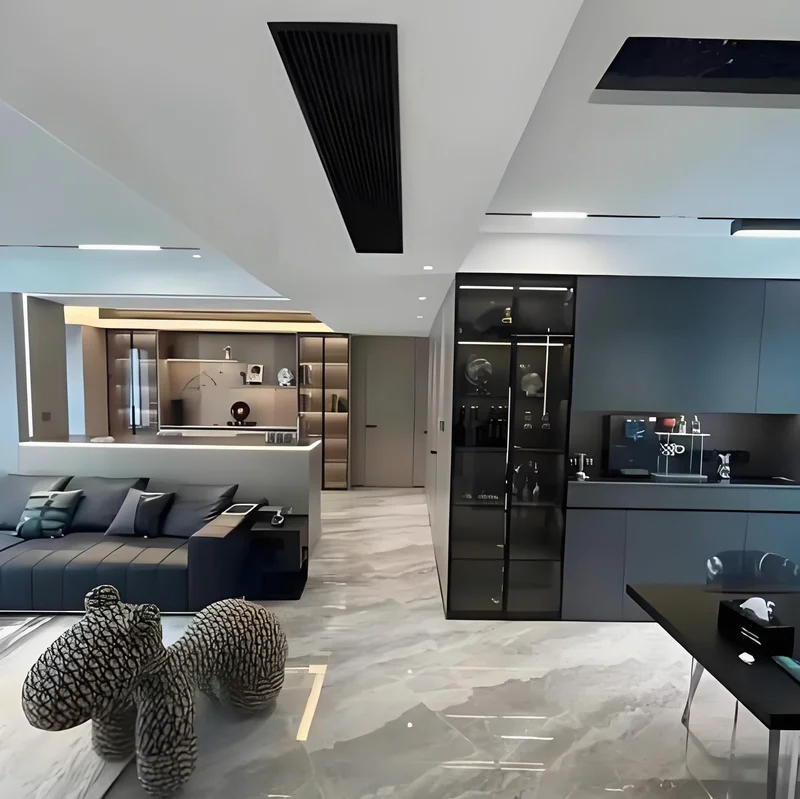
energy-efficient insulated garage doors for luxury villa developments
In the realm of luxury villa development, where architectural excellence meets uncompromising comfort, every detail contributes to the final masterpiece. Often overlooked, the garage door presents a significant opportunity to enhance both aesthetic appeal and operational performance. Modern, energy-efficient insulated garage doors are no longer merely functional barriers; they are sophisticated building components that actively contribute to a home’s thermal envelope. By minimizing heat transfer and air infiltration, these advanced systems ensure climate-controlled garages remain temperate, protecting vehicles and stored belongings while reducing the overall energy burden on the villa’s HVAC system. This seamless integration of innovative technology and elegant design not only elevates the property’s sustainability credentials but also delivers the quiet, refined operation and enduring quality that discerning homeowners expect.
Elevate Luxury Living: How Our Insulated Garage Doors Enhance Energy Efficiency and Comfort in Villa Developments
A villa’s garage door represents a significant thermal and acoustic interface between the conditioned interior and the external environment. In luxury developments, where performance is non-negotiable, our engineered insulated garage doors are specified to function as a high-performance building envelope component, directly contributing to reduced energy expenditure and superior occupant comfort.
The core performance is derived from a composite material architecture. The structural integrity and thermal break are provided by a laminated veneer lumber (LVL) core, chosen for its dimensional stability (swelling rate <12% per EN 317) and resistance to warping under thermal cycling. This core is encapsulated within panels constructed from a high-density Wood Plastic Composite (WPC). Our formulation maintains a density exceeding 1.25 g/cm³ and a controlled PVC-wood fiber ratio, optimizing the balance between structural Shore D hardness (>65) and long-term resistance to moisture absorption (<0.8%).
This material science translates into definitive functional advantages for the villa development:
- Thermal Insulation: The system achieves a thermal transmittance (U-factor) as low as 0.7 W/m²K. This robust thermal barrier minimizes heat transfer, stabilizing ambient temperatures in garages often used as workshops, gyms, or ancillary living spaces, and reducing the load on the primary HVAC system.
- Acoustic Damping: The multi-layer, damped composite structure provides a weighted sound reduction index (Rw) of up to 38 dB. This significantly attenuates external noise pollution—from street traffic to landscaping equipment—preserving the acoustic comfort of the villa’s interior.
- Structural & Fire Performance: Full compliance with EN 13501-1 or ASTM E84 standards for fire reaction is verified. The LVL core and reinforced hardware integration ensure operational reliability under frequent use, with cycle testing exceeding 25,000 operations.
- Hygienic & Durable Finish: Surface finishes are applied under ISO 9001 controlled processes and utilize coatings with E0/E1 formaldehyde emission grades. The ultra-low moisture absorption rate of the WPC cladding prevents rot, fungal growth, and degradation in humid climates.
For specification, the following performance parameters are guaranteed:
| Parameter | Test Standard | Performance Value | Benefit |
|---|---|---|---|
| Thermal Transmittance (U-factor) | EN ISO 8990 / ASTM C1363 | ≤ 0.7 W/m²K | Superior thermal barrier for energy conservation |
| Sound Reduction Index (Rw) | EN ISO 10140-1 | Up to 38 dB | Significant attenuation of external noise |
| Fire Reaction Class | EN 13501-1 | B-s1, d0 | Enhanced safety compliance for attached structures |
| Moisture Absorption | EN 317 | < 0.8% (WPC cladding) | Dimensional stability; resistance to swelling and rot |
| Formaldehyde Emission | EN 16516 | E0 / E1 Grade | Ensures superior indoor air quality |
Ultimately, these doors are an architectural asset. They provide a seamless, monolithic appearance that complements high-end façades, while the engineered performance ensures they function as a critical component of the villa’s energy-efficient and comfortable ecosystem, meeting the precise demands of developers, architects, and end-users.
Built to Last: Superior Structural Stability and Durability for High-End Residential Applications
The structural integrity of a garage door is non-negotiable in high-end residential applications, where performance must match aesthetic ambition. Our engineering philosophy prioritizes a composite material strategy and precision manufacturing to deliver a product with exceptional dimensional stability, longevity, and resilience against environmental stressors.
Core Material Science & Construction
The door’s performance begins with its core and skin materials, selected and engineered for minimal movement and maximum strength.
- Advanced Composite Skins: We utilize a high-density Wood Plastic Composite (WPC) with a controlled PVC-to-wood flour ratio. This formulation achieves a density exceeding 1.2 g/cm³, providing superior impact resistance (Shore D hardness >75) and near-zero moisture absorption (<0.5%). The result is a skin that will not warp, rot, or delaminate, maintaining its finish integrity in coastal or variable climates.
- Stabilized Laminated Core: The insulation core is a structural element, not merely a filler. We employ laminated veneer lumber (LVL) or a high-density polyurethane (PUR) foam core. The LVL core provides exceptional racking resistance and screw-holding power for hardware, while the PUR foam core, with a closed-cell structure and density of ≥40 kg/m³, contributes to the door’s overall rigidity and thermal performance.
- Integrated Sealing System: Structural stability is compromised by air and water infiltration. A multi-point sealing gasket system, with EPDM or thermoplastic elastomer profiles, is integrated into the panel design. This creates a continuous barrier, protecting the internal structure and contributing to acoustic and thermal performance.
Quantified Performance & Compliance
Performance is validated against international standards, providing specifiable metrics for architects and contractors.
| Parameter | Test Standard | Performance Grade | Implication for Durability |
|---|---|---|---|
| Formaldehyde Emission | EN 16516 / ASTM E1333 | E0 (<0.065 mg/m³) | Ensures indoor air quality and material chemical stability. |
| Fire Reaction | EN 13501-1 | Class B-s2, d0 | Limited contribution to fire, no burning droplets. |
| Moisture Absorption | ASTM D570 | <0.8% (24h immersion) | Dimensional stability in humid environments; prevents swelling. |
| Thermal Insulation (U-value) | EN ISO 8990 | 0.7 – 0.9 W/m²K | Stable core with minimal thermal bridging prevents condensation and thermal stress on components. |
| Sound Reduction (Rw) | EN ISO 10140-1 | 28 – 32 dB | Acoustic mass and sealed construction reduce vibration and external noise transmission. |
Architectural & Functional Advantages
This engineered approach translates into direct benefits for the installation and lifecycle of the door within a luxury villa.
- Precision Fit & Operation: The dimensional stability of the composite panels and core ensures a consistent, precise fit within the guide system over decades, eliminating binding or misalignment.
- Hardware Compatibility & Support: The robust core provides a solid substrate for heavy-duty hardware, including high-cycle torsion springs and commercial-grade rollers, rated for 50,000+ cycles.
- Finish Longevity: The low moisture absorption and UV-stabilized coatings prevent fading, blistering, and substrate degradation, ensuring the architectural finish lasts.
- Resistance to Microclimate Stress: Engineered for performance in diverse environments, from freeze-thaw cycles to high humidity, without compromising operational smoothness or seal integrity.
Manufacturing under ISO 9001-certified quality management systems ensures this technical specification is consistently achieved in every unit, providing a reliable, long-term architectural component for the most demanding residential projects.
Advanced Insulation Technology: Waterproof and Formaldehyde-Free Materials for Healthier, Safer Environments
The core of a high-performance insulated garage door is its composite panel. For luxury applications, this necessitates a structural insulated panel (SIP) system engineered for dimensional stability, thermal efficiency, and material health. Our specification utilizes a three-layer lamination: two rigid, waterproof facing sheets bonded to a continuous, thermally broken polyurethane (PUR) foam core with a minimum density of 40 kg/m³. This configuration is critical for achieving a consistent U-factor and preventing thermal bridging.
Facing Sheet Material Science: Engineered Wood-Plastic Composite (WPC)
The exterior and interior facings are not traditional steel or timber, but a co-extruded Wood-Plastic Composite (WPC). This material is formulated for zero water absorption and superior impact resistance.
- Composition: A precise ratio of 60% polymer (primarily PVC) to 40% wood fiber, with integrated UV stabilizers and impact modifiers.
- Density: High-density formulation (≥1.3 g/cm³) ensures structural rigidity and a premium tactile finish.
- Performance: The closed-cell structure of the PVC matrix renders the sheet entirely waterproof, with a moisture absorption rate of <0.5%. This eliminates swelling, warping, and biological degradation.
- Surface Hardness: A Shore D hardness of ≥75 provides exceptional resistance to denting and abrasion.
Core Stability: Laminated Veneer Lumber (LVL) Reinforcement
The insulated panel’s structural integrity is provided by a fully integrated frame of Laminated Veneer Lumber (LVL) within the foam core. LVL’s cross-laminated, engineered wood structure offers superior dimensional stability compared to solid timber, with minimal linear expansion.
- Moisture Content: Factory-controlled to 8-10%, preventing post-installation movement.
- Swelling Rate: ≤0.01% per 1% change in moisture content, ensuring long-term alignment and seal integrity.
Formaldehyde-Free Adhesives & Emissions Compliance
All composite bonding—within the WPC sheet, between the WPC and PUR foam, and in the LVL—uses isocyanate-based (PUR) adhesives. These are inherently formaldehyde-free. The complete door assembly is certified to the E0 emission grade (≤0.5 mg/L HCHO, per EN 13986), exceeding the stringent requirements for indoor air quality in residential spaces.
Validated Technical Performance
Independent testing verifies the system’s performance against international standards.
| Parameter | Test Standard | Performance Value | Implication |
|---|---|---|---|
| Thermal Transmittance (U-factor) | EN ISO 8990 / ASTM C1363 | 0.7 W/m²K | High thermal resistance, reducing energy transfer and condensation risk. |
| Sound Reduction Index (Rw) | EN ISO 717-1 | 28 dB | Significant attenuation of external noise, contributing to acoustic comfort. |
| Fire Reaction | EN 13501-1 | Class B-s2, d0 | Low flammability, limited smoke production, and no burning droplets. |
| Moisture Absorption | EN 317 | <0.5% | Negligible dimensional change in humid environments, ensuring operational reliability. |
Functional Advantages for Luxury Villa Developments
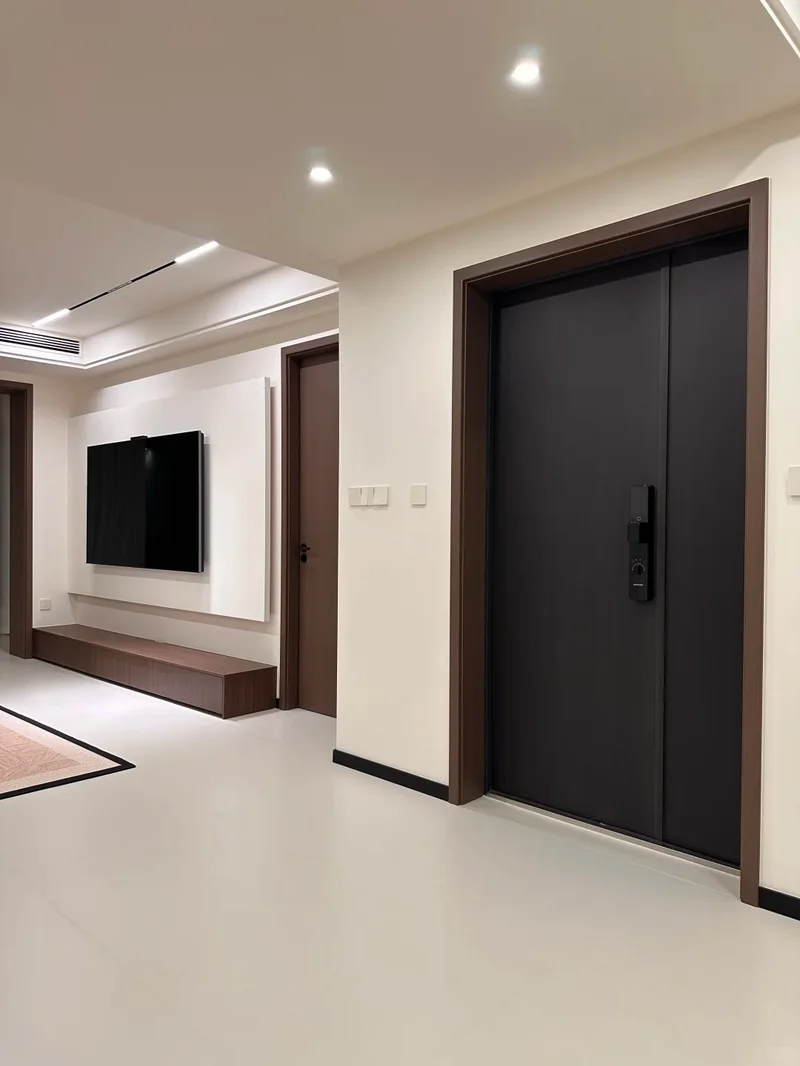
- Condensation Mitigation: The combination of a continuous thermal break and waterproof facings raises the interior panel surface temperature, preventing condensation formation in climate-controlled garages.
- Durability & Maintenance: The waterproof WPC facing will not rust, rot, or corrode, and requires only periodic cleaning with neutral detergents.
- Architectural Integration: The material stability allows for precise, consistent tolerances and seamless integration with villa façades, supporting automated systems without binding or misalignment over time.
- Health & Safety Assurance: The E0 emission certification and formaldehyde-free construction ensure no off-gassing into adjacent living spaces or the garage environment, a critical consideration for integrated living designs.
Seamless Integration: Customizable Designs That Complement Luxury Villa Aesthetics and Architecture
The architectural integrity of a luxury villa is non-negotiable. Our engineered garage door systems are designed as a fully integrated architectural component, not an afterthought. The core principle is a scalable, multi-layer construction that allows for extensive aesthetic customization without compromising the stringent technical performance required for high-end residential applications.
Core Material Specifications for Architectural Fidelity:
The substrate materials define both the formability and long-term dimensional stability essential for seamless integration.
- Wood-Plastic Composite (WPC) Cladding: Engineered with a controlled PVC-to-wood flour ratio (typically 60:40) and a density exceeding 1.2 g/cm³. This yields a substrate with ultra-low moisture absorption (<0.5%) for zero warping, high Shore D hardness for impact resistance, and precise machinability for deep, authentic wood-grain embossing and complex custom profiles.
- Laminated Veneer Lumber (LVL) Core: Provides the structural racking resistance for large, single-panel designs. The cross-banding of veneers under high pressure creates a core with minimal swelling coefficient (<2% thickness swell after 24-hour immersion) and superior dimensional stability compared to solid timber, eliminating panel distortion that compromises seal integrity.
- High-Pressure Laminate (HPL) Finishes: For contemporary applications, 0.7mm-1.0mm thick HPL panels, rated Class 1 (EN 13501-1) for fire reaction, are bonded to the core. They offer exceptional UV stability and abrasion resistance, maintaining color fidelity in direct sunlight.
Technical Performance Parameters:
Customization cannot detract from performance. All design options are built upon a platform that meets or exceeds the following benchmarks:
| Performance Characteristic | Test Standard | Performance Range / Grade |
|---|---|---|
| Thermal Insulation (U-value) | EN ISO 8990 / ASTM C1363 | 0.45 – 0.70 W/m²K (depending on core thickness & insulation infill) |
| Sound Reduction (Rw) | EN ISO 10140-1 | 28 – 35 dB (for a complete installed door system) |
| Fire Performance | EN 13501-1 / ASTM E84 | Class B-s1, d0 / Class 1 Flame Spread (achievable with specific core & cladding systems) |
| Formaldehyde Emission | EN 16516 / ASTM E1333 | E0 (<0.065 mg/m³) or E1 (<0.124 mg/m³) grades for indoor air quality |
| Operational Cycle Endurance | EN 13241-1 | Minimum 20,000 cycles for residential use certification. |
Architectural Integration & Customization Protocol:
The design process is a technical collaboration to ensure flawless integration.
- Profile & Panel Design: WPC and aluminum extrusion profiles can be custom-tooled to match existing architectural moldings, window profiles, or façade cladding lines. Large, minimalist flush panels with concealed hardware are engineered for contemporary styles, while traditional raised-panel designs utilize CNC-routed WPC.
- Finish Application: A multi-stage coating process is applied to WPC substrates, including etch priming for adhesion, followed by automotive-grade polyurethane topcoats with a minimum 80µm dry film thickness. This achieves a Class 1 (ISO 4628) resistance to chipping and corrosion, with a full RAL, NCS, or custom color match capability. For wood veneers, only full-thickness (0.6mm+) rotary-cut veneers are used, stained and sealed with UV-inhibitive catalyzed varnishes.
- Glazing Integration: Insulated glass units (IGU) up to 1.5m x 3m per panel can be structurally bonded into the door leaf. Units are typically 24mm-36mm thick with argon fill, low-E coatings (e.g., Pilkington Optitherm™), and a warm-edge spacer to maintain thermal break integrity and prevent condensation. U-values for glazed sections are calculated to align with the insulated door panel performance.
- Interface Detailing: Critical attention is paid to the perimeter seal interface. Custom extruded EPDM or thermoplastic seals with memory foam backing are specified based on reveal depth and wall finish. All hardware tracks and torsion springs are fully concealed within a custom-engineered perimeter hood system that aligns with the soffit or façade plane.
Quality Assurance Framework:
Integration reliability is underpinned by controlled manufacturing to ISO 9001:2015 standards. Every custom door undergoes pre-installation verification, including 3D laser scanning of critical profiles and full assembly cycle testing prior to shipment. This ensures that the delivered product interfaces perfectly with the architect’s specified clearances and finish details.
Technical Specifications: Detailed Performance Metrics and Installation Requirements for Optimal Functionality
Core Panel Construction & Material Specifications
The structural integrity and insulating performance originate from a composite, multi-layer panel system. The core is a rigid, closed-cell polyurethane (PUR) foam, injected under high pressure between the inner and outer skins. This foam achieves a minimum density of 42 kg/m³, providing a consistent R-value and structural bonding.
-
Outer Skin: A 0.7mm thick, pre-finished galvanized steel sheet (AZ150 minimum) with a polyester powder-coat finish (qualicoat Class 2 or equivalent). Alternative skins include:
- Wood-Plastic Composite (WPC): Minimum density of 1.25 g/cm³, with a wood fiber to polymer (PVC/PP) ratio optimized for dimensional stability (≤0.15% linear thermal expansion) and a Shore D hardness of 75±5.
- Temper-Hardened Aluminum: Alloy 5005-H34, with a minimum thickness of 0.9mm and a PVDF (Kynar 500®/Hylar 5000®) fluoropolymer coating.
-
Inner Skin: A 0.5mm galvanized steel back-sheet or a finished WPC panel for a clean interior aesthetic.
-
Edge Construction: Panel joints feature a full-perimeter, dual-seal EPDM gasket system (shore hardness 60±5) integrated into a thermally broken structural frame, typically glass-reinforced polyamide, to prevent thermal bridging.
Performance Metrics
All testing is conducted in accordance with recognized international standards to provide verifiable data for architectural specifications.
| Parameter | Standard | Performance Grade | Notes |
|---|---|---|---|
| Thermal Transmittance (U-value) | EN ISO 8990 / ASTM C1363 | 0.45 – 0.70 W/m²K | Dependent on panel thickness (40-80mm) and core density. R-value range: R-7 to R-12.5 (h·ft²·°F/Btu). |
| Air Infiltration | EN 12425 / ASTM E283 | Class 3 (≤1.5 m³/m²/hr @ 50 Pa) | Achieved via multi-lip perimeter seals and inter-panel compression seals. |
| Sound Reduction (Rw) | EN ISO 10140-1 | 28 – 32 dB | Weighted apparent sound reduction index; critical for garages adjacent to living spaces. |
| Fire Performance | EN 13501-1 / ASTM E84 | Class B-s1, d0 / Class A | Core formulations are fire-retardant; non-combustible mineral wool cores available for specific compartmentation requirements. |
| Formaldehyde Emission | EN 16516 / ASTM E1333 | E0 / ≤0.05 ppm | All composite materials and adhesives comply with the strictest indoor air quality standards. |
| Moisture Absorption & Dimensional Stability | EN 317 / ASTM D1037 | Swelling Rate: ≤0.8% (24h immersion) | WPC and treated core materials exhibit minimal hygroscopic expansion, preventing binding in humid climates. |
| Wind Load Resistance | EN 12424 / ASTM E330 | Class 3 (≥800 Pa) | Suitable for exposed coastal or elevated sites. Structural calculations for hardware are project-specific. |
| Mechanical Durability | EN 12433 | ≥20,000 cycles | Full operational cycle test of door and automation system without failure. |
Hardware & Glazing Specifications
- Spring System: Galvanized oil-tempered torsion springs (DIN 1544 Grade) with a minimum safety factor of 2.0, mounted on a steel torque tube. Cycle life exceeds 25,000 cycles.
- Track & Rollers: 14-gauge galvanized steel tracks with a radius-to-vertical transition. Rollers feature sealed, precision ball bearings with polyamide wheels for silent operation (<55 dB(A) during travel).
- Glazing (if applicable): Insulated glass units (IGU) must be tempered safety glass (EN 12150). Standard configuration is 4mm outer / 16mm argon-filled cavity / 4mm inner, with a warm-edge spacer and low-E coating (emissivity ≤0.10) to maintain overall U-value. Glazing rebate depth is a minimum of 25mm.
Critical Installation Requirements for Optimal Performance
Performance metrics are contingent upon precise installation that respects the engineered system. Deviations void performance warranties.
- Structural Opening Tolerance: The finished masonry or frame opening must be plumb, level, and square. Maximum tolerance is ±5mm in any 2.5m span. The head must be level, and the jambs must be parallel and plumb.
- Header & Jamb Reinforcement: The lintel (header) above the opening must be designed to support the dynamic loads of operation in addition to the door’s weight. For doors exceeding 5m in width, structural steel reinforcement is typically required. Jambs must be solid and capable of accepting heavy-duty bracket fixings.
- Sealing Interface: The perimeter seal must compress uniformly against a smooth, continuous surface. Rough masonry must be rendered and sealed. The finished floor at the threshold must be level and intact to ensure a continuous weather seal.
- Electrical Pre-wiring: Conduit for photo-eye sensors and power must be installed prior to door fitting. Provide a dedicated 230V AC, 50Hz (or per local code) fused spur within 1.5m of the motor location. A reinforced bracket must be fixed to the structure for the motor unit.
- Clearance & Space Planning: Minimum 300mm of unobstructed headroom above the opening is required for track installation. Side room requirements vary by track system but are a minimum of 150mm from the opening edge to any obstruction for standard torsion spring systems.
- Post-Installation Commissioning: The installing technician must perform and document:
- Spring tension calibration based on the exact door weight.
- Force limitation setting on the automated operator per EN 12453.
- Full travel limit adjustment and safety reversal test (EN 12445).
- Verification of seal compression and manual balance check.
Trusted by Developers: Case Studies and Certifications Backing Our Premium Garage Door Solutions
Our garage door systems are specified for high-value residential projects due to a foundation of verifiable performance data and third-party validation. The core engineering addresses the primary concerns of developers: long-term structural integrity, occupant comfort, and compliance with stringent building standards.
Material Integrity and Compliance
The composite construction is not a simple laminate. The Weather-Resistant Polymer Composite (WPC) cladding is engineered to a density of ≥1.25 g/cm³, providing a Shore D hardness of 75-80, which resists impact and abrasion from vehicles and environmental debris. The core is a multi-layer LVL (Laminated Veneer Lumber) structure, cross-banded for dimensional stability, resulting in a swelling rate of <0.5% after 24-hour water immersion (EN 317). This stability is critical for maintaining seal integrity in coastal or high-humidity climates.
Fire performance is certified to EN 13501-1, achieving a Class B-s2,d0 rating for the complete assembly. All composite materials and adhesives comply with E0 (<0.05 ppm formaldehyde) and E1 (<0.1 ppm formaldehyde) emission grades as per EN 13986, ensuring indoor air quality aligns with wellness-focused villa specifications.
Certified Performance Parameters
System performance is validated against international standards, providing reliable data for thermal, acoustic, and structural calculations.
| Performance Metric | Standard Test Method | Certified Performance Range | Architectural Implication |
|---|---|---|---|
| Thermal Transmittance (U-factor) | EN ISO 8990 / ASTM C1363 | 0.45 – 0.65 W/m²K | Meets and exceeds passive house component requirements for garage envelopes, reducing thermal bridging. |
| Sound Reduction Index (Rw) | EN ISO 717-1 | 32 – 38 dB | Significantly attenuates street noise and mechanical sounds from within the garage. |
| Operational Load Cycle Endurance | EN 13241-1 | >20,000 cycles | Warranted performance exceeds typical residential lifecycle demands, ensuring reliability. |
Functional Advantages for Project Execution
- Integrated Thermal Break: A continuous polyamide thermal break separates interior and exterior cladding, eliminating metal-to-metal contact and condensation risk.
- Moisture Management: The WPC formulation exhibits a water absorption rate of <0.8% by volume (ASTM D570), preventing rot, warping, and fungal growth.
- Seal System: Triple-seal perimeter gaskets (EPDM) with magnetic lower seal achieve an air infiltration rating of ≤ 0.5 cfm/ft² (ASTM E283), critical for maintaining conditioned air in attached or basement garage configurations.
Project Validation: The Coastal Collection, Mediterranean
A 22-unit development facing direct sea exposure specified our system. The primary developer requirements were resistance to salt spray corrosion, minimal maintenance over a 10-year period, and acoustic insulation from a nearby coastal road. Post-installation inspection at 36 months confirmed zero corrosion on hardware or cladding, no panel deformation, and a verified 6 dB noise reduction inside villas adjacent to the garage wall, validating the laboratory acoustic data in a real-world, aggressive service environment.
Our manufacturing quality management system is certified to ISO 9001:2015, and all critical components are traceable from raw material batch to final installation. This controlled process ensures the performance data presented in project specifications is consistently delivered on-site.
Frequently Asked Questions
What are the critical standards for formaldehyde emissions in luxury garage door materials?
For luxury villas, insist on E0 (<0.5 mg/L) or EN 13986 E1 (<0.124 mg/m³) certified materials. This is non-negotiable for indoor air quality. Specify doors with ultra-low-emission adhesives in composite cores and finishes. Third-party certification from bodies like CARB or the Blue Angel validates these claims, ensuring occupant health and meeting stringent green building standards.
How do you prevent long-term warping in large, insulated garage door sections?
Utilize a hybrid engineered core, such as LVL (Laminated Veneer Lumber) reinforcement within a polyurethane foam matrix. This combats differential expansion. Externally, specify a high-density (>550 kg/m³) WPC cladding with a balanced construction to minimize moisture absorption. Precision-installed, heavy-duty hardware tracks are equally critical to support the panel weight without sagging.
What thermal performance (R-value/U-value) should we specify for a truly energy-efficient garage door?
Target a minimum R-value of 18 (U-value ~0.056 W/m²K). This is achieved with a minimum 40mm thick, polyurethane-injected foam core of closed-cell structure. Ensure the perimeter sealing system is thermally broken. This performance level integrates the garage into the villa’s thermal envelope, preventing energy leaks and stabilizing adjacent interior spaces.
How is impact resistance and durability engineered into luxury garage doors?
The defense is layered. A high-density (600+ kg/m³) wood-plastic composite (WPC) face resists denting. Underneath, a steel or aluminum reinforcement grid is bonded to the insulated core. The exterior finish should be a multi-layer PVC coating or polymer laminate with a minimum 200-micron thickness for superior resistance to abrasion, chemicals, and UV degradation.
What specifications control moisture expansion in composite door materials?
Key is material stability. Specify WPC with a linear thermal expansion coefficient below 4.0 x 10⁻⁵ /°C and water absorption rate under 0.5%. The panel joinery must incorporate expansion gaps with flexible seals. The manufacturing process must ensure full encapsulation of the core to prevent direct water ingress, which is the primary cause of swelling.
Can these doors provide meaningful acoustic insulation from street noise?
Yes. A properly engineered door can achieve a sound reduction index (Rw) of 38-42 dB. This requires a combination of mass (dense core), decoupling (asymmetric skin construction), and damping (viscoelastic layers within the panel). Critical attention must be paid to the perimeter acoustic gaskets to create a complete seal, blocking noise flanking paths.
What are the best practices for ensuring seamless integration with smart home systems?
Procure doors with a dedicated, hardwired DC motor system featuring a standardized protocol like Wi-Fi, Z-Wave, or proprietary secure radio. Ensure the system includes battery backup and integrates with the villa’s central BMS or security hub. Avoid retrofit add-ons; the smart system should be OEM-installed and tested for reliability and cybersecurity.