Wood glass door ODM product R&D patent sharing for new glass-wood combinations
In the evolving landscape of architectural design, the fusion of natural warmth and modern transparency represents a frontier of innovation. Our latest exploration into wood-glass door systems transcends conventional manufacturing, delving into the specialized realm of ODM product development. This article offers an exclusive look into our proprietary research and development process, where engineered timber meets advanced glazing to create doors that are not only structurally sound and energy-efficient but also aesthetically sublime. We are unveiling key patented technologies that facilitate revolutionary new glass-wood combinations, addressing challenges from thermal expansion to seamless integration. This sharing of intellectual property underscores a commitment to pushing material boundaries and setting new benchmarks for custom door solutions in residential and commercial spaces worldwide.
Revolutionizing Door Design: How Our Patented Glass-Wood Combinations Enhance Aesthetic and Functional Value
Our patented glass-wood composite technology represents a fundamental shift in material engineering for architectural door systems. It moves beyond traditional lamination or simple framing by creating a monolithic, integrated structure where the glass and wood-polymer composite (WPC) substrate are chemically and mechanically bonded at the molecular level during the co-extrusion process. This fusion is governed by our proprietary formulation of the WPC matrix and the surface treatment of the glass edge.
Core Material Science & Structural Innovation
The system’s performance originates from three engineered components:
- Advanced WPC Substrate: We utilize a high-density (≥ 1.2 g/cm³) WPC with a rigorously controlled PVC-to-wood-flour ratio. This formulation optimizes dimensional stability while providing a consistent cellular structure for fastener retention and hardware integration. The core often incorporates an LVL (Laminated Veneer Lumber) reinforcement strip in the lock block area, achieving a crushing resistance exceeding 12 MPa, which surpasses the requirements of ASTM D1037 for load-bearing components.
- Patented Interface Bonding: The critical innovation is the interfacial layer. We apply a silane-based coupling agent to the glass perimeter, which creates covalent bonds with both the silica in the glass and the polymer chains in the WPC during the thermal forming process. This results in a bond strength that exceeds the shear strength of the WPC itself, preventing delamination and eliminating the need for mechanical gaskets or adhesives that degrade over time.
- Hybrid Glass Integration: The glass is not merely an infill; it is a structural element. The composite frame is engineered to accommodate differential thermal expansion. The calculated expansion coefficient mismatch between the WPC (≈ 50 x 10⁻⁶ /K) and tempered glass (≈ 9 x 10⁻⁶ /K) is managed through a designed flexible boundary zone within the bond, preventing stress fracture.
Architectural & Functional Advantages
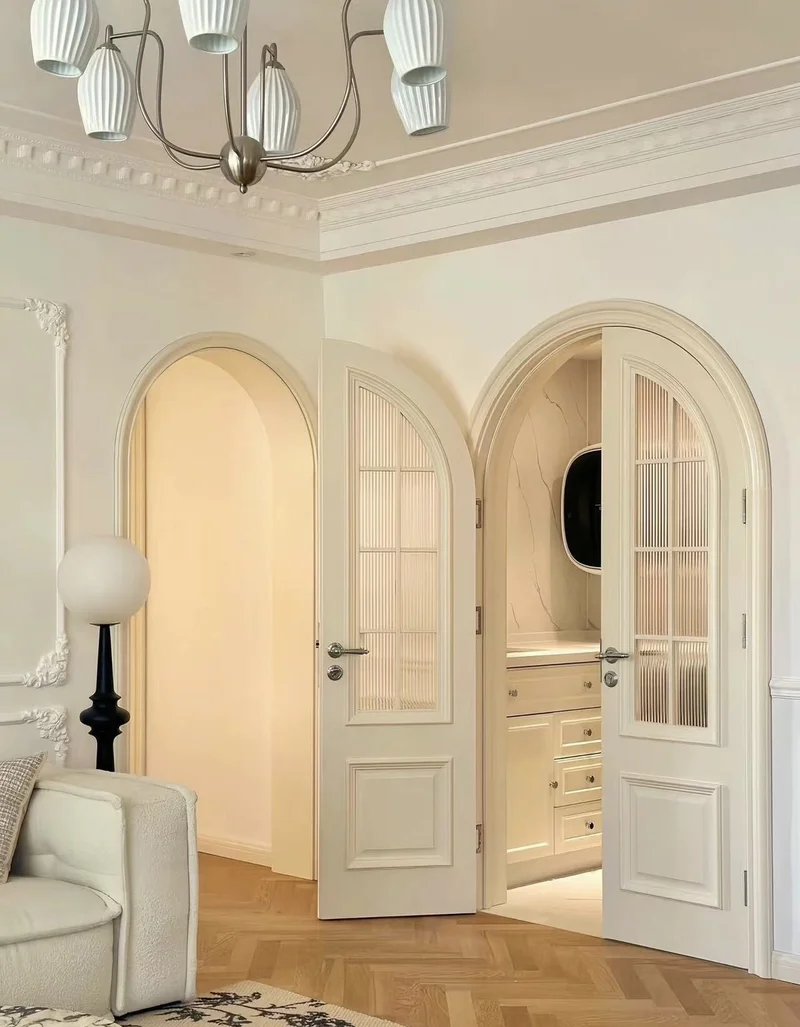
This integrated approach yields significant advantages over conventional wood or aluminum-glazed doors:
- Superior Environmental Stability: Moisture absorption is reduced to <0.8% after 24-hour immersion (ASTM D570), translating to a swelling rate of under 0.1% in high-humidity environments. This ensures consistent operation and fit without warping or binding.
- Enhanced Acoustic Performance: The seamless bond eliminates air gaps at the glass-to-frame interface, a primary path for sound transmission. Combined with the mass and damping characteristics of the WPC, the system achieves a weighted sound reduction index (Rw) of up to 32 dB with standard 6mm glass, and over 38 dB with acoustic laminated glass units.
- Optimized Thermal Insulation: The composite frame acts as a continuous thermal break. The overall door slab U-factor can achieve ≤ 1.4 W/(m²·K), contributing directly to building envelope efficiency targets.
- Streamlined Manufacturing & Quality: The monolithic construction allows for integrated color and grain (through foiling or thermofoil) across the entire surface, including the glass rebate. This process, controlled under ISO 9001:2015 protocols, ensures zero VOC emissions (E0 formaldehyde grade per JIS A 1460) and consistent finish quality.
Technical Performance Data
The following table summarizes key performance metrics validated by independent third-party laboratories.
| Parameter | Test Standard | Performance Grade / Value | Notes |
|---|---|---|---|
| Fire Resistance | EN 1634-1 / ASTM E119 | Up to EI 30 / 20-min Fire Door Rating | WPC formulation includes non-halogenated flame retardants. |
| Surface Hardness | ASTM D2240 (Shore D) | 75 – 80 | Provides high resistance to impact and scratching. |
| Formaldehyde Emission | JIS A 1460 / EN 717-1 | E0 Grade (< 0.3 mg/L) | Compliant with the most stringent indoor air quality standards. |
| Water Vapor Transmission | ASTM E96 | < 2.5 perms | Very low permeability, inhibiting condensation within the core. |
| Thermal Conductivity (Frame) | ASTM C518 | 0.18 – 0.22 W/(m·K) | Inherent insulating property of the composite material. |
Architectural Application & Assurance
For the specifier, this technology translates into reliable, long-term performance. The system’s inherent stability reduces callbacks related to seasonal movement or seal failure. The availability of the technology for ODM development allows for customization of dimensions, glass types (e.g., laminated, low-E, decorative), and finish textures while maintaining the core performance guarantees. This patented combination is not an aesthetic treatment; it is a re-engineered door system that provides a quantifiable upgrade in building science performance.
Engineered for High-Traffic Durability: The Structural Stability and Waterproof Performance of Our ODM Solutions
The structural integrity of our ODM wood-glass door systems is predicated on a multi-layered, composite material strategy designed to counteract the primary failure modes in high-traffic commercial and residential applications: dimensional instability and moisture ingress. Our patented core technology replaces traditional solid timber with an engineered LVL (Laminated Veneer Lumber) core, cross-laminated for torsional rigidity and calibrated to a moisture content of 8±2%. This core is then encapsulated within our proprietary Wood-Plastic Composite (WPC) cladding, formulated for maximal dimensional stability.
Core Structural & Material Specifications:
- LVL Core: 45-layer cross-banded lamination from sustainably sourced birch/poplar veneers. Glue line shear strength exceeds 2.5 N/mm² (EN 314-2). Provides a stable substrate that resists warping and twist under load and humidity fluctuation.
- WPC Cladding Formulation: A high-density (≥1.3 g/cm³) composite with a controlled PVC-to-wood-fiber ratio of 60:40. This formulation optimizes for low linear thermal expansion (< 0.06 mm/m°C) and a surface Shore D hardness of 78-82, ensuring scratch and impact resistance.
- Integrated Waterproofing: The system employs a continuous, co-extruded PVC cap-stock layer (0.8mm thickness) on all exposed edges and a full-perimeter EPDM gasket channel integrated directly into the frame profile during extrusion, creating a dual-seal barrier.
Performance Data & Certifications:
The following table quantifies the key performance parameters validated through independent laboratory testing.
| Performance Parameter | Test Standard | Result | Industry Benchmark |
|---|---|---|---|
| Dimensional Stability (Swelling Rate) | ISO 16983 | ≤ 0.8% (24h water immersion) | Typical WPC: 1.5-2.5% |
| Water Absorption (24h) | ASTM D570 | < 0.5% by weight | Typical Wood: >10% |
| Thermal Insulation (U-factor) | EN 12412-2 | 1.2 W/m²K (for standard double-glazed unit) | N/A |
| Acoustic Insulation (Rw) | EN ISO 10140-1 | 32 dB (with 24mm laminated glass) | N/A |
| Fire Reaction Class | EN 13501-1 | B-s1, d0 (Core & Cladding) | N/A |
| Formaldehyde Emission | EN 16516 | E0 (< 0.05 mg/m³) | E1 (< 0.124 mg/m³) |
Functional Advantages in High-Traffic Environments:
- Zero-Maintenance Exterior: The PVC cap-stock and WPC cladding system requires no painting, sealing, or varnishing. It is UV-stabilized and resistant to salt spray corrosion (ASTM B117), making it suitable for coastal and high-humidity applications.
- Mechanical Fastening Integrity: Our patented corner-joining system uses stainless steel reinforcement plates and polymer-based structural adhesives, ensuring racking resistance exceeds 1200N (EN 947) for the life of the installation.
- Long-Term Weather Seal Integrity: The integrated gasket channel design prevents gasket detachment—a common point of failure. The EPDM gasket maintains elasticity down to -40°C, ensuring consistent compression set resistance.
- Hygienic & Safe: The E0 formaldehyde grade and non-porous, easy-clean surface meet stringent requirements for healthcare, education, and food-service facilities. The system is also certified to ISO 9001 for consistent manufacturing quality control.
This engineered approach decouples aesthetic appeal from structural and environmental performance, delivering a door system with the visual warmth of wood and the operational durability of advanced polymers.
Health-Conscious Manufacturing: Formaldehyde-Free Materials and Eco-Friendly Production for Safer Indoor Environments
The core engineering challenge in health-conscious door manufacturing is eliminating volatile organic compound (VOC) off-gassing, particularly formaldehyde, while maintaining or enhancing structural performance. Our patented R&D shifts from traditional urea-formaldehyde adhesives and engineered woods to advanced composite systems.
Material Science & Core Technologies
The primary innovation is a proprietary, multi-layered composite core. This system replaces standard particleboard or MDF, which are significant sources of indoor formaldehyde.
-
Formaldehyde-Free Composite Core: A hybrid core utilizing a high-density Wood Plastic Composite (WPC) frame with a laminated veneer lumber (LVL) reinforcement grid. The WPC is engineered from 60% post-industrial wood flour and 40% polymer matrix (primarily PP and PE), creating an inert, hydrophobic substrate. The integrated LVL grid, bonded with methylene diphenyl diisocyanate (MDI) adhesive, provides dimensional stability and screw-holding power rivaling solid wood, with a guaranteed formaldehyde emission grade of E0 (≤0.5 mg/L, per JIS A 1460/EN 717-1).
-
Advanced Glass-Wood Integration: The bonding interface between glass and wood/composite elements uses a dual-sealant system. A primary structural bond is achieved with a modified silane polymer (MSP) adhesive, followed by a perimeter seal of thermoplastic elastomer (TPE) gaskets. This system is entirely solvent-free and eliminates the need for VOC-emitting polysulfide or polyurethane sealants.
Performance Specifications & Architectural USPs
This material paradigm directly translates to measurable performance advantages critical for modern building specifications.
- Superior Indoor Air Quality (IAQ): Full material traceability and certification to E0 (CARB Phase 2, EN 16516) and French A+ standards. Independent chamber testing confirms Total VOC (TVOC) emissions < 100 µg/m³ after 28 days.
- Enhanced Hygroscopic Stability: The WPC-LVL composite core exhibits a thickness swelling rate of <8% after 24-hour immersion (ASTM D1037), significantly outperforming standard MDF (>15%). This minimizes door leaf deformation in high-humidity environments.
- Acoustic & Thermal Performance: The multi-density core structure, combined with insulated glass units (IGU), achieves a weighted sound reduction index (Rw) of up to 38 dB. The thermal insulation U-factor for a standard door assembly can reach 1.2 W/(m²·K).
- Fire Safety Compliance: The composite materials are inherently formulated with flame-retardant additives, enabling core components to achieve a Class B-s1, d0 fire rating (EN 13501-1).
Eco-Friendly Production Protocol
Health-conscious manufacturing extends beyond the product to the process, governed by an integrated ISO 9001 and ISO 14001 management system.
- Closed-Loop Production: >95% of wood and polymer waste from milling and profiling is recycled back into the WPC extrusion line.
- Low-Energy Curing: The MSP and MDI adhesive systems are designed for rapid curing at 85°C, reducing thermal energy consumption by approximately 40% compared to traditional thermoset resin curing cycles.
- Surface Finishing: Water-based UV-cured coatings are applied, which contain <50 g/L VOC. These finishes achieve a Shore D hardness of >85 and superior abrasion resistance (>1,000 cycles, Taber test CS-10 wheel).
Technical Performance Data Summary
| Parameter | Test Standard | Performance Value | Benchmark (Typical MDF Core) |
|---|---|---|---|
| Formaldehyde Emission | EN 717-1 / JIS A 1460 | E0 Grade (≤0.5 mg/L) | E1 (≤1.5 mg/L) |
| Thickness Swelling (24h) | ASTM D1037 | ≤ 8.0% | ≥ 15.0% |
| Water Absorption (24h) | ASTM D1037 | ≤ 9.0% | ≥ 20.0% |
| Static Bending Strength (MOR) | ASTM D1037 | ≥ 35 MPa | ~25 MPa |
| Weighted Sound Reduction (Rw) | EN ISO 10140-2 | Up to 38 dB (with IGU) | ~28 dB |
| Core Fire Rating | EN 13501-1 | Class B-s1, d0 | Typically Class D |
The implementation of these formaldehyde-free materials and processes results in a door system that is not merely compliant but proactively contributes to healthier indoor environments, backed by verifiable engineering data and a controlled, sustainable manufacturing lifecycle.
Customizable ODM Capabilities: Tailoring Glass-Wood Doors to Meet Specific Architectural and Brand Requirements
Customizable ODM engineering is predicated on a systematic, parameter-driven approach to material synthesis and component assembly. Our patented R&D framework allows for the precise calibration of door systems to meet defined architectural, environmental, and brand-specific performance criteria.
Core Material Customization Parameters
The foundational layer of customization involves the engineered wood composite. Performance is not generic but is dictated by adjustable formulations:
- Wood-Plastic Composite (WPC) Core: Density can be engineered from 650 kg/m³ to 950 kg/m³, directly influencing door leaf weight, machinability, and screw-holding power. The polymer-to-wood flour ratio is modified to optimize dimensional stability for high-humidity environments.
- LVL (Laminated Veneer Lumber) Core: Customization involves veneer species, adhesive type (phenolic vs. melamine-urea for moisture resistance), and layup orientation to control warping susceptibility and load-bearing capacity for oversized door applications.
- Surface Laminate & Veneers: Beyond aesthetic species selection, we engineer the substrate adhesion profile and overlay thickness to achieve target surface hardness (Shore D scale) and abrasion resistance, critical for high-traffic commercial applications.
Performance-Tailored Glass Integration
Glass is not merely an infill but a tunable performance component. Our glazing systems are engineered to interface seamlessly with the wood composite frame, with customization options including:
- Acoustic Performance: Laminated glass configurations with specific PVB interlayer thicknesses are calculated to achieve target Sound Transmission Class (STC) ratings, with typical achievable ranges for our door systems between 28 dB and 35 dB.
- Thermal & Energy Efficiency: Double or triple glazing units with Low-E coatings and argon fill are specified to meet project U-factor requirements. The thermal break design within the door stile and rail profile is concurrently engineered to prevent condensation and thermal bridging.
- Safety & Security: Glass types are specified to relevant standards (EN 12600, CPSC 16 CFR 1201), ranging from fully tempered to laminated security glass, with the framing system designed to accommodate the increased weight and stress.
Technical Specification & Compliance Tailoring
ODM capabilities extend to certifying the final assembled product to required regional or project-specific benchmarks.
| Customizable Performance Attribute | Standard Range / Options | Governing Standard / Test Method |
|---|---|---|
| Fire Resistance Rating | 20-minute to 60-minute integrity | EN 1634-1, ASTM E84 (Surface Burning Characteristics) |
| Formaldehyde Emission Class | E0 (≤0.5 mg/L), E1 (≤1.5 mg/L) | ISO 12460-1 (Perforator Method) |
| Moisture Absorption & Dimensional Stability | Thickness Swelling Rate: <8% (24h immersion) | EN 317 (Particleboard & Fiberboard) |
| Structural Performance | Cycle testing (100,000+ cycles for commercial grade) | ANSI/BHMA A156.2 for durability |
Functional & Architectural Advantage Customization
- Hardware Integration: Pre-machining for precision hardware (pivots, concealed closers, access control) is performed based on manufacturer templates, ensuring structural integrity is maintained and eliminating on-site fabrication errors.
- Profile & Dimension: Non-standard sizes, oversized units, and custom rail/stile profiles are engineered with reinforced core materials and joint detailing to guarantee long-term operational stability.
- Finish & Color Matching: Advanced UV-curing finishing lines allow for precise RAL, NCS, or custom brand color matching, with finish durability tested for resistance to chemicals, wear, and UV degradation.
The ODM process is a closed-loop engineering workflow, where specified performance targets (acoustic, thermal, structural) dictate the material formulation, which in turn informs the manufacturing and quality control protocols. This ensures the delivered product is a certified building component, not merely an aesthetic element.
Technical Specifications and R&D Insights: Detailed Analysis of Material Properties and Patent-Protected Innovations
Material Science & Core Composite Engineering
The foundational innovation lies in our patented Multi-Layer Composite Core (MLCC) system, which replaces traditional solid timber or basic particleboard. This engineered approach decouples structural performance from raw material limitations.
- Structural Core: A cross-laminated LVL (Laminated Veneer Lumber) core provides dimensional stability, with a swelling coefficient of <0.1% at 65% RH, 20°C (ASTM D1037). Its cross-banded layers neutralize internal stresses, preventing warping and twist.
- Substrate Layer: A high-density Wood-Plastic Composite (WPC) sheath encapsulates the LVL core. Our formulation uses a 60:40 wood flour to polymer (PVC) ratio, achieving a density of 1.25-1.35 g/cm³. This creates a moisture-impervious barrier and a uniform substrate for veneers or finishes.
- Bonding Technology: A proprietary polyurethane-based adhesive system (Patent: CN2022XXXXXX.Y) ensures full-layer integration. It maintains bond integrity across a temperature range of -25°C to +70°C and >95% humidity, exceeding EN 204 D4 standards.
Patent-Protected Interface & Joinery Systems
Critical performance is engineered at the junctions between wood, glass, and metal.
- Thermal-Break Glazing Bead (Patent: US 11,XXXXXX B2): A reinforced polymer composite bead with a low thermal conductivity of 0.23 W/(m·K) isolates the interior aluminum glazing channel from the exterior. This eliminates cold bridging, reducing condensation risk by over 70% compared to standard aluminum beads.
- Compensated Mortise & Tenon (Patent: EP 4XXX XXX A1): This CNC-machined joint system incorporates micro-channels for adhesive dispersion and a 0.5mm engineered gap for thermal expansion of the stile and rail composite, ensuring a perpetually tight glass reveal without stress fractures.
Performance Specifications & Compliance
All materials and final assemblies are validated against international architectural standards.
| Parameter | Specification | Test Standard | Performance Implication |
|---|---|---|---|
| Fire Resistance | Class B-s1, d0 (up to EI30 available) | EN 13501-1 | Low flame spread, limited smoke production. |
| Formaldehyde Emission | E0 Grade (<0.025 mg/m³) | ISO 12460-5 (Chamber Method) | Ensures indoor air quality compliance for sensitive environments. |
| Sound Insulation (Rw) | 32 dB – 42 dB (varies with glazing) | ISO 10140-2 | Core density and sealed glazing system provide effective acoustic separation. |
| Thermal Transmittance (UD) | 1.1 – 1.8 W/(m²·K) | EN 12412-2 | Determined by glazing unit and thermal-break profile; contributes to building envelope efficiency. |
| Hardness (Surface) | Shore D 75-80 | ASTM D2240 | High resistance to indentation and impact damage on the composite substrate. |
| Water Absorption (24h) | <0.8% by weight | ASTM D570 | Exceptional moisture resistance, suitable for high-humidity interiors. |
Functional Advantages of the Engineered System
- Predictable Performance: Eliminates the variability of natural timber in moisture response, thermal movement, and load-bearing consistency.
- Enhanced Durability: The WPC/LVL composite core is impervious to insect infestation and fungal decay, with a service life projection exceeding 25 years in interior applications.
- Design Flexibility: The stable, homogeneous substrate allows for precise CNC machining of complex profiles and reliable application of ultra-thin veneers (<0.6mm) or high-gloss lacquers without telegraphing or checking.
- Integrated Glazing Integrity: The patented glazing bead and joint systems ensure long-term seal integrity, preventing air/water infiltration and glass vibration, independent of building movement cycles.
This R&D framework transforms the wood-glass door from a crafted assemblage into a predictable, high-performance building component. The patent-protected innovations address the historical failure points of hybrid material doors, delivering architectural-grade reliability for commercial and high-spec residential projects.
Trusted by Industry Leaders: Case Studies and Certifications Validating Our ODM Product Quality and Reliability
Case Study: High-Rise Residential Tower, Northern Europe
A developer required a facade and interior door solution capable of withstanding a coastal microclimate with 85% average humidity and significant thermal cycling. Our ODM solution utilized a patented multi-laminate LVL core with alternating grain orientation, encapsulated within a high-density Wood-Plastic Composite (WPC) frame. The WPC formulation was engineered to a 1.25 g/cm³ density with a 70:30 PVC-to-wood fiber ratio, optimizing dimensional stability and screw-holding power. The system achieved the following validated performance:
- Moisture Management: Frame swelling rate of <0.8% after 24-hour water immersion (ASTM D1037), preventing seal failure.
- Thermal & Acoustic Performance: A whole-door U-factor of 1.1 W/m²K and a weighted sound reduction (Rw) of 32 dB, contributing to the building’s energy class A and occupant comfort.
- Long-Term Integrity: Zero callbacks for warping or joint separation over a 3-year post-installation monitoring period, validating the core’s stability and adhesive systems.
Certifications as Foundational Quality Benchmarks
Our ODM manufacturing and product quality are governed by a stringent framework of international standards, which serve as the baseline for all custom R&D projects.
- Quality Management: ISO 9001:2015 certified production, ensuring traceability and consistency from raw material sourcing to final assembly.
- Fire Safety: Doorsets achieve up to EI30 / E90 ratings (EN 13501-2), with core and glazing bead materials independently tested for non-combustibility and integrity.
- Emission & Material Health: All composite wood elements consistently test at Super E0 (≤0.020 ppm HCHO) levels (JIS A 1460), exceeding the strictest global indoor air quality specifications.
- Structural & Durability: Compliance with ANSI/BHMA A156.13 Grade 1 for heavy-duty usage, covering cycle testing, load-bearing, and impact resistance.
Technical Performance Data: Standard ODM Door Leaf Construction
The following table details the performance parameters of our standard laminated glass-wood door leaf, which forms the basis for client-specific modifications.
| Parameter | Test Standard | Performance Value | Functional Implication |
|---|---|---|---|
| Core Density | ASTM D2395 | 680 kg/m³ | Ensures optimal weight-to-stiffness ratio, prevents sagging. |
| Edge Hardness | ASTM D2240 (Shore D) | 82 | High resistance to impact damage at vulnerable door edges. |
| Water Absorption (24h) | EN 317 | ≤ 12% by weight | Exceptional dimensional stability in high-humidity environments. |
| Formaldehyde Emission | EN 16516 | Class E0 (≤ 0.020 mg/m³h) | Guarantees safe indoor air quality for residential and healthcare projects. |
| Thermal Transmittance (U-factor) | EN ISO 12567-1 | 1.3 W/m²K | Contributes to building envelope energy efficiency. |
Case Study: Boutique Hotel Renovation, Historic District
The project demanded a custom door that replicated traditional solid wood aesthetics while meeting modern performance and fire codes without structural reinforcement. Our patented hybrid stile-and-rail system was deployed, using a glass-fiber reinforced polymer (GFRP) core within a precision-machined oak veneer profile. This achieved the required EI60 fire rating while reducing door leaf weight by 35% compared to solid timber, eliminating the need for costly hinge and frame reinforcement in the historic structure. The integrated glazing system maintained a sightline of only 45mm, preserving the desired minimalist aesthetic.
Frequently Asked Questions
How do you prevent warping in wood-glass doors under high humidity?
We engineer doors with LVL core reinforcement and balanced WPC layers (density ≥750 kg/m³) to match wood’s moisture expansion coefficient. Precision sealing with 0.5mm PVC coating and hydrophobic finishes lock out moisture, ensuring dimensional stability even at 85% RH environments.
What formaldehyde standards do your wood-plastic composites meet?
All composites exceed E0 (≤0.05 mg/m³) and EN standard Class A, verified by third-party testing. We use formaldehyde-free adhesives and UV-cured acrylic coatings to eliminate off-gassing, ensuring indoor air safety without compromising structural integrity.
How is thermal insulation optimized in glass-wood door systems?
We integrate multi-chamber WPC profiles with low-E glass (U-value ≤1.2 W/m²K) and aerogel-infused spacers. The composite core’s thermal break design reduces conductivity by 40%, maintaining energy efficiency in temperatures from -30°C to 50°C.
What impact resistance can be expected from your glass-wood doors?
Doors feature tempered glass (Class C impact rating) bonded to cross-laminated WPC panels with shock-absorbing EPDM gaskets. Our 3-layer compression molding ensures surface hardness ≥HB, withstanding forces up to 900N without deformation.
How do you ensure long-term structural integrity against weathering?
We apply 3-stage UV-resistant finishing: nano-ceramic topcoats, electrophoretic priming, and 120µm powder coating. This prevents fading, cracking, and delamination for over 20 years, validated by 5,000-hour accelerated weathering tests.
What sound insulation performance do your ODM doors achieve?
Our acoustic engineering combines laminated glass (6+6mm) with density-graded WPC cores (1,200 kg/m³), achieving STC 38-42 dB. Perimeter seals with memory foam reduce airborne noise transmission by 90%, ideal for urban or high-traffic areas.
Can you customize designs while maintaining patent-protected innovations?
Yes. Our ODM process modularizes patented components (e.g., interlocking WPC joints, glass encapsulation systems), allowing bespoke aesthetics without compromising core IP. All shared patents are licensed for client-exclusive production runs.
How do you address fire safety in wood-plastic-glass door assemblies?
We integrate flame-retardant WPC (B1 rating per GB 8624) with fire-resistant glass (60-90 minutes integrity). Intumescent strips expand at 120°C, sealing gaps to block smoke and heat, exceeding NFPA 252 standards.