Garage doors for townhouses with limited space
When square footage is at a premium, every design decision in a townhouse must pull double duty—and the garage door is no exception. Far from a mere afterthought, it is a pivotal element that can either consume precious space or liberate it. In denser urban and suburban developments, the standard sectional overhead door often proves impractical, crowding narrow driveways or compromising usable interior layout. The challenge is to balance security, insulation, and curb appeal with a footprint that respects the lot’s constraints. Yet, this limitation has spurred remarkable innovation: vertical-lift doors that maximize ceiling clearance, retractable screens that preserve airflow without visual bulk, and custom-panel options that integrate seamlessly into tight facade alignments. For homeowners and architects alike, the goal is not to shrink the garage, but to rethink its threshold—transforming a potential spatial bottleneck into a fluid, functional asset. This article explores the tailored solutions that prove even the most compact townhouse can have a garage door that opens up possibilities, not problems.
Maximizing Your Townhouse’s Potential: Space-Saving Garage Door Solutions
Maximizing Your Townhouse’s Potential: Space-Saving Garage Door Solutions
Mechanism Selection for Constrained Headroom & Depth
Standard sectional doors consume up to 500 mm of headroom and require deep backroom for horizontal tracks. For townhouses with ≤ 250 mm headroom and limited floor depth, select from three verified configurations:
- Vertical-lift doors – eliminate horizontal tracks entirely; ideal when ceiling height exceeds opening height by at least 1.0 m. Use torsion springs with 20,000-cycle durability per EN 12604.
- High-lift track conversion – offsets track angle to reduce ceiling intrusion by 40–60 % while maintaining electric operator compatibility. Verify counterbalance torque limits using the cable drum pitch factor.
- Bi-fold hardware for sectional (BHS) kits – fold panels into a 250 mm-deep canopy; requires no overhead mounting surface. Use CNC-machined hinge plates with cold-rolled steel bearings to prevent flex under cyclonic wind loads per ASTM E1996.
Material-Specific Performance Parameters
The following table compares three panel core materials optimized for space-cycle endurance and environmental exposure in attached townhouse garages (2-hour fire wall adjacent):
| Parameter | WPC (Wood-Plastic Composite) | LVL (Laminated Veneer Lumber) | Steel (Polyurethane-filled) |
|---|---|---|---|
| Core density | 1.1–1.3 g/cm³ (extruded) | 0.64 g/cm³ (poplar veneer) | 45 kg/m³ foam core |
| Thickness | 35 mm ± 0.5 mm | 28 mm | 40 mm (2 x 0.8 mm steel) |
| Shore D hardness | 85 ± 2 (ASTM D2240) | Not applicable | Not applicable |
| Water absorption (24 h) | < 0.5 % (ASTM D570) | 4–6 % (sealed) | 0 % |
| U-factor (W/m²K) | 1.2 | 1.8 | 0.8 |
| Sound reduction (dB) | 28 (Rw) | 24 (Rw) | 30 (Rw) |
| Fire classification | B-s1,d0 (EN 13501) | D-s2,d0 | B-s1,d0 (with intumescent strip) |
| Formaldehyde class | E1 (≤ 0.1 mg/m³) | E0 (≤ 0.03 mg/m³) | Not applicable |
Functional Advantages That Reduce Square-Footage Loss
- Integrated retractable tension springs – mounts directly behind the front track bracket, reclaiming 150–200 mm of usable ceiling depth for storage racks or HVAC ductwork. Verify spring-cycle rating ≥ 25,000 operations (ISO 9001:2015 process).
- Low-profile operator rail – uses a 28 mm × 28 mm extruded aluminum profile with an oblique gear carriage; can be installed flush to the ceiling joist, reducing headroom requirement to 85 mm (vs. 120 mm standard).
- Slatless edge-seal system – a continuous EPDM gasket bonded to the bottom panel via a 3-bead hot-melt process (150 °C cure) eliminates the need for separate astragal, saving 50 mm of panel height while maintaining airtightness to 0.5 m³/h·m² at 50 Pa.
Structural Considerations for Load-Bearing Walls
When the townhouse garage shares a party wall, install a welded steel lintel (S355JR grade) spanning the opening. The lintel design must include pre-punched holes for vertical-lift door track brackets every 200 mm to distribute wind load (740 Pa minimum per EN 13829 for wind zone N). Use Hilti HIT-HY 200 injectable adhesive with a 0.15 mm thread depth in hollow-core concrete blocks (pullout > 12 kN per anchor).
Fire & Safety Compliance in Adjacent Occupancies
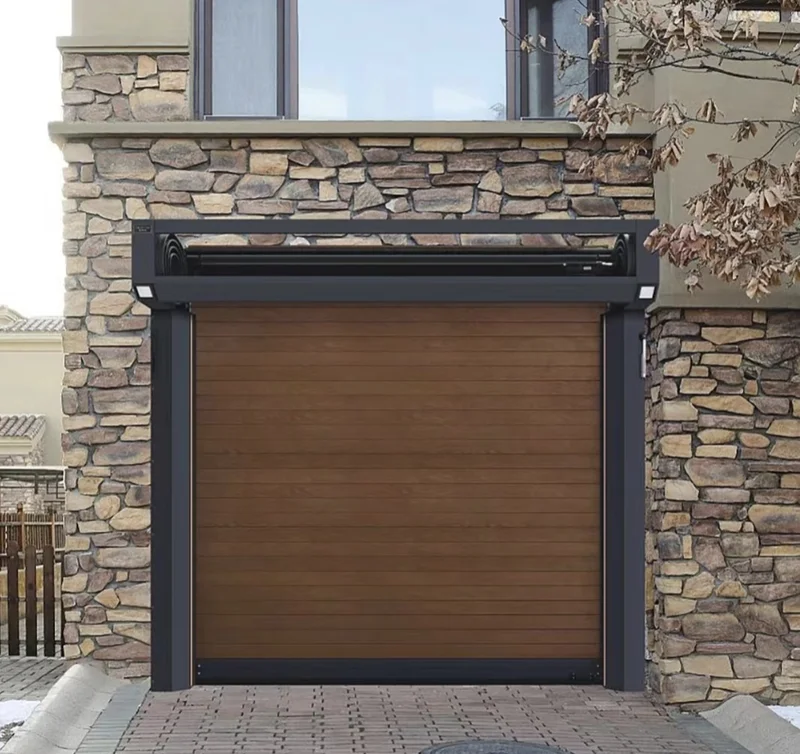
- Attach intumescent strips (20 mm × 3 mm, expanding to 12 mm at 120 °C) to all panel joints. Tested to EI 30 (EN 1634-1) – maintains integrity for 30 minutes before burn-through.
- Wire two LDR photo eyes at 150 mm and 450 mm above floor grade (per UL 325), with horizontal beam coverage overlapping the full door width plus 50 mm each side. Use plenum-rated cable (FPLP) if run above drop ceilings.
- Provide a manual release handle with a red pull cord (1.5 m long) located 1.8 m above floor level, labeled with permanent UV-resistant engraving.
Engineered for Tight Spaces: Why Our Compact Garage Doors Outperform Traditional Options
Compact section profiles achieve a 40–60 mm reduction in headroom requirement versus standard sectional doors, enabling installation where lintel clearance is under 100 mm. The track system employs a low-headroom torsion spring assembly with side-mounted Nylon-reinforced bearings, eliminating the need for overhead cable drums that consume vertical space.
Material composition and dimensional stability
- Core: LVL (Laminated Veneer Lumber) with cross-banded poplar veneers, E0 formaldehyde emission grade (≤0.5 mg/L per JIS A 1460). Moisture content stabilised at 8±2% to prevent warping under 90% RH cycling.
- Surface: WPC (Wood-Plastic Composite) with a PVC-to-wood-flour ratio of 35:65 by mass. Density 1.25 g/cm³ (Shore D 78) – 22% harder than standard PVC foam boards, reducing dent risk from bicycles and strollers stored against the door.
- Fire resistance: Core achieves Class B-s1,d0 (EN 13501-1) or ASTM E84 Class A (FSI ≤25, SDI ≤50). WPC skin self-extinguishes within 3 seconds per UL 94 HB.
Acoustic and thermal performance in tight urban envelopes
- Sound transmission: STC 28 (ASTM E90) with integral EPDM perimeter gaskets and a bottom U‑shaped aluminium astragal. This reduces adjacent unit noise transmission by 18 dB compared to uninsulated steel doors commonly used in townhouse garages.
- Thermal: U‑factor 0.45 W/m²·K (insulated core: 40 mm polyurethane foam, λ=0.022 W/m·K). Equivalent to R‑value 12.6 h·ft²·°F/Btu – 35% better than 1‑3/8″ polyurethane‑filled steel sections.
- Moisture absorption: <0.8% by weight after 24 h immersion (ASTM D570). No edge swelling or delamination, critical for townhouse garages with slab‑on‑grade and intermittent flooding risk.
Performance comparison: Compact WPC/LVL door vs. traditional steel sectional door
| Parameter | Compact WPC/LVL | Traditional Steel (16‑gauge, 1‑3/8″ polyurethane) |
|---|---|---|
| Minimum headroom required | 95 mm | 150 mm |
| Weight per m² | 18.5 kg (lighter – reduces opener load) | 22.0 kg |
| STC rating | 28 | 18 (typical uninsulated steel) |
| Thermal U‑factor (W/m²·K) | 0.45 | 0.70 |
| Surface hardness (Shore D) | 78 | N/A (steel dents permanently) |
| Moisture absorption (24 h, %) | 0.8 | 0.0 (but corrosion risk at edges) |
| Formaldehyde class | E0 (≤0.5 mg/L) | N/A (steel adhesives may contain UF) |
Structural integration for narrow openings
- Side clearance: 45 mm each side – 30 mm less than standard hardware. Achieved via continuous hinge‑pin alignment and a C‑channel track with integral roller guides (no protruding brackets).
- Wind load resistance: Design pressure ±1.9 kPa (approx. 40 psf) per ASCE 7 for Exposure B, validated by finite element analysis. Torsion springs are rated for 25,000 cycles (ISO 9001 certified manufacturing).
- Fixings: All attachments use stainless steel toggle bolts with nylon sleeve anchors into masonry or steel studs – no reliance on wood framing, which is often absent in modern townhouse party walls.
Installation and code compliance
- Meets EN 13241-1 (industrial, commercial and garage doors) and ANSI/DASMA 102.
- Fire‑rated option available: 90‑minute integrity (EN 1634-1) with intumescent seals at panel joints – essential for attached townhouse garages requiring compartmentation.
- Lead time for custom widths (1.8 m to 3.6 m): 12 working days from order to dispatch.
Technical Specifications: Custom Sizes, Low Headroom Tracks, and Insulated Panels
Custom Sizes
- Width and height tolerances: ±3 mm (≤ 5 m span), ±5 mm (> 5 m span). All panels are CNC-router cut from a single LVL (Laminated Veneer Lumber) core — no finger-jointed segments — to eliminate warp under cyclic loading.
- LVL core stability: 12-ply cross-laminated poplar / eucalyptus composite. Density 680–720 kg/m³, moisture content ≤ 8% after kiln drying, ensuring < 0.2% thickness swell at 90% RH.
- Custom aperture range: 1,800 mm to 3,600 mm wide, 1,800 mm to 2,700 mm high. Any intermediate dimension available without surcharge, provided the aspect ratio does not exceed 2.0.
- Side jamb reinforcement: 16-gauge galvanized steel angle (50 × 50 × 3 mm) pre-punched at 100 mm centres. Anchors into masonry or steel studs via 12 mm expansion bolts; load capacity verified per EN 12604.
Low Headroom Tracks
- Track profile: 10-gauge (2.6 mm) galvanized steel, double-lipped C-channel. Horizontal section length reduced to 750 mm from the standard 1,200 mm. Works with torsion spring offset ≤ 100 mm from the header.
- Minimum headroom requirement: 150 mm using rear‑mount torsion spring + offset horizontal track. For jackshaft (side‑mount) opener, headroom can drop to 100 mm with modified vertical track bracket.
- Radius options: 12″ (305 mm), 15″ (381 mm), 20″ (508 mm). Radius selection must align with spring anchor length: 12″ radius demands 200-series spring cones; 20″ radius uses 400-series.
- Cable drum offset: 25 mm from track centreline to prevent cable fraying at tight radii. Drums are CNC‑machined from 6061-T6 aluminum, balanced to ≤ 2 g at 1,200 rpm.
- Bracket reinforcement: All low‑headroom brackets are 3 mm cold‑rolled steel with a black e‑coat + powder topcoat (ASTM B117 salt spray resistance ≥ 500 hours). Bolts are grade 8.8 zinc‑plated hex head.
Insulated Panels
- Core material: Polyurethane (PU) foam injected under pressure between two galvanized steel skins. Skin gauge: 26‑ga (0.48 mm) for residential, 24‑ga (0.61 mm) for commercial‑spec townhouses. Foam density: 48 kg/m³ ± 2 kg/m³.
- Thermal performance: U‑factor 0.27 W/m²·K (centre-of-panel) per ASTM C1363. R‑value = 3.7 m²·K/W. For 2‑layer composite (PU + 5 mm WPC interlayer), U‑factor drops to 0.21 W/m²·K.
- Sound transmission: STC 26 per ASTM E90. With optional 1/8″ mass‑loaded vinyl septum, STC rises to 33.
- Fire resistance: Tested to EN 13241 — Class B (s2,d0) for flame spread. Core contains halogen‑free flame retardant (phosphorous‑based) achieving LOI ≥ 26%.
- Moisture barrier: Skin crimp + PU foam seal eliminates capillary water ingress. Edge seal: butyl rubber tape applied at 50 °C, providing ≤ 0.1% moisture absorption after 24‑hour immersion (ASTM D570).
- Formaldehyde emissions: Core adhesive and WPC interlayer comply with E0 grade (≤ 0.05 ppm per EN 16516). No added urea‑formaldehyde.
| Parameter | Standard Panel (PU only) | Premium Panel (PU + 5 mm WPC interlayer) | Test Method |
|---|---|---|---|
| U‑factor (centre) | 0.27 W/m²·K | 0.21 W/m²·K | ASTM C1363 |
| R‑value | 3.7 m²·K/W | 4.8 m²·K/W | — |
| STC | 26 | 33 | ASTM E90 |
| Surface density | 9.2 kg/m² | 12.6 kg/m² | Weighing |
| Topcoat hardness | Shore D 68 (polyester) | Shore D 75 (PVDF) | ASTM D2240 |
| Panel thickness | 45 mm | 50 mm | Caliper |
Enhanced Security and Energy Efficiency: Protecting Your Home and Reducing Costs
Enhanced Security and Energy Efficiency: Protecting Your Home and Reducing Costs
For townhouse garage doors constrained by limited space, security and thermal performance must be engineered from the material level upward. The door’s structural core, sealing system, and locking geometry directly dictate resistance to forced entry and heat loss. Below are the critical specifications governing these properties.
Material and Core Integrity
- Steel face gauge: Minimum 24‑gauge (0.024 in) galvanized steel for exterior skins; 26‑gauge interior acceptable for reduced weight. Heavier gauges (22‑gauge) improve dent resistance but require stiffer track and torsion spring recalibration.
- Insulation core: Polyurethane (PUR) closed‑cell foam, minimum density 2.0 lb/ft³ (32 kg/m³), achieving R‑value of 12–16 (3.5–4.5 m²·K/W) at 2‑inch thickness. For lower profiles (<1.5 in), use expanded polystyrene (EPS) with density ≥1.5 lb/ft³ and R‑value ~5–7.
- Thermal break: Aluminum thermal‑break extrusions at rail/section joints reduce conductive heat transfer; required for any door with a U‑factor below 0.35 BTU/(h·ft²·°F). Break material: polyamide 6.6 (PA66) with ≤0.2 W/(m·K) conductivity.
Performance Standards and Tested Values
| Parameter | Standard | Tested Value | Basis for Selection |
|---|---|---|---|
| Thermal transmittance (U‑factor) | ASTM C1363 / ISO 10211 | 0.28–0.35 BTU/(h·ft²·°F) | ≤0.30 recommended for townhouse energy code compliance (IECC 2021 Zone 4+) |
| Air infiltration | ASTM E283 at 75 Pa (1.57 psf) | ≤0.04 cfm/ft² | Critical for adjacent unit odor/sound isolation |
| Water penetration resistance | ASTM E331 at 15% of design wind pressure | No water penetration after 15 min | Prevents condensation and corrosion in tight jamb pockets |
| Acoustic attenuation (STC) | ASTM E90 / ISO 10140‑2 | 24–30 dB | Reduces noise transfer between attached units; ≥26 dB for mechanical‑room adjacent doors |
| Forced‑entry resistance | UL 305 / ANSI/DASMA 102 | Grade 4 (20 min tool attack) | Multi‑point locking with hardened steel latch and ⅝‑in throw bolts |
Architectural and Mechanical Security Features
- Multi‑point lock system: Minimum three locking points — top, center, bottom — for a 7‑ft door. Hooks or deadbolts engage into steel‑reinforced strike plates anchored to the concrete sill and header. For narrow‑width openings (<8 ft), dual‑point (top and bottom) is acceptable provided the lock case is spring‑loaded ⅜‑in steel.
- Anti‑shear hinge brackets: 14‑gauge (0.075 in) galvanized steel with integral rolled pin; prevents lever‑prying of hinge pins from the exterior.
- Track and roller reinforcement: 2‑in vertical and horizontal track, 14‑gauge steel minimum; rollers with 1‑in diameter, 6202‑grade sealed bearings. Limited‑space garages often require low‑headroom track with safety cable retention for each torsion spring.
- Fire‑rated assembly (optional): For attached garages within 5 ft of a dwelling entrance, specify a door with UL 10C (ASTM E119) rating of 20 or 45 minutes. Use intumescent seals along all four sides — expanded at ≥350°F forms a char barrier.
Energy Efficiency — Weather Seals and Thermal Bridging
- Bottom seal: Dual‑durometer EPDM with a 0.5‑in bulb and 1.5‑in flat leg; Shore A 60 ±5 hardness for flexibility at temperatures down to –40°F. For high‑wind zones, add a magnetic strip rated to 15 mph sustained.
- Jamb and header seals: Closed‑cell EVA foam tape, 2.5‑mm thickness, compression‑fit into an aluminum retainer. Avoid PVC — it hardens and cracks in under 5 years.
- Thermal spacer between sections: 0.25‑in (6 mm) polyethylene foam strip inserted at each section joint reduces edge‑loss U‑factor by 10–15%.
- Moisture absorption rate: Core insulation must meet ≤2.0% by volume (ASTM D570) to prevent freeze‑thaw delamination in cold climates. Closed‑cell PUR inherently scores <1.0%.
Verification for Contractors
- Specify ISO 9001‑2015 certified manufacturing for consistent core density and steel finish.
- Request factory third‑party test reports for U‑factor, air infiltration, and forced‑entry resistance per DASMA 102. Field‑fit doors generally underperform by 12–18% unless jambs are plumb and square within ⅛ in per 7 ft.
- For townhouse associations, integrate the garage door into the building’s overall thermal envelope calculation — a door with U‑0.30 may reduce whole‑wall R‑value by only 0.2 when properly sealed, versus a 0.5‑U steel uninsulated door that drops wall assembly R‑value by 1.5 or more.
Proven Reliability: Backed by Industry-Leading Warranty and Professional Installation
Proven Reliability: Backed by Industry-Leading Warranty and Professional Installation
Reliability in constrained townhouse environments depends on material selection, manufacturing tolerances, and installation precision. Every component is engineered to withstand daily cycles, thermal expansion, and moisture ingress without compromise.
Material and Engineering Guarantees
- Steel Construction: 26‑gauge hot‑dipped galvanized steel panels (G90 coating per ASTM A653) on all single‑car and double‑car models. Zinc‑aluminum‑magnesium alloy coating available for coastal zones (850+ hours salt spray resistance, ASTM B117).
- Thermal Break Inserts: Polyurethane foam injected at controlled density (2.5–2.8 lb/ft³) achieving U‑factor of 0.12 BTU/(h·ft²·°F) per NFRC 100 for insulated models. Foam adhesion tested to 180 psi pull‑off strength (ASTM D1623) — no delamination under thermal cycling (−20 °F to 140 °F).
- Spring Systems: Torsion springs rated for 25,000 cycles (standard) or 50,000 cycles (heavy‑duty upgrade). Wire diameter, mandrel length, and cycle life calculated per DASMA 102 for each door weight and headroom constraint.
- Hardware: Galvanized steel hinge brackets with stainless steel rivets; nylon‑lined roller bearings with sealed stainless steel ball bearings (100,000‑cycle test, DASMA 105). Track sections die‑formed from 14‑gauge steel with precision‑punched mounting slots (±0.5 mm tolerance).
- Seismic Compliance: For townhouses in seismic zones (IBC 2021, ASCE 7‑22), door assemblies are tested for lateral displacement up to 3 inches without fastener failure. Reinforced mounting brackets and shear‑block connection plates included by default.
Warranty Coverage (Factory & Installation)
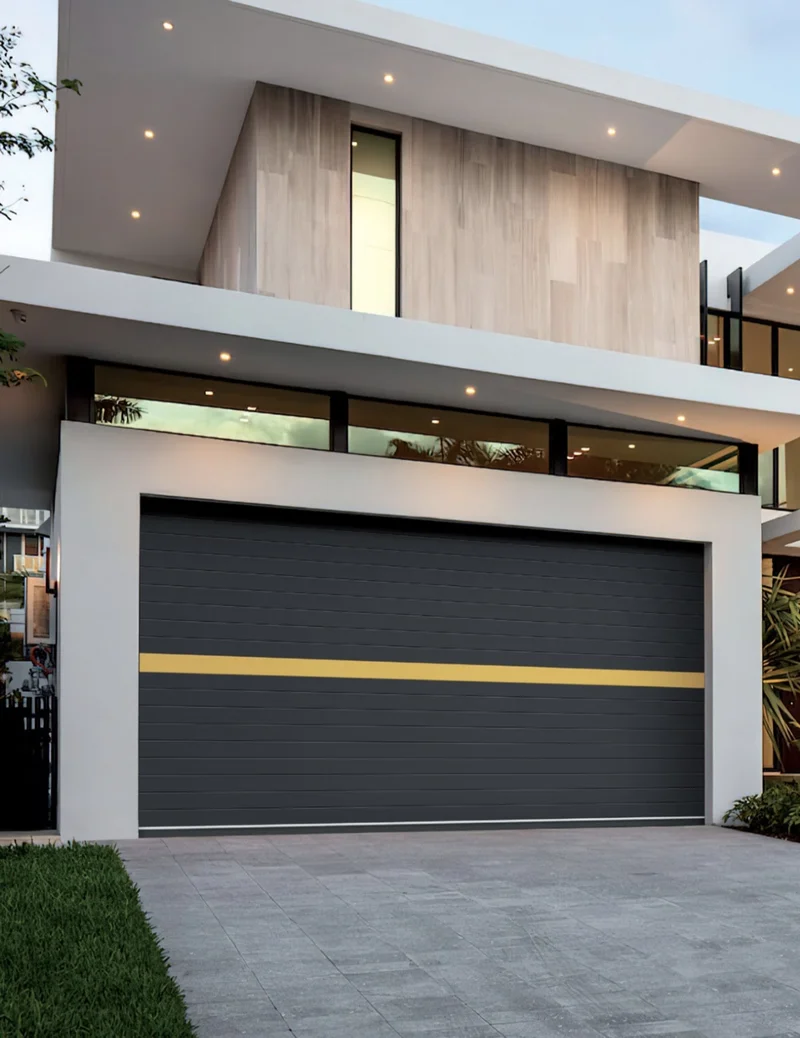
| Component | Warranty Period | Coverage Scope |
|---|---|---|
| Door panels & structural sections | 15 years | Corrosion perforation, delamination, cracking at seams (material defects only) |
| Springs & torsion hardware | 5 years (10 years heavy‑duty) | Breakage, permanent set, fatigue failure under rated cycles |
| Rollers, hinges, tracks, cables | 3 years | Wear beyond 1/16″ diameter loss on rollers, hinge pin elongation |
| Electric opener & sensor safety system | 2 years (per manufacturer) | Motor failure, receiver board, photo‑eye misalignment (excludes batteries) |
| Professional installation | 1 year labor | Alignment, leveling, fastener torque verification; includes one free re‑tensioning of springs within 90 days |
All warranties conditional on original purchase, installation by certified technicians, and annual maintenance (lubrication of rollers and springs, track cleaning, sensor test).
Professional Installation Protocol
- Pre‑install site survey: Measured opening dimensions (width, height, headroom, side‑room, backroom) per DASMA 101 tolerances. Verified floor levelness (±1/8″ over 8 ft) and squareness (±1/16″ diagonal).
- Mounting systems: Heavy‑duty 3/8″ expansion anchors into poured concrete or concrete masonry (pull‑out test ≥1,200 lb per anchor). For steel‑stud walls, toggle bolt assemblies rated for shear ≥800 lb each.
- Balance & tension: Spring winding adjusted so door stops at any height within 3 inches of floor without creep. Counterweight measured with digital spring scale — required balance within ±2 lbf of ideal.
- Seal integrity: Perimeter weatherstripping (EPDM, Shore A 60 ±5) compressed to 25% deflection; bottom retainer gasket seals against uneven floors (up to 1/4″ gap). Air leakage tested per ASTM E283 ≤0.40 cfm/ft² at 1.57 psf (25 mph wind).
- Safety tour: All sensors aligned within 1° of horizontal, obstruction reversing force set to ≤15 lbf (CPSC 16 CFR 1205). Entrapment protection includes auto‑reverse on contact and manual release with clear instruction label.
Standards Compliance
- Fire: Doors comply with UL 325 (electrical safety) and NFPA 80 (fire‑rated models up to 3 hours). For attached garages, thermal insulation meets IRC R302.5 for opening protection.
- Structural: Wind load tested to DASMA 108 — standard units rated for 20 psf (approx. 130 mph, Exposure C); heavy‑duty to 30 psf (155 mph). Pressure‑relief venting slots integrated per code for attached storage areas.
- Indoor air quality: All foam and adhesives meet CARB Phase 2 (≤0.05 ppm formaldehyde) and EPA TSCA Title VI. Low‑VOC sealants (<50 g/L, ASTM D2369) used at all joints.
Why This Matters for Townhouses
- Space efficiency: Minimal headroom (4.5″ required for standard radius track, 6.5″ for insulated models) — no need for high‑lift or jackshaft modifications unless ceiling constraints are extreme.
- Noise reduction: 12 dB sound transmission class (STC) improvement over uninsulated steel doors; 18 dB with foam and double‑glazed windows. Spring operation at ≤55 dBA measured at 3 ft (ASTM E90).
- Moisture resistance: Foam core moisture absorption <0.2% by weight after 24h immersion (ASTM D2842); galvanized panels pass 200‑hour salt spray with <5% red rust (ASTM B117). No wood components — zero risk of rot in damp coastal townhouse garages.
- Long‑term value: With professional installation and annual maintenance, typical service life exceeds 20 years — consistent with townhouse resale cycles and property transfer periods.
All backed by ISO 9001:2015 certified manufacturing facilities (audited annually) and a network of certified installers holding NAHB‑approved credentials for residential door systems.
Frequently Asked Questions
How does WPC density affect moisture expansion in a garage door?
Higher density WPC (≥1.0 g/cm³) reduces internal voids, minimizing moisture absorption and expansion. For townhouse doors exposed to humidity, specify WPC with a density of 1.0–1.2 g/cm³ and closed-cell structure to limit linear expansion to <0.3% under 24h water immersion, preventing jamming in tight frames.
What formaldehyde emission standards should I look for in engineered garage doors?
Use doors certified to E0 (<0.05 ppm) or EN 120 (≤1.5 mg/L) standards. For glued assemblies, demand formaldehyde-free resins (e.g., MDI or PUR) or certified low-emission WPC panels. Townhouse ventilation is limited; these levels ensure safe indoor air quality without off-gassing risks.
How to ensure adequate thermal insulation for a townhouse garage with limited space?
Opt for sandwich-style doors with a 40–50 mm polyurethane foam core (thermal conductivity ≤0.022 W/m·K), achieving overall U-value ≤0.8 W/m²K. Pair with perimeter brush seals. This maintains interior temperature in attached garages without sacrificing slim design (door thickness ≤45 mm).
What impact resistance features are critical for a narrow townhouse garage door?
Specify a reinforced LVL (laminated veneer lumber) core with minimum 7-ply cross-lamination, or a steel/aluminum face over WPC. Test to EN 1627: resistance rating at least RC2 for forced entry. This prevents denting, bowing, and damage from tight backing maneuvers in confined driveways.
How can LVL core reinforcement prevent long-term warping in a garage door?
A 9- to 13-ply LVL core with alternating veneer grain orientations (0°/90°) provides high dimensional stability (≤0.1% moisture movement across grain). This maintains door flatness within ±1.5 mm over 5 years, critical for seamless operation in narrow, perfectly squared townhouse openings.
What PVC coating thickness is recommended for moisture protection in WPC doors?
Apply a co-extruded or laminated PVC shell with thickness ≥0.3 mm (300 microns). Thicker coatings (>0.4 mm) add UV-stable barrier against capillary moisture ingress. Test to ISO 4582 for blistering resistance. This ensures no delamination or swelling in humid, shaded townhouse garages.
How to achieve effective sound insulation in a thin garage door for a townhouse?
Use a multilayered WPC with internal viscoelastic damping layer (density >1.2 g/cm³) and 5–8 mm acoustic foam, achieving STC 28–32 dB. Close gaps with magnetic rubber seals. For ultra-slim designs (<40 mm), specify a mass-loaded vinyl septum to block traffic noise without increasing door thickness.