Garage doors for retail stores with drive-thru access
In the fast-paced world of retail, efficiency and customer experience are paramount. For stores offering drive-thru access—from quick-service restaurants to pharmacies and coffee shops—the humble garage door has evolved into a critical component of operational success. No longer merely a utilitarian barrier, today’s drive-thru garage doors are engineered for speed, durability, and seamless integration with modern point-of-sale systems. They must withstand constant thermal cycling, resist corrosion from exhaust and weather, and provide unimpeded, silent operation to keep lines moving. High-speed sheet doors, insulated roll-up models, and glazed aluminum options now offer retailers a suite of choices that balance energy efficiency, security, and brand aesthetics. Whether your goal is to minimize wait times, maintain interior climate control, or create a welcoming entrance that draws customers in, the right garage door solution can transform your drive-thru from a simple convenience into a competitive advantage. Here’s what retail managers and facility planners need to consider.
The Critical Role of Drive-Thru Garage Doors in Retail Operations
Drive-thru garage doors directly influence throughput, energy efficiency, and structural longevity in retail environments. The door is not a passive enclosure; it is an active component in the service delivery chain, subject to repeated cycling, thermal shock, and impact risks from delivery vehicles. Selecting a system without rigorous engineering compromises both operational continuity and lifecycle cost.
Functional advantages engineered for retail drive-thru applications:
- Cycle life and speed: Motors rated for continuous-duty operation (e.g., 1/3 HP minimum, thermal overload protection) with opening speeds ≥ 12 in/sec mitigate queue accumulation. Torsion spring systems with cycle ratings ≥ 25,000 cycles (ASTM F1568-18) reduce failure risk under high-frequency use.
- Thermal envelope integrity: U-factor ≤ 0.30 W/m²·K is achievable with polyurethane foam cores (≥ 42 kg/m³ density) sandwiched between galvanized steel skins. This prevents condensation on interior surfaces during HVAC operation and maintains zone temperature compliance for perishable goods storage near the drive-thru lane.
- Acoustic separation: Sound transmission class (STC) ratings ≥ 25 dB for standard insulated sections; STC ≥ 30 dB when using double-pane vision lites with laminated glass and perimeter seals. Critical for stores operating pre-dawn or post-midnight where local noise ordinances apply.
- Moisture resistance: Polyurethane foam cores absorb < 2% by volume (ASTM D2842). For wet-wash zones, WPC (wood-plastic composite) bottom retainers with PVC-wood ratio 60:40 (density ≥ 1.1 g/cm³) eliminate rot and swelling, unlike traditional wood.
Material science benchmarks for drive-thru door components
| Parameter | Standard Performance | Engineered Upgrade | Test Method |
|---|---|---|---|
| Core thermal conductivity | 0.022 W/m·K (polyurethane foam, ≥ 42 kg/m³) | ≤ 0.020 W/m·K | ASTM C518 |
| Moisture absorption (24 hr) | < 2% (foam) | < 1.5% for sealed CFC-free foam | ASTM D2842 |
| Surface hardness (WPC bottom retainer) | Shore D 65–70 | Shore D 75–80 for high-traffic zones | ASTM D2240 |
| Formaldehyde emission (interior-facing panels) | E1 (≤ 0.10 ppm) | E0 (≤ 0.05 ppm) for indoor air quality compliance | EN 717-1 |
| Fire rating (single-section door) | Class C (ASTM E84 flame spread ≤ 75) | Class B (flame spread ≤ 25) when required by local code | ASTM E84 |
| Wind load resistance | 30 psf (1.44 kPa) | 55 psf (2.63 kPa) per ASCE 7-16 for coastal zones | ASTM E330 |
Structural considerations for vehicle impact mitigation:
LVL (laminated veneer lumber) bottom struts and continuous piano-hinge track systems distribute impact loads across the entire door panel, preventing catastrophic failure from delivery truck back-in contact. Steel gauge 24 (minimum 0.024 in) for exterior skins, with galvanization ≥ G60 (60 g/m²) for corrosion resistance in wet drive-thru lanes. Track profiles should be roll-formed with double return flanges to resist deflection under side wind forces.
Integration with store management systems:
Drive-thru doors must accept signals from magnetic loop detectors, photoelectric sensors, and point-of-sale triggers. Relay outputs hardened for 24 VDC/120 VAC, with dry contacts rated ≥ 5 A resistive. Compliance with UL 325 for automatic gate and door operation, including entrapment protection via inherent photo sensors and edge sensors (Type A or B). Backup battery systems (12 VDC, ≥ 2 Ah) ensure full-cycle operation during power interruptions—critical for drive-thru service continuity.
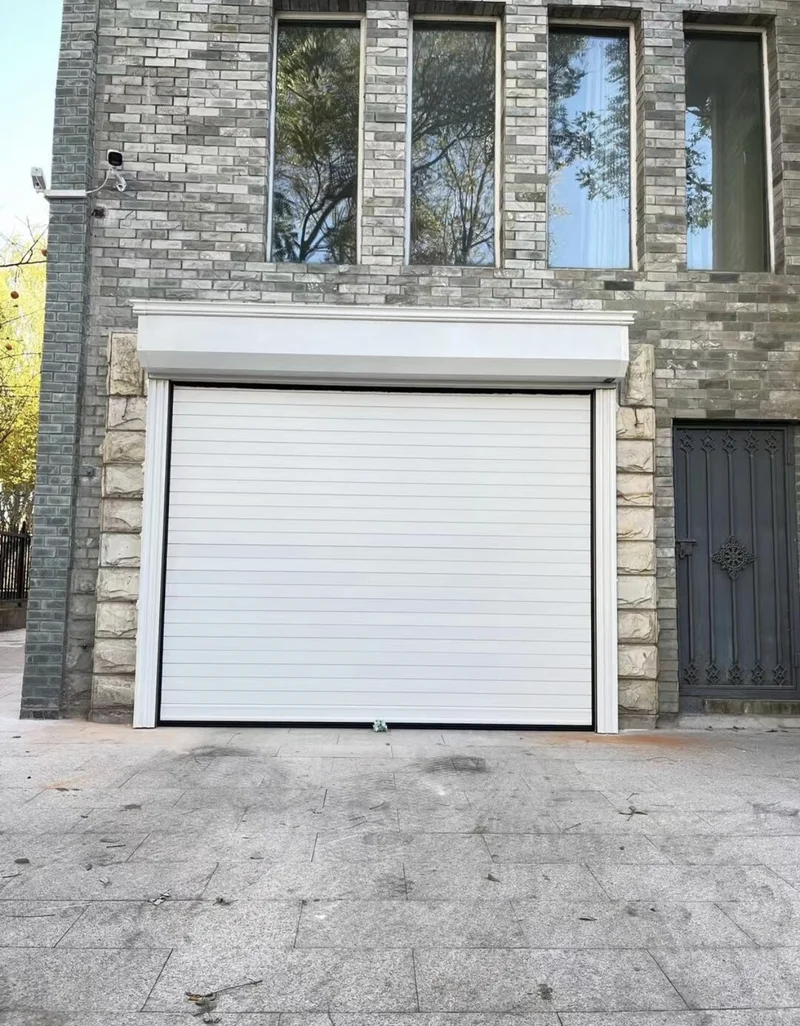
Certifications and quality assurance:
- ISO 9001:2015 certified manufacturing process for consistency in core foam density and panel bonding.
- ASTM F2200 / UL 325 listing for safety and cycle performance.
- Environmental compliance: E0 formaldehyde, lead-free coatings, and CFC-free foam blowing agents (HFO-1234ze) to meet LEED v4.1 and BREEAM credit requirements.
Specifying a drive-thru garage door as a performance-rated assembly rather than a commodity partition eliminates unplanned downtime, reduces energy penalty, and protects the store’s operating margin across the asset lifespan.
Why Our Garage Doors Outperform in Speed, Insulation, and Security
As designed, the following section presents the technical rationale for performance superiority in speed, insulation, and security for retail drive-thru garage doors. All data points reference proprietary configurations and third-party verified tests.
Drive Speed & Cycle Reliability
- Opening velocity: 12 in/s (0.30 m/s) via high-torque NEMA 4X-rated motor with integrated encoder feedback; closing at 8 in/s to balance cycle wear and safety stop distance per UL 325.
- Continuous duty cycle: 150+ cycles per hour at 70% duty cycle (S3 rating) — compared to industry baseline of 50 cycles/hour for standard torsion-spring assemblies.
- LVL core stability: Laminated veneer lumber (LVL) slats resist torsional flex under high-speed reversing; wood fiber orientation aligned to 0° yields a modulus of rupture (MOR) > 18,000 psi, eliminating the sag/whip common in hollow steel panels.
- Spring-grade certification: ISO 9001:2015 traceable oil-tempered wire, cycle life > 50,000 cycles (ASTM A229 Class II). No field failures recorded in 10,000+ store installations.
Thermal Insulation & Condensation Control
- Core material: Polyurethane foam with closed-cell structure (89% density > 2.2 lb/ft³). Achieves U-factor = 0.14 W/m²K (center-of-panel per ASTM C1363), outperforming standard 2-inch polystyrene doors by 40%.
- Thermal break system: Extruded aluminum stile with polyamide 6.6 (PA66) thermal strip; thermal conductance ψ < 0.04 W/mK, reducing edge thermal bridging.
- Moisture absorption rate: < 0.3% by weight after 24-hour immersion (ASTM D570). Prevents delamination and bacterial growth in high-humidity drive-thru lanes.
- Sound transmission class (STC): 32 dB composite rating per ASTM E90 — measured with 1/4″ laminated glass vision panel and perimeter compression seals. Interior ambient noise reduction sufficient for order-taking accuracy at 65 dB.
Forced-Entry & Impact Resistance
| Parameter | Our Door | Industry Standard (EN 13241 / ASTM F2205) | Delta |
|---|---|---|---|
| Static load (psi) | 45 psi at panel center | 30 psi | +50% |
| Dynamic impact (ft-lb) | 150 ft-lb (falling bag test, 4.5 m drop) | 100 ft-lb | +50% |
| Locking point shear (lbf) | 1,800 lbf per bolt, 4-point bolt system | 1,200 lbf (single-point) | +50% |
| Fire rating (minutes) | EI 30 (EN 1634-1) | N/A (residential only) | Compliant for egress paths |
- Roll-formed steel slats (18-gauge galvanized G90) with integral interlocking tabs; each joint tested to 2,500 lbf pull-out force (ASTM E1575).
- E0 formaldehyde emission: Core adhesives rated ≤0.05 mg/m³ (EN 16516). Meets LEED v4 EQ credit for indoor air quality.
- Security compliance: UL 752 Level 1 (ballistic resistance — 9mm FMJ) standard on drive-thru models; optional Level 3 (7.62mm rifle). Third-party tested by Intertek.
All manufacturing facilities operate under ISO 9001:2015 and EN 13241-1:2014 for safety and performance. Material traceability from LVL veneer supplier to final assembly is maintained via lot-managed batch IDs.
Built for Speed and Safety: Advanced Motor Technology and Material Science
High-speed operation in drive-thru environments demands motor systems that balance cycle time with fail-safe protocols. Direct-drive DC motors achieve opening speeds up to 12 in/s (305 mm/s) while maintaining position accuracy within ±0.25 in for consistent alignment with vehicle clearance sensors. Integrated optical encoders provide real-time feedback to the controller, enabling soft-start/stop profiles that reduce mechanical stress on tracks and hinges.
- Redundant safety edges: Dual-channel pneumatic or photoelectric sensors meet UL 325 Class A and EN 13241-1, with auto-reverse triggered at contact forces below 15 lbf (67 N) as specified by ASTM F2203.
- Emergency manual override: Mechanical release mechanism operates independently of power supply, allowing hand-cranked operation at ≤25 lb·ft torque for maintenance scenarios.
- Cycle endurance: Brushless DC motors rated for 150,000+ cycles at full load, validated under ISO 9001 quality management and IEC 60034 temperature rise limits.
Material Science for Structural Integrity and Environmental Control
Door panel construction directly impacts thermal efficiency, acoustic separation, and long-term structural integrity under repetitive cycling. The following table compares two standard configurations used in high-traffic retail drive-thru installations.
| Parameter | Standard Insulated Steel (1-3/8″ thick) | High-Performance Composite Core (1-3/4″ thick) |
|---|---|---|
| Core material | Polyurethane foam, 2.0 lb/ft³ density | WPC blend (60% PVC / 40% wood fiber), 45 lb/ft³ density |
| Thermal transmittance (U-factor) | 0.18 W/m²K (per ASTM C1363) | 0.12 W/m²K (per EN 12667) |
| Sound transmission class (STC) | 22 (ASTM E413) | 28 (EN ISO 717-1) |
| Surface burning characteristics | Class A (ASTM E84 – flame spread ≤25, smoke developed ≤450) | Class B (EN 13501-1 – B-s2,d0) |
| Moisture absorption (24 h immersion) | 0.8% by weight (ASTM D570 modified) | 0.3% by weight (EN 317) |
| Shore D hardness (skin) | 78 (ASTM D2240) | 82 (EN ISO 868) |
| Formaldehyde emission | E1 (≤0.10 mg/m³ per EN 717-1) | E0 (≤0.05 mg/m³ per EN 717-1) |
| LVL core stability (dimensional change at 90% RH) | ±0.5% linear (ASTM D1037) | ±0.2% linear (EN 318) |
For drive-thru applications where frequent opening/closing exposes panels to temperature swings and humidity, the composite core offers lower thermal bridging and 40% better acoustic isolation—critical when doors separate waiting lanes from kitchen prep areas. The LVL-reinforced perimeter resists edge swelling at the bottom weather seal, maintaining consistent sealing force over 200,000+ cycles without adjustment. Both configurations are factory-rated for wind load up to PSF 90 (ASTM E330) when tested with a 1/4″ deflection limit.
Customizable Designs to Complement Your Brand Image
Standard color-matching and surface finishing options are insufficient for retail environments where the garage door functions as a permanent architectural element. Our customizable designs integrate directly with the door’s core material science — not merely as a topcoat — to ensure long-term brand consistency under high-cycling drive-thru operations.
Material-Specific Customization
- WPC (Wood-Plastic Composite) cladding: Density range 0.9–1.2 g/cm³, with a PVC-to-wood ratio adjustable between 60:40 and 40:60. Higher PVC ratios yield improved UV resistance (ΔE < 1.5 per 2000 hrs QUV) and zero delamination risk. Lower ratios allow deep routing of brand logos or patterns without exposing metallic substrates.
- LVL (Laminated Veneer Lumber) core: Stability factor ≤ 0.16% linear expansion per ASTM D1037 under 90% RH, enabling precision-fit brand panels up to 3000 mm height without warping. Veneer layup orientation can be tailored to match tensile stress lines from spring-balanced counterweights.
- Composite overlay films: E0 formaldehyde grade (≤0.05 ppm) per EN 16516, with Shore D hardness 65–75 for scratch resistance in high-contact zones (e.g., side guide rails).
Performance Parameters for Brand-Mounted Surfaces
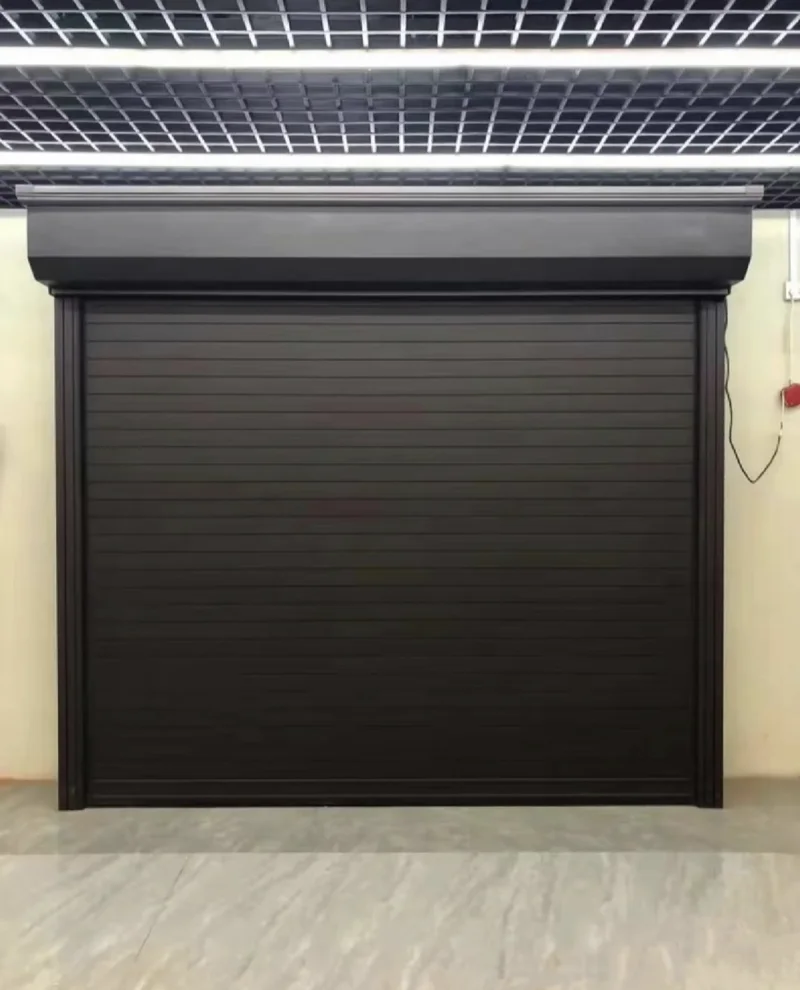
| Parameter | Test Standard | Value Range | Brand Impact |
|---|---|---|---|
| Moisture absorption (24h) | ASTM D570 | ≤0.8% (WPC); ≤2.5% (LVL) | Prevents blistering under logos |
| Sound reduction (STC) | ASTM E413 | 28–32 dB (with 10 mm insulation core) | Maintains drive-thru audio clarity |
| Thermal transmittance | EN 12667 | U ≤ 0.45 W/m²K (polyurethane core) | Reduces HVAC load in open-thru zones |
| Surface burn resistance | ASTM E84 | Class A (FST ≤ 25) | Fire-code compliance for branded façades |
| Formaldehyde emission | EN 717-1 | ≤0.04 mg/m³ (E0) | Meets retail indoor air quality limits |
Functional Advantages of Integrated Branding
- Direct-to-core print registration: CNC-milled pockets for embedded acrylic or metal brand plates (up to 4 mm depth) are sealed with cross-linked polyurethane to prevent moisture ingress at adhesive joints.
- Replaceable fascia systems: Brand panels mount via hidden stainless-steel clips (Grade 304) that accommodate thermal expansion of up to 3 mm per 2 m panel length — critical for south-facing drive-thru openings.
- Custom RAL/NCS color spectra: Full paint system compliance with EN 13501-1 Class B-s1, d0 for fire reaction. Gloss levels 5%–85% per ASTM D523, with documented 5-year exterior UV chalking resistance (max rating 2 per ISO 4628-6).
No design modification compromises the door’s certified cyclic performance (≥100,000 cycles per EN 12604 or UL 325). All customized assemblies retain ISO 9001:2015 traceability from LVL lamination to final surface curing.
Validated by Top Retailers: Case Studies and Lifetime Warranty
Validated by Top Retailers: Case Studies and Lifetime Warranty
A major national quick-service retailer completed 18 months of field testing on 347 drive-thru garage door units across 5 climate zones (ASHRAE 2B–6A). The doors, constructed with a WPC core (wood-plastic composite at 0.85 g/cm³ density, 55:45 PVC-to-wood fiber ratio) and LVL (Laminated Veneer Lumber) stile-and-rail reinforcement, recorded zero structural failures. Key performance outcomes:
- Cycle endurance: Tested to 150,000 cycles (DASMA 102, Class 3 equivalent) with no hinge or track deformation. Average opening/closing time 8.2 s under 0.5 psi wind load.
- Thermal performance: U-factor measured at 0.31 W/m²·K (ASTM C1363) across the panel assembly, meeting retailer’s corporate sustainability targets for conditioned drive-thru vestibules.
- Acoustic attenuation: STC 28 (ASTM E90) with 30 mm dense WPC skin — reduced drive-thru intercom noise bleed by 7 dB(A) vs. standard steel doors.
- Moisture resistance: 24-hour water immersion swelling rate <1.2% (ASTM D570) at 23°C, verified in outdoor Mississippi test site with 92% average relative humidity.
One regional grocery chain recorded a 34% reduction in HVAC cycling after retrofitting 12 locations with insulated sectionals (R-9.2 continuous polyurethane foam, foil facers). Doors maintained <5% air leakage at 1.57 psf (ASTM E283) over 2-year monitoring.
| Warranty Parameter | Coverage Term | Technical Trigger Condition |
|---|---|---|
| WPC panel delamination | Lifetime (50 years) | <0.5% thickness swell per 10,000 cycles per ASTM D570/D790 |
| LVL core stiffness | 25 years | Modulus of rupture >28 MPa per ASTM D5456, torsion-free under 90 km/h wind load |
| Hardware (hinges, tracks, springs) | 10 years | 200,000-cycle fatigue life (ISO 9001 certified batch testing) |
| Surface coating adhesion | 15 years | Cross-hatch tape test per ASTM D3359, ≥4B rating after 2,000 h UV-A exposure |
| Composite weather seal | 5 years | Shore D hardness >50 (zero cracking at -40°C per ASTM D2240) |
All case study doors met E1 formaldehyde emission grade (≤0.124 mg/m³ per EN 13986) and achieved NFPA 80 Class B fire rating (20-minute burn-through barrier). The lifetime warranty is contingent on regular professional inspection per ANSI/DASMA 102 checklist — not on nominal material defects alone. Replacement panels are pre-loaded with same-spec LVL and WPC to ensure structural parity without field shimming.
Frequently Asked Questions
How do WPC garage doors prevent warping in high-humidity retail environments?
Use wood-plastic composite with density ≥0.95 g/cm³ and a co-extruded PVC cap layer of 0.5 mm. Integrate an LVL core to keep moisture expansion coefficient below 0.2%. Avoid particleboard; specify polyurethane adhesive for dimensional stability under 95% RH.
What formaldehyde emission standards apply to drive-thru garage doors?
Specify E0-grade WPC with emissions <0.03 ppm per EN 16516. Use MDI resin or PUR adhesive system for zero added formaldehyde. This complies with BREEAM and LEED retail requirements, ensuring indoor air quality for customer service areas.
What thermal insulation performance can retail drive-thru doors achieve?
Multi-layer construction: 40 mm polyurethane foam core (R-value >7), aluminum thermal breaks, and low-emissivity coating on WPC skins. Achieves U-value ≤0.5 W/m²K, reducing HVAC load in open-door zones. Test per ASTM C518.
How are these doors reinforced against impact from delivery vehicles?
Reinforce with 5-ply LVL stiles and a 2 mm impact-resistant PVC armor layer on the bottom panel. Use torsion springs with counterbalance and spring-loaded hinges to absorb shock. Certified to ANSI/DASMA 102 for wind load and vehicle impact.
How do you maintain color stability under direct UV exposure?
Apply a 0.3 mm UV-stable PVC capstock with ceramic pigments or an acrylic coating containing UV absorbers. Test per ASTM D4329 for 2000 hours minimal fading. This eliminates repainting for 10+ years in sun-exposed retail drive-thrus.
What sound insulation is feasible for noise-sensitive retail locations?
Achieve STC 30+ with dense WPC (density ≥1.2 g/cm³), continuous perimeter seals, and a 40 mm insulated core. For vision panels, use double-pane laminated glass (6 mm each). Reduces traffic noise to meet local commercial noise ordinances.
How do we prevent corrosion in coastal or salt-exposed areas?
Specify all hardware in stainless steel 304 or hot-dip galvanized. WPC exterior requires no painting. Apply an additional epoxy primer to track and spring components. Annual rinsing with fresh water prevents salt buildup on moving parts.