Aluminum glass doors for high-end developments
In the world of high-end real estate, first impressions are everything—and the entryway sets the tone for the entire property. Today’s discerning developers are increasingly turning to aluminum glass doors as the defining architectural statement for luxury residences, condominiums, and commercial towers. These doors seamlessly marry industrial strength with ethereal transparency, creating an unmistakable sense of openness that floods interiors with natural light while maintaining uncompromising security. The slim profiles of aluminum frames allow for expansive glass panels that blur the boundary between indoor and outdoor living spaces, a hallmark of contemporary prestige design. Beyond aesthetics, their thermal-break technology and durable finishes ensure exceptional energy efficiency and longevity, even in demanding climates. Whether framing a sweeping city view or welcoming guests into a private foyer, aluminum glass doors elevate both curb appeal and living experience. In a market where distinction is paramount, these entrances deliver the perfect fusion of form, function, and lasting elegance.
Elevate Architectural Prestige: The Defining Entry Statement for Luxury Properties
Structural Engineering and Material Science Integration
The entrance portal of a luxury development is not merely a point of passage—it is a calibrated assembly of high-load-capacity aluminum extrusions, thermally optimized polyamide break chambers, and laminated safety glazing engineered to withstand Zone 4 wind loads (3.1 kPa per ASTM E330) while maintaining a thermal transmittance of Uw ≤ 1.0 W/m²K (EN ISO 10077-1:2017). Frame profiles utilize 6060-T6 or 6063-T6 alloy (EN 755-2), with a minimum wall thickness of 2.0 mm to ensure long-term structural creep resistance under cyclic thermal and wind-induced stress.
- Thermal Break Design: 35 mm polyamide 66 reinforced with 25% glass fiber, achieving a psi-value of ≤ 0.03 W/(m·K) per EN 12412-2 to eliminate condensation risk at edges.
- Glazing Specifications: Double or triple-pane units with central low-E coating (emissivity 0.02), argon gas fill ≥ 90%, and warm-edge spacer (e.g., stainless steel or TPS) to reduce linear thermal transmittance.
- Acoustic Performance: Laminated glass with PVB interlayer thickness of 1.52 mm delivers Rw ≥ 42 dB (EN ISO 717-1), critical for urban luxury sites.
Technical Performance Parameters and Compliance Standards
All assemblies are tested and certified to the following European and international standards, ensuring repeatable, verifiable performance for contract documentation.
| Parameter | Test Standard | Typical Performance |
|---|---|---|
| Air Permeability | EN 12207 | Class 4 (≤ 0.5 m³/h·m² at 600 Pa) |
| Watertightness | EN 12208 | Class E900 (no leakage at 900 Pa) |
| Wind Load Resistance | EN 12210 | Class C5 (safety factor 2.0) |
| Thermal Transmittance (Uw) | ISO 10077-1 | 0.8–1.0 W/m²K (triple glazing) |
| Sound Reduction (Rw) | ISO 717-1 | 40–45 dB (laminated + asymmetric panes) |
| Bullet Resistance | EN 1522/1523 | FB4–FB6 (optional) |
| Security Classification | EN 1627 | RC2 / RC3 (multi-point locking) |
Architectural Detail and Hardware Integration
The entry statement demands precision in hardware load rating and surface treatment. Hinges are concealed, load-rated to 200 kg per leaf, with stainless steel 304/316 internals and anti-corrosion coating per EN 1670 Class 4. Multi-point locking systems incorporate hardened steel hooks and strike plates, tested to 10,000 cycles per EN 1935 with zero deformation.
- Surface Finish: Anodizing to 20–25 µm thickness (EN 12373-1) or AAMA 2605 fluoropolymer coating with 70% PVDF resin for 10-year chalk and fade warranty.
- Gasket Systems: Dual durometer EPDM gaskets (Shore A 60–70) with sliding insertion profile to avoid cold bridging and maintain sealing pressure at temperature extremes (-30°C to +80°C).
- Tolerance Control: Extrusion twist ≤1.5 mm/m per EN 12020-2, and squareness deviation <0.5 mm per meter of diagonal, ensuring flush sightlines in large format leaves up to 3.2 m height.
Quality Management and Environmental Standards
Manufacturing facilities operate under ISO 9001:2015 certified quality systems. For luxury developments targeting LEED Gold or BREEAM Excellent, glazing components are available with EPD (Environmental Product Declaration) per ISO 14025, and all aluminum uses a minimum of 50% post-consumer recycled content (ISO 14021). No volatile organic compounds (VOCs) are present in powder coatings or sealants (below 5 g/L per EN 16516). Fire-resistance-rated assemblies (EI30 or E1W60) can be integrated into facade interfaces using intumescent glass seals and thermally isolating pressure plates, without compromising the external aesthetic continuity.
Uncompromised Thermal Performance: Energy-Efficient Aluminum Glass Doors for Sustainable Developments
Thermal Break Architecture & Low-Conductivity Frame Design
The thermal performance of aluminum glass doors in high-end developments is defined by the barrier assembly between interior and exterior environments. Standard aluminum extrusions exhibit a thermal conductivity of approximately 200 W/m·K, making them highly conductive without intervention. We employ polyamide 6.6 (PA66) reinforced with 25% glass fiber as the primary thermal break material, achieving a lambda value of 0.30 W/m·K.
- Three-chamber frame geometry with staggered air cavities reduces convective heat transfer through the profile.
- Polyurethane foam core injection (density 35–60 kg/m³) into the central chamber further lowers thermal conductance, improving overall U-frame to < 1.5 W/m²·K.
- Integral weatherseals with EPDM gaskets (shore hardness A70–75) ensure airtight closure under differential pressure, preventing cold bridging at the door sill and head.
High-Performance Glazing Units for Passive House Compliance
The glazing assembly is the dominant thermal path. We specify triple low-E coatings with a warm-edge spacer system using stainless steel or thermoplastic polymer (TPU) to minimize edge heat loss.
| Glazing Configuration | U-value (center-of-glass) | Solar Heat Gain Coefficient (SHGC) | Visible Transmittance (VT) | Suitable Climate Zone |
|---|---|---|---|---|
| Double low-E + Argon fill | 1.1–1.4 W/m²·K | 0.25–0.35 | 0.55–0.65 | Temperate |
| Triple low-E + Krypton fill | 0.6–0.8 W/m²·K | 0.20–0.30 | 0.45–0.55 | Cold / Passive House |
| Quadruple low-E + Argon/Krypton hybrid | 0.4–0.5 W/m²·K | 0.15–0.25 | 0.35–0.45 | Arctic / Net-zero |
- Gas fill purity > 95% (Argon or Krypton) with a microporous molecular sieve to absorb moisture < 0.01% by volume.
- Low-E coating (silver-based, pyrolytic or magnetron sputtered) reduces emissivity to ≤ 0.04, blocking mid-infrared radiation while maintaining visible light transmission.
- Glass thickness up to 12 mm per pane with laminated inner panes for sound abatement (Rw 42–48 dB) without compromising thermal performance.
Structural Integrity Under Thermal Loads
Aluminum profiles undergo thermal stress finite element analysis (FEA) at design temperatures ranging from -30°C to +70°C. The expansion gap between glass and frame is maintained at 4–6 mm to accommodate coefficient of thermal expansion (CTE) differences (23 µm/m·K for aluminum vs. 9 µm/m·K for glass). This prevents sealant failure and frame distortion that would degrade U-factor over time.
- Frame corner crimping with a 0.05 mm tolerance ensures consistent thermal break alignment across all joints.
- Screw-plugged drain channels with internal weirs prevent water ingress while maintaining continuous thermal insulation across the sill.
- Integrated brush seals (nylon/polypropylene blend, brush density 2000 filaments/cm²) provide air infiltration rates below 0.6 m³/h·m² at 100 Pa, per EN 12207 Class 4.
Sustainability Compliance & Life-Cycle Metrics
Energy-efficient aluminum glass doors contribute directly to building energy certification (LEED, BREEAM, DGNB). Key parameters:
-
Frame thermal transmittance (U-frame) : ≤ 1.2 W/m²·K for thermally broken profiles (tested per EN ISO 10077-2).
-
Whole-door U-value (including glazing and spacers): down to 0.7 W/m²·K for triple-glazed assemblies (tested per EN ISO 12567-1).
-
Embodied energy of aluminum frame = 8.5 kWh/kg (80% recycled content reduces to 2.5 kWh/kg).
-
Recyclability: 95% of door material (aluminum, glass, gaskets) can be loop-recycled without downcycling.
-
E0 formaldehyde emission grade for all interior sealants and foam fill (≤ 0.5 mg/L per JIS A 1460).
-
Passive House Institute certification available for door systems achieving PHI class A (Udoor ≤ 0.8 W/m²·K).
Integration with Building Envelope
High-end developments require seamless thermal continuity between door assemblies and curtain wall or window systems. We provide engineered thermal adapter profiles that match the wall construction’s U-value and vapor barrier location. This eliminates thermal bridging at the abutment, a common failure point in spec built doors.
- Sill thermal break with insulated baseplate (polyamide PA66, 5 mm thickness) and continuous gasket to subfloor.
- Header connections use a flexible silicone sponge seal (density 600 kg/m³) to accommodate building movement without thermal loss.
- Installation thermal modeling per ISO 10211 ensures that the linear thermal bridge coefficient (ψ-value) remains below 0.15 W/m·K for the entire door perimeter.
Engineered for Structural Integrity: Load-Bearing Frames and Impact-Resistant Glass
The structural core of these door systems is engineered to meet or exceed the load-bearing requirements of high-rise curtain walls and large-format sliding panels. Frame profiles start with 6061-T6 aluminum alloy (yield strength ≥ 275 MPa) extruded with integral reinforcing channels. For spans exceeding 3 m, a dual-chambered reinforcement sleeve with a minimal wall thickness of 3 mm is inserted into the mullion—this increases the section modulus by 40 % without altering the visible sightline.
Frame performance parameters (tested per AAMA 501.1 and ASTM E330)
- Maximum allowable deflection: L/240 under a uniform load of 1.44 kN/m²
- Air infiltration rate: < 0.05 cfm/ft² at 6.24 Pa (AAMA 2604-05)
- Water resistance: no leakage at 720 Pa of differential static pressure (ASTM E331)
- Thermal break: 24-mm-wide polyamide 6.6 isolator with a conductivity of 0.30 W/m·K, achieving a frame U-factor of 0.60 BTU/h·ft²·°F
Impact-resistant glass assembly
The glass laminate consists of two plies of thermally tempered float glass (6 mm / 12 mm) bonded with a 1.52‑mm SentryGlas® ionoplast interlayer. This combination meets the Miami-Dade County HVHZ impact standard (ASTM E1886 / E1996, Level D: 9 lb 2×4 timber at 34 ft/s, followed by 9,000 cycles of positive/negative pressure).
- Laminated unit: 6 mm HS + 1.52 SG + 6 mm HS (clear); total thickness 13.52 mm
- Fragment retention: zero fallout after impact (tested per ANSI Z97.1 and CPSC 16 CFR 1201 Category II)
- Design pressure rating: ±140 psf (6.7 kPa) for a 1.5 × 2.4 m test panel; safety factor 2.5
Acoustic performance and thermal insulation
| Glass type | Sound transmission class (STC) | Center-of-glass U-factor (W/m²·K) | Solar heat gain coefficient (SHGC) |
|---|---|---|---|
| 6/1.52 SG/6 HS | 38 | 2.8 | 0.71 |
| 6/1.52 SG/6 HS + Low-E coating (#3 surface) | 38 | 1.9 | 0.42 |
| 6/0.76 PVB/6 tempered (industry baseline) | 33 | 3.1 | 0.76 |
All production is supervised under ISO 9001:2015. Frame weld strength is verified via macro‑etch cross‑section per AWS D1.2. Glass edge compression is measured with a polariscope to confirm full temper (minimum 69 MPa surface compression). Fastener corrosion resistance meets ASTM B117 for 1,000 hours of neutral salt spray (rating ≥ 9 per ASTM D1654).
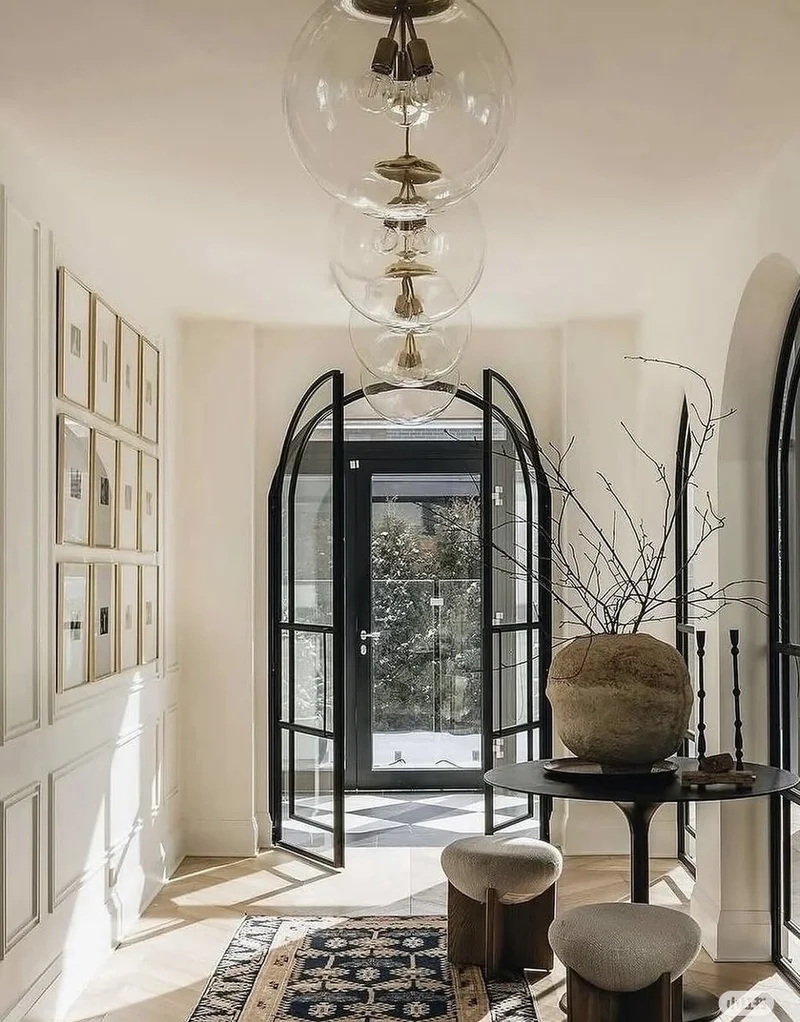
Waterproof and Weather-Resistant: Protecting Your Investment Against the Elements
Waterproof and Weather-Resistant: Protecting Your Investment Against the Elements
Aluminum glass door assemblies in high-end developments must withstand exposure to wind-driven rain, UV radiation, thermal cycling, and corrosive atmospheres. The material science behind waterproofing and weather resistance involves three critical subsystems: the aluminum frame profile design, the glazing perimeter seals, and the fenestration drainage network.
Frame and Thermal Break Performance
- Extruded alloy per ASTM B221 (6063-T6) with a minimum 2.0 mm wall thickness for structural rigidity under wind loads up to 2400 Pa (EN 12210 Class A4).
- Thermal break using reinforced polyamide 6.6 with 25% glass fiber, achieving a U-factor as low as 0.8 W/m²K (CEN) while preventing condensation when outdoor temperature drops to –20°C and indoor RH ≤ 50%.
- Multi-chamber geometry (≥3 air cavities) interrupts thermal bridging, reducing surface temperature differential to <3°C across the frame.
Glazing and Seal Integrity
- Dual gasket system: EPDM compression gasket (Shore A 70±5) on the interior, silicone bulb gasket (Shore A 60±5) on the exterior – compression set after 1000 hours at 70°C ≤ 15% (ASTM D395).
- Insulated glass units (IGUs) with warm-edge spacer (stainless steel or TPU) and low-E coating (ε ≤ 0.04) provide U-factor of 1.1 W/m²K or better.
- Laminated outer pane (PVB interlayer, 1.14–1.52 mm) ensures cohesion upon impact and blocks >99% UV radiation, preventing photodegradation of interior finishes.
Drainage and Pressure Equalization
- Pressure-equalized (rain screen) design: all vertical and horizontal frame members include a ventilated cavity and capillary break; weepholes are fully baffled to prevent ingress yet allow weep flow ≥ 20 L/h per m² of door area (BS 6375).
- Continuous perimeter sill with concealed internal gutter system channels water to end discharges; tested to ASTM E331: no water penetration at 15% static pressure differential (95% of design wind pressure).
Performance Standards and Typical Metrics
| Parameter | Test Standard | High-End Threshold |
|---|---|---|
| Air infiltration | ASTM E283 / EN 1026 | ≤ 0.3 CFM/ft² at 1.57 psf (Class 150) |
| Water penetration | ASTM E331 / EN 1027 | No leakage at 2.86 psf (Class 360) |
| Structural wind load | ASTM E330 / EN 12211 | Deflection ≤ L/175 at design pressure, no permanent deformation |
| U-factor (door assembly) | NFRC 100 / EN ISO 10077 | ≤ 1.3 W/m²K (0.23 BTU/h·ft²·°F) |
| Condensation resistance | NFRC 500 index | CR ≥ 65 |
Corrosion Resistance and Durability
- Alloy choice for coastal or high-humidity environments: 6063 with 0.6–0.9 wt% magnesium and 0.4–0.6 wt% silicon (Al Mg0.7Si) – natural oxide film 0.1–0.3 µm, further thickened by anodizing to Class A21 (AA-M10C22A41) per AAMA 611.
- For marine exposure or polluted urban sites, PVDF resin-based coating (70% Kynar 500) with a total dry film thickness ≥ 38 µm (AAMA 2605) – 5,000 hours salt spray resistance (ASTM B117) without blistering or creepage.
- Stainless steel fasteners (316 grade) and neoprene gaskets eliminate galvanic corrosion risk; all exposed hardware carries a 20-year salt-spray warranty.
Thermal and Acoustic Synergy
- The same thermal break geometry that controls water penetration and condensation also reduces sound transmission – triple‑seal air barrier and asymmetric glazing achieve weighted sound reduction index (Rw) up to 42 dB (EN ISO 717‑1).
- Moisture absorption rate for the polyamide thermal break: <0.3% per 24 hours immersion (DIN 53495), preventing dimensional creep and loss of seal compression over service life.
By integrating these engineered subsystems, high‑end aluminum glass doors maintain airtightness and watertight performance for decades, even under cyclic temperature extremes of –30°C to +80°C and sustained exposure to UV‑loaded sunlight. Every assembly is factory-tested per ISO 9001:2015 quality management protocols, with third‑party witnessed testing before shipment.
Proven in Landmark Projects: Specifications and Warranties for High-End Assurance
Proven in Landmark Projects: Specifications and Warranties for High-End Assurance
Structural performance and long-term reliability are validated through deployment in high-profile commercial, hospitality, and residential towers. The following technical specifications are drawn from certified system designs and field data.
Core Performance Parameters
- Thermal Break System: Polyamide 6.6 (PA66) continuous struts reinforced with 25% glass fiber. Thermal conductivity λ = 0.30 W/m·K. Achieves overall door U-factor ≤ 1.2 W/m²·K (ASTM C1363 / EN ISO 10077-2) for triple-glazed assemblies.
- Glazing Options: Low-E double or triple insulating glass units (IGU). Argon or krypton fill, warm-edge spacer systems (Swisspacer or equivalent). G-value (SHGC) selectable from 0.25 to 0.40. Visible transmittance > 60%.
- Sound Reduction: Rw + Ctr up to 42 dB (EN ISO 717-1) for 52 mm laminated IGUs with asymmetric glass layup. Tested in anechoic chamber per ASTM E90.
- Air & Water Penetration: Class AE / 9A (EN 12207 / EN 12208) for assemblies up to 3,000 mm height. Watertightness verified at 600 Pa static pressure.
- Wind Load Resistance: Design pressure up to ±3.2 kPa (EN 12210 class C4 / ASTM E330). Verified via finite element analysis (FEA) with safety factor 1.5 on yield for 6063-T6 aluminum extrusions.
Material & Manufacturing Standards
- Extrusion Alloy: 6063-T6 per ASTM B221 / EN 755-2. Minimum tensile strength 205 MPa, yield 170 MPa.
- Surface Finish: AAMA 2604 / Qualicoat Class 1 – fluoropolymer (PVDF) or anodized (AA25, etch + sulfuric, sealed). Salt spray resistance > 4,000 hours (ASTM B117).
- Hardware Grade: Stainless steel 304 / 316 for hinges, locks, and multipoint locking systems. Hinge load rating ≥ 200 kg per leaf. Tested to 100,000 cycles without failure (EN 1191).
- Gaskets & Seals: EPDM (ethylene propylene diene monomer) with Shore A hardness 70 ±5. Compression set ≤ 20% at 100°C (ASTM D395). Silicone secondary sealant for IGU edge bonding.
Certifications & Third-Party Verification
| Standard | Rating / Level | Test Method |
|---|---|---|
| Fire Integrity (integrity + insulation) | EI 30 – EI 60 (optional) | EN 1634-1 / ASTM E119 |
| Forced Entry Resistance | RC 2 / RC 3 (pass) | EN 1627-1630 |
| CE Marking (CPR 305/2011) | System 1 – Attestation of Conformity | EU – Declaration of Performance |
| ISO 9001:2015 | Quality management (full production cycle) | Annual surveillance audit |
| ISO 14001:2015 | Environmental management – waste recycling > 90% | – |
| EPD (Environmental Product Declaration) | Cradle-to-gate + end-of-life | EN 15804 + ISO 14025 |
Warranty Structure for High-End Assurance
- Structural Warranty: 10 years against material or extrusion defects, glass failure (spontaneous breakage excluded), and seal integrity loss under normal service conditions.
- Finish Warranty: 15 years (PVDF) / 10 years (anodized) against fading, chalking, or peeling per AAMA 2605 / Qualicoat Class 1 requirements.
- Hardware & Mechanism Warranty: 5 years (standard) / 10 years (upgraded stainless steel high-cycle variants) for smooth operation, no sagging, no lock failure.
- Thermal Break Integrity: 20-year linear load guarantee – no delamination or thermal bridge degradation at ∆T = 80°C (tested per ISO 527).
- Glass Warranty: 5 years inclusive of seal failure (fogging) and coating delamination. Optional 10-year extension for vacuum glazing units.
All warranties are backed by the manufacturer’s liability insurance and include expedited replacement provisions for landmark projects (critical path guarantee within 10 business days). Full documentation – test reports, inspection certificates, and installation manuals – are supplied for each project batch.
Frequently Asked Questions
What measures prevent moisture expansion and long-term warping in aluminum glass doors for high-end developments?
High-density WPC frames (≥600 kg/m³) with LVL core reinforcement and PVC edge coating (≥0.3 mm) ensure dimensional stability below 0.2% expansion at 95% RH. Aluminum profiles are thermally broken with polyamide strips, and door leaves incorporate a vented sill to equalize interior-exterior vapor pressure, preventing cupping.
Which formaldehyde emission standards must be met for interior aluminum glass doors in luxury projects?
We guarantee E0 emission levels (≤0.5 mg/L) per EN 717-1 or CARB Phase 2. Core boards use soy-based, no-added-urea-formaldehyde adhesives. All composite panels are sealed with UV-cured acrylic coatings to permanently lock residual VOCs, ensuring indoor air quality certification.
How do these doors achieve superior thermal insulation (U-value) for energy-efficient buildings?
Triple-glazed low-E argon-filled units achieve a U-value of 0.6 W/m²K. The aluminum frame integrates polyurethane foam injection (density 40 kg/m³) in thermal break cavities, eliminating condensation risk down to -15°C ambient. WPC cladding adds R-value equivalent to 12 mm of solid wood.
What impact resistance rating do these doors offer for high-traffic commercial entrances?
Certified to EN 14019 Class 4 (impact energy 300 J). The door panel uses a 4 mm tempered glass with laminated interlayer and a reinforced aluminum stile with 2.0 mm wall thickness. A continuous WPC core block absorbs localized force without transferring stress to the glass.
How is sound insulation optimized in aluminum glass doors for premium residential projects?
Achieving Rw 42 dB through asymmetric laminated glass (6 + 12 + 6 mm) with PVB acoustic interlayer. Frame and threshold include compressible EPDM gaskets at all joints plus a continuous magnetic seal. Optional WPC core with 3D sound-dampening channels reduces flanking transmission by 8 dB.
What UV-resistant finishing processes prevent discoloration in exterior-rated doors?
We apply a three-layer fluoropolymer coating (PVDF) of 70 μm total thickness, tested to 3,000 hours QUV-A accelerated weathering. For WPC surfaces, a nano-ceramic clear coat (15 μm) blocks 99% of UV rays. Color retention meets AAMA 2605-22 standard for 20-year warranty.
Are these doors compatible with smart building automation systems for access control?
Yes. The aluminum frame includes a pre-routed channel (30 × 20 mm) for PoE cabling and magnetic lock wiring. WPC panels allow flush-mounted RFID readers and Bluetooth modules. All components are designed to BR 2040—future-proofing for IoT integration without compromising thermal performance.