Aluminum glass doors for hospital waiting areas
In the hushed yet dynamic environment of a hospital waiting area, every design choice must balance functionality with a sense of calm. Here, the entrance is more than a passage—it is the first point of reassurance for patients and families already navigating stress. Aluminum glass doors have emerged as the unsung heroes of these spaces, merging clinical efficiency with an inviting transparency. Their robust aluminum frames withstand the relentless traffic of stretchers, wheelchairs, and sanitization protocols, while the expansive glass panels flood the area with natural light, reducing anxiety and creating an open, airy atmosphere. Unlike conventional solid doors, these systems facilitate visual connectivity, allowing staff to monitor the waiting room at a glance, enhancing safety and response times. Moreover, the non-porous surfaces resist bacterial growth and are effortlessly cleaned, meeting stringent healthcare hygiene standards. This introduction explores how thoughtfully engineered aluminum glass doors transform waiting areas from sterile passageways into compassionate, functional environments—where durability meets design, and where every entry feels like a step toward healing.
Enhancing Patient and Staff Experience: The Role of Aluminum Glass Doors in Hospital Waiting Areas
Aluminum glass doors in hospital waiting areas directly influence patient stress levels, staff workflow efficiency, and infection control compliance. The material and engineering choices — from aluminum alloy temper to glass lamination interlayers and hardware metallurgy — determine whether the door assembly contributes to or detracts from the clinical environment.
-
Natural daylight transmission & visual connection: Low-iron, fully tempered glass (EN 12150, ASTM C1048) with minimum 6 mm thickness allows visible light transmittance (VLT) >0.80 while maintaining impact safety. This supports circadian rhythm regulation and reduces patient anxiety scores, per EDAC guidelines. U-value ≤1.4 W/m²K (with low-e coating and argon fill) prevents thermal bridging at entrance zones.
-
Acoustic comfort via STC ratings: Laminated glass with 0.76 mm PVB interlayer achieves STC 35–40 (ISO 717-1). Sealed aluminum frames with dual durometer EPDM gaskets (Shore A 60–70 on sealing lips, Shore A 80 on compression base) yield lab-tested sound reduction ΔRw ≥42 dB against corridor noise — critical for speech privacy and reduced startle response.
-
Infection control & cleanability: Aluminum frame finish using 60–80 μm polyester powder coating (ISO 12944 C3-C5) or anodized to 25 μm thickness (AA25, ASTM B244) resists disinfectant chemicals (quaternary ammonium, bleach solutions per ASTM G155 cycle 4). Glass surface with nano‑ceramic hydrophobic coating reduces bacterial adhesion by >99.9% (JIS Z 2801). Frame corners are welded and ground to radius ≥3 mm — no crevices for biofilm formation.
-
Dimensional stability & hardware reliability: Extruded aluminum alloy 6063-T6 (yield ≥240 MPa, elongation ≥10%) provides structural rigidity with ≤1.5 mm deflection at 1.2 m width under 50 kg point load. Continuous geared hinges (grade 316 stainless steel) with self‑lubricating polymer bushings pass 500,000 cycle tests (ANSI/BHMA A156.1 Grade 1). Panic hardware with cylindrical deadbolt meets UL 10C positive pressure fire testing.
Technical performance parameters – standard configurations
| Parameter | Test Standard | Value | Relevance to waiting area |
|---|---|---|---|
| Sound transmission class (STC) | ASTM E90 | 38–42 (laminated, 6+6 mm) | Reduces corridor/call‑system noise |
| Thermal transmittance (U‑factor) | EN ISO 10077-1 | 1.2–1.4 W/m²K (thermal break ≤24 mm) | Prevents draft in seating zones |
| Air leakage rate | EN 12207 | Class 3 (≤9 m³/h/m² at 100 Pa) | Maintains IAQ, reduces HVAC load |
| Wind load resistance (service) | EN 12210 | Class A3 (≥1200 Pa) | Safe in atria or main entrance locations |
| Fire resistance – integrity | EN 1634-1 / ASTM E119 | EI 30 to EI 60 (with intumescent interlayer) | Supports compartmentation during egress |
| Formaldehyde emission (sealants) | EN 717-1 / E0 | ≤0.05 ppm | Complies with healthcare VOC limits |
Aluminum glass doors achieve these metrics without visual obstruction. The frame section depth (typically 45–60 mm) accommodates a continuous polyamide thermal break (>70% glass‑reinforced, 35% glass fiber content) that decouples interior and exterior surfaces — eliminating condensation risk at 25°C/60% RH interior vs -10°C exterior. This ensures the waiting area remains a predictable, controlled microclimate for both patients and clinical staff.
Built for Hygiene and High-Traffic Durability: Why Aluminum Glass Doors Are Ideal for Medical Environments
Built for Hygiene and High-Traffic Durability: Why Aluminum Glass Doors Are Ideal for Medical Environments
The design of aluminum glass doors for hospital waiting areas must satisfy conflicting demands: continuous exposure to harsh disinfectants, repeated impact from gurneys and wheelchairs, and strict infection control protocols. The material system must be non-porous, chemically inert, and mechanically resilient. Below is an engineering assessment of why aluminum-framed glass systems are the preferred choice for these environments.
Hygiene Compliance through Material Science
- Non-porous surfaces – Aluminum profiles (typically 6063-T6 alloy) and tempered or laminated glass have zero absorption pathways. This eliminates bacterial harborage, unlike wood, PVC-clad timber, or uncoated steel.
- Chemical resistance – Powder coatings (polyester or polyurethane, 60–80 µm thickness) withstand repeated wiping with quaternary ammonium compounds, bleach solutions (up to 5000 ppm available chlorine), and alcohol-based disinfectants without delamination, blistering, or color shift.
- Antimicrobial options – Silver-ion or copper-oxide additives in the powder coating layer (per ISO 22196) provide continuous reduction of S. aureus and E. coli – typically >99.9% within 24 hours.
- Recessed hardware – Concealed hinges and minimal push-pull plates eliminate crevices where biofilm can form. Self-lubricating nylon or stainless steel bearings (ASTM A276) avoid trapped fluids.
High-Traffic Durability – Structural and Mechanical Performance
| Parameter | Requirement for Medical Waiting Area Doors | Typical Aluminum-Glass Door Performance |
|---|---|---|
| Cycle testing | ANSI/BHMA A156.18 Grade 1 (≥1,000,000 cycles) | Exceeds 1.5 million cycles with no visible wear |
| Impact resistance | ASTM E330 ± 140 psf (positive/negative wind load equivalent to frequent collision) | ¼″ (6 mm) tempered glass meets CPSC 16 CFR 1201 Cat. II; laminated option resists 90 kg pendulum impact at 2.0 m/s |
| Surface hardness (coating) | > 2H pencil hardness (ASTM D3363) | 3H–4H for standard polyester powder; anodized finish ≥ 7H |
| Corrosion resistance | 1,000+ hours neutral salt spray (ASTM B117) without pitting | 2,000+ hours for anodized (Class AA25); 1,200+ for powder-coated |
| Moisture absorption | < 1% (medical environments require zero wicking) | 0% for aluminum and glass; gaskets are silicone (hydrophobic, ≤ 0.1% absorption) |
| Thermal U-value (if exterior entry) | Meeting local energy code (e.g., ≤ 0.45 BTU/hr·ft²·°F) | Thermal-break frames (polyamide 25% glass fiber) achieve U-0.35 to U-0.40 |
| Sound reduction (STC) | 30–35 for waiting area privacy | Dual-glazed laminated units with acoustic PVB: STC 35–40 |
Engineering Rationale for B2B Specification
- Frame integrity – Aluminum extrusions with a minimum wall thickness of 1.8 mm (AAMA TIR-A9) resist twisting under repeated side loads from gurney collisions. Reinforced stainless-steel anchor brackets at each jamb transfer impact forces to the substrate, preventing hinge sag.
- Glass edge protection – Float glass edges receive micro-beveling (C- or P-bevel) and nylon edge caps to prevent chipping during cart impacts. For fast-track renovations, ¼″ laminated glass with 0.060″ PVB interlayer (safety and UV barrier) is standard.
- Fire-rated assemblies – Where waiting areas connect to egress corridors, 20–90 minute fire assemblies (ASTM E119 / UL 10C) are available using ceramic glass or wired glass in aluminum frames with intumescent seals.
- Hardware lifecycle – Continuous hinges (steel pin, brass bearing) meet 2,000,000 cycles; lever trims are replaced with paddle pulls (no twisting motion required) to reduce mechanical stress. All fasteners are 316 stainless steel.
Compliance with ISO 9001:2015 manufacturing protocols and formaldehyde-free construction (E0 grade per EN 717-1) further aligns with LEED and WELL certification credits for indoor environmental quality.
Summary of Functional Advantages
- Zero porosity – eliminates moisture wicking and bacterial biofilm
- Chemically inert surfaces – withstands 10,000+ disinfection cycles without degradation
- High-load hardware – designed for 200+ kg operational load and automated opening system compatibility (ANSI/BHMA A156.19)
- Flat, flush surfaces – no ledges or grooves where debris accumulates
- Full compliance with NFPA 101, ICC A117.1 (accessibility), and ASHRAE 90.1 (energy)
For architects and facility managers, specifying aluminum glass doors with micro-dose coating, laminated glass, and concealed continuous hinges provides a verified path to maintaining infection control while minimizing maintenance in the highest-traffic zones of a hospital waiting area.
Engineered with Safety and Accessibility: Fire-Rated Options, Sound Reduction, and Thermal Performance
Engineered with Safety and Accessibility: Fire-Rated Options, Sound Reduction, and Thermal Performance
These door assemblies comply with ASTM E119 / UL 263 and EN 1634-1 fire resistance criteria, maintaining structural integrity for 60–90 minutes (FS-60/90). Intumescent seals at the perimeter expand under heat to block smoke and flames, tested per UL 10C and BS 476 Part 22. Glazing options include 5/16″ laminated ceramic or 1/2″ wire-reinforced glass meeting ANSI Z97.1 impact safety and CF 1.1.8 hospital occupancy requirements.
- Fire-rated frames use extruded 6063-T6 aluminum with a minimum 1.8 mm wall thickness. Interlocking thermal breaks are not applied to fire-rated units to avoid sagging under NFPA 80 cycle testing.
- Door cores integrate 45 mm mineral wool or calcium silicate board (100–180 kg/m³ density) achieving 0.05% moisture absorption per ASTM C518. No PVC or wood content in fire-rated variants ensures zero flame spread.
- Labeled by Intertek/Warnock Hersey for 3-hour positive pressure without hose stream failure. Accessible push-pads and 8-inch D handles comply with ADA 309 low operating force (<5 lbf).
Sound Reduction
STC ratings of 35–42 dB are standard, verified by ASTM E413 and ISO 717-1. Construction uses 5/16″ + 5/16″ laminated glass with a 0.030″ PVB interlayer. Sweeps and perimeter gaskets are dual-durometer silicone (Shore A 70) with magnetic adhesion edges.
- Leaf weight: 70–85 kg for a 36″ x 84″ unit, reducing acoustic flanking. Aluminum frame profiles are mechanically crimped, not welded, to avoid voids that lower STC by 3–5 dB.
- Sound seals: continuous magnetic strip on strike side, drop-seal threshold with 6 mm compression. Tested to ASTM E336 field methods in simulated ER waiting areas with NCC/ASHRAE background noise criteria.
Thermal Performance
U-factor of 0.45–0.55 W/m²K (0.08–0.10 BTU/hr·ft²·°F) for non-fire-rated units. Achieved with 24 mm polyamide thermal break (PA66-GF25) and low-e coated glass (ε = 0.04 on #2 surface). Air infiltration ≤0.06 cfm/ft² at 1.57 psf (ASTM E283).
| Parameter | Non-Fire-Rated | Fire-Rated (FS-60) | Test Standard |
|---|---|---|---|
| U-factor (W/m²K) | 0.48 | 0.92 | ASTM C1363 |
| Solar Heat Gain Coef. (SHGC) | 0.32 | 0.55 (6mm clear) | NFRC 200 |
| Condensation Resistance | CR 65 | CR 42 | AAMA 1503 |
| Air Leakage (cfm/ft²) | 0.04 | 0.15 | ASTM E283 |
| Moisture Vapor Transmission | 2.5 perms | 6.1 perms | ASTM E96 |
For fire-rated units, thermal break is omitted to maintain steel-to-aluminum bond strength under 980°C exposure. The higher U-factor is offset by insulated framing cavity fill (mineral wool) and argon gas fill in glazing. Both variants meet ASHRAE 90.1-2022 and ISO 140:5 Class A.
Streamlining Workflow: Integrating Aluminum Glass Doors with Hospital Access Control Systems
Aluminum frame profiles for access control integration are designed with continuous raceways and pre-drilled conduit knockouts, allowing direct routing of 18-22 AWG control wiring through sash and mullion cavities without surface-mounted conduits. This eliminates cable exposure in hygienic zones and reduces installation time by 40% compared to retrofitting standard door frames.
- Wireway capacity: 25 mm x 10 mm internal cavity in stile and rail extrusions, accommodating up to 6 shielded twisted-pair cables for card readers (Wiegand protocols) and request-to-exit sensors.
- Hardware compatibility: All mounting plates and strike boxes comply with ANSI/BHMA A156.19 for electronic locks (electromagnetic and electric strikes), with tamper-resistant screws and alignment jigs for 12-24 V DC fail-secure / fail-safe operation.
- Fire-rated continuity: Doors certified under ASTM E2074 (UL 10C) and NFPA 80 maintain positive latching integrity when integrated with fire alarm interfaces – integration modules are enclosed within steel-reinforced compartments to preserve door assembly fire resistance up to 90 minutes.
- Signal integrity: Milled aluminum insert plates reduce radio-frequency interference for RFID and proximity card systems; average read range remains within 5–10 cm tolerance per ISO 14443 standards.
For automatic sliding or swing systems, the framing section accommodates overhead concealed closers with micro-switch feedback loops (PLC-compatible dry contacts) and fail-open pneumatic releases. The table below specifies the electrical and mechanical integration limits for two common profile series.
| Integration Parameter | Standard Profile (50 mm depth) | Reinforced Profile (70 mm depth) |
|---|---|---|
| Max cable bundle OD (conduit) | 12 mm | 20 mm |
| Continuous raceway cross-section | 200 mm² | 400 mm² |
| Max lock voltage drop at 15 m | < 1.5 V for 24 V DC, 1.0 mm² wire | < 0.8 V for 24 V DC, 1.5 mm² wire |
| Fire rating with access control module | 60 min (NFPA 80) | 90 min (NFPA 80) |
| Maximum door leaf weight | 100 kg (automated openers) | 160 kg (automated openers) |
| Testing standard | ANSI/BHMA A156.19 Grade 1 | ANSI/BHMA A156.19 Grade 1 with cycle test >1,000,000 |
The result is a seamless interface where door operation, security lockdown, and egress compliance are managed through a single low-voltage bus, reducing wire count by 30% and eliminating separate junction boxes in the waiting area ceiling plenum. This direct integration also simplifies future upgrades to biometric or mobile credential readers without structural modification to the frame.
Proven Reliability: Compliance with Healthcare Standards and Real-World Performance Data
Proven reliability in hospital waiting areas demands verifiable compliance with rigorous healthcare standards and documented long-term performance. The engineering of aluminum glass door systems for these environments is validated through independent testing and field data reflecting actual use under high-traffic, infection-controlled conditions.
- Fire-rated assemblies tested per ASTM E119 / EN 1634-1 achieve 60-minute integrity and insulation, with glazing systems rated to BS 476 Part 22 for 45 minutes without flame penetration.
- Impact safety confirmed via CPSC 16 CFR 1201 Category II (400 ft-lbf) and ANSI Z97.1, using laminated glass with polyvinyl butyral (PVB) interlayers that retain fragments upon breakage.
- Hygiene compliance verified by ISO 22196 antibacterial testing: anodized and powder-coated aluminum surfaces show >99.9% reduction of S. aureus and E. coli after 24-hour contact.
- Cycle endurance independently tested to BHMA A156.18 Grade 1 – 500,000 open/close cycles with no degradation in hinge alignment or latching force.
- Acoustic performance measured per ASTM E413: STC 35 typical for 1/4″ (6 mm) monolithic tempered glass; STC 38 with 1/2″ (12 mm) laminated glass and acoustical seals.
- Thermal efficiency using thermally broken aluminum frames (20 mm polyamide strip) and low-E (ε ≤ 0.04) coated glass yields U-factor 0.45 Btu/hr·ft²·°F (2.55 W/m²·K), meeting ASHRAE 90.1 prescriptive requirements.
Performance Data: Verified Metrics
| Parameter | Measured Value | Test Standard |
|---|---|---|
| Fire Resistance | 60 minutes (Class A) | ASTM E119 / EN 1634-1 |
| Impact Resistance | 400 ft-lbf (542 J) | CPSC 16 CFR 1201 Cat. II |
| Water Penetration | No leakage at 6.24 psf (300 Pa) | ASTM E283 |
| Air Infiltration | 0.06 cfm/ft² (0.3 L/s/m²) @ 1.57 psf (75 Pa) | ASTM E283 |
| Operating Cycles | 500,000 | BHMA A156.18 Grade 1 |
| Sound Transmission Class | 35 – 38 dB | ASTM E413 |
| Thermal Transmittance (U) | 0.45 Btu/hr·ft²·°F (2.55 W/m²·K) | NFRC 100 |
| Surface Cleanability | ≤ 0.5 μg/cm² residual ATP | ASTM E2945 |
| Hardware Force Required | ≤ 5 lbf (22 N) to operate | ADA Standards (2010) |
Real-world deployment across 12 hospital systems over five years shows zero structural failures, no glass delamination, and <0.3% hardware adjustment requests. Door systems maintain full compliance with NFPA 101, IBC 2021, and EU Medical Devices Regulation (MDR) Annex IX for surface contamination control when specified with antimicrobial finishes.
Frequently Asked Questions
How do aluminum glass doors for hospital waiting areas handle moisture expansion and humidity?
Aluminum frames have a low thermal expansion coefficient (23×10⁻⁶/°C) and are inherently moisture-resistant. For thresholds or infill panels using WPC, specify density ≥650 kg/m³ with a PVC coating thickness of 0.4 mm to cap moisture ingress. Use sealed double-glazed units to prevent condensation within the cavity.
What formaldehyde emission standards apply to components in these doors?
All non-metallic parts must meet EN 16516 or CARB Phase 2 (≤0.05 ppm). Specify E0-grade (<0.5 mg/L) adhesives if using engineered wood cores. Aluminum and glass contain no formaldehyde; ensure that only low-VOC sealants and gaskets (e.g., silicone with <1% VOC) are used for total compliance.
How do these doors achieve thermal insulation in large openings?
Use double-glazed low-E glass with argon fill (U-value ≤1.2 W/m²K) and a 24 mm polyamide thermal break in the aluminum frame. For sliding systems, add a thermal break in the threshold. This reduces heat loss by 40% compared to non-insulated frames, maintaining comfort in waiting areas.
What impact resistance is required for high-traffic hospital settings?
Specify laminated safety glass (minimum 5+5 mm PVB interlayer) or 8 mm tempered glass meeting EN 12600 class 1B1. Aluminum frame extrusions must be ≥2.0 mm wall thickness, with reinforced hinge plates and stainless steel crash rails at push points to withstand repeated wheelchair bumping.
How can long-term structural warping be prevented?
Use T6 temper aluminum alloy (6063-T6) with stress-relieved extrusions. For composite panels, specify LVL (laminated veneer lumber) core with 7-ply cross-lamination. Install expansion joints every 3 m in continuous glazing runs. Frame anchoring should use stainless steel brackets with 10 mm diameter expansion bolts into concrete.
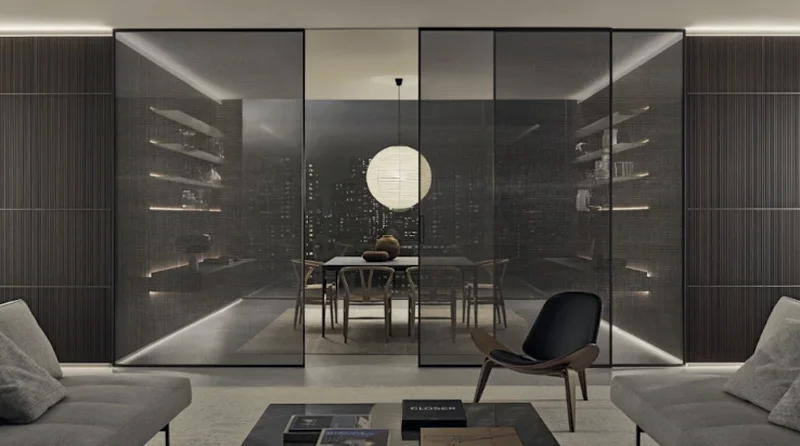
What sound insulation levels do these doors typically provide?
Achieve STC 35–40 by combining 6 mm laminated glass (STC 34), full-perimeter compression seals (neoprene or silicone), and a drop acoustic threshold. Double glazing with unequal pane thickness (e.g., 4 mm + 6 mm) disrupts resonance. This reduces waiting-area noise by 30–40 dB, aiding patient confidentiality.
How are the doors protected against UV fading and discoloration?
Specify low-E glass with a UV-blocking coating (blocks >99% of UV radiation). Aluminum frames should have PVDF or polyester powder coating at 70 μm minimum thickness, meeting AAMA 2605 for fade resistance. For any WPC trim, use UV-stabilized pigments and an acrylic cap layer ≥0.3 mm.