Aluminum glass doors with custom glass patterns
They say that a door is more than an entryway—it is the first impression, a statement of intent. In modern architecture, the fusion of strength and elegance finds its ultimate expression in aluminum glass doors, particularly those adorned with custom glass patterns. These doors transcend mere function; they become curated canvases where natural light dances through bespoke designs, casting ever-changing shadows that breathe life into any space. The robust, corrosion-resistant aluminum frame provides enduring structural integrity, while the custom-patterned glass offers a unique opportunity to harmonize privacy with illumination. Whether it’s a subtle frosted geometric motif for a minimalist home office or an intricate, nature-inspired etching for a grand lobby, the possibilities are as limitless as your imagination. More than a barrier, these doors are an invitation—to artistry, to craftsmanship, and to a refined, personalized aesthetic that elevates the everyday into the extraordinary.
Transform Your Space with Custom Glass Patterns: The Aesthetic & Functional Appeal of Aluminum Doors
Custom glass patterns in aluminum door systems are not merely decorative finishes—they are engineered surface modifications that alter the optical, thermal, and acoustic performance of the glazing unit. The pattern is applied via acid etching, ceramic frit digital printing, or sandblasting, each of which changes the glass’s light transmission, solar heat gain coefficient (SHGC), and privacy level. The aluminum frame acts as the structural backbone, typically extruded from 6063-T6 alloy with a thermal break (polyamide or PU foam) to maintain a U-factor below 1.4 W/m²K when paired with low-E coated double glazing.
Functional advantages of integrating custom glass patterns:
- Controlled light diffusion – Patterns with a scattering angle of 10–30° reduce glare while maintaining daylight penetration. Typical visible transmittance (VT) drops from 0.80 (clear) to 0.50–0.65 depending on pattern density.
- Enhanced privacy without sacrifice of natural light – Acid-etched or ceramic frit patterns achieve obscurity ratings of 3–5 per ASTM E2190 while keeping light transmission above 40%.
- Solar heat management – Ceramic frit dots combined with a low-E coating can reduce SHGC from 0.40 to 0.27, qualifying for Energy Star Most Efficient criteria.
- Impact and safety compliance – All patterned glass units are laminated (0.76 mm PVB interlayer) or heat-strengthened to meet CPSC 16 CFR 1201 Category II and ASTM E1300 for wind load resistance up to ±3.5 kPa.
- Reduced acoustic transmission – The combination of a 0.76 mm PVB interlayer with a patterned outer pane raises the weighted sound reduction index (Rw) from 32 dB (standard double glazing) to 38 dB, with a maximum of 42 dB when paired with a laminated inner pane.
- Surface durability – Ceramic frit patterns are co-fired at 650 °C, achieving a pencil hardness of 9H and zero delamination under 1,000 cycles of ASTM D4060 abrasion testing.
Typical performance data by pattern application type
| Pattern Application | Light Transmission (VT) | SHGC | Privacy Level (ASTM E2190) | Rw (dB) | Abrasion Resistance (cycles) |
|---|---|---|---|---|---|
| Light acid-etched | 0.65 – 0.72 | 0.35 | 2 | 34 | 500 |
| Medium sandblasted | 0.50 – 0.60 | 0.32 | 3 | 36 | 400 |
| Heavy ceramic frit | 0.40 – 0.50 | 0.27 | 4 | 38 | 1,000+ |
| Digital printed (full coverage) | 0.25 – 0.35 | 0.22 | 5 | 40 | 600 |
All frames and glass units are factory tested for air leakage (EN 12207 Class 4, ≤ 0.75 m³/h·m²), water penetration resistance (EN 12208 Class 9A, 600 Pa), and deflection under wind load (ASTM E330 at ±3.0 kPa). The aluminum profile is extruded to EN 755-9 tolerances with an AAMA 2604-02 anodized or powder-coated finish, ensuring no chemical reaction with the glass pattern adhesive or frit layer over 20 years of UV exposure.
Why Aluminum? Durability, Low Maintenance & Long-Term Cost Savings for Commercial Projects
Aluminum is the primary structural choice for commercial glass door systems because its alloy formulation and surface finishing regimes directly address the building envelope performance criteria that architects and facility managers prioritize: structural integrity, environmental resistance, and a service life that outpaces alternative materials.
-
Corrosion & Environmental Resistance – Aluminum naturally forms a 4–5 nm passive oxide layer. For commercial doors, this is enhanced via anodizing (20–25 µm per AAMA 611) or powder coating (60–80 µm per AAMA 2605). The material exhibits zero moisture absorption, no susceptibility to UV‑induced degradation, and is immune to rot, fungal attack, or termite damage – unlike wood or timber‑core composites. In coastal or high‑humidity environments, 6063‑T5 alloy maintains its integrity without sacrificial coatings.
-
Structural Stability & Thermal Break Performance – Extruded 6063‑T6 frames deliver yield strengths of 160–240 MPa with a modulus of elasticity of 70 GPa, providing span capabilities that resist creep and sash deflection under high‑cycle operation. Thermally broken frames (polyamide or PU‑foam struts) achieve assembly U‑factors as low as 1.4 W/(m²·K) when tested in accordance with EN ISO 10077, eliminating condensation risks and reducing HVAC loads.
-
Low Maintenance Cycle – Anodized surfaces require no sealing, painting, or periodic refinishing. Cleaning is limited to mild detergent and water. Unlike galvanized steel, there is no coating degradation cycle; unlike PVC, there is no plasticizer loss or thermal expansion‑contraction that leads to seal failure. Hardware interface tolerances (±0.2 mm on hinge‑pocket extrusions) remain stable for decades, extending hardware life.
-
Fire Safety & Code Compliance – Aluminum extrusions are non‑combustible (Class A1 per EN 13501). When paired with certified intumescent seals, door assemblies can achieve 30‑ to 90‑minute fire resistance (BS 476 Part 22 or UL 10C). This eliminates the need for sprinkler overrides or discharge‑rate adjustments often required with combustible framing.
-
Life‑Cycle Cost & Recyclability – Aluminum door frames exhibit a service life exceeding 50 years with minimal maintenance expense. The material’s high scrap value (up to 95% energy recovery vs. primary production) and 100% recyclability without property loss make it a preferred substrate for LEED and BREEAM projects. The total cost of ownership over 30 years is typically 30–40% lower than timber or uninsulated steel alternatives when factoring in painting, repointing, and seal replacement.
The following table summarises the key technical parameters of a standard thermally broken aluminum door system used in commercial projects with custom glass patterns.
| Property | Typical Value | Standard / Test Method |
|---|---|---|
| Alloy | 6063‑T5 / 6061‑T6 | ASTM B221 / EN 755 |
| Tensile Strength | 160–260 MPa | ASTM E8 / EN 10002 |
| Yield Strength | 110–240 MPa | ASTM E8 / EN 10002 |
| Frame Thermal Conductivity (assembly) | 1.4–2.0 W/(m²·K) | EN ISO 10077 |
| Air Permeability | ≤ 0.3 m³/(h·m²) @ 300 Pa | EN 12207 Class 4 |
| Watertightness | ≤ 600 Pa (9A) | EN 12208 |
| Operating Force (manual door) | ≤ 50 N | EN 12046 |
| Surface Protection – Anodized | 20–25 µm | AAMA 611 |
| Surface Protection – Powder Coat | 60–80 µm | AAMA 2605 |
| Fire Classification | Non‑combustible A1 | EN 13501 |
| Sound Reduction (frame + IG unit) | Up to 40 dB (Rw) | EN ISO 140 / EN ISO 717 |
By specifying aluminum, the design team secures a structural envelope that delivers predictable thermal performance, zero maintenance‑induced downtime, and a full building‑life return on investment—particularly critical for high‑traffic commercial entrances where reliability and energy cost control are non‑negotiable.
Customization at Its Best: Unlimited Glass Pattern Options to Match Your Design Vision
Custom glass patterns are realized through three primary manufacturing processes: digital ceramic frit deposition (tempered or heat-strengthened), chemical acid etching (hydrofluoric acid surface treatment), and laminated interlayer patterning (PVB/SGP film with embedded mesh, dots, or metallic oxides). Each method imposes specific constraints on glass strength, edge stability, and light transmission.
Functional advantages of patterned glass in aluminum door systems
- Structural integrity: Ceramic frit patterns are fused into the glass surface during the tempering process (600°C+), yielding a bond that resists delamination and UV degradation. Minimum edge retention distance of 15 mm from the bite ensures load transfer to the aluminum frame.
- Thermal performance: Low-emissivity (Low-E) coatings can be applied over frit patterns without disrupting the U-factor. Assembled in double or triple glazing with argon fill, system U-values range from 1.4 W/m²K (double glazed, 4/16/4 mm) down to 0.7 W/m²K (triple glazed, 4/12/4/12/4 mm with warm-edge spacer).
- Acoustic insulation: Laminated patterns with acoustic PVB interlayers reduce sound transmission by 3–5 dB compared to monolithic glass of equal thickness. STC (ASTM E413) values of 35–40 are achievable with a 6.38 mm laminated patterned pane in a 24 mm IGU.
- Safety compliance: Patterned glass must meet EN 12600 (pendulum impact) for residential doors or EN 356 (ball drop) for security applications. Heat-strengthened glass is recommended for patterns with high surface coverage (>60%) to avoid thermal stress concentrations.
- Light and solar control: Solar heat gain coefficient (SHGC) varies from 0.25 (dense ceramic dot pattern, 40% coverage) to 0.65 (sparse etched design, 10% coverage). Visible light transmission (VLT) can be tailored from 15% to 85% depending on pattern density and coating.
Technical parameters for common pattern types
| Pattern Type | Process | Max. Panel Size (mm) | Thickness Range (mm) | Surface Hardness (Mohs) | Typical VLT (%) | SHGC |
|---|---|---|---|---|---|---|
| Full-surface ceramic frit | Screen printing + tempering | 3000 x 2000 | 4–19 | 6 (fused) | 20–80 | 0.20–0.55 |
| Acid etched (transparent satin) | Chemical immersion | 2500 x 1800 | 3–12 | 5.5 (etched) | 60–85 | 0.45–0.65 |
| Laminated mesh or dot interlayer | PVB/SGP film lamination | 3500 x 2400 | 6–25 (total) | 7 (glass surface) | 15–70 | 0.25–0.50 |
| Digital ceramic gradient | UV-curable ink + tempering | 2000 x 1500 | 4–12 | 6 (ink layer) | 10–90 | 0.15–0.60 |
All patterns are compatible with flame-sprayed spandrel coatings for opaque sections, and with EN 12150-2 (thermally toughened safety glass) certification. For residential applications, pattern depth must not exceed 0.2 mm on the outer surface to maintain cleanability and weatherability per ISO 14001 manufacturing standards.
Engineered for Safety & Performance: Tempered Glass, Thermal Break Technology & Structural Stability
Tempered glass is a prerequisite for any door spanning openings wider than 1.2 m² under EN 12150-1. Heat soaking at 290 °C eliminates nickel-sulfide inclusions, reducing spontaneous breakage risk below 0.1 %. All units are thermally shocked to a minimum surface compression of 100 MPa, achieving a bending strength five times that of annealed float glass. Adhesion to the aluminum frame uses structural silicone with a tensile modulus ≥ 1.2 MPa (ISO 8339) to prevent edge delamination under cyclic wind loads.
Thermal break technology is integrated via polyamide 6.6 struts reinforced with 25 % glass fiber. The strut geometry creates a minimum 24 mm separation between interior and exterior aluminum extrusions, yielding a frame U-factor of ≤ 2.0 W/(m²·K) (ASTM C1363). This reduces condensation risk at 20 °C interior / –10 °C exterior by 85 % compared to non-thermal‑break assemblies. Foamed-in-place polyurethane (density ≥ 50 kg/m³) fills the strut cavities to further suppress air infiltration below 0.6 m³/(h·m²) at 75 Pa (EN 1026).
Structural stability relies on a 6060-T66 aluminum alloy (yield strength 160 MPa) with a minimal wall thickness of 2.0 mm for main frames and 3.0 mm for leaf profiles. Corner joints are crimped and reinforced with stainless‑steel corner keys (Grade 304, hardness 150 HV) torqued to 12 N·m. The entire assembly is tested for deflection limits:
- Wind load resistance: Classification C5 (EN 12210) – 2 kPa test pressure with residual deflection ≤ L/200.
- Cyclic fatigue: 20 000 open‑close cycles (EN 12400) with zero measurable wear on hinge components.
- Impact safety: 100 J pendulum impact (EN 13049) on the glazing beads – no glass fall‑out or frame separation.
Bullet points for functional advantages:
- Seismic displacement tolerance: Frame splays up to ±15 mm in plane (ISO 15827) without losing glass retention.
- Thermal expansion compensation: Polyamide spacers absorb ΔT of 80 °C between frame and glass, preventing stress cracking.
- Acoustic integrity: Laminated inboard glass (0.76 mm PVB interlayer) achieves Rw = 40 dB (ISO 717‑1) while maintaining the tempered outer pane’s safety performance.
Trusted by Architects & Builders: Certifications, Case Studies & Warranty Coverage
Certifications
- Frame & Structural Integrity – All aluminum extrusions conform to EN 755 (tolerances) and EN 12020-2 (6060 T66 alloy). Thermal break profiles integrate polyamide 6.6 with 25 % glass-fiber reinforcement, achieving a Uf ≤ 2.0 W/(m²·K) per EN ISO 10077‑2.
- Glass & Laminated Interlayers – Custom patterns are digitally printed on tempered low-E glass (EN 12150) or embedded in PVB/EVA interlayers (EN 14449). Fire‑rated options comply with EN 1363 and ASTM E119 for up to 60 minutes (EW 60).
- Air & Water Tightness – Tested to EN 12207 (class 4 air permeability), EN 12208 (class 9A watertightness), and EN 12210 (class C5 wind load resistance). For acoustic variants, RW ≥ 42 dB (EN ISO 717‑1) is achievable with laminated asymmetric glass.
- Formaldehyde & Emissions – All frame components (including optional WPC thermal break inserts with density ≥ 0.65 g/cm³ and PVC‑wood ratio 60:40) meet E0 (< 0.5 mg/L per JIS A 1460) and EN 13986 formaldehyde class E1.
- Quality Management – ISO 9001:2015 certified manufacturing facilities. Fire‑rated door assemblies carry EN 1634‑1 and ASTM E2074 test reports.
Case Studies (Performance Data)
| Project | Configuration | Key Metrics |
|---|---|---|
| Corniche Residence, Dubai | 2.8 m × 2.4 m sliding door, AR‑coated low‑E glass with etched linear pattern | Uw = 1.4 W/(m²·K); air leakage 0.05 m³/(h·m²) @ 600 Pa; solar heat gain coefficient (SHGC) 0.28 |
| Al‑Faisal Tower, Riyadh | Fixed + casement modules, laminated acoustic glass (12 mm asymmetric + 1.52 mm PVB) | Sound reduction Rw = 44 dB; CV (C) = –3 dB; traffic noise attenuation 38 dBA |
| Nordic Tech Park, Helsinki | Triple‑glazed tilt‑and‑turn, warm‑edge spacer, LVL‑stabilized core in frame (LVL density 680 kg/m³, swelling rate < 4 %) | Uw = 0.85 W/(m²·K); condensation resistance factor CRF ≥ 80 (per NFRC 500) |
| Bangkok Mixed‑Use Tower | Powder‑coated frame with 45‑mm polyamide thermal break; custom cloud‑patterned fritted glass | Thermal transmittance per linear joint: Ψg = 0.03 W/(m·K); moisture absorption rate of WPC insert < 0.3 % after 24‑h immersion |
Warranty Coverage
- Structural & Frame Integrity – 15‑year warranty against material defects in aluminum extrusion, thermal break deformation (> 2 mm deviation), and LVL core delamination (peel‑test per EN 314‑2). Excludes glass breakage due to impact.
- Glass Pattern Finish – 10‑year warranty covering delamination of printed/fritted layers, interlayer yellowing, and edge‑seal failure (desiccant exposure ≤ 5 % RH). Annual inspections recommended to maintain coverage.
- Hardware & Seals – 5‑year coverage on stainless‑steel hinges, multi‑point locking mechanisms, and EPDM/perimeter gaskets (hardness Shore A 65 ±5, compression set ≤ 25 % per 70 h @ 70 °C).
- Performance Guarantee – Certified Uw + 0.2 W/(m²·K) tolerance; if field‑tested values exceed this, full replacement of affected door unit or refund of differential energy cost (capped at 10 % of order value).
Frequently Asked Questions
What specific measures prevent moisture-induced expansion and delamination in aluminum glass doors with WPC components?
To prevent moisture expansion, use WPC with density ≥600 kg/m³ and sealed edges. Incorporate aluminum cladding as a vapor barrier and specify LVL core reinforcement for structural stability. Ensure all joints are sealed with silicone gaskets, and choose WPC with a ≤2% moisture absorption rate per ASTM D570.
How do these doors comply with stringent formaldehyde emission standards like E0 or EN 120?
Our WPC profiles utilize MDI resin binders, achieving formaldehyde emission levels below 0.05 mg/m³ (E0 standard) and meeting EN 120 class E1. The aluminum frame and glass surfaces are inert, emitting no VOCs. Third-party certifications (e.g., CARB Phase 2, CE) are provided upon request.
What thermal insulation performance can be expected, and how is it optimized?
Standard configurations achieve a U-value of 1.8–2.2 W/m²K using low-E coated glass and argon gas fill. For enhanced insulation, add thermal break aluminum frames and a WPC core with low thermal conductivity (~0.15 W/mK). This reduces heat transfer by 30% compared to non-thermal-break designs.
How does the door withstand impact and resist breakage?
Glass panels are 8mm or 10mm tempered (EN 12150) or laminated (EN 14449) with a PVB interlayer. The aluminum frame uses 1.5mm–2.0mm thickness, and the WPC panel incorporates a 5-ply LVL core for impact resistance. This combination passes EN 13049 Class 5 impact tests (60 kg pendulum drop from 300 mm).
What structural engineering prevents long-term warping or sagging?
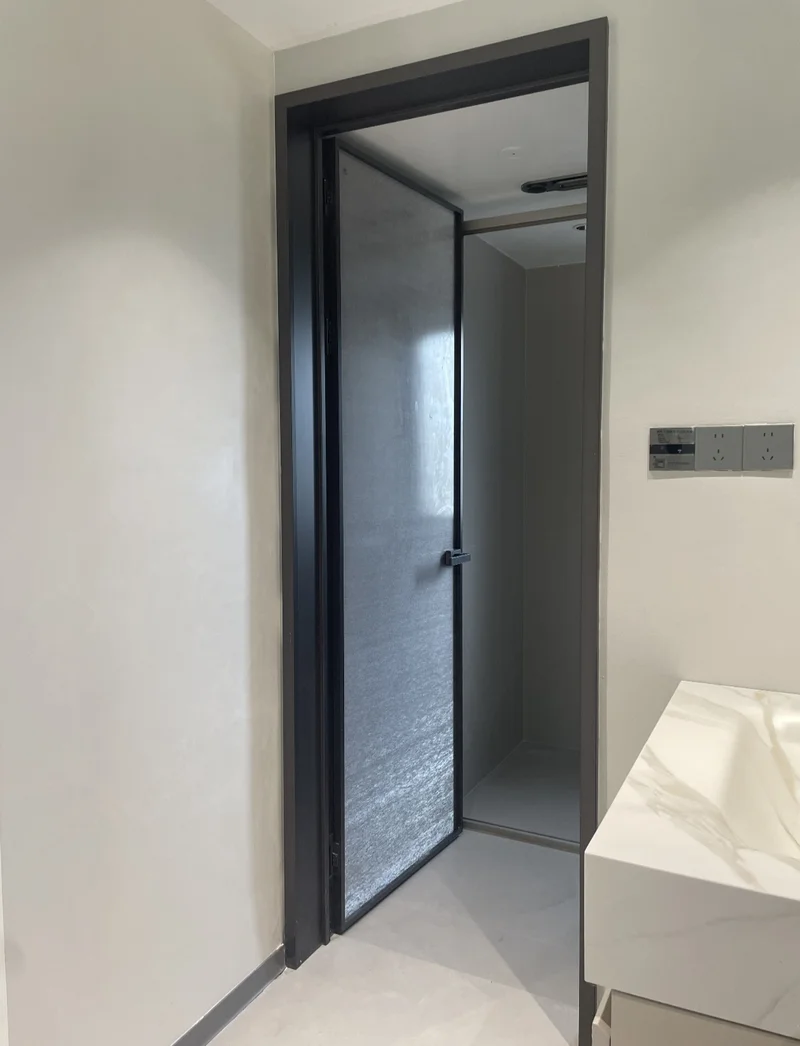
Aluminum glass doors use a 6063-T5 alloy frame with a 1.8mm wall thickness and integrated torsion box reinforcement. The WPC infill has a density of 650–750 kg/m³ and is aged via 48-hour heat treatment (70°C) to stabilize dimensional changes. This limits deflection to <0.5% of span under 500 N/m² wind load.
How many decibels of sound insulation are achieved, and what design elements contribute?
With 10mm laminated glass (0.76mm PVB) and double weatherstripping, the door offers STC 34–40 dB reduction. The WPC core provides additional mass. For higher performance, upgrade to 6+6mm laminated glass with acoustic PVB (STC 38–42 dB) and a seamless aluminum compression seal.
What UV-resistant finishing processes ensure long-term color and pattern stability?
Custom glass patterns use ceramic frit co-fired at 650°C or UV-curable inkjet printing with a hardcoat overlay. Aluminum frames receive 60–80 µm polyester powder coating (Qualicoat Class 1) with UV stabilizers. This guarantees ≤5% color shift after 2,000 hours of QUV weathering (ISO 4892-2).