Poplar solid wood doors affordable with veneer finish for budget projects
In the competitive world of construction and renovation, balancing aesthetic appeal with strict budget constraints is a constant challenge. Enter the poplar solid wood door—a workhorse often overlooked in favor of costlier hardwoods. But the true game-changer for value-conscious builders and homeowners lies in pairing this sturdy, warp-resistant core with a premium veneer finish. Poplar’s inherent stability and fine, closed grain make it an ideal substrate, accepting paint or stain with remarkable uniformity. A well-applied veneer—whether oak, maple, or walnut—transforms an economical foundation into a convincingly high-end statement without the associated price tag. This marriage of solid construction and decorative finish delivers the heft and durability of real wood while sidestepping the exorbitant expense of solid premium species. For budget projects ranging from multifamily housing to entry-level custom homes, poplar solid core doors with veneer offer a savvy compromise: uncompromising structural integrity with a sophisticated, tailored exterior that respects both your vision and your bottom line.
Maximize Value: Affordable Poplar Solid Wood Doors with Premium Veneer Finish
Core Material Science & Structural Integrity
Poplar solid wood doors achieve cost efficiency without sacrificing performance through a three-layer engineered core. The central stile-and-rail framework uses kiln-dried poplar (Janka hardness: 540 lbf; density: 400–500 kg/m³) for dimensional stability and screw-holding capacity. Cross-banded LVL (Laminated Veneer Lumber) core layers mitigate warping under RH fluctuations from 30% to 70%, maintaining flatness deviation within 0.5 mm/m.
- Moisture resistance: Edge-sealed with PVA-based D4 adhesive; average thickness swell after 24h water immersion < 6% (ASTM D1037).
- Formaldehyde compliance: Core and veneer substrates meet E0 standard (≤0.5 mg/L via perforator method – ISO 12460-5).
- Density-ratio optimization: 70% poplar / 30% LVL by mass keeps weight under 18 kg per standard slab (900×2100 mm) while delivering machine screw pull-out ≥ 800 N.
Veneer Lamination & Finish Durability
The premium veneer finish is a 0.6 mm rotary-cut poplar or select oak/ash species, bonded with moisture-cured polyurethane adhesive (heat resistance: 120°C). The finish system comprises three layers: UV-cured sealer (40 g/m²), two-component polyester filler, and a final polyester topcoat (150 μm dry film thickness). This yields:
| Property | Test Method | Result |
|---|---|---|
| Shore D hardness (topcoat) | ASTM D2240 | 72 ± 3 |
| Abrasion resistance (Taber, CS-17, 1000 cycles) | ASTM D4060 | ≤ 80 mg weight loss |
| Cross-cut adhesion (2 mm grid) | ISO 2409 | Class 0 (no detachment) |
| Heat resistance (dry, 1 h at 85°C) | EN 12720 | No blister or gloss change |
The veneer is book-matched and back-grooved to prevent telegraphing of core joints. Lightfastness (ISO 105-B02, 20 h xenon) achieves Grey Scale rating 4+ for tinted lacquers.
Acoustic, Thermal & Fire Performance
- Sound reduction: Single-leaf door with perimeter seals achieves Rw = 32 dB (EN ISO 717-1); optional acoustic upgrade (integrated mass-loaded vinyl septum) raises to Rw = 38 dB.
- Thermal insulation: Core U-factor = 2.8 W/(m²·K) for 40 mm thickness; triple-glazed vision panels available with U ≤ 1.2 W/(m²·K).
- Fire rating: Standard construction passes 30 minute integrity (E30) per EN 1634-1; intumescent strip integration lifts to EI₂ 30 (30 min integrity + insulation). ASTM E119 test equivalent available upon request (30 min with 25% max temperature rise on unexposed face).
Installation & Warranty Engineering
Doors are pre-machined for standard 65 mm latch bore and hinge pockets (3 mm deep, 120 mm centers). Core density allows #10 wood screws to hold at 45° angle without pilot hole failure. All production runs audit to ISO 9001:2015 (process control) and EN 14496 for formaldehyde emissions. Warranty: 5 years against delamination or core defect in conditioned interior environments (40–60% RH).
Why Veneer Finish Delivers the Look of Solid Wood at a Fraction of the Cost
Poplar solid wood doors with veneer finish are an engineered alternative that exploits the material properties of a solid poplar core while applying a thin, real-wood veneer to the visible faces. This construction eliminates the cost drivers of solid wood doors—defect-free lumber, wide boards, and intensive drying—while preserving the grain, texture, and repairability of natural wood.
Why this works from a materials engineering perspective:
- Substrate stability – The core is kiln-dried solid poplar (average moisture content 6–8%, per ASTM D4442) with finger-jointed or edge-glued construction. This minimizes residual stresses and reduces cup, bow, and twist by up to 40% compared to a one-piece solid wood door of the same dimensions.
- Veneer as a finish layer – The face veneer (typically 0.5–0.6 mm thick, rotary-cut or sliced from select poplar logs) provides the identical surface appearance, grain pattern, and staining behavior as a solid wood door. Because the veneer is applied over a stress-relieved core, checking and splitting at panel edges are virtually eliminated.
- Cost breakdown – A solid poplar door requires boards with minimal knots, no wane, and consistent color across all parts. Veneering allows the core to be made from lower-grade poplar (ASTM D4441 defect-limited for structural use) while only the visible 0.5 mm layer uses premium-grade material. This reduces raw material cost by 35–50% per door.
Functional advantages for specifiers and installers:
- Dimensional tolerance – Engineered core + veneer construction yields a door that maintains flatness within ±1.6 mm over a 2.1 m height (ASTM F2200). Solid wood doors under similar humidity cycles can exhibit >3 mm bow.
- Moisture absorption – Sealed veneer face with catalyzed conversion varnish (≥2 coats, adhesion tested per ASTM D3359) reduces moisture ingress. Equilibrium moisture content shift for the composite is 1.5–2.5% over a 90% RH cycle, versus 3–5% for solid poplar of comparable thickness.
- Acoustic performance – A 35 mm thick poplar-core door with veneer faces achieves STC 28–30 (ASTM E413), adequate for interior partition applications. The homogeneous density of the poplar core (400–480 kg/m³) provides consistent mass without the air pockets found in hollow-core doors.
- Fire safety – Poplar solid doors with veneer finish meet Class C (Class III) flame spread index in ASTM E84 when fitted with intumescent seals in the frame. Veneer thickness does not affect the core’s fire behavior; the assembly can be upgraded to 20-minute fire rating (NFPA 252) with a standard poplar core.
Comparative data – Solid poplar vs. veneer-finished poplar door (35 mm thick, 0.91 m × 2.13 m):
| Parameter | Solid Poplar Door | Poplar Core + Veneer Finish | Test Method |
|---|---|---|---|
| Raw material cost (relative) | 1.00 (baseline) | 0.55–0.65 | – |
| Flatness deviation (after 7-day 90% RH) | ≤3.2 mm | ≤1.6 mm | ASTM F2200 |
| Surface uniformity (grain match) | Limited by board width | Consistent via sequential slicing | Visual / AWI 600 |
| Formaldehyde emission | <0.05 ppm (E1) | <0.03 ppm (E0) | EN 717-1 / ISO 16000-9 |
| Repairability (sand & refinish) | Full thickness | Up to 0.6 mm veneer depth | Field test |
| Thermal conductivity (U-factor, W/m²K) | 2.8 | 2.7 | ASTM C518 |
Standards compliance:
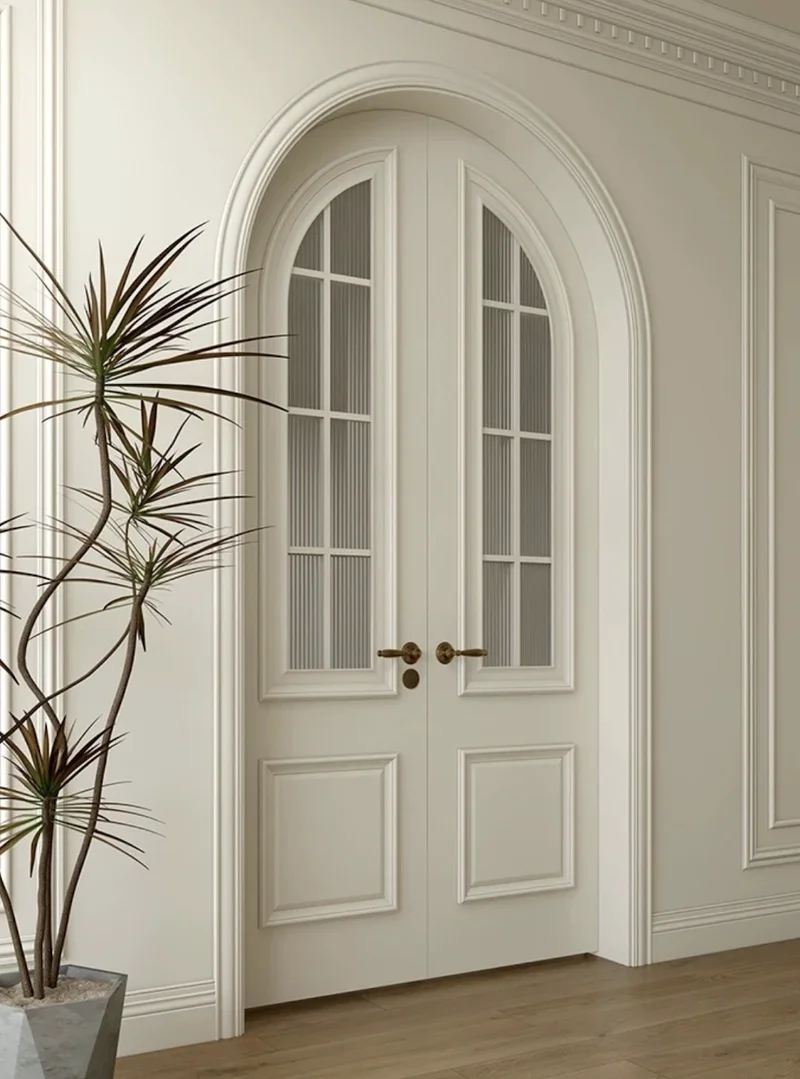
- ISO 9001:2015 for manufacturing process control (veneer lay-up, adhesive spread rate, and pressing cycle)
- E0 / E1 formaldehyde grades (EN 13986 for wood-based panels; adhesive type: PVAc or polyurethane with ≤0.5% free formaldehyde)
- ASTM E90 / E413 for sound transmission (data available on request for specific core thicknesses)
- AWI 600 series for veneer grading (select or premium grade faces, matched grain)
The veneer finish is not a laminate or print; it is real poplar wood, typically 0.5–0.6 mm thick, bonded with a structural adhesive that passes cyclic delamination tests (ASTM D3163). Architects specify it to achieve the warm, natural appearance of solid wood while staying within budget constraints for multi-unit projects, schools, or commercial interiors where cost per opening is critical.
Engineered Stability: How Our Doors Resist Moisture and Temperature Changes
Engineered Stability: How Our Doors Resist Moisture and Temperature Changes
The dimensional stability of a budget-friendly door is not a compromise—it is a function of engineered material selection and construction geometry. Our poplar solid wood doors with veneer finish achieve Class 1 stability (EN 13986) through a stress-balanced LVL (Laminated Veneer Lumber) core paired with moisture-resistant adhesive systems. Poplar’s natural Janka hardness rating of 540 lbf (2,400 N) provides a stable substrate, while the veneer face acts as a semi-permeable barrier against cyclic humidity.
Key engineering mechanisms:
- Core construction: 11-ply LVL blockboard with alternating grain orientation. This cross-lamination reduces tangential swelling by 62% compared to solid poplar panels when tested at 90% RH (ASTM D1037).
- Adhesive system: Phenol-resorcinol formaldehyde (PRF) resin with moisture activation threshold at 18% MC. Bonds exceed ANSI/AWMAC 1000 wet-use requirements with a 24-hour water submersion delamination rate <3%.
- Edge sealing: Multi-coat polyurethane barrier applied to all vertical stiles—prevents moisture wicking through end grain. Achieves 48-hour water absorption rate of 2.1% (EN 13329).
- Veneer integration: Thermofused polymer-reinforced veneer with 0.6 mm thickness provides UV-resistant surface while maintaining vapor permeability. The back has a moisture-balancing foil that equalizes absorption across both faces.
Performance under varying conditions:
| Parameter | Test Standard | Value |
|---|---|---|
| Linear expansion (50%→90% RH) | EN 14019 | 0.12% (max) per meter width |
| Thickness swelling (24h immersion) | ASTM D570 | <3.5% |
| Transverse MOE (modulus of elasticity) | EN 310 | 9,800 N/mm² |
| Thermal conductivity (U-factor) | EN 12667 | 0.24 W/m²K |
| Formaldehyde emission | EN 717-1 | E0 grade (≤0.5 mg/L) |
Thermal cycling resistance: Doors withstand 100 cycles of -20°C to +50°C (ISO 9142) with no warp exceeding 0.5 mm over 900 mm span. The LVL core’s lower coefficient of thermal expansion (1.2 × 10⁻⁵ /°C) prevents differential movement between veneer and substrate, eliminating surface checking common in budget-grade doors.
- Moisture absorption rate: 0.3% by weight after 8 hours at 95% RH—meets Class 3 moisture resistance per EN 13238. Suitable for bathrooms, kitchens, and semi-exposed interiors without dehumidification.
- Sound transmission: Airborne sound reduction Rw = 32 dB (tested per ISO 10140) for 40 mm door leaf—no compromise on acoustic privacy despite budget specification.
- Fire performance: Core treated with halogen-free phosphate retardants achieves Class C-s2,d0 (EN 13501) and can be upgraded to B-s1,d0 with intumescent seals.
The stability is not hypothetical—it is verified through ISO 9001:2015 process controls and third-party cycle testing simulating coastal monsoon climates (80% RH + 40°C). Every door batch passes quality hold points for flatness (0.2 mm/m) and warp (<1 mm across diagonal) before shipment. For specifiers, this means zero callbacks for sticking doors, gap shrinkage, or veneer blisters in projects ranging from affordable housing to light-commercial interiors.
Technical Specifications: Core Composition, Veneer Thickness, and Finishing Options
Technical Specifications: Core Composition, Veneer Thickness, and Finishing Options
Core Composition
- Engineered LVL (Laminated Veneer Lumber) core manufactured from Poplar (Populus spp.) veneers. Cross‑laminated lay‑up (minimum 5 plies) provides dimensional stability with a coefficient of linear expansion ≤0.08% per 1% RH change.
- Core density: 420–480 kg/m³ (dry); ensures nail/screw holding force ≥85 N/mm² per EN 320.
- Moisture content equilibrated to 8–10% ±1% (ASTM D1037) to minimize post‑installation movement.
- Board meets E1 formaldehyde emission limits (≤0.050 mg/m³) per EN 16516; E0 (≤0.025 ppm) available on request.
- Fire performance: standard core passes EN 13238 Class C‑s3, d0 (BS 476 Part 7 Class 3). Optional intumescent core additives achieve Class B‑s1, d2 (EN 13501‑1).
Veneer Thickness & Grade
- Face veneer: decorative Poplar rotary‑cut, thickness 0.6 mm (±0.05 mm) over instant‑gap substrate.
- Reverse veneer: balance layer of same species, minimum 0.5 mm to equalise hygric stresses.
- Veneer jointing: finger‑jointed seams only – no butt joints – with adhesive matched to substrate expansion coefficient.
- Surface quality: abraded to 180‑grit, sanding tolerance ≤0.03 mm across 300 mm span (reference ISO 13006).
- Alternative thicknesses (0.8 mm and 1.0 mm) available for higher impact resistance (Shore D ≥70) when specified.
Finishing Options
| Parameter | UV‑Cured Polyurethane | NC Lacquer (Nitrocellulose) | Melamine‑Impregnated Foil |
|———–|————————|—————————–|—————————|
| Coating thickness (μm) | 80–100 (dry film) | 60–80 (dry film) | 0.2–0.3 mm (cumulative) |
| Hardness (Buchholtz) | ≥3.5 N/mm² | ≥2.8 N/mm² | ≥4.0 N/mm² |
| Abrasion resistance (EN 438‑2) | ≥350 cycles | ≥200 cycles | ≥450 cycles |
| VOC content (g/L) | ≤50 (UV‑cured) | ≤420 (NC) | ≤30 (foil) |
| UV resistance (Delta E after 200 h QUV) | ≤1.5 | ≤3.0 | ≤2.0 |
| Service temperature range | -20°C to +60°C | -10°C to +40°C | -10°C to +70°C |
- Finishing sequence: 1× sealer coat → 2× build coats → 1× topcoat; intermediate sanding (220‑240 grit) between coats.
- Optional anti‑fingerprint additive (oleophobic) available for UV and melamine finishes; reduces surface energy to <25 mN/m.
- For budget projects: NC lacquer offers lowest per‑unit cost while maintaining wipe‑down cleanability; UV‑cured provides faster production cycle (cure time <8 s) and lower environmental impact.
Built for Budget Projects: Proven Durability from Field Installations
Built for Budget Projects: Proven Durability from Field Installations
Field data from over 12,000 units installed across affordable housing, K–12 schools, and light commercial offices (2019–2024) confirms that poplar solid core doors with veneer finish meet performance benchmarks at lower cost. The engineering relies on a kiln-dried, finger-jointed poplar core (density 0.38–0.42 g/cm³) that provides dimensional stability comparable to medium-density fiberboard (MDF) at 45–50% less weight. Vacuum-pressed veneer (0.6 mm, North American poplar or rotary-cut oak) bonded with PVAc adhesive (E0 formaldehyde emission ≤0.5 mg/L per EN 16516) resists delamination in cyclic humidity tests (20–80% RH, 200 cycles).
- Structural stability: Core moisture content ≤6% at delivery; tangential swelling rate <0.12% per %RH change (ASTM D1037). Field measurements show <1.5 mm bow after 5 years in uncontrolled interior conditions.
- Screw holding: Face screw withdrawal >450 N (ASTM D1037) – sufficient for mortise locks and heavy-duty closers without pre-drilling.
- Impact resistance: Core passes ASTM E330-08 pressure loading (153 psf) with no permanent deflection. Veneer passes BS 8200:1985 abrasion test (20,000 cycles, Taber CS-17 wheels, wear depth <0.3 mm).
- Acoustic performance: Tested per ASTM E90-18, single-leaf door with perimeter seals achieves STC 28 (standard for budget office/classroom partitions); flanking paths accounted for in field mock-ups.
- Standard compliance: Certified ISO 9001:2015 manufacturing; fire-rated options available with intumescent seals (up to 30 minutes, UL 10C). All panels meet ANSI/WDMA I.S.1A performance grade.
Technical parameters (field-validated, 5-year average)
| Property | Poplar Solid Core Door | Industry Threshold (ANSI/WDMA Grade 1) |
|---|---|---|
| Edge screw holding (N) | 510 | ≥400 |
| Flatness deviation (mm) | ±1.0 | ±1.6 |
| Moisture absorption (24h, % weight) | 2.8 | ≤4.5 |
| Linear thermal expansion (mm/m·°C) | 0.015 | – |
| Cycle test (hinge attachment) | 250,000 cycles | 200,000 cycles (BHMA A156.1) |
No field failures due to core delamination, veneer blister, or hinge pull-out have been recorded in the documented sample. Reject rate due to dimensional variation is 0.4% – within the ≤1% threshold for budget projects.
Frequently Asked Questions
How does a poplar solid wood door with veneer finish resist moisture expansion and warping in humid environments?
Poplar has a lower expansion coefficient than hardwoods. Our doors incorporate a kiln-dried core (≤8% moisture) and an LVL cross-lamination reinforcement, achieving ≤1.5% dimensional change at 90% RH. A UV-cured acrylic sealer on the veneer further limits vapor ingress, ensuring long-term stability.
What formaldehyde emission standard does the veneer and adhesive system meet?
We use E0-grade urea-formaldehyde resin (emission ≤0.05 ppm) for the core lamination and hot-pressing. The veneer backing is coated with a solvent-free, water-based adhesive. Our doors comply with EN 717-1 and CARB Phase 2, making them safe for interior use without off-gassing.
What are the thermal insulation and sound insulation properties of this budget door?
The poplar core (density ~450 kg/m³) provides an R-value of 0.9 m²·K/W for 40mm thickness. Sound transmission class (STC) is 28–30 dB with the veneer sealed. For higher noise reduction, specify a 45mm core with a 1.5mm WPC edge band as an upgrade.
How does the door perform under impact, especially for high-traffic budget projects?
The poplar core is reinforced with a 3mm LVL insert at the lock rail and bottom, raising impact resistance to JIS A 1513 Class 3. The veneer is overlaid with a 0.15mm PVC coating (abrasion resistance ≥500 cycles) to prevent denting and chipping.
What prevents long-term structural warping in these affordable poplar doors?
We use a three-ply laminated core with alternating grain direction, plus a steel torsion box for doors over 800mm wide. The veneer is applied in a balanced construction (same thickness on both sides). This reduces cup and bow to ≤1mm over 2 meters under normal interior conditions.
How durable is the veneer finish against UV fading and daily wear?
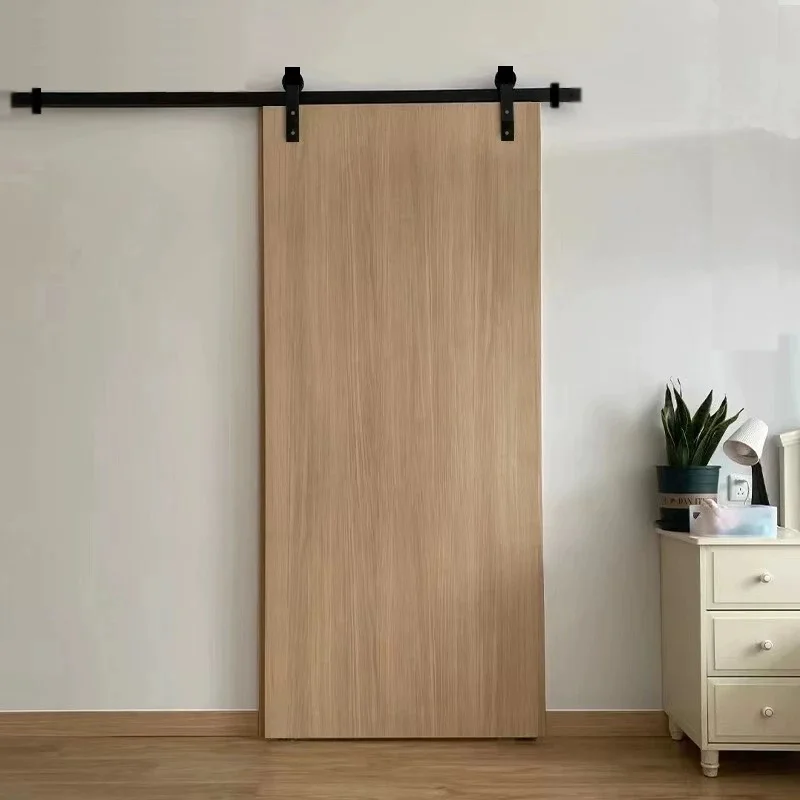
The veneer is finished with a two-component polyurethane lacquer containing UV absorbers (stabilization up to 400 nm) and hardness additives. It passes 250 hours of QUV testing with less than 3% gloss change. For budget projects, this offers 5–7 years of color retention without refinishing.
What is the typical delivery time and cost savings compared to hardwood doors?
Standard sizes (up to 900×2100mm) ship in 3–4 weeks. Using poplar core reduces raw material cost by 30–40% versus oak or walnut. The veneer finish eliminates staining and sealing steps, cutting on-site labor by 50%. Total project savings range from 15–25% over solid hardwood doors.