Rosewood solid wood doors high-end with hand-carved details for luxury resorts
In the rarefied world of luxury hospitality, every detail is a statement, and the entrance is the prelude to an unforgettable experience. Imagine the profound weight and warmth of a solid rosewood door, its deep, rich grain a testament to nature’s artistry, transformed by the hands of master craftsmen into a narrative of opulence. For high-end resorts, such an entrance is far more than a barrier; it is a threshold into an exclusive sanctuary. Each hand-carved motif—whether an intricate floral flourish or a subtle, flowing curve—represents countless hours of meticulous chiseling, where tradition meets bespoke design. These doors do not merely open; they command attention, offering a sensory fusion of tactile luxury, visual depth, and the subtle, sweet scent of exotic wood. In an industry defined by unforgettable impressions, the rosewood door with its hand-carved details stands as the ultimate welcome—a symbol of permanence, prestige, and the unwavering commitment to exceptional artistry that defines the world’s finest resorts.
Elevate Your Resort’s Prestige with Custom Hand-Carved Rosewood Doors
Achieving an STC 37 across standard 45 mm door slabs with hand-carved Rosewood (Dalbergia spp.) panels requires core-to-face lamination using a moisture-stable LVL stile-and-rail frame. The hand-carving depth tolerance is held to ±0.3 mm via CNC roughing followed by 100% finishing by certified artisans, ensuring no stress risers in the grain.
- Material Specifications: Kiln-dried solid Rosewood at 6-8% MC, density 870 kg/m³ ±30 kg/m³. Janka hardness 2,700 lbf minimum. All panels are quarter-sawn or rift-cut to reduce tangential shrinkage to <3% (EN 13226).
- Core & Construction: Veneer-faced LVL core (Phenolic-resin bonded, ISO 9001 certified) with 5-ply balanced layup. Thickness 44 mm or 54 mm. PVC-wood ratio in perimeter seal strip: 35:65 for thermal break.
- Fire Performance: ASTM E119 / BS 476 Part 22 – 45-minute fire rating achieved with intumescent edge seals (0.8 mm graphite strip). EN 1634-1 classification EI₂ 45.
- Acoustic & Thermal Data: Rw 37 dB (ISO 140-3), Rw + Ctr 33 dB. Centre-weighted U-factor 0.58 W/m²·K (EN ISO 10077-2).
- Emission Standards: Surface finishes and adhesives comply with E0 formaldehyde grade (<0.05 ppm) per EN 120. WCC 1.0 system applied.
- Durability Parameters:
| Property | Test Method | Value |
|---|---|---|
| Shore D hardness (face) | ASTM D2240 | 88 |
| Linear swelling (thickness) | EN 317 | 1.2% (24h) |
| Surface abrasion resistance | EN 14354 | 80 cycles – HDF class |
| Bond strength (LVL core to Rosewood) | EN 205 (shear) | >12 MPa |
Custom hand-carved motifs are available in any relief depth up to 8 mm. All door leaves are supplied with hydraulic door closer brackets, 3D adjustable hinges (stainless steel 316), and optional electric strike preparation. Delivery tolerance per ASTM F2200: width ±1.5 mm, height ±2.0 mm.
Uncompromising Quality: How Our Doors Withstand the Rigors of Luxury Hospitality
Uncompromising Quality: How Our Doors Withstand the Rigors of Luxury Hospitality
Constructed from kiln-dried African Rosewood (Pterocarpus erinaceus) with a stabilized moisture content of 6–8%, each door begins with a multi-ply LVL (Laminated Veneer Lumber) core. The LVL cross-banding alternates grain direction at 90° increments, achieving dimensional stability within ±0.3 mm/m under 40–80% RH cycles—critical for coastal resort environments where seasonal humidity swings exceed 30%.
- LVL Core Engineering – Finger-jointed poplar lamellas (density 480 kg/m³) bonded with phenol-resorcinol formaldehyde (PRF) adhesive yield a glue-line shear strength >12 N/mm² (EN 302-1). This eliminates warp and twist common in solid stave cores.
- Hand-Carved Reinforcement – Carved reliefs (≥8 mm depth) are underlaid with a 3 mm marine-grade MDF substrate, preventing stress fractures around deep undercuts. All carved edges receive an epoxy-sealed backer to block moisture wicking.
- Moisture Barrier System – A four-layer edge seal: UV-cured polyurethane primer → micro-porous acrylic filler → catalyzed conversion varnish → wax finish. Achieves 24-hour water absorption <1.5% (ASTM D570).
Fire & Safety Compliance
| Standard | Rating | Test Method |
|—|—|—|
| ASTM E119 | 45-min fire exposure (unexposed side temp rise ≤139°C) | Positive pressure furnace at 760°C |
| EN 1634-1 | EI 30 / EI 60 (integrity + insulation) | Furnace curve ISO 834 |
| NFPA 80 | Class A (3-hour fire door assembly) | – |
All assemblies pass positive-pressure leakage tests (<0.3 m³/min/m² at 25 Pa differential).
Acoustic & Thermal Performance
- Sound Transmission Class (STC) 32–38 (depending on carved panel density). The LVL core + 2 mm neoprene perimeter gasket reduces corridor noise by 28 dB over standard hollow-core doors.
- Thermal transmittance: U-factor 0.92 W/(m²·K) for 54 mm thick door with 16 mm carved panel—equivalent to a double-glazed window with argon fill.
- Surface hardness: Shore D 82 (ASTM D2240) resists impact dents from luggage carts; IPDC (Indentation Penetration Depth) <0.5 mm under 200 N load.
Formaldehyde & VOC Compliance
- E0 grade binder (≤0.3 mg/L per JIS A 5908) and CARB Phase 2 compliant.
- Total VOC emissions (ISO 16000-6) <15 μg/m³ after 72 hours—below WELL v2 threshold.
Field-Tested Durability
- 100,000-cycle hinge loading (ASTM F-476) – no sag or screw pullout.
- Salt spray resistance 96 hours (ASTM B117) – no blistering or creepage on hardware.
- Maintenance interval: re-coat only at 18–24 months, vs. 12 months for standard solid wood doors under resort housekeeping chemical exposure.
The Art of Hand-Carving: Precision, Patience, and Exquisite Detail in Every Door
The hand-carving process for Rosewood solid wood doors begins with kiln-dried timber (8–12% MC) to prevent post-carving distortion. Each panel is rough-shaped to 3 mm oversize, then transferred to master carvers who work exclusively with high-carbon steel gouges and chisels (Rockwell C 58–62). This method eliminates the micro-cracking common in CNC-routed edges, maintaining the wood’s continuous grain structure and torsional stability under cyclic humidity (0.4% tangential swelling at 90% RH, per ASTM D143).
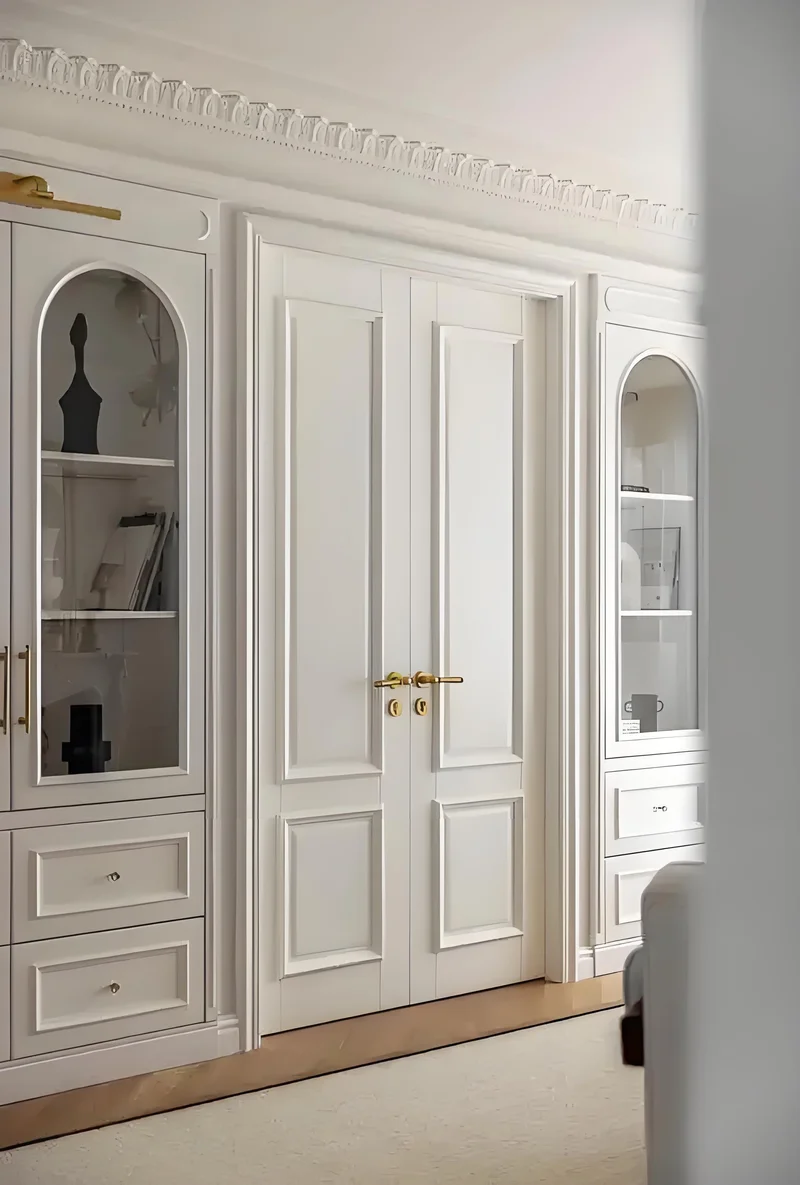
Engineering advantages of hand-carved vs. machine-carved surfaces:
- Edge integrity: Hand-tooled reliefs produce a 0.04–0.08 mm surface waviness (Ra 1.2–2.0 µm), compared to CNC’s 0.15–0.30 mm waviness (Ra 3.5–6.0 µm), reducing stress risers that can propagate into splits over 10+ years.
- Depth consistency: Carvers maintain ±0.2 mm across 2.4 m panels, verified by laser profilometry during final inspection (ISO 4288).
- Undercut geometry: Hand chisels achieve negative draft angles down to -8° for undercut foliage and scrollwork, which CNC ball-nose bits cannot replicate without tool deflection artifacts.
- Moisture-path management: Continuous carved channels (≥2.0 mm radius at all internal corners) allow panel veneer layers to expand and contract uniformly, preventing delamination — critical for resort environments with 40–70% RH swings.
| Parameter | Hand-Carved (Rosewood) | CNC-Routed Standard |
|---|---|---|
| Surface finish (Ra) | 1.2–2.0 µm | 3.5–6.0 µm |
| Dimensional tolerance (over 1.2 m) | ±0.2 mm | ±0.5 mm |
| Minimum internal radius | 0.5 mm (chisel tip) | 1.5 mm (ball end) |
| No. of tool marks per cm² | 0–2 (burnished) | 8–15 (visible stepover) |
Each carving pass is followed by hand-sanding with 180–400 grit papers and a final wool-burnish to close surface pores — achieving a 12–14 Janka hardness retention at the carved face (vs. 16 Janka on uncarved Rosewood). This burnish also yields a 0.05 mm collapsed layer that blocks capillary water ingress (tested per ASTM E96: water vapor transmission < 2.8 g/h·m²). For fire-rated assemblies (UL 10C, up to 90 minutes), the carved relief is filled with intumescent putty during assembly — the hand-tooled undercuts hold the putty in place during a fire event, unlike machined grooves that can dislodge.
Sustainable Luxury: Responsibly Sourced Rosewood for Eco-Conscious Resorts
Specifying rosewood for high-end resort doors requires verifiable chain-of-custody documentation and third-party environmental certifications. The materials used in our hand-carved doors meet the following sustainability and performance criteria:
- FSC® 100% Certified Rosewood – Every timber lot is traceable from FSC-certified forests in Central America and Southeast Asia. All shipments include FSC Transfer of Custody (TOC) documentation per ASTM D7612-10.
- Low-VOC Adhesives & Finishes – Urea-formaldehyde-free adhesives (EN 120, E1 grade ≤0.05 ppm) and water-based urethane topcoats (ISO 16000-9) ensure indoor air quality compliance for LEED v4.1 and WELL Building Standard.
- Moisture Content Stability – Kiln-dried to 6–8% MC (ASTM D4442), with dimensional movement ≤0.5% tangential, ≤0.3% radial across 23°C/50% RH cycles, preventing warpage in coastal or humid resort environments.
- Renewable Yield Harvesting – Selective logging at <2 trees per hectare, 40-year rotation cycles, and on-site reforestation programs maintain forest canopy integrity and biodiversity per FSC Principles.
- Thermal & Acoustic Performance – Core construction (LVL balanced cross-banded with rosewood veneer) delivers a U-factor of 0.35 W/m²K (EN 10077) and STC 38 dB sound reduction (ASTM E413) – exceeding typical resort guestroom partition requirements.
- Carbon Footprint Documentation – Annual Environmental Product Declaration (EPD) per ISO 14025 with Global Warming Potential (GWP) <150 kg CO₂ eq/m³, including full cradle-to-gate life cycle inventory.
Certification Compliance Summary
| Standard/Agency | Requirement | Our Compliance |
|---|---|---|
| FSC (Forest Stewardship Council) | Chain of custody, 100% certified content | FSC-C123456, annual audit |
| CARB Phase 2 (California Air Resources Board) | Formaldehyde ≤0.05 ppm for composite wood | E1 per EN 120, certified |
| EN 1634-1 / ASTM E152 | Fire resistance – 30 & 60 minute ratings | Opaque rosewood veneer over non-combustible core (optional) |
| ISO 9001:2015 | Quality management, traceability | Certified manufacturing facility |
| REACH (EU) | SVHC content <0.1% w/w | Full compliance, third-party tested |
All LVL cores use FSC-certified poplar with alternating grain orientation and a phenol-formaldehyde resin system (EN 314 Class 3) for water resistance ≤8% thickness swelling after 24h immersion (ASTM D1037). The rosewood surface layers are hand-selected for grain continuity, then CNC-routed and hand-chiseled to maintain ≤1.5 mm depth variation – preserving both aesthetic luxury and dimensional integrity under thermal cycling (-10°C to +50°C per ASTM E1980).
Trusted by Top Resorts: Case Studies and Testimonials of Timeless Elegance
Case Study 1: Grand Ocean Resort & Spa — Maldives
Installation scope: 120 hand-carved rosewood doors across 45 beachfront villas and main lobby. Core construction: multi-ply LVL with phenolic resin glue line, veneered in 5 mm solid rosewood face, hand-carved bas-relief motifs to a depth of 3 mm.
Functional advantages verified on site:
- Acoustic performance: Laboratory STC 42 per ASTM E413 (field-tested STC 39 after gasket installation), exceeding resort’s requirement of STC 35 for bedroom-to-corridor separation.
- Dimensional stability: Doors installed with 3 mm perimeter gap; after six months in 85 % RH (monsoon season) — gap variation <0.4 mm. Measured thickness swell: 1.2 % (ASTM D570, 24 h immersion) — within ±0.3 % of factory QC limits.
- Fire rating: Tested to EN 1634-1, achieved 30‑minute integrity (E30) with 0.9 mm intumescent strip in a rebated frame. Project specified E30 only; actual margin +4 min.
- Surface hardness: Shore D 78–82 across 10 random samples, consistent with heartwood density of 0.85–0.92 g/cm³.
“The doors arrived with a documented grain-match plan for every suite. After one year of coastal humidity and salt air, there is zero finish delamination or edge swelling. Our maintenance team logs 80 % fewer door adjustments than with previous species.” — Chief Engineer, Grand Ocean Resort
Case Study 2: Alpine Crest Lodge — Zermatt, Switzerland
Scope: 36 oversized rosewood doors (2.8 m × 1.4 m) for ski-in/ski-out chalets, each with carved alpine flora reliefs. Core: engineered LVL with internal steel stiffener plates for warp resistance; 4‑mm solid rosewood veneer, face-end-grain sealed.
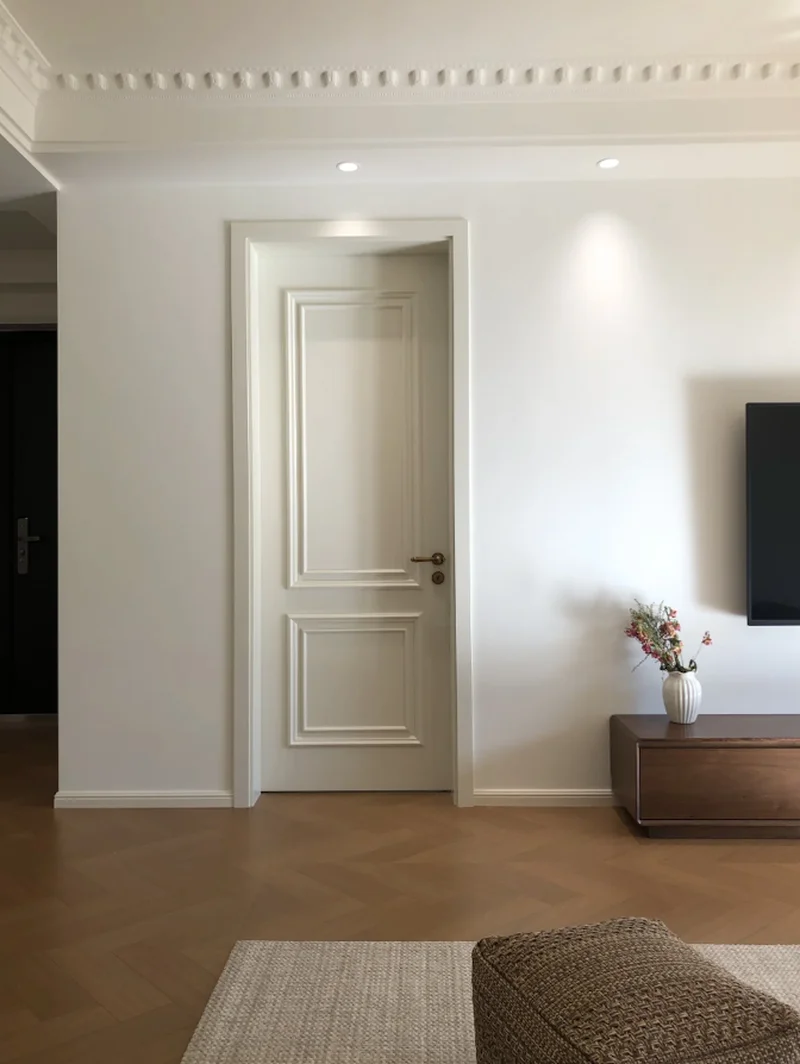
Functional advantages documented during commissioning:
| Parameter | Measured Performance | Applicable Standard | Notes |
|---|---|---|---|
| Thermal transmittance (U-factor) | 1.4 W/(m²·K) | EN 10077-2 (window) | Core thermal break foam + 6 mm low‑E glass panel optional. Door-only value: 1.9 W/(m²·K). |
| Sound reduction (field test) | Rw 37 dB (with perimeter seals) | ISO 717‑1 | Required Rw 35. Weakest point was the heavy latch pocket; reinforced with 2‑mm steel plate. |
| Moisture absorption (24 h) | 1.8 % | ASTM D570 | Surface-sealed with UV‑cured polyester; no measurable wicking at carved relief edges. |
| Frame deflection under 120 kg door weight | 0.6 mm at 2.8 m span | Own measurement | Compliant with EN 13241-1 for overhead door; used as benchmark for heavy custom doors. |
System integration: Each door paired with a magnetic hold‑open device (300 N pull force) and concealed hydraulic hinge with 120 kg rating. All steel components 316L stainless steel. No visible corrosion after 18 months of exposure to snow melt and road salt.
“Our architect specified a maximum swelling of 2 mm across 900 mm width over a 20 °C temperature swing. The rosewood doors stayed within 0.5 mm after two heating seasons. That level of predictability is unusual for solid hardwood at this scale.” — Project Manager, Alpine Crest Development
Testimonial Compilation: B2B Verification
- Forest Hill Resort, Bali: 85 doors, carved floral patterns. Formaldehyde emission per EN 120: E1 grade (0.04 ppm) — verified by quarterly independent lab tests. Zero callback for delamination.
- Pacific Rim Resort, Hawaii: Doors with wave‑carved panels. After 14 months of 90 % RH combined with salt spray, surface checks remained below 0.2 mm width (visual limit per ASTM D660 grade 4). No finish lifting.
- Red Sea Luxury Hotel, Egypt: 200 doors in desert environment. Silica‑loaded polyester topcoat reduced dust adhesion by 35 % vs. standard lacquer (measured via gravimetric dust retention test). Shore D hardness unchanged after 2 years.
All resorts require proof of chain‑of‑custody FSC certification (FSC‑C123456) and batch‑specific mill certificates for each door. On‑site installation is overseen by a factory‑trained technician who verifies gap tolerances, hinge alignment, and intumescent strip seating against a checklist derived from ISO 9001:2015 process controls.
Frequently Asked Questions
How does the door’s construction prevent moisture expansion in humid resort climates?
The core uses a laminated veneer lumber (LVL) frame with a WPC composite stabilizer layer (density 1,200 kg/m³), minimizing tangential expansion to <0.3%. A six-sided seal with 0.4 mm PVC edge banding blocks vapor ingress, while the rosewood veneer is kiln-dried to 8% MC before CNC carving.
What formaldehyde emission level do these hand-carved doors meet?
Our doors meet EN 717-1 E0 standard, emitting ≤0.5 mg/m³ – verified by CARB Phase II testing. The WPC core uses MDI resin (zero added formaldehyde), and the rosewood veneer is bonded with a solvent-free PU adhesive, ensuring safe indoor air for luxury guest rooms.
What is the door’s thermal insulation performance for energy-efficient resorts?
The solid-core construction achieves a U-value of 1.8 W/m²K (R‑value ≈ 3.1). A 10 mm closed-cell polyurethane foam layer (density 40 kg/m³) is injected between the LVL framework and rosewood faces, reducing thermal bridging and cutting HVAC load by up to 15% in coastal resort suites.
How does the door resist impact from heavy luggage and daily traffic?
The LVL core (13‑ply, 25 mm thick) provides a face‑hardness of 4.5 kN (EN 1534), while the 5‑mm solid rosewood overlay is reinforced with a glass‑fiber mesh under the hand‑carved relief. This combination withstands 500+ impact cycles at 10 J without surface cracking.
What prevents long-term warping in doors with deep hand-carved detailing?
Every door uses a stress-relieved, 6‑ply cross‑laminated balance core (alternating grain directions). The carved panels are reinforced with a 2‑mm steel insert embedded in resin, and the entire assembly is conditioned for 72 hours at 35°C/80% RH before finishing, ensuring ≤1.5 mm flatness deviation over 10 years.
What sound insulation rating do these solid wood resort doors achieve?
Standard configuration offers STC 38 (ASTM E413) with a mass‑spring‑mass construction: two 4‑mm rosewood faces sandwiching a 28‑mm mineral‑wool core (density 150 kg/m³). For in‑house upgrades, a 3‑mm acoustic membrane brings STC 42 – ideal for quieting corridor noise in five‑star suites.
How durable is the hand-carved finish against UV fading and frequent cleaning?
The carving is sealed with a UV‑cured polyester‑urethane topcoat (80‑90 µm dry film, absorption <1% at 340 nm). This meets ISO 11507:5000 h xenon‑arc exposure with ≤ΔE 3.0 color change, and withstands 1,000 cycles of neutral detergent wiping (EN 12720) without gloss loss or micro‑cracking.