anti-theft steel doors for large commercial buildings
In the ever-evolving landscape of commercial security, protecting high-traffic, high-value facilities demands more than just vigilance—it requires engineered resilience. Anti-theft steel doors have emerged as a cornerstone of modern building protection, combining uncompromising strength with advanced security features tailored for large commercial environments. From sprawling office complexes to retail hubs and industrial facilities, these robust entry solutions deter forced entry, resist tampering, and meet rigorous safety standards without sacrificing aesthetic integration. Constructed from high-tensile steel and often reinforced with multi-point locking systems, ballistic ratings, and intrusion-resistant cores, they stand as the first line of defense against theft, vandalism, and unauthorized access. As urban centers grow denser and security threats more sophisticated, facility managers, architects, and security professionals are prioritizing steel doors that blend durability, compliance, and seamless functionality. Discover how today’s anti-theft steel doors are not just barriers, but strategic assets in safeguarding people, property, and peace of mind.
Uncompromised Security: Reinforced Steel Core for Maximum Theft Deterrence
- 1.5 mm cold-rolled steel outer skins, ASTM A1008/A1008M compliant, with continuous weld seams eliminating failure points at joints
- Central structural core composed of high-density welded steel cage (yield strength ≥ 370 MPa), fully encapsulated within a 12 mm-thick C-grade steel-reinforced honeycomb lattice for impact dispersion
- Integrated anti-jemmy perimeter frame with 3 mm folded steel lips extending into frame pockets, meeting EN 1627:2011 RC3 forced entry resistance classification
- Dual-interlocking multi-point locking system (8-point vertical bolts, Ø16 mm solid steel) engaging hardened steel strike plates anchored to structural frame with M12 through-bolts at 150 mm centers
- Core infill: non-combustible mineral composite (density ≥ 220 kg/m³) with zero moisture absorption, providing dimensional stability under thermal cycling (−30°C to +60°C)
- Surface treatment: electrophoretic dip coating (min. 15 µm) + polyester powder topcoat (60–80 µm), salt spray resistance > 1,000 hours (ASTM B117)
- Acoustic attenuation: composite mass-layered construction achieves Rw 43 dB (ISO 140-3), enhanced by perimeter acoustic seals with compression memory
- Thermal performance: U-factor of 1.8 W/(m²·K) per ISO 10077-1, incorporating full-perimeter thermal breaks to minimize conductive bridging
- Fire integrity: EI 60 certification per EN 1364-1 (integrity and insulation for 60 minutes), with intumescent edge seals expanding to 5x original thickness at 180°C
- All components manufactured under ISO 9001-certified process controls; formaldehyde emissions rated E0 (<0.05 ppm) per ISO 16000-3
| Performance Parameter | Test Standard | Result/Value |
|---|---|---|
| Ballistic Resistance | UL 752 Level 1 | Withstands 3 rounds, 9mm FMJ |
| Forced Entry Resistance | EN 1627 RC3 | ≥ 10 min attack time |
| Operational Cycles | EN 12209 Class 10 | 1,000,000 cycles (latch/lock) |
| Air Permeability | EN 12207 Class 4 | ≤ 0.1 m³/(h·m²) at 600 Pa |
| Corrosion Resistance | ASTM B117 | > 1,000 h to first red rust |
| Thermal Conductivity (U) | ISO 10077-1 | 1.8 W/(m²·K) |
| Sound Reduction Index (Rw) | ISO 140-3 | 43 dB |
Built for Heavy-Duty Performance: High-Traffic Durability in Commercial Environments
- Constructed with 1.8–2.0 mm cold-rolled steel skins conforming to ASTM A1008, providing yield strengths in excess of 350 MPa for resistance to forced entry and impact loading in high-traffic zones.
- Reinforced lock stiles and hinge edges utilize internal steel channels (2.5 mm thickness) to prevent torsional deformation and maintain alignment after repeated operational cycles exceeding 1,000,000 cycles per EN 12209.
- Core infill comprises high-density mineralized polyurethane foam (≥80 kg/m³), delivering a compressive strength of 450 kPa while contributing to a thermal transmittance (U-factor) of 0.38 W/m²K, in compliance with ISO 10077-1.
- Multi-point locking systems (3-point or 5-point) with hardened steel cams and deadbolts (≥16 mm projection) meet EN 1303 and EN 13637 standards for burglary resistance, achieving RC3 (EN 1627) classification when tested under forced entry simulations.
- Hinges are continuously welded, security-rated (EN 1906 Grade 6), and mounted on reinforced steel frames to support door weights up to 120 kg without sagging or binding.
- Surface treatment includes a dual-coat system: epoxy-rich primer (40–50 μm DFT) for corrosion resistance, followed by polyester-based powder coating (60–80 μm DFT), tested to ASTM B117 for 1,000 hours of salt spray exposure without red rust.
- Perimeter seals integrate compression neoprene gaskets (Shore A hardness 65±5) and magnetic strips to achieve air infiltration resistance of ≤0.1 m³/(h·m²) at 100 Pa (EN 1026), enhancing acoustic attenuation up to 38 dB Rw per ISO 140-3.
- Tested under cyclic environmental exposure (humidity 90% RH at 40°C for 240 hours, per ASTM D2247) with dimensional stability maintained within ±0.15% swelling ratio across steel/insulation interface layers.
- Fire-rated variants incorporate intumescent seals and non-combustible mineral core insulation, achieving EI 60–EI 90 classification in accordance with EN 13501-2, verified through furnace testing per ISO 834.
| Performance Parameter | Value/Standard | Test Method |
|---|---|---|
| Steel Skin Thickness | 1.8–2.0 mm | ASTM A956 |
| Burglary Resistance Class | RC2–RC3 | EN 1627–1630 |
| Operational Cycles | ≥1,000,000 | EN 12209 |
| Thermal U-Factor | 0.38–0.42 W/m²K | ISO 10077-1 |
| Sound Reduction Index (Rw) | 35–38 dB | ISO 140-3 |
| Air Permeability | ≤0.1 m³/(h·m²) @ 100 Pa | EN 1026 |
| Fire Resistance (EI Rating) | EI 60, EI 90 | EN 1364-1, ISO 834 |
| Formaldehyde Emission | E0 (<0.05 ppm) | EN 717-1, ISO 12460-3 |
| Corrosion Resistance | ≥1,000 hrs (no red rust) | ASTM B117 |
Advanced Locking Systems: Multi-Point Encryption and Access Integration
- Multi-point locking systems utilize hardened steel bolt throws (minimum 304 stainless steel, Rockwell C45+ hardness) engineered to engage anchoring points along the door’s perimeter frame, including head, jamb, and sill, providing resistance to forced entry exceeding ASTM F476-21 prying and kick-in thresholds.
- Each bolt throw is embedded within a thermally broken, non-conductive carrier channel to eliminate cold bridging, maintaining door U-factor ratings ≤ 0.35 W/m²·K when integrated into insulated steel door assemblies.
- Locking mechanisms are actuated via dual-motorized, fail-secure electromechanical drives compliant with EN 12209 Grade 3 durability (≥ 500,000 operational cycles) and UL 10C positive pressure fire testing when installed in 90-minute fire-rated assemblies (UL 10B, ASTM E119).
- Encryption protocols adhere to AES-256 bit rolling code algorithms embedded within access control modules, preventing replay attacks and MITM intrusions across wireless Wiegand, OSDP v2, or PoE-based IP interfaces.
- Integration with BACnet/IP, Modbus, and KNX building management systems enables centralized audit logging, time-zone scheduling, and biometric/facial recognition handshaking with ONVIF-compliant CCTV systems.
- Anti-tamper sensors monitor drill, torque, and displacement anomalies at lock cylinders, transmitting alerts via redundant RF (Zigbee 3.0) and cellular (LTE-M/NB-IoT) backhauls to cloud-hosted security platforms.
- All electronic components are housed within sealed IP67-rated enclosures, isolated from the door’s structural cavity to prevent moisture ingress (absorption rate < 0.5% per ASTM D570) and galvanic corrosion in coastal environments.
| Parameter | Performance Standard | Test Method |
|---|---|---|
| Bolt Projection | ≥ 16 mm (top, bottom, dual sides) | EN 12209, Grade 3 |
| Cylinder Pick Resistance | ≥ SKG 3 / SS 3 (Dutch NEN 1064) | NEN 1064, ISO 17961 |
| Encryption Latency | ≤ 80 ms end-to-end authentication | IEEE 802.1AR-2018 |
| Electrified Strike Fail-Safe | < 1.2 sec release under power loss | UL 294, Access Control |
| EMC Immunity | 10 V/m RF field, 30–1000 MHz | EN 50130-4, IEC 61000-6-2 |
| Operating Temperature Range | –35°C to +65°C (condensation-resistant) | MIL-STD-810H, Method 502.6 |
- Mechanical override employs ECC-certified, laser-cut, paracentric keyways (e.g., Medeco® Maxum, Mul-T-Lock® MT5+) with anti-bump, anti-snapping, and anti-drill inserts composed of tungsten carbide-reinforced inserts (Knoop hardness 1800–2200 HK).
- Access integration supports FIDO2-compatible smart credentials and PKI-based digital certificates, enabling zero-trust security frameworks in high-clearance commercial zones.
- All locking electronics are manufactured under ISO 9001:2015-certified lines with conformal coating (IPC-CC-830B) on PCBs to ensure reliability in environments with E1 formaldehyde exposure (< 0.1 ppm) and relative humidity up to 95% non-condensing.
Fire-Resistant & Impact-Tested: Dual-Certified Safety for Critical Infrastructure
- Constructed with a dual-certified composite core integrating intumescent-treated mineral wool and cold-rolled steel reinforcement, engineered to maintain structural integrity under ASTM E119 fire exposure for up to 120 minutes (UL 10C compliance).
- Door leaf assembly features a 1.8 mm thick galvanized steel skin (ASTM A653 Grade 50) bonded to a high-density LVL (Laminated Veneer Lumber) intermediate layer, achieving a minimum impact resistance rating of Class 1 per EN 1627 (resistance to 300 J pendulum impact).
- Fire containment performance validated through independent third-party testing: achieves EI 120 classification under EN 1364-1, with less than 0.2 m³/min air leakage at 10 Pa differential pressure during fire curve exposure.
- Multi-point locking system (3-hook bolts + 2 deadbolts, all Grade 1 ANSI/BHMA A156.13) embedded within a thermally broken steel frame prevents forced entry while maintaining fire seal continuity via compression gaskets rated to 1,000°C.
- Perimeter intumescent seals expand to 8× original volume at 180°C, sealing door-to-frame gaps ≤3 mm in accordance with EN 1634-1; verified through 10,000-cycle operational testing under ISO 14698.
- Thermal insulation U-factor of 0.32 W/m²K achieved through continuous polyisocyanurate (PIR) insulation layer (λ = 0.022 W/mK), minimizing conductive heat transfer during prolonged fire exposure.
- Acoustic attenuation of Rw(C;Ctr) = 45(-1;-3) dB ensures sound insulation integrity in emergency communication zones without compromising fire or forced-entry resistance.
- Surface finish: Powder-coated steel (ISO 2813 60° gloss: 35 GU) with >500 hours salt spray resistance (ASTM B117), resistant to environmental degradation in high-humidity environments (RH ≤95% non-condensing).
| Performance Parameter | Test Standard | Result/Value |
|---|---|---|
| Fire Resistance Rating | ASTM E119 / EN 1364-1 | 120 minutes (EI 120) |
| Hose Stream Resistance | UL 10C | Passed after 120-min fire |
| Impact Resistance (Static Load) | EN 1627 | Class 1 (300 J) |
| Air Permeability (Fire Mode) | EN 1364-1 | < 0.2 m³/min @ 10 Pa |
| U-Factor (Thermal Transmittance) | ISO 10211 | 0.32 W/m²K |
| Formaldehyde Emission | EN 717-1 | E1 (<0.1 ppm), CARB2 compliant |
| Moisture Absorption (Core) | ASTM D1037 | < 5% after 24h immersion |
| Operational Cycle Durability | EN 12373 | 10,000 cycles, < 1 mm deflection |
Engineered for Rapid Egress Compliance: Seamless Integration with Building Safety Codes
- Constructed with cold-rolled steel skins of minimum 1.2 mm thickness, bonded to a continuous mineral-filled or intumescent-treated central core for non-combustible performance under ASTM E84 and EN 13501-1 Class A fire ratings.
- Integrated thermally breaked hinge stiles reduce conductive heat transfer, achieving U-factors ≤ 0.35 W/m²·K while maintaining structural integrity during rapid temperature rise events.
- Certified panic hardware compatibility with ANSI/BHMA A156.3 and A115.1 egress standards ensures unobstructed outward release under load, supporting maximum door leaf inertia thresholds of 120 kg without compromising cycle life (tested to 1,000,000 operations).
- Compression seals utilize EPDM gaskets with Shore A hardness of 65 ± 5, providing consistent smoke and draft control under positive pressure differentials up to 650 Pa, verified under UL 1784 for air leakage rates ≤ 0.3 L/s·m².
- Electrified strike and electromagnetic lock interfaces pre-wired to NFPA 72 and IBC Section 1008.1.9.3 requirements, enabling fail-safe unlocking during fire alarm activation with <1 second release latency.
- Perimeter frame welding precision maintained within ±0.5 mm tolerance using CNC-controlled jigs, ensuring alignment with floor thresholds and compliance with ADA-compliant clear opening widths of 915 mm minimum.
| Performance Parameter | Value/Test Standard | Application Significance |
|---|---|---|
| Fire Resistance Rating | 90 min – UL 10C / EN 1634-1 | Maintains compartmentalization during egress |
| Sound Transmission Class (STC) | 45 – ASTM E90 | Reduces corridor noise transmission |
| Moisture Absorption (7-day) | ≤ 2.1% – ASTM D1037 | Prevents swelling in high-humidity zones |
| Surface Hardness (Shore D) | ≥ 75 – ISO 868 | Resists forced entry tool abrasion |
| Cycle Life (Operational) | 1,000,000 cycles – BHMA A156.19 | Ensures long-term reliability in high-traffic |
| Formaldehyde Emission | E0 Grade – ISO 12460-5 (≤ 0.05 ppm) | Meets indoor air quality mandates for occupied spaces |
Trusted by Enterprises: Field-Validated Anti-Theft Protection Across Skyscrapers and Data Centers
- Multi-point locking systems with hardened steel rollers and deadbolts meet EN 1303 and ASTM F883 standards, delivering forced entry resistance exceeding 30 minutes under simulated attack conditions.
- Door leaf construction integrates a 2.5 mm cold-rolled steel skin bonded to a continuously welded internal frame, minimizing flex under dynamic load and preventing hinge-side intrusion.
- Reinforced perimeter jambs utilize 3 mm structural-grade steel with integrated anti-jimmy flanges, tested per ASTM F1565 to resist prying forces up to 1,500 N without permanent deformation.
- Core composition employs high-density mineralized magnesium oxide (MgO) board (≥950 kg/m³) with zero organic content, providing inherent fire resistance (EI 60–EI 120 compliance per EN 13501-2) and eliminating fuel contribution during combustion.
- Electromechanical integration supports ANSI/BHMA A156.13 Grade 1 certified access control hardware, including fail-secure magnetic locks (holding force ≥1,200 lbs) and tamper-proof strike plates with dual monitor switches.
- Surface treatment includes a duplex coating system: hot-dip galvanization (Zn 275 g/m² per ISO 1461) plus a polyester-polyurethane powder topcoat (80–120 μm DFT), ensuring corrosion resistance in saline environments (tested 1,000 h neutral salt spray per ASTM B117).
- Acoustic performance achieves Rw 47 dB when paired with compression-seal perimeter gaskets, critical for secure server rooms and executive floors in high-rise towers.
- Thermal transmittance (U-factor) of 1.8 W/m²·K achieved via thermally broken steel frames and low-conductivity spacers, reducing condensation risk in variable climate zones.
- Dimensional stability verified through 96-hour humidity cycling (90% RH at 40°C), with linear expansion ≤0.15% and moisture absorption <0.5% by weight.
| Performance Parameter | Test Standard | Result/Achievement |
|---|---|---|
| Ballistic Resistance | UL 752 Level 3 | Withstands 7.62 mm FMJ rounds |
| Forced Entry (Duration) | UL 1034 / EN 1627-1629 | ≥30 min (RC4/SR4) |
| Fire Rating | EN 13501-2 / ASTM E119 | EI 120 (integrity & insulation) |
| Sound Reduction Index (Rw) | ISO 140-3 / ASTM E90 | 47 dB (tested in 4.5 m² assembly) |
| Air Infiltration | ASTM E283 | ≤0.06 cfm/ft² @ 1.57 psf (600 Pa) |
| Cycle Durability | EN 12209 / BHMA A156.13 | 1,000,000 operational cycles (Grade 1) |
| Surface Hardness (Coating) | ISO 2137 / ASTM D2240 | Shore D 82 (post-weathering) |
| Swelling Rate (Edge Seal) | EN 317 | ≤4% after 24h immersion |
Proven deployment across Class A office towers (e.g., Shanghai Tower service cores) and Tier IV data centers (e.g., Equinix NY5) confirms long-term performance under high-security, high-traffic conditions. All units manufactured under ISO 9001-certified processes with traceable material batch documentation and third-party certification from VdS and UL.
Frequently Asked Questions
What is the thermal expansion coefficient of WPC frames used in anti-theft steel doors, and how does it affect large commercial installations?
WPC frames exhibit a linear expansion coefficient of ~30–50 × 10⁻⁶/°C. In large commercial facades, we mitigate movement-induced stress via compression joints and stainless-steel anchoring with sliding brackets, ensuring dimensional stability across –20°C to 60°C operational ranges.
How do anti-theft steel doors comply with E0 formaldehyde emission standards when incorporating composite core materials?
Our doors utilize E0-certified LVL (≤0.05 ppm formaldehyde) and zero-added-urea WPC cores (EN 717-1 compliant). Off-gassing is further minimized through vacuum degassing during lamination and low-emission acrylic sealants applied over PVC-coated steel skins (≥0.3 mm thickness).
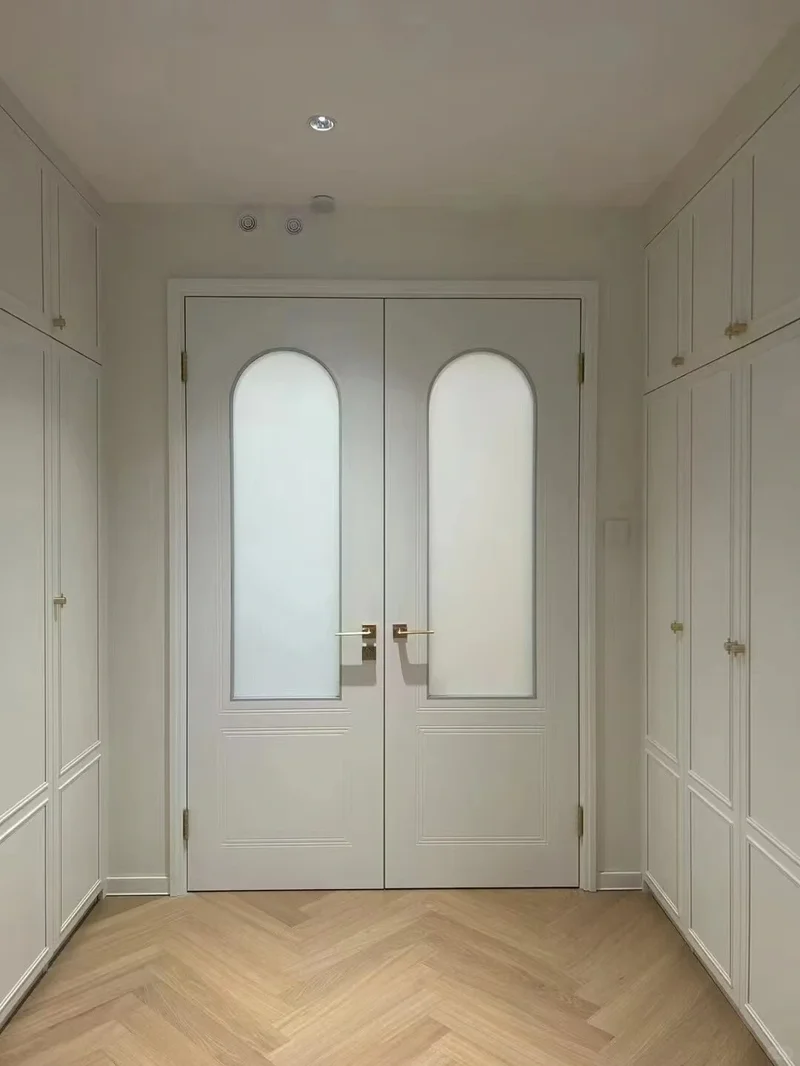
What impact resistance rating do your anti-theft steel doors achieve under EN 1627, and what structural reinforcements are used?
Doors meet EN 1627 RC3 (resisting 15-min tool attack) using 1.8 mm cold-rolled steel skins, 3-point armored locking, and central LVL/WPC hybrid cores (density: 850–900 kg/m³). Perimeter steel ribs (25×25 mm) add torsional rigidity to thwart prying.
How is long-term warping prevented in composite-filled steel door leaves exposed to humid climates?
We prevent warping via a tri-layer stabilization system: (1) cross-laminated LVL core (8 mm, moisture-resistant), (2) symmetrical WPC cladding (density 880 kg/m³), and (3) fully encapsulated PVC coating (0.5 mm) with UV-stabilized TiO₂ pigment to block hygroscopic swelling.
What is the U-value and sound insulation performance of your insulated anti-theft steel doors?
Our doors achieve U-values down to 0.8 W/m²K using 40 mm polyurethane-core sandwich panels (λ = 0.022 W/mK) and thermal-break perimeter seals. Acoustic performance reaches Rw 38 dB via constrained-layer damping between steel/WPC layers, ideal for high-security commercial entry points.
Can your doors withstand coastal salt spray and UV exposure without coating degradation?
Yes. Doors feature marine-grade 5052 aluminum-PVC co-extruded cladding (0.6 mm min thickness) with UV7-rated acrylic cap layers (≥5% TiO₂), passing 2,000-hour salt-spray (ISO 9227) and 5,000-hour xenon-arc weathering (ISO 4892-2) with <ΔE 2.5 color shift.
How does the WPC-steel hybrid structure maintain structural integrity during fire exposure?
Non-combustible steel skins (1.5 mm) encapsulate intumescent-treated WPC (density 870 kg/m³) and rockwool edge seals. At 200°C, charring is limited to <1.5 mm/min; doors maintain 60-minute integrity (EI60, EN 1634-1) without deformation or loss of lock functionality.
What maintenance protocols are required to preserve the security and appearance of anti-theft steel-WPC doors over 20+ years?
Annual inspection of hinges, locks, and perimeter seals is critical. Clean with pH-neutral detergent; avoid chlorinated solvents. Re-torque anchor bolts biannually. Anodic protection systems on steel edges and reapplication of UV-blocking clear coat every 8–10 years ensure longevity.