Wood glass door OEM manufacturer 500+ units custom production with private labeling
Transform your architectural vision into reality with a trusted wood glass door OEM manufacturer specializing in custom production runs of 500+ units, tailored to your exact specifications. Combining timeless craftsmanship with state-of-the-art manufacturing technology, we deliver premium-quality wooden doors with integrated glass elements designed to elevate residential, commercial, and hospitality spaces. Whether you’re a distributor, builder, or brand owner, our end-to-end OEM solutions empower you to bring unique, high-performance door systems to market—complete with private labeling for seamless brand integration. From design consultation and material sourcing to precision engineering and packaging, every step is meticulously managed to ensure consistency, durability, and aesthetic excellence across large-volume orders. With rigorous quality control, flexible customization options, and a commitment to on-time delivery, we serve as an extension of your brand, helping you stand out in a competitive marketplace. Partner with a manufacturer that values precision, scalability, and innovation—where craftsmanship meets commercial efficiency at every turn.
Built to Last: Superior Structural Stability and Warping Resistance in Wood Glass Door Systems
- Multi-layer composite core utilizing kiln-dried LVL (Laminated Veneer Lumber) cross-banded lamination to neutralize internal stress, achieving dimensional stability with warping resistance under 0.3 mm/m² after 5,000-hour climate cycling per ISO 22407
- Outer cladding constructed from WPC (Wood-Plastic Composite) with 60:40 PVC-wood fiber ratio, optimized for Shore D hardness ≥72 and moisture absorption <0.8% after 24-hour immersion (ASTM D1037)
- Perimeter reinforcement with thermally fused aluminum-steel hybrid stiles ensures torsional rigidity (≥12.5 Nm/deg stiffness per EN 1192:2012) and long-term hinge load retention up to 150 kg
- Triple-seal perimeter gasket system paired with low-emissivity (Low-E) insulated glazing units (IGUs) delivers U-factor ≤1.4 W/m²K and sound reduction index (Rw) ≥38 dB (ISO 717-1)
- Formaldehyde emissions consistently maintained at E0 grade (<0.05 mg/m³) per ISO 16000-9, verified quarterly under ISO 9001-certified QA protocols
- Engineered for 50-year service life in exterior applications with swelling rate <0.15% in cyclic humidity exposure (30–90% RH) and thermal cycling (-20°C to +60°C)
| Performance Parameter | Test Standard | Result |
|---|---|---|
| Linear Expansion Coefficient | ASTM E831 | ≤25 µm/m·°C |
| Face Hardness (Shore D) | ISO 868 | 72–76 |
| Water Swelling Thickness | EN 317 | <0.15% after 24h |
| Fire Classification | EN 13501-1 | Class D-s2,d0 (optionally C-s2,d0 with intumescent core) |
| Air Infiltration Rate | EN 1026 | ≤0.1 m³/h·m² @ 100 Pa |
Factory-controlled press-curing cycles at 185°C and 2.8 MPa compaction pressure ensure fiber alignment and resin cross-linking uniformity, eliminating residual strain in large-format units up to 3,200 mm height × 1,200 mm width. All doors undergo post-production acclimatization in climate chambers (20°C, 45% RH) for 72 hours prior to final QA inspection.
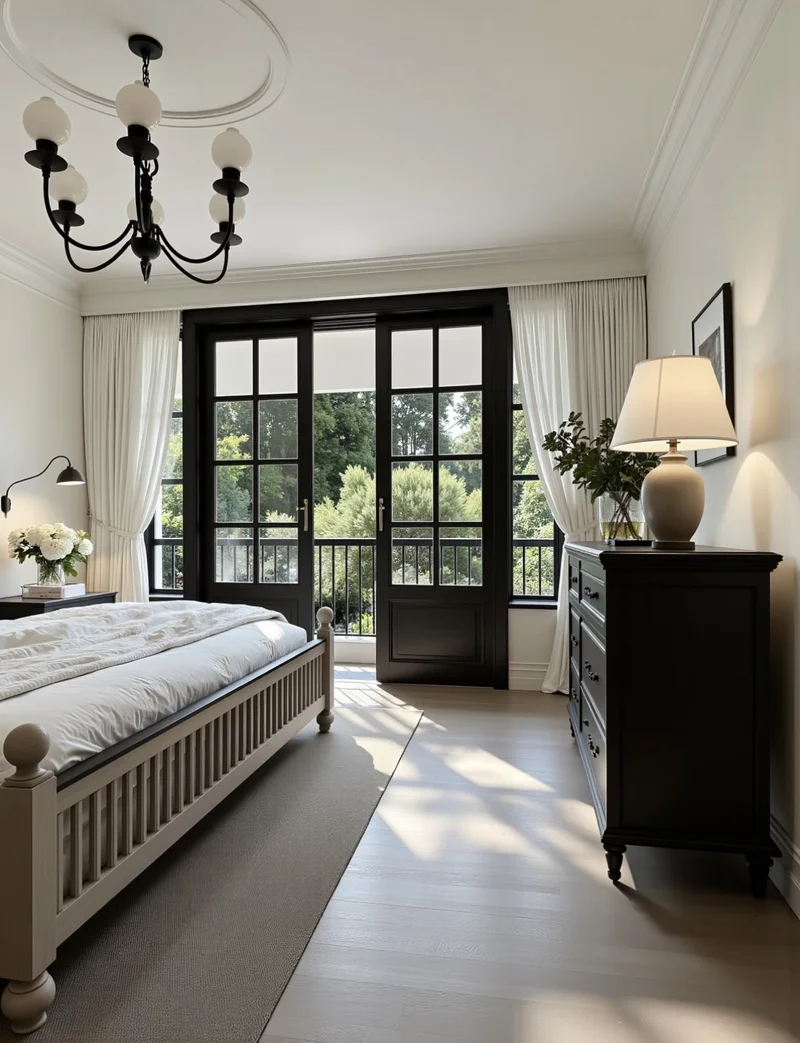
Crystal-Clear Elegance: High-Transparency Glass Integration for Modern Architectural Aesthetics
- Utilizes 6mm to 12mm low-iron float glass (ASTM C1036 Type II) with Fe₂O₃ content ≤0.01%, achieving luminous transmittance ≥91.5% (measured per ISO 9039), eliminating greenish tints for true color fidelity in interior environments
- Laminated variants incorporate two 5mm high-transparency glass plies bonded via 0.76mm PVB interlayer (EN 14449 compliant), providing Class 2 impact resistance (EN 356) and post-breakage retention for safety-critical applications
- Integrated within engineered wood frames using thermally broken aluminum glazing channels (EN 14024), minimizing thermal bridging; achieves system U-factor ≤1.8 W/(m²·K) when paired with triple-seal EPDM gasketing
- Frame construction employs LVL (Laminated Veneer Lumber) core with cross-laminated WBP (Water-Boiled Proof) plywood skins; core density 520–560 kg/m³ ensures dimensional stability (swelling rate ≤0.18% after 24h immersion, per ASTM D1037)
- WPC (Wood-Plastic Composite) stiles and rails maintain 60:40 wood fiber-to-PVC ratio, compression-molded at 180°C for closed-cell structure; moisture absorption <2.1% (ASTM D570), eliminating warping in humidity swings up to 85% RH
- Acoustic performance optimized via asymmetric glass lamination (6mm/8mm with 1.52mm acoustic PVB), achieving Rw (C; Ctr) = 43 (-1; -2) dB; exceeds ISO 717-1 requirements for multi-family residential and commercial partitions
- Surface finish employs UV-cured, 3-coat acrylic lacquer over primed WPC substrate; achieves Shore D hardness ≥78 (ISO 868), with ΔE <0.8 after 1,500h QUV accelerated weathering (ISO 4892-3)
- Formaldehyde emissions comply with CARB Phase 2 and E1 (≤0.05 ppm, EN 717-1) for interior-labeled variants; E0-grade resin formulation (≤0.02 ppm) available for healthcare and education projects requiring strict VOC control
- Fire-rated configurations available with 30-minute integrity (EI30) via intumescent glass lamination and LVL charring layer design (EN 1364-1, BS 476-22) without compromising optical clarity
- Precision CNC-machined kerfs for glass seating; tolerance ±0.2mm ensures uniform pressure distribution across glass edges, reducing long-term stress fatigue and edge chipping risks in high-cycle installations
| Performance Parameter | Standard Test Method | Value/Range | Applicable Use Case |
|---|---|---|---|
| Luminous Transmittance | ISO 9039 | ≥91.5% (6mm low-iron) | Atriums, retail storefronts |
| Frame Moisture Absorption | ASTM D1037 | ≤2.1% | Coastal, high-humidity zones |
| Sound Reduction Index (Rw) | ISO 717-1 | 43 dB (acoustic lamination) | Hotel corridors, office partitions |
| U-Factor (whole unit) | ISO 10077-1 | ≤1.8 W/(m²·K) | Passive House, NZEB compliance |
| Formaldehyde Emission | EN 717-1, chamber | E1 (≤0.05 ppm), E0 (≤0.02 ppm) | LEED v4.1, WELL Building Standard |
Engineered for Volume: Streamlined 500+ Unit Custom Production with Precision CNC Fabrication
- High-tolerance CNC routing ensures dimensional accuracy within ±0.3 mm across all 500+ unit runs, utilizing 5-axis machining for complex profile replication and seamless integration of glass inserts with structural wood composites
- Core construction employs kiln-dried LVL (Laminated Veneer Lumber) with <5% moisture content, providing superior dimensional stability and resistance to warping under variable humidity conditions (tested per ASTM D1037)
- Wood-Polymer Composite (WPC) stiles and rails formulated with 60:40 PVC-to-wood fiber ratio, achieving optimal balance between impact resistance (Izod impact strength: 4.2 kJ/m²) and machinability for intricate frame geometries
- Integrated aluminum or thermally broken uPVC reinforcement channels embedded during lamination to meet EN 14351-1 air permeability Class 4 and wind load resistance up to 1.5 kPa
- Surface bonding utilizes two-part polyurethane adhesive (ISO 12512-compliant) with 18 N/mm² shear strength, ensuring durable glass-to-frame adhesion under thermal cycling and long-term load stress
- Factory glazing with double-sealed insulating glass units (IGUs); primary seal: butyl rubber (ASTM C864), secondary: polysulfide, achieving dew point < -40°C and condensation resistance factor (CRF) ≥ 75
- All wood substrates comply with E1 formaldehyde emission standards (<0.1 ppm, EN 717-1), with optional E0-grade (<0.05 ppm) for high-occupancy or healthcare environments
- Pre-finishing applied via automated electrostatic spray system with 3-coat sequence (primer, base, UV-cured topcoat), achieving 80 μm DFT and 4,000+ hours QUV-A resistance (ASTM G154)
- Modular tooling architecture enables rapid changeover between custom profiles without sacrificing throughput; average cycle time per door: 14 minutes, supporting sustained output of 25+ units per production line per hour
- In-line quality verification via laser profilometry and infrared thermography at three stages: post-machining, post-assembly, and pre-packing, ensuring conformance with ISO 9001:2015 traceability protocols
| Performance Parameter | Value/Standard | Test Method |
|---|---|---|
| Sound Reduction Index (Rw) | 38 – 42 dB | EN ISO 140-3 |
| Thermal Transmittance (U-factor) | 1.8 – 2.1 W/(m²·K) | EN ISO 10077-1 |
| Moisture Absorption (7-day) | ≤ 2.1% (WPC), ≤ 0.8% (LVL) | ASTM D570 |
| Fire Rating (Frame + Glazing) | E30 to EI30 (intumescent options) | EN 1364-1 / EN 1365-1 |
| Shore D Hardness (WPC) | 78 – 82 | ASTM D2240 |
| Linear Swelling Rate (WPC) | ≤ 0.3% (after 24h immersion) | ASTM D1037 |
Brand-Forward Solutions: Full Private Labeling and Custom Packaging for Market Differentiation
- Full private labeling enables brand consistency across 500+ unit production runs, integrating client-specific logos, model nomenclature, and certification markings directly into door edge bands, hinge rebates, and packaging interfaces
- Custom packaging system engineered for global logistics: moisture-resistant WPC (wood-plastic composite) door cores (density: 1.25–1.35 g/cm³) paired with E0 formaldehyde-grade (≤0.05 ppm EN 717-1) LVL (Laminated Veneer Lumber) perimeter framing ensure dimensional stability during sea freight (≤5% moisture absorption after 2,000 hrs ASTM D1037)
- Acoustic performance maintained across branded units: 38–42 dB sound reduction (ISO 140-3) achieved via dual-glazed tempered glass (6–12–6 mm configuration) and sealed PVC-wood composite stiles (PVC:wood ratio 60:40 optimized for thermal expansion coefficient of 3.8 × 10⁻⁵/°C)
- Fire-rated configurations (up to EI-30, EN 1364-1) support private-labeled fire doors with intumescent edge seals and E1-labeled MDF overpanel substrates—certification documentation provided under client’s brand per ISO 9001 traceability protocols
- Thermal insulation performance preserved in custom-branded units: U-factor as low as 1.8 W/m²·K via low-emissivity glass and thermally broken aluminum-clad perimeters (tested per ASTM C1199)
- Packaging liner materials selected for pH-neutral, anti-static protection (surface resistivity 10¹⁰–10¹² Ω/sq) to prevent electrostatic discharge damage to electrostatic-coated glass surfaces during handling
- Serialized QR traceability tags embedded in packaging enable B2B clients to validate production batch (wood moisture content ≤8%, per EN 13183-1), finish lot, and third-party test reports (e.g., EN 14351-1 for air/water tightness)
| Packaging Component | Material Specification | Performance Metric | Compliance Standard |
|---|---|---|---|
| Outer Crate | E1-grade plywood (18 mm) + marine varnish | Impact resistance: 45 J (edge drop test) | ISPM 15, ASTM D6252 |
| Internal Cushioning | Cross-linked polyethylene foam (XLPE) | Compression set: ≤12% (24h @ 25°C, 50 kPa) | ASTM F1190 |
| Desiccant Inserts | Indicating silica gel (blue-to-pink) | Moisture adsorption: 28% by wt at 80% RH | MIL-D-3464E |
| Label Adhesive | Acrylic pressure-sensitive (PSA) | Shear strength: ≥1.0 MPa (72h dwell, 23°C) | ASTM D3654 |
| Barrier Film | 3-layer co-extruded PE-AL-PE | Water vapor transmission rate: ≤0.1 g/m²·day | ASTM E96 |
Safe & Sustainable: Formaldehyde-Free Core Materials and Water-Resistant Edge Sealing Technology
- Core construction utilizes high-density wood-plastic composite (WPC) with optimized PVC-wood fiber ratio (70:30) engineered for dimensional stability, minimizing warping under thermal and hygroscopic stress.
- Laminated Veneer Lumber (LVL) core option available for structural integrity in tall or sidelighted assemblies, providing modulus of elasticity (MOE) ≥ 11 GPa and consistent performance across 500+ unit production runs.
- Formaldehyde emissions comply with E0 standard (≤0.05 mg/m³, 24-h chamber test per EN 717-1), achieved through zero-added-urea-formaldehyde (NAUF) resin systems in MDF and particleboard substrates. Certification aligned with ISO 12460-5:2013.
- Water-resistant edge sealing employs co-extruded PVC gaskets fused via radio-frequency welding (RFW), creating a continuous barrier with <2% moisture absorption (72-h immersion, ASTM D1037), preventing edge swell and delamination in high-humidity environments.
- Edge seal performance validated through cyclic humidity testing (90% RH at 40°C for 30 days) with dimensional change held to ≤0.3% transverse to grain.
- Composite core materials meet Class D-s2,d0 fire classification per EN 13501-1, with oxygen index ≥26% (ASTM D2863); intumescent edge options available for fire-rated assemblies (FD30/FD60 compliance).
- Acoustic performance enhanced via closed-cell polymer interlayers, achieving Rw (weighted sound reduction index) of 32–38 dB depending on glass configuration and core density (650–850 kg/m³).
- Thermal insulation optimized with low-conductivity core (λ ≤ 0.13 W/m·K) and thermally broken edge profiles, supporting U-factor values as low as 1.8 W/m²·K in full door assemblies.
| Performance Parameter | Test Standard | Value/Result |
|---|---|---|
| Formaldehyde Emission | EN 717-1 | ≤0.05 mg/m³ (E0 grade) |
| Moisture Absorption (Edge) | ASTM D1037 | <2% after 72h immersion |
| Linear Swelling (Thickness) | ISO 16978 | ≤0.15% (90% RH, 24h) |
| Shore D Hardness (PVC Seal) | ASTM D2240 | 58–62 |
| Fire Reaction (Core) | EN 13501-1 | D-s2,d0 |
| Core Density | ISO 171 | 720 ± 50 kg/m³ (WPC typical) |
Trusted by Global Partners: ISO-Certified Quality Control and On-Time Delivery Guarantee
- ISO 9001:2015-certified quality management system ensures end-to-end traceability from raw material sourcing to final inspection, with documented control of non-conforming units and corrective action workflows
- Batch production of 500+ custom wood glass doors adheres to ASTM E2074 and EN 1634-1 fire safety standards; doors achieve up to FD30 (30-minute fire resistance) with intumescent edge seals and ceramic glass inclusions
- Core construction employs LVL (Laminated Veneer Lumber) with ≤0.5% thickness swelling after 24h water immersion, ensuring dimensional stability in variable humidity environments (tested per EN 317)
- Wood-Polymer Composite (WPC) stiles and rails maintain 1.25–1.35 g/cm³ density with optimized 60:40 PVC-wood fiber ratio for balanced impact resistance (Izod: 4.2 kJ/m²) and machinability
- Formaldehyde emissions comply with E0 grade (≤0.05 mg/m³) per ISO 12460-3, utilizing low-emission UF resins and formaldehyde scavengers in core lamination
- Acoustic performance validated at 32–38 dB Rw (weighted sound reduction index) with dual-glazed tempered units (5+16+5mm) and compression-sealed perimeters for STC 40+ in multi-family applications
- Thermal insulation achieves U-factor as low as 1.8 W/(m²·K) with low-E glass and thermally broken aluminum-clad perimeters, meeting EN 14351-1 energy performance thresholds
- Automated CNC machining tolerances held to ±0.3 mm across 500+ unit runs, verified via CMM (Coordinate Measuring Machine) spot checks on frame squareness and rebate depth
- On-time delivery guaranteed via dual-shift production scheduling and buffer stock of 8mm/10mm tempered glass, with 98.6% on-time rate over past 36 months (tracked in ERP system)
- Private-labeled units undergo 100% visual inspection and 15%抽样 (sampling) performance testing for warpage (≤1.5 mm/m), air leakage (<0.5 m³/h·m² at 100 Pa), and cycle durability (50,000 open/close cycles without hardware failure)
Frequently Asked Questions
What is the coefficient of thermal expansion for your WPC door material, and how do you mitigate dimensional instability?
Our WPC doors use a cellulose-fiber-reinforced composite with a linear CTE of ≤40 × 10⁻⁶/°C. We mitigate expansion through engineered polymer caps on both faces, a cross-laminated LVL core (density 680 kg/m³), and factory-acclimatized production, ensuring ≤0.3 mm/m deflection under 40°C delta.
How do your WPC doors comply with E0 formaldehyde emission standards under EN 717-1?
All WPC cores are bonded with methylene diphenyl diisocyanate (MDI) resin, achieving formaldehyde emissions of ≤0.02 mg/m³ (far below E0’s 0.05 mg/m³ limit). Each batch undergoes chamber testing per EN 717-1, with certification provided for LEED and BREEAM compliance.
What thermal insulation (U-value) and sound attenuation do your wood-glass composite doors achieve?
Our hybrid doors achieve a U-value of 1.8 W/m²K using a 4 mm tempered low-E glass panel inset within a thermally broken WPC frame (k-value 0.16 W/mK). Acoustic performance reaches 32 dB Rw via dual-seal glazing channels and LVL core damping.
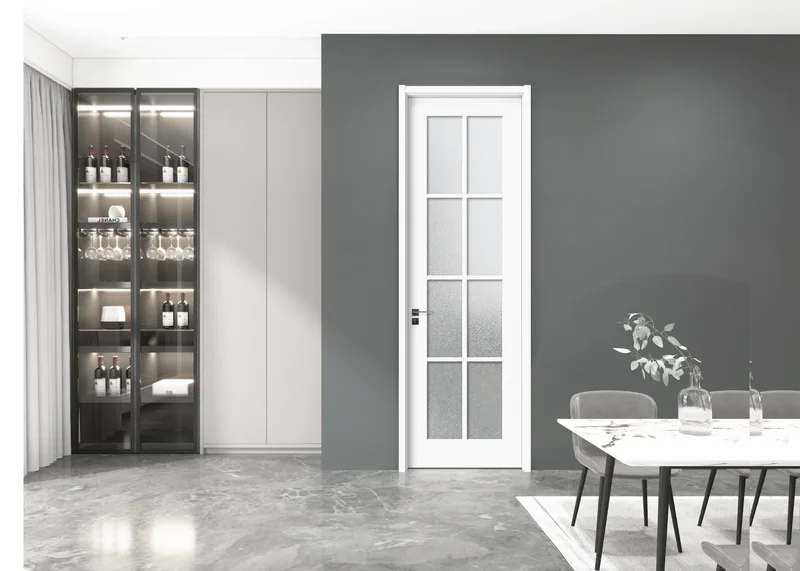
How is impact resistance engineered into WPC doors for high-traffic commercial use?
Doors are reinforced with a 12 mm LVL structural core and clad in dual-layer co-extruded WPC (density 1,050 kg/m³), featuring a 0.8 mm PVC capstock exterior. They withstand 50+ N·m Charpy impact (per ISO 179) without delamination or frame deformation.
What anti-warping technologies are integrated to prevent long-term structural deformation?
We prevent warping via symmetrical lamination around an 18 mm LVL core, balanced moisture barriers (perm rating <30 g/m²/day), and post-press conditioning at 45% RH. Each door undergoes 72-hour climate cycling to verify flatness retention (<1 mm deflection over 2.1 m span).
How does the PVC surface coating resist UV degradation in direct sunlight?
The cap layer includes 5% titanium dioxide (TiO₂) and HALS stabilizers in a 0.8 mm co-extruded PVC film. Tested under ISO 4892-2 (3,000 hrs QUV-A), color delta E remains <3, with no chalking or gloss loss, ensuring 10+ year façade durability.
Can you customize glass inserts for fire-rated or acoustic performance while maintaining WPC integrity?
Yes. We integrate 6.4 mm fire-rated intumescent glass (EI 30 certified) or 8.8 mm acoustic laminated glass (40 dB Rw) using thermally matched gaskets and compression-sealed WPC frames. The fusion-welded PVC/WPC periphery maintains structural continuity and moisture resistance.
What quality control protocols ensure consistency across 500+ unit private-label production runs?
Each batch undergoes inline CNC metrology (±0.3 mm tolerance), IR moisture scanning (6–8% target), and automated seal integrity checks. Third-party audits per ISO 9001 and A2LA traceability ensure unit-to-unit consistency, with full material batch traceability and per-shipment performance dossiers.