Wood glass door ODM service design R&D (frame+glass matching) for brand partners
In the world of architectural design, the door is more than an entryway; it is a statement of craftsmanship and a pivotal element of brand identity. For forward-thinking brands seeking to differentiate their offerings, the synergy between a wooden frame and its glass infill is where true distinction is born. Our specialized ODM service is dedicated to this precise art of matching. We partner with you from the ground up, merging your vision with our expertise in material science, structural engineering, and aesthetic design. Through collaborative research and development, we transform conceptual elegance into tangible, high-performance wood glass doors. This is not merely manufacturing—it is a co-creative journey to develop signature products that embody your brand’s unique character and uncompromising standards.
Elevate Your Brand with Custom Wood-Glass Door Solutions: Tailored ODM Design for Unique Architectural Needs
Custom wood-glass door ODM is a precision engineering discipline, transforming architectural specifications into high-performance, branded building components. Success hinges on the scientific integration of frame material properties with glazing performance, engineered to meet exacting project standards.
Core Engineering Philosophy: The Frame-Glazing System
We treat the door as a unified system where frame and glass are co-engineered. The structural frame dictates load-bearing capacity and long-term dimensional stability, while the glazing unit defines environmental performance. Our R&D focuses on optimizing this interface for superior performance.
Advanced Frame Material Science & Engineering
We engineer composite wood substrates to surpass the limitations of solid timber, providing predictable performance for large-format door systems.
- High-Density WPC (Wood Plastic Composite): Engineered for extreme environments. A high wood flour content (typically >60%) bonded with premium polymers yields a density >1.2 g/cm³, resulting in minimal water absorption (<0.5%) and superior resistance to warping, termites, and decay.
- PVC-Wood Hybrid Profiles: Optimized for thermal break performance. The precise PVC-to-wood ratio is calibrated to achieve a low U-factor while maintaining structural rigidity and a consistent surface for finishing.
- LVL (Laminated Veneer Lumber) Core: Provides exceptional dimensional stability for large panels. The cross-laminated, engineered wood core minimizes swelling and shrinkage, with typical thickness swelling rates below 8% after 24-hour immersion, ensuring long-term alignment and operation.
Technical Performance Parameters
Our ODM process is governed by verifiable international standards, ensuring compliance for global projects.
| Performance Category | Standard / Metric | Typical ODM Specification Range |
|---|---|---|
| Structural & Durability | Bending Strength (ASTM D1037) | 35 – 55 MPa |
| Shore D Surface Hardness | 75 – 85 | |
| Thickness Swelling (24h) | ≤ 0.8% (WPC), ≤ 8% (Engineered Wood) | |
| Environmental Safety | Formaldehyde Emission | E0 (≤0.5 mg/L) or E1 (≤1.5 mg/L) per EN 717-1 |
| Fire Resistance Rating | Up to 30/60 mins (EN 13501-2 or local equivalent) | |
| Acoustic & Thermal | Sound Reduction (Rw) | 30 – 40 dB (system-dependent) |
| Thermal Transmittance (U-value) | 1.2 – 2.0 W/(m²·K) (with insulated glass unit) |
Tailored Glazing Integration: Beyond Aesthetics
Glass selection is a functional specification. We engineer the glazing pocket and sealing system to match the performance profile of the chosen glass unit.
- Acoustic Performance: Laminated glass with specialized PVB interlayers (e.g., acoustic dampening interlayer) is specified to achieve target Rw values, with seals engineered to prevent flanking sound transmission.
- Thermal & Solar Control: We integrate double or triple glazing units with Low-E coatings and argon fill. The thermal expansion coefficients of frame and spacer are matched to prevent seal failure and maintain insulating value over the product lifecycle.
- Safety & Security: Laminated glass provides impact resistance and hold-in-place performance. The frame is reinforced at hinge and lock points to withstand forced-entry loads, creating a certified system.
The ODM Advantage for Brand Partners:
- IP Protection & Brand Consistency: Full control over design patents, tooling, and finish specifications ensures your brand identity is perfectly executed and legally protected.
- Technical Documentation: We provide comprehensive submittal packages including material datasheets, independent test reports (fire, acoustic, structural), and detailed installation guides.
- Supply Chain Integrity: Rigorous quality management (ISO 9001) from raw material sourcing to finished product, ensuring every unit bearing your brand meets the published specification.
Seamless Frame and Glass Integration: Engineered for Structural Stability and Aesthetic Harmony
The structural integrity and visual continuity of a wood-glass door are defined at the interface of frame and glazing. Our R&D process engineers this integration as a unified system, where material properties and precision joinery ensure long-term performance without compromising design intent. The core principle is managing differential movement and stress concentration between the composite frame and the glass panel.
Material Synergy for Dimensional Stability
Frame stability is non-negotiable for maintaining glass seal integrity and door operation. We specify engineered wood composites based on performance parameters, not aesthetics alone.
- High-Density WPC (Wood Plastic Composite) Frames: Engineered with a wood flour to polymer (typically PVC/PP) ratio optimized for minimal hygroscopic expansion. Typical density ranges of 1.3-1.5 g/cm³ provide the necessary Shore D hardness (75-85) for hardware mounting while maintaining consistent moisture absorption rates below 0.8%.
- LVL (Laminated Veneer Lumber) Core Reinforcement: For full-wood veneer frames, a cross-banded LVL core is mandatory. This laminated structure neutralizes internal wood stresses, reducing warping potential and providing a stable substrate for precision machining of the glazing rebate.
- Hybrid Polymer-wood Profiles: For ultra-high moisture resistance (e.g., spa or coastal applications), co-extruded profiles with a solid polymer exterior shell and wood-composite interior offer swelling rates below 0.1% per 24hrs immersion.
Glazing System Engineering
The glazing channel is machined to exacting tolerances to accommodate the specific glass assembly, which functions as a structural shear panel.
| Glazing System Component | Technical Parameter & Function | Performance Standard / Typical Value |
|---|---|---|
| Primary Seal (Structural) | Butyl or PIB-based sealant. Provides long-term adhesion and moisture barrier. | Adhesion strength > 0.7 N/mm²; Low gas permeability. |
| Spacer & Desiccant | Aluminum or composite spacer filled with molecular sieve. Manages interstitial condensation. | Dew point < -40°C per ASTM E546; Thermal break spacer for improved U-factor. |
| Secondary Seal (Weather) | Silicone or polysulfide. Provides flexibility for thermal and dynamic movement. | Elastic recovery > 80%; Movement accommodation capability ±12.5%. |
| Glazing Block & Shim | Ethylene Propylene Diene Monomer (EPDM) or rigid PVC. Distributes weight, prevents glass-to-frame contact. | Shore A hardness 70-80 (EPDM); Chemically inert. |
Integrated Performance Outcomes
This systems approach yields quantifiable architectural advantages:
- Structural Wind Load Resistance: The mechanically locked glass unit transfers lateral loads to the frame, with systems tested to meet EN 12211 for performance up to Class C4 (2400 Pa).
- Acoustic Insulation: A combination of laminated glass (with PVB or ionomer interlayer), airtight seals, and dense frame materials achieves STC ratings of 35-42 dB, suitable for commercial partitions and residential sound control.
- Thermal Efficiency: The use of warm-edge spacers, low-E coated IGUs, and thermally broken or low-conductivity frames results in U-factors as low as 0.28 Btu/(hr·ft²·°F) (1.6 W/m²K).
- Fire & Safety Compliance: Glazing can be specified to meet EN 13501-2 integrity classifications (E, EI). All composite materials are certified to E0 or E1 formaldehyde emission grades (EN 717-1, JIS A 1460), with inherent flame retardancy options.
Aesthetic Cohesion Through Precision
The technical foundation enables clean aesthetics. We achieve seamless visual lines through:
- Shadow Line Consistency: Machined glazing rebates ensure a uniform reveal depth around the entire door perimeter.
- Flush Glazing Options: For a fully planar appearance, glass can be set flush with the frame face, protected by a minimal silicone fillet or a mechanically fastened trim.
- Color & Texture Matching: Wood veneers, foils, and paint finishes are applied post-assembly to ensure color continuity across the frame and any applied cover strips, eliminating visible seams.
Advanced Material Technology: Waterproof and Formaldehyde-Free Construction for Health and Durability
The structural integrity and indoor environmental quality of a wood-glass door are fundamentally determined by the composite technology of its frame. Our ODM R&D focuses on engineered wood composites that eliminate inherent weaknesses of solid timber while surpassing conventional MDF or particleboard in performance. The core technology is a multi-layered, co-extruded Wood-Plastic Composite (WPC) system, engineered for zero water absorption and zero formaldehyde emission.
Core Material Science & Construction
The frame utilizes a high-density WPC (≥ 1.1 g/cm³) shell with a rigid Polyvinyl Chloride (PVC) matrix encapsulating precisely graded wood flour. This PVC-wood ratio is optimized for dimensional stability, achieving a Shore D hardness of 75-80. The core is a cross-laminated LVL (Laminated Veneer Lumber) or a proprietary extruded polymer foam, selected for application to resist warping and provide a stable substrate for hardware. All laminates and edgebands are bonded with isocyanate (EPI) or PUR (Polyurethane Reactive) adhesives, which are inherently formaldehyde-free.
Formaldehyde-Free Certification & Health Standards
All composite materials, adhesives, and finishes comply with the strictest international health standards. We guarantee emissions not exceeding E0 grade (≤ 0.5 mg/L per JIS A 1460 or equivalent), often achieving CARB Phase 2 and EPA TSCA Title VI compliance. This is verified through third-party testing via the chamber method (ISO 16000, ASTM D6007). The complete absence of urea-formaldehyde resins is a non-negotiable specification in our material stack.
Technical Performance Data
The following table quantifies the performance advantages of our advanced composite system against common benchmarks.
| Performance Parameter | Advanced WPC/LVL Composite | Solid Timber (Oak) | Standard MDF |
|---|---|---|---|
| Water Absorption (24h) | ≤ 0.8% (ASTM D570) | 12-18% | Complete delamination |
| Thickness Swelling (24h) | ≤ 0.5% (EN 317) | 5-8% | > 25% |
| Formaldehyde Emission | E0 / F**** (≤ 0.3 mg/L) | Naturally < E0 | Typically E1 (≤ 1.5 mg/L) |
| Fire Rating (Core) | Class B-s1, d0 (EN 13501-1) | Class D | Class D |
| **Thermal Insulation (U-factor)*** | 1.2 – 1.8 W/m²K | ~ 2.5 W/m²K | ~ 2.2 W/m²K |
| **Acoustic Insulation (Rw)*** | 28 – 35 dB (EN ISO 10140) | 25 – 30 dB | 20 – 25 dB |
*Performance range depends on overall door system design, glass type, and seals.
Functional Advantages for Architectural Specification
- Total Moisture Immunity: The closed-cell PVC matrix and sealed edges result in a 24-hour water absorption rate below 0.8%, making the frame suitable for high-humidity environments (e.g., bathrooms, coastal properties, and commercial entries) without risk of swelling, rot, or mold.
- Guaranteed Indoor Air Quality: The E0/F**** material stack ensures no contribution to VOC loadings, critical for healthcare, educational, and residential projects with stringent IEQ (Indoor Environmental Quality) mandates like LEED or WELL.
- Dimensional Stability: Coefficient of thermal expansion is engineered to match that of insulating glass units, minimizing stress on seals. The system maintains operational integrity across a temperature range of -20°C to 60°C.
- Structural Longevity: The combination of a high-density wear surface and a stable, non-biodegradable core provides superior resistance to impact, scratching, and cyclic loading compared to homogeneous materials.
Precision R&D for High-Performance Doors: Meeting Rigorous Standards in Commercial and Residential Settings
Precision R&D begins with the molecular-level engineering of the door frame composite. We utilize a proprietary high-density Wood Plastic Composite (WPC) formulation, where the precise PVC-to-wood-flour ratio is optimized for dimensional stability and structural integrity. This core is often reinforced with a cross-laminated LVL (Laminated Veneer Lumber) spine, providing exceptional resistance to warping and torsional stress. The composite is engineered to achieve a moisture absorption rate below 1.5% (ASTM D570), ensuring performance in high-humidity environments. Frame surface treatments are not merely aesthetic; they are multi-layer co-extruded polymer caps with a minimum Shore D hardness of 75, providing superior scratch, impact, and UV resistance.
Glass integration is a structural science, not just a glazing operation. Our R&D focuses on the compatibility of thermal expansion coefficients between frame and glass unit, preventing seal failure and stress fractures. We engineer the glazing channel depth, compression of the dual-seal gasket system (EPDM or silicone), and the strategic placement of thermal breaks to create a unified performance assembly.
Functional Advantages of the Engineered System:
- Structural & Dimensional Stability: LVL-reinforced WPC core maintains door geometry with a swelling rate of <0.5% under 90% RH, critical for consistent operation and sealing.
- Superior Acoustic Performance: Achieves up to 38 dB (Rw) sound reduction through mass-loaded glass options (laminated with acoustic PVB interlayer) and precisely sealed, gasketed frames.
- Advanced Thermal Insulation: Configurable U-factors as low as 0.8 W/(m²·K) using warm-edge spacers, argon-filled cavities, and low-E coatings matched to the frame’s thermal break profile.
- Enhanced Fire & Safety Integrity: Frame composites are formulated for low flammability and can be paired with fire-rated glass to achieve certified ratings (e.g., EI30/EI60 per EN 13501-2).
- Sustainable Material Integrity: All composites adhere to E0 (<0.5 mg/L) formaldehyde emission grades (EN 16516), with formulations utilizing recycled polymer content without compromising performance.
Technical Performance Parameters for Standard Configurations
| Performance Category | Test Standard | Residential Grade Specification | Commercial Grade Specification | Key Influencing Factors |
|---|---|---|---|---|
| Thermal Insulation (U-factor) | EN ISO 10077-1 / ASTM C1199 | 1.2 – 1.6 W/(m²·K) | 0.8 – 1.2 W/(m²·K) | Glass type (double/triple, low-E), gas fill, spacer conductivity, frame thermal break design. |
| Acoustic Insulation (Rw) | EN ISO 10140-1 / ASTM E90 | 32 – 35 dB | 35 – 38 dB | Glass mass & laminate interlayer, glazing seal integrity, frame mass and damping. |
| Structural Load (Door Leaf) | EN 14351-1 / ASTM E330 | Positive & Negative Pressure @ 1200 Pa | Positive & Negative Pressure @ 1800 Pa | LVL core reinforcement, corner joint engineering (integrated polymer reinforcement), hardware mounting point design. |
| Fire Resistance (When Specified) | EN 13501-2 / ASTM E119 | – | EI 30 / EI 60 | Frame composite formulation, intumescent seal expansion, compatibility with certified fire-rated glazing. |
| Durability (Cycle Testing) | EN 1191 / ANSI/BHMA A156.2 | 100,000 cycles (Grade 4) | 200,000 cycles (Grade 1) | Hardware integration geometry, bearing surface material, hinge and lock reinforcement. |
Our R&D protocol is governed by a certified ISO 9001 quality management system, ensuring traceability and consistency from raw material batch testing to final performance validation. This data-driven approach allows for precise matching of frame and glass components to meet project-specific architectural specifications, local building codes, and brand partner performance benchmarks.
Streamlined Partnership Process: From Concept to Production with Expert Support and Quality Assurance
Phase 1: Concept & Feasibility Engineering
Our R&D team initiates the partnership with a technical deep-dive. We analyze your design concept against performance requirements, material constraints, and manufacturing parameters. This stage defines the critical path:
- Material Selection Matrix: We evaluate substrate options (e.g., high-density WPC vs. LVL core, solid wood stiles) based on dimensional stability, moisture absorption (<8% per ASTM D1037), and required Shore D hardness for machining.
- Glass & Frame Integration Protocol: Determining the compatibility of glass type (e.g., laminated acoustic, low-E insulated) with the frame’s thermal expansion coefficient and structural load capacity. We model stress points at the glazing rebate.
- Regulatory Compliance Roadmap: Establishing target certifications (EN 1634-1 fire integrity, ASTM E90 Sound Transmission Class, CARB/EN 16516 formaldehyde emission E0/E1) to guide material sourcing and production.
Phase 2: Design for Manufacturing (DfM) & Prototyping
Engineering drawings transition into functional prototypes. Our focus is on manufacturability without compromising design intent or performance.
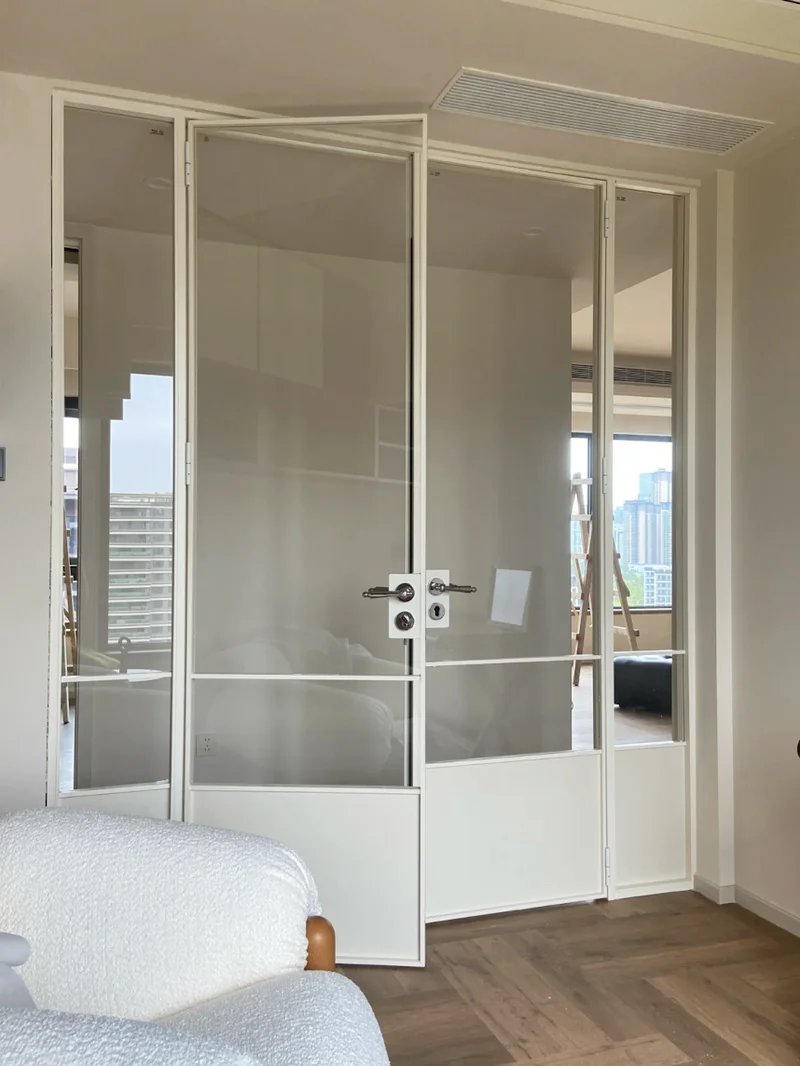
- Jointing & Stability Analysis: Specifying joinery (e.g., multi-point mortise and tenon, concealed hardware integration) and core materials to prevent warping. LVL core stability is verified under varying humidity cycles (per EN 942).
- Glazing System Detailing: Engineering the sash profile, gasket geometry (EPDM vs. TPE), and drainage system to achieve target performance:
- Thermal Insulation: U-factor calculations for the complete door assembly.
- Acoustic Performance: Target dB reduction validated through material mass and glass interlayer selection.
- Weathering & Durability: Sealant compatibility and finish adhesion testing.
Phase 3: Pre-Production Validation & Quality Gates
Prior to tooling and line setup, prototypes undergo rigorous validation against agreed specifications.
| Validation Stage | Key Parameters Tested | Standards / Metrics |
|---|---|---|
| Material Compliance | Formaldehyde emission, density, MOR (Modulus of Rupture) | EN 16516 (E0/E1), ASTM D1037 |
| Performance Testing | Operational force, cycle testing, air/water/structural resistance | ANSI/BHMA A156.115, EN 12207-12211 |
| Dimensional & Finish QA | Profile tolerances (±0.5mm), coating adhesion, color consistency | ISO 9001 controlled gauging, cross-cut test per ASTM D3359 |
Phase 4: Production & Sustained Quality Assurance
With approved samples, full-scale production commences under integrated quality controls.
- In-Line Process Control: Real-time monitoring of critical processes: PVC extrusion temperatures, WPC composite ratios, laminate press pressure/time cycles, and glass sealant application.
- Batch Testing Regime: Random sampling from each production lot for destructive and non-destructive testing, ensuring continuous compliance.
- Documentation & Traceability: Full material lot traceability (from substrate to finish) and test reports provided with shipment, ensuring transparency for your site approvals and regulatory audits.
Phase 5: Expert Support & Continuous Improvement
Partnership extends beyond delivery. Our engineering support provides:
- Technical Documentation Package: Detailed installation guides, material safety data sheets (MSDS), and maintenance protocols specific to the product.
- Field Performance Feedback Loop: Analysis of any site-reported issues to inform future material or process enhancements.
- Value Engineering Consultancy: Ongoing collaboration to optimize product lines for cost, sustainability, or performance based on market feedback.
Frequently Asked Questions
How do you prevent long-term warping in wood-glass door frames?
We use LVL (Laminated Veneer Lumber) core reinforcement with balanced construction to counteract internal stress. Frames are engineered with a moisture-resistant WPC cladding (density ≥ 650 kg/m³) and a multi-layer UV-cured finish, stabilizing the material against humidity fluctuations and thermal cycling to ensure dimensional integrity.
What standards govern formaldehyde emissions in your composite materials?
All our wood-plastic composites and adhesives comply with the strictest international standards: E0 (≤0.05 ppm) and EN 717-1 Class E1. We use zero-added-formaldehyde resins and conduct batch testing via the chamber method, ensuring indoor air quality safety for residential and commercial projects.
How is thermal insulation performance quantified in your door systems?
Our doors achieve a U-value as low as 1.0 W/(m²·K) through a combination of thermally broken aluminum or reinforced PVC frames, dual-sealed insulated glass units (argon-filled, Low-E coated), and high-density WPC infill. This significantly reduces energy transfer and condensation risk.
What solutions exist for impact resistance and security in glass panels?
We integrate laminated safety glass with PVB or SGP interlayers (up to 10.8mm total thickness), which meets ANSI Z97.1 impact standards. For high-security needs, the glass can be tempered and paired with multi-point locking systems embedded in a reinforced frame for forced-entry resistance.
How do you manage the differential expansion between wood composites and glass?
We engineer a proprietary compression gasket system using EPDM or TPE seals within a designed expansion gap. This accommodates the distinct thermal expansion coefficients of WPC (≈50 x 10⁻⁶ /K) and glass (≈9 x 10⁻⁶ /K), preventing seal failure and ensuring consistent weatherproofing.
What acoustic insulation levels can your door assemblies achieve?
Our engineered doors provide sound insulation up to 40 dB Rw. This is achieved through laminated glass configurations (asymmetrical thicknesses), airtight magnetic seals, and high-mass, mineral-filled WPC cores that effectively dampen sound wave transmission for urban or high-noise environments.
Which finishing processes ensure exterior durability against weathering?
We apply a 5-stage finishing process: chromate pretreatment, electrostatic PVC coating (minimum 200µm), and UV-resistant acrylic topcoat. This provides a Class 1 weathering rating (GB/T 1766), excellent color retention, and resistance to moisture, corrosion, and fading for over 15 years.
How is structural integrity maintained at the door frame and hinge junctions?
Critical stress points are reinforced with galvanized steel or aluminum alloy inserts cast directly into the WPC profile during extrusion. Hinge plates are through-bolted into these metal reinforcements, distributing load and preventing sagging under repeated use with doors weighing over 80kg.