Aluminum Glass Doors with Stainless Steel Hardware for Malls
In the dynamic world of retail architecture, first impressions are everything. The entrance to a mall is more than a threshold; it is a statement of modernity, security, and inviting elegance. Aluminum glass doors, engineered for durability and sleek minimalism, provide the perfect solution. Framed in robust yet lightweight aluminum, these expansive glass panels flood interior spaces with natural light, creating an open, welcoming atmosphere that beckons shoppers inside. The integration of premium stainless steel hardware elevates this functionality to an art form. Beyond its polished, corrosion-resistant finish, this hardware ensures smooth, reliable operation under the constant demands of high-traffic environments. Together, this combination delivers a seamless blend of aesthetic appeal, enduring performance, and a subliminal promise of a premium shopping experience from the very first touch.
Enhancing Mall Aesthetics and Safety with Sleek, Durable Entrances
The primary entrance is the architectural focal point of a mall, setting the tone for the retail experience. Achieving a balance between dramatic visual appeal and uncompromising performance requires a meticulous engineering approach to material selection and system integration.
Material Science & Technical Specifications
The performance of an entrance system is dictated by the properties of its constituent materials. Aluminum-glass door systems with stainless steel hardware represent the optimal technical solution.
-
Aluminum Alloy & Glazing: High-grade 6063-T5 or 6061-T6 aluminum alloys are standard, providing a yield strength exceeding 160 MPa. They are thermally broken with polyamide (PA66) strips with a minimum 24mm bridge depth to prevent condensation and heat transfer. Glazing is typically tempered or laminated safety glass, with options for low-E coatings to achieve U-factors as low as 1.0 W/(m²·K). For critical safety areas, laminated glass with a 1.52mm PVB interlayer provides exceptional impact resistance and post-breakage integrity.
-
Stainless Steel Hardware: Hardware components—pivots, closers, locks—must be manufactured from 300-series (304 or 316) stainless steel. Grade 316, with its added molybdenum, is specified for coastal or high-pollution environments for superior pitting resistance. Critical performance metrics include cycle testing to exceed 500,000 cycles (EN 1527) and a minimum door holding force of 1300N for panic hardware (EN 1125).
Functional Advantages & Architectural USPs
- Structural Integrity & Safety: Engineered for high-traffic loads, with frame deflection limits defined by ASTM E1300. Integrated panic hardware and fire-rated options (up to 120 minutes, certified to EN 1634-1 or ASTM E119) ensure life safety compliance.
- Durability & Maintenance: The anodized or powder-coated aluminum finish (qualifying to AAMA 2604/2605 standards) and inherent corrosion resistance of stainless steel result in a system with a lifecycle exceeding 30 years with minimal maintenance.
- Aesthetic Cohesion & Customization: The slim sightlines of aluminum profiles maximize glass area, enhancing transparency. Finishes can be precisely matched (e.g., brushed stainless steel hardware with a matching aluminum finish) for a monolithic appearance. Custom anodized colors and glass tints are available.
- Environmental Performance: Thermal breaks and low-E glazing significantly reduce thermal bridging, lowering HVAC loads. Acoustic insulation performance can achieve a Sound Transmission Class (STC) rating of up to 40 dB for noise-sensitive locations.
Technical Performance Comparison: Standard vs. Enhanced Configurations
| Parameter | Standard Configuration | Enhanced Performance Configuration | Test Standard |
|---|---|---|---|
| Thermal Transmittance (U-value) | 2.8 – 3.5 W/(m²·K) | 1.0 – 1.6 W/(m²·K) | EN ISO 10077-1 / NFRC 100 |
| Air Infiltration | Class 3 (≤ 9.0 m³/(h·m²)) | Class 4 (≤ 3.0 m³/(h·m²)) | EN 12207 / ASTM E283 |
| Water Tightness | Class 5A (600 Pa) | Class 7A (≥ 900 Pa) | EN 12208 / ASTM E331 |
| Wind Load Resistance | Class C3 (1200 Pa) | Class C5 (≥ 2000 Pa) | EN 12210 / ASTM E330 |
| Acoustic Insulation (STC/Rw) | 28 – 32 dB | 35 – 40 dB | EN ISO 10140 / ASTM E90 |
Specification Guidance
For procurement and installation, architects should specify:
- Material Certifications: Mill certificates for aluminum alloy (EN 755-9) and stainless steel (EN 10088-3), plus test reports for thermal break profiles.
- Performance Ratings: Clearly defined required classes for air, water, wind, and thermal performance from the tables above.
- Hardware Standards: All hardware must be certified to relevant EN (e.g., EN 1154 for closers) or ANSI/BHMA (e.g., A156.115 for pivots) standards, with a defined minimum cycle life.
- Glazing Specification: Full specification including glass type (tempered, laminated), thickness, interlayer, coatings, and safety compliance (CPSC 16 CFR 1201 or EN 12600).
Engineered for High-Traffic Durability: The Structural Integrity of Our Aluminum Glass Doors
The structural integrity of a mall entrance system is non-negotiable. Our aluminum-glass door assemblies are engineered from first principles to withstand cyclical loading, impact, and environmental stress for decades. The core philosophy is a synergistic system where each component’s material properties are specified to meet precise performance thresholds.
Material Specifications & System Synergy
- Aluminum Alloy & Fabrication: We utilize 6063-T6 or 6061-T6 aluminum alloys, thermally treated to a T6 temper for optimal strength-to-weight ratio. Extrusions are designed with multi-chambered profiles for structural rigidity and thermal break. Minimum profile wall thicknesses exceed 1.8mm for critical structural members, with 2.5mm+ standard for threshold and stile sections.
- Glass Specification: Laminated safety glass is mandatory. A typical configuration is 10.76mm (6mm tempered outer pane + 1.52mm PVB interlayer + 6mm tempered inner pane). The PVB interlayer retains glass fragments upon impact and contributes to acoustic damping (achieving up to 40 dB sound reduction). For enhanced performance, options include low-E coatings and argon-filled insulated glass units (IGU) with U-factors as low as 1.1 W/(m²·K).
- Stainless Steel Hardware: All load-bearing hardware—continuous geared hinges, multi-point lock mechanisms, and pivot sets—is manufactured from 316-grade austenitic stainless steel. This grade provides superior chloride resistance crucial for environments with high human traffic and winter de-icing salts. Components undergo precision machining and are rated for a minimum of 1,000,000 cycles.
Performance Data & Testing Compliance
All systems are validated against international standards to ensure predictable, long-term performance.
| Performance Characteristic | Test Standard | Our Specification | Industry Typical |
|---|---|---|---|
| Operational Cycle Life | EN 16361 / ASTM F1574 | >1,000,000 cycles | 250,000 – 500,000 cycles |
| Static Load (Deflection) | EN 14019 | < L/200 at 1200 Pa | < L/200 at specified load |
| Hardness (Anodized Finish) | ISO 2819 | ≥ 15 HV (Hardcoat, 25µm min) | ≥ 12 HV |
| Air Infiltration | ASTM E283 | ≤ 0.5 cfm/ft² @ 75 Pa | ≤ 1.0 cfm/ft² @ 75 Pa |
| Water Penetration Resistance | ASTM E331 | Pass @ 1370 Pa (20 psf) | Pass @ 860 Pa (15 psf) |
Key Engineering Advantages for High-Traffic Scenarios
- Fatigue Resistance: The aluminum-stainless steel interface is engineered to prevent galvanic corrosion, using non-conductive shims and approved lubricants. This preserves the integrity of moving parts under constant use.
- Impact & Abuse Tolerance: The laminated glass and robust framing system are designed to withstand accidental impact from carts and equipment. The structural silicone glazing bond, calculated for shear and tensile stress, transfers wind and impact loads from the glass to the frame.
- Dimensional Stability: Aluminum’s low coefficient of thermal expansion (23 µm/m·K) ensures minimal frame movement across temperature extremes, maintaining alignment and weather-seal integrity. Thermal break materials have a continuous operating temperature range of -40°C to 80°C.
- Maintenance & Service Life: The system is designed for in-situ adjustment and component replacement. Stainless steel hardware resists pitting and maintains its functional properties, while the anodized aluminum finish (with a minimum 25µm hardcoat) achieves a Class AA corrosion rating per ANSI AAMA 611.
The result is a door system with a calculated service life exceeding 30 years under continuous commercial operation, backed by material certifications and performance test reports.
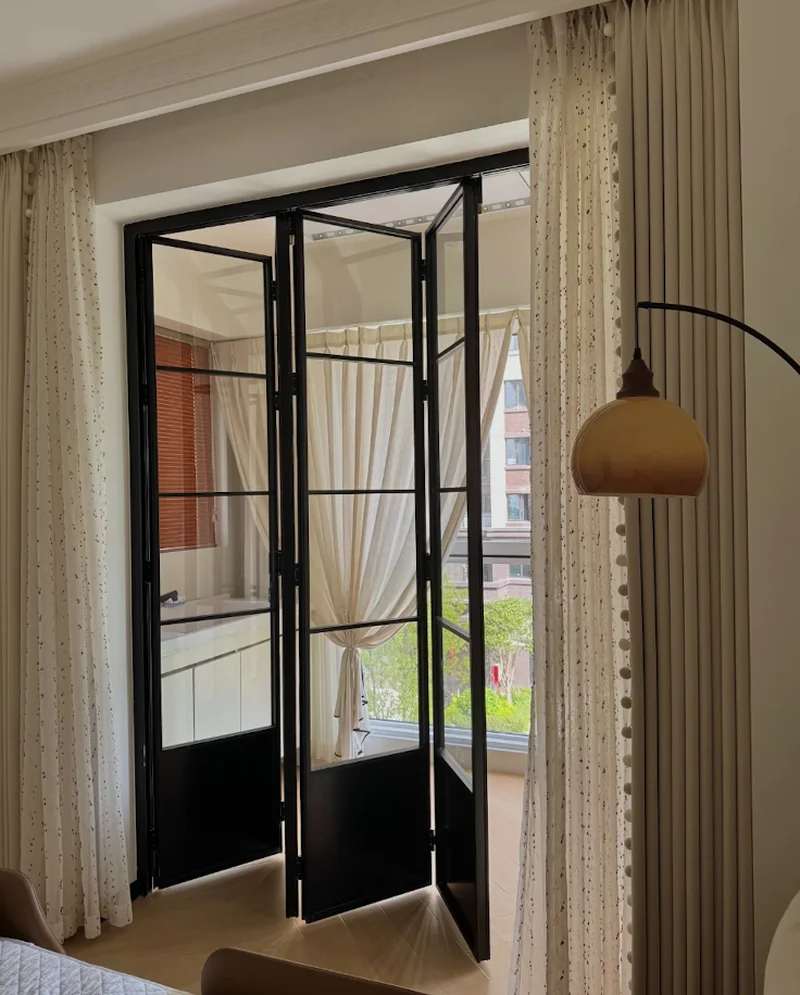
Stainless Steel Hardware for Corrosion Resistance and Smooth Operation in Demanding Environments
Stainless steel hardware is the critical mechanical interface that ensures long-term performance and reliability in high-traffic mall environments. The selection is based on austenitic grades, primarily AISI 304 and the superior AISI 316, chosen for their chromium (Cr) and nickel (Ni) content which forms a passive, self-repairing oxide layer for corrosion resistance.
Material Specifications & Corrosion Resistance
The fundamental resistance is determined by alloy composition and surface finish. AISI 316 includes molybdenum (Mo) (2-3%), providing significantly enhanced resistance to chlorides and acidic cleaners common in mall maintenance.
| Grade | Key Alloying Elements | Primary Corrosion Resistance | Recommended Mall Environment |
|---|---|---|---|
| AISI 304 | 18% Cr, 8% Ni | Excellent resistance to atmospheric oxidation, organic chemicals, and mild detergents. | Interior doors, low-humidity zones, standard entryways. |
| AISI 316 | 16% Cr, 10% Ni, 2-3% Mo | Superior resistance to pitting and crevice corrosion from chlorides, acids, and saline atmospheres. | Main entrances, food court entries, high-humidity zones, coastal locations. |
Surface finish, measured in Ra (Roughness average), directly impacts both corrosion initiation and mechanical wear. A polished finish (Ra < 0.5 µm) reduces surface area for contaminant adhesion, while a uniform brushed or satin finish (Ra ~ 0.8-1.2 µm) provides a balance of aesthetics and durability.
Engineering for Smooth Operation & Durability
Hardware components are subject to cyclic loading and abrasive wear. Performance is engineered through:
- Precision Bearing Systems: Pivot sets and roller assemblies utilize sealed, stainless-steel ball bearings with a minimum ABEC-1 rating. This ensures consistent swing effort, eliminates lateral play, and withstands load cycles exceeding 500,000 operations.
- Load-Bearing Capacity: All hinges and pivots are rated with a minimum 5:1 safety factor relative to the door leaf weight. Calculations account for dynamic wind load (per EN 12211) and misuse forces.
- Wear Resistance: Critical contact points, such as strike plates and latch bolts, are often surface-hardened to a Rockwell C hardness of 40-45 HRC, maintaining dimensional stability and preventing galling.
- Lubrication: Internal mechanisms employ PTFE-based or silicone greases that are inert, non-migrating, and functional across a temperature range of -30°C to 80°C, ensuring consistent operation in all seasonal conditions.
Functional Advantages in Mall Applications
- Maintenance Minimization: The inherent corrosion resistance eliminates the need for protective coatings that can degrade, peel, or require reapplication, reducing lifecycle maintenance costs.
- Hygienic Surface: The non-porous, easily cleaned surface meets sanitary requirements for food court and restroom access points.
- Aesthetic Permanence: The material integrity ensures that finishes do not discolor, chip, or corrode, maintaining architectural intent and a premium appearance over decades.
- Fire & Safety Compliance: Stainless steel maintains structural integrity at elevated temperatures, supporting hardware’s role in fire-rated door assemblies tested to standards such as EN 1634-1 or ASTM E2074.
Specification & Compliance
All hardware must be supplied with material certification (e.g., Mill Certificate) verifying grade composition. For full traceability and quality assurance, components should be sourced from manufacturers with ISO 9001 quality management systems and whose products are tested to relevant performance standards (e.g., ANSI/BHMA A156.115 for pivots, A156.2 for locksets).
Customizable Design Options to Match Your Mall’s Brand and Architectural Style
The architectural integrity of a mall is defined by the cohesion of its elements. Our aluminum glass door systems are engineered as a customizable substrate, allowing precise alignment with brand identity and structural aesthetics without compromising performance. The core principle is a decoupling of finish from function; the high-performance framework accepts a vast array of finishes, while the glass and hardware provide further dimensions for customization.
Core Material and Finish Customization
The extruded aluminum profiles form the structural skeleton. Customization begins with the alloy temper (e.g., 6063-T5, T6) selected for optimal strength-to-weight ratio for the specific door configuration (sliding, pivoting, automatic). The finish application is a critical process layer, with each method offering distinct durability and aesthetic characteristics:
| Finish Type | Process & Substrate | Key Performance Metrics | Typical Architectural Application |
|---|---|---|---|
| Anodizing | Electrochemical oxide layer on base aluminum. | Thickness: AA-MAC-C22, Class I (18-25µm). Abrasion resistance: ≥ 9 on the Tabor scale. Superior UV stability. | Modernist, tech-focused aesthetics; high-traffic ingress points. |
| Powder Coating | Electrostatic application & thermal curing of polyester/epoxy powders. | Thickness: 60-80µm. Adhesion: 0 (ASTM D3359). QUV accelerated weathering > 2000 hrs. | Full RAL, Pantone, or custom color matching; thematic or bold brand zones. |
| PVDF (Fluoropolymer) | Spray-applied Kynar®/Hylar® based coating. | Thickness: ≥ 30µm. Chalking resistance: ΔE < 5 after 10 yrs Florida exposure. Exceptional chemical resistance. | Coastal or high-pollution environments; luxury brand facades. |
Glass Specification and Performance
Glass is the primary visual and environmental interface. It is a composite system, not a single material, and is specified based on optical, thermal, and safety criteria.
- Laminated Glass: A polyvinyl butyral (PVB) or SentryGlas® (SGP) interlayer bonds two glass plies. SGP offers higher post-breakage stability and shear modulus. Standard interlayer thicknesses are 0.76mm, 1.52mm, or 2.28mm for increased acoustic and security performance.
- Insulated Glass Units (IGU): Constructed with dual or triple glazing, argon or krypton gas fill, and low-emissivity (Low-E) coatings on surface #2 or #3. Achieves U-factors as low as 0.28 W/(m²·K). Warm Edge spacers with desiccant are standard to prevent condensation and edge seal failure.
- Tints, Frits, and Patterns: Ceramic frit can be applied in patterns or gradients with 20-80% coverage for solar control and branding, baked permanently onto the glass surface. Tinted glass (grey, bronze, blue) or reflective coatings can be integrated to manage Solar Heat Gain Coefficient (SHGC).
Hardware as an Architectural Accent
Stainless steel hardware is specified per ASTM A276, with grade 304 for standard interiors and grade 316 for coastal or de-icing salt environments. Finishes are not merely cosmetic but are surface treatments affecting cleanability and wear.
- Mechanical Finishes: Brushed (No. 4), bead-blasted (satin), or polished (mirror). Each has defined Ra (roughness average) values influencing light reflection and fingerprint masking.
- PVD (Physical Vapor Deposition): A vacuum-deposited ceramic coating in colors like satin brass, dark bronze, or black. Provides superior corrosion resistance per ASTM B117 salt spray testing (> 96 hrs without base metal corrosion) and consistent color matching across batches.
Integrated Functional Customization
The door system integrates several performance-driven customizable features:
- Acoustic Performance: Utilizing laminated glass with specific PVB interlayer thickness and perimeter seals can achieve a Sound Transmission Class (STC) rating of 38-42 dB, critical for buffering food courts or cinema entrances.
- Thermal Break & Condensation Resistance: The polyamide thermal break in the aluminum profile is standard. Its performance, combined with the IGU, is calculated to ensure the interior frame surface temperature remains above the dew point per ISO 10077-2, preventing condensation.
- Fire-Rated Assemblies: Where required, doors can be integrated into 60- or 90-minute fire-rated glazing assemblies, tested to standards such as EN 1634-1 or ASTM E119, using specially tempered glass and intumescent seals.
Technical Specifications: Materials, Dimensions, and Installation Requirements for Seamless Integration
1.0 Material Specifications
1.1 Aluminum Alloy Framing
- Alloy & Temper: 6063-T5 or 6061-T6 aluminum alloy. 6063-T5 offers superior anodizing and extrusion finish quality for architectural applications, while 6061-T6 provides higher structural strength for larger spans or high-wind load scenarios.
- Surface Finishes:
- Anodizing: Minimum 25µm (AA25) thickness per EN ISO 10074/QUALANOD specifications. Provides a durable, integral oxide layer. Standard colors: Clear, Black, Champagne.
- Powder Coating: Thermosetting polyester or fluorocarbon (PVDF) coatings applied to a minimum thickness of 60µm per QUALICOAT Class 2 or GSB MASTER specifications. Primer is mandatory for corrosion resistance.
- Thermal Break: Polyamide 66 with glass fiber reinforcement (≥25%) as per EN 14024. Must have a minimum thermal barrier width of 24mm. The mechanical shear strength of the thermal break material must exceed 24 N/mm².
1.2 Glass Infill
- Standard Configuration: Thermally toughened (tempered) safety glass, minimum 10mm thick, conforming to EN 12150-1 / ANSI Z97.1.
- Performance Glazing Options:
- Thermal Insulation: Double-glazed Insulated Glass Units (IGU) with Low-E coating (emissivity ≤ 0.04) and argon gas fill. Target U-factor ≤ 1.1 W/m²K.
- Acoustic Control: Laminated glass with PVB or SentryGlas® interlayer. Configurations can achieve sound reduction ratings (Rw) up to 42 dB (C;tr).
- Safety & Security: Laminated glass, minimum 11.5mm thickness (6mm+1.52mm PVB+6mm), meeting CPSC 16 CFR 1201 Cat II or EN 12600 impact class.
1.3 Stainless Steel Hardware
- Grade: Austenitic Grade 304 or 316 stainless steel per EN 10088-3 / ASTM A276. Grade 316 is specified for coastal or high-humidity environments.
- Finish: Brushed (No. 4) or mirror (No. 8) polish. All components must be passivated post-fabrication to remove free iron and enhance corrosion resistance.
- Components: Includes continuous geared hinges, multi-point locking systems, concealed floor springs or overhead closers, and panic bars. Hardware must be certified to relevant performance standards (e.g., EN 1125 for panic devices).
2.0 Dimensional Tolerances & Structural Performance
| Parameter | Specification | Standard / Test Method |
|---|---|---|
| Frame Dimensional Tolerance | ±0.5mm on profile cross-section; ±1.0mm on cut length | EN 12020-2 |
| Squareness Tolerance | ≤ 1.0mm per meter of diagonal | EN 1529 |
| Air Infiltration | Class 4 (≤ 1.5 m³/hr·m² @ 100 Pa) | EN 12207 |
| Water Tightness | Class 9A (≥ 600 Pa) for main entrance applications | EN 12208 |
| Wind Load Resistance | Up to Class C5 (≥ 2000 Pa) based on frame design and glazing | EN 12211 |
| Door Cycle Testing | Minimum 1,000,000 cycles for swing doors; 500,000 for sliding systems | EN 16005 / BHMA A156.4 |
3.0 Installation & Integration Requirements
3.1 Structural Interface
- Opening Preparation: Rough openings must be plumb, level, and square within a 3mm tolerance over the full height and width. The structural support must be designed to carry the door assembly’s dead load plus dynamic operational loads.
- Anchorage: Use 300-series stainless steel shims and anchor bolts. Minimum anchor diameter: 10mm. Anchors must engage into the structural substrate by a minimum of 50mm. Frame must be anchored at a maximum of 400mm centers.
3.2 Sealing & Weatherproofing
- Perimeter Seals: Employ dual-stage EPDM or silicone gaskets. The primary seal must be a compression gasket; the secondary seal must be a water-diverting fin seal.
- Sill Details: For level thresholds, use an extruded aluminum sill with integrated drain channels. For accessible (zero-threshold) designs, a specialized drainage trough system below the finished floor is mandatory.
3.3 Alignment & Adjustment
- Hardware Setup: All pivot points and gear tracks must be aligned to a tolerance of ±0.5mm over the travel length. Floor springs and overhead closers must be adjusted for opening force (max 50N per EN 16005) and closing speed.
- Glass Bearing: Glass panels must be supported on dedicated EPDM or thermoplastic setting blocks. Hard point contact between glass and metal is prohibited.
3.4 Performance Verification
- Post-installation, conduct operational testing of all automatic functions, safety sensors, and locking points. Verify air and water infiltration seals with a field smoke test for critical interfaces.
Trusted by Leading Retail Centers: Case Studies and Compliance Certifications
Our aluminum-glass door systems are engineered to meet the rigorous demands of high-traffic retail environments. The following case studies and certifications validate their performance under real-world conditions.
Case Study: The Galleria, Dubai
A retrofit project requiring 84 sets of automatic sliding doors to handle over 120,000 daily visitors. The primary challenges were extreme solar heat gain, constant abrasive sand particulates, and maintaining consistent ingress/egress flow.
- Material Specification: Doors utilized thermally broken 6063-T6 aluminum profiles with a 25-micron powder coating (Qualicoat Class 3). Glass was 12mm tempered low-E with a argon-filled cavity, achieving a U-factor of 1.2 W/m²K.
- Hardware Solution: Stainless steel (Grade 316) automatic sliding gear, rated for >1,000,000 cycles, with IP54-rated ingress protection for dust and moisture.
- Outcome: Post-installation energy audits showed a 15% reduction in adjacent zone HVAC load. After 36 months of operation, the hardware shows negligible wear, and the glass/assembly maintains a sound reduction rating (Rw) of 38 dB.
Case Study: Westfield London, UK
Focus on fire safety and crowd management in a multi-level complex. Required doors to integrate with central building management system (BMS) while providing critical fire compartmentalization.
- Material Specification: Doors were certified to EN 1634-1 for integrity (E) and radiation (W) for 60 minutes. Aluminum profiles featured a dedicated intumescent seal channel.
- Hardware Solution: Electromagnetic hold-open devices integrated with smoke detection, coupled with Grade 304 stainless steel pivots and closers certified to EN 1154.
- Outcome: System passed third-party fire performance tests. The seamless BMS integration allows for dynamic crowd control during peak hours and automatic safe egress protocols.
Compliance & Performance Certifications
Our manufacturing and product standards are independently verified. Key certifications include:
| Standard / Test | Scope / Parameter | Performance Grade / Note |
|---|---|---|
| ISO 9001:2015 | Quality Management System | Certified for design, manufacturing, and installation. |
| EN 14351-1:2006+A2:2016 | Windows and Doors – Product Standard | Covers performance characteristics for permeability, strength, and durability. |
| ASTM E283 | Air Infiltration Rate | Tested at ≤ 0.47 cfm/ft² at 6.24 psf (Class 40 equivalent). |
| ASTM E1886 / E1996 | Impact & Windload Resistance | Missile Level D and Wind Zone 4 compliant for coastal regions. |
| ANSI/BHMA A156.10 | Power Operated Pedestrian Doors | Grade 1 for automatic sliding door cycles and safety. |
| Qualicoat / GSB | Powder Coating Durability | Class 3 (Severe) for corrosion and UV resistance. |
Critical Material & Assembly Specifications:
- Aluminum Alloy: 6063-T6 thermally broken profiles, minimum 1.8mm wall thickness.
- Glass: Typically 10-12mm insulated glass unit (IGU), with options for laminated, tempered, or low-E coatings. U-factors from 1.0 to 1.5 W/m²K achievable.
- Stainless Steel Hardware: Grade 304 or 316 for corrosion resistance. All moving components (bearings, rollers) have a minimum cycle life rating of 1,000,000 cycles.
- Sealants & Gaskets: EPDM gaskets with a minimum Shore A hardness of 70 for long-term compression set resistance.
Frequently Asked Questions
How do aluminum-glass doors prevent structural warping in high-moisture mall environments?
Expert-grade doors utilize thermally broken aluminum profiles with a polyamide barrier, decoupling interior and exterior surfaces to minimize thermal transfer and condensation. This, paired with a low moisture expansion coefficient (<0.1%) and precision-engineered stainless steel pivot hardware, ensures dimensional stability and prevents warping, even in high-traffic, humidity-fluctuating entrances.
What formaldehyde emission standards should mall doors meet for indoor air quality?
Insist on core materials certified to E0 (≤0.5 mg/L) or EN Standard (≤0.124 mg/m³) formaldehyde emission levels. For doors with wood-plastic composite (WPC) elements, verify they use non-toxic binders and that any laminated components are sourced from CARB Phase 2 or TSCA Title VI compliant manufacturers to ensure superior indoor environmental quality.
What thermal insulation performance can be expected from these entrance systems?
High-performance systems feature multi-chambered, thermally broken aluminum frames filled with polyurethane foam, coupled with double or triple glazing using Low-E glass and argon gas fill. This achieves a U-value as low as 1.0 W/(m²K), significantly reducing thermal bridging and HVAC load, which is critical for maintaining mall climate control and energy efficiency.
How is impact resistance engineered for high-traffic mall security and safety?
Impact resistance is achieved through a layered design: tempered or laminated safety glass (minimum 10mm thickness), reinforced with a structural LVL (Laminated Veneer Lumber) or high-density WPC core (≥800 kg/m³). The hardware, such as heavy-duty stainless steel hinges with reinforced anchor points, is engineered to withstand repeated dynamic loads and accidental impacts.
What specifications ensure long-term durability of the stainless steel hardware?
Specify hardware manufactured from 304 or 316-grade stainless steel with a minimum thickness of 3mm for critical load-bearing components. A physical vapor deposition (PVD) coating or electrophoretic finish provides a consistent, corrosion-resistant layer, ensuring smooth operation and maintaining aesthetic integrity against constant use and environmental exposure for decades.
How do you achieve effective sound insulation at main mall entrances?
Effective sound insulation (up to 40-45 dB Rw) is accomplished through a combination of compressed EPDM or silicone perimeter seals, double-glazed units with asymmetric glass thicknesses (e.g., 6mm/12mm air gap/8mm), and insulated frame profiles. This acoustic engineering minimizes noise transmission from exterior areas into the mall’s interior.
What are the critical specs for WPC components used in door construction?
For structural integrity, specify WPC with a high-density core (≥750 kg/m³), a minimum PVC coating thickness of 0.5mm for weather resistance, and UV-stabilized additives. The material must have a low thermal expansion coefficient and be reinforced with fiberglass or aluminum profiles to prevent sagging and ensure compatibility with the aluminum frame system.