Aluminum glass doors with frosted glass for office partitions
In today’s dynamic workplace, the balance between collaboration and concentration is paramount. Aluminum glass doors with frosted glass for office partitions offer a sophisticated solution, masterfully blending form and function. These sleek, modern installations harness the inherent strength and clean lines of aluminum framing, ensuring durability and a timeless aesthetic. The true genius, however, lies in the frosted glass. It acts as a visual filter, bathing interiors in soft, diffused natural light to create an open, airy atmosphere while providing essential privacy and reducing visual distractions. This elegant compromise fosters a sense of transparency and connectivity without sacrificing individual focus, making them an intelligent investment for any forward-thinking office design aiming to enhance both productivity and well-being.
Maximizing Office Privacy and Natural Light: The Dual Benefits of Frosted Glass in Modern Partitions
Frosted glass in aluminum-framed partitions resolves the fundamental architectural conflict between visual privacy and daylight penetration. The effect is achieved through surface etching or the application of a ceramic frit pattern, which diffuses light by scattering it. This creates a translucent barrier that obscures direct imagery while transmitting a high percentage of visible light. The aluminum framing system provides the structural integrity, with thermal break profiles and dual seals managing the glazing unit’s performance.
Functional Advantages of Frosted Glass Partitions:
- Optical Diffusion: The primary mechanism for privacy. Surface treatment scatters incident light, preventing a clear view while maintaining high light transmittance (typically 50-75% for frosted variants, compared to ~90% for clear glass). This eliminates the need for secondary window treatments.
- Acoustic Performance: When combined with a laminated glass construction (e.g., 6.38mm: 3mm glass + 0.38mm PVB interlayer + 3mm glass), the partition system can achieve a Sound Transmission Class (STC) rating of 35-38 dB. The frosted surface does not diminish this acoustic performance.
- Thermal & Energy Efficiency: Utilizing a dual-glazed insulated glass unit (IGU) with a low-emissivity (Low-E) coating and argon fill in a thermally broken aluminum frame yields a superior U-factor (as low as 0.28 Btu/(hr·ft²·°F) or 1.6 W/(m²·K)). The frosted layer is applied to the interior pane surface, not interfering with the Low-E coating’s function.
- Material Durability & Safety: The ceramic frit is fired onto the glass at high temperatures, making it abrasion-resistant and integral to the pane. For safety and security, specifying fully tempered (ASTM C1048) or laminated glass is non-negotiable. Tempered glass meets ANSI Z97.1 / CPSC 16 CFR 1201 impact safety standards.
- Hygienic & Low Maintenance: The non-porous, inorganic glass surface inhibits microbial growth and is easily cleaned without degrading the frosted effect. It is inherently non-combustible (Class A fire rating per ASTM E84) and emits zero VOCs.
Technical Performance Data: Glazing & System Specifications
| Parameter | Specification | Standard / Test Method | Performance Implication |
|---|---|---|---|
| Light Transmittance (Visible) | 50% – 75% (varies by frosting density) | ASTM D1003 | Balances daylight harvesting with privacy level. |
| Acoustic Insulation (STC) | 35 dB (monolithic) / 38 dB (laminated IGU) | ASTM E90 / E413 | Effective speech privacy in open-plan zones. |
| Thermal Insulation (U-Factor) | 1.6 – 2.0 W/(m²·K) (Thermally broken frame with Low-E IGU) | NFRC 100 / EN 673 | Reduces perimeter heat transfer and HVAC load. |
| Glass Safety & Strength | Fully Tempered or Laminated | ANSI Z97.1, CPSC 16 CFR 1201, EN 12150 | Safe breakage pattern; laminated glass retains fragments. |
| Surface Hardness | Ceramic frit: > 7 Mohs; Resists abrasion. | ASTM C1048 (for tempered) | Frosting is durable against cleaning and contact. |
| Fire Resistance | Glass is non-combustible. Frame system ratings vary. | ASTM E84 (Class A), EN 13501-1 | Contributes to compartmentalization; specify rated assemblies for full fire walls. |
Critical Specification Considerations:
- Frosting Method: Acid-etched glass provides a uniform, satin finish but can be slightly more susceptible to fingerprint marking. Ceramic frit patterns offer design flexibility (gradients, logos) and superior durability. The frit is applied before tempering, making it permanent.
- Glazing Configuration: For optimal performance, specify a double-glazed IGU with the frosted surface on the #2 or #3 surface (interior face of the outer pane or interior face of the inner pane). This protects the frosting and allows use of a Low-E coating on surface #3 for maximum thermal efficiency.
- Frame System Integrity: The aluminum profile must be engineered for the glazing unit’s weight and thickness. Look for profiles with a continuous thermal barrier, polyamide strip isolation, and dual EPDM gasket seals (e.g., to AAMA 911-07) to ensure air infiltration rates below 0.3 cfm/ft (ASTM E283) and water penetration resistance above 15 psf (ASTM E331).
- Acoustic Sealing: The frame-to-glass and floor/ceiling junctions are critical. Use compression seals and acoustic gaskets. A properly sealed system with laminated glass is essential to achieve the published STC ratings.
In practice, the system’s success depends on integrating the correct glass specification with a performance-grade aluminum framing system. This ensures the partition functions as a complete building envelope component, managing light, energy, sound, and privacy simultaneously.
Engineered for High-Traffic Durability: The Structural Stability of Aluminum Framed Glass Doors
The structural integrity of a glass partition door in a high-traffic office environment is dictated by the synergistic performance of its aluminum alloy frame and the glazing system. The primary engineering objective is to resist cyclical loading, deflection, and long-term wear while maintaining precise operation.
Core Engineering Principles:
- Alloy Specification & Thermal Break: Frames are fabricated from 6063-T5 or 6061-T6 aluminum alloys, chosen for their optimal yield strength-to-weight ratio and excellent corrosion resistance. A polyamide thermal barrier is mechanically locked within the profile, decoupling interior and exterior surfaces to prevent thermal bridging, which reduces condensation and improves thermal insulation (typical U-factor for the door assembly ranges from 1.8 to 2.5 W/m²K).
- Profile Design & Reinforcement: Multi-chambered extruded profiles increase torsional rigidity. For larger door leaves or higher wind-load requirements, internal steel or aluminum reinforcement is inserted into the primary chambers, significantly enhancing load-bearing capacity without increasing visible profile dimensions.
- Glazing System: The frosted glass is typically 10mm or 12mm thick tempered safety glass. The tempering process induces surface compression, increasing its bending strength approximately 4-5 times that of annealed glass and ensuring it breaks into small, granular pieces if fractured. The glass is set within the frame using a combination of structural silicone and continuous EPDM gaskets, allowing for calculated thermal expansion and absorbing vibration.
Performance Data & Technical Standards:
| Parameter | Specification / Performance | Standard / Test Method |
|---|---|---|
| Frame Material | Aluminum Alloy 6063-T5 | EN 755, ASTM B221 |
| Door Leaf Deflection | ≤ L/200 under design load | EN 14019, ASTM E1300 |
| Operational Cycle Testing | > 200,000 cycles (hinge & hardware) | ANSI/BHMA A156.115 |
| Air Infiltration | Class 4 (≤ 0.5 m³/m·h @ 100 Pa) | EN 12207 |
| Water Tightness | Class 5A (≥ 600 Pa) | EN 12208 |
| Acoustic Performance (with sealed perimeter) | Up to 35-40 dB Rw reduction | EN ISO 10140 |
Functional Advantages in High-Traffic Scenarios:
- Superior Load Distribution: The engineered aluminum profile system transfers operational stresses (from constant opening/closing) and incidental impacts away from the glass edges, the system’s most vulnerable points.
- Hardware Integration: Hinges and multi-point locking mechanisms are mounted to reinforced profile sections, not just the glazing rebate. This prevents sagging over time and ensures consistent latching alignment.
- Dimensional Stability: Aluminum’s negligible coefficient of thermal expansion and resistance to moisture absorption ensure the frame does not warp, swell, or contract in varying office climates, maintaining smooth operation and perimeter seals.
- Maintenance & Longevity: Anodized or powder-coated finishes (typically 25-40µm) provide exceptional resistance to abrasion from cleaning and contact. The system requires no painting or sealing upkeep, with a designed service life exceeding 25 years under normal commercial use.
Creating Seamless Office Environments: Waterproof and Formaldehyde-Free Construction for Healthier Workspaces
A seamless office environment is defined by the integration of aesthetic continuity and high-performance building science. For partitions utilizing aluminum glass doors with frosted glass, this is achieved through a holistic construction methodology that prioritizes occupant health and long-term material integrity. The core principle involves specifying components that are inherently waterproof and free from volatile organic compound (VOC) off-gassing, notably formaldehyde.
Material Science of Waterproof Construction
The critical vulnerability in any partition system is at the interface between the glass door panel and its supporting frame or adjacent wall. A truly waterproof assembly relies on engineered materials for framing, sills, and integrated seals.
- Aluminum Alloy & Surface Treatment: The 6063-T5 or 6061-T6 aluminum alloy profiles are standard, but waterproof performance is dictated by the surface treatment. A minimum of 15-20 micron anodized coating or a 70-80 micron thermosetting polyester powder coating (tested to ASTM D968 / ISO 2409 for adhesion) provides a non-porous, impermeable barrier against humidity.
- Integrated Drainage Channels: High-specification aluminum frames incorporate multi-chamber designs with integrated drainage channels (weep holes) within the sill profile. This manages incidental water ingress from cleaning or condensation, channeling it away from the interior.
- Elastomeric Sealants: Perimeter sealing utilizes EPDM (Ethylene Propylene Diene Monomer) gaskets or compression seals with a Shore A hardness of 60±5, ensuring resilience and a lasting watertight seal without relying on adhesive tapes that degrade. Silicone structural glazing provides a secondary barrier.
Formaldehyde-Free & Indoor Air Quality (IAQ) Compliance
Formaldehyde, commonly found in composite woods, adhesives, and certain insulation cores, is a primary contributor to poor IAQ. Specifying formaldehyde-free components is non-negotiable for healthier workspaces.
- Core Material Specifications: Where partition infill panels (spandrel sections) or door framing inserts are used, they must specify ultra-low emitting materials.
- Mineral Wool Core: Provides inherent fire resistance (A2-s1,d0 / Class A), formaldehyde-free composition, and acoustic damping.
- WPC (Wood-Plastic Composite) Core: Must be specified with a PVC-wood ratio favoring high-density PVC (≥ 1.3 g/cm³) and using calcium-zinc stabilizers instead of heavy-metal-based ones. Formaldehyde-free binders are mandatory.
- LVL (Laminated Veneer Lumber) Core: Must be certified to E0 (≤0.5 mg/L, Japanese JIS / F**** standard) or CARB Phase 2 compliant, using phenolic or MDI (Methylene Diphenyl Diisocyanate) adhesives which emit negligible formaldehyde.
- Adhesives & Sealants: All mastics, glazing tapes, and construction adhesives must carry relevant VOC compliance certifications, such as the California Department of Public Health (CDPH) Standard Method v1.2 or similar EU Ecolabel criteria.
Performance Data for Specification
| Parameter | Specification | Test Standard | Benefit |
|---|---|---|---|
| Water Tightness | ≥ 600 Pa (Class 5A / 5B) | EN 12208 / ASTM E331 | Resistance to driven rain and pressure differential. |
| Air Permeability | ≤ 1.5 m³/(h·m²) @ 100 Pa (Class 4) | EN 12207 / ASTM E283 | Minimizes drafts and moisture-laden air infiltration. |
| Formaldehyde Emission | E0 / ≤0.065 ppm (CDPH) | EN 16516 / ISO 16000-3 | Ensures compliance with stringent indoor air quality standards. |
| Acoustic Insulation (Rw) | Up to 42 dB (with double-glazed, laminated frosted glass & sealed system) | EN ISO 10140-2 | Contributes to speech privacy and noise control. |
| Thermal Transmittance (U-value) | 2.8 – 3.1 W/(m²·K) (with thermal break frame & double glazing) | EN ISO 10077-2 / EN 12412 | Reduces condensation risk and improves energy efficiency. |
Functional Advantages of the Integrated System
- Mitigated Mold Risk: A waterproof assembly with a vapor-pressure-equalized frame design prevents interstitial condensation, eliminating the primary condition for mold growth within the partition cavity.
- Structural Longevity: The combination of corrosion-resistant aluminum and stable, low-moisture-absorption cores (<0.5% by volume for WPC, <1% for LVL) prevents swelling, warping, and fastener corrosion.
- Simplified Maintenance: Surfaces can be cleaned with standard disinfectants without risk of material degradation, supporting stringent hygiene protocols.
- Project Certification Readiness: Material documentation (EPDs, HPDs, VOC test reports) directly supports credits in LEED v4.1, WELL Building Standard, and BREEAM, particularly for Low-Emitting Materials and Moisture Management.
Ultimately, specifying aluminum glass door partitions with a forensic focus on waterproof engineering and certified formaldehyde-free materials transforms the partition from a mere space divider into a reliable, health-promoting component of the building envelope. This approach de-risks projects by future-proofing against IAQ complaints and moisture-related callbacks.
Customizable Design Solutions: Tailoring Frosted Glass Doors to Your Office Layout and Brand Aesthetics
Customizable frosted glass door systems are engineered to integrate precisely with diverse office layouts and corporate identity requirements. The core principle is a modular framework of high-grade aluminum extrusions, which provides the structural integrity to support a wide range of glass infill specifications and finish options. The aluminum alloy, typically 6063-T5 or T6, undergoes precision extrusion and powder-coating to a minimum thickness of 60-80 microns, ensuring long-term dimensional stability and corrosion resistance for custom configurations.
The frosted glass itself is a critical variable. The frost is achieved through either acid-etching or ceramic frit application, with the latter offering superior durability and design precision. For acoustic or fire-rated partitions, the glass specification shifts to laminated constructions. A typical acoustic laminate consists of two 6mm tempered glass panels bonded with a 1.52mm acoustic PVB interlayer, achieving a Sound Transmission Class (STC) rating of 36-40 dB. Fire-rated glazing utilizes clear intumescent interlayers that become opaque and expand under heat, providing integrity (E) and, in some cases, insulation (EI) ratings of 30 to 120 minutes, certified to standards such as EN 1364-1 or ASTM E119.
Functional advantages of a tailored system include:
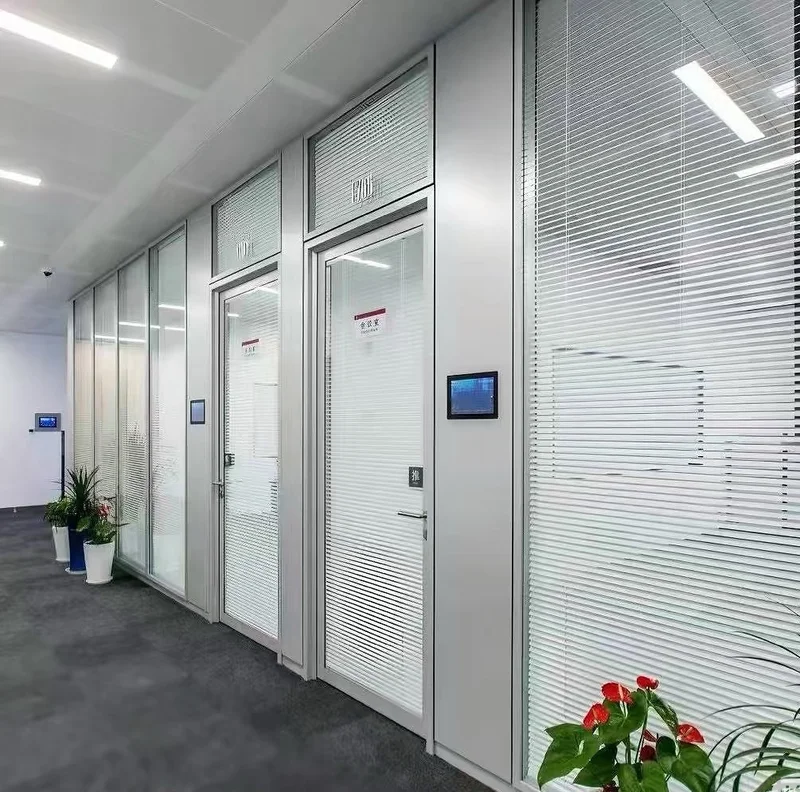
- Spatial Optimization: Sliding, pivot, or single/double-acting swing configurations can be specified to maximize usable floor space and manage traffic flow, all within the same engineered aluminum profile system.
- Brand Integration: Ceramic frit patterns can be digitally printed to incorporate logos, geometric patterns, or gradient opacity, transforming the partition into a branded architectural element without compromising light transmission.
- Performance Consistency: Regardless of custom dimensions or finish, the integrated door hardware—concealed closers, multi-point locks, and threshold seals—maintains specified performance for security, accessibility, and operational feel.
For projects requiring specific environmental or performance benchmarks, the following technical parameters guide material selection:
| Specification Category | Standard Option | High-Performance Option | Test Standard / Notes |
|---|---|---|---|
| Glass Frosting Method | Acid-Etched | Ceramic Frit (Silk-screen Printed) | Frit offers UV stability, higher abrasion resistance, and precise pattern control. |
| Acoustic Performance | Laminated Glass (STC 36) | Laminated Glass + Perimeter Seal System (STC 40+) | STC rating measured per ASTM E413; performance is system-dependent (glass + frame + seals). |
| Thermal Insulation (U-Factor) | Standard Double Glazing (U-value ~2.8 W/m²K) | Low-E, Argon-filled Double Glazing (U-value ~1.2 W/m²K) | U-factor for the complete glazed door assembly, calculated per EN ISO 10077 or NFRC 100. |
| Fire Rating | Integrity Only (E 30/60) | Integrity & Insulation (EI 60/90/120) | Must be tested and certified as a complete assembly (frame, glass, hardware). |
| Frame Finish Durability | Class II Powder Coat (≥60µm) | Class I Architectural Powder Coat (≥80µm) | Qualicoat or GSB Master quality standards; includes corrosion resistance testing. |
The aluminum framing system is designed for non-destructive disassembly and reconfiguration, supporting future office churn. All custom components, from specialized glass to anodized finish profiles, are manufactured under a quality management system certified to ISO 9001, ensuring that one-off designs meet the same rigorous tolerances and performance criteria as standard catalog items.
Technical Specifications and Installation: Precision Engineering for Easy Integration into Existing Partitions
Technical Specifications
- Frame System: Engineered from 6063-T5 or 6063-T6 aluminum alloy, providing a minimum yield strength of 160 MPa. Standard anodizing thickness is AA-M10 (10µm) or powder-coated with a minimum 60µm polyester/epoxy hybrid finish, achieving a pencil hardness of ≥H. Profiles are thermally broken with 24mm polyamide strips, achieving a U-factor of ≤2.8 W/(m²·K).
- Glass Specification: 10mm or 12mm thick clear tempered float glass, acid-etched to a uniform satin (frosted) finish on one side. The glass meets ANSI Z97.1 / EN 12600 Class 1 safety standards. Light transmission ranges from 25% to 50%, with a haze factor >90% for visual obscuration.
- Hardware Integration: Frame profiles are pre-machined for top-hung or floor-spring pivot systems. Hinge rebates are precision-milled to accommodate standard DIN EN 1935 Grade 13 hardware. Continuous vertical gasket channels accept EPDM or silicone seals with a Shore A hardness of 60±5.
- Fire & Acoustic Performance: Systems can be specified to achieve up to 30 minutes integrity (EI30) in accordance with EN 13501-2. Acoustic performance, when paired with appropriate seals and laminated glass variants, can achieve a weighted sound reduction index (Rw) of up to 38 dB.
- Structural Compliance: Designed to meet or exceed relevant sections of EN 14351-1 for windows and doors, and ASTM E 1300 for glass load resistance.
Installation Methodology for Existing Partitions
Integration into existing demountable or drywall partitions requires precise interface detailing. The door system is designed as a cassette unit for retrofit applications.
- Opening Preparation: The existing partition opening must be plumb, level, and square within a 3mm tolerance over the full height and width. Structural adequacy of the surrounding partition head channel and studs must be verified to support dynamic door loads.
- Ancillary Component Fit-Out: A proprietary perimeter adapter frame is secured to the existing partition structure. This frame accommodates standard plasterboard or demountable panel thicknesses (typically 16mm to 25mm).
- Cassette Installation: The pre-assembled door leaf and frame cassette is inserted into the adapter frame. Shim spaces are minimized to ≤5mm per side, using non-compressible plastic shims.
- Mechanical Fixing: The cassette is fixed through the adapter frame into the primary partition structure using stainless steel screws at 400mm centers. Fixings must not overtighten to avoid profile distortion.
- Sealing and Finishing: Low-pressure expanding polyurethane foam is applied to the cavity between the cassette and the adapter frame. After curing, a low-modulus silicone sealant matching the profile finish is applied to the interior and exterior joints. The final step involves the installation of magnetic or brush-type perimeter seals onto the door leaf.
| Critical Interface Parameter | Specification / Tolerance | Verification Method |
|---|---|---|
| Opening Verticality | ≤2mm deviation over full height | Laser level / precision spirit level |
| Adapter Frame Fixing | M5 x 50mm stainless steel screws, 400mm c/c | Torque driver set to 4.5 N·m |
| Head Clearance | 5mm ±1mm (for top-hung systems) | Feeler gauge |
| Threshold Gap | 4mm ±0.5mm (for floor-spring systems) | Feeler gauge |
| Seal Compression | EPDM gasket compressed by 25-30% of its free height | Visual and functional check |
Functional Advantages of the Precision-Engineered System
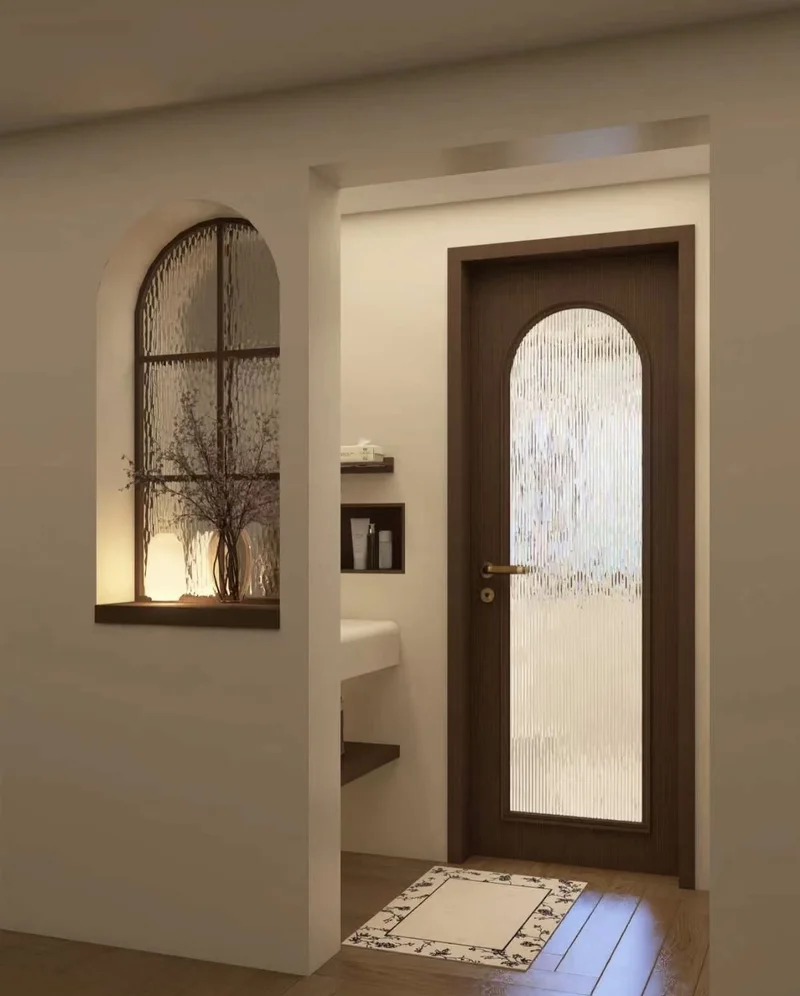
- Minimal On-Site Modification: Pre-machined profiles and cassette design eliminate the need for cutting or welding on-site, preserving the integrity of the existing partition.
- Predictable Performance: Factory-controlled assembly of glass, seals, and hardware ensures consistent operational performance (e.g., closing force, acoustic rating) as per laboratory testing.
- Serviceability: The design allows for the removal and reinstallation of the door leaf without disturbing the fixed frame or surrounding partition finish, facilitating long-term maintenance.
- Aesthetic Continuity: The adapter frame system ensures a flush, gapless transition between the new door and the existing partition face, maintaining a seamless visual line.
Trusted by Industry Leaders: Case Studies and Certifications for Quality Assurance in B2B Applications
Case Study: Global Financial Headquarters, London
A Tier-1 bank mandated a complete refit of its trading floors, requiring partitions that balanced acoustic privacy, fire compartmentalization, and aesthetic transparency. The specification called for 44mm double-glazed units with acid-etched frosted glass, set in 50mm thermally broken aluminum profiles.
Key Technical Challenges & Solutions:
- Acoustic Performance: Achieved a weighted sound reduction index (Rw) of 42 dB. This was critical for confidential client meetings adjacent to high-noise environments. The result was attained through a laminated inner pane (6.38mm) with a 1.52mm acoustic PVB interlayer and a hermetically sealed perimeter gasket system (Shore A 70±5).
- Fire Integrity: Systems were required to provide 60 minutes of integrity (EI60) per EN 1364-1. This was validated through third-party testing of the complete assembly, including glass, frame, and intumescent seals, which expand at 120°C to seal critical gaps.
- Operational Durability: Doors were cycled over 200,000 times using a mechanical testing rig per EN 16005, with no measurable deflection in the hinge mechanism or loss of sealing performance.
Certifications and Quality Assurance Protocols
Our manufacturing and product compliance are governed by a stringent framework of international standards, providing verifiable performance data for specification.
Core Management System Certifications:
- ISO 9001:2015: Ensures traceability of every extruded aluminum profile (Alloy 6060-T66) from billet to anodizing/powder coating, with batch-level documentation for mechanical properties (minimum tensile strength Rm ≥ 160 N/mm² per EN 755).
- ISO 14001:2015: Governs the environmental management of our production processes, including the recycling of aluminum swarf (>95% recovery rate) and treatment of etching byproducts from glass processing.
Product-Specific Performance Certifications:
- Structural & Wind Load: Profiles are engineered and tested per EN 12150 (tempered glass) and EN 13049 (wind load resistance for windows and doors). Our standard 50mm profile system is certified for a permissible design pressure of 2000 Pa.
- Thermal & Condensation Resistance: Thermally broken profiles with polyamide 66 barriers (24mm) achieve a Uf-value of 1.8 W/(m²K). The overall door system UD-value, with low-emissivity coated double glazing (Ug = 1.1 W/(m²K), can reach ≤ 1.5 W/(m²K), mitigating thermal bridging and condensation risk.
- Surface Durability: Anodized finishes (AA25 per EN ISO 7599) and powder coatings (Qualicoat Class 2 or GSB Master) are subjected to accelerated weathering tests, including >1000 hours of salt spray resistance and cyclic UV exposure.
Technical Performance Data for Specification
The following table provides benchmark performance data for our standard 50mm profile system with double-glazed frosted glass units, as validated by independent laboratories.
| Parameter | Standard / Test Method | Performance Value | Notes |
|---|---|---|---|
| Acoustic Insulation (Rw) | EN ISO 10140-2 | 38 – 42 dB (C; Ctr) | Varies with glass construction (laminated/annealed) and sealing. |
| Thermal Transmittance (UD) | EN ISO 10077-1 | ≤ 1.5 W/(m²K) | With low-e coated IGU (4-16-4, Argon fill). Profile Uf = 1.8 W/(m²K). |
| Air Permeability | EN 1026 | Class 4 | ≤ 3.0 m³/(h·m²) at 600 Pa differential pressure. |
| Water Tightness | EN 1027 | Class 9A | No water penetration at 600 Pa static pressure. |
| Wind Load Resistance | EN 12211 | Class C5 (2000 Pa) | Positive and negative pressure. Maximum deflection L/200. |
| Door Durability (Cycles) | EN 16005 | > 200,000 | Tested on 100kg door leaf; includes force to open/close monitoring. |
| Glass Safety & Treatment | EN 12150-1 (Tempered) EN 14449 (Laminated) | Compliant | Frosting via acid-etching or ceramic frit; does not compromise temper. |
Material & Safety Compliance:
- Glass: All glass is fully tempered (Class 1 fragmentation per EN 12150) or laminated for safety. Frosted finishes are either acid-etched (providing a consistent, durable surface) or ceramic frit fired onto the glass, ensuring no degradation or peeling.
- Aluminum: Profiles are extruded from EN AW-6060 T66 alloy, with a minimum yield strength (Rp0.2) of 150 MPa. Thermal break bars are glass fibre reinforced polyamide 66 (GF25), tested for shear and tensile strength per EN 14024.
- Seals: EPDM gaskets with a rated service temperature range of -40°C to +70°C, resistant to ozone and UV degradation. Intumescent seals expand at defined temperatures to meet fire rating requirements.
Frequently Asked Questions
How do aluminum-framed frosted glass doors prevent moisture-induced warping in humid office environments?
Aluminum alloys for frames must specify 6063-T5 or higher temper grades with anodized or powder-coated finishes (minimum 60μm). Pair with tempered frosted glass using butyl rubber seals and continuous thermal breaks in frames to manage differential expansion. This maintains dimensional stability at 85%+ humidity levels.
What formaldehyde emission standards should WPC components in these partitions meet?
All wood-plastic composite (WPC) elements—like base tracks or trim—must comply with E0 (≤0.5 mg/L) or EN Standard Class E1 (≤0.124 mg/m³) formaldehyde limits. Specify WPC with ≥1.2 g/cm³ density and certified low-VOC adhesives. This ensures indoor air quality meets GB 18580-2017 or equivalent international healthy building protocols.
Can these door systems provide sufficient sound insulation for confidential office areas?
Yes, when configured correctly. Use laminated frosted glass (6mm+8mm interlayer) in a thermally broken aluminum frame with magnetic seals. This assembly achieves 35-40 dB Rw sound reduction. Critical gaps at thresholds must be sealed with automatic drop-down gaskets for acoustic continuity.
What thermal insulation properties do aluminum-glass partitions offer?
Performance depends on system design. Specify frames with polyamide 66 thermal breaks (≥24mm wide) and double-glazed frosted glass (Low-E coating, argon fill). This achieves a U-value as low as 1.8 W/(m²·K), reducing thermal bridging and meeting energy codes like ASHRAE 90.1 for perimeter zones.
How is impact resistance addressed in high-traffic office applications?
For glass, specify fully tempered or laminated frosted panels meeting ANSI Z97.1 or EN 12600 Class 1 impact standards. For frames, use reinforced aluminum profiles (wall thickness ≥2.0mm) with stainless steel pivot hardware. Corner joints should be mechanically fastened, not just adhesively bonded, for structural integrity.
What finishing processes ensure long-term durability against UV exposure?
Opt for fluorocarbon paint (PVDF) coating on aluminum, with a minimum 25μm thickness, or a premium anodized layer (AA20 grade). For WPC components, specify integrated UV stabilizers during extrusion. This prevents fading and chalkiness after 10,000+ hours of accelerated weathering testing.
How are structural loads managed to prevent sagging in large door panels?
For spans exceeding 1200mm, incorporate reinforced aluminum profiles with internal steel or LVL (Laminated Veneer Lumber) cores. Hinges must be heavy-duty, stainless steel (minimum 3-point mounting), and sized to support the calculated moment load. Regular adjustment points should be accessible for maintenance.