Aluminum Glass Door Wholesale for Distributors
In the competitive world of building materials distribution, securing a reliable and high-quality source for aluminum glass doors is not just a procurement task—it’s a strategic advantage. These elegant and durable products represent a cornerstone of modern architectural design, demanded by contractors and developers for projects ranging from sleek commercial storefronts to contemporary residential entries. For distributors, the wholesale partnership you choose directly impacts your inventory’s appeal, your project timelines, and ultimately, your bottom line. This article explores the essential considerations for distributors navigating the wholesale market, from evaluating structural integrity and thermal performance to ensuring consistent supply chain logistics and scalable pricing models. Discover how aligning with the right wholesale partner can elevate your product offering and solidify your reputation as a trusted source for premium building solutions.
Maximize Your Profit Margins with Premium Aluminum Glass Doors
Premium aluminum glass doors are not a commodity; they are a high-performance engineered system. The profit for distributors lies in specifying and supplying systems that solve architectural problems, thereby commanding higher margins and reducing costly callbacks. The core value is delivered through advanced material specifications, adherence to international standards, and quantifiable performance metrics that justify the premium.
Material & Construction Integrity
The structural and thermal performance is dictated by the aluminum alloy and thermal break. We specify 6063-T5 or 6061-T6 alloys, with a minimum 1.4mm wall thickness for commercial applications, ensuring dimensional stability under wind load and long-term use. The polyamide thermal break must have a minimum 24mm bridge and a shear strength exceeding 30 N/mm² (per EN 14024) to prevent deflection and maintain insulation integrity. Glass units are the critical component for performance. Standard offerings should include:
- Double Glazed Units (DGU): 24mm overall, with Low-E coating (emissivity ≤ 0.04) and argon fill, achieving a U-factor of ≤ 1.1 W/m²K.
- Laminated Acoustic Glass: 6.38mm (3mm+0.38PVB+3mm) or greater, providing sound reduction ratings (Rw) of 35-40 dB.
- Safety & Security Laminates: Utilizing 1.52mm SGP or PVB interlayers to meet CPSC 16 CFR 1201 Cat II or ANSI Z97.1 impact standards.
Performance Specifications & Compliance
Distributors must verify supplier certifications to mitigate liability and assure specifiers. Mandatory benchmarks include:
- Quality Management: ISO 9001:2015 certification for consistent manufacturing processes.
- Structural Performance: Compliance with ASTM E330 (structural performance) and ASTM E283 (air infiltration) for North America, or EN 12210 and EN 12207 for European projects. Air infiltration rates should be ≤ 0.5 cfm/ft² (Class 40 per ASTM E283).
- Fire Rating: For rated assemblies, doors must be part of a tested system meeting local codes (e.g., 20/45/60/90-minute ratings per NFPA 80 or EN 1634-1).
- Environmental & Health: All sealants, gaskets, and composite materials must comply with E0 or E1 formaldehyde emission grades (per EN 16516).
Functional Advantages for End-Users
These technical specifications translate into direct benefits you can communicate to contractors and architects:
- Superior Thermal Efficiency: U-factors ≤ 1.1 W/m²K reduce HVAC operational costs, a key selling point for sustainable building projects.
- Enhanced Acoustic Control: Laminated glass configurations achieve Rw 40 dB, critical for urban environments, offices, and educational facilities.
- Long-Term Durability & Low Maintenance: High-grade aluminum with a minimum 25µm powder coating (qualifying to AAMA 2604 or QUALICOAT Class 2) ensures corrosion resistance and color stability, eliminating premature replacement.
- Architectural Flexibility: Engineered for slim sightlines (frame profiles from 50mm) while maintaining structural performance, enabling modern aesthetic designs without compromise.
Technical Comparison: Standard vs. Premium Door System
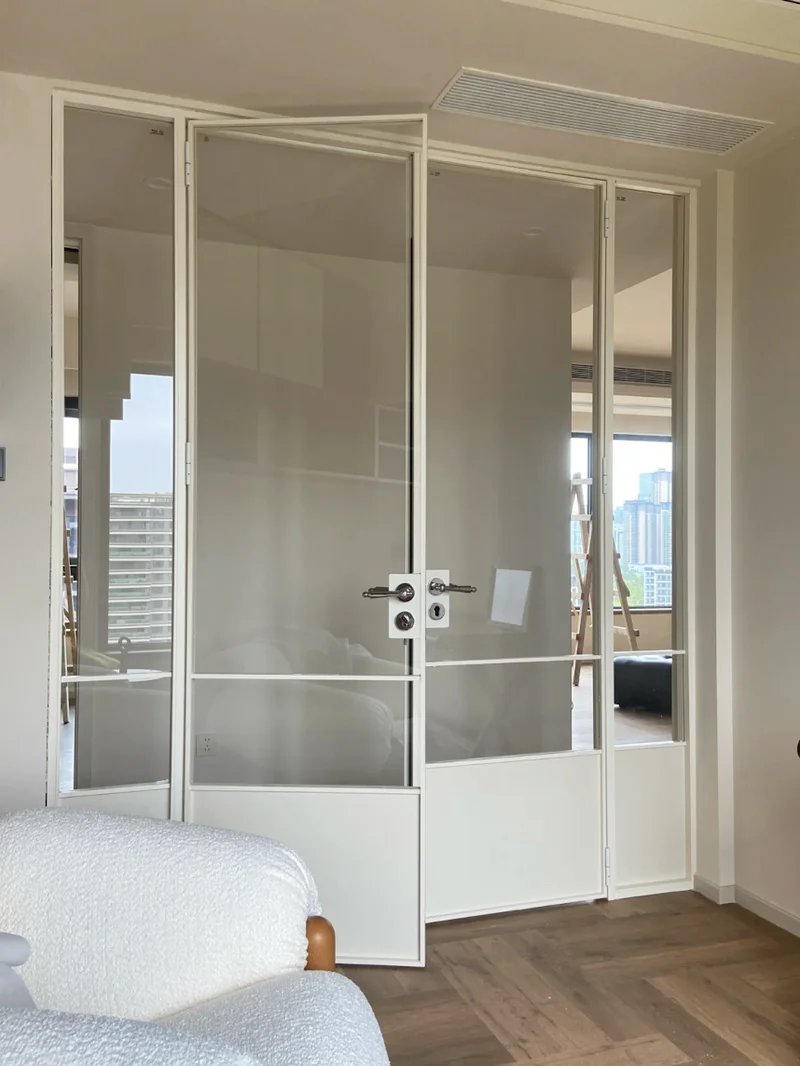
The following table quantifies the performance delta between a basic commercial door and a premium engineered system, illustrating the justification for a higher price point.
| Parameter | Standard Commercial Door | Premium Engineered Door | Test Standard / Note |
|---|---|---|---|
| Aluminum Alloy / Wall Thickness | 6063-T5, 1.2mm | 6063-T5 or 6061-T6, 1.4-2.0mm | ASTM B221 / Structural calc. required |
| Thermal Break Shear Strength | ~20 N/mm² | >30 N/mm² | EN 14024 |
| Air Infiltration Rate | ≤ 1.0 cfm/ft² (Class 25) | ≤ 0.5 cfm/ft² (Class 40) | ASTM E283 |
| Acoustic Performance (Rw) | 28-31 dB | 35-40 dB | EN ISO 10140 (with laminated glass) |
| Glass Unit U-Factor | ~1.6 W/m²K (clear DGU) | ≤ 1.1 W/m²K (Low-E, Argon) | EN 673 / NFRC 100 |
| Surface Hardness (Coating) | Pencil Hardness H (AAMA 2603) | Pencil Hardness 2H (AAMA 2604) | ASTM D3363 |
| Moisture Absorption (Thermal Break) | < 0.5% | < 0.1% | ISO 62 |
Stocking and promoting doors that meet these premium specifications allows you to move beyond price-based competition. You provide architects and contractors with a reliable, performance-guaranteed solution that protects their project’s integrity and your reputation, directly maximizing your operational and profit margins.
Engineered for High-Traffic Durability: The Structural Integrity of Our Doors
The structural integrity of our aluminum glass door systems is derived from a calculated synergy of alloy composition, thermal engineering, and reinforced hardware. This is not a commodity product; it is a performance-engineered assembly designed to withstand the mechanical stress and cyclical loading inherent in commercial, institutional, and high-density residential applications.
Core Structural Components:
- Alloy & Profile Engineering: We utilize 6063-T5 or 6061-T6 aluminum alloys, chosen for their optimal balance of strength, corrosion resistance, and extrudability. Profiles are designed with multi-chambered, internally reinforced geometries. This increases the moment of inertia, resisting deflection under wind load and heavy use. All extrusions undergo a controlled anodizing or powder-coating process per AAMA 2603-2605 standards, ensuring a durable, corrosion-resistant finish.
- Glass & Glazing System: Laminated glass with a PVB or SGP interlayer is standard for critical safety and security. For thermal performance, insulated glass units (IGU) are fabricated with warm-edge spacers and argon fill, achieving U-factors as low as 0.28 Btu/(hr·ft²·°F). Glass is structurally captured using high-durability EPDM or silicone gaskets, not simple beadings, to absorb vibration and prevent stress transfer.
- Hardware Integration: The load path is critical. Hinges and pivots are manufactured from forged or machined stainless steel (grade 304 or 316), with load-rated bearings. Multi-point locking systems engage with reinforced stainless steel keepers anchored directly into the aluminum frame, not just the profile wall. This ensures uniform stress distribution and prevents premature failure at locking points.
Performance Data & Specifications:
| Parameter | Test Standard | Performance Range | Notes |
|---|---|---|---|
| Wind Load Resistance | ASTM E330 / EN 12211 | Up to 2400 Pa (PSF 50) | Varies by profile series and glazing. |
| Air Infiltration | ASTM E283 / EN 1026 | Class ≤ 0.15 cfm/ft² (≤ 0.5 m³/(hr·m²)) | AAMA Commercial Grade performance. |
| Water Penetration Resistance | ASTM E331 / EN 1027 | Up to 600 Pa (PSF 12.5) | Tested under negative and positive pressure. |
| Acoustic Performance (STC/OITC) | ASTM E90 / E413 | Up to STC 48 / OITC 42 | Achieved with laminated glass and specific glazing configurations. |
| Cyclic Durability (Operational Testing) | AAMA 920 / EN 1191 | > 100,000 cycles | Testing of full hardware set under load. |
| Thermal Transmittance (U-factor) | NFRC 100 / EN ISO 10077-2 | 0.28 – 0.60 Btu/(hr·ft²·°F) | Dependent on thermal break material (polyamide or polyurethane) and glazing. |
Functional Advantages for High-Traffic Environments:
- Minimized Deflection: The engineered profile systems maintain alignment, ensuring consistent operation and seal compression over the door’s service life, preventing drafts and water ingress.
- Hardware Longevity: By designing the frame and hardware as an integrated system, we eliminate point loads and galling, which are primary causes of sagging, binding, and latch mechanism failure.
- Maintained Insulative Properties: The stability of the frame under load preserves the integrity of the thermal barrier and glazing seals, ensuring long-term energy performance and preventing condensation within the IGU.
- Predictable Service Life: Every component, from the alloy temper to the bearing type, is selected against known wear and fatigue data. This allows for accurate lifecycle forecasting and reduces total cost of ownership through minimized reactive maintenance.
Waterproof and Weather-Resistant Solutions for Demanding Environments
The long-term performance of an aluminum glass door system in demanding environments is determined by the integrity of its sealing and the stability of its composite components. Failure points typically occur at the interface between materials and within the core substrates themselves. Our wholesale solutions are engineered to address these vulnerabilities at a fundamental level.
Core Material Engineering for Humidity and Thermal Cycling
Door leaf stability is paramount. We utilize engineered cores with defined material properties to prevent warping, swelling, and delamination.
- High-Density Wood Plastic Composite (WPC) Cores: Engineered to a minimum density of 0.75 g/cm³, our WPC formulations achieve a moisture absorption rate of less than 0.5% after 24-hour immersion (ASTM D570). This eliminates the swelling common in solid timber or particleboard.
- LVL (Laminated Veneer Lumber) Stability: For structural applications, LVL cores are specified with cross-banded veneer orientation and phenolic resins, providing dimensional stability with a linear expansion coefficient of less than 0.01% per 1% moisture content change.
- PVC-Wood Hybrid Profiles: The optimal PVC-to-wood flour ratio (typically 60:40) is calibrated for balance, ensuring a low thermal expansion coefficient (approx. 5 x 10⁻⁵ /K) while maintaining a Shore D hardness of 75-80 for impact resistance.
Advanced Glazing and Sealing Systems
The glazing pocket is a critical line of defense. Our systems employ a multi-barrier sealing approach.
- Primary Weather Seal: A continuous EPDM gasket with a minimum tensile strength of 12 MPa and a service temperature range of -50°C to +120°C forms the primary barrier against water and air infiltration.
- Structural Glazing & Secondary Drainage: Butyl tape provides the initial adhesive seal. The system is then designed with a dedicated internal drainage pathway within the frame to channel any incidental moisture to the exterior, preventing accumulation.
- Thermal Insulated Glass Unit (IGU) Performance: Standard IGUs are 24mm argon-filled units with warm-edge spacers, achieving a center-pane U-factor as low as 1.0 W/(m²·K). For coastal or high-pollution areas, we recommend a third laminated glass ply for added security and acoustic performance (up to 40 dB Rw sound reduction).
Technical Performance Specifications
| Parameter | Test Standard | Performance Grade | Note |
|---|---|---|---|
| Air Infiltration | ASTM E283 / EN 12207 | Class 4 (≤ 0.5 m³/(m·h) @ 75 Pa) | Superior to standard commercial grade. |
| Water Resistance | ASTM E331 / EN 12208 | Class 5A (≥ 600 Pa) | Suitable for severe wind-driven rain exposure. |
| Wind Load Resistance | ASTM E330 / EN 12211 | Positive & Negative Pressure up to 2400 Pa | Corresponds to design pressures for most high-rise and coastal applications. |
| Operational Cycle Testing | EN 1191 | ≥ 10,000 cycles (Grade 4) | Validates hardware and frame integrity for high-traffic use. |
| Formaldehyde Emission | EN 16516 / JIS A 1460 | E0 (≤ 0.065 mg/m³) | Ultra-low emission core and adhesive materials. |
Architectural and Compliance Assurance
All components are sourced from ISO 9001-certified production lines, with batch-traceable material certificates. Fire-rated door assemblies are available, tested to relevant sections of EN 1634-1 or ASTM E84, with integrated intumescent seals that activate at approximately 180°C. The aluminum profiles are finished with a minimum 70μm PVDF (Kynar 500® or Hylar 5000®) coating, rated for 25+ years of color and chalk resistance under ISO 12944-2 C4 (High) and C5-M (Marine) corrosion categories.
Formaldehyde-Free and Eco-Friendly: Safe and Sustainable Building Materials
The core structural and infill materials in modern aluminum door systems are engineered to meet stringent indoor air quality (IAQ) and lifecycle sustainability standards without compromising performance. For distributors, specifying these materials is a critical value proposition for contractors and architects focused on green building certifications (LEED, BREEAM) and occupant health.
Material Science & Composition
The shift from traditional particleboard or MDF cores to advanced composites eliminates formaldehyde-based binders. Key engineered components include:
- High-Density WPC (Wood-Plastic Composite) Profiles: Utilizing a controlled PVC-wood flour ratio (typically 60:40) and a density exceeding 1.3 g/cm³, these profiles achieve dimensional stability superior to solid wood. The encapsulated cell structure results in near-zero moisture absorption (<0.5%), preventing warping and microbial growth.
- LVL (Laminated Veneer Lumber) Core: For applications requiring high load-bearing capacity, LVL cores use phenol-formaldehyde (PF) or polyurethane (PUR) adhesives, which are chemically stable and non-off-gassing after curing. These adhesives are distinct from urea-formaldehyde (UF) resins and meet the strictest emission standards.
- Powder Coatings & Sealants: All finishes are formulated without volatile organic compounds (VOCs). Thermosetting polyester powder coatings are applied via electrostatic spray and cured under heat, forming a durable, inert surface with a typical hardness of ≥80 Shore D.
Technical Standards & Certifications
Compliance is verified through independent testing and documented chain-of-custody.
- Formaldehyde Emissions: All composite wood elements comply with CARB ATCM Phase 2, EPA TSCA Title VI, and the European EN 13986 E1 (<0.1 ppm) or superior E0 grade. Certificates of Analysis (CoA) are available for each batch.
- Fire Performance: Core and glazing materials are tested per relevant standards. Typical ratings include:
- Aluminum Profile System: Class A1 (EN 13501-1) / Non-combustible (ASTM E136).
- WPC/LVL Infill: Class B-s1, d0 (EN 13501-1) / Flame Spread Index ≤25 (ASTM E84).
- Quality & Environmental Management: Manufacturing processes are certified to ISO 9001 for quality assurance and ISO 14001 for environmental management, ensuring traceability and controlled production.
Architectural Performance Advantages
The integration of non-toxic materials directly enhances key performance metrics.
- Acoustic Insulation: The dense, homogeneous structure of formaldehyde-free composites improves sound damping. When paired with insulated glass units (IGU), systems achieve a weighted sound reduction (Rw) of up to 42 dB.
- Thermal Insulation: Stable, low-conductivity cores contribute to overall thermal break efficiency. The complete door assembly can achieve a thermal transmittance (U-factor) as low as 1.1 W/(m²·K).
- Long-Term Durability: The resistance to moisture and temperature cycling ensures long-term integrity, with swelling rates below 0.1% after 24-hour water immersion (EN 317), minimizing callbacks and maintenance.
Technical Performance Summary of Core Materials
| Parameter | High-Density WPC | LVL Core (PUR Bonded) | Test Standard |
|---|---|---|---|
| Density | ≥ 1.3 g/cm³ | ≥ 0.65 g/cm³ | EN 323 |
| Moisture Absorption (24h) | < 0.5% | < 8% | EN 317 |
| Formaldehyde Emission | Not Detected | E0 Grade (<0.05 ppm) | EN 717-1 / JIS A 1460 |
| Swelling in Thickness (24h) | ≤ 0.1% | ≤ 2.0% | EN 317 |
| Thermal Conductivity (λ) | 0.15 – 0.20 W/(m·K) | 0.12 – 0.14 W/(m·K) | EN 12667 |
Customizable Designs and Finishes to Meet Diverse Market Needs
Customization in aluminum glass door systems is not merely aesthetic; it is a critical engineering function that determines performance, compliance, and project viability. Our wholesale program provides distributors with a configurable platform, grounded in material science and certified performance standards, to address precise architectural specifications.
Core Material and Profile Engineering
The foundation of any custom design is the aluminum alloy and thermal break. We utilize 6063-T5 or 6063-T6 alloys, with temper selection balancing formability and structural strength. Profiles are engineered for multi-chamber designs, with polyamide thermal breaks of a minimum 24mm depth to achieve a thermal transmittance (U-factor) as low as 1.6 W/(m²·K). Powder coating is applied to a minimum thickness of 70μm per Qualicoat Class 2 or GSB Master standards, with a comprehensive RAL and custom color matching capability. Anodizing options are available in AA-M10-C22 (Architectural Class II) and AA-M10-C25 (Architectural Class I) specifications.
Glass Unit Performance Configurations
The glazing unit is the primary variable for acoustic, thermal, and safety performance. Configurations are built to order from certified components.
| Performance Parameter | Standard Double Glazing | Enhanced Acoustic Insulation | High-Performance Solar Control | Safety & Security |
|---|---|---|---|---|
| Typical Configuration | 4mm Clear / 16mm Argon / 4mm Clear | 6mm Laminated / 16mm Argon / 4mm Laminated | 6mm Low-E (pyrolytic) / 16mm Argon / 4mm Clear | 6mm Tempered / 16mm / 6mm Tempered Laminated |
| Thermal U-factor (Center of Glass) | ~1.1 W/(m²·K) | ~1.3 W/(m²·K) | ~0.7 W/(m²·K) | ~1.2 W/(m²·K) |
| Sound Reduction (Rw) | 31 dB | 38-42 dB | 33 dB | 37 dB |
| Solar Heat Gain Coefficient (SHGC) | 0.70 | 0.65 | 0.30 – 0.45 | 0.65 |
| Safety Standard | EN 1279 | EN 1279, EN ISO 10140 | EN 1279 | EN 12150 (Tempered), EN 12600 (Laminated) |
Hardware and Functional Integration
Hardware selection is integral to door performance and lifecycle cost. We specify and integrate systems based on project traffic and security needs.
- Bearing Systems: Stainless steel ball bearings with a minimum cycle rating of 200,000 (EN 1527) for standard use; heavy-duty roller systems rated for >500,000 cycles for commercial applications.
- Locking Mechanisms: Multi-point locking gear with stainless steel bolts, compatible with a range of cylinder profiles (EN 1303 Grade 6). Options include electric strikes and access control pre-wiring.
- Seal Integrity: Dual-compression EPDM gaskets (shore hardness 70±5) ensure consistent weatherproofing, achieving air infiltration ratings better than Class 4 per EN 12207 and watertightness to Class 9A per EN 12208.
Finish and Aesthetic Durability
Beyond color, surface finish engineering protects against environmental degradation.
- Powder Coatings: Available in polyester, polyurethane, and super-durable PVDF resin systems. Chalk resistance >8 (ISO 2813), salt spray resistance >1000 hours (ASTM B117).
- Anodized Finishes: 20-25μm anodic layer thickness, sealed to achieve >75% reflectance retention after 10,000 hours of QUV-B exposure.
- Woodgrain Foil Laminates: High-pressure laminates with 200μm wear layer, featuring UV-stable acrylic top coats. Moisture absorption rate <18% by volume (EN 438-2).
Quality Assurance and Compliance Framework
All customizable components fall within a controlled quality management system (ISO 9001:2015). Material traceability, from alloy batch to final assembly, is documented. Finished products carry relevant certifications:
- Structural Performance: EN 14351-1 for windows and external pedestrian doorsets.
- Fire Rating: Options available up to EI30 (Integrity & Insulation for 30 minutes) per EN 16034.
- Environmental: EPDs (Environmental Product Declarations) available for full life cycle assessment (LCA).
Streamlined Logistics and Bulk Order Support for Distributor Efficiency
Our logistics framework is engineered to eliminate bottlenecks in your supply chain. We operate a network of regional consolidation hubs, pre-stocking core product lines and high-demand components to enable rapid fulfillment. For bulk orders, we implement a just-in-sequence (JIS) packing system where door sets, hardware, and glazing units are palletized in the exact sequence required for installation, reducing on-site handling by up to 40%.
Operational Advantages:
- Consolidated Shipments: Full-container-load (FCL) optimization for mixed SKUs, including doors, compatible framing systems, and ancillary components, minimizing landed cost.
- Advanced Material Handling: Door leaves and large glass panels are crated using engineered timber (LVL core for dimensional stability) and secured with high-density polyethylene (HDPE) edge protectors to prevent transit damage.
- Real-Time Inventory Sync: API-enabled platform access for distributors provides live visibility into stock levels of raw material batches (e.g., 6063-T5 aluminum alloy extrusions, 12mm tempered glass inventories) and finished goods.
For project-specific orders, our technical logistics team coordinates directly with your project managers. We schedule deliveries in phased waves aligned with construction milestones, with all materials arriving site-ready. Documentation packages include:
- Mill certificates for aluminum alloys and glass
- Batch-specific test reports for thermal breaks (U-factor ≤ 1.6 W/m²K) and acoustic performance (Rw ≥ 35 dB)
- Compliance certificates for fire-rated assemblies (up to 90 minutes, tested to EN 1634-1 or ASTM E119)
Bulk Order Technical Specifications & Support
Standard bulk configurations are optimized for container loading. Below are the standard packaging parameters for our 2400mm x 1200mm aluminum glass door leaf.
| Parameter | Specification | Notes / Test Standard |
|---|---|---|
| Unit Packaging | 4 leaves per crate | LVL-reinforced wooden crate, weather-sealed |
| Crate Dimensions (LxWxH) | 2500mm x 1300mm x 150mm | Optimized for 40′ HC container |
| Gross Weight per Crate | ~320 kg | Includes leaves, hardware kit, and packing |
| Door Leaf Core Material | WPC (Wood Plastic Composite) | Density: ≥ 680 kg/m³; PVC-Wood ratio: 70:30 |
| Moisture Resistance | Swelling rate ≤ 0.8% (24h immersion) | EN 317 (Particleboard and Fiberboard) |
| Formaldehyde Emission | E0 Grade (≤ 0.5 mg/L) | EN 16516 (Chamber method) |
| Surface Hardness | ≥ 85 Shore D | ASTM D2240 |
| Thermal Insulation (U-Value) | 1.4 – 1.8 W/m²K | Center of glass, calculated per EN 673 |
For orders exceeding 10 containers, we activate dedicated project protocols. This includes reserved production lines, raw material allocation from certified mills (ISO 9001), and weekly quality audit reports. Our engineering support extends to providing shop drawing reviews and load calculation verifications for large-scale deployments to ensure structural and performance specifications are met prior to manufacturing.
Frequently Asked Questions
What are the critical technical specifications for moisture and thermal performance in aluminum glass doors?
For optimal performance, specify doors with a thermal break using 24mm polyamide strips and dual-sealed insulating glass (argon-filled, Low-E coating). The aluminum alloy should be 6063-T5 or higher. This system achieves a U-value below 1.6 W/(m²·K), preventing condensation and ensuring energy efficiency in diverse climates.
How do you ensure long-term dimensional stability and prevent warping in door frames?
Utilize frames reinforced with engineered LVL (Laminated Veneer Lumber) cores or high-density WPC (≥ 700 kg/m³). These materials have minimal moisture expansion coefficients. Coupled with a powder-coated or PVDF-finished aluminum exterior, this hybrid construction resists thermal cycling and humidity, guaranteeing structural integrity for decades.
What standards govern formaldehyde emissions and material safety for composite components?
Insist on core materials and adhesives certified to E0 (≤0.5 mg/L) or ENF (≤0.025 mg/m³) emission standards. Reputable wholesalers provide third-party test reports (e.g., CARB Phase 2, F★★★★). For WPC elements, verify they are 100% virgin polymer-based, not recycled, to eliminate VOC risks.
What defines true impact resistance and security in wholesale aluminum glass doors?
Security requires a multi-point locking system (minimum 3 points) integrated into a reinforced frame. Specify tempered or laminated security glass (often 6+6mm). The aluminum profile wall thickness must be ≥1.8mm. For high-traffic areas, consider doors with reinforced corners and anti-burst hinge technology.
How is sound insulation performance quantified and achieved in these door systems?
Target an Rw (weighted sound reduction index) of ≥35 dB for commercial use. This is achieved through double-glazed units with asymmetrical glass thicknesses (e.g., 6mm/10mm), specialized acoustic interlayers, and full-perimeter magnetic or compression seals. The frame must have a multi-chamber design filled with acoustic foam.
What finishing processes ensure durability against UV degradation and corrosion?
Demand a pretreatment (chromate or zirconium-based) followed by a 60-80μm thick polyester powder coating or 70μm PVDF (Kynar 500®) fluorocarbon coating. This process, tested to AAMA 2605 standards, provides superior color retention, resistance to salt spray (>1500 hours), and protection against chalking for over 20 years.
What are the procurement benchmarks for verifying product quality and compliance?
Require mill test certificates for aluminum alloy (6063-T5), material safety data sheets, and performance test reports for air/water infiltration (ASTM E283/E331), structural load (ASTM E330), and thermal transmittance. Audit the supplier’s in-house quality control for welding integrity, hardware integration, and glass processing.