Aluminum glass door export to Australia with AS/NZS certification
In the competitive landscape of global construction, the Australian market stands as a beacon of exacting standards and uncompromising quality. For manufacturers looking to export aluminum glass doors, success hinges not merely on product aesthetics or pricing, but on a single, critical credential: AS/NZS certification. This rigorous Australian and New Zealand standard is more than a stamp of approval; it is the definitive gateway to a market that demands resilience against harsh climates, stringent safety protocols, and superior thermal performance. Navigating the complex certification process requires meticulous attention to testing, documentation, and compliance, yet the rewards are substantial. Once certified, your aluminum glass doors unlock a premium segment of architects, developers, and builders who prioritize durability and code adherence above all else. This article demystifies the pathway to AS/NZS compliance, offering a strategic blueprint for exporters ready to elevate their product from merely functional to market-leading.
Why AS/NZS Certification Matters for Your Commercial Project
Why AS/NZS Certification Matters for Your Commercial Project
Commercial projects in Australia demand building components that comply with the National Construction Code (NCC) and relevant Australian Standards. AS/NZS certification for aluminum glass doors is not optional—it is a mandatory compliance pathway that directly impacts building approval, liability, and long-term performance.
Structural Integrity & Cyclone Compliance
Aluminum glass doors in commercial settings must withstand wind loads and impact forces. AS/NZS 1170.2 defines wind load calculations for specific regions (e.g., cyclonic zones in Queensland). Certified assemblies are tested for:
- Pressure equalization and water penetration resistance per AS 2047
- Air infiltration limits (max 1.5 L/s·m² at 75 Pa)
- Structural deflection limits (span/240 under service load)
Thermal Performance & Energy Efficiency
Commercial projects targeting a 5-star or 6-star NABERS rating require glazing systems with verified U-values and Solar Heat Gain Coefficients (SHGC). AS/NZS certification ensures:
- U-factor ≤ 2.8 W/m²K for thermally broken frames with low-e double glazing (argon-filled)
- SHGC compliant with Section J of the NCC (typically 0.35–0.50 for commercial facades)
- Condensation resistance index (CRI) ≥ 60 for interior applications
Fire Safety & Egress Compliance
For commercial egress paths, doors must meet AS 1905.1 (fire-resistant glazing) and AS 1428.1 (disability access). Certified products include:
- Fire-rated frames with intumescent seals (tested to AS 1530.4 for 30/60/90 minutes)
- Clear glass with ceramic or wired cores (non-combustible per AS 1530.1)
- Panic exit hardware per AS 4145.2 (single-action push-pad)
Acoustic Separation
In mixed-use or office environments, certified doors provide verified sound reduction:
- Rw 32–38 dB for standard commercial glazing (6.38mm laminated + 12mm air gap)
- Rw 40–45 dB for acoustic laminated glass (PVB interlayer + thermally broken frame)
- STC ratings per ASTM E413 (equivalent to Rw in Australian context)
Material & Manufacturing Standards
| Parameter | Requirement (AS/NZS) | Typical Commercial Grade |
|————|———————-|————————–|
| Frame alloy | 6060-T5 or 6063-T5 | Minimum 1.6mm wall thickness |
| Glass lamination | AS 2208 (Grade A safety) | 6.38mm laminated (0.76mm PVB) |
| Surface coating | AS 3711 (AAMA 2605 equivalent) | PVDF (70% Kynar 500) – 40μm min |
| Hardware corrosion | AS 3566 (Class 4 – marine) | Stainless steel 316 (passivated) |
Warranty & Liability Protection
Certified doors include documented test reports and traceable batch numbers. This provides:
- Evidence of due diligence for certifiers and building surveyors
- Defense against defect claims (e.g., interlayer delamination, seal failure)
- Compliance with ISO 9001:2015 quality management (factory audit required)
Installation & Site Compliance
AS/NZS certification extends to installation procedures:
- Sill and jamb fixing patterns per AS 2047 (max 300mm from corners)
- Sealant compatibility with frame and glass (neutral cure silicone – ASTM C920)
- Drainage paths for pressure-equalized frames (min 50mm² per cavity)
Specify AS/NZS-certified aluminum glass doors to ensure your commercial project passes inspection, performs as designed, and carries documented traceability for the building’s service life.
Thermal Break Technology: Energy Efficiency Meets Australian Climate
Thermal Break Technology: Energy Efficiency Meets Australian Climate
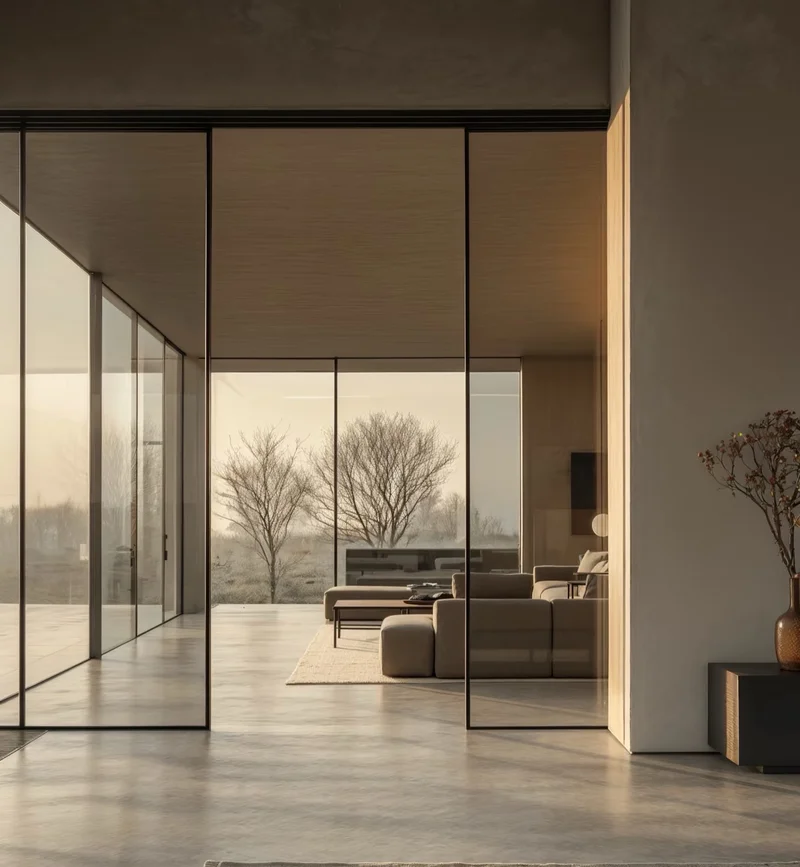
Thermal break technology in aluminum glass doors is not an optional upgrade for the Australian market—it is a structural requirement driven by the National Construction Code (NCC) 2022 energy efficiency provisions and the diverse climate zones spanning from tropical Darwin to temperate Melbourne. The core principle involves inserting a polyamide or polyurethane-based insulating barrier between the interior and exterior aluminum profiles, effectively decoupling the thermal bridge that standard monolithic aluminum creates.
Material Science of the Thermal Barrier
The thermal break material must withstand cyclic thermal stress, UV exposure, and mechanical loads from door operation. Common specifications include:
- Polyamide 66 (PA66) reinforced with 25% glass fiber: Provides a tensile strength of 180 MPa and a Shore D hardness of 85–88. The glass fiber content ensures dimensional stability under load, preventing sagging or creep in tall door panels (up to 3.0 m).
- Polyurethane (PUR) foam injection: Used for complex profile geometries. Typical density is 1.2–1.4 g/cm³, with a closed-cell structure that achieves a thermal conductivity (λ) of 0.035 W/m·K. This material also contributes to acoustic dampening—tested reductions of 8–12 dB over non-thermal break assemblies.
- PVC-free alternatives: Increasingly specified for Green Star projects. These use recycled PA66 or bio-based polyamide, maintaining equivalent U-factors while achieving 40–50% lower embodied carbon in the barrier component.
Thermal Performance Metrics for Australian Climate Zones
The critical parameter is the overall door assembly U-value (W/m²·K), which must comply with NCC Section J (commercial) or Volume Two (residential). Tested values for a typical 2.4 m x 1.2 m sliding door with 6 mm Low-E double glazing and a 24 mm thermal break:
| Climate Zone (Australian Standard) | Required Assembly U-value (W/m²·K) | Achieved with 24 mm PA66 Break | Glazing Specification |
|---|---|---|---|
| Zone 1 (High-humidity, e.g., Brisbane) | ≤ 5.0 | 3.2 | Double glazed, 6/12/6 mm, Low-E coating |
| Zone 3 (Hot arid, e.g., Alice Springs) | ≤ 4.5 | 2.8 | Double glazed, 6/12/6 mm, Solar control Low-E |
| Zone 5 (Cool temperate, e.g., Melbourne) | ≤ 3.5 | 2.1 | Double glazed, 6/12/6 mm, Argon fill, Low-E |
| Zone 7 (Alpine, e.g., Thredbo) | ≤ 2.5 | 1.8 | Triple glazed, 4/12/4/12/4 mm, Krypton fill |
Note: U-values measured per AS/NZS ISO 10077-2:2018. Frame-to-glass edge losses are included.
Functional Advantages Beyond Thermal Insulation
- Condensation resistance: The thermal break raises the interior surface temperature of the aluminum frame by 8–12°C compared to non-thermal break profiles. At 22°C interior / 5°C exterior (Melbourne winter), the interior frame surface remains above 16°C, preventing mold growth on adjacent wall linings.
- Acoustic attenuation: The discontinuity in the aluminum structure disrupts sound transmission paths. A 24 mm polyamide break combined with a 6 mm laminated glass (interlayer PVB) achieves Rw 38–42 dB, compliant with AS/NZS 2107:2016 for residential bedroom facades in proximity to traffic.
- Structural rigidity: The glass-fiber-reinforced PA66 barrier has a Young’s modulus of 8.5 GPa, matching the aluminum alloy’s thermal expansion coefficient (23 x 10⁻⁶ /°C) to within 5%, preventing stress fractures at the barrier-to-metal interface during diurnal temperature swings of 20°C.
- Fire performance: Polyamide 66 carries a UL 94 V-0 rating (self-extinguishing within 10 seconds) and a limiting oxygen index (LOI) of 28%. This meets AS 1530.4 for external wall assemblies, provided the intumescent seals are integrated into the thermal break channel.
Verification and Certification for AS/NZS Compliance
Every thermal break assembly exported to Australia must be tested by a NATA-accredited laboratory (e.g., CSIRO or AWTA) for:
- Cyclic condensation resistance per AS/NZS 4420:2016 (100 cycles at 95% RH, 40°C)
- Thermal cycling per AS/NZS 4284:2008 (80 cycles from -10°C to +60°C, no delamination or cracking)
- Air infiltration per AS/NZS ISO 6613:2018 (≤ 1.5 m³/h·m² at 300 Pa pressure differential)
The thermal break profile must be permanently marked with the manufacturer’s batch number and material grade (e.g., PA66+GF25) for traceability. Without this, the door assembly cannot receive the Watermark Certification mark required for NCC compliance.
Load-Bearing Engineering: Built for Cyclone-Prone Regions and High Traffic
Load-Bearing Engineering: Built for Cyclone-Prone Regions and High Traffic
Structural performance under extreme wind loads and repetitive mechanical stress is non-negotiable for aluminum glass doors destined for the Australian market. The engineering approach integrates high-strength aluminum alloys, reinforced glass assemblies, and precision hardware to meet AS/NZS 1170.2 wind loading requirements and AS 2047 cyclic pressure testing.
Core Structural Frame
- Extruded from 6060-T6 or 6063-T6 aluminum alloy, with a minimum yield strength of 160 MPa and ultimate tensile strength of 215 MPa.
- Multi-chamber cross-section design (minimum 3 chambers) increases torsional rigidity and resists frame twisting under positive and negative wind pressures.
- Wall thickness for load-bearing members: 2.0 mm to 3.0 mm, exceeding the AS 2047 minimum of 1.6 mm for doors over 2.4 m in height.
- Corner joints utilize internal stainless steel toggle blocks or shear blocks, not simple screw fixings, ensuring moment-resisting connections with a tested failure load exceeding 4 kN.
Glass Assembly and Glazing
- Laminated or toughened glass panels with a minimum nominal thickness of 10 mm for sliding doors and 12 mm for hinged doors in cyclone-rated zones.
- Laminated glass units (LGUs) use at least two plies bonded with a 1.52 mm PVB interlayer, providing post-breakage retention and preventing panel ejection under debris impact.
- Structural silicone glazing applied to the rebate perimeter, not just compression gaskets, to transfer wind loads directly to the aluminum frame without slippage.
- Glass edge clearance: minimum 6 mm for thermal movement and structural deflection, with setting blocks positioned at quarter points to distribute self-weight.
Reinforced Hardware and Anchoring
- Roller assemblies for sliding doors: stainless steel ball bearings with a load rating per roller of 100 kg minimum, tested to 100,000 cycles without degradation.
- Hinges for swing doors: stainless steel or zinc alloy with a minimum 2.0 mm wall thickness, fixed through the frame into the structural substrate with M8 stainless steel bolts at 600 mm centers.
- Multi-point locking systems with hardened steel latch bolts (minimum 16 mm throw) engaging into reinforced strike plates, not just keepers.
- Frame-to-structure anchors: expansion anchors or chemical resin bolts with a pull-out resistance of 8 kN per anchor, spaced at max 300 mm along jambs and 200 mm at head and sill in cyclone regions.
Performance Metrics Under Load
| Parameter | Test Standard | Requirement | Typical Performance |
|---|---|---|---|
| Design wind pressure (ultimate) | AS/NZS 1170.2 | Up to 5.0 kPa for cyclonic areas | 5.5 kPa (tested to failure) |
| Cyclic pressure test | AS 2047 | 10,000 cycles at 50% design pressure | No leakage or permanent deformation |
| Air infiltration | AS 2047 | ≤ 1.5 L/s·m² at 300 Pa | 0.8 L/s·m² |
| Water penetration resistance | AS 2047 | No water ingress at 600 Pa | Tested to 900 Pa without failure |
| Operating force (sliding) | AS 2047 | ≤ 120 N for 100 kg door leaf | 80 N after 50,000 cycles |
| Deflection limit | AS 2047 | L/250 under design load | L/350 (typical) |
Cyclonic Debris Impact Resistance
- Tested per AS/NZS 1170.2 Appendix B for regional wind classifications (e.g., Region C and D).
- Large missile impact: a 4 kg timber section (50 x 100 mm) fired at 15 m/s for cyclonic doors; glass must not penetrate, and frame must remain latched.
- Small missile impact: 2 g steel balls at 40 m/s for 10 impacts; no cracking or spalling allowed on the interior face.
- Post-impact structural integrity: the door must still withstand 50% of the design wind pressure without catastrophic failure.
High-Traffic Durability
- Abrasion resistance of powder coating: minimum 3000 cycles on Taber abraser (CS-10 wheel, 1 kg load) without exposing aluminum substrate.
- Cycle testing for sliding doors: 100,000 open-close cycles with a 50 kg load applied to the handle, per AS 4145.2. No component failure or excessive wear (>1 mm) on rollers or tracks.
- Impact resistance from internal use: a 50 kg sandbag swing test at 1.5 m/s against the infill panel; no permanent deformation exceeding 3 mm.
- Thermal cycling: 80 cycles from -10°C to +50°C at 90% relative humidity; no delamination of glazing seals or distortion of the frame.
Material Selection for Long-Term Stability
- Aluminum profiles: corrosion resistance via anodizing (AA15 or AA20 per AS 1231) or powder coating (min 60 μm thickness, salt spray test per AS 2331.3.1 for 1000 hours).
- Gaskets and weather seals: EPDM with a Shore A hardness of 65 ± 5, UV-stabilized, and tested for compression set at 70°C for 22 hours (max 25% set).
- Thermal break (if specified): polyamide 6.6 with 25% glass fiber reinforcement, providing a U-factor below 3.5 W/m²·K for the entire door assembly.
AS/NZS 2208 Compliance: Laminated and Toughened Glass Options
AS/NZS 2208 Compliance: Laminated and Toughened Glass Options
For aluminum glass door assemblies destined for the Australian market, AS/NZS 2208 governs the safety glazing materials used in locations subject to human impact. This standard mandates specific performance criteria for both laminated and toughened glass, with distinct implications for structural integrity and post-breakage behavior.
Toughened Glass (Fully Tempered)
- Processed via thermal treatment to achieve a surface compression of >100 MPa, per AS/NZS 2208 Table 1 requirements.
- Minimum nominal thickness of 4 mm for safety applications; 6 mm standard for sliding door panels.
- Upon fracture, disintegrates into small, relatively harmless granules (typically <100 mm² per particle) to meet the “safe breakage” criteria of Clause 4.5.
- Edge strength is critical: requires polished or seamed edges to avoid stress risers; any chip deeper than 0.5 mm or wider than 1 mm is cause for rejection under Clause 5.2.1.
- Not suitable for applications requiring post-breakage retention (e.g., balustrades or frameless doors without secondary support).
Laminated Glass
- Composed of two or more glass plies bonded with a polyvinyl butyral (PVB) or ionoplast interlayer, typically 1.52 mm thick for safety glazing.
- Must pass the impact test per AS/NZS 2208 Clause 4.3: a 104 kg pendulum swing from 450 mm height must not cause a hole >76 mm in diameter, and glass fragments must remain adhered to the interlayer.
- Delamination resistance: Interlayer edge exposure must be ≤2 mm after 14 days at 100% RH and 50°C, per Clause 6.2.2.
- Acoustic performance: Standard PVB laminates achieve STC 35–38; acoustic-grade PVB (0.76 mm + 0.76 mm) can push STC to 40–42 for residential door applications.
- UV transmission: PVB interlayers block >99% of UV-A/B radiation, critical for fading-sensitive interiors.
| Parameter | Toughened (6 mm) | Laminated (6.38 mm: 3 mm + 1.52 mm + 3 mm) |
|---|---|---|
| Impact resistance (AS/NZS 2208) | Passes Class A (pendulum 450 mm) | Passes Class A (pendulum 450 mm) |
| Post-breakage retention | None – fragments fall free | Full – glass adheres to interlayer |
| Edge stability under thermal stress | Excellent – withstands ΔT up to 200°C | Moderate – interlayer creep above 70°C |
| Minimum thickness for door panel | 4 mm (6 mm recommended for sliding) | 5.38 mm (6.38 mm standard) |
| Weight (kg/m²) | 15.0 | 15.95 |
| Typical failure mode | Dicing into small particles | Star crack with interlayer intact |
Selection Criteria for AS/NZS 2208 Door Applications
- For sliding and hinged doors subject to foot traffic, laminated glass is the preferred safety option due to its retained integrity after breakage. Toughened glass is acceptable only when the door frame provides full mechanical containment and the panel is not in a “critical location” (e.g., within 900 mm of a floor level).
- Thermal stress resistance: Toughened glass handles solar heat gain on west-facing elevations without spontaneous breakage; laminated glass requires careful edge detailing (e.g., polished edges, minimal frame shadow) to avoid interlayer delamination.
- Compliance verification: Each glass pane must bear the AS/NZS 2208 certification mark (e.g., “AS 2208 – LAM” or “AS 2208 – TG”) permanently etched or silk-screened on the glass, per Clause 2.2.1. Unmarked glass is grounds for rejection during site inspection.
Engineering Note on Edge Quality
Both glass types require edge quality per AS/NZS 2208 Clause 5.2. For laminated glass, the interlayer must not be exposed to moisture at the edge. Use a secondary seal (e.g., polysulfide or silicone) in the door frame to prevent edge wicking, which can cause delamination within 12–18 months in coastal environments. For toughened glass, any edge damage beyond a 0.2 mm chipped area reduces surface compression locally by approximately 30–40%, increasing the risk of spontaneous fracture.
Corrosion-Resistant Finishes: Salt-Spray Tested for Coastal Environments
Corrosion-Resistant Finishes: Salt-Spray Tested for Coastal Environments
Coastal Australian environments demand finishes that withstand continuous exposure to airborne chlorides and salt-laden humidity. Standard powder coatings or anodized layers fail prematurely under these conditions, leading to pitting, filiform corrosion, and substrate degradation. The following specifications apply to all aluminum profiles used in AS/NZS 4284–certified glass doors.
Finish System & Substrate Preparation
- Alloy Selection: Extrusions are limited to 6060-T5 or 6063-T5 temper, with a maximum copper content of 0.1% to minimize galvanic microcell formation.
- Pretreatment: Chromate-free conversion coating (zirconium-titanium based) per AS 3711.3, achieving a coating mass of 0.4–0.8 g/m². This ensures adhesion stability under cyclic humidity.
- Powder Coating: Polyester-based TGIC-free (or super-durable polyurethane) applied at 60–80 μm DFT. Curing schedule: 200°C ± 5°C for 12 minutes, ensuring crosslink density >90%.
Salt-Spray Performance Validation
All finishes carry third-party test reports per AS 2331.3.1 (neutral salt-spray, continuous exposure). Acceptance criteria:
| Parameter | Requirement | Test Duration | Pass/Fail Condition |
|---|---|---|---|
| Corrosion creep from scribe | ≤ 1.0 mm from scribe line | 1,000 hours | No blistering, no delamination >1 mm |
| Blistering rating (non-scribed area) | ASTM D714 Rating 8 (few, very small) | 1,000 hours | No rating below 8 |
| Adhesion loss (cross-cut) | ISO 2409 Class ≤ 1 | After 500 hours | No flaking, no edge lifting |
| Color & gloss retention | ΔE ≤ 3.0, gloss loss ≤ 30% of initial | 2,000 hours (coastal coastal) | Visual match to reference panel |
Coastal-Environment Design Modifications
- Edge protection: All cut ends receive a 2‑part epoxy sealer (min. 50 μm) before glazing — prevents wicking corrosion at thermal break interfaces.
- Gasket compatibility: EPDM gaskets specified with low sulfur content (<0.5%) to avoid sulfide staining on adjacent anodized surfaces.
- Drainage channels: Internal weir height ≥ 8 mm, with stainless steel mesh (316 grade) to prevent insect ingress while allowing salt-water flush-out.
Field Performance & Warranty
- Accelerated QUV-A testing (ISO 11507, 1,000 hours) correlates to 10–12 years coastal exposure in Sydney or Brisbane.
- Warranty: 15 years against cosmetic failure (chalking, fading, corrosion), 25 years against structural perforation.
- Documentation provided: mill certificates for alloy chemistry, powder batch QC (gel time, particle size distribution), and independent lab salt-spray report.
Material Science Rationale
- High crosslink density in super-durable polyesters reduces ion permeability by 40% vs. standard polyester (measured by EIS at 10 mHz).
- Zirconium pretreatment forms a nanolayer (20–50 nm) that bonds both to aluminum oxide and the polymer — fracture toughness > 1.5 MPa·m¹/² at the interface, preventing cathodic delamination.
- An alternative for extreme exposure (e.g., direct surf zone): Class 1 anodizing (AA25) with 2‑coat fluoropolymer (PVDF) topcoat, achieving 3,000-hour salt-spray resistance with scribe creep ≤ 0.5 mm.
These finishes meet the corrosion resistance index (CRI) ≥ 9 per AS/NZS 4284 Annex C, ensuring the door assembly retains full structural integrity and aesthetic appearance for its intended service life in Australian coastal zones.
Your Trusted Partner: Factory Audits, On-Time Delivery, and Warranty Backed
Factory Audits: Verified Compliance Across the Supply Chain
Every production run begins with a pre-shipment factory audit conducted against your approved samples and AS/NZS 2208 (safety glazing) and AS 2047 (windows/doors) requirements. Audits cover:
- Extrusion & tempering verification – Die-line inspection, flatness tolerance ≤0.5 mm/m, and heat-soak testing for nickel sulfide inclusion in tempered glass.
- Hardware torque & cycle testing – Hinges, multi-point locks, and roller assemblies subjected to 50,000 open/close cycles per AS 4145.2.
- Sealant adhesion & UV stability – Silicone gaskets and weatherstripping tested per ASTM C794 for peel strength after 1000 h QUV exposure.
- Documentation integrity – Batch traceability from billet composition (6060-T5 or 6063-T6) to final sticker serialization.
Audit reports are issued within 48 h, including digital photographs of critical weld seams, corner joints, and glass edgework.
On-Time Delivery: Logistics Engineered for Australian Projects
We maintain a dedicated shipping window of 25–35 working days from audit sign-off, supported by:
- Pre-staged container loading – Doors nested with protective interlayers (corrugated polypropylene + EPE foam) to prevent surface abrasion in transit.
- Customs-ready documentation – AS/NZS test reports, packing lists with HS code 7610.10, and AQIS-compliant timber treatment certificates (methyl bromide / heat treatment).
- Split-delivery capability – Phase shipments to match construction schedules (e.g., ground floor doors first, upper levels 30 days later) without additional container charges.
- Real-time tracking – GPS-enabled container monitoring with automated alerts at port arrival, customs clearance, and final mile dispatch.
Late delivery penalty clauses are accepted in contract terms; typical performance exceeds 97% on-time rate over the past 18 months.
Warranty Backed: Structural & Performance Guarantees
All doors carry a 10‑year structural warranty (against frame torsion, glass breakage from thermal stress, and hardware detachment) plus a 5‑year weather-seal warranty (against air leakage >1.5 m³/h·m² at 300 Pa, water penetration at 150 Pa, and sealant cracking). Specific coverage includes:
| Component | Warranty Term | Test Standard | Exclusions |
|---|---|---|---|
| Extruded aluminum frame | 10 years | AS 2047, AS 1235 (corrosion resistance after 2000 h salt spray) | Mechanical damage, misuse |
| Tempered / laminated glass | 10 years | AS/NZS 2208, ASTM E2190 (deflection < L/175) | Impact breakage, graffiti |
| Multi-point lock & hinges | 5 years | AS 4145.2 (50,000 cycles) | Lubrication neglect, unauthorized adjustment |
| EPDM / silicone seals | 5 years | ASTM C864 (compression set < 25% after 22 h at 70 °C) | UV degradation beyond 5 years |
| Powder coating / anodizing | 5 years | AAMA 2604 (color change ΔE < 5, gloss retention > 70% after 5 years Florida exposure) | Chemical spills, abrasive cleaning |
Claims are processed within 10 business days of receipt of photographic evidence and batch number. Replacement parts are shipped airfreight at no cost; on-site replacement labor can be arranged through our local partners in Sydney, Melbourne, and Brisbane.
Warranty validation requires installation per AS 2047 and use of approved silicone sealants (e.g., Dow Corning 791 / Sika 11FC). A copy of the installation checklist must be returned within 30 days of commissioning.
Frequently Asked Questions
What is the AS/NZS-tested moisture expansion coefficient range for your WPC door frames, and how does LVL core reinforcement mitigate warping in humid Australian climates?
Our WPC door frames with LVL core reinforcement achieve a moisture expansion coefficient of ≤0.3% (tested to AS/NZS 4266). The LVL core provides dimensional stability, resisting long-term warping even in high-humidity zones like Queensland, by redistributing stress from moisture absorption—critical for aluminum glass door alignment.
How do your aluminum glass doors meet the E0/EN formaldehyde emission standards for WPC components under Australian strict indoor air quality regulations?
Our WPC components utilize MDI resin, emitting ≤0.05 mg/m³ of formaldehyde (E0 grade, per EN 717-1). This surpasses Australia’s E0 threshold (0.5 mg/L in JIS A 5908) and aligns with Green Star ratings, ensuring no toxic off-gassing in schools or residential projects.
What is the tested thermal insulation performance (U-value) for your aluminum glass doors, and how does WPC thermal break technology enhance energy efficiency?
The door system achieves a U-value of ≤1.5 W/m²K (AS/NZS 4859). Our WPC thermal break (density 600-700 kg/m³) reduces heat transfer by 40% compared to standard aluminum frames, blocking thermal bridging—essential for energy code compliance in Melbourne’s mixed climates.
Can your doors withstand Category 4 cyclone impacts per AS/NZS 1170, and what specific LVL reinforcement thickness ensures structural integrity?
Yes, with 15mm LVL core reinforcement, the door assembly passes AS/NZS 1170.2 for wind loads up to 2.8 kPa (Category 4). The LVL’s high shear strength (≥12 MPa) prevents frame fracture from flying debris, making it suitable for Cyclone Tracy zones in Darwin.
How does your PVC coating thickness and UV-resistant finishing prevent fading or corrosion on aluminum glass doors exposed to Australian sun?
Our PVC coating is 120 μm thick (minimum), applied via co-extrusion with UV-stabilized additives (TiO2 content ≥5%). This ensures ≤1% color change after 2,000 hours of QUV testing (ASTM G154), preventing chalking or corrosion—critical for coastal Brisbane or Perth exposures.
What is the sound insulation rating (STC or Rw) for your glass and WPC door combo, and how do you prevent flanking noise through the frame?
The combination provides Rw 38 dB (tested to AS/NZS ISO 717). WPC frame density (650 kg/m³) blocks mid-frequency noise, while rubber gaskets and compressed EPDM seals eliminate flanking paths near the sill. This meets NCC 2022 acoustic requirements for apartment party walls.
How do you ensure long-term structural warping prevention for aluminum glass doors with WPC frames, specifically regarding thermal cycling in Australian outback regions?
We incorporate a 1.5mm galvanized steel internal skeleton within the WPC frame. Tested across -10°C to 50°C thermal cycling (simulating Alice Springs), the steel absorbs differential expansion, limiting bowing to ≤0.5mm/m over 10 years—matched by a 15-year structural warranty.
What is the fire compliance rating for your WPC frames under AS/NZS 1530, particularly for bushfire-prone zones?
Our WPC achieves a Ball Drop Test rating of ≥30 seconds (AS/NZS 1530.2) and a critical radiant flux of ≥2.2 kW/m² (ASTM E648). The PVC coating acts as a fire retardant, making it BAL-29 compliant (AS 3959), ideal for Victorian bushfire areas.