Aluminum glass doors for resort villas
Imagine stepping onto the polished marble floor of your resort villa, where the boundary between indoors and the pristine ocean breeze dissolves into a single, seamless vista. This is the promise of aluminum glass doors—an architectural choice that marries uncompromised durability with ethereal transparency. In the luxury hospitality sector, these doors are not mere entryways; they are transformative design elements that elevate the guest experience. Crafted from corrosion-resistant aluminum alloys and tempered insulated glass, they withstand coastal salt spray and tropical humidity while framing breathtaking panoramas. Beyond aesthetics, their thermal-break technology ensures energy efficiency, keeping interiors cool without sacrificing natural light. For resort developers, the decision is clear: aluminum glass doors deliver lasting value through low maintenance, superior security, and effortless integration with outdoor living spaces. They invite the landscape in, creating an immersive sanctuary where every sunrise and sunset becomes part of the villa’s soul.
Seamless Indoor-Outdoor Living: Elevate the Resort Guest Experience
Aluminum door systems designed for resort villas achieve seamless indoor-outdoor transitions through precision-engineered thermal breaks, low-threshold profiles, and structural glass spans. The critical performance parameters center on thermal continuity, acoustic isolation, and long-term dimensional stability in coastal or variable climate environments.
- Thermal Break Integrity: Frames utilize dual-chamber polyamide (nylon 66) strips reinforced with 25% glass fiber, maintaining a U-factor of ≤1.2 W/m²K (ASTM C1363). This prevents condensation on interior surfaces even at –20°C ambient with 50% indoor RH.
- Threshold Design for Accessibility: Sliding and folding systems incorporate a 15 mm–20 mm low-profile threshold with integrated thermal barrier and drainage channels. Maximum step height complies with ADA/EN 17210 for barrier-free access.
- Structural Glazing Capacity: Load-bearing frames (e.g., 6063-T5 aluminum, min 2.5 mm wall thickness) support triple-glazed units up to 3.2 m height with a design wind load of 2.5 kPa (EN 12210 Class A4). Central deflection limited to L/200.
- Acoustic Performance: Double/triple glazing with asymmetrical laminate (4/0.76 PVB/6 mm + 12 mm Ar + 6 mm) achieves STC 38–42 (ASTM E90). Leaf-to-leaf seals with EPDM gaskets reduce air leakage to ≤0.3 cfm/ft² at 6.24 psf (ASTM E283).
- Coastal Corrosion Resistance: All aluminum extrusions receive AA25 anodizing (25 μm) or AAMA 2605-compliant PVDF coating (70% Kynar 500®). Salt spray resistance exceeds 4,000 hours per ASTM B117 without pitting.
- Hardware Reliability: Multi-point locking systems with stainless steel components rated for 100,000 cycles (EN 13126-16). Operator torque ≤20 N·m for 50 kg sash panels.
| Performance Parameter | Test Standard | Sliding Door (Double Glazed) | Folding Door (Triple Glazed) |
|---|---|---|---|
| U-factor (W/m²K) | EN 10077 | 1.4 ± 0.1 | 1.1 ± 0.1 |
| Sound Reduction (STC) | ASTM E90 | 35 ± 2 | 42 ± 2 |
| Air Infiltration (m³/h·m²) | EN 12207 | <0.5 (Class 4) | <0.3 (Class 4) |
| Operating Force (N) | EN 13126-1 | ≤50 (sliding) | ≤60 (folding) |
| Threshold Height (mm) | – | 18 ± 1 | 15 ± 1 |
| Frame Core Temperature Profile | – | Thermal break at 45 °C ΔT | Triple-chamber break at 55 °C ΔT |
Integration of optional motorized drives (Somfy or similar) allows concealed brushless DC motors with 12–24 V DC, torque capacity up to 150 kg per panel, and soft-start/stop ramping to avoid frame stress. For security, drill-resistant hardened steel hooks and shoot bolts meet EN 1627 RC2/RC3 standards.
The combination of low U-factor, high acoustic damping, and certified coastal-grade materials ensures the door assembly maintains dimensional stability (door leaf twist ≤2 mm over 3 m width) and no delamination of thermal breaks after 1,000-hour humidity cycling (ISO 6270-1).
Built for High-Traffic Durability: Withstanding Frequent Use and Harsh Coastal Conditions
Aluminum Alloy Composition & Surface Treatment: Extruded 6063-T6 alloy with a minimum yield strength of 180 MPa ensures frame rigidity under repeated mechanical loading. The thermal break polyamide strip (25 mm width) reduces U-factor to ≤1.8 W/m²K while maintaining structural continuity. All exposed surfaces undergo Class A3 anodizing (25 µm thickness) or PVDF coating (70 µm), tested per ASTM B117 to withstand 4,000+ hours of neutral salt spray without pitting or blistering.
Hardware & Hinge System for Cyclic Load: Stainless steel 316L hinges with oil-impregnated bronze bushings rated for 200,000+ open-close cycles (EN 12400 Class 4). Heavy-duty roller assemblies use double-bearing nylon wheels with Shore D hardness 75, tracked in anodized aluminum rails with 2 mm wear-resistant surface. Tested to maintain ≤0.5 mm sag after 100,000 cycles with a 100 kg door panel.
Glass Lamination & Edge Protection: Tempered laminated glass (6 mm + 1.52 mm PVB + 6 mm) with a point load resistance of 2.5 kN (EN 12150). Edge seal uses high-modulus silicone secondary sealant with a moisture vapor transmission rate <0.1 g/m²·day, preventing interlayer delamination even at 95% RH and 50°C. Sound reduction STC 35–40 dB (ISO 717-1).
Corrosion & Weather Resistance:
| Parameter | Specification | Standard |
|---|---|---|
| Salt spray endurance | 4,000+ hours (frame); 3,000+ hours (hardware) | ASTM B117 |
| Air permeability | Class 4 (≤0.75 m³/h·m² at 600 Pa) | EN 12207 |
| Water penetration resistance | Class 9A (no leakage at 500 Pa) | EN 12208 |
| Thermal break tensile strength | ≥50 N/mm² (polyamide) | DIN 4102 |
| UV stability (PVDF) | ΔE ≤ 0.5 after 5,000 hours QUV (ASTM D4587) |
Seal & Gasket Lifecycle: EPDM bulb gaskets with hardness Shore A 65, compression set ≤20% after 72 h at 100°C (ASTM D395). Weatherstripping is co-extruded with a low-friction Teflon cap to reduce wear. Tested for 50,000 cycles of opening/closing at 1.5 m/s with no loss of weather-tight seal integrity.
Structural Anchoring to Structure: Frame-to-wall connection uses 316L expansion anchors embedded 50 mm into concrete, with anti-rotation brackets. At wind loads of 2.5 kPa (coastal cyclone zone), deflection remains below L/250. Dynamic impact tested per ASTM E1886 – 150 missiles (2 g each) at 50 ft/s produce no permanent deformation or glass breakage.
Energy Performance: Thermal Break Design and Low-E Glass for Climate Control
Energy Performance: Thermal Break Design and Low-E Glass for Climate Control
-
Thermal Break System – Extruded aluminum profiles incorporate a min. 24 mm polyamide (PA66+25GF) thermal barrier, injection-molded to prevent galvanic corrosion and maintain structural continuity under cyclic thermal loading. The assembly achieves a U-factor of ≤ 1.8 W/m²·K per EN 10077, reducing heat flux by 60% compared to non-isothermal aluminum frames. For extra-heavy glass or high wind loads (>3 kPa), reinforced polyurethane (PU) pour-and-debridge sections are available with a Shore D hardness of 85 ± 3.
-
Low-E Glass Coating – Hard-coat (pyrolytic) or soft-coat (sputtered) silver-based layers control spectral selectivity. Soft-coat triple-silver configuration yields a center-of-glass U-value of 0.9 W/m²·K, visible transmittance (Tvis) ≥ 0.60, and solar heat gain coefficient (SHGC) adjustable from 0.23 (Solarban 70) to 0.38 (Cardinal LoĒ³-340). All coatings meet ASTM E903 and ISO 9050 for thermal and optical performance certification.
-
Argon/Krypton Gas Fill – Cavity width 12–20 mm filled with 90% argon (or 95% krypton for enhanced insulation in cold climates). Edge seal: warm-edge spacer with stainless steel or silicone foam, maintaining thermal break continuity and reducing condensation risk. Dew point of sealed unit ≤ -60°C per EN 1279.
-
Thermal Break vs. Non-Isothermal Performance (ASTM C1363 / EN ISO 12567-2)
| Parameter | Standard (no break) | Polyamide break | PU pour-and-debridge |
|---|---|---|---|
| Frame U-value (W/m²·K) | 3.6 | 1.8 | 1.6 |
| Condensation resistance (CR) | ≤ 40 | ≥ 70 | ≥ 75 |
| Structural deflection at 2.5 kPa | 2.0 mm | 1.5 mm | 1.2 mm |
| Moisture absorption (ASTM D570, 24h) | — | <0.15% | <0.10% |
-
Climate-Adaptive Glass Package Configurations – For tropical resorts: medium SHGC (≤ 0.40) with external reflective laminate to reduce cooling load. For alpine or desert projects: high Tvis (≥ 0.65) with low SHGC (≤ 0.28) combined with integral blinds (multi-cavity frame design). Acoustically sealed IGU over 32 mm reduces STC to 38–42 dB without compromising thermal performance.
-
System Integration & Certification – All thermal break and glass assemblies comply with ASHRAE 90.1 (2022), IECC 2021, and Dubai Municipality Green Building regulations. Fire-rated options (EN 1634-1, up to EI 60) maintain thermal break continuity via intumescent seals along frame joints. ISO 9001:2015 certified production with reproducible U-factor results within ±0.05 W/m²·K per lot.
Corrosion-Resistant Construction: Engineered for Longevity in Salt-Air Environments
Corrosion-Resistant Construction: Engineered for Longevity in Salt-Air Environments
Resort villas directly exposed to coastal environments require enclosure systems that resist chloride-induced degradation over a 25+ year service life. The aluminum-glass door assembly must maintain structural integrity, thermal performance, and aesthetic finish under persistent salt spray, high humidity, and UV exposure. Material selection and surface protection protocols are specified per ASTM B117 (salt spray testing) and ISO 9227 for corrosion resistance validation.
Alloy and temper selection
- Extruded frames: 6061-T6 or 6005A-T5 aluminum alloys, with magnesium and silicon content optimized for weldability and pitting resistance. Copper content kept below 0.15% to minimize galvanic coupling.
- Thermal break cores: Polyamide PA66 reinforced with 25% glass fiber, non-hygroscopic, and chemically inert to salt fog. Thermal conductivity < 0.3 W/m·K.
Surface protection systems
- Hard-anodized finish: AA25 micron minimum coating thickness per ISO 7599, sealed in hot deionized water to close micro-porosity. Achieves 4,000+ hours neutral salt spray resistance per ASTM B117 with no blistering or pitting beyond 5% of surface.
- Duplex powder coating (optional): Epoxy primer (60–80 μm) + polyester topcoat (60–80 μm) cured at 200 °C. Both layers are free of metallic flakes to avoid galvanic cells. Meets Qualicoat Class 2 sea-side classification.
Performance comparison of surface finishes
| Finish Type | Salt Spray Resistance (ASTM B117) | Minimum Coating Thickness | Edge Corrosion Protection | Service Life in C5/M Environment |
|---|---|---|---|---|
| Anodized (AA25, sealed) | 4,000 hours | 25 μm | Full edge coverage via anodizing | 15–20 years before cosmetic touch-up |
| Polyester powder (duplex) | 1,000 hours | 120 μm (total) | Electrostatic wrap ≥ 60% of profile surface | 10–15 years (depending on UV) |
| 316L stainless steel cladding (on mullion splines) | 5,000+ hours | N/A | No coating; material inherent | 25+ years |
Hardware and fasteners
- All exposed screws, hinges, and locking components: AISI 316L (1.4404) stainless steel, passivated per ASTM A380.
- Non-exposed internal fasteners: 304 stainless steel with PTFE-based anti-seize coating to prevent bi-metallic corrosion at aluminum interfaces.
- Drainage and weep channels: Silicone-based gasketing, closed-cell EPDM seals rated for continuous immersion in 3.5% NaCl solution at 40 °C (1000 hours, no cracking or loss of compression set > 25%).
Frame-to-structure interface
- Continuous capillary break using closed-cell PVC foam tape (≥ 6 mm thickness) between aluminum frame and concrete/stucco substrate to prevent alkali-induced corrosion.
- All perimeter joints sealed with neutral-cure silicone sealant (ASTM C920, Class 25, Type S) that remains flexible under thermal cycling (−30 °C to +90 °C) without adhesive failure.
Testing and certification
- Entire assembly subjected to cyclic corrosion testing per ASTM D5894 (modified salt spray + UV condensation) for 14 cycles (equivalent to 2 years coastal exposure). No loss of glass retention, no visible corrosion on cut edges, and no measurable loss of screw torque (≤ 5% initial value).
- Aluminum supplier holds ISO 9001:2015 and EN 15088 (structural aluminum for building) certifications.
This construction approach ensures that aluminum glass doors for resort villas maintain watertightness, thermal break performance, and appearance over the building life cycle, even in direct beachfront installations.
Customizable Designs: Tailored Aesthetics to Complement Any Villa Architecture
Customizable Designs: Tailored Aesthetics to Complement Any Villa Architecture
Customization begins at the structural level. Frame profiles are extruded from 6063-T6 aluminum alloy (yield strength ≥ 160 MPa, hardness 8–10 HB) with polyamide thermal breaks of 14 mm to 34 mm width, enabling U‑factors from 1.4 W/m²K (high‑performance double glazing) down to 0.8 W/m²K (triple glazing with warm‑edge spacers). For resort villas in coastal or high‑humidity environments, all exposed aluminum surfaces receive a marine‑grade PVDF or anodized finish (ANSI AAMA 2603/2604/2605) with a minimum coating thickness of 50 µm.
- Profile geometry & reinforcement – Sash depths range from 60 mm to 200 mm. For oversized openings (>2.5 m sash height), cores integrate LVL‑reinforced aluminum (modulus of elasticity > 14 GPa), reducing deflection to L/300 under wind load (AS/NZS 1170.2 or ASCE 7). This allows seamless corner‑to‑corner glass spans without mid‑mullions.
- Finish palette – Any RAL or NCS color, plus textured wood‑grain (anodizing or sublimation) that replicates teak, mahogany, or weathered oak. The wood‑grain layer achieves a Taber abrasion resistance of < 15 mg/1000 cycles (ASTM D4060).
- Composite cladding integration – Where the villa interior demands a wood‑like aesthetic, frames accept bolt‑on WPC cladding panels (density 0.9–1.2 g/cm³, PVC‑wood ratio 60:40 to 70:30). These panels exhibit 24‑hour water absorption < 0.5% (EN 317) and a swelling rate of ≤ 0.3% (ASTM D570). For fire‑rated assemblies, the cladding can be replaced with a non‑combustible mineral‑fiber laminate that matches the same profile and color.
Glass configuration performance comparison – Below are typical assemblies available for different architectural requirements (all with tempered or laminated safety glass as base):
| Glazing Assembly | U‑factor (W/m²K) | Rw (dB) | SHGC | Max. Panel Size (mm) |
|---|---|---|---|---|
| 8 mm tempered monolithic | 5.7 | 32 | 0.85 | 2400 × 3600 |
| 6 mm + 12 mm Ar + 6 mm low‑E | 1.4 | 38 | 0.45 | 3200 × 3200 |
| 5 mm + 12 mm Ar + 5 mm + 12 mm Ar + 5 mm | 0.8 | 44 | 0.36 | 2500 × 3000 |
| Laminated (PVB 1.52 mm) 8.8 mm + 12 mm Ar + 6 mm low‑E | 1.5 | 48 | 0.48 | 3000 × 2500 |
All double‑glazed units incorporate a warm‑edge spacer (stainless steel or 1‑butyl hybrid) to minimize condensation risk at an RH of 50% and outdoor temperature of −10 °C.
- Acoustic attenuation – For villas near public pools or entertainment zones, laminated glass with a 0.76 mm acoustic PVB interlayer (ISO 16933) achieves Rw 48 dB with a coincidence frequency shifted above 3150 Hz. The frame‑to‑glass glazing gaskets are Shore A 70 ±5 EPDM, compressed to 15% strain for a sealed envelope.
- Fire‑rated options – Tests per EN 1634‑1 or ASTM E119: frames can hold Pyrobel ceramic glazing (EI30–EI120) without altering the visible profile depth. The thermal break polyamide in fire‑rated assemblies is replaced with a high‑temperature‑stable glass‑fiber reinforced compound (Shore D 80, continuous service temperature 130 °C).
- Hardware & structural integration – All hinges, handles, and locking points use stainless steel 316 (for coastal villas) or 304 (inland) with a salt‑spray resistance of ≥ 720 h (ASTM B117). Multi‑point locking (up to 6 points) meets burglar resistance class RC2/RC3 (EN 1627). Thresholds are designed with a continuous thermal break and a low‑profile 15 mm height to satisfy accessibility codes (ADA / UK Part M).
Moisture management is built into the design: frame drainage chambers are depressurized and vented externally with a minimum 100 mm² per m of sash, and a 0.5 mm neoprene weep baffle prevents insect ingress while allowing condensate removal. The system’s air‑permeability is tested to ≤ 0.05 m³/h·m² at 50 Pa (EN 1026 / ASTM E283).
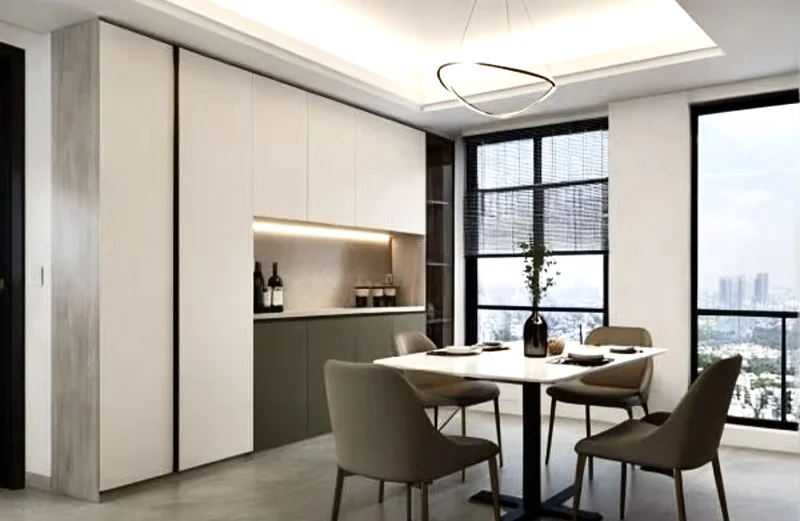
For architects requiring a uniform visual language across modernist, colonial, or tropical‑vernacular villas, the same aluminum‑glass door platform can be delivered with flush‑bolt casings, concealed sashes, or French‑side‑hinged outswing variants—all while maintaining identical thermal, acoustic, and structural ratings.
Frequently Asked Questions
How do aluminum glass doors resist moisture expansion in humid resort climates?
Our frames use aluminum alloy 6063-T6 with thermal breaks, zero moisture absorption. Any integrated WPC components have density >1.2 g/cm³ and closed-cell structure, limiting expansion to <0.3%. Tempered glass seals with EPDM gaskets prevent water ingress, ensuring dimensional stability in coastal or poolside environments.
What formaldehyde emission standards do these doors meet?
All composite cores, if present, comply with EN 717-1 E0 (≤0.5 mg/L) and CARB Phase 2. Adhesives and seals are solvent-free. For pure aluminum-glass doors, emissions are negligible; we confirm with third-party testing to ensure villa indoor air quality meets strict resort health certifications.
How is thermal insulation performance achieved in large glass panels?
We use argon-filled low-E double glazing (U-value ≤1.8 W/m²K) with warm-edge spacers. The aluminum frame incorporates polyamide thermal breaks ≥34 mm wide. This reduces heat transfer by 70% compared to standard aluminum, maintaining comfortable indoor temperatures and reducing HVAC load in tropical resorts.
What impact resistance do these doors offer for high-wind or coastal areas?
Standard configurations use 6+6 mm laminated safety glass (EN 12600 Class 1B1) and frame profiles with 2.0 mm wall thickness. For cyclone-prone resorts, we reinforce with LVL core inserts and stainless steel hinges, achieving wind load resistance up to 2.5 kPa (tested per ASTM E330).
How is long-term structural warping prevented in spans over 3 meters?
Aluminum frames are extruded from 6063-T6 temper (yield strength ≥160 MPa) and reinforced with internal steel or LVL cores in sliding or fixed panels. The torsion-resistant design limits deflection to L/240 under design wind loads, ensuring squareness and smooth operation for decades.
What is the sound insulation rating for these glass doors?
With laminated glass (6+6 mm PVB interlayer) and full perimeter compression seals, we achieve STC 35–38 dB (ASTM E90). This reduces external noise from waves, pool equipment, or traffic by over 90%, meeting resort guest expectations for quiet luxury suites.
How does the UV-resistant finishing protect against tropical sun?
Our powder coating uses polyester resin with UV stabilizers, applied at 60–80 μm thickness (ISO 2360) and tested to 5000 hours QUV (ASTM D4587). Alternatively, marine-grade anodizing (AA15, 25 μm) resists fading and chalking, maintaining color and gloss in year‑round intense UV.