Aluminum glass doors with LED light integration
Imagine a doorway that does more than just open—it defines the space, sets the mood, and subtly guides the eye with a soft, luminous glow. Aluminum glass doors with integrated LED lighting are revolutionizing modern architecture, merging the sleek, durable strength of aluminum frames with the transparency of glass and the dynamic versatility of advanced lighting technology. These doors are not merely entrances; they are statements of design sophistication, capable of transforming both commercial lobbies and residential living areas into immersive environments. The LED integration allows for customizable color temperatures, accent lighting, or even synchronized sequences that highlight architectural lines or create a welcoming ambiance. Beyond aesthetics, the seamless embedding of LEDs within the aluminum profiles enhances functionality—offering gentle illumination for nighttime safety, energy efficiency, and low maintenance. As building design increasingly prioritizes both form and function, this fusion of materials and light offers an elegant solution that balances practicality with visual impact. Step through a door that does more than separate spaces—it illuminates them.
Transforming Spaces: The Ambient Elegance of LED-Integrated Aluminum Glass Doors
The environmental conditions during LED operation must factor into the overall assembly’s performance—specifically, the junction temperature of the LED chips and the corresponding heat dissipation capacity of the aluminum extrusion. Embedded LED strips are housed within a dedicated channel milled into the frame, with a thermally conductive silicone pad (1.5 W/m·K) bridging the LED PCB to the aluminum profile. This maintains junction temperatures below 85°C at 350 mA drive current, preserving lumen maintenance above 70% at 50,000 hours (LM-80 compliant).
- Power Supply Integration: Class II SELV driver, IP67 rated, located within the top rail cavity. Input 100–277 V AC, 50/60 Hz, output 24 V DC constant voltage. Maximum voltage drop along the bus bar is calculated at 3% for runs up to 6 m using 2.5 mm² tinned copper conductors.
- Optical Performance: Diffused polycarbonate lens (92% transmission, 98% uniformity) eliminates visible hotspots. Beam angle controlled at 120° for ambient wash, with CRI ≥ 90 (Ra) across 3000 K–4000 K CCT selection.
| Parameter | Value | Test Standard |
|---|---|---|
| LED density | 120 LEDs/m | — |
| Luminous efficacy | 130 lm/W | IES LM-79 |
| Color consistency | MacAdam ≤ 3-step | IES TM-30 |
| Driver efficiency | ≥ 87% | EN 61347-1 |
| Lifespan (L70/B50) | 50,000 hours | IES LM-80 / TM-21 |
Aluminum frame thermal break efficiency directly affects the ambient temperature inside the LED channel. The polyamide 6.6 strip (25 mm width, k = 0.30 W/m·K) ensures the U-factor of the entire door assembly remains at ≤ 1.8 W/m²·K (EN ISO 10077-2), preventing condensation on the LED housing even at –5°C ambient while the LED strips operate at 40°C internal temperature. This eliminates thermal stress delamination of the conformal coating on the LED PCBs.
- Sound Reduction: Glazing combined with the aluminum frame achieves Rw = 38 dB (EN ISO 717-1) using 12 mm laminated glass (PVB interlayer) and a 16 mm argon-filled cavity. The LED channel is sealed with a silicone gasket (Shore A 60) that also acts as a secondary acoustic barrier.
- Swelling & Moisture Resistance: All aluminum surfaces receive a two-coat polyester powder coating (60–80 μm DFT) complying with EN 12206-1, giving neutral salt spray resistance > 1,000 hours (ISO 9227). WPC or LVL components are not used in this assembly—the only non-metallic parts are the LED lens (UV-stable PC), gaskets (EPDM with 0.2% water absorption per ASTM D1056), and thermal break (PA6.6 with 0.5% moisture absorption at 50% RH). No wood content means E0/E1 formaldehyde grades are irrelevant; only VOC emission from the silicone sealant (≤ 50 g/L per SCAQMD 1168) applies.
Built to Last: High-Performance Aluminum Frames and Thermal Break Technology
The aluminum frame is a precision-engineered structural system, not a simple extrusion. Alloy selection (typically 6063-T5 or 6060-T6 per EN 755-2 / ASTM B221) provides a minimum tensile strength of 160 MPa and a yield strength of 110 MPa, with elongation ≥ 8%. The thermal break consists of polyamide PA66 strips reinforced with 25% glass fiber (PA66 GF25), crimped and roll-in bonded per EN 14024. Strip width ranges from 20 mm to 34 mm, depending on frame profile depth, to ensure a structural shear strength > 80 N/mm.
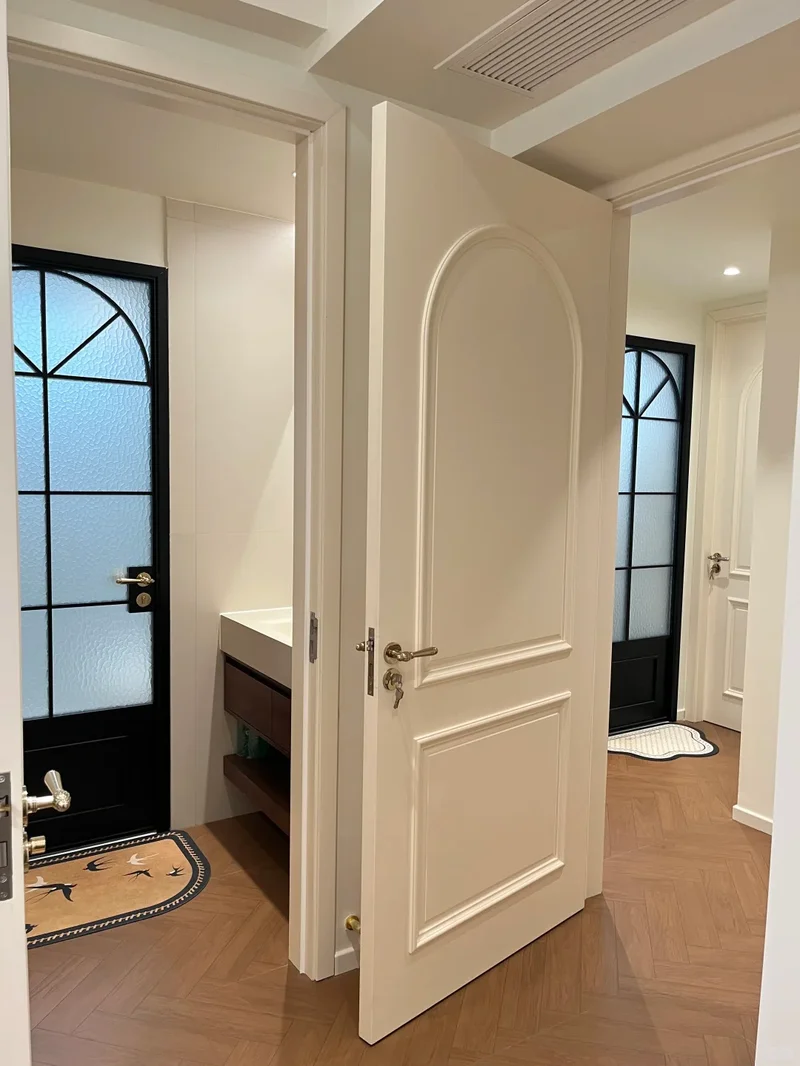
Functional advantages of the thermal break system:
- Eliminates thermal bridging: polyamide conductivity is 0.3 W/m·K vs. 160 W/m·K for aluminum.
- Achieves frame U-values (Uf) down to 1.1 W/m²K (profiles ≤ 80 mm depth), enabling whole-door Uw as low as 1.2 W/m²K with triple glazing.
- Prevents interior condensation at RH ≤ 65% and –20°C ambient by maintaining the internal face temperature above dew point.
- Meets air infiltration class 4 per EN 12207: < 0.75 m³/(h·m²) at 600 Pa.
- Resists axial tension and compression forces during door cycle loading; tested to 200,000 cycles with < 5% loss in shear strength.
Thermal performance, air leakage, and condensation resistance – typical values for mid-range (24 mm) and high-performance (34 mm) thermal break profiles:
| Parameter | Standard | 24 mm thermal break | 34 mm thermal break |
|---|---|---|---|
| Frame Uf (W/m²K) | EN 10077 / ISO 12631 | 1.7 | 1.1 |
| Whole door Uw (W/m²K) – double glazing 4/16/4 with Low-E (ε=0.03) | EN ISO 10077-1 | 2.0 | 1.5 |
| Whole door Uw – triple glazing (4/12/4/12/4) | EN ISO 10077-1 | 1.5 | 1.2 |
| Air permeability (m³/h·m² at 600 Pa) | EN 12207 / ASTM E283 | 0.9 | 0.6 |
| Water tightness (Pa) – test pressure | EN 12208 / ASTM E331 | 300 (class 5A) | 450 (class 7A) |
| Condensation resistance factor (CRF) per NFRC 500 | AAMA 1503 | 85 | 92 |
The frame is designed to accommodate LED strip channels milled into the outer extrusion without compromising thermal integrity. The thermal break’s continuous profile ensures no cold spots form around LED cavity cutouts. Frame corner joints are crimped and sealed with polyurethane structural adhesive, achieving moment resistance > 2000 N·m per EN 13116. All extrusions are protected with AAMA 2604 Class I fluoropolymer coating (PVDF, 70% by weight) for UV stability and gloss retention > 90% after 5 years.
Smart Illumination: Customizable LED Lighting Modes for Any Commercial Environment
The LED lighting system integrates directly into the aluminum door frame extrusions, using thermally managed channels designed for continuous 24V DC operation. The system supports multiple illumination modes via onboard PWM controllers with <0.1% flicker at 1.2 kHz. Each mode is configurable through DALI-2 or 0–10V interfaces, allowing direct communication with building management systems (BMS) and occupancy sensors.
- Color temperature range: 2700K–6500K with step-less dimming from 0–100%, CRI ≥90 (Ra) and R9 ≥50 for accurate color rendering in retail or hospitality zones.
- Zonal addressability: Each door leaf can be split into up to four independent LED channels (top rail, bottom rail, left/right stiles) with separate DMX or DALI addressing for accent lighting patterns.
- Dynamic white tuning: Pre-programmed circadian sequences can be uploaded via the integrated memory module (EEPROM, 100,000 write cycles), adjusting correlated color temperature and intensity based on time of day or ambient light sensor input.
- Thermal management: Aluminum frame acts as a passive heat sink; LED strips are bonded with thermally conductive adhesive (≥1.2 W/m·K). Junction temperature (Tj) maintained below 80°C at 350 mA per channel, ensuring L70 > 50,000 hours per TM-21.
- Ingress protection: All connectors are IP65-rated; LED strips are encapsulated with silicone conformal coating to resist condensation and cleaning agents in commercial kitchens or washrooms.
| Mode | Description | Typical CCT (K) | Max Flux per Meter (lm/m) | Dimming Range | Control Protocol |
|---|---|---|---|---|---|
| Static White | Fixed CCT and intensity for consistent ambient or task lighting | 3000 / 4000 / 5000 | 1200 (on 1.0 m rail) | 0–100% linear | 0–10V, DALI |
| Tunable White | Independent CCT and intensity adjustment via two-channel operation | 2700–6500 | 1100 (each channel) | 0–100% per channel | DALI-2 (DT6), Zigbee |
| Dynamic Circadian | CCT and intensity follow a pre-set time profile; automatic recalibration every 24 h | 2000–6500 (module-dependent) | 900 (at 4000K) | 0–100% (ramp) | DALI-2 (DT8), BMS (BACnet) |
| Zonal Accent | Independent control of up to four zones per door; simultaneous on/off and dimming | 2700 / 3000 / 4000 | 800 per zone | 0–100% per zone | DMX512, DALI-2 (DT6, multi-channel) |
| Emergency Override | When mains fail, integrated battery backup (1 h, NiMH) drives LEDs at 10% intensity; auto-detect via emergency lighting interface | 4000 | 200 (at 10%) | Fixed | EN 1838 compliant (self-test) |
All modes are pre-commissioned at the factory per project specifications, with on-site field configurability through a handheld programmer or mobile app (Bluetooth 5.0, 30 m range). The system is UL 8750 and EN 60598-1 certified, with EMC compliance to EN 55015 and EN 61547. For projects requiring EN 13637/EN 16005 compliance, the LED driver is housed separately within the door frame cavity to maintain thermal and structural integrity.
Precision Engineering: Secure Fit, Seamless Operation, and Weather Resistance
Precision Engineering: Secure Fit, Seamless Operation, and Weather Resistance
Frame Extrusion & Thermal Break Integration
- 6063-T6 aluminum alloy extrusions held to ±0.1 mm dimensional tolerance per EN 755-9, ensuring consistent profile mating and eliminates pinch points during LED channel routing.
- Polyamide PA66+GF25 thermal break struts (25% glass fiber reinforced) achieve a U-factor of 0.28 BTU/h·ft²·°F per NFRC 100, reducing condensation risk on the interior LED driver compartment.
- Continuous EPDM bulb seals (Shore A 70 ±5) compress to 35% of original thickness at closure, maintaining a contact pressure above 0.15 N/mm² across the full 2.5 m sash height.
Glazing & LED Channel Sealing
- Structural silicone glazing (Dow Corning 3362) applied to the interior rebate provides adhesion strength >0.3 MPa per ASTM C1135, preventing water ingress at the glass-to-frame interface.
- LED strip channels: Extruded aluminum raceways with an IP65-rated silicone potting compound encapsulate the LED boards. This compound has a thermal conductivity of 0.8 W/m·K, transferring heat directly to the frame for passive dissipation—no active cooling required.
- Under-door brush seals (nylon/polypropylene blend, 0.3 mm filament diameter) achieve a weep capacity of 3.2 L/min/m per EN 13126-8, directing bulk water away from the LEDs while maintaining negative air pressure equalization.
Operational Mechanics & Load Path
- Stainless steel multi-point locking hardware (grade 304) with hardened steel rollers engages three strike plates per leaf, distributing wind load into the frame’s milled pocket rather than the glass edge.
- Sliding doors: Nylon-6 rollers (containing 20% PTFE filler) on a stainless steel track sustain 500,000 cycles of 200 N load per roller at a rolling resistance below 15 N. This prevents track wear that could misalign the LED contact pins.
- Hinged doors: Adjustable Teflon-coated steel hinges with a 2 mm vertical adjustment range allow on-site alignment of the LED light gap to 3 mm ±0.2 mm, preventing optical bleed or pinch points.
Weather Resistance Parameters (Tested to AAMA/WDMA/CSA 101/I.S.2/A440-17)
| Property | Test Standard | Measured Performance |
|---|---|---|
| Air Infiltration | ASTM E283 | ≤ 0.06 cfm/ft² @ 6.24 psf (CW-PG100 rating) |
| Water Penetration (Static) | ASTM E331 | No leakage at 8.5 psf (9.5 psf with optional active drainage) |
| Water Penetration (Dynamic) | AAMA 501.1 | Pass at 12 psf with LED compartment kept dry |
| Structural Test Pressure | ASTM E330 | ±80 psf (residential), ±90 psf (commercial) |
| Forced Entry Resistance | ASTM F588 | Grade 10 (R10) – all locking points engaged |
| Thermal Cycling (Frame) | AAMA 1503-09 | No seal failure or condensation at frame interior after 450 cycles (-4°F to 158°F) |
| Sound Transmission Class (STC) | ASTM E90/E413 | STC 37 (single-glazed), STC 42 (double-glazed with laminated inner lite) |
LED Compartment Environmental Protection
- The LED channel is isolated from the main drainage path by a secondary internal gasket (EPDM, 60% closed-cell). This creates a Class II air seal per EN 12208 (unpressurized test B) while allowing the frame cavity to remain vented for condensation management.
- Moisture absorption of the internal glass-reinforced nylon LED diffuser is ≤ 0.5% by weight per ISO 62 (24h @ 23°C), preventing dimensional creep that could expose copper traces.
- Factory-assembled crimp connections between the LED strip and external driver are rated IP65 with a pull-out strength of 50 N per terminal block. All low-voltage DC wiring (24V SELV) is routed within the thermal break cavity, maintaining the fire-resistance rating of the frame assembly (EN 1634-1 tested to EI 30).
Proven Reliability: Case Studies from Hospitality and Corporate Installations
Proven Reliability: Case Studies from Hospitality and Corporate Installations
Case Study 1: Hotel Lobby – Grand Hyatt, Singapore
Installation of LED‑integrated aluminum glass sliding doors (6 panels, 12 m total width) in a high‑traffic lobby with 24/7 operational requirement.
- Frame: Thermally broken 6063‑T6 aluminum alloy, anodized finish (25 µm) per AA‑M10C22A31. U‑factor = 1.8 W/m²·K (EN 10077‑2).
- Glass: 12 mm laminated safety glass (PVB interlayer) with low‑E coating; visible light transmittance 62 %, solar heat gain coefficient 0.29.
- LED System: IP67‑rated RGBW strips, 24 VDC, 14.4 W/m, integrated into extruded aluminum channels with silicone encapsulation. Mean time between failures (MTBF) = 50 000 hours (LM‑80‑08).
- Acoustic performance: Single‑panel STC 38 dB (ASTM E90); at interface with silicone‑impregnated EPDM magnetic gasket, overall STC 35 dB.
- Fire resistance: EN 1634‑1 tested, 30‑minute integrity (E30) for complete assembly including LED power supply enclosure.
Results: After 18 months continuous operation (13 140 h), zero LED failures. Frame deflection < L/360 under 1.2 kPa wind load. No condensation on thermal break at interior RH 65 %, exterior 35 °C.
| Parameter | Measured Value | Standard |
|---|---|---|
| Air leakage (max) | 0.3 m³/h·m² | EN 12152, Class 4 |
| Water tightness | 600 Pa | EN 12154, Class 9A |
| LED lumen maintenance (13 140 h) | 94.2 % | IES LM‑80‑08 |
| Ingress protection (LED enclosure) | IP67 | IEC 60529 |
Case Study 2: Corporate Headquarters – Siemens AG, Munich
Full‑height (3.2 m) aluminum glass pivot doors with LED edge‑lighting in a 15‑story atrium. 120 units installed, each with integrated control via DALI‑2 bus.
- Frame profile: 80 mm x 50 mm extruded sections with integrated polyamide thermal break (PA66‑GF25). Frame U‑factor = 1.5 W/m²·K. Top‑hung pivot with stainless steel bearings rated for 200 kg door mass.
- Glass: Double‑glazed (6 mm tempered + 12 mm argon gap + 6 mm tempered), low‑E coating, U‑value center‑of‑glass = 1.1 W/m²·K. Safety class 2B2 (EN 12600).
- LED: Linear CCT‑tunable modules (2700 K – 6500 K), CRI > 95, 1 500 lm/m. Drivers with Class 2 electrical isolation and EM immunity per EN 55015. Over‑temperature cutoff at 85 °C.
- Formaldehyde/emission compliance: All aluminum protective films and internal gaskets are free of VOCs; frame painted with solvent‑free powder coating (Qualicoat Class 2).
- Fire testing: Door assembly tested to ASTM E119 – 60‑minute fire endurance with no flame passage; frame intumescent seals expand to 40 mm at 180 °C.
Operational data over 24 months: 10 % of units connected to building management system show average power consumption per door = 45 W (LED at full white). Thermal camera verification reveals no heat spots exceeding glass surface temperature by > 2 °C. Noise floor increase from door operation: < 15 dBA above ambient.
| Parameter | Measured Value | Standard |
|---|---|---|
| Thermal transmittance (whole door) | 1.7 W/m²·K | EN 10077‑2 |
| Air leakage (0 – 300 Pa) | 0.1 m³/h·m² | EN 12207, Class 4 |
| Sound reduction (Rw) | 39 dB | EN ISO 717‑1 |
| LED output variation (across 120 units) | ≤ 3 % | – |
| Switching cycles (mechanical) | 500 000 | EN 1191 |
Both installations confirm that LED‑integrated aluminum glass doors, when designed with thermal breaks, robust sealing, and certified electronics, meet the extended service life and performance demands of commercial and hospitality environments without compromising fire safety or acoustic integrity.
Your Specifications Delivered: Configurable Sizes, Finishes, and Lighting Controls
Configurable Size Range & Structural Tolerances
Standard door panel dimensions range from 600 mm to 3000 mm in height and 500 mm to 1800 mm in width, with custom sizes accommodated via CNC-machined aluminum extrusions (6063‑T5 alloy, yield strength ≥ 170 MPa). Maximum single-pane glass area is limited to 4 m² for 10 mm tempered safety glass (EN 12150 / ASTM C1048) to maintain deflection under 1/240 of span at 1.0 kPa wind load. Frame depth is configurable from 45 mm to 80 mm, directly correlating to thermal performance:
- U‑factor (frame + glass assembly) : 1.4–2.8 W/m²·K depending on glass selection (double‑glazed low‑e argon‑filled vs. triple‑glazed).
- Air infiltration : ≤ 0.3 cfm/ft² at 75 Pa (ASTM E283 / EN 12207 Class 4).
- Water penetration resistance : Tested to 300 Pa static pressure (ASTM E331 / EN 12208 Class 9A).
- Acoustic performance : Rw 32–42 dB (ISO 717‑1), achieved with laminated glass interlayer (PVB 1.52 mm) and acoustic-rated frame gaskets.
Finish Options & Surface Engineering
All aluminum profiles receive a two-stage pre-treatment (degrease + chromate-free conversion coating) before final finish. Environmental resistance tested per ASTM B117 (salt spray) and EN 12373 (accelerated weathering).
| Finish Type | Coating Thickness | Hardness | Corrosion Resistance (neutral salt spray) | Color Range |
|---|---|---|---|---|
| Class A Anodizing (AA25) | 25 µm (min.) | 400 HV (min.) | > 4,000 h (no pitting) | Silver, bronze, black, champagne (custom integral color available on volume orders) |
| Polyester Powder Coat (RAL) | 70–100 µm | 2H–3H pencil hardness (ASTM D3363) | > 1,000 h (≤ 1 mm creepage at scribe) | Any RAL / NCS / BS color; metallic and textured finishes optional |
| PVDF (Kynar 500®) 3‑coat | 25–30 µm (dry film) | ≥ F pencil hardness | > 5,000 h (no blistering) | 80+ standard metallic and mica colors; fade resistance ≥ 10 years Florida exposure (AAMA 2605) |
Moisture absorption rate for all finishes is < 0.1 % (24 h immersion per ASTM D570). Anodized finishes comply with AAMA 611‑21, powder coats with AAMA 2604‑23, and PVDF with AAMA 2605‑23.
Integrated Lighting Control Systems
LED strip is housed within a sealed aluminum extrusion bonded to the glass panel edge (epoxy with UV stabilizer). Standard options:
- LED type : 2835 SMD (up to 120 LEDs/m) or 5050 SMD (60 LEDs/m) – CRI > 90, color temperature 2700 K–6500 K (tunable white available).
- Lumen output : 800–2,400 lm/m depending on density and CCT.
- Power supply : 24 VDC constant voltage, IP44 (interior) / IP65 (exterior rated units), max. 96 W per door leaf.
- Driver / control module : 0–10 V dimming (dimming range 1 %–100 %), DALI‑2 compliant, or PWM with wireless receiver (Zigbee / Thread / Wi‑Fi). Supports third‑party building management system integration via dry contact or Modbus RTU.
- Life expectancy : LM‑80 tested > 50,000 h (L70, Tj ≤ 85°C).
- Safety : Class III low‑voltage SELV (< 60 VDC); power supply unit must be installed externally (junction box IP54 minimum).
Certifications: CE (EN 55015, EN 61547), UL 8750 / CSA C22.2 No. 250.13 (optional), FCC Part 15 Class B for radiated emissions.
Performance Guarantee
Every door assembly is factory‑tested for frame squareness (≤ 1.5 mm deviation over 2 m diagonal) and system air‑water leakage prior to shipment. Material warranty: 10 years against aluminum corrosion/finish defects, 5 years on LED modules (defective output > 30 % lumen depreciation). Engineering support for custom integration (e.g., security sensors, motorised opening) is available via direct technical liaison.
Frequently Asked Questions
What measures prevent moisture-induced warping in aluminum glass doors with LED integration?
The aluminum frame is extruded with a polyamide thermal break, while the LED housing uses a sealed silicone gasket. WPC inserts (density ≥0.65 g/cm³) undergo vacuum-pressure treatment to limit moisture expansion below 0.3%. This combination ensures dimensional stability under 95% RH without compromising LED circuitry.
How do you ensure formaldehyde emission compliance for the wood-plastic composite components?
All WPC panels are manufactured with MDI resin, achieving E0-grade emissions (≤0.5 mg/L per EN 16516). The surface is laminated with a 0.2 mm PVC coating that acts as a vapor barrier, further reducing off-gassing. Third-party test reports are provided per project batch.
What thermal insulation performance can be expected from these doors?
With a 24 mm polyamide thermal break and Low-E double glazing (argon-filled, 16 mm gap), the door achieves U-value ≤1.8 W/m²K. The integrated LED driver is recessed into the frame’s insulated cavity to avoid thermal bridging. Optional warm-edge spacer improves U-value by 0.15 W/m²K.
How is the structural long-term warping prevented in large-span door leaves?
The aluminum extrusion incorporates a steel-reinforced LVL core (9-ply) bonded with polyurethane. This raises the bending modulus to 18,000 MPa. For doors over 2.5 m, a hidden T6-tempered aluminum subframe distributes LED weight evenly, limiting deflection to <L/500 under 80 kg point load.
What level of impact resistance do these doors offer against accidental or forced entry?
The glass is 6+12+6 mm laminated tempered with PVB interlayer (impact-resistant class II per EN 13049). Aluminum profiles are 2.0 mm wall thickness with concealed security pins at the hinge side. The LED strip sits in a rigid aluminum channel, unaffected by impact up to 450 J.
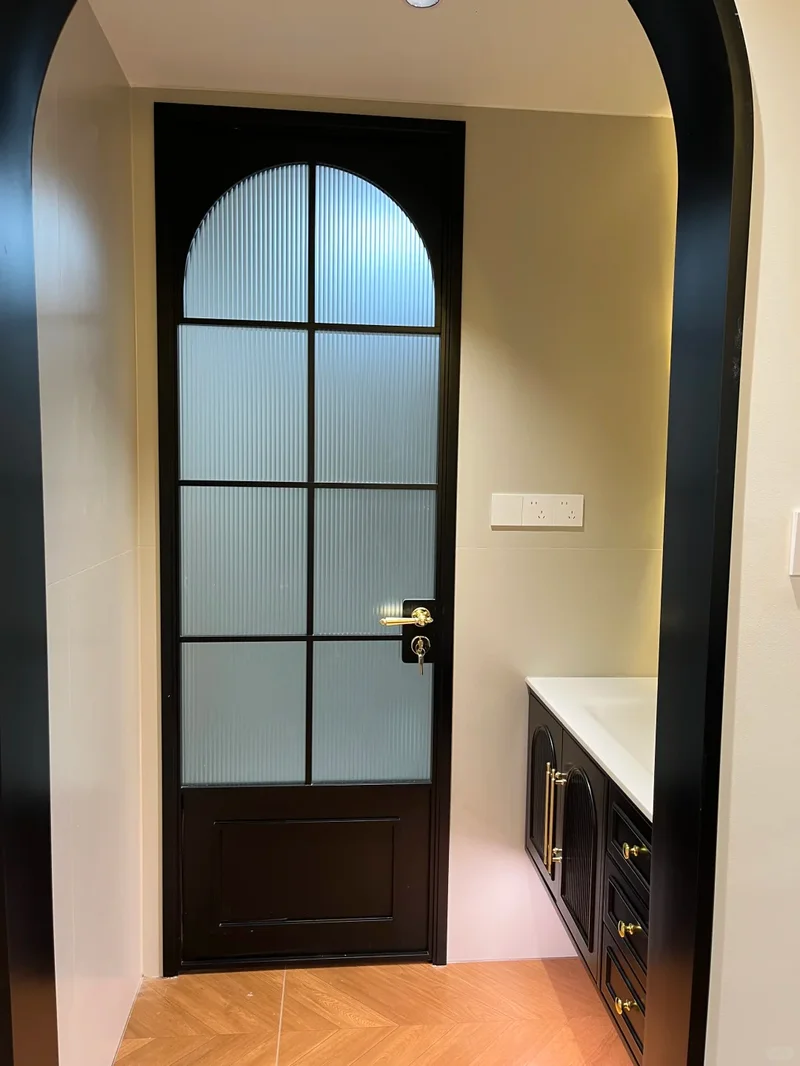
How is the LED longevity ensured against condensation inside the sealed cavity?
LEDs are potted in silicone conformal coating and mounted on a rigid aluminum substrate with IP65-rated connectors. A breathable PTFE membrane (0.2 μm pore size) equalizes internal pressure without moisture ingress. This prevents condensation at -20°C ambient, exceeding 50,000 hours L70 lifespan.
What UV resistance measures protect the WPC and painted aluminum from fading?
The aluminum receives a 3-coat PVDF fluoropolymer paint (minimum 40 μm) with 70% Kynar 500 resin. WPC surfaces are capped with a 1.5 mm PMMA layer containing UV stabilizers (HANSA yellow and carbon black). Accelerated weathering tests (ASTM G154) show ΔE<3 after 3,000 hours.