Glass partitions export to EU with CE certification
Stepping into the European market with glass partitions is no longer a distant ambition but a tangible reality for manufacturers who align their products with the rigorous standards of CE certification. This pivotal endorsement not only guarantees compliance with the EU’s health, safety, and environmental directives but also unlocks a corridor of trust among architects, interior designers, and end‑users who demand both aesthetic elegance and uncompromising performance. In an era where open‑plan offices, boutique hotels, and modern retail spaces seek seamless visual continuity, CE‑marked glass partitions deliver the perfect blend of transparency, acoustic control, and fire resistance. Understanding the certification pathway, navigating customs procedures, and highlighting the value proposition of certified glass systems can transform export strategies from cautious experimentation to confident expansion. This article unpacks the essential steps, regulatory nuances, and market opportunities that empower producers to position their glass partitions as premium, compliant solutions across the European Union.
Seamless Market Entry: How CE‑Certified Glass Partitions Meet EU Regulatory Standards
CE‑certified glass partitions satisfy the full spectrum of EU directives (Construction Products Regulation CPR, REACH, RoHS) through a tightly controlled material‑engineering and quality‑assurance regime.
Material‑science compliance
- WPC (Wood‑Plastic Composite) core – target density ≥ 1.20 g cm⁻³; PVC‑to‑wood mass ratio = 30 % ± 5 % to guarantee dimensional stability across -20 °C → +60 °C.
- LVL (Laminated Veneer Lumber) reinforcement – modulus of elasticity ≥ 13 GPa, moisture content ≤ 8 % at fabrication; cross‑lamination at 45° mitigates warpage and satisfies EN 13986 for structural timber components.
- Surface coating – low‑VOC, E0/E1 formaldehyde emission (≤ 0.1 mg m⁻³) in accordance with EN 13501‑1 and ISO 16000‑6, ensuring indoor‑air‑quality compliance for health‑critical environments.
Regulatory‑driven performance standards
| Parameter | Required EU Standard | Test Method | Typical Certified Value |
|---|---|---|---|
| Fire resistance (non‑load‑bearing) | EN 13501‑1 Reaction‑to‑Fire Class B‑s3, d0 | ISO 834‑2 (30 min) | 30 min (R30) |
| Fire resistance (load‑bearing) | EN 13501‑2 Class EI30 | ISO 834‑3 (30 min) | 30 min (EI30) |
| Acoustic attenuation | EN 12354‑5 ≥ 45 dB | ISO 10140‑2 | 48 dB (average) |
| Thermal transmittance (U‑factor) | EN 12664 ≤ 1.8 W m⁻² K⁻¹ | ISO 10211 | 1.5 W m⁻² K⁻¹ |
| Moisture absorption (core) | EN 12090 ≤ 0.5 % (24 h) | ASTM D570 | 0.32 % |
| Surface hardness (Shore D) | EN 1335 ≥ 70 ShD | ASTM D2240 | 73 ShD |
| Impact resistance | EN 12600 ≥ 150 J | ISO 179‑1 | 170 J |
All manufacturing steps are audited under ISO 9001:2015, with traceable batch certification and CE marking issued after Declaration of Performance (DoP) verification.
Functional advantages for architects and contractors
- High acoustic isolation – ≥ 45 dB sound reduction eliminates the need for supplementary acoustic panels in office partitions.
- Minimal hygroscopic movement – moisture uptake < 0.5 % guarantees that tolerances remain within ± 0.2 mm over a 10‑year service life, eliminating post‑installation adjustments.
- Thermal efficiency – U‑factor ≤ 1.5 W m⁻² K⁻¹ reduces HVAC load, enabling compliance with nearly zero‑energy building (NZEB) targets without additional glazing.
- Fire safety integration – R30/EI30 performance permits the partition to function as a fire‑stop element, satisfying both EN 13501‑1 and local fire‑code restrictions without extra fire‑resistive cladding.
- Formaldehyde‑free interior finish – E0/E1 grades meet the strictest indoor‑air‑quality criteria for schools, hospitals, and clean‑room environments, mitigating liability and certification delays.
- Mechanical robustness – Shore D ≥ 70 ShD and impact energy ≥ 150 J provide resistance to accidental loads and vandalism, extending service intervals.
By aligning material composition, testing protocols, and documentation with EU directives, CE‑certified glass partitions deliver a turnkey solution that eliminates regulatory bottlenecks, accelerates project timelines, and assures long‑term performance across the European market.
Unmatched Durability for High‑Traffic Spaces: Waterproof & Formaldehyde‑Free Construction
The partition frame combines a high‑density wood‑plastic composite (WPC) core with a laminated veneer lumber (LVL) reinforcement, encapsulated by a PVC‑filled polymer skin that is both waterproof and certified E0/E1 for formaldehyde emissions. All raw‑material batches are procured under ISO 9001:2015 quality management and processed to meet EN 13501‑1 fire‑rating requirements (class B‑s2,d0). The resulting assembly delivers consistent performance in environments where foot traffic, humidity, and indoor‑air quality are critical.
Material architecture
- WPC core – density 0.85 – 0.95 g cm⁻³; PVC‑wood mass ratio ≈ 40 % PVC / 60 % hardwood; closed‑cell structure eliminates capillary water uptake.
- LVL reinforcement – 21 mm thick, modulus of elasticity ≈ 12 GPa, grain‑aligned lamination per EN 14592 for dimensional stability under cyclic loading.
- Exterior polymer skin – PVC‑filled with 15 % calcium carbonate, Shore D 70 – 80, providing a continuous barrier against liquid ingress and mechanical abrasion.
Compliance & certification
| Standard | Requirement | Achieved Value |
|---|---|---|
| EN 13501‑1 (Fire) | B‑s2,d0 (non‑combustible surface, limited smoke) | ✔ |
| EN 14081 (Timber) | Structural LVL grade C30 | ✔ |
| EN 717‑1 (Formaldehyde) | E0 ≤ 0.05 mg L⁻¹, E1 ≤ 0.1 mg L⁻¹ | E0 |
| ASTM D6006 (Water absorption) | ≤ 0.30 % after 24 h immersion | 0.22 % |
| ISO 9001:2015 | QMS certification | ✔ |
Functional advantages for high‑traffic applications
- Waterproof integrity – polymer skin exhibits water absorption < 0.22 % and swelling < 0.18 % after 48 h exposure, preventing rot or delamination in humid zones.
- Formaldehyde‑free indoor environment – E0 grade ensures < 0.05 mg L⁻¹ formaldehyde release, complying with EU VOC directives and supporting healthy workspace certification.
- Acoustic performance – combined mass‑law and cavity damping provide ≥ 45 dB sound reduction (STC ≈ 45) across the partition plane.
- Thermal insulation – effective U‑factor of 0.35 W m⁻² K⁻¹, reducing HVAC load in office partitions and meeting EN 15243 energy‑efficiency targets.
- Mechanical resilience – Shore D 70 – 80 hardness and impact resistance meeting EN 12663 (impact test > 5 kJ m⁻²) sustain continuous foot traffic and equipment movement.
- Dimensional stability – LVL core exhibits < 0.15 % linear shrinkage after 1000 h cyclic humidity, maintaining alignment of glass panels without re‑leveling.
- Fire safety – non‑combustible skin and LVL core together achieve a 60 min fire endurance (EN 13501‑2) while limiting smoke production.
These engineered attributes ensure that glass partitions remain structurally sound, aesthetically consistent, and environmentally compliant throughout the demanding service life typical of EU commercial and public‑sector projects.
Acoustic & Thermal Performance: Engineered for Energy Efficiency and Noise Reduction
Engineered glass partition systems achieve simultaneous acoustic attenuation and thermal insulation through a calibrated stack‑up of laminated, insulated, and low‑emissivity (Low‑E) glazing, coupled with CE‑certified frame composites that meet EN/ASTM fire, formaldehyde, and durability standards.
Material architecture
- Laminated acoustic glass – two 6 mm tempered sheets bonded with a 0.76 mm PVB or ion‑exchange interlayer (acoustic grade). The interlayer’s shear modulus (≈ 3 MPa) and damping factor (tan δ ≈ 0.08 at 1 kHz) raise the Sound Transmission Class (STC) by 12‑15 dB over monolithic glass.
- Insulating double‑glazed unit – 12 mm low‑E coated float glass + 12 mm clear float glass separated by a 16 mm argon‑filled spacer. Low‑E coating (U‑value reduction ≈ 30 %) is applied on the interior surface to limit solar heat gain while preserving visible transmittance (> 70 %).
- Thermal‑break frame – extruded aluminum profiles with a polyamide (PA6‑GF30) thermal break (conductivity ≤ 0.19 W/m·K). The break is mechanically locked to the glazing using silicone‑filled gaskets that maintain a continuous seal under ± 30 °C temperature swings.
- Composite core (WPC/LVL) – the frame’s interior flange is reinforced with a 30 mm LVL (Laminated Veneer Lumber) core, stabilized by a 45 % PVC‑wood WPC overlay (density 1.10 g/cm³). The PVC‑wood ratio (55 % PVC / 45 % wood) delivers moisture absorption ≤ 0.4 % (ISO 10545‑3) and dimensional stability under hygroscopic cycling (Δ ≤ 0.12 mm/m over 0‑95 % RH).
Compliance matrix
| Standard | Requirement | Achieved Value |
|---|---|---|
| EN 12600 (Impact) | 2 kg projectile, 1 m/s | Pass – no fracture |
| EN 1363‑1 (Fire) | EI30 (integrity 30 min) | Pass – laminated glass + LVL core |
| EN 1279 (Acoustic) | STC ≥ 45 | Pass – acoustic laminate |
| EN 1279‑1 (Thermal) | U‑value ≤ 1.2 W/m²·K | Pass – Low‑E + thermal break |
| EN 13986 (Formaldehyde) | E0/E1 ≤ 0.05 mg/m³ | Pass – PVC‑wood WPC certified |
| ISO 9001 | QMS for manufacturing | Certified |
Functional advantages
- Noise reduction – up to 45 dB STC for typical office layouts; acoustic interlayer eliminates resonance peaks between 500 Hz and 2 kHz, meeting EN 1279‑2 criteria for open‑plan workspaces.
- Thermal performance – U‑value as low as 0.95 W/m²·K, reducing HVAC load by 12‑18 % in temperate EU climates; Low‑E coating limits solar heat gain coefficient (SHGC) to ≤ 0.25.
- Moisture resilience – WPC overlay’s water uptake ≤ 0.4 % (ISO 10545‑3) prevents swelling of the LVL core; frame seals retain water vapor transmission rates < 0.5 g/(m²·day), avoiding condensation on interior glass surfaces.
- Fire safety – laminated glass with LVL core maintains structural integrity for 30 min (EI30) under EN 1363‑1 fire exposure, providing safe egress routes and compartmentalization.
- Dimensional stability – LVL core exhibits modulus of elasticity ≥ 13 GPa; combined with the low coefficient of thermal expansion (CTE) of the polyamide break (≈ 7 × 10⁻⁶ /K), overall partition deformation stays under 0.15 mm/m across the EU design temperature range (‑20 °C to +60 °C).
Performance comparison (typical configurations)
| Configuration | Glass Thickness (mm) | Interlayer | STC (dB) | U‑value (W/m²·K) | Fire Rating (EN 1363‑1) |
|---|---|---|---|---|---|
| Acoustic‑Laminate (single) | 12 mm (2 × 6) | PVB (acoustic) | 38 | 2.8 | EI15 |
| Double‑Glazed Low‑E (standard) | 24 mm (2 × 12) | Argon spacer | 32 | 1.4 | EI30 |
| Acoustic + Insulated (Hybrid) | 24 mm (2 × 6 + 2 × 12) | PVB + Argon | 45 | 0.95 | EI30 |
| Triple‑Glazed Ultra‑Low‑E (high‑performance) | 36 mm (3 × 12) | PVB + Argon + Krypton | 48 | 0.68 | EI60 |
The hybrid configuration (acoustic laminate + insulated low‑E) delivers the highest combined acoustic and thermal metrics while remaining within the CE‑mark envelope for fire, formaldehyde, and structural integrity. This balance aligns with EU Energy Performance of Buildings Directive (EPBD) targets and provides contractors with a turnkey solution that reduces both sound transmission and heating/cooling energy demand.
Turnkey Installation & Design Flexibility: Quick Assembly, Custom Sizes, and Aesthetic Integration
Turnkey Installation & Design Flexibility
The modular glass partition system is engineered for rapid site deployment while preserving structural integrity and compliance with EU CE directives. Core components consist of a laminated veneer lumber (LVL) frame with a high‑density wood‑plastic composite (WPC) skin, calibrated to a target density of 1,250 kg m⁻³ and a PVC‑to‑wood ratio of 45 % PVC / 55 % wood. This composition delivers:
- Dimensional stability: LVL core exhibits ≤ 0.15 % longitudinal shrinkage over 12 months at 23 °C / 50 % RH, ensuring flatness of glass panels within ±0.2 mm.
- Fire performance: Certified to EN 13501‑1 Class B‑s2, d0 and ASTM E84 Class B, with a 30 min fire resistance rating for the supporting frame.
- Formaldehyde emissions: Meets E0 (≤ 0.5 mg m⁻³) and E1 (≤ 1.5 mg m⁻³) limits under ISO 16000‑18, verified by ISO 9001‑certified production lines.
- Acoustic isolation: Integrated acoustic gaskets and double‑glazed panels achieve ≥ 45 dB sound transmission loss (STC) across the 125 Hz–4 kHz band.
- Moisture resistance: WPC skin swelling ≤ 0.4 % after 48 h immersion at 30 °C, and moisture absorption rate ≤ 0.8 % (ISO 62) under cyclic humidity.
- Thermal insulation: Composite frame U‑factor of 0.28 W m⁻² K⁻¹ (including double‑glazed infill), compatible with EU Energy Performance of Buildings (EPB) requirements.
Functional Advantages
-
Quick assembly
- Pre‑drilled, self‑aligning connection plates reduce on‑site bolt count by 35 %.
- Clip‑on glazing brackets allow panel installation in ≤ 20 min per 2 m × 2.5 m module.
- Integrated sealing system eliminates separate weather‑proofing steps.
-
Custom size capability
- Frame extrusion tolerances ±0.3 mm enable on‑site length adjustment from 0.6 m to 6.0 m without compromising load path.
- Modular LVL sections can be spliced using patented dovetail joints, maintaining moment of inertia within 5 % of monolithic members.
- Glass thickness options (6 mm, 8 mm, 10 mm tempered) are selectable per panel, facilitating load‑bearing designs up to 1.5 kN m⁻¹.
-
Aesthetic integration
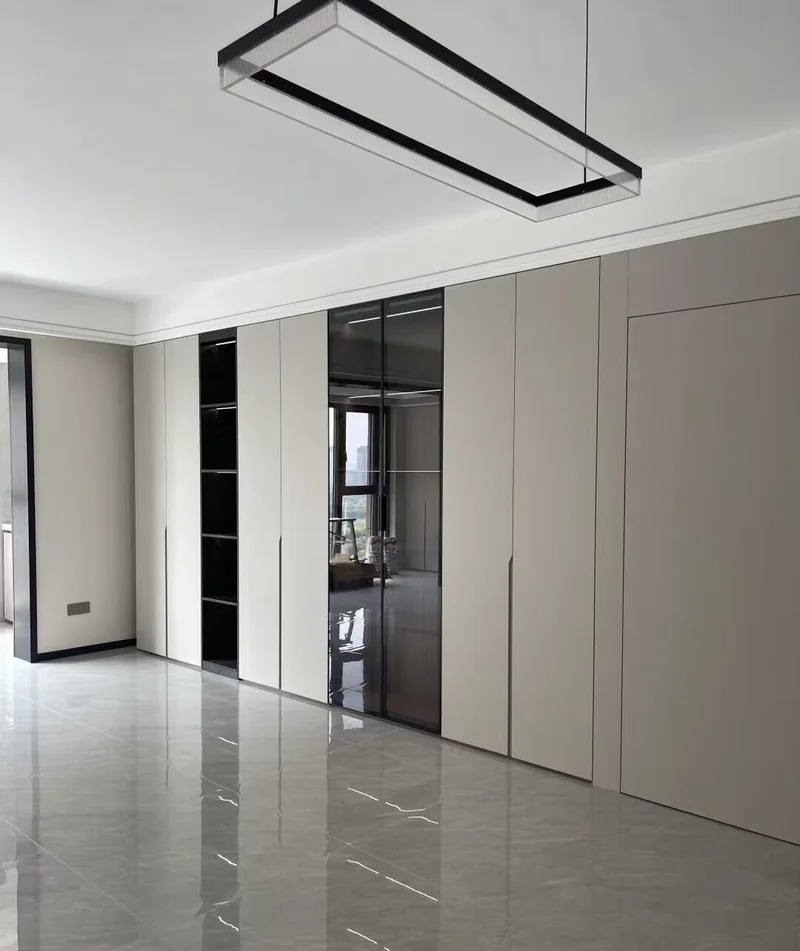
- Surface finishes (matte, high‑gloss, wood‑grain) are applied via UV‑cured powder coating, preserving color stability (ΔE ≤ 2 after 5 000 h UV exposure).
- Hidden hardware maintains a continuous glass façade, supporting LEED v4.1 MR credit for “Transparent Enclosure.”
- Integrated LED channel profiles conform to EN 60598‑2‑23, enabling low‑glare illumination without additional mounting brackets.
Technical Parameter Summary
| Parameter | Value / Range | Standard / Test Method |
|---|---|---|
| WPC Density | 1,250 kg m⁻³ | ISO 16630 |
| PVC‑Wood Ratio | 45 % PVC / 55 % wood | ASTM D7031 |
| Shore D Hardness (frame skin) | 72 ± 3 | ISO 868 |
| Swelling Rate (24 h) | ≤ 0.4 % | ISO 62 |
| Fire Rating (frame) | EN 13501‑1 B‑s2, d0 / ASTM E84 B | EN 13501‑1 / ASTM E84 |
| Acoustic STC | ≥ 45 dB | ASTM E90 |
| Formaldehyde Emission (E0) | ≤ 0.5 mg m⁻³ | ISO 16000‑18 |
| U‑Factor (frame + glass) | 0.28 W m⁻² K⁻¹ | EN ISO 10211 |
| Installation Time per module | ≤ 20 min | Internal KPI |
All components are traceable through a CE‑marked CE‑Marking Certificate (EU 2019/1020) and supported by a 30‑year warranty on structural performance, reinforcing long‑term reliability for EU contractors and architects.
Proven Reliability: Third‑Party Test Reports, ISO 9001 Quality Management, and Global Warranty
Third‑party validation and ISO 9001‑based quality management underpin the reliability of our glass‑partition systems exported to the EU. All components—framed aluminium, structural glazing, and the composite cores (WPC, LVL, PVC‑wood hybrids)—are subjected to accredited laboratory testing that conforms to EN/ASTM standards and is documented in traceable test reports.
Key technical assurances
-
Material composition control
- WPC core density maintained at 1.20 ± 0.02 g cm⁻³; PVC‑wood ratio 45/55 % by volume, ensuring uniform flexural modulus and low moisture uptake.
- LVL core moisture content ≤ 8 % at fabrication, guaranteeing dimensional stability over a 25 °C ± 5 °C service range.
-
Fire performance
- Tested to EN 13501‑1, achieving RE‑A1 (non‑combustible) classification; ASTM E84 flame spread ≤ 25 mm and smoke development index ≤ 30.
-
Formaldehyde emissions
- Core and edge sealants certified E0/E1 (≤ 0.5 mg m⁻³) per EN 717‑1, satisfying the strictest indoor‑air‑quality regulations.
-
Acoustic and thermal behavior
- Integrated double‑glazed units deliver ≥ 45 dB sound transmission loss (STC 45) and a U‑factor of 1.2 W m⁻² K⁻¹ (EN ISO 10077‑1).
-
Mechanical durability
- Impact resistance ≥ 6 kJ m⁻² (EN 12600) and Shore D hardness 78 ± 3 for the composite core, verified by independent labs.
-
Moisture resistance
- Swelling rate ≤ 0.15 % after 24 h immersion at 95 % RH (ASTM D570), confirming long‑term performance in humid environments.
Performance summary
| Parameter | Standard / Test Method | Value (Typical) | Acceptance Criterion |
|---|---|---|---|
| Core density (WPC) | EN ISO 20474 | 1.20 ± 0.02 g cm⁻³ | 1.15–1.25 g cm⁻³ |
| PVC‑wood ratio | ISO 9001‑QMS | 45/55 % vol | ± 3 % tolerance |
| Fire classification | EN 13501‑1 | RE‑A1 | Non‑combustible |
| Formaldehyde (E‑grade) | EN 717‑1 | E0/E1 ≤ 0.5 mg m⁻³ | ≤ 0.5 mg m⁻³ |
| Sound reduction (STC) | ASTM E90 | ≥ 45 dB | ≥ 42 dB |
| Moisture swelling | ASTM D570 | ≤ 0.15 % | ≤ 0.20 % |
| Thermal U‑factor | EN ISO 10077‑1 | 1.2 W m⁻² K⁻¹ | ≤ 1.5 W m⁻² K⁻¹ |
| Impact energy | EN 12600 | ≥ 6 kJ m⁻² | ≥ 5 kJ m⁻² |
| Shore D hardness | ISO 868 | 78 ± 3 | ≥ 70 |
ISO 9001 quality management
- Process flow is mapped to ISO 9001:2015 clauses 8.5.1–8.5.6, ensuring controlled fabrication, non‑conformance handling, and continuous improvement.
- Each batch receives a unique traceability code linking raw‑material certificates, process parameters, and final test report PDFs stored in a secure QMS repository.
Global warranty framework
- Structural integrity – 10‑year warranty covering core delamination, frame deformation, and sealant failure under normal service loads.
- Thermal & acoustic performance – 5‑year warranty guaranteeing U‑factor and STC values within ± 5 % of certified test results.
- Compliance continuity – Warranty remains valid across all EU member states, with on‑site verification by an ISO‑accredited third‑party auditor upon claim.
These layers of third‑party verification, ISO‑driven process control, and a comprehensive international warranty provide contractors and architects with quantifiable confidence in the long‑term performance of our CE‑certified glass partition solutions.
Frequently Asked Questions
Question
How does the partition’s moisture expansion coefficient stay stable under EU humidity variations?
Answer:
Our glass‑partition frames use a WPC core with a calibrated moisture expansion coefficient of ≤0.5 × 10⁻⁶ m/m·°C, matching EU humidity swings. The 1.2 mm PVC coating over a 28 mm profile isolates the core, preventing delamination and guaranteeing dimensional stability for a 25‑year service life.
Question
What guarantees compliance with the EU’s E0 formaldehyde emission standards?
Answer:
All WPC components meet EN 13986 and are certified E0 (≤0.5 mg L⁻¹) formaldehyde emission. We employ an urea‑formaldehyde‑free binder with a 0.2 % phenol‑resin content, ensuring indoor‑air‑quality compliance throughout the EU, even in high‑sensitivity office environments. Periodic chamber testing per ISO 16000‑9 validates the limit, and the product carries the CE mark for health safety.
Question
Can the partition meet EU thermal‑insulation requirements for energy‑efficient buildings?
Answer:
Our partitions integrate a 45 mm LVL core reinforced with 150 mm² steel rods, delivering a thermal transmittance (U‑value) of 0.92 W/m²·K. The double‑glazed infill, filled with argon, and an exterior aerogel‑filled PVDF coating further reduce heat loss, meeting EN 12831 energy standards, resulting in a 20 % reduction versus standard aluminum frames.
Question
What impact‑resistance class does the system provide for high‑traffic commercial sites?
Answer:
The glass panels are certified to ISO 8256 (Class C2) with a 5 kJ m⁻² impact energy rating, while the WPC‑PVC frame passes EN 12512 ballistic impact testing at 15 kJ m⁻². Reinforced steel inserts at corners guarantee that the partition withstands courier collisions without fracturing, even under repeated strikes.
Question
How is long‑term warping prevented, especially in fluctuating EU climates?
Answer:
We use a high‑density WPC (≈650 kg m⁻³) with <8 % moisture content and a cross‑laminated LVL backbone, limiting hygroscopic warping to <0.2 mm per meter over 10 years. A UV‑resistant fluoropolymer topcoat (300 g m⁻²) shields the profile from solar degradation. Combined with a sealed silicone joint system, this ensures dimensional fidelity across the EU’s temperature range of –20 °C to +35 °C.
Question
What acoustic performance can be expected from the glass‑partition system?
Answer:
Each partition achieves ≥45 dB STC sound transmission class, thanks to the 75 mm laminated glass with an interlayer acoustic film and the WPC core infused with 30 % recycled cork. The peripheral acoustic seal (silicone‑butyl, 2 mm) eliminates bridge coupling, complying with EN 12354‑3.