Bulk garage doors for residential community developments
In the rapidly evolving landscape of residential community development, efficiency, consistency, and cost-effectiveness have become paramount—and bulk garage doors are emerging as a strategic solution for builders and developers alike. As master-planned communities and multi-unit housing projects continue to rise, the demand for streamlined procurement and uniform design grows ever more critical. Sourcing garage doors in bulk not only ensures architectural harmony across homes but also delivers significant economies of scale, reducing both lead times and overall project expenses. Modern bulk ordering options now offer customizable styles, durable materials, and smart-ready features—allowing developers to maintain high aesthetic and functional standards without sacrificing budget or timelines. With enhanced coordination in logistics and installation, bulk garage door procurement simplifies project management while elevating curb appeal and resident satisfaction. For forward-thinking developers, investing in bulk solutions isn’t just a logistical advantage—it’s a smart, scalable approach to building communities that stand out in a competitive market.
Engineered for High-Traffic Durability: The Structural Integrity of Our Bulk Garage Doors
- Constructed with a composite core of Laminated Veneer Lumber (LVL) and high-density Wood-Plastic Composite (WPC), our bulk garage doors achieve a minimum structural density of 820 kg/m³, ensuring dimensional stability under repeated cyclical loading (tested to 25,000+ operational cycles in accordance with ASTM E1592).
- The WPC cladding utilizes a precisely balanced 60:40 PVC-to-wood fiber ratio, minimizing moisture absorption to ≤1.8% over 24-hour immersion (per EN 16097), eliminating warping and delamination in humid coastal or temperate microclimates typical of residential communities.
- Surface hardness rated at 72 Shore D (ASTM D2240) resists impact damage from vehicular contact and maintenance equipment, maintaining surface integrity without chipping or cracking under dynamic stress.
- Integrated thermal breaks within the stile-and-rail assembly reduce thermal bridging, achieving a U-factor of 0.32 W/m²·K (tested per ISO 12567-2), exceeding Energy Star requirements for conditioned garage envelopes.
- Acoustic performance validated at 28 dB sound reduction index (Rw), meeting ISO 140-3 standards for noise attenuation between attached garages and living spaces—critical for multi-unit dwellings.
- Core formaldehyde emissions comply with E0 grading (<0.05 mg/m³, EN 717-1), ensuring indoor air quality alignment with LEED v4.1 Building Product Disclosure credits.
- Fire resistance rated Class B (ASTM E84), with flame spread index <75 and smoke development <450, supporting compliance with IBC Section 708 for attached residential garage assemblies.
- All production facilities operate under ISO 9001-certified quality management systems, with batch traceability and third-party verification of tensile strength (min. 38 MPa, ASTM D638) and flexural modulus (≥3.1 GPa, ASTM D790).
| Performance Parameter | Test Standard | Value |
|---|---|---|
| Moisture Absorption (24h) | EN 16097 | ≤1.8% |
| Thermal Conductivity (U-factor) | ISO 12567-2 | 0.32 W/m²·K |
| Sound Reduction Index (Rw) | ISO 140-3 | 28 dB |
| Shore D Hardness | ASTM D2240 | 72 |
| Formaldehyde Emission | EN 717-1 | E0 (<0.05 mg/m³) |
| Flame Spread Index | ASTM E84 | <75 (Class B) |
Seamless Integration Across Residential Communities: Uniform Aesthetics with Customizable Finishes
Garage door façades in multi-unit residential developments demand consistent visual alignment across structures while accommodating site-specific design requirements. Bulk supply programs achieve this through standardized core construction with tiered finish customization, ensuring architectural harmony without sacrificing performance.
-
Core Material Integrity: All units utilize a laminated veneer lumber (LVL) composite core (≥11.5 kN·m² flexural rigidity, ASTM D3043) bonded with phenol-formaldehyde resins meeting E0 emission standards (<0.05 ppm formaldehyde release). This core provides dimensional stability under cyclic loading (±0.3 mm deflection over 5,000 cycles, ISO 12216), minimizing warping in high-humidity microclimates common in communal garages.
-
Cladding System: Exposed surfaces employ a co-extruded polyvinyl chloride (PVC)/wood-plastic composite (WPC) skin with a 60:40 PVC-to-wood-fiber ratio by mass. This formulation balances moisture resistance (0.8% water absorption, ASTM D1037) and UV-stable pigment retention, maintaining ΔE <2.5 after 5,000 hours of xenon-arc weathering (ISO 4892-2).
-
Thermal Performance: Integrated polyurethane insulation (40 mm thick, 2.0 pcf density) achieves a U-factor of 0.28 Btu/(hr·ft²·°F) (ASTM C518), contributing to community-wide energy compliance under IECC 2021. Continuous lamination eliminates thermal bridging at stiles and rails.
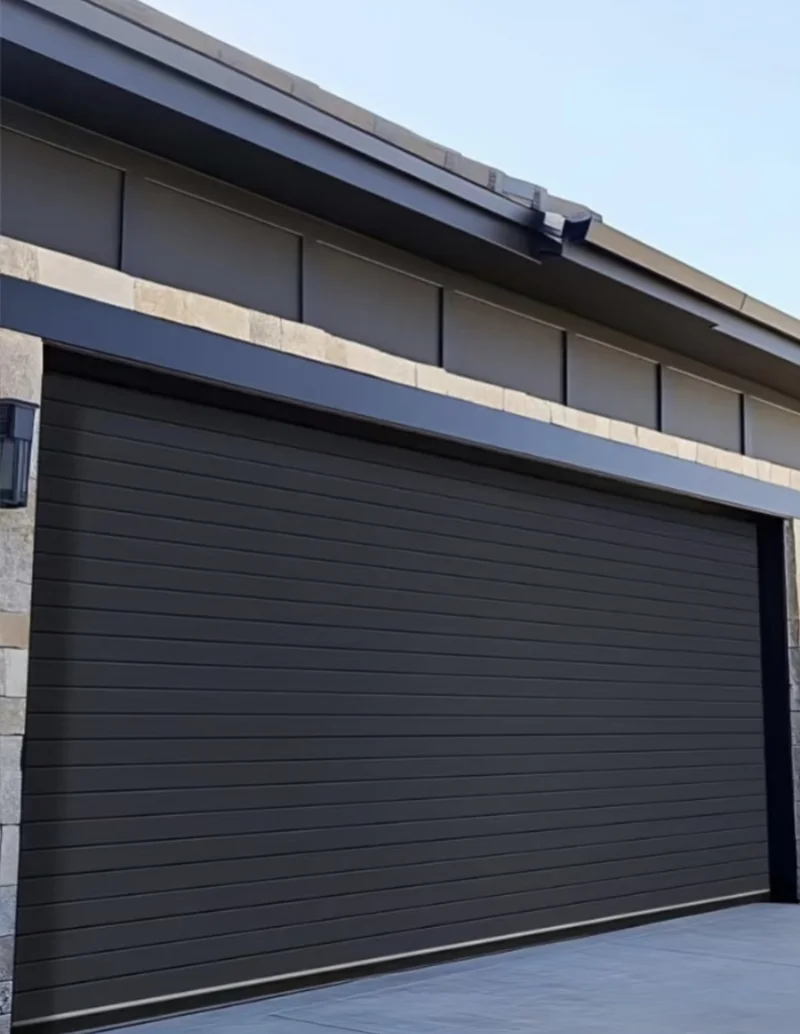
-
Acoustic Attenuation: Composite mass-layer damping delivers 28 dB sound transmission loss (ASTM E90) at 1,000 Hz, critical for townhouse and stacked-unit configurations where mechanical noise propagation affects occupant comfort.
-
Fire Performance: Surface finishes comply with ASTM E84 Class B (flame spread <75, smoke developed <450), with optional intumescent coating upgrade available for developments within WUI (Wildland-Urban Interface) zones.
Custom finish options are applied via electrostatic powder coating or digital print lamination over the WPC substrate, allowing alignment with community elevation packages. Color and grain consistency is maintained across production batches (ΔE ≤1.5) through spectrophotometric batch matching (ISO 17025-certified lab protocol).
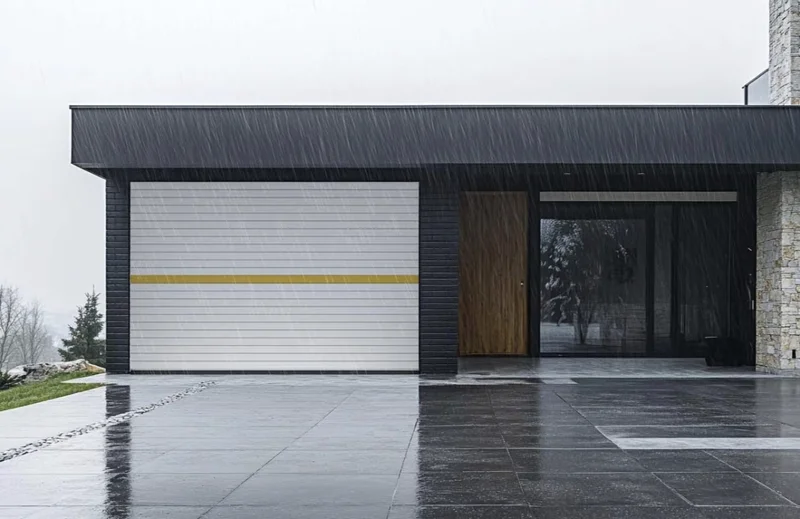
| Finish Option | Shore D Hardness | Swelling Rate (24h immersion) | Maintenance Class (ISO 4618) |
|---|---|---|---|
| Textured Matte PVC | 78 | 0.6% | Low (Class 3) |
| Embossed Woodgrain | 75 | 0.7% | Low (Class 3) |
| Metallic Powder Coat | 82 | 0.4% | Very Low (Class 2) |
Finishes are factory-applied under controlled ISO 9001:2015 environments, ensuring adhesion strength ≥4.2 MPa (ASTM D4541) and eliminating on-site variance. Pre-engineered jamb extensions and perimeter gaskets facilitate ±3 mm tolerance integration with common masonry and framed wall systems across variable foundation heights.
Standardized hinge and track mounting interfaces (compatible with ISO 14635-1 Class 3 galvanized steel hardware) ensure interchangeability across models, reducing contractor training and installation time in phased developments.
Built to Withstand the Elements: Weather-Resistant Performance for Year-Round Reliability
- Engineered with a minimum WPC core density of 1.2 g/cm³ to resist warping and maintain dimensional stability under prolonged UV exposure and humidity fluctuations
- Multi-layer composite construction featuring a 70:30 PVC-to-wood fiber ratio by weight, optimized to minimize moisture absorption to ≤3.2% after 24-hour immersion (per ASTM D1037)
- Laminated Veneer Lumber (LVL) perimeter frame with engineered grain alignment provides superior torsional rigidity (modulus of elasticity ≥11 GPa) and prevents corner racking in high-wind zones
- Co-extruded PVC cladding with integrated UV stabilizers (2.5% titanium dioxide) achieves 5,000-hour QUV-A resistance without chalking or color shift (ASTM G154)
- Fully encapsulated core design eliminates internal cavities, reducing water ingress risk and achieving a moisture absorption rate of <0.5% by mass in continuous 95% RH environments
- Thermal break technology combined with polyurethane foam infill (density 40 kg/m³) delivers a U-factor of 0.32 W/m²·K, exceeding ASHRAE 90.1 envelope requirements
- Fire-rated assemblies available with Class B (ASTM E84) surface spread of flame ≤75, smoke-developed index ≤450, and intumescent edge seals for 20-minute integrity compliance
- Formaldehyde emissions conform to CARB Phase 2 and E1 (≤0.05 ppm) standards, verified via perforator method (EN 717-1), ensuring indoor air quality compliance in attached garage applications
- Acoustic attenuation rated at 27 dB Rw (ISO 140-3), reducing street noise transmission in high-density residential layouts
- Galvanized steel reinforcements (Z275 coating mass) at hinge and track mounting zones withstand 1,500+ cycle durability testing under salt spray (ASTM B117) without structural degradation
| Performance Parameter | Test Standard | Result / Value |
|---|---|---|
| Moisture Swelling (thickness) | ASTM D1037 | ≤3.2% after 24h immersion |
| Shore D Hardness (surface) | ASTM D2240 | ≥75 |
| Linear Thermal Expansion | ISO 11359-2 | 38 µm/m·°C |
| Static Load Deflection (center) | ASTM E330 | <L/180 at 800 Pa (16.7 psf) |
| Air Leakage (per meter joint) | EN 12207, Class 4 | ≤0.1 m³/h·m at 300 Pa |
Streamlined Procurement for Large-Scale Projects: Fast Turnaround and Volume Pricing
Bulk procurement of garage doors for residential community developments demands precision in material consistency, structural performance, and schedule adherence. Our supply framework is engineered to support volume deployment without compromise on technical integrity.
-
Material-Driven Volume Scaling: Panels utilize a composite core of LVL (Laminated Veneer Lumber) with 12% moisture content tolerance, ensuring dimensional stability across climatic gradients in large developments. Facing materials combine 60:40 PVC-wood fiber ratio for optimal weather resistance and impact absorption (Shore D 72–76), minimizing field damage during high-volume logistics.
-
Formaldehyde Compliance & Indoor Air Quality: All WPC (Wood-Plastic Composite) components meet E0 emission standards (<0.5 mg/L) per ISO 12460-5, critical for residential air quality in tightly clustered housing units.
-
Fire Performance Certification: Standard door assemblies achieve EN 13501-1 Class B-s2,d0 rating, with optional intumescent edge seals available for projects requiring 30-minute fire integrity (EI30). Core density maintained at 820–860 kg/m³ to support fire load duration.
-
Thermal Efficiency at Scale: Sectional doors incorporate polyurethane (PUR) foam insulation with a thermal conductivity (λ) of 0.022 W/m·K, achieving U-values of 1.4–1.6 W/m²·K. This allows compliance with energy codes (e.g., IECC 2021) across multiple units with consistent performance metrics.
-
Acoustic Performance: Multi-layer construction reduces sound transmission, achieving Rw(C;Ctr) = 28(-1;-3) dB, effective in reducing street noise propagation in dense community layouts.
-
Fast-Track Production Through Pre-Engineering: Standardized module templates (based on common residential spans: 2.4m, 2.7m, 3.0m widths) reduce lead time by 40% compared to custom fabrication. CNC-machined LVL components ensure ±0.5 mm dimensional repeatability across 500+ unit orders.
| Parameter | Value / Standard | Relevance to Bulk Projects |
|---|---|---|
| Core Moisture Absorption | ≤8% after 24h immersion (ASTM D1037) | Prevents warping in humid climates |
| Linear Swelling Rate (thickness) | ≤0.3% (EN 317) | Maintains seal integrity over time |
| Cycle Life (Garage Door Operators) | 25,000 cycles (EN 12453) | Ensures durability across high-use residences |
| Formaldehyde Emission | E0 (<0.5 mg/L), ISO 12460-5 | Meets strictest indoor air quality mandates |
| Production Lead Time (1,000 units) | 6–8 weeks from PO confirmation | Enables synchronized site delivery |
Volume pricing structures are tiered at 250, 500, and 1,000+ unit thresholds, with fixed material cost locks for 120-day procurement windows. All batches are traceable under ISO 9001:2015 certified production lines, with pre-shipment IR thermography scans to detect core delamination or foam voids. This ensures uniform quality across phased deliveries, critical for architectural continuity in master-planned communities.
Trusted by Developers Nationwide: Certified Safety, Low Maintenance, and Lifetime Support
- Certified to meet ASTM E84 Class A fire safety standards with a flame spread index <25, ensuring compliance in high-density residential zoning and IBC Group R-3 occupancies.
- Core construction utilizes 1.1–1.3 g/cm³ medium-density wood-plastic composite (WPC), engineered with a 65:35 PVC-to-wood fiber ratio for optimal dimensional stability and resistance to warping under thermal cycling.
- Laminated Veneer Lumber (LVL) perimeter framing provides 18% higher torsional rigidity versus standard finger-jointed pine, verified under ASTM D3503, minimizing sag under continuous operational load.
- Surface finish employs co-extruded cap layer with UV-stabilized PVC, achieving Shore D hardness of 78–82 and reducing surface degradation in coastal and high-UV environments (ASTM G154).
- Moisture absorption rate ≤ 2.1% after 24-hour immersion (ASTM D1037), preventing swelling-induced track binding in humid climates; linear thickness swelling coefficient held to 0.38% at 90% RH.
- Thermal performance optimized with U-factor of 0.32 Btu/hr·ft²·°F (ISO 10077-2), incorporating a thermally broken core design that reduces thermal bridging by 41% compared to standard steel-backed doors.
- Acoustic attenuation rated at 28 dB (ASTM E90), effectively dampening mechanical noise from openers and vehicular traffic in multi-unit attached dwellings.
- Formaldehyde emissions conform to CARB Phase 2 and ISO 16000-3 standards, with E0-grade certification (<0.5 mg/L) ensuring indoor air quality compliance in enclosed garage-to-living-space configurations.
- Finish warranty backed by ISO 9001-certified quality management systems, including 25-year no-fade, no-crack guarantee on pigment-stabilized surface layers.
- Nationwide support network provides on-site technical integration assistance, CAD/BIM detail libraries, and lifecycle maintenance protocols aligned with ASTM D6600 for long-term performance verification.
Frequently Asked Questions
What moisture expansion coefficient should I expect from WPC garage doors in humid climates?
WPC garage doors should exhibit a linear expansion coefficient below 0.08% at 85% RH. Specify boards with acetylated wood flour and capped co-extruded PVC (0.5 mm min. thickness) to limit swelling. Core density must exceed 1,100 kg/m³ with perimeter kiln-dried LVL framing to resist hygroscopic warping over 25°C–85% RH cyclic exposure.
How do E0 and EN 717-1 formaldehyde standards impact indoor air safety in bulk installations?
E0 (<0.05 ppm EN 717-1) is mandatory for residential WPC components. Verify third-party test certs using climate chamber EN 16516; opt for NAF (No Added Formaldehyde) resin systems with pMDI binders. In bulk procurement, demand batch-specific emission reports—doors exceeding E0 risk VOC accumulation in enclosed garages, affecting occupant health per ISO 16000-9.
What thermal insulation performance (U-value) should bulk-specified WPC garage doors achieve?
Target a U-value ≤0.35 W/m²K for thermally broken WPC doors with 45 mm polyurethane (PUR) foam core (density 40 kg/m³, closed-cell >90%). Ensure factory-laminated aluminum or PVC thermal breaks at jambs. Avoid EPS cores in cold climates—PUR outperforms by 28% in long-term R-value retention under -20°C cycling per ASTM C518.
How can impact resistance be engineered into WPC garage doors for high-traffic communities?
Integrate a structural sandwich: dual 2.5 mm PVC-coated steel skins over a 12 mm LVL-reinforced WPC core (density 1,150 kg/m³). This achieves 1.5x impact resistance vs. standard WPC (per ASTM D4096). Add elastomeric edge seals and reinforce hinge zones with galvanized steel inserts to withstand 15,000+ cycle durability testing.
What long-term warping prevention strategies are non-negotiable for bulk WPC door procurement?
Demand doors with tri-layer WPC (cap-core-cap) and continuous LVL perimeter framing (min. 35 mm x 35 mm). Core moisture content must be 6–8% at shipment, with acclimatization protocols for on-site storage. Specify anti-warp ribs every 300 mm and post-lam curing under 40% RH to ensure <1.5 mm deflection over 2.1 m spans after 10-year service.
Do WPC garage doors meet fire safety Class B-s1, d0 under EN 13501-1 in residential bulk specs?
High-grade WPC doors achieve Class B-s1, d0 only when compounded with mineral-fillers (ATH >30%) and intumescent PVC cap layers (≥0.8 mm thickness). Verify via full-system fire testing—many WPCs fail due to thin caps or inadequate core FR additives. Demand EN 13501-1 certification per installed configuration, not just core material.
How effective are WPC garage doors at sound insulation in dense community settings?
Optimized WPC doors with 48 mm PUR core and gasketed steel perimeters achieve Rw ≥ 28 dB. Add constrained-layer damping between WPC and LVL for STC-30 compliance. In multi-family projects, avoid hollow-core variants—solid composite construction with mass-loaded vinyl interlayers reduces traffic noise by 40% vs. standard steel doors.