Fire-Rated Solid Wood Doors with UL 60-Minute Certification for Office Building Safety
In the evolving landscape of commercial construction, safety and aesthetics are no longer competing priorities—nowhere is this more evident than in the growing demand for fire-rated solid wood doors with UL 60-minute certification. These meticulously engineered doors blend the timeless elegance of natural wood with rigorous performance standards, offering office building developers and architects a solution that meets both life-safety codes and design aspirations. Certified to withstand fire exposure for up to one hour, these doors play a critical role in compartmentalizing flames and smoke, providing crucial time for evacuation and emergency response. Constructed to comply with stringent UL 263 and ASTM E119 testing protocols, they deliver proven fire resistance without sacrificing architectural integrity. As office spaces increasingly prioritize occupant safety alongside premium finishes, UL 60-minute fire-rated solid wood doors have emerged as an essential component in modern, code-compliant building projects—where performance, beauty, and protection converge seamlessly.
Understanding UL Certified 60-Minute Fire Resistance in Commercial Doors
- UL certification for 60-minute fire resistance in commercial doors signifies that a door assembly has undergone rigorous standardized testing per UL 263 (ASTM E119) and maintained structural integrity and thermal containment for one hour under controlled fire conditions.
- This rating is not a property of the door alone but applies to the complete assembly—door, frame, hardware, glazing, seals, and installation method—tested as an integrated system. Any deviation from the approved design can invalidate the rating.
- Solid wood doors achieving this certification are typically constructed with engineered cores, intumescent materials, and protective veneers that expand under heat to seal gaps and resist flame penetration. The wood species, density, and thickness are critical factors in meeting thermal insulation and hose-stream requirements post-fire exposure.
- The 60-minute threshold is among the highest for door assemblies and is mandated in specific high-risk or high-occupancy areas such as stairwell enclosures, exit passageways, mechanical rooms, and fire barrier walls within office buildings. Compliance ensures occupants have sufficient egress time and limits fire spread between compartments.
- A critical component of UL 60-minute certification is passage of the hose-stream test, conducted immediately after the fire exposure cycle. The assembly must withstand the impact and erosive force of a high-pressure water stream without disintegration, demonstrating durability under real-world firefighting conditions.
- Third-party inspection and labeling are required; each certified door bears a permanent UL label indicating the fire endurance rating, applicable assembly type (e.g., U300 for door assemblies), and manufacturer details. Authorities Having Jurisdiction (AHJs) verify these labels during inspections to ensure code compliance.
- Maintenance and modification protocols are strictly governed. Field alterations—such as cutting for hardware or replacing components—must adhere to the original listing’s allowances. Unauthorized modifications void certification and compromise building safety.
- In office building applications, specifying UL 60-minute fire-rated solid wood doors supports both life safety and architectural aesthetics, combining performance with natural material appeal. However, performance must never be secondary to design intent.
- Compliance with NFPA 80, International Building Code (IBC), and local regulations is enforced through periodic inspections and documentation. Only assemblies listed in the UL Fire Resistance Directory may be legally installed in rated walls.
Why Solid Wood Fire-Rated Doors Are Ideal for Office Building Projects
- Superior durability and longevity in high-traffic office environments
- Natural aesthetic appeal that enhances corporate interiors and supports biophilic design principles
- Proven structural integrity under fire exposure due to dense wood composition and advanced core treatments
- Seamless integration with UL 60-minute fire-rated assemblies, ensuring compliance with stringent building codes
- Effective smoke and flame containment, contributing to occupant egress and fire suppression timelines
Solid wood fire-rated doors with UL 60-minute certification offer a critical balance between safety performance and architectural intent in office building projects. Unlike engineered alternatives, solid wood provides inherent thermal stability and charring behavior that slows heat transfer during a fire event. This predictable performance, when combined with proprietary intumescent seals and fire-retardant treatments, enables the door assembly to maintain integrity and insulation for the full 60-minute rating period.
The UL 60-minute certification signifies rigorous third-party testing under controlled, standardized conditions. Each door undergoes exposure to temperatures exceeding 1,700°F, simulating real-world fire progression. Solid wood doors that pass this test demonstrate resistance to flame penetration, structural collapse, and excessive heat transmission—key factors in compartmentalizing fire and protecting escape routes.
Beyond safety, solid wood doors deliver long-term value. Their robust construction withstands repeated use in commercial corridors, lobbies, and executive suites without significant wear. Refinishing capabilities extend service life, aligning with sustainability goals in modern office developments. Additionally, wood’s natural acoustic properties contribute to improved sound attenuation between occupied spaces, enhancing workplace privacy and concentration.
Design flexibility is another advantage. Solid wood doors can be customized in dimension, profile, and finish to align with diverse interior styles—from traditional boardrooms to contemporary open-plan offices. This adaptability supports unified design narratives without compromising on fire safety.
In summary, solid wood fire-rated doors fulfill dual mandates in office construction: uncompromised life safety and elevated design quality. Their certification to UL 60-minute standards ensures compliance with IBC and NFPA requirements, while their material authenticity and resilience support occupant well-being and facility longevity. For architects, developers, and facility managers, these doors represent a strategic investment in safety, durability, and aesthetic coherence.
Key Safety and Building Code Requirements for Fire-Rated Office Entrances
-
Fire-rated solid wood doors installed in office building entrances must comply with stringent safety and building code requirements to ensure occupant protection during fire events. These doors, when certified to UL 10C for 60-minute fire endurance, are integral components in maintaining compartmentalization and limiting the spread of flames and smoke.
-
Compliance begins with adherence to the International Building Code (IBC), which mandates that fire-rated door assemblies in corridors, stairwells, and egress paths must meet specific fire-protection ratings based on building occupancy and construction type. For office buildings classified as Group B occupancy, 60-minute fire-rated doors are typically required in exit enclosures and vertical shafts.
-
The door assembly—including the door slab, frame, hardware, glazing (if applicable), and installation methods—must be listed and labeled by a recognized testing laboratory such as Underwriters Laboratories (UL). The UL 60-minute certification confirms that the entire assembly has undergone standardized fire exposure tests, including hose stream testing, to evaluate structural integrity and resistance to thermal degradation.
-
Proper labeling is critical. Each fire-rated door must bear a legible, permanent label indicating the fire rating, manufacturer, and certification agency. Field modifications that compromise the door’s integrity—such as unauthorized cutting for hardware or excessive trimming of edges—void certification and violate code.
-
Hardware must be listed for use in fire-rated assemblies. This includes self-closing and positive latching mechanisms that ensure the door automatically closes and remains securely shut during a fire. Panic hardware may be required depending on occupant load and egress requirements under NFPA 101, the Life Safety Code.
-
Gaps between the door and frame are strictly regulated. Per NFPA 80, maximum undercut is ¾ inch, and side and top clearances must not exceed 1/8 inch. Intumescent edge seals may be required to expand under heat and seal gaps during fire exposure.
-
Installation must strictly follow the manufacturer’s instructions and the listing documentation. Inspections by authorities having jurisdiction (AHJ) are required to verify compliance before occupancy. Non-compliant installations, even with certified components, fail to meet code and compromise life safety.
How UL Certification Ensures Compliance and Performance in Fire-Rated Doors
-
UL certification is a definitive benchmark for fire safety performance in building components, particularly fire-rated solid wood doors used in office environments. Administered by Underwriters Laboratories, a globally recognized safety science organization, UL 60-minute certification demonstrates that a door assembly has undergone rigorous standardized testing to ensure it can withstand fire exposure for up to one hour while maintaining structural integrity and limiting the spread of flames and smoke.
-
Fire-rated solid wood doors bearing UL 60-minute certification are evaluated as complete assemblies, including frame, hardware, glazing (if applicable), and fire-resistant core materials. Testing per UL 10C involves subjecting the assembly to a controlled time-temperature curve simulating real fire conditions. The door must resist flame penetration, limit temperature rise on the non-fire side, and maintain operational functionality—such as latching and closing mechanisms—throughout the 60-minute exposure.
-
Compliance with UL standards ensures adherence to the International Building Code (IBC) and NFPA 80, which mandate fire-rated barriers in office buildings to compartmentalize fire and support occupant evacuation. UL certification provides documented evidence that the door meets or exceeds these regulatory requirements, reducing liability for architects, contractors, and building owners.
-
Performance validation extends beyond fire resistance. UL-certified doors are assessed for durability under cyclic operation, ensuring long-term reliability in high-traffic office settings. The certification process also verifies proper labeling, installation protocols, and listing parameters, which are critical for inspection and code enforcement.
-
Only products listed in the UL Online Certifications Directory with a corresponding classification—such as “Fire Door Assembly” under category code DHMX—are deemed compliant. This listing confirms ongoing follow-up inspection services by UL, ensuring continued manufacturing consistency and quality control.
-
In office building safety, selecting UL 60-minute certified solid wood doors combines aesthetic appeal with verifiable protection. The certification serves not only as a compliance tool but as a performance guarantee—ensuring that, in the event of fire, the door performs as engineered, safeguarding lives and critical building zones.
Design and Aesthetic Advantages of Fire-Rated Wood Doors in Corporate Interiors
-
Fire-rated solid wood doors with UL 60-minute certification fulfill critical safety mandates without sacrificing the aesthetic integrity of corporate interiors. Unlike conventional fire doors constructed from steel or composite materials, these doors leverage the natural warmth and visual refinement of solid wood, offering architects and interior designers a functional yet elegant solution for high-performance environments.
-
The inherent grain patterns, tonal depth, and tactile quality of solid wood contribute to a refined corporate aesthetic, aligning with biophilic design principles that enhance occupant well-being and perceived space quality. When specified with premium hardwood species—such as oak, walnut, or cherry—these doors integrate seamlessly into executive offices, boardrooms, lobbies, and other high-visibility areas where design excellence is paramount.
-
Modern manufacturing techniques ensure that fire performance does not compromise design flexibility. Doors can be fabricated with custom profiles, panel configurations, and finish options—including clear lacquers, stains, and oils—that preserve the material’s authenticity while meeting stringent UL 263 and ASTM E119 standards. This allows for consistency in finish and detailing across both fire-rated and non-fire-rated partitions, maintaining visual continuity throughout the interior.
-
Additionally, the dimensional stability and precision engineering of certified fire-rated wood doors support tight tolerances and seamless integration with contemporary hardware and framing systems. Concealed hinges, flush pulls, and minimalist thresholds can be incorporated without affecting fire integrity, enabling a clean, unobtrusive aesthetic that complements modern corporate design language.
-
Acoustical performance further enhances their suitability for office environments. Solid wood’s mass contributes to sound attenuation, reducing noise transmission between private offices, conference rooms, and open workspaces—supporting both safety and acoustic privacy.
-
By combining regulatory compliance with high-end materiality, fire-rated solid wood doors represent a strategic convergence of form and function. They allow design teams to uphold rigorous safety standards while delivering spaces that reflect organizational prestige, craftsmanship, and attention to detail. This dual advantage positions them as a preferred solution in premium commercial projects where safety, sustainability, and design coherence are non-negotiable.
Frequently Asked Questions
What does UL 60-minute fire-rated certification mean for solid wood doors in office buildings?
A UL 60-minute fire-rated certification for solid wood doors signifies that the door has undergone rigorous testing by Underwriters Laboratories and can withstand exposure to fire for up to one hour, maintaining structural integrity and limiting the transfer of heat and flames. In office building applications, this rating is critical for compartmentalizing fire spread, allowing safe egress, and meeting life safety code requirements such as those in the International Building Code (IBC) and NFPA 101.
Can solid wood doors truly achieve 60-minute fire resistance?
Yes, certain engineered solid wood doors can achieve 60-minute fire resistance when constructed with fire-retardant-treated lumber, intumescent cores, and tested door assemblies that include rated frames, hardware, and seals. These doors must be part of a fully certified assembly system tested per UL 10C positive pressure hose stream test and listed in UL’s Fire Resistance Directory to ensure compliance.
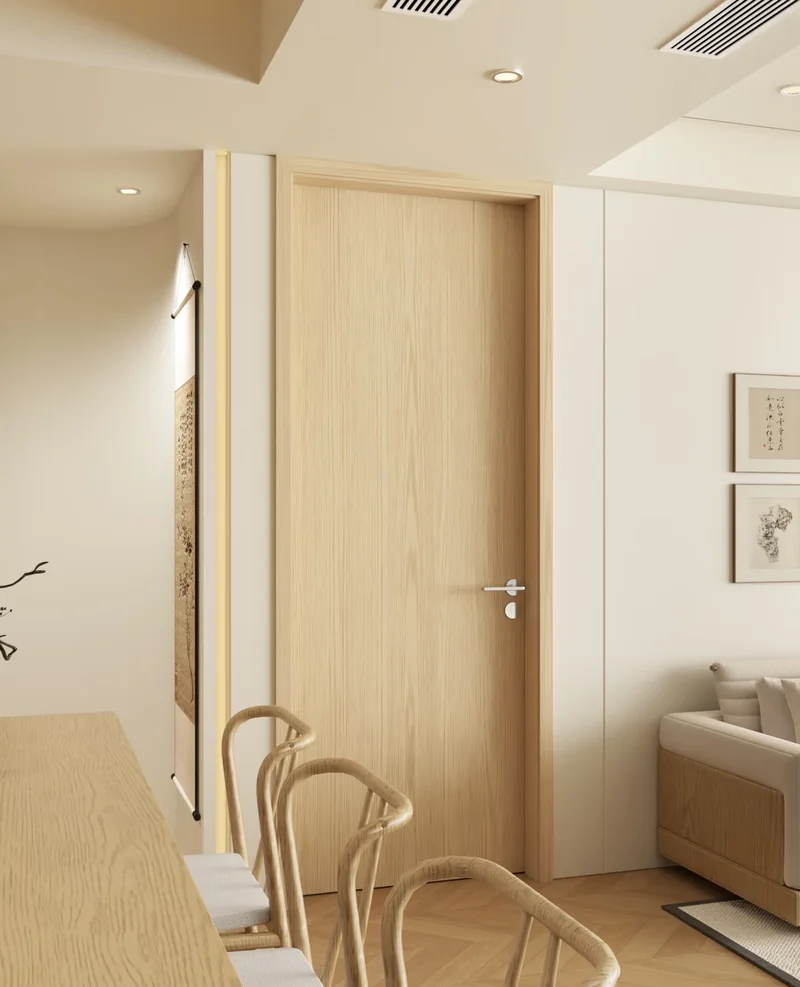
How do fire-rated solid wood doors differ from standard solid wood doors?
Fire-rated solid wood doors are specifically engineered with fire-resistant materials such as intumescent layers, dense core substrates, and special glazing when vision panels are present. Unlike standard solid wood doors, they are part of a system that includes UL-listed components (hinges, seals, closers, frames) and are subject to strict manufacturing tolerances to ensure performance during fire exposure.
Are fire-rated solid wood doors permitted in all areas of an office building?
Fire-rated solid wood doors are permitted in areas requiring fire containment, such as stairwells, egress corridors, fire barriers, and tenant-separated spaces, provided they meet the hourly rating required by code for the specific location. Their use is typically restricted by occupancy type, location within exit enclosures, and maximum allowed dimensions per ASTM E119 and IBC Section 716.
What are the critical components required in a UL-certified 60-minute fire door assembly?
A complete UL-certified 60-minute fire door assembly includes the door slab, fire-rated frame, listed hardware (hinges, closers, latches), gasketing, fire-rated threshold, and intumescent seals. All components must be from the same UL-certified design (category “W-U”的), and substitutions not in the listing will void the fire rating.
How are fire-rated solid wood doors tested and listed for compliance?
Fire-rated solid wood doors are tested as complete assemblies under UL 10C, which simulates fire exposure with temperature up to 1,700°F over 60 minutes followed by a hose stream test. The listing appears in the UL Fire Resistance Directory or UL Product iQ database, specifying exact construction, dimension limits, glazing, and required components. Only listed assemblies are code-compliant.
Do fire-rated solid wood doors require special installation protocols?
Yes, installation must strictly follow the manufacturer’s UL-listed instructions, including gap tolerances (max 3/32″ at perimeter, 3/16″ at bottom), attachment of intumescent side seals, use of correct fasteners, and precise alignment with the rated frame. Field modifications such as cutting or notching void the certification unless explicitly permitted in the listing.
Are intumescent seals necessary on fire-rated solid wood doors?
Yes, intumescent seals are essential in fire-rated solid wood door assemblies. These heat-activated seals expand during fire exposure to seal gaps around the door edge, preventing smoke and hot gas migration. They must be UL-listed, continuously installed, and compatible with the specific door and frame design in the fire rating listing.
Can fire-rated solid wood doors include glass panels?
Yes, but only if the glass is part of the UL-listed assembly. Fire-rated solid wood doors may incorporate ceramic glass, wired glass, or fire-protected glass that meets hose stream and temperature rise requirements. The maximum size, thickness, and framing method for glazing are specified in the listing, and improper installation compromises the entire assembly’s rating.
How often should fire-rated solid wood doors be inspected in office buildings?
Per NFPA 80, fire-rated solid wood doors in office buildings must be inspected annually by a certified fire door inspector. Inspections must verify the presence of all labeled components, operational functionality (e.g., self-closing), absence of damage, proper clearances, and seal integrity to maintain compliance with life safety codes.
Can fire-rated solid wood doors be finished on-site after installation?
On-site finishing is permitted only if it complies with the manufacturer’s written instructions and does not compromise the fire rating. Typically, thin-film, non-insulating coatings like stains or clear finishes are allowed, but thick varnishes, laminates, or paint layers not evaluated during certification can void the listing. Always consult the door’s UL design for coating limitations.
What is the maximum permitted size for a 60-minute fire-rated solid wood door?
The maximum size is determined by the specific UL-listed design, but common 60-minute fire-rated solid wood doors are limited to 4’0” wide by 8’0” tall. Larger dimensions require special engineering and testing. Oversizing beyond the listing parameters voids the fire rating and violates IBC Section 716 compliance.