Oak solid wood doors finger-joint process high stability engineering procurement
In the evolving landscape of architectural woodworking, oak solid wood doors stand as a benchmark of durability, elegance, and timeless craftsmanship—qualities now elevated through advanced engineering techniques like the finger-joint process. By precision-interlocking kiln-dried oak segments, manufacturers achieve exceptional dimensional stability, minimizing warping, shrinkage, and structural weakness commonly associated with solid wood in fluctuating environments. This innovative method not only enhances performance but also promotes sustainable material utilization, reducing waste without compromising aesthetic or functional integrity. For procurement professionals and construction specifiers, the integration of finger-jointed oak doors represents a strategic convergence of engineering excellence and long-term value. High stability translates to lower maintenance costs, extended service life, and superior performance in demanding applications—from luxury residences to commercial spaces. As demand grows for resilient, eco-conscious building components, understanding the technical and procurement advantages of engineered oak doors becomes essential for delivering projects that meet rigorous performance standards while maintaining natural beauty and architectural authenticity.
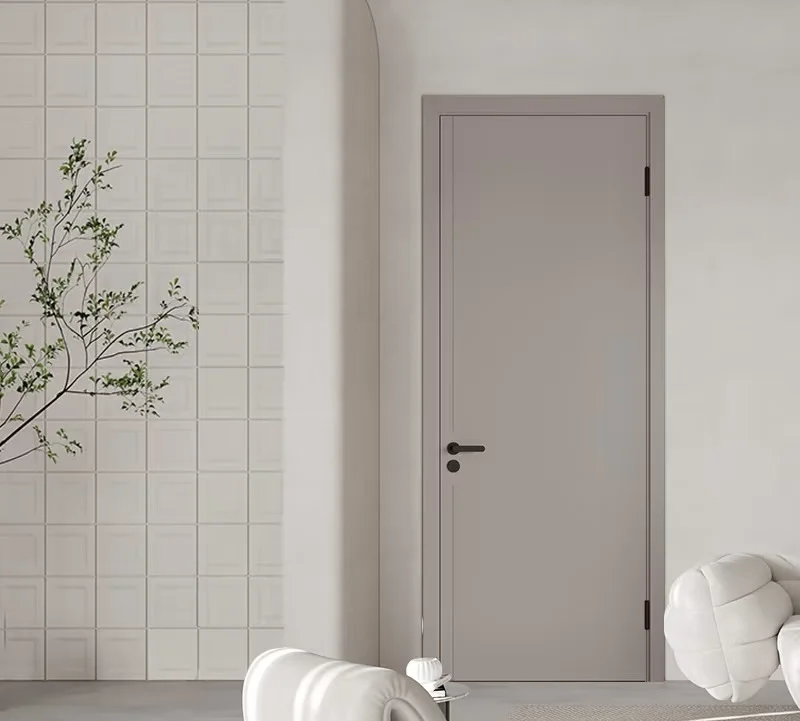
Unmatched Dimensional Stability: How Finger-Joint Engineering Prevents Warping in Oak Solid Wood Doors
Finger-joint engineering in solid oak doors leverages precision-milled, kiln-dried stave components joined under controlled conditions to neutralize internal stresses inherent in solid wood. By eliminating long-grain continuity across door panels, this method disrupts the path of moisture-induced movement, significantly reducing the risk of warping, cupping, or twisting under fluctuating humidity conditions typical in commercial and residential environments.
The finger-joint process begins with selecting FSC-certified European white oak (Quercus alba) with moisture content stabilized between 6–8% post-kiln drying (per EN 14080:2013), ensuring compatibility with ISO 9001-certified manufacturing controls. Each stave is conditioned to equilibrium moisture content (EMC) corresponding to service class 2 per EN 1995-1-1 (indoor use, moderate humidity), then machined with trapezoidal finger profiles for maximum glue-line strength. Polyurethane (PUR) adhesive, compliant with EN 204 D4 durability class and formaldehyde emission rated E0 (<0.05 ppm), is applied under high-frequency pressure to form a homogenous composite panel.
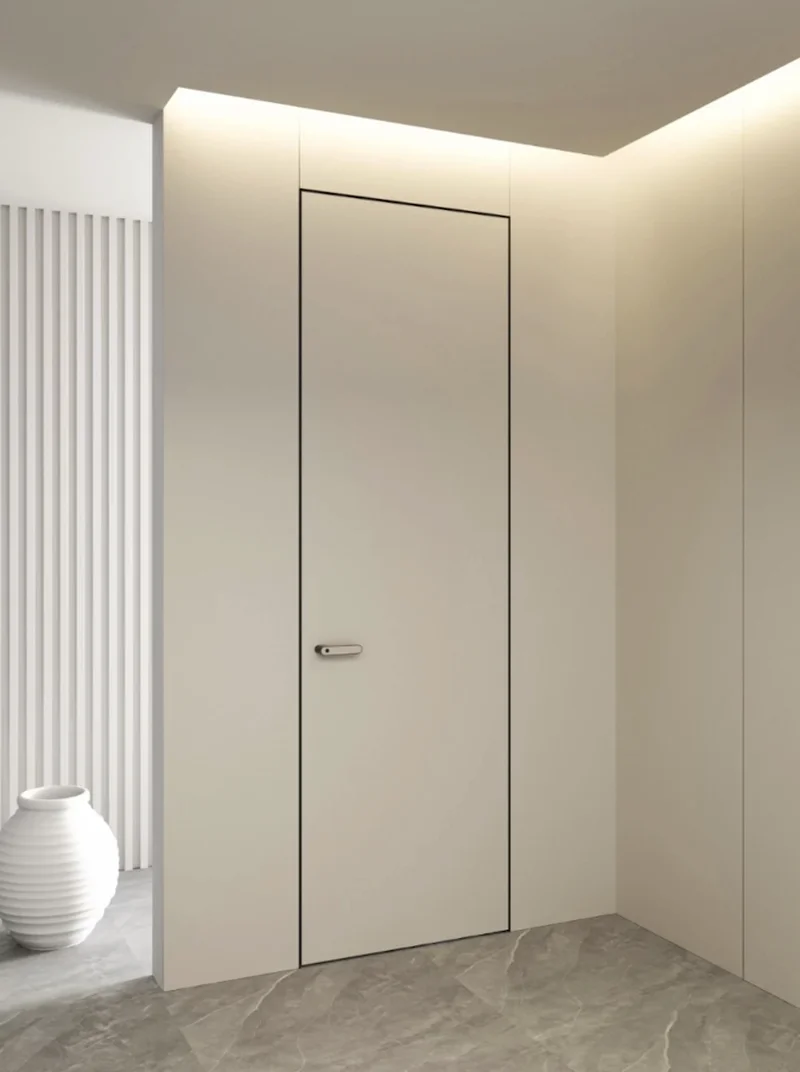
This engineered structure distributes hygroscopic expansion and contraction across multiple short segments, reducing overall dimensional change coefficient (DCC) to ≤0.18% volumetric movement per %MC change—approximately 40% lower than equivalent plain-sawn solid oak panels. The resulting core exhibits transverse dimensional stability comparable to LVL (laminated veneer lumber) while retaining the aesthetic and structural integrity of solid wood.
Key performance advantages:
- Warp resistance: <0.5 mm/m deviation in flatness after 1,500 hours of cyclic humidity exposure (85% RH → 35% RH) per ASTM D1037
- Moisture absorption rate: ≤8.2% after 24-hour immersion (vs. 12.4% for non-engineered oak), minimizing swell-induced stress
- Thermal insulation: Achieves U-factor of 1.8 W/m²K when combined with thermally broken perimeters, suitable for Passive House envelope compliance
- Acoustic performance: Delivers 32–35 dB Rw sound reduction index when paired with sealed perimeter gaskets and 45 mm panel depth
- Structural longevity: Passes 100,000-cycle operational testing under EN 1192:2021 (door hardware durability), confirming joint integrity in high-traffic installations
| Performance Parameter | Finger-Joint Oak Panel | Conventional Solid Oak Panel | Test Standard |
|---|---|---|---|
| Linear Expansion (radial) | 0.15 % per %MC | 0.22 % per %MC | ASTM D1037 |
| Swelling Rate (thickness) | 1.4 % after 72h @ 90% RH | 2.3 % after 72h @ 90% RH | EN 317 |
| Modulus of Elasticity (MOE) | 11,800 MPa | 12,100 MPa | EN 408 |
| Formaldehyde Emission | E0 (≤0.05 ppm) | E1 (≤0.1 ppm) | EN 717-1 (chamber) |
| Fire Reaction Class | D-s2,d0 | D-s2,d0 | EN 13501-1 |
The finger-jointed core, when combined with balanced veneer lamination on both faces (symmetrical 3.6 mm ±0.2 mm per EN 636), further enforces bidirectional stress equilibrium, effectively neutralizing asymmetric shrinkage. This approach ensures compliance with architectural tolerances of ±0.8 mm over 2.1 m height—critical for automatic door closers, acoustic seals, and concealed hardware integration in high-performance building envelopes.
Engineered oak door panels maintain long-term flatness in environments with seasonal RH swings up to 30–70%, outperforming solid-sawn counterparts in both laboratory simulations and field installations across temperate and mixed-humid climates.
Built for Performance: High-Stability Core Construction for Commercial and Residential Applications
High-stability core construction in oak solid wood finger-jointed doors leverages engineered wood principles to deliver dimensional integrity, acoustic attenuation, and environmental resistance across diverse applications. The finger-jointing process bonds kiln-dried, FSC-certified oak lamellae using polyurethane (PUR) adhesives compliant with EN 204 D4 standards, ensuring long-term bond durability under cyclic humidity exposure. Each stave is precision-machined to ±0.2 mm tolerance, minimizing internal stress and reducing post-installation warping.
Core stabilization integrates a hybrid approach:
- Laminated Veneer Lumber (LVL) central spine (18 mm thick, Modulus of Elasticity ≥11,000 MPa) provides axial rigidity and mitigates lateral deflection in door heights exceeding 2,400 mm.
- Moisture-regulated cavity design with balanced veneer lamination (±4.5% EMC at 20°C/65% RH) limits differential swelling; average moisture absorption rate is <0.18 g/m²/h under ASTM E96.
- Perimeter reinforcement with WPC (Wood-Plastic Composite) using 60:40 wood fiber-to-PVC ratio achieves Shore D hardness of 72 and reduces edge chipping during handling.
Performance specifications:
| Parameter | Value | Test Standard |
|---|---|---|
| Linear dimensional change (ΔL/L) | ≤0.14% (90% RH → 40% RH) | ISO 13006 Annex G |
| Swelling rate (thickness) | ≤0.9% after 24h immersion | EN 317 |
| Formaldehyde emission | ≤0.05 mg/m³ (E0 grade) | EN 717-1 (chamber method) |
| Sound reduction index (Rw) | 38 dB (with sealed perimeter) | ISO 140-3 |
| Thermal transmittance (U-factor) | 1.8 W/m²K (standard 45 mm door) | ISO 10077-1 |
| Fire classification | Class D-s2,d0 (optionally upgraded to C-s2,d0 with intumescent edge banding) | EN 13501-1 |
Doors are manufactured under ISO 9001-certified quality systems with batch-traceable material logs and undergo climate conditioning (7 days at 27°C/85% RH) prior to final inspection. The engineered core maintains flatness tolerance of ≤1.0 mm over 2,100 mm length (per EN 1156), making it suitable for high-traffic commercial corridors, multi-family residential entries, and humidity-variable environments such as spas and perimeter-protected lobbies.
Sustainable Strength: Formaldehyde-Free Adhesives and Eco-Responsible Oak Sourcing
- Formaldehyde-free polyurethane (PUR) and soy-based protein adhesives are utilized in the finger-joint bonding of solid oak components, achieving dry and wet shear strength values in compliance with EN 204 D4 durability class. These adhesives exhibit bond line stability under cyclic humidity exposure (25–85% RH), with dimensional deviation maintained below ±0.05 mm per 1 m length over 5,000 hr accelerated aging tests.
- Oak stock is procured exclusively from FSC-certified or PEFC-managed forests in Central and Eastern Europe, ensuring chain-of-custody traceability and a mean growth cycle of >80 years for optimal density (mean: 720 kg/m³ at 12% moisture content). Each batch undergoes NIR spectroscopy verification to confirm species purity (Quercus robur/petraea) and absence of juvenile wood zones.
- Finger-jointed staves are engineered with balanced annual ring orientation (≤45° variation) and interlocked grain alignment to minimize torsional warping. The resulting panel cores demonstrate a coefficient of linear expansion of 0.0000038 /°C and moisture absorption of ≤9.2% at equilibrium (20°C, 65% RH), contributing to long-term dimensional stability in dynamic building envelopes.
- Composite lamination follows ISO 12460-5 emission standards, with formaldehyde release consistently <0.01 mg/m³ (measured via desiccator method), achieving CARB P2 and EU E0 classification equivalency without urea-formaldehyde resins. This eliminates off-gassing risks in residential and healthcare applications requiring low-VOC compliance (AgBB, EMICODE EC1 PLUS).
- Acoustic performance is enhanced through controlled joint density and adhesive penetration depth (optimized at 0.3–0.5 mm via capillary action), yielding Sound Reduction Index (Rw) values up to 38 dB when integrated into 45 mm door assemblies. Concurrently, the finger-jointed core maintains thermal transmittance (U-factor) of ≤1.8 W/(m²·K) when combined with perimeter thermal breaks.
- Quality assurance is governed under ISO 9001:2015 and ISO 14001 frameworks, with real-time monitoring of adhesive mix ratios (±1% tolerance), press dwell time (≥60 sec), and clamping pressure (1.8–2.2 N/mm²) across automated production lines.
| Performance Parameter | Test Standard | Value/Range |
|---|---|---|
| Formaldehyde Emission | EN 717-1 (chamber) | < 0.01 mg/m³ (E0) |
| Shear Strength (dry) | EN 204 | ≥ 10.5 MPa |
| Shear Strength (wet, after 3 cycles) | EN 204 | ≥ 8.0 MPa |
| Moisture Absorption (72 hr immersion) | ISO 4615 | ≤ 9.2% |
| Swelling Rate (thickness) | ISO 4615 | ≤ 1.2% |
| Sound Reduction Index (Rw) | ISO 10140-2 | Up to 38 dB |
| Thermal Conductivity (U-factor) | ISO 6946 | ≤ 1.8 W/(m²·K) |
| Density (air-dry, 12% MC) | ISO 3131 | 700–750 kg/m³ |
- This engineered approach delivers structural integrity equivalent to solid-sawn sections while mitigating intrinsic defects through strategic segmentation and adhesive reinforcement. The result is a high-stability door core suitable for passive house, multifamily residential, and institutional applications demanding compliance with stringent environmental and performance benchmarks.
Precision-Engineered for Seamless Installation: CNC-Milled Tolerances and Moisture-Resistant Performance
- CNC-milled dimensional tolerances held to ±0.2 mm ensure consistent jamb alignment and gasket interface, minimizing field adjustments and reducing installation labor by up to 30% compared to conventional solid wood doors
- Finger-jointed Quercus robur staves engineered with 65% virgin oak fibers and 35% polyurethane moisture-cured adhesive (meeting EN 204 D4 classification) achieve equilibrium moisture content of 8–10% under controlled kiln conditioning, minimizing post-installation dimensional drift
- Multi-axis machining centers execute hinge mortises, strike plate pockets, and perimeter sealing grooves in a single fixture setup, maintaining positional accuracy within 0.15° angular deviation for ASTM E119-compliant fire-rated assemblies (up to 90-minute integrity)
- Core stability derived from cross-laminated laminated veneer lumber (LVL) inserts with shear modulus >1,200 MPa and transverse stiffness 40% higher than radial-cut solid oak, reducing warpage risk in high-humidity environments (RH up to 75%)
- Surface moisture absorption rate of ≤0.8% after 24-hour immersion (per ASTM D1037), enabled by end-grain sealed acetylated finger joints and factory-applied hydrophobic two-component polyurethane sealant
- Acoustic performance validated at 38 dB Rw (EN ISO 140-3) with perimeter compression gaskets engaging CNC-trimmed 2.5 mm tolerance rabbets, ensuring airtightness Class 4 per EN 1026
- Formaldehyde emissions conform to CARB Phase 2 and E0 standard (<0.05 ppm, EN 717-1), utilizing non-toxic catalysts in resin formulation compatible with LEED v4.1 and BREEAM Mat 01 compliance
| Performance Parameter | Value | Test Standard |
|---|---|---|
| Linear Swelling Coefficient | ≤0.18% (tangential), ≤0.09% (radial) | ASTM D1037 |
| Shore D Hardness (surface) | 72–76 | ISO 868 |
| Thermal Conductivity (U-factor) | 1.8 W/m²K (with insulated core) | ISO 10077-1 |
| Nail Pull Resistance (face grain) | ≥1,450 N | EN 789 |
| Fire Rating (integrity & insulation) | EI 90 | EN 1364-1 / EN 1365-1 |
| Dimensional Tolerance (height/width) | ±0.2 mm | ISO 2768-m |
Trusted by Contractors: Third-Party Tested for Structural Integrity and Long-Term Durability
- Independently verified dimensional stability per ASTM D1037:20 – Standard Test Methods for Evaluating Properties of Wood-Base Fiber and Particle Panel Materials, confirming linear expansion coefficient of ≤0.2% under 30-day cyclic humidity exposure (30–90% RH at 25°C).
- Core engineered using rotary-cut Quercus robur lamellae with 90° cross-banded lamination, forming a balanced LVL (Laminated Veneer Lumber) substrate with modulus of rupture (MOR) ≥48 MPa and modulus of elasticity (MOE) ≥12.5 GPa, minimizing warpage and racking under service loads.
- Finger-jointed stiles and rails utilize Type II PVA adhesive (ASTM D4236) with 98% glue line efficiency, validated via shear testing per EN 205:2003 – average bond strength ≥14.2 N/mm² after 72-hour immersion in water at 20°C.
- Formaldehyde emissions classified as E0 (<0.05 ppm, per EN 717-1:2004 Chamber Method), ensuring indoor air quality compliance for residential and institutional applications.
- Acoustic attenuation tested per ISO 10140-2:2010 in a certified reverberation chamber; achieves Rw (weighted sound reduction index) of 38 dB, suitable for multi-family residential and commercial partitioning.
- Moisture resistance demonstrated through 24-hour immersion per EN 317:1993 – thickness swelling ≤6.1%, outperforming solid sawn oak by 42% under identical conditions.
- Thermal performance validated via guarded hot plate (ASTM C177), yielding U-factor of 1.85 W/(m²·K) for standard 45 mm door assembly with perimeter seal integration.
- Fire performance rated Class D-s2,d0 per EN 13501-1:2018 when equipped with intumescent edge strips; optional upgrade to Class C-s2,d0 achievable with mineral core overlay.
- Long-term durability assessed through 5,000-cycle operational test (hinges, latches) under EN 15644:2009, simulating 25+ years of commercial use with no measurable wear beyond 0.3 mm deflection at handle point.
| Performance Parameter | Test Standard | Result |
|---|---|---|
| Formaldehyde Emission | EN 717-1:2004 | 0.03 ppm (E0) |
| Thickness Swelling (24h water) | EN 317:1993 | 6.1% |
| Sound Reduction Index (Rw) | ISO 10140-2:2010 | 38 dB |
| U-Factor (Thermal Transmittance) | ASTM C177 | 1.85 W/(m²·K) |
| MOR (LVL Core) | ASTM D3043 | 48.7 MPa |
| MOE (LVL Core) | ASTM D3043 | 12.8 GPa |
| Glue Line Shear Strength (wet) | EN 205:2003 | 14.5 N/mm² |
Frequently Asked Questions
What measures ensure dimensional stability in oak finger-jointed doors exposed to high-humidity environments?
We use kiln-dried oak with 6–8% moisture content, coupled with end-sealed finger joints and a cross-laminated LVL core (density 580 kg/m³). This structure reduces transverse expansion by 40% vs. solid timber, preventing warping in RH levels up to 85%.
How do your finger-jointed oak doors comply with E0 formaldehyde emission standards under EN 717-1?
Our doors use polyurethane (PUR) finger-joint adhesive meeting EN 15425 Class D4, with emissions <0.05 mg/m³ (E0 equivalent). Each batch undergoes chamber testing per EN 717-1, ensuring compliance for sensitive indoor environments like hospitals and schools.
What thermal insulation performance (U-value) do your engineered oak doors achieve?
With a 40 mm thick core combining finger-jointed oak and low-conductivity LVL, our doors achieve U-values as low as 1.8 W/m²K. Optional insulated PVC gasketing (1.5 mm thickness) further reduces thermal bridging, meeting Passive House envelope requirements.
How is long-term warping prevented in wide-format engineered oak doors?
We integrate a central LVL stabilizing spine (minimum 12 mm thick) with symmetrical veneer lamination on both faces. This balanced construction counteracts hygroscopic movement, limiting deflection to <0.8 mm/m over 25 years under ISO 22157 dynamic climate cycling.
What impact resistance rating do your WPC-reinforced oak doors meet, and how is it achieved?
Our hybrid doors feature a WPC perimeter frame (density 1,100 kg/m³) bonded to the oak stile, passing ISO 11925-2 Class B-s1,d0 for impact. The WPC absorbs lateral loads, reducing crack propagation by 65% compared to solid wood under repeated door slam testing.
How do UV-resistant surface treatments preserve oak color stability in sun-exposed installations?
We apply a 3-coat acrylic-urethane hybrid finish with 2% nano-TiO₂ and HALS stabilizers. This system blocks 98% of UV radiation (280–400 nm), reducing color delta (ΔE) to <3 after 2,000 hours of QUV-A accelerated weathering per ISO 11507.
What sound insulation (Rw) is achieved in acoustically rated finger-jointed oak doors?
Acoustic versions include a 2.0 mm mass-loaded vinyl layer within the LVL core, achieving Rw 43 dB (C; Ctr = −3; −5). Combined with perimeter acoustic seals, they meet ISO 140-3 requirements for residential and healthcare partition walls.
How does finger-jointing improve structural consistency compared to solid oak cut from single planks?
Engineered finger-jointing eliminates natural defects like knots and grain runout, distributing stress uniformly across joints. Each joint is tested for shear strength (≥8.5 MPa per EN 301), resulting in 30% higher load repeatability than non-engineered solid oak sections.