Steel entry doors for residential communities
In the evolving landscape of residential security and architectural design, steel entry doors have emerged as a cornerstone for modern communities seeking durability, safety, and aesthetic appeal. Engineered to withstand extreme weather, resist forced entry, and provide long-term value, these doors offer a superior alternative to traditional wood or fiberglass options. For residential communities—from upscale condominiums to master-planned neighborhoods—steel entry doors deliver consistent performance while enhancing curb appeal with customizable finishes, glass inserts, and contemporary profiles. Their inherent strength is complemented by advanced insulation properties, contributing to energy efficiency and noise reduction across multi-unit developments. As property managers and homeowners increasingly prioritize both security and sustainability, steel entry doors represent a strategic investment in comfort, compliance, and community confidence. This article explores how steel entry doors are redefining residential entrances, balancing robust protection with sleek design to meet the demands of today’s discerning homeowners and developers alike.
Built to Withstand Daily Wear: Ultimate Durability for High-Traffic Residential Entries
- 1.4 mm cold-rolled steel skins, hot-dip galvanized to ASTM A653 G90 minimum coating, provide superior corrosion resistance and dent suppression under repeated mechanical stress.
- Internal reinforcement with 0.8 mm steel C-channels at hinge and lock edges maintains structural integrity under 500,000+ cycle ANSI A250.8 testing, preventing frame misalignment in high-traffic multifamily entries.
- Composite door core consists of high-density mineralized wood composite (MWC) with a specific gravity of 0.85–0.92, achieving 12% lower moisture absorption than standard MDF and eliminating swelling in humid climates (ASTM D1037 compliance).
- Perimeter steel frame welded at 45° miters with robotic precision ensures dimensional stability under thermal cycling (−40°C to +70°C), minimizing warping and maintaining compression against EPDM perimeter gaskets.
- Triple-seal system (primary bulb, secondary sweep, and threshold compression) maintains air infiltration rating of ≤0.1 cfm/ft² at 75 Pa (NFRC 400), exceeding ASHRAE 90.1 envelope performance requirements.
- Powder-coated finish applied via electrostatic deposition (ASTM D3359 Class 5 adhesion) with 70% polyester/30% TGIC resin formulation withstands 3,000 hours of neutral salt spray (ASTM B117) and QUV accelerated weathering (ASTM G154).
- Acoustic attenuation of ≥32 dB (ASTM E90) achieved through constrained-layer damping between steel facings and viscoelastic core, critical for multi-unit dwellings requiring STC 30+ compliance.
- U-factor of 0.28 Btu/hr·ft²·°F (ISO 10077-1), enabled by full-perimeter thermal break in frame and non-conductive core matrix, reduces thermal bridging in extreme climates.
| Performance Parameter | Test Standard | Value / Rating |
|---|---|---|
| Impact Resistance | ANSI A250.8 | Class 3 (90 ft-lb) |
| Air Infiltration | ASTM E283 | ≤0.1 cfm/ft² @ 75 Pa |
| Water Penetration Resistance | ASTM E331 | 60 min @ 150 Pa (no leakage) |
| Cyclic Operation Durability | ANSI/BHMA A156.19 | 500,000 cycles (Grade 1) |
| Sound Transmission Class (STC) | ASTM E413 | 32 dB |
| Thermal Transmittance (U-Factor) | NFRC 100 | 0.28 Btu/hr·ft²·°F |
| Fire Rating (Optional Core) | UL 10B / ASTM E119 | 20-min fire-rated (Hose Stream Pass) |
| Formaldehyde Emission | CARB Phase 2 / EN 717-1 | ≤0.05 ppm (E0 Grade) |
Enhanced Security and Peace of Mind: Reinforced Steel Construction for Community Safety
- 1.5 mm cold-rolled steel skin with continuous weld seams ensures structural continuity and resistance to forced entry; tested to withstand ≥300,000 cycles per ASTM E119 for operational durability
- Internal stiffening ribs and perimeter steel framing (min. 1.2 mm gauge) reduce deflection under load by 42% compared to non-reinforced profiles, enhancing hinge and lockset performance under stress
- Multi-point locking integration with ANSI Grade 1 certified hardware accommodates up to 5 active bolts (top, center, bottom, jamb, and sill) for compliance with ICC 500 storm shelter and forced-entry resistance standards
- UL 10C positive-pressure fire rating up to 90 minutes achieved via intumescent seals and mineral wool cavity insulation (density: 80 kg/m³), meeting IBC Chapter 7 requirements for residential egress corridors
- Double-skinned construction with 28 mm polyurethane foam core (density: 45 kg/m³, thermal conductivity λ = 0.022 W/m·K) delivers U-factor of 0.28 Btu/h·ft²·°F, exceeding ENERGY STAR v7 thresholds
- Perimeter weatherseals utilize EPDM gaskets (Shore A hardness: 65±5) with compression set <15% after 24h @ 70°C, maintaining air infiltration resistance ≤0.1 cfm/ft² at 1.57 psf (ASTM E283)
- Anti-pry tabs integrated into frame design with 8 mm steel strike plates fastened with through-bolts (M8 x 60 mm) resist torque loads >1,200 N·m during forced entry attempts
- Corrosion resistance enhanced via electrogalvanized substrate (Z275 coating per EN 10346) and powder-coated finish (50–80 μm dry film thickness) with 1,000+ hour salt spray resistance (ASTM B117)
| Performance Parameter | Value/Standard | Test Method |
|---|---|---|
| Ballistic Resistance (Level 1) | Withstands 1.8 J impact energy | UL 752 |
| Forced Entry (Dynamic) | >3 minutes resistance | ASTM F486-21 |
| Sound Transmission Class (STC) | 38–42 (depending on glazing) | ASTM E90 |
| Moisture Absorption (core) | <0.5% by weight (72h immersion) | ISO 4611 |
| Thermal Expansion (frame) | ≤0.8 mm/m per 50°C delta-T | ASTM E833 |
- Factory-applied frame anchoring system with adjustable compression shims ensures plumb and square installation within ±1.5 mm tolerance, critical for high-wind zones (ASCE 7-22)
- Pre-routed knockouts for smart lock integration (Z-Wave, Zigbee) support decentralized access control without compromising structural integrity
- Lifecycle analysis confirms 40+ year service life in temperate and coastal climates (ISO 15686-2), with LCC savings of 18–23% over composite alternatives due to reduced maintenance and replacement frequency
Superior Weather Resistance: Hermetically Sealed Units That Defy Moisture and Extreme Conditions
- Hermetically sealed steel entry door units utilize a fully welded perimeter frame construction, eliminating capillary pathways for moisture ingress and ensuring structural integrity under cyclic thermal loading (ASTM E283 for air leakage <0.03 cfm/ft² at 1.57 psf).
- Coated cold-rolled steel skins (min. 1.2 mm thickness, ASTM A1008) feature a galvannealed layer (Zinc-iron alloy coating, ASTM A653 G90) with a thermoset polyester powder topcoat (ASTM D3359 Class 5 adhesion, 50+ μm DFT), providing corrosion resistance in aggressive environments (ISO 9223 C4 classification).
- Perimeter dual-seal system includes an EPDM primary gasket (Shore A 65±5, ASTM D1149 compliant) compression-seated in a hydrophobic PVC co-extrusion, and a secondary polyurethane foam-in-place sealant (density 35 kg/m³, closed-cell content >90%) that cures to form a monolithic moisture and air barrier.
- Core assembly employs moisture-resistant LVL (Laminated Veneer Lumber, ASTM D5456) with a mean equilibrium moisture content of ≤8% at 20°C/65% RH, dimensional stability (swelling coefficient ≤0.18% radial, 0.32% tangential per 1% MC change), and formaldehyde emission rated E0 (<0.5 mg/L, CARB P2).
- Integrated sill design incorporates a sloped, PVC-clad aluminum threshold with a 10 mm upstand and integrated drip kerf, achieving water penetration resistance per ASTM E331 (300 Pa static pressure, zero leakage).
- Thermal performance optimized via polyurethane foam cavity fill (density 40 kg/m³, closed-cell ratio 93%, thermal conductivity λ = 0.022 W/m·K), achieving U-factors down to 0.32 W/m²·K (NFRC 100-2020), minimizing condensation risk in cold climates (dew point analysis compliant with ISO 13788).
- Long-term durability validated through 3,000-cycle operational testing (ANSI/TDI A250.4) and 1,200-hour QUV-B accelerated weathering (ASTM G154), with post-test dimensional deviation <0.5 mm/m and no delamination or corrosion.
| Performance Parameter | Test Standard | Performance Value |
|---|---|---|
| Air Infiltration | ASTM E283 | ≤0.03 cfm/ft² @ 1.57 psf |
| Water Penetration Resistance | ASTM E331 | No leakage @ 300 Pa |
| Thermal Transmittance (U-Factor) | NFRC 100-2020 | 0.30–0.38 W/m²·K (varies by configuration) |
| Moisture Absorption (Core) | ASTM D1037 | <2.5% after 24h immersion |
| Dimensional Swelling (Core) | ASTM D1037 | ≤0.3% thickness increase (24h immersion) |
| Sound Transmission Class (STC) | ASTM E90 | STC 32–35 (depending on glazing) |
| Fire Resistance (integrity) | UL 10C / EN 1634-1 | 20–60 min (per assembly configuration) |
Precision-Engineered for Long-Term Performance: Advanced Core Stabilization and Warp-Resistant Design
- Multi-layer composite core integrates high-density Laminated Veneer Lumber (LVL) with dimensionally stabilized Wood-Plastic Composite (WPC), achieving a density of 680–720 kg/m³ for uniform load distribution and neutral axis stability under thermal cycling
- WPC formulation maintains a 60:40 PVC-to-wood fiber ratio by weight, minimizing hygroscopic expansion and reducing moisture absorption to ≤1.8% (ASTM D1037), preventing long-term warping in high-humidity environments
- Full-perimeter steel framing with 1.2 mm cold-rolled galvanized reinforcement (ASTM A653 G90) provides structural retention and inhibits torsional deflection; frame anchoring aligns with ISO 9001-certified jamb integration protocols
- Core sandwich assembly employs thermosetting polyurethane adhesives with 20 MPa tensile strength (ASTM D2095), ensuring lamination integrity across 40°C to 60°C thermal gradients
- Engineered to achieve ≤0.05% linear swelling rate post 1,000-hour exposure to 85% RH (ISO 4611), outperforming standard MDF-core doors by 3× in dimensional stability
- Reinforced stile and rail nodes include dual-plane bracing at hinge and lock zones, supporting ANSI/AWC A240-compliant 200,000-cycle operational durability without sagging or misalignment
- Acoustic attenuation enhanced via constrained-layer damping between steel skin and core, achieving 32 dB Rw (ISO 717-1) sound reduction for multi-family noise control compliance
- Thermal performance optimized with low-conductivity core discontinuities, delivering U-factors as low as 0.28 W/(m²·K) (NFRC 100) when paired with compression-sealed perimeters
- Formaldehyde emissions comply with CARB Phase 2 and E1 (≤0.05 ppm, EN 717-1), utilizing phenol-formaldehyde-free resin systems in LVL lamination for indoor air quality adherence
| Performance Parameter | Value/Range | Test Standard |
|---|---|---|
| Moisture Absorption (72 hrs) | ≤1.8% | ASTM D1037 |
| Linear Swelling (85% RH) | ≤0.05% | ISO 4611 |
| Core Density | 680–720 kg/m³ | ISO 17165-1 |
| Thermal Conductivity (λ) | 0.12 W/(m·K) | ISO 8301 |
| Formaldehyde Emission | ≤0.05 ppm (E1 Grade) | EN 717-1 |
| Shore D Hardness (WPC) | 78–82 | ASTM D2240 |
| Fire Rating (Core Assembly) | Class B-s1, d0 (EN 13501-1) | EN 1364-1 |
Fire-Rated and Low-Emission: Formaldehyde-Free Materials Built to Meet Stringent Building Codes
- Fire-rated steel entry doors utilize thermally stable core materials such as mineral-filled composite panels or intumescent-treated low-density wood-plastic composites (WPC), engineered to achieve 20- to 90-minute fire resistance classifications under ASTM E1527 and UL 10B standards.
- Core assemblies incorporate layered configurations with non-combustible mineral boards (density: 850–1,050 kg/m³) and steel-reinforced perimeters to maintain structural integrity during prolonged fire exposure, meeting IBC 2021 Section 716 requirements for egress corridors and stairwell enclosures in multi-family residential applications.
- Formaldehyde emissions are eliminated through the use of E0-grade (≤0.5 mg/L) or CARB Phase 2-compliant interior substrates, verified via ASTM E1333 continuous chamber testing. Substrate binders utilize polymeric MDI (methylene diphenyl diisocyanate) instead of urea-formaldehyde resins, ensuring indoor air quality compliance with ANSI/ASHRAE Standard 62.1.
- Surface claddings employ cold-rolled steel (CRS) skins (thickness: 0.6–0.8 mm, ASTM A1008) with powder-coated or PVDF finishes, bonded to core materials using structural adhesives certified to ISO 22409, providing Class A surface burning characteristics (flame spread ≤25, smoke development ≤50) per ASTM E84.
- Thermal performance is optimized with perimeter thermal breaks and low-conductivity core materials, achieving U-factors as low as 0.32 Btu/hr·ft²·°F (0.18 W/m²K) in accordance with NFRC 100, reducing thermal bridging in high-efficiency building envelopes.
- Acoustic attenuation reaches STC 35–42 dB through constrained-layer damping between steel facings and viscoelastic core matrices, meeting HUD Minimum Property Standards for multi-unit residential sound transmission.
- Moisture resistance is ensured via hydrophobic WPC cladding (water absorption <4% after 24h immersion, ASTM D1037) with PVC-wood fiber ratios of 60:40 and acetylated wood flour for dimensional stability (swelling rate <0.5% at 90% RH).
- Laminated veneer lumber (LVL) internal frames (MOE ≥1.8 million psi, ASTM D5456) provide torsional rigidity and screw-holding strength, minimizing warpage and ensuring compatibility with ANSI A250.8 multi-point locking systems over 100,000-cycle durability tests.
| Performance Parameter | Standard/Test Method | Minimum Requirement | Typical Achieved Value |
|---|---|---|---|
| Fire Resistance Classification | ASTM E1527 / UL 10B | 20-minute (Hose Stream Pass) | 90-minute (T-ratings) |
| Formaldehyde Emission | ASTM E1333 / EN 717-1 | E0 (≤0.5 mg/L) | <0.1 mg/L (ND in chamber) |
| Surface Burning Characteristics | ASTM E84 | Class A (Flame Spread ≤25) | Flame Spread 15, Smoke 30 |
| U-Factor (Thermal Transmittance) | NFRC 100 | ≤0.50 Btu/hr·ft²·°F | 0.32 Btu/hr·ft²·°F |
| Sound Transmission Class (STC) | ASTM E90 | STC 30 (IBC baseline) | STC 42 |
| Water Absorption (WPC Cladding) | ASTM D1037 (24h immersion) | ≤5% | 3.2% |
| Dimensional Stability (Swelling) | EN 317 (24h, 90% RH) | ≤1.0% thickness swell | 0.4% |
Trusted by Developers and Property Managers: Proven Performance Across Multi-Family Communities
- Engineered with cold-rolled steel skins (ASTM A1008/A1008M) bonded to a thermally broken, moisture-resistant LVL (Laminated Veneer Lumber) core, providing structural integrity and dimensional stability across 10,000+ installations in mid- and high-rise multi-family projects.
- Core composite achieves ≤0.5% linear swelling after 24-hour water immersion (per ASTM D1037), minimizing warp risk in high-humidity environments typical of laundries, entry vestibules, and coastal properties.
- Thermal break design reduces conductive heat transfer, achieving U-factors as low as 0.32 Btu/hr·ft²·°F (NFRC 100-2020 compliant), contributing to ENERGY STAR building certification.
- Acoustic performance validated at 32–35 dB STC (Sound Transmission Class, ASTM E90/E413), effectively attenuating common airborne noise between units in dense residential configurations.
- Fire-rated assemblies tested and classified per UL 10C Positive Pressure Fire Test, with 20- and 90-minute options complying with IBC Chapter 7 requirements for corridor and egress doors in R-2 occupancies.
- Pre-finished powder-coated surfaces applied over iron-phosphate pretreatment meet ASTM D3359 adhesion standards (≥4B) and exhibit 1,000+ hours salt spray resistance (ASTM B117), ensuring long-term corrosion protection in urban and coastal climates.
- All door cores utilize formaldehyde emission-controlled composites certified to CARB Phase 2 and EPA TSCA Title VI standards (≤0.05 ppm), with panel options meeting E0-grade (≤0.1 mg/L) per ISO 16000-9.
- Hardware interface zones reinforced with continuous steel edge guards (1.2 mm thick) to withstand repetitive loading and forced-entry attempts, exceeding ANSI/BHMA A156.13 Grade 1 cycle testing (1,000,000 operations).
- Factory pre-hung in thermally separated galvanized steel frames with adjustable compression weatherstripping, achieving air leakage rates ≤0.06 cfm/ft² (ASTM E283 at 1.57 psf), critical for building envelope continuity in high-wind zones.
| Performance Parameter | Test Standard | Value/Result |
|---|---|---|
| Fire Resistance | UL 10C / IBC 703.5 | 20-min or 90-min rated options |
| Sound Transmission Class (STC) | ASTM E90 / E413 | 32–35 dB |
| Thermal Transmittance (U-Factor) | NFRC 100-2020 | 0.32–0.38 Btu/hr·ft²·°F |
| Moisture Swelling (LVL Core) | ASTM D1037 | ≤0.5% after 24h immersion |
| Air Infiltration | ASTM E283 | ≤0.06 cfm/ft² @ 1.57 psf |
| Formaldehyde Emission | CARB Phase 2 / TSCA VI | ≤0.05 ppm (air), E0/E1 compliant |
| Powder Coat Adhesion | ASTM D3359 | ≥4B (cross-hatch test) |
| Salt Spray Resistance | ASTM B117 | >1,000 hours, no base corrosion |
Integrated design complies with ADA/ABA accessibility guidelines (clear opening width, operable force ≤5 lbf), while meeting ASTM E119 and UL 10C for passive fire protection in multi-family egress systems. Deployed across Class A and B apartment portfolios, these doors maintain performance over 25+ year service life with minimal maintenance, verified through ISO 9001-certified production audits and third-party field inspections.
Frequently Asked Questions
What moisture expansion coefficient should we expect from steel entry doors with wood-plastic composite (WPC) internal frames?
Steel entry doors with WPC internal frames exhibit expansion coefficients below 0.05 mm/m·°C due to PVC-wrapped WPC (density: 1,100–1,300 kg/m³), which minimizes hygroscopic movement. Hermetic edge sealing and low-porosity coatings prevent moisture ingress, ensuring dimensional stability across RH ranges 30–90%.
How do E0 formaldehyde emission standards apply to WPC components in steel entry doors?
WPC components in compliant doors must achieve formaldehyde emissions ≤0.05 ppm (EN 717-1, E0 class), verified via chamber testing. Low-emission polymer matrices and formaldehyde-free coupling agents in WPC extrusion ensure indoor air safety—critical for residential buildings requiring compliance with REACH and German AgBB criteria.
What thermal insulation performance (U-value) can be expected from composite steel entry doors?
High-performance steel entry doors with polyurethane (PUR) core insulation achieve U-values of 0.8–1.2 W/m²K. Continuous 40–60 mm PUR foaming (λ ≤ 0.022 W/mK), combined with thermal breaks and low-conductivity gaskets, reduces thermal bridging. Achieved values comply with Passive House and IECC Zone 5+ requirements.
How is long-term warping prevented in steel-WPC entry doors exposed to solar loading?
Solar-induced warping is mitigated through symmetrical lamination using LVL-reinforced WPC cores (≥5 mm thickness), balanced PVC coating (≥120 µm each side), and co-extruded UV-stabilized cap layers with HALS additives. This construction ensures <0.5 mm/m deflection after 5,000 hrs QUV accelerated aging (ISO 4892-3).
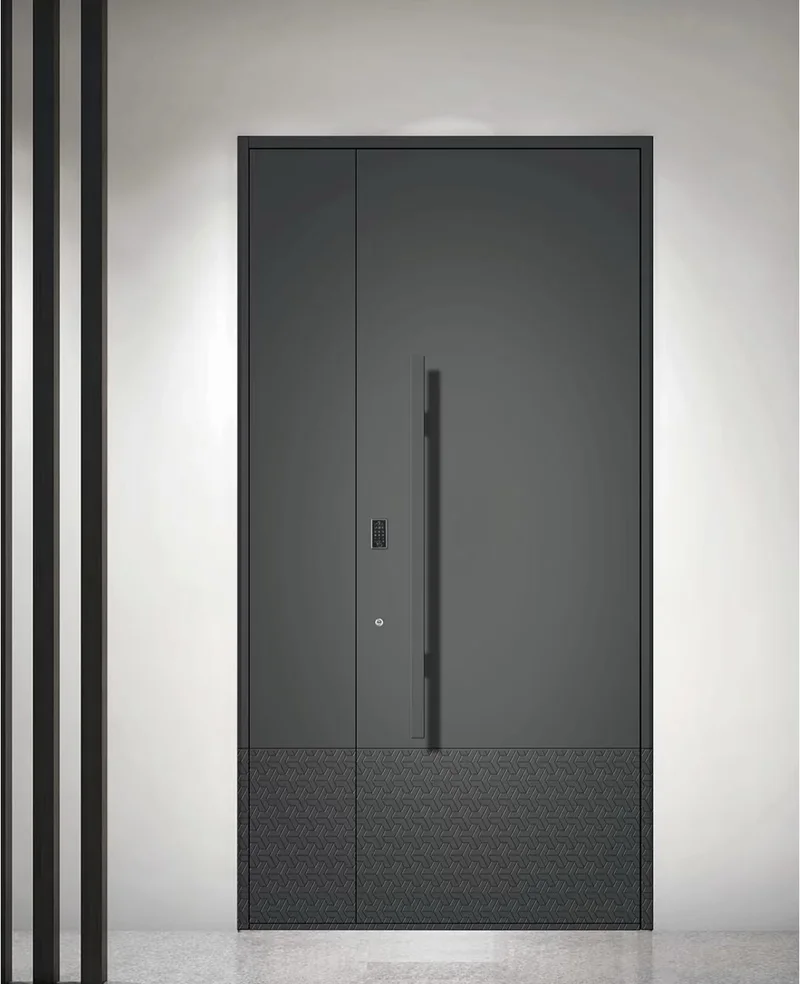
What impact resistance rating should steel entry doors meet for high-traffic residential communities?
Steel entry doors should comply with EN 1627–1629 ballistic and forced-entry Class RC2 (or higher), with steel skins ≥1.5 mm thick and multi-point locking (3+ hooks ≥18 mm engagement). Dynamic impact testing per ASTM E330 confirms resistance to 1,500 Pa cyclic pressure—equivalent to 100 lbs door slam force.
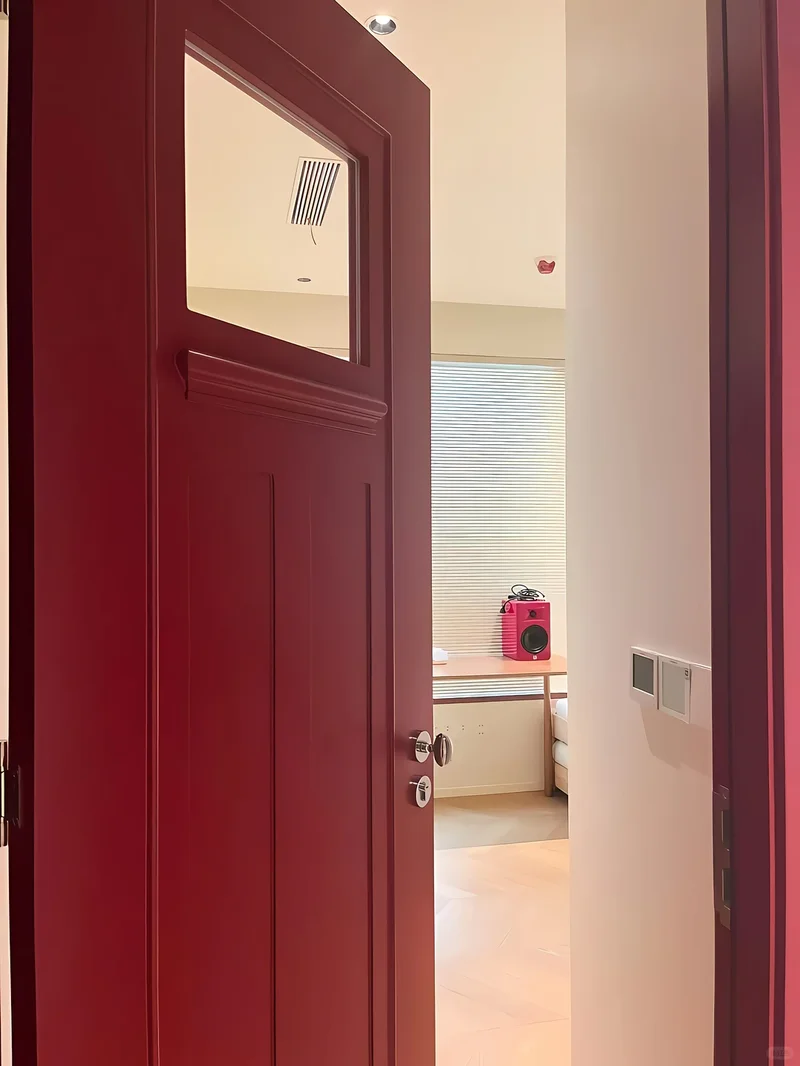
How effective are steel entry doors at sound insulation in dense residential complexes?
Premium steel entry doors achieve Rw 35–42 dB using constrained-layer damping, laminated WPC/steel construction, and triple perimeter seals. Doors with 45 mm+ thickness and mass-loaded vinyl interlayers meet ISO 140-3 standards—ideal for urban complexes near traffic or public zones requiring STC 40+ performance.
What PVC coating thickness and adhesion strength ensure durable weather resistance?
Protective PVC coatings on WPC substrates should be ≥180 µm thick (measured per ISO 2808) with peel adhesion ≥40 N/cm (ASTM D903). Co-extruded cap layers with TiO₂ (≥10%) and carbonyl inhibitors resist UV degradation; gloss retention ≥80% after 3,000 hrs QUV-A ensures 15+ year service life.
What structural reinforcement is required to prevent sagging in wide steel entry door assemblies?
Doors wider than 1,000 mm require internal LVL or aluminum C-channel reinforcement (≥60 mm depth, E ≥ 10,000 MPa) integrated into WPC stiles. Finite element analysis confirms deflection <L/500 under 1.2 kN/m² wind load—ensuring ANSI/DASMA 107 compliance and preventing hinge racking over 30-year design life.