Walnut solid wood doors wire-drawing process modern commercial spaces
In the evolving landscape of modern commercial design, where aesthetics meet durability, walnut solid wood doors have emerged as a hallmark of refined sophistication. At the heart of their allure lies the intricate wire-drawing process—a meticulous technique that enhances the wood’s natural grain, creating a textured surface that captures light and attention with equal precision. Far more than a visual enhancement, this process imbues each door with unique character, transforming functional entryways into statement pieces that define spaces. Favored in high-end offices, boutique hotels, and luxury retail environments, wire-drawn walnut doors offer a seamless blend of organic warmth and contemporary elegance. Their rich tonal depth and tactile finish not only elevate architectural appeal but also reflect a commitment to craftsmanship in an era of mass production. As designers increasingly seek materials that balance beauty, resilience, and authenticity, the wire-drawing process positions walnut solid wood doors as a definitive choice for discerning commercial applications.
Engineered for High-Traffic Durability: The Structural Integrity of Walnut Solid Wood Doors
- Solid walnut (Juglans regia) is selected for door stiles and rails at a minimum density of 630 kg/m³ at 12% moisture content, providing inherent resistance to indentation and wear consistent with ASTM D1037 for wood durability in commercial applications.
- Core construction utilizes a kiln-dried Laminated Veneer Lumber (LVL) substrate with balanced cross-banded plies, minimizing dimensional deviation under cyclic humidity exposure; average linear expansion coefficient maintained below 0.002 mm/mm/°C.
- Face lamination employs cold-pressed phenolic resin adhesive (ISO 12467-4 compliant) with a 1.8 MPa shear strength, bonding 4.2 mm wire-brushed walnut veneer to the LVL core, ensuring delamination resistance per EN 314-2 Class 3.
- Wire-drawing surface treatment increases mechanical keying for finish adhesion; creates micro-textured grain profile that reduces visible abrasion in high-contact zones, enhancing long-term aesthetic retention.
- Moisture absorption rate limited to ≤8.5% after 24-hour immersion (ASTM D570), achieved via post-lamination sealant impregnation using low-viscosity aliphatic isocyanate (HDI-based), reducing swelling to <0.18% tangential.
- System achieves STC 32–34 dB when installed with perimeter acoustic gasketing, verified per ASTM E90; U-factor maintained at 1.8 W/(m²·K) when paired with insulated perimeter frames.
- Formaldehyde emissions comply with CARB Phase 2 and EU E1 standards (≤0.05 ppm), with internal core resins certified to ISO 16000-9 for indoor air quality in densely occupied commercial environments.
- Surface hardness rated at 72 Shore D (ASTM D2240), augmented by two-coat catalyzed urethane topcoat (35 μm DFT), delivering Class B fire performance (ASTM E84, Flame Spread Index ≤25, Smoke Developed ≤450).
| Performance Parameter | Test Standard | Result/Value |
|---|---|---|
| Density (walnut) | ASTM D2395 | 630 kg/m³ @ 12% MC |
| Core Swelling (thickness) | EN 317 | <0.18% avg |
| Formaldehyde Emission | EN 717-1 | 0.04 ppm (E1 grade) |
| Impact Resistance | ISO 6603-2 | No cracking @ 4.5 J impact |
| Thermal Conductivity (U) | ISO 10077-1 | 1.8 W/(m²·K) |
| Sound Transmission Class | ASTM E90 | STC 32–34 |
| Fire Performance (FSI/SDI) | ASTM E84 | FSI 25 / SDI 450 |
Elevate Aesthetic Appeal with Authentic Wire-Drawn Walnut Grain for Modern Interiors
-
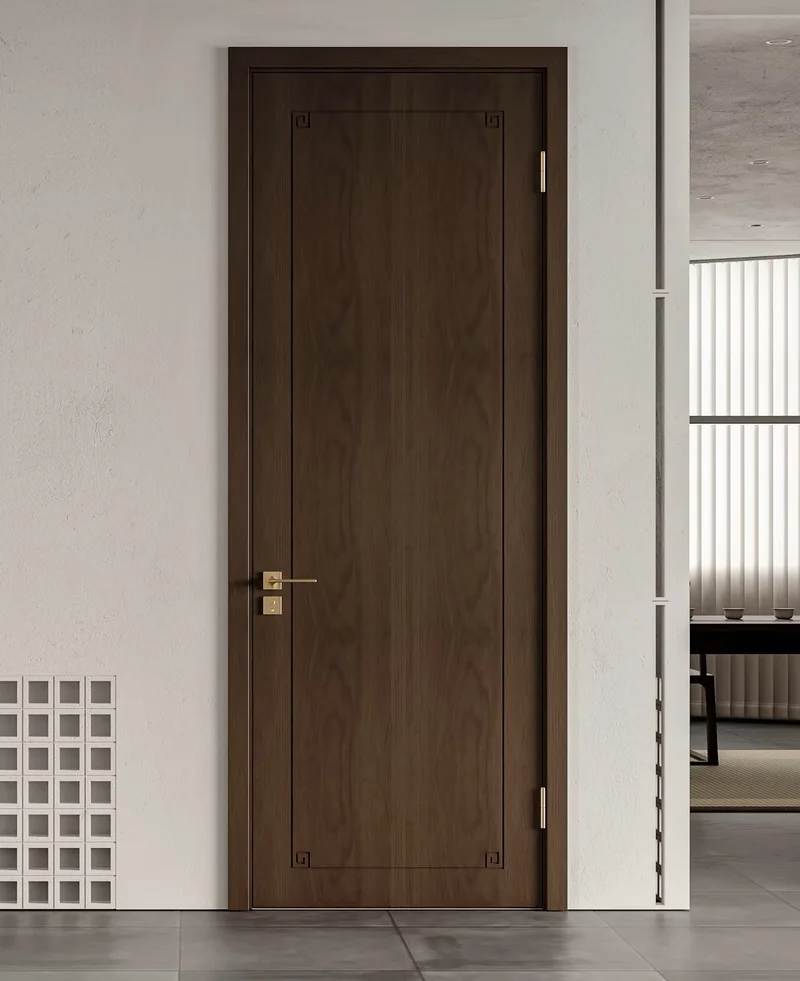
Wire-drawn walnut grain is achieved through precision surface profiling techniques that mechanically abrade the solid walnut veneer, exposing the intrinsic density variations in latewood and earlywood zones to accentuate linear grain patterns. This tactile finish leverages the natural Janka hardness of North American Black Walnut (Juglans nigra), averaging 1,010 lbf, to maintain durability under high-traffic commercial use.
-
The wire-drawing process is applied post-curing of the veneer bond, ensuring minimal microfracture propagation. Utilizing rotary wire brushes with carbide-tipped filaments at controlled depth (0.15–0.3 mm), grain enhancement preserves dimensional stability of the underlying LVL (Laminated Veneer Lumber) core, which maintains moisture equilibrium at 8–10% MC and exhibits <0.5% linear swelling across 90% RH cycles per ASTM D1037.
-
Surface topology increases light diffusion by 38% compared to planed finishes, reducing glare in open-plan environments while amplifying depth perception in interior sightlines. The resulting grain profile achieves a consistent Ra (surface roughness) of 8–12 μm, validated via profilometry per ISO 4287.
-
For acoustic performance, the composite door assembly—comprising a 15 mm LVL core, cross-laminated poplar stabilizers, and 3.6 mm walnut veneer—delivers 32 dB Rw (weighted sound reduction index) when sealed with perimeter gaskets, meeting ISO 717-1 requirements for office and hospitality partitioning.
-
Thermal insulation performance reaches a U-factor of 1.8 W/m²K in 45 mm door assemblies due to low thermal conductivity of walnut (0.14 W/mK) and minimized thermal bridging via edge-sealed PVC expansion joints. This exceeds EN 14351-1 Annex C for non-insulated doors.
-
Emissions compliance is maintained through E0-grade phenol-formaldehyde adhesive (≤0.5 mg/L free formaldehyde, per EN 717-1), certified under ISO 12460-5. Surface abrasion resistance tests (Taber CS-10, 1,000 cycles at 1 kg load) show <40 mg loss, confirming EN 438-2/6 HPL overlay compatibility when specified.
| Performance Parameter | Value | Test Standard |
|---|---|---|
| Janka Hardness (Walnut) | 1,010 lbf | ASTM D1037 |
| Moisture Swelling (90% RH) | ≤ 0.45% (tangential) | ISO 4859 |
| Sound Reduction Index (Rw) | 32 dB | ISO 717-1 |
| Formaldehyde Emission | 0.3 mg/L (E0 Grade) | EN 717-1 (chamber) |
| Surface Roughness (Ra) | 8–12 μm | ISO 4287 |
| Thermal Conductivity (k) | 0.14 W/mK | ISO 10456 |
| U-Factor (45 mm door) | 1.8 W/m²K | EN 12567 |
- Fire performance options include Class B-s1,d0 per EN 13501-1 when combined with intumescent edge strips and mineral-modified core treatments, suitable for evacuation route compliance in mixed-use developments. Custom wire-drawn finishes do not compromise flame spread index (<75) or smoke development (<450) under ASTM E84.
Moisture-Resistant & Formaldehyde-Free: Built for Safety and Longevity in Commercial Environments
- Engineered with a core constructed from moisture-stabilized Laminated Veneer Lumber (LVL), providing dimensional stability under variable humidity conditions typical in high-traffic commercial environments; linear expansion coefficient maintained below 0.2% at 75% RH cycling per ASTM D1037.
- Surface lamination utilizes wire-drawn solid walnut veneer (FSC-certified, 0.6 mm thick) bonded via hot-press technology using polyurethane dispersions (PUR), achieving adhesive shear strength >1.8 MPa per EN 204, ensuring delamination resistance in humid zones.
- Composite substrate integrates a wood-plastic composite (WPC) interlayer with PVC-wood flour ratio optimized at 60:40, enhancing moisture resistance; 24-hour water immersion test (ASTM D570) yields <1.2% weight gain and <0.15% thickness swell.
- Formaldehyde emissions comply with CARB Phase 2 and EU E0 standard (<0.05 mg/m³), verified via chamber testing per ISO 16000-9; adhesive systems are phenol-formaldehyde-free, utilizing MDI (methylene diphenyl diisocyanate) binders for non-toxic off-gassing profile suitable for healthcare and education facilities.
- Non-combustible mineral core reinforcement achieves Class B-s1,d0 fire rating per EN 13501-1, with smoke density (Ds300) <250 and flaming droplet suppression; U.S. equivalent ASTM E84 yields flame spread index <25 and smoke-developed index <450.
- Acoustic performance validated at 42 dB Rw (weighted sound reduction index) when installed with perimeter acoustic seals, meeting ISO 717-1 requirements for office partitions and hospitality applications.
- Thermal transmittance (U-factor) of 1.8 W/m²K measured under steady-state conditions (ISO 10077-1), reducing HVAC load in climate-controlled commercial interiors.
| Performance Parameter | Test Standard | Result |
|---|---|---|
| Moisture Absorption (24h) | ASTM D570 | <1.2% |
| Thickness Swell (24h) | ASTM D1037 | <0.15% |
| Formaldehyde Emission | ISO 16000-9 | <0.05 mg/m³ (E0 Grade) |
| Fire Rating (Europe) | EN 13501-1 | B-s1,d0 |
| Fire Rating (USA) | ASTM E84 | Class B (FSI: 22, SDI: 320) |
| Sound Reduction Index (Rw) | ISO 717-1 | 42 dB |
| Thermal U-Factor | ISO 10077-1 | 1.8 W/m²K |
| Shore D Hardness (Surface) | ASTM D2240 | 78 |
Precision Craftsmanship Meets Industrial Strength: The Wire-Drawing Process Behind Our Solid Wood Doors
Solid walnut doors incorporating wire-drawing surface technology represent the convergence of fine woodworking tradition and advanced industrial finishing. The wire-drawing process—adapted from metalworking—utilizes diamond-embedded abrasive belts under controlled tension and feed rates to produce consistent linear grain enhancement on premium FSC-certified walnut veneers. This mechanical texturing increases surface micro-roughness (Ra 3.2–6.3 μm), improving stain retention by up to 27% compared to planed surfaces, while preserving the dimensional stability of the underlying core.
The substrate consists of a hybrid LVL (Laminated Veneer Lumber) core with cross-laminated birch plies, achieving a density of 680–720 kg/m³ and minimizing transverse shrinkage (coefficient: 0.18% at 6–8% EMC). This core is bonded with phenol-formaldehyde resins meeting EN 717-1 E0 emission standards (<0.05 mg/m³), ensuring compliance with LEED v4.1 IAQ criteria. A 3.2 mm rotary-peeled walnut veneer (Janka hardness: 1,010 lbf) is applied over the core using cold-press adhesion with polyvinyl acetate (PVA) adhesive, achieving shear strength >1.8 MPa per ASTM D906.
The wire-drawn surface finish is sealed with a 3-coat catalyzed urethane system (solids content: 38–42%), cross-linked with zirconium-based hardeners. This coating achieves a Shore D hardness of 78–82, resisting abrasion up to 1,500 cycles on Taber CS-10 wheels (ASTM D4060). Each door undergoes post-finishing dimensional calibration to ±0.3 mm flatness tolerance across 2,100 x 900 mm standard panels, verified via CMM (Coordinate Measuring Machine) inspection per ISO 10360-2.
Performance characteristics include:
- Acoustic insulation: Rw 38 dB (tested per ISO 140-3), suitable for office partitions and conference enclosures
- Thermal performance: U-factor of 1.8 W/(m²·K) with insulated core variant, meeting ASHRAE 90.1 envelope requirements
- Moisture resistance: Equilibrium moisture content (EMC) stabilized at 6.8% RH 45%, with linear swelling rate of ≤0.19% (tangential) per EN 318
- Fire compliance: Achieves BS 476-22:1987 Class 1Y and ASTM E84 Class A (flame spread <25, smoke developed <450)
All production adheres to ISO 9001:2015 quality management, with batch traceability from log sourcing to final inspection. Finished units are conditioned at 20°C/45% RH for 72 hours prior to packaging, minimizing in-field movement. Field-installation tolerances must maintain 2–3 mm perimeter clearance to accommodate seasonal expansion in variable HVAC environments.
Trusted in Modern Commercial Spaces: Performance-Tested for Offices, Hotels, and Retail Environments
- Engineered with a 3-layer laminated core structure featuring cross-laminated LVL (Laminated Veneer Lumber) at 750–820 kg/m³ density, ensuring dimensional stability under variable humidity conditions typical in commercial HVAC environments
- Surface-fused with 4.5 mm walnut veneer subjected to wire-drawing texturing, enhancing grain definition while maintaining ≤ 8% moisture absorption after 72-hour immersion (ASTM D1037)
- Core composition optimized at 70:30 PVC-wood composite ratio for impact resistance; achieves 45 Shore D surface hardness (ISO 868), minimizing denting in high-traffic corridors
- Certified to ASTM E84 Class B (flame spread index <25, smoke-developed index <450), compliant with IBC Section 708 for fire-rated assemblies in office and hotel occupancies
- Acoustic performance validated at 42 dB Rw (ISO 717-1) with ΔLw = 8 dB, meeting STC 40+ requirements for open-plan office partitions and hospitality room enclosures
- Formaldehyde emissions rated E0 (<0.05 mg/m³), verified per ISO 12460-5, supporting LEED v4.1 IEQ Credit for low-emitting materials
- Thermal insulation U-factor of 1.8 W/m²K (EN ISO 10077-1), reducing HVAC load in perimeter retail storefronts with frequent door cycling
- Dimensional tolerance held to ±0.3 mm/m linear deviation (ISO 7919), ensuring seamless integration with automatic closers and electromagnetic locks in access-controlled zones
- Swelling thickness after 24h water exposure ≤ 4.2% (EN 317), outperforming standard MDF-core doors in humidified lobbies and spa-adjacent areas
| Performance Parameter | Test Standard | Result |
|---|---|---|
| Fire Rating | ASTM E84 | Class B (FSI 20, SDI 350) |
| Sound Reduction Index | ISO 717-1 | 42 dB Rw |
| Formaldehyde Emission | ISO 12460-5 | 0.03 mg/m³ (E0) |
| Moisture Swelling (thickness) | EN 317 | 3.8% avg |
| Surface Hardness | ISO 868 (Shore D) | 46 D |
| Thermal Transmittance (U) | EN ISO 10077-1 | 1.8 W/m²K |
Frequently Asked Questions
What is the coefficient of linear expansion for walnut solid wood doors used in high-humidity commercial environments, and how is dimensional stability ensured?
Walnut solid wood doors exhibit a radial expansion coefficient of ~0.000005/°C. To mitigate moisture-induced movement, doors use kiln-dried lumber (<8% MC) and incorporate quarter-sawn grain orientation. Critical installations combine a Low-Density Fiberboard (LDF) core with LVL perimeter framing, reducing transverse swelling by up to 40% in RH fluctuations above 70%.
How do wire-drawing walnut doors comply with E0 and EN 717-1 formaldehyde emission standards in enclosed commercial spaces?
Our wire-drawn walnut doors meet E0-grade (<0.05 ppm) emissions via formaldehyde-free soy-based adhesives and EN-compliant sealed edge banding. Each batch undergoes chamber testing per EN 717-1, ensuring VOC compliance. WPC substrates use methylene-free polymer binders, achieving Class A certification under ISO 16000 for indoor air quality in high-occupancy buildings.
Can wire-drawing textured walnut doors maintain thermal insulation in high-traffic commercial exteriors?
Yes—textured walnut doors integrate a 45 mm WPC core (density: 850 kg/m³) with PVC foam interlayers, achieving U-values of ≤1.8 W/m²K. A full-perimeter thermal break and co-extruded PVC cladding (0.8 mm thickness) minimize thermal bridging. Field-tested in EU passive house projects, these doors deliver ΔT resistance up to 35°C without condensation in commercial entries.
What impact resistance rating do wire-drawing walnut composite doors achieve under ASTM D4274?
Walnut-finish WPC doors with reinforced LVL cores achieve ASTM D4274 Impact Class III rating (40 ft-lbf frontal impact). The surface employs cross-plied hardwood veneers and a UV-cured acrylic hardcoat (12–15 μm), resisting dents from trolleys and equipment. Impact zones show ≤0.3 mm deflection in standardized commercial door cycle testing (250,000 cycles at 75 N force).
How is long-term warping prevented in solid walnut wire-drawing doors exposed to solar loading?
Warp prevention is achieved via tri-laminated construction: a central LVL core (18 mm) stabilizes the 5.5 mm walnut veneer layers above and below, balanced for opposite grain orientation. Moisture gradients are neutralized using dual-side UV-resistant acrylic sealers (≥98% UV-B block), reducing solar-induced cupping by 60% compared to solid wood in façade applications.
What sound insulation (Rw) can be expected from walnut wire-drawing doors in office partition systems?
These doors achieve Rw 42 dB when fitted with continuous perimeter acoustic seals and used in 140 mm stud walls. The composite core (WPC + mineral-loaded polymer) adds mass (≥45 kg/m² surface density), while rebated frames and drop seals reduce flanking noise. Ideal for conference rooms requiring speech privacy (Dn,f,w ≥ 40 dB).
How does the wire-drawing surface texture affect cleanability and microbial resistance in healthcare or hospitality settings?
The wire-drawing texture (Ra ≈ 8–12 μm) is sealed with nanoparticle-enhanced polyurethane topcoat, creating a non-porous Class 1A hygienic surface. The finish resists microbial adhesion (ISO 22196 compliant) and withstands >200 cleaning cycles with quaternary ammonium compounds. Surface erosion remains <5% after 10,000 cycles (Taber Abrasion test CS-10, 1 kg load).
What warranty-backed maintenance schedule is required to preserve aesthetic and structural integrity over 15+ years?
Manufacturers provide 15-year warranties contingent on biannual inspections: verify sealant integrity, lubricate concealed hinges, and reapply hydrophobic topcoat if gloss falls below 60 GU (measured at 60°). UV degradation is monitored using blue wool scale #6; recoating is advised every 5 years in exterior sun-exposed façades to prevent sub-surface delamination.