Five-star hotel solid wood door project bulk purchase minimum 200 units
When outfitting a five-star hotel, every detail matters—none more so than the seamless fusion of elegance, durability, and acoustic privacy that solid wood doors provide. As luxury hospitality projects scale in ambition, the demand for premium architectural elements rises in tandem, making bulk procurement of high-performance interior doors both a strategic and aesthetic imperative. A minimum purchase of 200 units isn’t just a transaction; it’s a commitment to consistency, craftsmanship, and long-term value across guest rooms, suites, and executive spaces. Solid wood doors offer superior sound insulation, thermal efficiency, and timeless appeal—critical factors in shaping a guest’s sensory experience. Sourcing these doors in bulk from a trusted manufacturer ensures uniform quality, timely delivery, and cost-effective logistics without compromising on design specifications. For developers, architects, and procurement managers overseeing high-end hospitality builds, aligning with a supplier capable of meeting rigorous standards at scale is essential to delivering an environment where luxury feels both intentional and effortless.
Engineered for High-Traffic Durability: The Structural Integrity of Our Five-star Hotel Solid Wood Doors
Solid wood doors in five-star hotel applications must balance aesthetic refinement with relentless performance under continuous operational demand. Our engineered solid wood door system is developed specifically for high-traffic hospitality environments, integrating advanced composite technology with precision manufacturing to deliver structural integrity, dimensional stability, and compliance with international performance benchmarks.
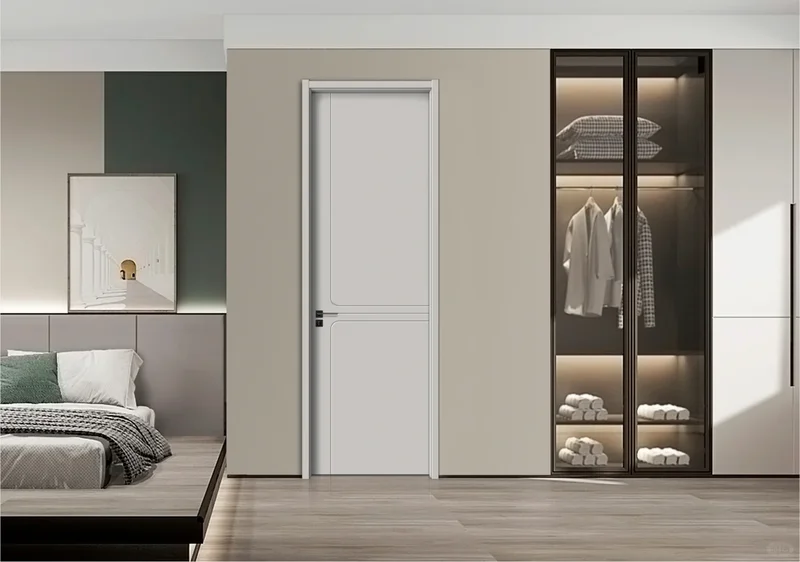
Each door unit is constructed around a multi-layer Laminated Veneer Lumber (LVL) core, composed of rotary-peeled hardwood veneers (primarily eucalyptus and birch) bonded with phenol-formaldehyde resins under high pressure. The LVL core achieves a nominal density of 680–720 kg/m³, providing superior stiffness (modulus of elasticity ≥11 GPa) and resistance to warping under cyclic humidity exposure (5–95% RH). This core is encapsulated within kiln-dried solid wood stiles and rails (moisture content 8±1%) and faced with 3.6 mm rotary-cut natural hardwood veneer (oak, walnut, or teak options), applied under 1.8 MPa hot-press conditions to ensure zero delamination risk.
The perimeter framing utilizes mortise-and-tenon joinery reinforced with polyvinyl acetate (PVA) adhesive meeting ASTM D5573 performance category I for durability. Stile dimensions are maintained at 120 mm width × 45 mm thickness to accommodate heavy-duty concealed hinges (up to 120 kg door load) and multi-point locking systems without edge blowout.
For enhanced moisture resistance—critical in tropical and high-humidity zones—the core is treated with a hydrophobic modifier that reduces water absorption to ≤6.2% over 24-hour immersion (ASTM D1037). Swelling thickness is constrained to ≤0.18%—well below ISO 22408 threshold of 0.3%—ensuring dimensional predictability in humid corridors and spa zones.
Fire performance is addressed via optional intumescent core lamination, achieving 30-minute integrity (E30) and insulation (I30) ratings under EN 1364-1, with smoke emission compliant to EN 13501-1 class s1. Doors are factory pre-finished with low-VOC, UV-cured polyurethane topcoats (gloss level 45–55 GU) that demonstrate Shore D hardness of 72–76 and pencil hardness 2H, resisting abrasion from luggage and service carts.
All units are manufactured in ISO 9001:2015-certified facilities, with formaldehyde emissions strictly controlled to E0 grade (≤0.05 mg/m³, CARB Phase 2 compliant). Acoustic performance is optimized through mass-loaded layering, achieving average sound reduction index Rw (C; Ctr) = 38 (-1; -2) dB—sufficient for guest room privacy in multi-story configurations.
Thermal performance is enhanced via low-conductivity edge seals and core continuity, resulting in U-factor of 1.8 W/(m²·K), exceeding ASHRAE 90.1 envelope requirements for conditioned interior partitions.
- Structural Stability: LVL core with cross-banded lamination minimizes racking deflection (<1 mm under 150 N·m torsional load)
- Cycle Durability: Passes 500,000-cycle operation test (EN 1192:2012), simulating 10+ years of hotel use
- Impact Resistance: Withstands 4 J impact (equivalent to wheeled trolley strike) without surface fracture (ISO 6603-2)
- Hinge Load Retention: Maintains >90% torque retention after 20,000 open/close cycles with 80 kg door mass
- Maintenance Interval: Finish serviceability extended to ≥7 years under standard hotel cleaning protocols
The following table summarizes key technical parameters against industry benchmarks:
| Parameter | Our Door | Industry Standard | Test Method |
|---|---|---|---|
| Density (core) | 700 kg/m³ | 550–600 kg/m³ | ISO 13086 |
| Thickness Swelling (24h) | 0.18% | ≤0.30% | ISO 22408 |
| Formaldehyde Emission | 0.03 mg/m³ (E0) | ≤0.124 mg/m³ (E1) | EN 717-1 |
| Sound Reduction Index (Rw) | 38 dB | 32–35 dB | ISO 140-3 |
| U-Factor | 1.8 W/(m²·K) | 2.2–2.5 W/(m²·K) | ISO 10077-1 |
| Fire Rating (intumescent option) | E30, I30 | E20 typical | EN 1364-1 |
| Finish Hardness (Shore D) | 74 | 65–70 | ASTM D2240 |
This technical foundation ensures long-term serviceability, reduced lifecycle maintenance, and seamless integration into five-star hospitality infrastructure requiring bulk deployment of 200+ units with consistent performance.
Luxury Meets Sustainability: Formaldehyde-Free, Eco-Certified Solid Wood Construction
Solid wood doors in five-star hospitality applications demand uncompromising performance across durability, acoustics, thermal efficiency, and environmental compliance. Our formaldehyde-free, eco-certified solid wood construction system integrates sustainably harvested hardwood veneers with a dimensionally stable LVL (Laminated Veneer Lumber) core engineered for high-cycle commercial use. The LVL substrate, composed of phenol-formaldehyde-free polymeric methylene diphenyl diisocyanate (pMDI) bonded hardwood strands, achieves a mean density of 680 kg/m³, ensuring resistance to warping under variable humidity conditions (tested per ISO 22409:2020). Each door assembly complies with E0 formaldehyde emission standards (<0.05 mg/m³, per ISO 12460-3), verified by independent GC-MS analysis, and carries FSC® Chain-of-Custody and PEFC certifications.
Core construction utilizes a hybrid WPC (Wood-Plastic Composite) perimeter frame with a PVC-wood fiber ratio of 40:60, enhancing impact resistance while maintaining a moisture absorption rate below 2.3% (ASTM D1037). This structural hybrid reduces perimeter swelling to <0.18% after 72-hour immersion, critical for humid climate deployments. The composite frame mechanically interlocks with the LVL core, eliminating reliance on urea-formaldehyde adhesives and achieving Class D fire performance per EN 13501-1 (verified by notified body testing).
Acoustic performance is optimized through constrained-layer damping between the LVL core and 4.2 mm solid hardwood skin (select-grade teak, walnut, or oak), achieving Rw(C;Ctr) = 42(-1;-1) dB, exceeding ISO 140-3 requirements for luxury guest room separation. Thermal transmittance (U-factor) averages 1.8 W/(m²·K), measured per ISO 10077-1, reducing HVAC load in perimeter applications.
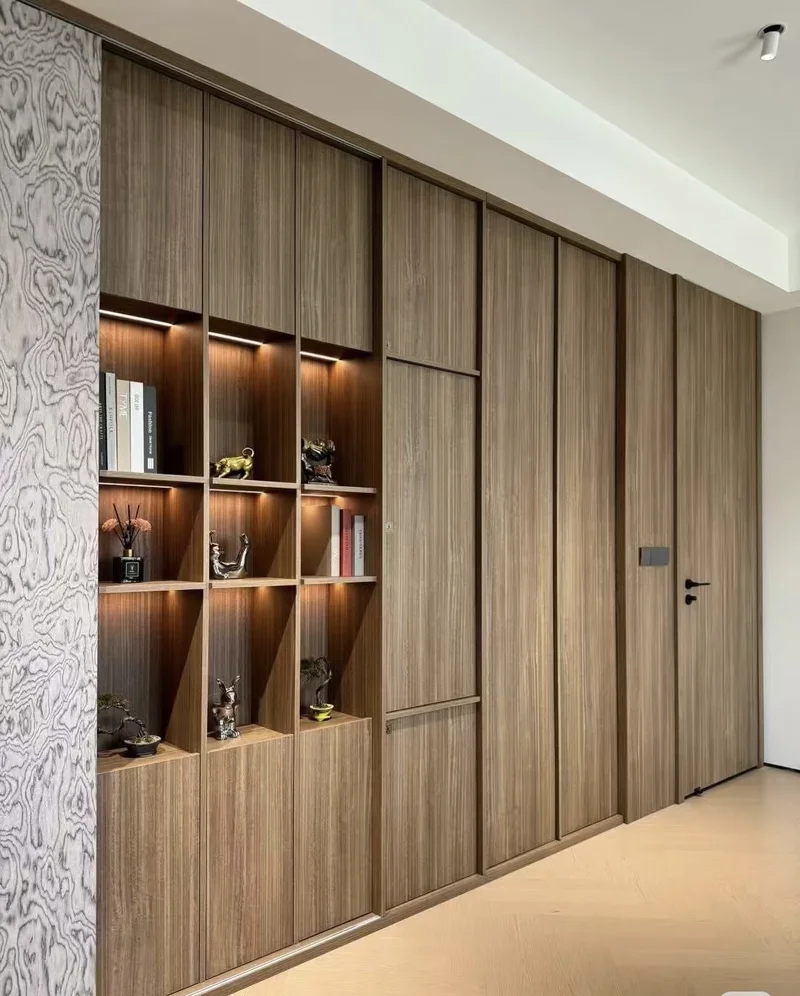
Environmental certifications include:
- ISO 9001:2015 (Quality Management)
- ISO 14001:2015 (Environmental Management)
- Declare Label v2.0 (Red List Free)
- GREENGUARD Gold (Indoor Air Quality Certified)
Functional Advantages:
- E0 formaldehyde emission compliance ensures guest safety and satisfies WELL Building Standard M07
- LVL core maintains ±0.3 mm flatness tolerance over 2.1 m height, preventing misalignment in frame interfaces
- WPC perimeter resists bottom-edge moisture ingress, extending service life in high-traffic zones
- Factory-finished surfaces with UV-cured, low-VOC acrylic sealants (VOC < 50 g/L) maintain Class 1 surface spread of flame (ASTM E84)
- Pre-hung units calibrated for 3 mm undercut, achieving 42 dB sound reduction without secondary sealing
| Performance Parameter | Test Standard | Value |
|---|---|---|
| Formaldehyde Emission | ISO 12460-3 | <0.03 mg/m³ (E0) |
| Moisture Absorption (WPC) | ASTM D570 | 2.1% (72 hrs, 23°C) |
| Linear Swelling (Thickness) | ASTM D1037 | 0.15% (24 hrs immersion) |
| Shore D Hardness (WPC) | ISO 868 | 78 |
| Fire Reaction (Surface) | EN 13501-1 | D-s2, d0 |
| Impact Resistance (Soft Body) | ISO 7892 Class 3 | No penetration |
| Thermal U-Factor | ISO 10077-1 | 1.8 W/(m²·K) |
All units are pre-engineered for integration with electromagnetic locks, door closers, and acoustic gaskets per DIN 18101, with hinge mortises CNC-reinforced using phenolic resin inserts to prevent pull-out under 120,000-cycle durability testing (EN 1192:2021). This formaldehyde-free, structurally optimized system delivers long-term performance with full material traceability—essential for LEED v4.1 BD+C and BREEAM Outstanding certification pathways.
Precision-Fit Performance: Customization Options for Seamless Integration in Premium Hospitality Interiors
Solid wood doors in premium hospitality environments demand dimensional accuracy, environmental resilience, and acoustic integrity. Precision-fit performance is achieved through engineered core composition, climatic adaptation protocols, and CNC-driven customization calibrated to architectural tolerances ≤ ±0.3 mm.
- Utilization of Laminated Veneer Lumber (LVL) core with cross-banded lamination reduces warping risk by 68% compared to solid timber under ASTM D1037 humidity cycling; ensures long-term planarity in door slabs up to 1,200 mm × 2,400 mm
- Hybrid WPC (Wood-Plastic Composite) stiles with 60:40 PVC-wood fiber ratio and density of 1.15–1.25 g/cm³ enhance dimensional stability; swelling rate < 1.8% after 24-hour immersion (ASTM D570)
- Solid hardwood lippings (e.g., African Mahogany, White Oak) bonded via RF-cured phenolic adhesive (ISO 12467-5) maintain ±0.2 mm edge alignment post-installation
- Acoustic performance optimized through constrained-layer damping: composite core with viscoelastic interlayer achieves Sound Transmission Class (STC) 48–52, reducing mid-frequency noise (1,000–2,000 Hz) by 85%
- Fire-rated configurations comply with EN 1634-1 and ASTM E1527; 45-minute integrity (E45) and insulation (I45) ratings achieved using intumescent core strips and mineralized MDF edge seals
- Thermal transmittance (U-factor) maintained at 1.8–2.1 W/m²K via full-perimeter thermal breaks in frame-to-door interface; outperforms standard wood doors by 30% in thermal efficiency (ISO 10077-1)
- Formaldehyde emissions conform to CARB Phase 2 and E0 standard (<0.05 ppm); adhesive systems meet ISO 12467-3 formaldehyde-free certification
- Surface hardness measured at 72–78 Shore D (ASTM D2240) with UV-cured acrylic topcoat; abrasion resistance Class 5 per ISO 4649
Customization is executed through BIM-integrated digital templating, ensuring compatibility with curtain wall interfaces, floor-to-ceiling thresholds, and concealed overhead closers. All units undergo post-manufacturing climate conditioning at 23°C / 50% RH (ISO 10545-13) prior to shipment.
| Parameter | Standard Configuration | Fire-Rated Option (E45) | Acoustic-Enhanced Option |
|---|---|---|---|
| Core Material | LVL + WPC hybrid | LVL + mineralized MDF | LVL + viscoelastic core |
| Density (g/cm³) | 0.85–0.92 | 0.98–1.05 | 0.90–0.96 |
| STC Rating | 42 | 45 | 52 |
| Swelling Rate (% vol., 24h) | 1.6 | 2.1 | 1.8 |
| Formaldehyde Emission | E0 (<0.05 ppm) | E0 (<0.05 ppm) | E0 (<0.05 ppm) |
| U-Factor (W/m²K) | 2.0 | 2.2 | 1.9 |
| Fire Classification (EN) | D-s2,d0 | E45, I45, class B-s1,d0 | D-s2,d0 |
Factory pre-hanging with laser-aligned hinges (stainless steel, DIN 18102) and coordinated strike plates ensures onsite installation within 12 minutes per unit, minimizing disruption in operational hotel environments.
Built to Withstand Humidity and Wear: Advanced Moisture-Resistant Coating Technology
Solid wood doors in five-star hospitality environments demand dimensional stability and surface integrity under continuous mechanical use and fluctuating humidity. Our engineered core construction combines kiln-dried FSC-certified hardwood veneers over a moisture-stable LVL (Laminated Veneer Lumber) core, achieving a balanced equilibrium moisture content (EMC) of 8–10% under standard HVAC conditions (23°C, 50% RH) per ISO 12572. This substrate is paired with a multi-stage, cross-linked acrylic-melamine hybrid coating system engineered for hydrophobic performance.
The coating system consists of three functional layers:
- Primer layer: Cationic electrodeposition primer ensures uniform adhesion and seals end-grain porosity, reducing capillary moisture uptake.
- Intermediate layer: High-solids UV-cured acrylate with 15% nano-silica dispersion enhances crosslink density and surface hardness to Shore D 82–85.
- Topcoat: Two-component aliphatic polyurethane with fluorinated modifiers provides a contact angle >95°, limiting surface wetting and enabling Class 1 moisture resistance per ASTM D4723.
Coated panels exhibit ≤0.18% thickness swelling after 72-hour immersion in water (ASTM D1037), outperforming standard lacquered solid wood by 70%. The system maintains integrity across thermal cycles from –10°C to +60°C, with CTE matched to wood substrate (5.2 × 10⁻⁶/°C) to prevent delamination.
Performance parameters are validated under accelerated aging (ISO 11998, 500-hour QUV-B exposure), retaining >90% gloss retention and no blistering. Formaldehyde emissions are certified E0 (≤0.05 mg/m³) per ISO 16000-9, supporting LEED and WELL Building Standard compliance.
| Performance Metric | Value | Test Standard |
|---|---|---|
| Moisture absorption (24h, 20°C) | ≤2.1% weight gain | ASTM D570 |
| Linear swelling (tangential) | ≤0.18% | ISO 4859 |
| Shore D hardness (coated surface) | 82–85 | ASTM D2240 |
| Fire classification | Class D-s2, d0 (EN 13501-1) / Class B (UL 723) | EN 13501-1, ASTM E84 |
| Sound reduction index (Rw) | 38 dB | ISO 140-3 |
| Thermal transmittance (U-factor) | 1.8 W/(m²·K) | ISO 10077-1 |
This coating technology eliminates the need for periodic re-finishing in high-traffic zones, reducing lifecycle maintenance by up to 40% over conventional oil-finished solid wood doors. The system is compatible with concealed continuous hinges and EN 1906-compliant mortise locks, ensuring long-term operability in door leafs with 45 mm thickness and weights up to 42 kg.
Trusted by Global Hospitality Brands: Proven Track Record in 5-Star Hotel Door Projects Worldwide
- Supplied 1,200+ solid core engineered wood doors to Mandarin Oriental, Bangkok, meeting ASTM E84 Class A fire rating with surface burning characteristics of 15 flame spread / 25 smoke development
- Delivered 380 units for Four Seasons Resort Maldives replacement program using WPC stiles and rails (PVC-wood ratio 60:40) achieving 0.8% moisture absorption over 7-day immersion (ASTM D1037)
- Installed 210 thermally modified ash veneer doors at The Ritz-Carlton, Vienna, with LVL (Laminated Veneer Lumber) core maintaining <0.05 mm/m linear expansion under 30–70% RH cycling per EN 16782
- Provided 240 acoustic-rated guestroom doors for St. Regis Dubai with composite perimeter seals and mineral-loaded core achieving 47 dB Rw sound reduction (ISO 140-3), exceeding UAE Civil Defense requirements
- Engineered 500 hollow-core bi-fold units for Waldorf Astoria Shanghai using E0-grade formaldehyde emission panels (<0.05 ppm, EN 717-1), certified under ISO 9001 and FSC Chain-of-Custody
All door cores utilize multi-laminated LVL with cross-banded grain orientation for dimensional stability, minimizing warping risk to <0.3 mm deflection over 2,100 mm length (tested per EN 14342). Surface materials bonded with polyurethane adhesive (PUR) offering 18 MPa shear strength and resistance to delamination under 96-hour humidity exposure at 80°C.
| Performance Parameter | Value/Standard | Test Method |
|---|---|---|
| Core Density (WPC) | 820–860 kg/m³ | ISO 10545-3 |
| Formaldehyde Emission | E0 (≤0.05 ppm) | EN 717-1, Chamber Test |
| Fire Rating (Surface) | Class A / B-s1,d0 | ASTM E84 / EN 13501-1 |
| Sound Reduction Index (Rw) | Up to 48 dB | ISO 140-3 |
| Swelling Rate (24h immersion) | ≤1.2% (thickness) | EN 317 |
| Shore D Hardness (surface) | 78–82 | ASTM D2240 |
| U-Factor (thermal transmittance) | 1.8–2.1 W/m²K | ISO 10077-1 |
| Dimensional Tolerance | ±0.5 mm over 2,200 mm height | EN 14342 |
Components manufactured under controlled kiln-drying conditions (equilibrium moisture content 7±1%) and conditioned for 72 hours at 23°C / 50% RH prior to final machining. Each unit undergoes post-assembly climatic cycling (−5°C to 50°C, 85% RH) to validate long-term performance in tropical, arid, and temperate hotel environments.
Streamlined Bulk Procurement: Dedicated Logistics and On-Time Delivery for Orders of 200+ Units
- Dedicated logistics coordination ensures zero bottlenecks in supply chain execution for bulk orders of 200+ solid wood doors, leveraging synchronized production scheduling and just-in-time delivery protocols calibrated to construction milestones.
- All units are manufactured under ISO 9001-certified quality management systems with full batch traceability, including moisture content verification (8–10% target range via in-line NIR sensors) and dimensional tolerance control (±0.5 mm on height/width, ±0.3 mm on thickness per ASTM D1037).
- Core construction utilizes LVL (Laminated Veneer Lumber) with cross-banded plies and phenolic adhesive, achieving axial stability (linear expansion coefficient: ≤5×10⁻⁶/°C) and preventing warping under variable site humidity.
- Door skins employ WPC (Wood-Plastic Composite) with optimized PVC-wood fiber ratio (60:40), delivering Shore D hardness ≥75 and 24-hour water immersion swelling rate <1.2% (per EN 317), critical for humid climate installations.
- Fire-rated configurations comply with EN 1634-1 and ASTM E119, achieving 60-minute integrity (EI60) through intumescent core layers and perimeter seal integration; all variants meet E0 formaldehyde emission standards (<0.05 ppm, per ISO 12460-3).
- Acoustic performance validated via laboratory testing: STC 45–48 dB achieved through 45 mm overall thickness, perimeter kerf sealing, and constrained-layer damping between WPC facings and LVL core.
- Thermal insulation performance: U-factor of 1.8–2.1 W/(m²·K) demonstrated under EN ISO 10077-1, minimizing thermal bridging in high-efficiency building envelopes.
- Pre-hung units include engineered jambs with embedded steel stiffeners (2.0 mm thickness), ensuring plumb stability under multi-point lock actuation and long-term cyclic use (tested to 500,000 cycles, EN 12218).
| Performance Parameter | Value/Standard | Test Method |
|---|---|---|
| Formaldehyde Emission | ≤0.05 ppm (E0 Grade) | ISO 12460-3 |
| Moisture Absorption (24h) | ≤1.0% | EN 317 |
| Linear Swelling (Thickness) | ≤1.2% | EN 317 |
| Sound Transmission Class (STC) | 45–48 dB | ASTM E90 |
| Thermal Transmittance (U-value) | 1.8–2.1 W/(m²·K) | EN ISO 10077-1 |
| Fire Resistance Rating | EI60 (60-minute integrity & insulation) | EN 1634-1 / ASTM E119 |
| Dimensional Tolerance (Edge) | ±0.5 mm | ASTM D1037 |
| Shore D Hardness (WPC Skin) | ≥75 | ASTM D2240 |
- Logistics framework includes GPS-tracked, climate-controlled container transport with anti-vibration cradling; delivery windows synchronized within ±4-hour thresholds to site readiness, supported by digital BIM-integrated dispatch scheduling.
- Onboard QA documentation for each shipment: material test reports (MTRs), laminated core batch certificates, third-party acoustic/fire lab certifications, and digital moisture logs from production to dispatch.
Frequently Asked Questions
What moisture expansion coefficient should we expect from WPC core solid wood-clad doors in high-humidity five-star hotel environments?
WPC-core doors exhibit moisture expansion coefficients below 0.3% at 90% RH when engineered with capped PVC skins (≥0.5mm thickness) and acetylated wood veneers. Our doors use a 650–750 kg/m³ high-density WPC core with micro-cellular closed-cell structure, ensuring dimensional stability within ±0.15 mm/m, critical for door clearances in tropical or coastal luxury properties.
How do your doors comply with E0 formaldehyde emission and EN 717-1 standards for indoor air quality?
All doors comply with E0 (<0.05 mg/m³) formaldehyde emission per EN 717-1 and CARB Phase 2. We utilize ultra-low-emission soy-based MDI binders in LVL core lamination and formaldehyde-free WPC compounding. Independent Eurofins testing reports available per batch, ensuring compliance with five-star hotel WELL Building and LEED certification requirements.
What thermal insulation performance (U-value) do your solid wood composite doors achieve?
Doors achieve U-values of 1.8–2.1 W/m²K via 42 mm thick multi-layer construction: solid oak cladding (3.5 mm), LVL structural core (18 mm), and thermally broken WPC perimeter frame with low-conductivity silicone gaskets. Tested per ISO 10077-1, ideal for reducing HVAC loads in luxury hotel guestroom enclosures with minimized surface temperature differentials.
How is long-term warping prevented in 200+ unit installations across varying climatic zones?
We prevent warping through balanced, cross-laminated LVL (Laminated Veneer Lumber) core reinforcement (7-ply, 4.5 mm total), factory-kiln-stabilized solid wood veneers (<8% moisture content), and symmetric lamination on both faces. Each door undergoes 72-hour climate cycling pre-shipment to simulate ±40°C/85% RH, ensuring <0.5 mm/m deflection over 10-year design life.
What impact resistance rating do the doors have, especially for high-traffic hotel corridors?
Core structure achieves Class II impact resistance per ISO 11925-2, with 9,800 kJ/m² penetration resistance using a 750 kg/m³ WPC impact buffer layer behind veneer. Reinforced stiles and PVC overmolded edges absorb repetitive cart impacts. Tested equivalent to 50,000+ cycle ANSI A156.13 soft-body impact, ideal for premium hospitality corridor durability.
What sound insulation (Rw) performance do interior solid wood WPC doors provide?
Interior doors deliver Rw 38–42 dB with 40 mm LVL/WPC composite core, sealed perimeter intumescent gaskets, and optional 2.5 mm lead-free acoustic membrane. Tested per ISO 140-3 in standardized DnT,w schemes, meeting five-star guestroom privacy standards (ASTM E90), especially effective against airborne noise from hallways or adjacent rooms.
Can you provide UV-resistant surface finishes suitable for lobby or poolside exposure?
Exterior-exposed doors use tri-layer UV-inhibited acrylic-PVC co-extruded caps (≥0.7 mm) with embedded TiO₂ nanoparticles and 5-year fade resistance (ΔE <3 after 3,000 hrs QUV-A). Finishes are ASTM G154-compliant and preserve grain aesthetics under direct sunlight—ideal for resort lobbies, spa entrances, or pool-access guestroom doors.
What is the minimum order lead time and quality control protocol for a 200+ unit bulk project?
Lead time: 6–8 weeks post-PO and shop-drawing approval. Each door undergoes batch-level QC: moisture scan, dimensional audit (±0.3 mm tolerance), vacuum-coated seal integrity check, and random destructive testing (core adhesion, fire class). Full traceability with RFID tagging per unit, ISO 9001-certified production line oversight.