High-end residential solid wood door project oak/walnut personalized customization
In the realm of high-end residential design, the entry door serves as a profound first statement—a silent ambassador of the home’s character and the homeowner’s discernment. Our bespoke solid wood door projects, crafted from select oak and walnut, transcend mere functionality to become heirloom-quality art. Each piece is a collaboration, where the inherent nobility of these fine hardwoods meets unparalleled personalization. From the bold, linear grain of oak to the rich, deep chocolate tones of walnut, every choice—from finish and panel design to hardware integration—is meticulously tailored. This is where enduring craftsmanship converges with individual vision, creating not just an entrance, but a definitive signature of luxury and timeless style for your most personal space.
Elevate Your Home’s Aesthetic and Value with Bespoke Solid Wood Doors
Bespoke solid wood doors are engineered not merely as entryways but as integrated architectural components that enhance structural performance, occupant comfort, and long-term asset value. The selection of premium oak (Quercus spp.) or walnut (Juglans spp.), combined with precision manufacturing, yields a product where material integrity and technical specification are paramount.
Material Science & Core Construction
The performance foundation lies in the engineered core and solid wood substrates. We utilize cross-laminated LVL (Laminated Veneer Lumber) cores for dimensional stability, mitigating the stress and warping inherent in wide solid wood panels. This core is laminated with full-thickness, book-matched oak or walnut veneers (typically 6mm+) to achieve a monolithic solid wood appearance. Adhesive systems are formaldehyde-free (E0 grade per JIS A 1460/EN 717-1) and exceed ASTM D 3434 standards for wood bonding.
Technical Performance Specifications
Our doors are certified to meet or exceed international standards for critical performance criteria.
| Performance Category | Standard / Metric | Specification | Benefit |
|---|---|---|---|
| Structural & Durability | Density (Core) | ≥ 650 kg/m³ | Ensures screw-holding power, hinge longevity, and impact resistance. |
| Shore D Hardness (Face) | Oak: 70-75, Walnut: 65-70 | Quantifies surface resistance to denting and wear in high-traffic areas. | |
| Dimensional Stability (Swelling) | ≤ 1.2% thickness swell (24h water immersion, EN 317) | Predicts performance in variable humidity, critical for kitchen/bathroom applications. | |
| Environmental & Safety | Formaldehyde Emission | E0 Grade (<0.05 ppm) | Ensures superior indoor air quality (IAQ) for occupant health. |
| Fire Rating | Class B-s2, d0 (EN 13501-1) / 20-min Fire Door (ASTM E84) | Provides compartmentalization and meets residential code requirements. | |
| Acoustic & Thermal | Sound Reduction (Rw) | 32-37 dB (Ctr) (EN ISO 10140-2) | Significantly attenuates airborne noise, enhancing privacy and tranquility. |
| Thermal Insulation (U-Factor) | 1.2 – 1.5 W/(m²·K) | Improves building envelope efficiency, reducing energy transfer. |
Architectural & Functional Advantages
- Custom Engineering for Microclimates: Each door is conditioned to a equilibrium moisture content (EMC) specific to the project’s geographic region, with moisture absorption rates engineered below 8% for humid climates (≥70% RH).
- Integrated Performance: Pre-hung systems feature full-perimeter magnetic seals and adjustable thresholds, achieving an air infiltration rating of ≤ 0.3 cfm/ft² (ASTM E283) for superior draft and dust exclusion.
- Long-Term Value Preservation: The use of UV-cured, catalyzed varnish or oil finishes with a cross-linked polymer structure provides a wear layer with exceptional resistance to solvents, abrasion (≥1000 cycles, EN 15186), and UV degradation, maintaining aesthetic integrity for decades with minimal maintenance.
Project Assurance
All manufacturing processes are governed under an ISO 9001:2015 quality management system, with full traceability from rough lumber to finished assembly. This ensures that every bespoke door delivers not only on aesthetic vision but on the precise technical parameters required for high-performance residential construction.
Tailored to Your Vision: Unmatched Personalization in Oak and Walnut Finishes
The core of a high-end solid wood door is its engineered stability. We utilize a multi-layered, cross-laminated LVL (Laminated Veneer Lumber) core, pressure-bonded with E0-grade (<0.05 ppm formaldehyde) phenolic resin. This construction provides a dimensional stability coefficient of <0.1% under 65%±5% RH, eliminating warping and ensuring a perfect fit within architectural tolerances over time.
The premium oak and walnut veneers are sourced from managed forests and are precision-sliced to a consistent 0.6mm thickness. They are then laminated to a high-density WPC (Wood-Plastic Composite) substrate using a proprietary hot-press process. This WPC substrate, with a density of 1.25 g/cm³ and a PVC-wood fiber ratio of 7:3, provides an impermeable barrier, resulting in a moisture absorption rate of less than 8% (ASTM D1037), far superior to solid lumber or MDF.
Functional Advantages of the Engineered Veneer System:
- Superior Moisture Resistance: The WPC barrier and full-perimeter edge sealing yield a thickness swelling rate of <6% after 24-hour immersion, ensuring performance in high-humidity environments like spas or coastal residences.
- Acoustic Performance: The combination of the dense LVL core, WPC substrate, and optional acoustic infill cores achieves sound reduction ratings (Rw) of up to 38 dB, conforming to ISO 10140 standards for privacy.
- Thermal Insulation: Doors with insulated cores achieve U-factors as low as 0.8 W/m²K, contributing to building envelope efficiency.
- Structural Integrity: The Shore D surface hardness of the finished veneer system exceeds 75, providing exceptional resistance to impact and abrasion.
Personalization is executed with precision engineering. Custom panel profiles, raised mouldings, and intricate inlays are machined using 5-axis CNC technology, ensuring repeatable accuracy to within ±0.2mm. All finishes are applied in a controlled, ISO 9001-certified environment.
Technical Performance Data: Oak vs. Walnut Standard Finishes
| Parameter | Test Standard | Engineered Oak Finish | Engineered Walnut Finish | Notes |
|---|---|---|---|---|
| Surface Hardness | ASTM D2240 (Shore D) | 78 ± 2 | 76 ± 2 | Measured on final catalyzed lacquer layer. |
| Swelling Rate (24h) | ASTM D1037 | ≤ 5.5% | ≤ 6.0% | Thickness swelling after water immersion. |
| Fire Rating (Core) | EN 13501-1 | Class B-s2, d0 | Class B-s2, d0 | Achieved with certified fire-retardant core option. |
| Colorfastness | ISO 105-B02 | Class 7 (Excellent) | Class 6 (Very Good) | Resistance to artificial weathering (xenon arc). |
| Formaldehyde Emission | EN 16516 | E0 (<0.05 ppm) | E0 (<0.05 ppm) | Chamber method, post-production. |
The final finish system is a critical component. We employ a multi-stage process of grain enhancement, catalyzed pigmented stains, and a minimum of five layers of UV-cured polyurethane lacquer. This system provides a consistent sheen (from 10° to 90° gloss) and achieves a cross-cut adhesion rating of Class 0 (ISO 2409). For specialized projects, full-aniline dye penetration and hand-rubbed oil-wax finishes are available, though these require specific maintenance protocols outlined in our technical data sheets. All hardware preparations are CNC-machined to BHMA or DIN standards, ensuring flawless integration with specified architectural hardware.
Engineered for Lasting Performance: Superior Structural Stability and Moisture Resistance
The structural integrity of a solid wood door is its primary defense against operational failure. Our engineered approach begins with a multi-layered core, utilizing cross-laminated LVL (Laminated Veneer Lumber) for dimensional stability that surpasses traditional solid timber. This core is engineered to a precise density, resisting the internal stresses that cause warping, twisting, and bowing—common failures in monolithic wood slabs subjected to fluctuating interior climates.
Core Stability & Moisture Management:
- LVL Core Construction: Cross-banded veneers neutralize wood’s natural directional movement, reducing linear expansion/contraction to <0.1% under standard conditions (ASTM D1037).
- Advanced Edge-Sealing: All core and substrate edges are sealed with a proprietary polymer barrier prior to veneer application, preventing moisture ingress at the most vulnerable points.
- Controlled Acclimatization: All wood components are kiln-dried and stabilized to a moisture content (MC) of 6-8%, in equilibrium with controlled interior environments, before fabrication.
The surface performance is defined by our proprietary high-pressure laminate (HPL) cladding or full-veneer encapsulation. This is not a simple veneer; it is a consolidated material system with exceptional moisture resistance and durability.
Surface System Performance:
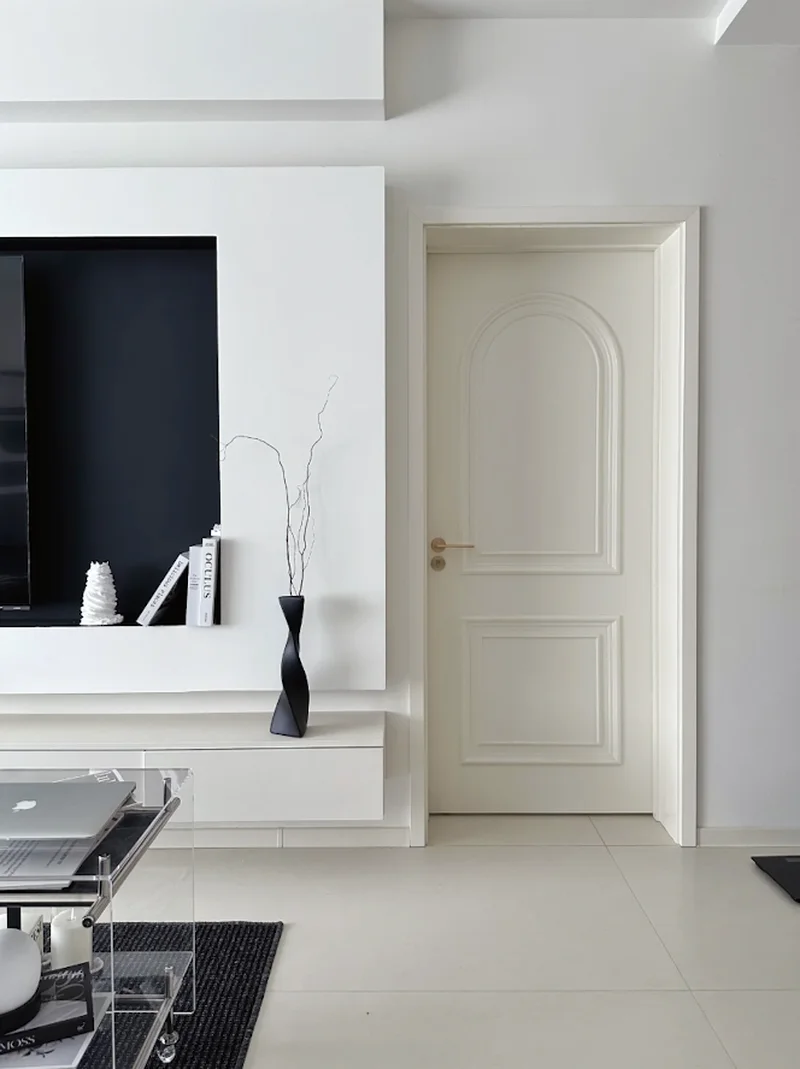
- Moisture Resistance: The cladding exhibits a thickness swelling rate of <0.5% after 24-hour immersion (EN 317), effectively creating a moisture barrier that protects the wood substrate.
- Impact & Abrasion Resistance: Surface hardness exceeds 90 Shore D (ISO 7619-1), with high resistance to scratches, dents, and impact from daily use.
- Thermal & Acoustic Insulation: The complete door assembly, with its insulated core and airtight perimeter seal, achieves a thermal transmittance (U-factor) as low as 1.2 W/m²K and sound reduction ratings up to 38 dB (Rw).
For projects specifying natural oak or walnut veneers, we apply a catalyzed conversion varnish or UV-cured polyurethane finish in a controlled environment. This multi-coat system provides superior moisture and stain resistance while preserving the wood’s natural aesthetics.
Finish System Technical Data:
| Parameter | Test Standard | Performance Grade | Note |
| :— | :— | :— | :— |
| Formaldehyde Emission | EN 16516 / ASTM E1333 | E0 (<0.5 mg/L) | Far exceeds standard E1 requirements for indoor air quality. |
| Surface Hardness | ASTM D3363 | 3H | Pencil hardness rating for exceptional scratch resistance. |
| Moisture Vapor Resistance | ASTM D1653 | Excellent | Low permeability rating protects against humidity diffusion. |
| Fire Performance | EN 13501-1 | Class B-s1, d0 | Low flammability, limited smoke production, and no dripping. |
All manufacturing processes adhere to ISO 9001:2015 quality management systems, ensuring traceability and consistent performance. This engineered methodology guarantees that each door delivers lasting structural stability and environmental resistance, forming a reliable, high-performance component within the building envelope.
Health-Conscious Craftsmanship: Formaldehyde-Free Construction for Safer Indoor Air
The specification of formaldehyde-free construction is a non-negotiable standard for high-end residential environments, directly impacting long-term indoor air quality (IAQ) and occupant well-being. Our methodology eliminates urea-formaldehyde (UF) resins from all composite elements, substituting them with ultra-low emitting alternatives and solid wood engineering to achieve true E0-grade performance (≤0.05 ppm per JIS A 1460, equivalent to CARB Phase 2 NAF).
Core Material Science & Construction Protocol:
- Adhesive Systems: We employ isocyanate-based (pMDI) binders for all core lamination and edge-bonding. These chemically inert adhesives contain no formaldehyde donors, cure to form a stable polymer matrix, and exhibit superior moisture resistance, contributing to long-term dimensional stability.
- Engineered Core Stability: Our multi-laminated LVL (Laminated Veneer Lumber) cores are fabricated using phenol-formaldehyde (PF) or pMDI resins. PF resins, when fully polymerized under heat and pressure, emit negligible formaldehyde (well below E0 thresholds) and provide exceptional structural integrity and resistance to warping.
- Veneer & Substrate Bonding: Oak and walnut veneers are applied to pre-finished, certified E0-grade medium-density fiberboard (MDF) substrates or solid wood rails/stiles using hot-press technology with PUR (Polyurethane Reactive) adhesives. PUR adhesives are solvent-free and formaldehyde-free, creating a durable, waterproof bond.
- Finish Chemistry: Our multi-stage catalyzed lacquer and oil finishes are formulated with low-VOC (Volatile Organic Compound) content, independently certified to meet or exceed SCAQMD Rule 1113 and ASTM D6886 standards, ensuring off-gassing is minimized post-installation.
Functional Advantages of Formaldehyde-Free Engineering:
- Immediate Occupancy Compliance: Doors contribute to achieving IAQ standards for sensitive environments (e.g., bedrooms, nurseries) immediately upon installation, with no required off-gassing period.
- Enhanced Hygroscopic Stability: Formaldehyde-free boards (MDF, LVL) typically exhibit more consistent moisture absorption rates (<8% per 24h immersion per EN 317), reducing internal stress and the risk of delamination or surface telegraphing.
- Predictable Performance in Climate-Controlled Spaces: The absence of hygroscopic UF resins eliminates a variable in the door’s equilibrium moisture content (EMC), ensuring consistent fit, operation, and acoustic/sealing performance in tandem with HVAC systems.
Technical Performance Data:
The following table compares key performance parameters of our formaldehyde-free composite components against conventional E1-grade materials.
| Parameter | Test Standard | Our Formaldehyde-Free Component (E0/NAF) | Conventional E1-Grade Component | Performance Implication |
|---|---|---|---|---|
| Formaldehyde Emission | JIS A 1460 / EN 717-1 | ≤ 0.05 ppm (NAF) | ≤ 0.124 ppm (E1) | Drastically reduced contribution to indoor air pollution. |
| Moisture Absorption (24h) | EN 317 | ≤ 8% | ≤ 12% | Superior dimensional stability in high-humidity zones (e.g., en-suites). |
| Internal Bond Strength | EN 319 | ≥ 0.75 N/mm² | ≥ 0.65 N/mm² | Enhanced core integrity and resistance to delamination under stress. |
| VOC Emission (after 28d) | ASTM D5116 | < 0.5 mg/m³ | Typically 1.0 – 2.0 mg/m³ | Lower total volatile load for improved IAQ. |
Architectural Integration & Verification:
Specification requires explicit callouts for “NAF (No Added Formaldehyde) core and substrates” and “Formaldehyde-free adhesive systems (pMDI or PUR).” All material batches are accompanied by mill certificates and can be validated via third-party testing against the cited standards. This construction approach is integral to projects targeting WELL Building Standard (Air Feature), LEED v4.1 Low-Emitting Materials credit, or similar healthy building certifications.
Precision Specifications and Technical Excellence for Seamless Integration
Material Integrity & Core Construction
The structural performance of a high-end solid wood door is dictated by its core and material composition. We utilize a proprietary engineered core system to ensure dimensional stability, flatness, and longevity, surpassing the limitations of traditional solid lumber.
- Multi-Layer LVL (Laminated Veneer Lumber) Core: A cross-laminated core of select oak or walnut veneers, bonded with phenolic resin under high pressure and heat. This construction virtually eliminates warping, twisting, and checking, providing a stable substrate for veneers with a predictable swelling rate of <2.5% under 65% to 85% RH cycling (ASTM D1037).
- High-Density WPC (Wood-Plastic Composite) Edge Banding & Rail Components: Critical stress points, such as lock blocks and hinge reinforcers, are machined from custom-formulated WPC with a density of ≥1.25 g/cm³. This material offers superior screw-holding power (withdrawal resistance >1200 N per EN 320), dimensional immunity to moisture, and a Shore D hardness of 85, preventing compression and wear.
- Precision Veneer Lamination: Premium 0.6mm rotary-cut or flat-sliced oak/walnut veneers are laminated to the core using a closed-system, isocyanate-based adhesive (E0 formaldehyde emission grade per EN 16516). The process ensures a permanent, void-free bond with a moisture content variance of ≤1.5% between core and veneer.
Performance Specifications & Certifications
All doors are manufactured under an ISO 9001:2015 certified quality management system. Performance is validated against international standards, providing predictable outcomes for architectural specifications.
| Parameter | Specification | Test Standard | Performance Implication |
|---|---|---|---|
| Fire Resistance | Up to FD30 / 30-minute integrity | EN 1634-1 / ASTM E84 (Class B) | Meets code for residential separations and protected routes. |
| Sound Insulation | Rw 28 dB – 32 dB (core-dependent) | EN ISO 10140-2 | Effective attenuation of household noise for privacy. |
| Thermal Insulation | U-factor range: 1.2 – 1.5 W/m²K | EN ISO 8990 / ASTM C518 | Contributes to building envelope efficiency. |
| Formaldehyde Emission | E0 Grade (<0.065 mg/m³) | EN 16516 / JIS A 1460 | Ensures superior indoor air quality. |
| Surface Hardness | ≥4H (Clear Polyurethane Finish) | ASTM D3363 | High resistance to scratches and incidental impact. |
Architectural Integration & Tolerances
Seamless integration into millwork and structure is non-negotiable. Our technical excellence is realized in precise, repeatable manufacturing tolerances and integrated hardware preparation.
- Dimensional Tolerances: Overall door slab dimensions are held to ±0.8mm. Squareness is maintained within a 1.5mm diagonal differential. This precision ensures consistent reveal lines and eliminates on-site trimming.
- Precision Machining: All hinge and lock mortises, bore holes, and continuous hinges are CNC-machined to a positional tolerance of ±0.5mm. This allows for the direct, shim-free installation of precision hardware (e.g., Salice, Blum, Assa Abloy) and guarantees perfect swing geometry.
- Moisture Management: All components are conditioned to a 7-9% equilibrium moisture content (EMC) prior to assembly. Finished doors are sealed with a 360-degree, 6-mil edge seal to control moisture absorption rates to <8% under high humidity (95% RH, 48hrs per EN 321).
- Finish System Compatibility: The substrate and primer system are engineered for compatibility with high-build, catalyzed polyurethane or UV-cured lacquer finishes, ensuring no telegraphing of substrate imperfections and a Class 1 fire-rated finish when specified.
Trusted by Architects and Homeowners: Our Commitment to Quality and Satisfaction
Our engineering and manufacturing protocols are governed by a singular principle: to deliver a component that performs as impeccably as it appears. We achieve this through a rigorous, multi-stage validation process that begins at the material level and extends through to final installation tolerances.
Material Integrity & Core Construction
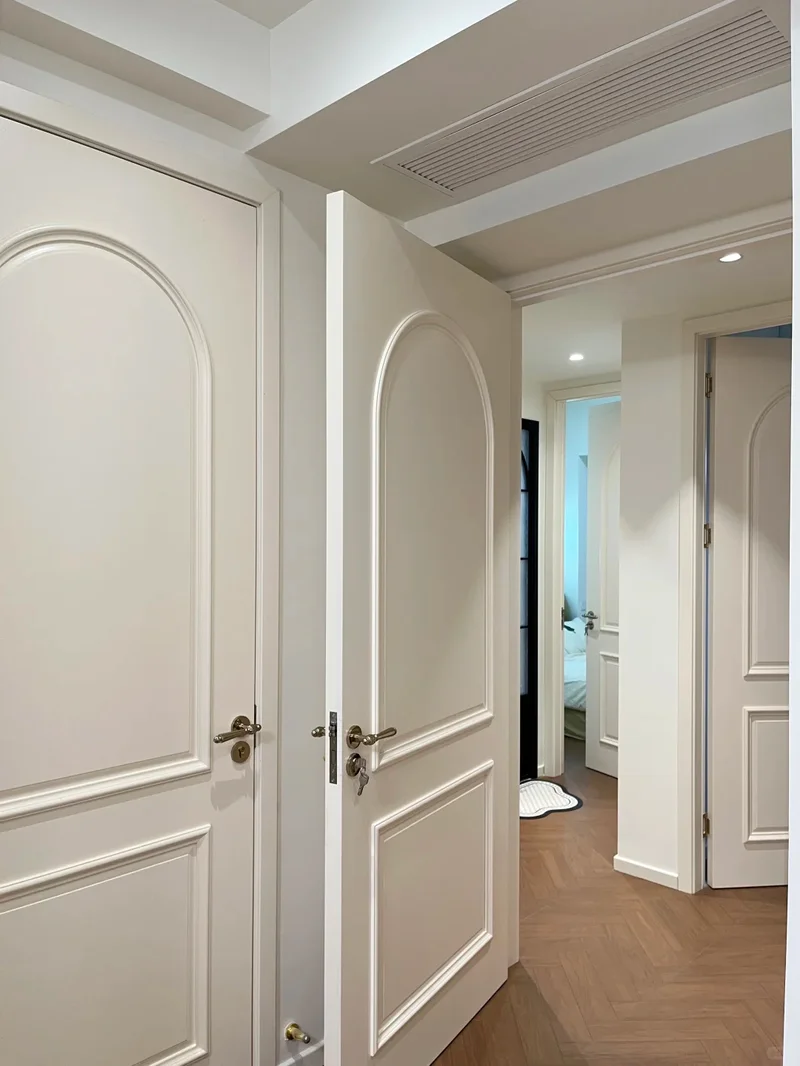
The structural longevity and performance of a door are dictated by its core. Our engineered solid wood panels utilize a cross-laminated LVL (Laminated Veneer Lumber) core, stabilized to a moisture content of 6-8%. This construction method virtually eliminates warping and twisting, providing a dimensional stability coefficient (ΔL) of <0.1% under cyclic humidity testing (ASTM D1037). The core is then laminated with sustainably sourced, book-matched oak or walnut veneers of a minimum 0.6mm thickness, selected for grain consistency and color match.
Performance Specifications & Compliance
All products are tested and certified to meet or exceed international standards for safety, environmental impact, and performance.
| Performance Category | Standard / Metric | Our Specification | Industry Benchmark |
|---|---|---|---|
| Structural Stability | Swelling Rate (24h immersion) | ≤ 12% | Typical: ≤ 15% |
| Acoustic Insulation | Weighted Sound Reduction (Rw) | 32 – 37 dB (varies by configuration) | Standard Door: ~25 dB |
| Thermal Insulation | U-Factor | 1.2 W/m²K | Typical Solid Wood: ~1.8 W/m²K |
| Fire Resistance | Integrity (EN 1634-1 / ASTM E814) | Up to 30-minute rated (EI30) configurations available | N/A for residential |
| Emissions | Formaldehyde Release | E0 Grade (≤ 0.05 ppm per JIS A 1460 / EN 717-1) | E1 (≤ 0.1 ppm) is common |
Functional Advantages for High-End Projects
- Precision Fit & Finish: CNC-machined to a tolerance of ±0.5mm, ensuring seamless integration with architectural millwork and hardware systems.
- Moisture Management: A multi-stage catalyzed conversion varnish or oil finish is applied, achieving a moisture absorption rate of <40 g/m² (24h, per EN 927-5) to protect against humidity fluctuations.
- Hardware Compatibility: Substrate density is engineered to 650-720 kg/m³, providing optimal holding power for premium hinges and multipoint locks without requiring reinforcement.
Quality Assurance Framework
Our commitment is institutionalized through a certified Quality Management System (ISO 9001:2015). Every door is traceable via a unique batch number, documenting its material origin, production date, and QC inspector. Final inspection includes checks for surface flatness (≤0.3mm/1m), color uniformity under D65 standard lighting, and functional operation. We provide a comprehensive technical data sheet (TDS) with each delivery, containing all relevant performance data and maintenance protocols for the architect’s project documentation.
Frequently Asked Questions
What are the critical differences in moisture stability between oak and walnut for solid doors in humid climates?
Oak has a lower moisture expansion coefficient (~0.0037) than walnut (~0.0042), making it inherently more dimensionally stable. For high-humidity zones, we specify kiln-dried wood to 8-10% moisture content and apply a full-perimeter, 1.2mm PVC edge-sealing system to block vapor ingress and prevent warping.
How do you ensure formaldehyde emissions meet the strictest health standards for indoor living spaces?
We exclusively use adhesives and finishes certified to EN 13986 E0 (<0.5 mg/L) and CARB Phase 2 standards. Core materials are 100% solid wood or LVL with no added urea-formaldehyde. Third-party lab reports are provided for each batch, ensuring emissions are negligible for immediate occupancy.
What structural engineering methods prevent long-term warping or sagging in large, heavy solid wood doors?
We integrate a laminated veneer lumber (LVL) core grid within the solid wood stiles and rails. This engineered core, with cross-banded veneers, counteracts natural wood movement. Combined with a balanced construction method and heavy-duty, multi-point hinges, this ensures permanent alignment under loads up to 120kg.
What is the achieved sound insulation rating, and how is it technically accomplished?
Our doors achieve a weighted sound reduction index (Rw) of 32-36 dB. This is achieved through a core design featuring a staggered LVL and acoustic foam layer, combined with a full-perimeter magnetic sealing gasket. The mass of the solid wood and the decoupled layers effectively dampen mid-to-high-frequency noise.
Can you detail the finishing process for UV and scratch resistance?
We employ a 8-step finishing process: grain enhancement, 3 layers of catalyzed varnish with UV inhibitors, and a final ceramic-fortified topcoat. This results in a 3H+ hardness rating (ASTM D3363) and superior resistance to fading. The total dry film thickness exceeds 120 microns for lasting protection.
What are the thermal insulation properties, and how do they impact energy efficiency?
The solid wood and LVL core provide a natural thermal break. Our doors achieve a U-value of approximately 1.2 W/m²K. When paired with proper sealing, this significantly reduces thermal bridging at the entry point, contributing to a stable indoor climate and lowering HVAC energy loads.
For high-traffic areas, what specifications guarantee impact resistance and durability?
We specify a minimum surface density of 750 kg/m³ for the solid wood species. The door slab is reinforced with a full-height, 16-gauge steel plate in the lock area. The high-performance finish is specifically engineered for impact resilience, meeting ANSI/BHMA Grade 1 standards for heavy residential use.