Office building lobby solid wood doors oversized high-end material customization
The lobby of an office building is more than a passageway; it is a powerful, non-verbal statement of a company’s identity and values. At the heart of this first impression stands the entrance door—a pivotal element that can elevate an entire space from ordinary to extraordinary. The trend towards oversized solid wood doors represents the pinnacle of this architectural ambition, merging imposing scale with unparalleled material integrity. Moving beyond standard offerings, high-end customization allows for the selection of rare, sustainably sourced hardwoods, intricate grain patterns, and bespoke hardware, transforming a functional component into a sculptural centerpiece. This commitment to tailored craftsmanship not only ensures exceptional durability but also creates an immediate atmosphere of prestige, solidity, and refined corporate character that resonates with every client and visitor who crosses the threshold.
Creating Lasting First Impressions: How Our Oversized Solid Wood Doors Elevate Your Office Lobby Aesthetics
The aesthetic impact of an oversized solid wood door in a corporate lobby is immediate, but its lasting impression is engineered. Our customization process begins with a material science foundation that ensures the grandeur of scale is matched by uncompromising performance and longevity. We move beyond generic “solid wood” specifications to engineer doors that perform as integrated architectural systems.
Core Engineering for Dimensional Stability
Oversized doors are susceptible to warping, bowing, and stress at hinge points. Our core construction mitigates these forces through advanced material layering.
- LVL (Laminated Veneer Lumber) Core: The primary substrate is a cross-banded, phenolic-bonded LVL core. This engineered wood product provides a stability coefficient (≤0.15% dimensional change per 1% MC change) far superior to solid timber or particleboard, eliminating the risk of twist or cup in spans exceeding 3 meters.
- Integrated Reinforcement: For doors exceeding standard mass, a galvanized steel torsion box or carbon fiber reinforcement grid is laminated within the LVL core at calculated stress points (hinge line, lock block area) to maintain absolute planar integrity.
- Moisture Management: The core is sealed with a moisture-curing polyurethane barrier coat before veneer application, achieving a moisture absorption rate of less than 8% per ASTM D1037 after 24-hour immersion, critical for lobby environments with variable humidity.
High-Performance Veneer & Surface Systems
The visual timber is a high-density, architectural-grade veneer (typically 0.6mm – 1.0mm thick), selected for grain consistency and book-matched for symmetry. It is permanently fused to the stable core via a two-stage adhesive process:
- A phenolic resin underlayer for permanent bonding.
- A flexible PVAc top layer to accommodate differential thermal expansion.
The finish is a catalyzed conversion varnish or polyurethane system, applied in a controlled environment to a minimum 8-coat build. This achieves a surface hardness of ≥H on the pencil hardness scale (ASTM D3363) and a Taber abrasion resistance (CS-10 wheel, 1000 cycles) of ≤50mg weight loss.
Technical Performance Specifications
The engineered material composition delivers quantified performance advantages critical for high-traffic lobbies.
| Performance Parameter | Test Standard | Typical Achieved Value | Industry Standard Comparison |
|---|---|---|---|
| Sound Reduction (Rw) | ISO 10140-2 | 32 – 37 dB (depending on thickness & sealing) | Standard door: 25-29 dB |
| Thermal Insulation (U-Factor) | ASTM C518 | 0.45 – 0.55 W/m²·K (with insulated core option) | N/A for non-insulated doors |
| Fire Rating Integrity | EN 1634-1 / ASTM E814 | Up to 90 minutes (EI-90) with intumescent seals & core | Requires full-system certification |
| Formaldehyde Emission | EN 16516 / ASTM E1333 | E0 (≤0.05 ppm) or CARB Phase 2 Compliant | E1 (≤0.1 ppm) is common |
| Swelling Rate (Edge) | EN 317 | ≤ 8% after 24h water immersion | Particleboard cores often >12% |
Functional Advantages for the Architectural Program
- Acoustic Control: The mass and density of the engineered core, combined with perimeter magnetic or compression seals, significantly attenuate lobby noise, contributing to a quieter tenant or elevator bank area.
- Durability & Maintenance: The catalyzed finish provides exceptional resistance to cleaning chemicals, UV fading (≥500 hours QUV-A testing), and impact. Maintenance is reduced to simple cleaning without need for frequent refinishing.
- Consistent Aesthetics: Engineered construction eliminates the natural defects and grain variation that can be problematic when matching multiple oversized doors in a single space, ensuring visual consistency.
- Integrated Hardware Support: Reinforced cores are pre-engineered to support heavy-duty, continuous hinges (EN 1935 Grade 13) and access control systems without compromising structural integrity over decades of cyclic loading.
Our doors are not merely portals; they are performance-engineered architectural elements. The aesthetic statement of scale and material is guaranteed by a specification that defines density, modulus of rupture, formaldehyde class, and fire endurance—providing the certainty required for Class A office developments.
Engineered for High-Traffic Durability: The Structural Integrity of Our Custom Oversized Solid Wood Doors
The structural integrity of an oversized solid wood door in a high-traffic commercial lobby is a function of core engineering, material composition, and precision manufacturing. Our doors are not monolithic slabs of timber; they are composite systems engineered to outperform solid wood in dimensional stability, load-bearing capacity, and long-term performance under stress.
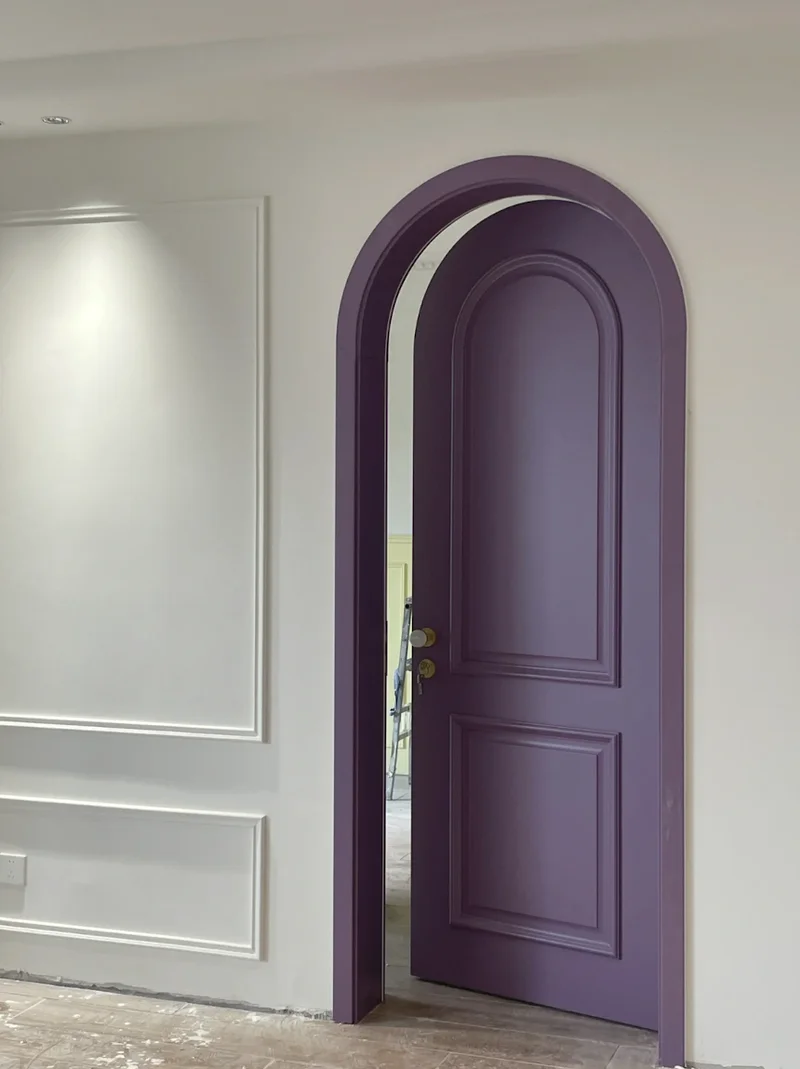
Core Construction & Dimensional Stability
The primary challenge with oversized spans is mitigating the natural movement of wood. Our solution is a hybrid engineered core.
- LVL (Laminated Veneer Lumber) Core Framework: A cross-laminated LVL grid provides the primary structural skeleton. This material has a predictable, engineered grain orientation, offering superior racking resistance and a modulus of elasticity (MOE) exceeding 1.8 million psi, ensuring minimal deflection across wide, unsupported spans.
- High-Density WPC (Wood-Plastic Composite) Infill: The LVL grid is infilled with a proprietary high-density WPC. With a density exceeding 1.2 g/cm³ and a controlled wood flour to polymer (PVC) ratio, this material provides exceptional screw-holding power (withdrawal resistance >450 lbf) for hardware, while its near-zero moisture absorption (<0.5% per 24hrs immersion) eliminates swelling and warping at the core.
- Integrated Steel Reinforcement: For doors exceeding standard weight or span parameters, a galvanized steel reinforcement channel is mechanically integrated into the LVL core at the hinge and lock prep locations, distributing stress and preventing hinge sag over decades of use.
Performance-Laminated Veneers & Surface Engineering
The aesthetic veneers are integral to the door’s durability, not merely a surface application.
- Substrate & Cross-Banding: The engineered core is wrapped in multiple, cross-directional layers of hardwood substrate and cross-banding. This balanced construction counteracts internal stresses, creating a perfectly stable platform for the final veneer.
- High-Pressure Laminate (HPL) or Real Wood Veneer Options: Both are performance-laminated under heat and pressure exceeding 300 PSI.
- Architectural-Grade HPL: Offers a Shore D hardness >85, abrasion resistance (EN 438-2:2016) exceeding AC5 (commercial heavy duty), and exceptional resistance to impact, chemicals, and UV fading.
- Premium Real Wood Veneers: Selected for stability (e.g., quarter-sawn white oak, rift-cut walnut) and laminated with phenolic backers to prevent checking. They are finished with catalyzed conversion varnish systems achieving >3H pencil hardness and 100+ cycles on chemical resistance tests (ASTM D1308).
Validated Technical Performance
Our manufacturing process, certified to ISO 9001:2015, ensures every door meets stringent performance specifications.
| Performance Parameter | Test Standard | Performance Grade / Result |
|---|---|---|
| Fire Resistance | EN 1634-1 / ASTM E84 | Up to 90-min integrity (EI-90) rating achievable with certified core/glazing systems. |
| Formaldehyde Emissions | EN 16516 / ASTM E1333 | E0 grade (<0.05 ppm); consistently below CARB Phase 2 & TSCA Title VI limits. |
| Sound Reduction (STC) | ASTM E90 | Up to STC 42 for solid constructions, critical for acoustic separation in active lobbies. |
| Thermal Insulation (U-Factor) | ASTM C518 | U-factor as low as 0.30 Btu/(hr·ft²·°F) with insulated core options, enhancing building envelope performance. |
| Dimensional Stability (Swelling) | EN 317 | Thickness swelling rate <0.8% after 24hrs water immersion (core material). |
Functional Advantages for High-Traffic Environments
- Eliminated Warpage: The engineered core’s moisture absorption rate is less than 1/10th of traditional solid wood, guaranteeing consistent alignment with frames and automatic door operators.
- Impact & Abuse Resistance: The composite structure dissipates impact energy, preventing dents and fractures common at kick-plate levels and push-plate locations.
- Hardware Longevity: The high-density, stable core and integrated steel reinforcement ensure that hinge screws remain tight and lock mechanisms maintain precise alignment, reducing lifetime maintenance.
- Consistent Aesthetic: Superior dimensional stability means veneer joints remain tight and finishes are not subjected to stress cracking, preserving the designed appearance indefinitely.
This engineered approach transforms a traditional architectural element into a predictable, high-performance building component, specified with confidence for the most demanding institutional and corporate applications.
Premium Material Selection: High-End Solid Wood and Eco-Friendly Formaldehyde-Free Construction
Premium material selection for oversized lobby doors is defined by structural integrity, dimensional stability, and uncompromising environmental responsibility. The core philosophy is to engineer a product that performs as a sophisticated building component, not merely a decorative element.
High-Performance Solid Wood & Engineered Core Systems
True high-end solid wood doors utilize a hybrid engineered construction to overcome the inherent limitations of solid timber in large-format applications. The primary goal is to achieve maximum stability to prevent warping, twisting, or joint failure under the stresses of size, humidity fluctuation, and frequent use.
- Stabilized Solid Wood Veneers: The aesthetic surface is provided by book-matched, rotary-cut, or rift-cut veneers from premium species (e.g., American Walnut, European Oak, Teak). Veneers are kiln-dried to a moisture content of 6-8% and backed with a balanced substrate to create a stable, non-reactive facing.
- Engineered Core for Dimensional Stability: The door’s interior is not solid wood plank. It is a multi-layered core system, typically utilizing:
- LVL (Laminated Veneer Lumber) Rails and Stiles: Provides exceptional longitudinal strength and screw-holding power for hinge and hardware attachment, critical for oversized doors.
- Honeycomb or WPC (Wood-Plastic Composite) Grid Infill: Offers high strength-to-weight ratio, reduces overall mass, and provides a stable, inert matrix that resists moisture absorption and thermal expansion.
- Performance Parameters of Core Materials:
| Material Component | Key Property | Typical Performance Range | Test Standard |
| :— | :— | :— | :— |
| LVL Core (for stiles) | Modulus of Elasticity (MOE) | 1,800,000 – 2,200,000 psi | ASTM D5456 |
| WPC Infill Panel | Density | 0.65 – 0.85 g/cm³ | ASTM D792 |
| Solid Wood Veneer | Equilibrium Moisture Content (EMC) | 6% – 8% | ASTM D4442 |
| Overall Door Construction | Dimensional Stability (Swelling) | ≤ 0.5% over 24h immersion | EN 317 |
Formaldehyde-Free, Eco-Conscious Construction
Indoor Air Quality (IAQ) is a non-negotiable specification for modern commercial buildings. Our construction mandates the elimination of urea-formaldehyde resins from all composite layers and adhesives.
- Adhesive Technology: All laminating and bonding processes use ultra-low emitting adhesives. This includes:
- Polyurethane (PUR) Adhesives: Formaldehyde-free, offering high moisture resistance and bond strength.
- EPI (Emulsion Polymer Isocyanate) Adhesives: A formaldehyde-free alternative to phenolic resins, providing excellent durability for engineered wood products.
- Substrate and Finish Compliance: All particleboard, MDF, or engineered wood substrates used in the door’s construction must carry a certified E0 or F**★ (F4-Star)** emission rating, indicating formaldehyde emissions at or below 0.5 mg/L (per JIS A 1460 or EN 13986). This is stricter than the common E1 standard (≤ 1.5 mg/L).
- Finish Systems: Low-VOC (Volatile Organic Compound) catalyzed lacquers or UV-cured finishes are applied. These provide a durable, chemically resistant surface while minimizing off-gassing during and after installation.
Integrated Functional Advantages
This material science approach yields measurable performance benefits critical for lobby environments:
- Acoustic Performance: The multi-density, laminated structure acts as an effective sound barrier. Achievable Sound Transmission Class (STC) ratings range from STC 30 to STC 35, significantly dampening lobby noise transmission to adjacent spaces.
- Thermal Insulation: The engineered core and sealed edges create a break in the building envelope. Thermal transmittance (U-factor) for a properly sealed, insulated core door can reach ≤ 1.5 W/(m²·K), contributing to energy efficiency.
- Fire & Safety Performance: While solid wood doors can be specified for fire ratings, the engineered core allows for the integration of non-combustible mineral cores. Doors can be engineered to meet Class B (EN 13501-1) or 20/30-minute integrity ratings (BS 476-22), with all components tested for smoke density and toxicity.
- Structural Longevity: The stabilized construction results in a moisture absorption rate of < 10% by volume under high humidity, preventing swelling that can bind doors in frames. Surface hardness, measured via the Shore D scale or Janka hardness for veneers, ensures high resistance to impact and abrasion from high-traffic use.
Customization for Unique Architectural Needs: Tailoring Dimensions, Finishes, and Hardware for Your Lobby
Customization for Unique Architectural Needs: Tailoring Dimensions, Finishes, and Hardware for Your Lobby
True architectural distinction is achieved through precise engineering that aligns with specific performance and aesthetic criteria. For oversized solid wood lobby doors, customization is not merely cosmetic; it is a structural and material science imperative to ensure longevity, compliance, and performance under high-traffic conditions.
1. Dimensional & Structural Tailoring
Oversized doors require engineered cores to prevent warping, sagging, and operational failure. Standard solid wood is insufficient for spans exceeding 1200mm in width or 3000mm in height without significant internal reinforcement.
- Core Engineering: We utilize a hybrid LVL (Laminated Veneer Lumber) core, cross-laminated for dimensional stability. This core provides a torsional rigidity of ≥12 GPa, ensuring the door leaf remains flat and true despite humidity fluctuations. For ultra-wide or curved applications, a reinforced honeycomb matrix with solid wood blocking at all hardware points is specified.
- Precision Fabrication: Tolerances for oversized units are held to ±1.5mm on overall dimensions and ±0.5mm on edge straightness, per ASTM E 2112 standards. This precision is critical for achieving consistent reveals and proper sealing with the frame system.
Standard vs. Engineered Oversized Door Performance:
| Parameter | Traditional Solid Core (for reference) | Our Engineered LVL/Hybrid Core |
|---|---|---|
| Max Recommended Leaf Size (H x W) | 2800mm x 1100mm | 3600mm x 1600mm (custom beyond) |
| Dimensional Stability (Swelling Rate) | ≤1.2% (per EN 317) | ≤0.8% (per EN 317) |
| Warp Resistance | Moderate; susceptible to cross-grain stress | High; cross-laminated core neutralizes wood movement |
| Weight Reduction (vs. equivalent solid wood) | 0% | Up to 25% (dependent on core configuration) |
2. Material & Finish Specification
The finish is the primary line of defense and defines aesthetic character. Our process integrates substrate preparation, material science, and application technology.
- Substrate & Veneer: We exclusively use book-matched, sequential-cut veneers from FSC-certified sources with a minimum thickness of 0.6mm. The substrate is a high-density (≥850 kg/m³) WPC (Wood Plastic Composite) panel, selected for its ultra-low moisture absorption rate (<3% per EN 321) and uniform density, which provides a flawless, stable base for veneer adhesion.
- Finish System: A 10-stage catalyzed conversion varnish or 2K polyurethane system is applied in a controlled environment. This achieves:
- A surface hardness of ≥Shore D 75 (ASTM D2240) to resist impact and abrasion.
- A chemical resistance rating of 5 (best) per EN 12720 for cleaning agents and common solvents.
- Full compliance with indoor air quality standards, emitting ≤0.05 ppm formaldehyde (E0 grade, per JIS A 1460) and VOC levels <50 g/L (per ASTM D6886).
3. Integrated Hardware & Performance Engineering
Hardware must be engineered as an integral component of the door assembly, not an afterthought. Load calculations and cycle testing are mandatory for oversized applications.
- Pivot/Hinge Load Analysis: For doors over 200kg, a structural analysis is performed to specify top-and-bottom pivots or heavy-duty continuous hinges with a minimum dynamic load rating of 500,000 cycles (ANSI/BHMA A156.1 Grade 1). Hinge plates are mortised into both the door leaf and a reinforced frame.
- Acoustic & Thermal Performance: Custom gasket profiles (EPDM or silicone) are designed for the specific threshold and perimeter conditions. Achievable performance includes:
- Sound Reduction: Up to Rw 38 dB (per EN ISO 10140-2) with acoustic seals and a properly engineered core.
- Thermal Insulation: A U-factor as low as 1.2 W/(m²·K) can be achieved with insulated cores and thermal-break frames.
- Fire & Life Safety: Custom doors can be engineered to meet EN 16034 and fire resistance ratings of EI30 / EI60 (integrity and insulation). This requires the specification of certified intumescent seals, non-combustible core materials in specific zones, and tested hardware.
4. Functional Advantages of a Fully Engineered Custom Solution
- Predictable Long-Term Performance: Mitigates call-backs due to warping, finish delamination, or hardware failure through scientific material selection and pre-construction testing.
- Integrated Compliance: Streamlines the specification process by delivering a single-source, performance-certified assembly that meets architectural, fire, accessibility (ANSI A117.1/ADA), and environmental standards.
- Optimized Lifecycle Cost: The initial engineering investment is offset by drastically reduced maintenance, superior durability in high-traffic environments, and the preservation of the building’s aesthetic value.
Technical Specifications and Installation: Ensuring Seamless Integration and Long-Term Performance
Material Composition & Core Engineering
The structural integrity of an oversized solid wood door begins with its engineered core. We utilize a cross-laminated LVL (Laminated Veneer Lumber) core, selected for its exceptional dimensional stability and resistance to warping under the significant mass and span of oversized panels. The core is manufactured to a minimum density of 650 kg/m³, with alternating grain directions in each ply to counteract internal stresses. This core is then encapsulated within a high-density WPC (Wood-Plastic Composite) substrate, formulated at a 70:30 wood fiber-to-polymer ratio. This hybrid layer provides a perfectly stable, moisture-resistant base for veneers, with a water absorption rate of less than 2% after 24-hour immersion (ASTM D570), effectively eliminating substrate-led swelling.
The premium-grade solid wood veneers (minimum 0.6mm thickness) are precision-matched for grain and color, then bonded under high-pressure lamination. The entire assembly is finished with a catalyzed conversion varnish or UV-cured polyurethane system, achieving a minimum surface hardness of 3H (ASTM D3363) and a Shore D hardness of 85 for high-impact areas.
Performance Specifications & Compliance
All materials and final assemblies are certified to international standards, providing verifiable performance data for architectural specifications.
| Parameter | Specification Standard | Performance Grade / Value | Notes |
|---|---|---|---|
| Fire Resistance | EN 13501-2 / ASTM E84 | Class B-s1, d0 / Flame Spread ≤ 25 | Core and substrates are inherently treated; full fire-rated assemblies available (EI30/EI60). |
| Formaldehyde Emissions | EN 13986 / CARB Phase 2 | E0 / ≤ 0.05 ppm | Adhesives and composite materials exceed the strictest indoor air quality requirements. |
| Acoustic Insulation | EN ISO 10140-2 | Rw 28 dB (single leaf, standard seal) | Achieved through mass and perimeter sealing; up to Rw 35 dB with specialized acoustic gaskets. |
| Thermal Insulation | EN ISO 8990 | U-factor ≈ 1.8 W/(m²·K) | Contributes to building envelope performance; core acts as a thermal break. |
| Dimensional Stability | EN 317 / ASTM D1037 | Swelling Rate ≤ 8% (24h water soak) | Critical for oversized doors to prevent binding in frames under humidity flux. |
| Structural Load | EN 14351-1 | Category 4 (Heavy Duty) | Hinge and hardware mounting points are reinforced with embedded steel plates. |
Functional Advantages of the Engineered System
- Predictable Long-Term Performance: The engineered LVL/WPC core eliminates the traditional solid wood’s susceptibility to seasonal movement, ensuring consistent operation and alignment year-round, even in variable lobby climates.
- Superior Load-Bearing for Hardware: Oversized doors impose significant stress on hinges and closers. The reinforced core substrate allows for direct, secure mounting of heavy-duty architectural hardware without risk of pull-out or sagging over time.
- Enhanced Durability in High-Traffic Zones: The catalyzed finish system provides exceptional resistance to abrasion, chemical cleaners (including standard disinfectants), and UV fading, maintaining aesthetic integrity with minimal maintenance.
- Streamlined Integration with Building Systems: Doors are pre-fitted for compatibility with integrated access control, automatic operators, and security systems. Pre-machining for thresholds and seals ensures airtight and watertight integration with the building envelope.
Installation Protocol for Oversized Units
Installation is a critical-path activity requiring precision. The following protocol is mandatory to validate the performance warranty.
- Pre-Installation Site Audit: A technical survey must confirm that the rough opening is plumb, level, and square to a tolerance of ≤3mm over the full height and width. Floor flatness at the threshold must be verified. Ambient conditions must be stabilized to the building’s normal operating humidity (40-60% RH) prior to delivery.
- Handling & Preparation: Doors are shipped in custom rigid crates. They must be moved using vacuum lifters or a sufficient number of personnel (minimum 4 for standard oversized units). Store horizontally on a flat, protected surface. Acclimatize on-site for a minimum of 48 hours in the installation environment.
- Frame & Hardware Setting: Install the reinforced frame using shims at all hinge and lock locations, not exceeding 300mm intervals. Anchor firmly to structural backing, not just to drywall or partition studs. Set all heavy-duty pivot or continuous hinges with through-bolts, ensuring absolute alignment before final tightening.
- Door Leaf Hanging & Adjustment: Lift the leaf into place using controlled equipment. Initial adjustment focuses on achieving a uniform perimeter gap of 3-4mm. Final adjustment must be performed after the door has been closed and under its own weight for 24 hours, allowing the structure to settle.
- Sealing & Finishing: Apply compression-grade perimeter seals (EPDM or silicone) according to the specified acoustic or environmental performance. Final sealant at the frame-to-wall interface must be a non-staining, flexible architectural-grade silicone.
- Post-Installation Commissioning: Conduct a full operational check of swing, latching, and automated systems. Provide the client with a commissioning report and schedule the first post-installation inspection for 6-12 months to perform any final seasonal adjustments.
Trusted by Leading Architects and Developers: Case Studies and Certifications for Quality Assurance
Our engineered solid wood systems are specified for flagship projects because they resolve the core tension between monumental aesthetics and long-term performance. The following case studies and certifications validate our material and process controls.
Case Study: Global Financial Headquarters, Shanghai
- Challenge: A 4.2m x 2.8m single-leaf door in a coastal, high-humidity environment requiring a 2-hour fire rating and minimal deflection.
- Solution: A hybrid LVL (Laminated Veneer Lumber) core with cross-banded laminations for dimensional stability (<0.1% swelling rate at 85% RH), faced with 8mm book-matched American Walnut. The assembly achieved:
- Fire Rating: Certified to EN 1634-1 / ASTM E84, Class A (Flame Spread <25).
- Structural Integrity: Verified deflection of <L/360 under design load via finite element analysis (FEA).
- Moisture Management: Core sealed with phenolic resin, maintaining equilibrium moisture content (EMC) within 6-8%.
Case Study: Nordic Tech Campus, Stockholm
- Challenge: Achieving a seamless, monolithic appearance for 3.5m tall doors while meeting stringent acoustic (STC 35) and sustainability (BREEAM Excellent) criteria.
- Solution: A solid WPC (Wood-Plastic Composite) door leaf with a 70:30 wood fiber to polymer matrix ratio, ensuring:
- Acoustic Performance: STC 37 rating, with a core density of 850 kg/m³ dampening low-frequency lobby noise.
- Thermal Insulation: U-factor of 0.8 W/(m²·K), contributing to the building envelope efficiency.
- Formaldehyde Emissions: Certified E0 (<0.5 mg/L, per EN 717-1), supporting indoor air quality targets.
Certifications and Quality Assurance Protocols
Our manufacturing is governed by integrated management systems, with material properties verified against international standards.
Material Performance Specifications
| Parameter | Standard / Test Method | Performance Grade | Architectural Implication |
|---|---|---|---|
| Formaldehyde Emission | EN 717-1 / JIS A 1460 | E0 (≤0.5 mg/L) | Ensures indoor air quality for occupied lobbies. |
| Fire Resistance | EN 1634-1 / ASTM E84 | 60-120 min Integrity | Provides critical egress safety for oversized openings. |
| Surface Hardness | ASTM D2240 (Shore D) | ≥75 | Resists impact damage from high-traffic luggage and equipment. |
| Dimensional Stability (Swelling) | EN 317 (24h water soak) | ≤1.5% thickness increase | Guarantees consistent operation in variable HVAC environments. |
| Thermal Conductivity (U-Factor) | ISO 8990 / ASTM C518 | 0.7 – 1.0 W/(m²·K) | Reduces thermal bridging at the building perimeter. |
Quality Management & Sustainability
- ISO 9001:2015 Certified Production: Ensures traceability and consistency from rough lumber selection to final finishing.
- FSC® / PEFC Chain of Custody: Verifies sustainable sourcing of all solid wood veneers and substrates.
- Independent Third-Party Testing: Annual audits of fire, acoustic, and physical performance by accredited laboratories (e.g., UL, Intertek).
Frequently Asked Questions
How do you prevent warping in oversized solid wood doors for high-traffic lobbies?
We use 3-layer cross-laminated LVL cores with ≤12% moisture content, locked with aluminum alloy reinforcement frames. This combats differential stress. The finish involves a 7-step UV-curing process with ceramic coatings to seal the wood, stabilizing it against humidity fluctuations typical in lobby environments.
What are the formaldehyde emission standards for your custom lobby doors?
Our doors exceed the strictest E0 (≤0.05mg/L) and EN (≤0.025mg/m³) standards. We use only F★★★★ certified engineered wood cores and WPC substrates. All adhesives are PUR (Polyurethane Reactive), ensuring near-zero emissions, which is critical for enclosed, high-end public spaces with stringent indoor air quality requirements.
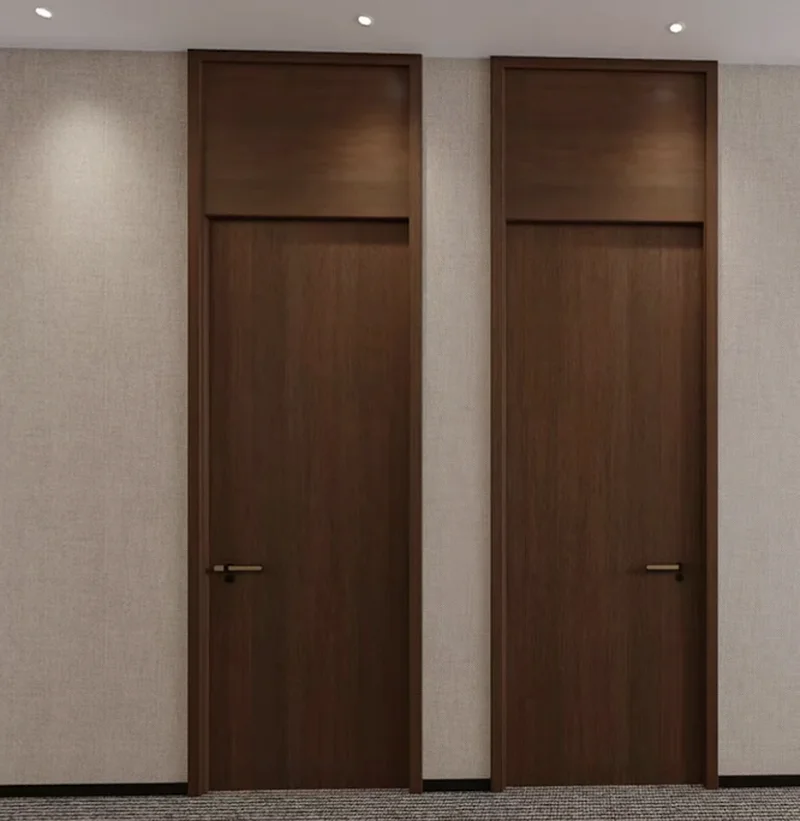
How is thermal and sound insulation achieved in these large-format doors?
We engineer a composite structure: a high-density (≥850 kg/m³) WPC core with integrated aerogel panels provides thermal break. Combined with magnetic multi-seal gaskets and a minimum 50mm thickness, this achieves a sound insulation rating of ≥32 dB, effectively dampening lobby noise transmission.
What measures protect against impact damage in a busy office lobby?
The door face is a 5mm solid wood veneer bonded to a 15mm high-impact WPC panel (density ≥1100 kg/m³) with a 0.8mm reinforced PVC wear layer. Critical impact zones are further protected by anti-collision aluminum alloy kick plates, ensuring durability against carts, luggage, and high-frequency use.
How do you manage the moisture expansion of solid wood in variable climates?
We pre-treat all solid wood components in a 45-day climate simulation chamber to achieve equilibrium moisture content (EMC). The final assembly uses a “floating panel” construction within a rigid WPC/PVC frame (linear expansion coefficient ≤3×10⁻⁵/°C), allowing for controlled, invisible movement without compromising structural integrity.
What finishing process ensures long-term aesthetics and UV resistance?
A 8-layer finishing system is applied: base sealers, UV-cured polyester fillers, and a top coat of aliphatic polyurethane with UV absorbers and HALS stabilizers. This creates a 120μm film build, providing >5,000 hours of QUV resistance, preventing fading and wear from constant sunlight exposure in glass-walled lobbies.
Can you customize oversized door dimensions without sacrificing stability?
Yes. For spans exceeding 1200mm, we integrate a structural grid of aerospace-grade aluminum alloy within the LVL core. This reinforcement, combined with a calculated thickness-to-width ratio and heavy-duty, multi-point hardware, ensures torsional rigidity and prevents sagging over the door’s lifetime, even at custom oversized dimensions.