Solid Wood Door Bulk Customization: Full-Process Connection for Size, Material, and Process
In the world of bespoke architectural interiors, the promise of bulk solid wood door customization often meets the reality of fragmented communication, leading to costly errors and project delays. True efficiency is not merely about volume, but about seamless integration. This article explores the transformative power of a full-process connection, where size specifications, material selection, and intricate manufacturing workflows are intelligently linked from initial design to final installation. By bridging these critical phases, manufacturers and project managers can achieve unprecedented precision, consistency, and scalability. Discover how a unified approach unlocks not only operational excellence but also the freedom to realize ambitious design visions with confidence, ensuring every door is a perfect fit in both form and function.
Tailored to Your Project: Streamlined Bulk Customization for Size, Material, and Process
Dimensional Engineering & Structural Integrity
Our bulk customization protocol begins with a structural analysis of your specified dimensions. We engineer each door to maintain core stability and prevent warping, regardless of scale.
- Non-Standard Sizing: We accommodate heights exceeding 3000mm and widths beyond 1200mm without compromising structural integrity. Custom thicknesses from 35mm to 60mm are standard.
- Core Technology: For large-format or high-stress doors (e.g., entrance units), we utilize Laminated Veneer Lumber (LVL) or hybrid cores. LVL provides a stability coefficient (≤1.2% dimensional change) superior to solid timber, ensuring flatness and screw-holding power.
- Precision Fabrication: CNC machining achieves a dimensional tolerance of ±0.5mm, critical for seamless integration into prefabricated architectural elements and ensuring consistent hinge and hardware mounting.
Standard vs. Extended Custom Size Parameters
| Parameter | Standard Range | Extended Custom Capability | Critical Control Point |
| :— | :— | :— | :— |
| Height | 1980mm – 2400mm | Up to 3000mm+ | LVL core lamination orientation for vertical load distribution. |
| Width | 700mm – 900mm | Up to 1200mm+ | Reinforcement of stile joints and hardware mounting zones. |
| Thickness | 40mm | 35mm – 60mm | Adjustment of rail and stile profile to maintain mortise & tenon strength. |
| Weight Capacity | Standard hardware | Engineered for heavy-duty architectural hardware | Core density mapping and hinge plate reinforcement protocols. |
Material Science & Performance Specification
Selection is guided by project-specific performance requirements. We provide full material traceability and test certificates.
- Wood Species & Engineered Composites:
- Solid Hardwoods (Oak, Ash, Walnut): Selected for architectural finish and durability. Kiln-dried to 8-10% moisture content, with controlled acclimatization.
- High-Density WPC (Wood-Plastic Composite): For high-moisture or exterior applications. Density >1.1 g/cm³ ensures minimal water absorption (<0.5%) and superior dimensional stability.
- PVC-Wood Hybrids: Optimized polymer-to-wood fiber ratio for consistent surface finish and impact resistance (Shore D hardness >75).
- Performance Certifications:
- Fire Safety: Doors can be engineered to meet EN 13501-2 or ASTM E84 Class A/B ratings, utilizing non-combustible mineral cores and intumescent seals.
- Emissions: All substrates and adhesives comply with E0 (≤0.5 mg/L) or E1 (≤1.5 mg/L) formaldehyde emission grades per EN 16516.
- Acoustic & Thermal: Achievable sound reduction up to Rw 38 dB and thermal insulation U-factors as low as 1.2 W/m²K through specialized core designs and sealing systems.
Integrated Process Connection: From CAD to Site
Customization is managed through a closed-loop digital workflow, ensuring specification fidelity from design to delivery.
- Technical Consultation & DFM (Design for Manufacturability): Our engineering team reviews your architectural drawings to validate specifications against performance goals and manufacturing parameters, proposing optimizations for cost or efficiency.
- Digital Template & Batch Programming: Approved drawings are converted into machine-readable templates. Nesting software optimizes material yield from raw panels, and tool paths are programmed for CNC mills, routers, and finishing lines.
- Batch Production with Traceability: Each custom batch is assigned a unique lot number. Components are machined, assembled, and finished in controlled sequences, with quality checkpoints at each stage (e.g., moisture content verification, glue line inspection).
- Pre-Delivery Audit & Packing: Finished doors undergo a final audit against the original project specification sheet. They are then packed in project-specific, numbered lots with protective packaging designed for secure shipping and organized on-site installation.
Built to Last: Premium Solid Wood Construction for Enhanced Durability and Stability
The structural integrity and longevity of a solid wood door are determined by the intrinsic properties of its core material and the engineering of its composite assembly. For bulk customization, this demands a scientific approach to material selection and lamination to ensure dimensional stability under variable environmental loads.
Core Material Engineering for Dimensional Stability
The primary challenge with solid wood is its hygroscopic nature. Our engineered approach utilizes laminated veneer lumber (LVL) cores or select, kiln-dried solid wood blocks, precision-milled and assembled to counteract natural wood movement.
- LVL Core Construction: Cross-laminated veneers with alternating grain direction create a monolithic core with superior dimensional stability. The process minimizes linear expansion/contraction, providing a predictable substrate for veneers and finishes. Key performance metrics include a swelling rate of <2% after 24-hour water immersion (per ASTM D1037).
- Advanced Solid Wood Block Core: For applications requiring traditional mass, we use a modular block system. Kiln-dried to 8-10% moisture content (MC), blocks are finger-jointed and bonded under high pressure. This method isolates potential defects, redirects stress, and prevents large-scale warping or cupping seen in single-piece slabs.
Performance Laminates & Composite Integration
Where enhanced performance is required, we integrate specialized materials into a hybrid solid wood substrate.
- Moisture & Fire Barrier Layers: Impermeable WPC (Wood-Plastic Composite) or high-density PVC layers can be laminated within the core assembly. This creates a capillary break, reducing overall moisture absorption to <8% and improving fire resistance ratings (up to EI30 per EN 13501-2).
- Acoustic & Thermal Insulation: For specialized architectural requirements, the core cavity can be engineered with sound-dampening composites or insulated materials. This can achieve sound reduction ratings (Rw) up to 42 dB and improve thermal insulation (U-factor as low as 0.8 W/m²K).
Technical Specifications & Standards Compliance
All materials and processes are governed by stringent international standards to ensure consistent, verifiable performance in bulk orders.
| Performance Category | Test Standard | Typical Specification | Benefit for Bulk Projects |
|---|---|---|---|
| Formaldehyde Emissions | ISO 12460, EN 13986 | E0 (≤0.5 mg/L) or E1 (≤1.5 mg/L) | Guarantees indoor air quality compliance for healthcare, education, and residential projects. |
| Surface Hardness | ASTM D2240 (Shore D) | ≥75 | Resists indentation and impact damage during installation and in high-traffic areas. |
| Dimensional Stability (Swelling Rate) | ASTM D1037 | ≤2.0% (24h water immersion) | Predictable tolerances for precise joinery and hardware fitting, critical for large-scale installations. |
| Fire Resistance | EN 13501-2 | EI 30 / EI 60 achievable with integrated composites | Meets regulatory safety requirements for commercial and multi-occupancy buildings. |
| Quality Management | ISO 9001 | Certified Full-Process Control | Ensures traceability and consistent quality across every unit in a bulk customization order. |
Functional Advantages of Engineered Solid Wood Construction:
- Eliminated Warping: The multi-directional lamination of LVL or modular block cores neutralizes internal stresses, preventing door failure due to humidity cycling.
- Superior Screw Holding Power: The homogeneous density of engineered cores provides consistent fastener retention, essential for heavy-duty hardware in commercial applications.
- Predictable Finishing: A stable, low-MC substrate ensures uniform absorption of stains and coatings, resulting in a consistent aesthetic finish across thousands of doors.
- Long-Term Value: Reduced callbacks for warping, sticking, or hardware misalignment lower the total cost of ownership for contractors and building managers.
Seamless Integration: Full-Process Connection from Design to Installation
The full-process connection model is engineered to eliminate information loss and tolerance stacking between design, engineering, fabrication, and installation. This is not a simple handoff but a digitally integrated workflow where architectural intent directly drives machine parameters and material selection, ensuring the delivered product is a precise physical manifestation of the initial specification.
Core Technical Workflow & Material Governance:
-
Digital Design-to-Fabrication Link: CAD/BIM models are not used merely for visualization. Critical dimensions, tolerances, and material callouts are extracted automatically to generate CNC machine code and cutting bills. This direct link prevents manual transcription errors and ensures that non-standard geometries are manufacturable from the outset.
-
Material Specification & Pre-Qualification: The process begins with the validation of material properties against the project’s environmental and performance requirements.
- Solid Wood & Engineered Core Stability: For large-format or high-stress doors, we specify and utilize LVL (Laminated Veneer Lumber) cores with cross-banded veneers. This provides dimensional stability (<0.5% moisture-induced swelling) and superior screw-holding power, preventing warping in environments with variable humidity (e.g., HVAC zones, coastal areas).
- Surface Material Science: For high-moisture or high-traffic applications, we integrate advanced cladding materials. WPC (Wood-Plastic Composite) cladding with a density >1.2 g/cm³ offers superior impact resistance (Shore D >75) and moisture absorption rates below 0.8%. The PVC-to-wood flour ratio is optimized for UV stability and low thermal expansion.
- Regulatory & Performance Compliance: All materials are pre-certified to relevant standards, forming a selectable library for the specifier:
- Fire Performance: EN 13501-1 or ASTM E84 Class A/B.
- Emissions: E0 (CARB Phase 2) or E1 (EN 13986) formaldehyde emission grades.
- Acoustic Performance: Engineered assemblies achieving STC/Rw ratings of 35-42 dB, validated through core density, sealing geometry, and mass layer integration.
-
In-Process Quality Gates: The manufacturing sequence incorporates validated checkpoints aligned with ISO 9001 protocols. Critical control parameters are monitored in real-time.
| Process Stage | Monitored Parameter | Control Standard | Purpose |
|---|---|---|---|
| Material Conditioning | Wood Moisture Content (MC) | 6-8% (±0.5%) | Ensures dimensional stability post-fabrication, prevents glue-line failure. |
| Core Assembly | Adhesive Spread Rate & Press Pressure | ASTM D905 / Manufacturer PS | Guarantees uniform bond strength and core integrity under load. |
| Finishing | Film Thickness (Primer/Topcoat) | Dry Film Thickness (DFT) gauge, 60-80 microns | Ensures specified durability, chemical resistance, and aesthetic consistency. |
| Final Inspection | Door Flatness & Dimension | EN 14351-2 / Project Tolerance | Verifies compliance with architectural tolerances for seamless installation. |
- Pre-Installation Logistics & Interface Management: Each door unit is packaged with a unique identifier linked to its installation drawing and building location. Hardware pre-preparation (hinge mortising, lock boring) is completed to exact specifications of the provided hardware, eliminating on-site machining. Substrate requirement details (frame tolerance, floor clearance) are communicated prior to shipment.
Functional Advantages for the Project Team:
- Predictable Performance: Material properties and assembly methods are traceable, providing predictable outcomes for fire, acoustic, and structural performance.
- Reduced On-Site Risk: Elimination of field modifications preserves the factory-applied finish and warranty, and maintains the designed fire or acoustic rating of the assembly.
- Schedule Certainty: A closed-loop process from approved detail to shipment provides reliable lead times and sequential delivery aligned with the construction schedule.
- Single-Point Accountability: The integrated process ensures that any deviation from specification is identified and resolved within the manufacturing cycle, not on-site.
Eco-Friendly and Safe: Formaldehyde-Free Materials for Healthier Indoor Environments
Material Science & Formaldehyde-Free Technology
The elimination of formaldehyde from solid wood door construction is not merely a marketing claim but a material science imperative. Traditional composite cores and adhesives are the primary emission sources. Our full-process connection protocol addresses this by mandating formaldehyde-free substrates and cross-linking polymer adhesives.
- Core Materials: We utilize advanced, certified formaldehyde-free alternatives. LVL (Laminated Veneer Lumber) cores are engineered with phenolic-based adhesives that are inherently formaldehyde-free, providing superior dimensional stability (swelling rate <12%) and predictable load-bearing capacity. For non-structural applications, high-density WPC (Wood-Plastic Composite) cores are specified, with a controlled PVC-to-wood flour ratio and mineral fillers to achieve optimal density (≥0.85 g/cm³) and screw-holding force, while ensuring zero formaldehyde addition.
- Adhesive Systems: All laminating and edge-bonding processes employ reactive polyurethane (PUR) hot-melt or epoxy-based adhesives. These systems cure via moisture reaction or catalytic cross-linking, forming inert polymer chains without releasing volatile organic compounds (VOCs) or formaldehyde.
- Surface Finishes: Our UV-curing acrylic-polyurethane hybrid finishes are solvent-free. The polymerization under UV light creates a fully reacted, non-off-gassing surface layer with high cross-link density, contributing to the finished product’s Shore D hardness of ≥75 and chemical resistance.
Technical Standards & Certifications
Compliance with international health and safety standards is rigorously validated through third-party testing, providing verifiable documentation for your project specifications.
- Formaldehyde Emissions: All materials and final assembled door units comply with the most stringent global standards, certified to CARB NAF (No Added Formaldehyde), Japanese F★★★★ (F4-Star), and Chinese GB/T 39600-2021 E0 levels. Emissions are typically below 0.02 ppm (0.025 mg/m³), indistinguishable from natural wood.
- Quality & Environmental Management: Manufacturing is governed under ISO 9001:2015 for quality assurance and ISO 14001:2015 for environmental management, ensuring traceability and consistency in the formaldehyde-free material supply chain.
- Fire Performance: Core and material assemblies can be engineered to meet specified EN 13501-1 or ASTM E84 Class A fire ratings, utilizing non-halogenated fire retardants integrated into the composite matrix.
Architectural Performance Advantages
Specifying formaldehyde-free materials directly enhances key architectural performance metrics, contributing to healthier and more durable built environments.
- Improved Indoor Air Quality (IAQ): Eliminating urea-formaldehyde resins and solvent-based coatings drastically reduces total VOC (TVOC) load, a critical factor for WELL Building Standard and LEED v4.1 EQ credit compliance.
- Enhanced Moisture & Dimensional Stability: Formaldehyde-free engineered cores like LVL and high-density WPC exhibit superior resistance to hygroscopic stress. This results in a lower equilibrium moisture content and minimal expansion/contraction, critical for maintaining integrity in high-humidity zones (e.g., lobbies, restrooms).
- Moisture Absorption Rate: <8% (24h immersion, per ASTM D1037)
- Thickness Swelling: <6% (24h immersion, per EN 317)
- Acoustic & Thermal Performance: The homogeneous density of our specified cores improves sound transmission loss. When paired with proper sealing systems, doors achieve STC ratings up to 32 dB. The low thermal conductivity of these materials also contributes to improved U-factors, aiding in building envelope energy efficiency.
Technical Parameter Comparison: Core Substrates
The following table compares key performance parameters of primary formaldehyde-free core substrates used in bulk customization.
| Parameter | Standard LVL Core (Phenolic-Bonded) | High-Density WPC Core | Premium Particleboard (NAF) | Test Standard |
|---|---|---|---|---|
| Density (kg/m³) | 650 – 720 | ≥ 850 | 680 – 750 | EN 323 |
| Modulus of Rupture (MOR) | ≥ 28 MPa | ≥ 22 MPa | ≥ 16 MPa | EN 310 |
| Internal Bond Strength | ≥ 0.85 MPa | ≥ 0.65 MPa | ≥ 0.45 MPa | EN 319 |
| 24h Thickness Swelling | ≤ 10% | ≤ 6% | ≤ 12% | EN 317 |
| Formaldehyde Emission | NAF / F★★★★ | NAF / Undetectable | NAF / E0 | EN 717-1 / JIS A 1460 |
| Primary Application | Structural door slabs, large formats | High-moisture areas, painted finishes | Cost-optimized interior doors |
Technical Excellence: Detailed Specifications and Customization Options for Precision Fit
Material Specifications & Performance Standards
The structural integrity and long-term performance of a solid wood door are dictated by its core material composition and adherence to international standards. Our engineering process begins with material selection based on quantifiable performance metrics.
Core Material Options & Scientific Properties:
- Solid Hardwood Core (Oak, Walnut, Maple): Engineered for premium applications. We utilize kiln-dried stock with a moisture content of 6-8% to ensure dimensional stability. Panels are laminated to minimize natural movement, with a maximum allowable swelling rate of ≤1.2% after 24-hour water immersion (ASTM D1037).
- LVL (Laminated Veneer Lumber) Core: The engineered solution for maximum stability. Composed of cross-laminated veneers with phenolic adhesives, it provides a uniform density profile, eliminating warping and twisting. Critical for oversized doors, with a dimensional tolerance of ±0.5mm over 2400mm height.
- High-Density WPC (Wood-Plastic Composite) Core: For high-moisture or extreme thermal flux environments. Our formulation maintains a wood fiber to polymer (typically PVC/PP) ratio of 7:3, achieving a density of 650-750 kg/m³. This yields a water absorption rate of <0.5% and a thermal expansion coefficient comparable to aluminum.
Performance Compliance Table:
| Parameter | Standard / Grade | Performance Range | Application Note |
|---|---|---|---|
| Formaldehyde Emission | EN 13986 / CARB Phase 2 | E0 (≤0.5 mg/L) / E1 (≤1.5 mg/L) | Certified mill reports provided for all batches. |
| Fire Resistance | EN 13501-1 / ASTM E84 | B-s1, d0 / Class A (Flame Spread ≤25) | Achieved through non-combustible mineral core options and intumescent sealants. |
| Sound Insulation (Rw) | ISO 10140-1/-2 | 32 dB to 42 dB (Ctr) | Core density, mass, and acoustic seal detailing determine final rating. |
| Thermal Insulation (U-Value) | ISO 10077-1 | 1.2 to 1.8 W/m²K | Dependent on core material and optional insulated core infills. |
| Surface Hardness | ASTM D2240 (Shore D) | D70 – D85 | Higher density species and catalyzed lacquer finishes achieve top-end durability. |
Precision Fit: Dimensional Customization & Tolerances
Precision fit is non-negotiable for architectural integrity and performance. Our full-process connection from CAD to CNC machining enforces rigorous tolerances.
- Size Range: Custom sizes from 600mm x 1980mm to 1400mm x 2800mm. Thicknesses: 35mm, 40mm, 45mm, 55mm (standard); up to 80mm for specialized acoustic/fire-rated assemblies.
- Machining Tolerances:
- Overall Height/Width: ±0.75mm
- Door Thickness: ±0.3mm
- Squareness (Diagonal Difference): ≤1.5mm on 2100mm door
- Bore/Edge Preparation: Hinge mortise depth ±0.2mm; lock prep ±0.5mm
- Critical Edge & Surface Preparation: All edges are precision-milled and sanded to a 120-grit minimum prior to sealing. For veneered doors, balanced construction (symmetrical layup of veneer and backing layers) is mandatory to prevent cupping.
Customization Options for Architectural Integration
Customization extends beyond size to encompass functional and aesthetic integration with the building envelope.
Functional Hardware & Glazing Integration:
- Bore Specifications: Accommodates all standard and multipoint locking systems. CNC templates for Assa Abloy, Schlage, Sargent, etc.
- Glazing: Prepared for insulated glass units (IGU) up to 35kg. Structural silicone glazing (SSG) pockets and pressure plate systems are engineered to accommodate calculated deflection.
Finish & Edge Detailing:
- Primer & Sealing: All six sides receive a penetrating sealant primer to equalize moisture absorption, critical for controlling swelling at edges.
- Edge Banding Options: 0.6mm to 3mm real wood veneer, thermofused PVC (Shore D 82+), or aluminum alloy profiles for high-impact areas.
- Factory-Applied Finishes: Catalyzed varnish or polyurethane systems, applied in controlled environments. Achieves a film thickness of 120-150 microns for optimal durability and moisture barrier properties.
Quality Assurance Protocol:
Each door undergoes final inspection against a digital twin of the shop drawing. Verification includes dimensional checks with laser micrometers, hardware fit verification using jigs, and a final visual inspection under 1000-lux lighting for finish consistency. Documentation package includes material certificates, finish VOC content reports, and installation guidance.
Trusted by Professionals: Case Studies and Certifications for Reliable Bulk Orders
Case Study 1: High-Rise Residential Tower, Coastal City
Project Challenge: Supply 850+ solid wood apartment entry doors with stringent requirements for dimensional stability in a high-humidity (75-85% RH) marine environment and a minimum 32 dB sound reduction rating (STC).
Technical Solution & Validation:
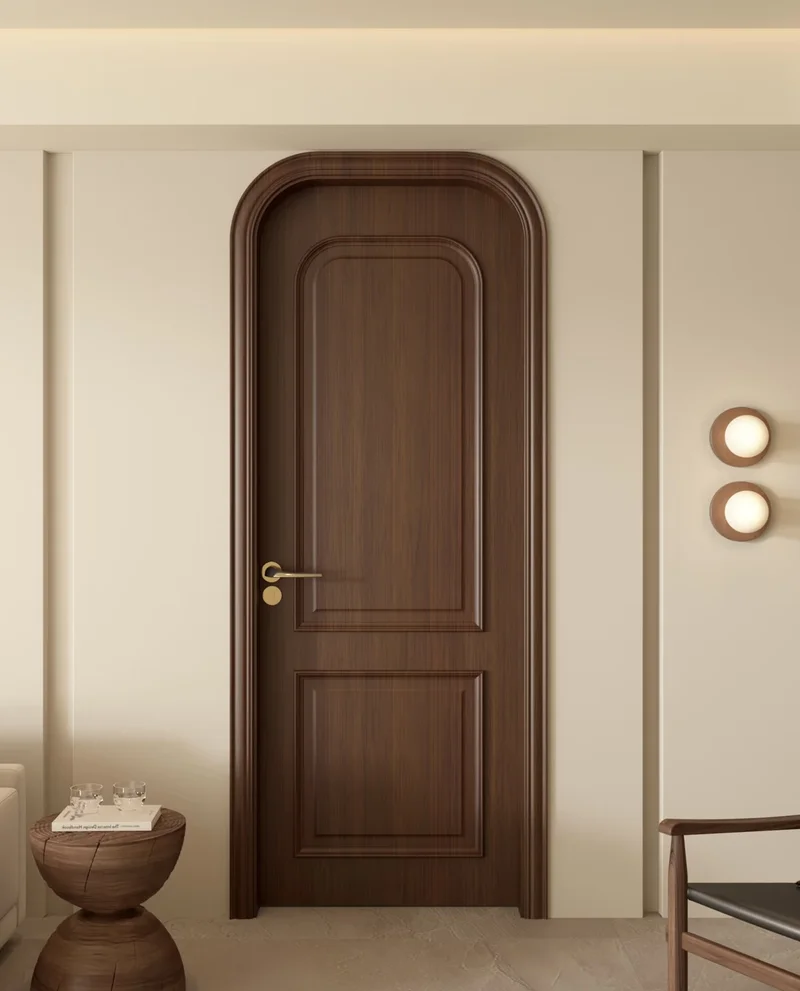
- Core & Material Engineering: Doors utilized a 3-ply cross-laminated LVL (Laminated Veneer Lumber) core with a moisture content stabilized at 8% (±1%). The core was encapsulated with a 6mm WPC (Wood-Plastic Composite) substrate (density: 1.25 g/cm³) on both faces before applying the 6mm solid oak veneer. This WPC layer acts as a hydrostatic barrier, reducing the door’s overall moisture absorption rate to <2.5%.
- Performance Certification: Third-party lab testing confirmed a swelling rate of ≤0.15% after 72-hour immersion (ASTM D1037). Acoustic performance achieved STC 34, validated per ASTM E90.
- Process Assurance: Full digital traceability from rough opening dimensions (tolerance: +2mm/-1mm) to final finishing, managed under our ISO 9001:2015 certified quality management system. This ensured zero on-site rework for fit.
Case Study 2: Boutique Hotel Chain, Historic District Renovation
Project Challenge: Custom, non-standard sized (up to 2800mm height) solid wood doors for 120 guest suites, requiring Class B fire ratings (EN 13501-2) and ultra-low VOC emissions to meet strict indoor air quality protocols.
Technical Solution & Validation:
- Fire & Safety Compliance: Door construction integrated a proprietary, intumescent sealant system within the stile and rail joinery and a certified fire-retardant treated LVL core. Achieved a 30-minute integrity (EI30) rating.
- Material Health: All adhesives and catalyzed lacquer finishes were specified to meet E0 formaldehyde emission levels (≤0.05 ppm per JIS A 1460 / EN 717-1). This was verified via batch-specific mill certificates.
- Bespoke Manufacturing: CNC machining of custom rail and stile profiles ensured historical aesthetic replication while maintaining the fire-rated assembly’s integrity. Each door’s unique size and hardware prep was documented in a digital fabrication file.
Certifications & Technical Standards Compliance
Our full-process control is validated by independent certifications, providing verifiable performance data for specification.
Material & Product Performance Certifications
| Standard | Scope / Parameter | Certified Performance / Grade | Relevance for Bulk Orders |
| :— | :— | :— | :— |
| ISO 9001:2015 | Quality Management System | Certified | Ensures process consistency, traceability, and defect prevention across thousands of units. |
| EN 14351-1 / ASTM E1886 | Door Set Performance | U-factor ≤1.2 W/(m²·K), Air Infiltration Class 4 | Guarantees thermal and airtightness performance for energy-efficient building envelopes. |
| CARB Phase 2 / EN 13986 | Formaldehyde Emissions | E0 / Super E0 Grade | Provides legally compliant, health-safe indoor air quality documentation. |
| ASTM D1037 | Dimensional Stability | Swelling Rate <0.2% (24h water immersion) | Predicts long-term performance in variable humidity, critical for project logistics and warranties. |
Key Functional Advantages Validated by Testing:
- Structural Integrity: LVL core doors demonstrate a torsional stability increase of over 40% compared to traditional solid block cores, eliminating warping in transit and service.
- Surface Durability: 7-layer UV-cured catalyzed lacquer finishes achieve a Shore D hardness of >85, withstanding over 1,000 cycles in abrasion tests (EN 15185).
- Acoustic & Thermal Performance: Our standard 45mm door construction achieves STC 30-36 and a typical U-factor of 1.1-1.4 W/(m²·K), supporting LEED and BREEAM credits.
- Finish Longevity: Accelerated weathering testing (ASTM G154) confirms less than ∆E 2.0 color shift after 2,000 hours of UV exposure for our pre-finished products.
Frequently Asked Questions
What are the technical specifications for preventing warping in large-format solid wood doors?
Our engineered LVL core and cross-laminated construction counteract wood’s natural stress. Doors are precision-machined to a moisture content of 8-12%, matching the installation environment’s equilibrium. This, combined with a full-perimeter, multi-point locking hardware system, ensures dimensional stability against seasonal humidity shifts.
How do you ensure compliance with stringent formaldehyde emission standards (E0/ENF)?
We exclusively use ultra-low-emission adhesives and finishing systems certified to ENF (≤0.025 mg/m³) or CARB Phase 2 standards. Every batch of core materials and surface coatings undergoes chamber testing, with documentation provided. This guarantees indoor air quality safety for sensitive environments like healthcare and residential spaces.
What is the process for achieving high sound insulation (STC/Rw ratings)?
We build a multi-density composite structure: a high-mass WPC skin (density ≥ 800 kg/m³), a decoupled LVL core, and acoustic sealant channels. This assembly achieves STC 35-40 dB. Critical is the integration of full-perimeter magnetic seals and a 3-point locking system to eliminate flanking noise paths.
How is thermal insulation and energy efficiency engineered into the door system?
The core utilizes a honeycomb or insulated foam insert with a low thermal conductivity coefficient (λ ≤ 0.035 W/m·K). Combined with thermally broken frames and triple-seal gaskets, the overall U-value can reach ≤1.2 W/m²·K. This significantly reduces energy transfer and prevents condensation.
What surface treatments provide durability against impact and UV degradation?
We apply a 5-layer UV-cured polyester coating or a 0.5mm PVC laminate with anti-UV additives. This finish undergoes a 1000-hour QUV accelerated weathering test, ensuring colorfastness and resistance to abrasion (≥500 cycles, Taber test) and impact (IK08 rating), suitable for high-traffic commercial entrances.
For bulk customization, how do you handle precise sizing and tolerance control?
We employ CNC digital templating from on-site laser measurements. Tolerances are held to ±1mm for door slabs and ±1.5mm for frame profiles. A digital twin of each opening is created pre-production, ensuring perfect fit and accounting for structural settlement or irregular reveals in the building.
What is the structural reinforcement for heavy-duty or oversized door leaves?
For leaves exceeding standard dimensions, we integrate a galvanized steel reinforcement grid within the WPC composite skin and use a multi-ribbed LVL core. Hinge areas receive embedded steel plates. This maintains structural integrity, preventing sagging under weights over 80kg while allowing for standard hardware operation.