Solid Wood Door Wholesale Manufacturer: Engineering, Procurement, Pricing, Quantity Discounts & National Delivery
In the world of construction and design, specifying a solid wood door is a statement of quality and permanence. Partnering with the right wholesale manufacturer, however, is what transforms that statement into a seamless, value-driven reality. This article delves into the critical partnership between specifiers and a dedicated solid wood door producer, exploring the integrated journey from initial engineering and precise procurement to transparent pricing structures. We will examine how tailored quantity discounts can optimize project budgets and how a robust national delivery network ensures these crafted essentials arrive on time, every time, regardless of scale or location. Discover how the right manufacturing alliance elevates procurement from a simple transaction to a cornerstone of project success.
Maximize Project Value with Engineered Solid Wood Doors: Durability and Aesthetic Appeal for Commercial and Residential Applications
Engineered solid wood doors represent a significant evolution from traditional solid timber, offering superior dimensional stability and consistent performance through advanced material science and manufacturing. The core value lies in the precise lamination and treatment of wood components to mitigate inherent weaknesses, such as warping and checking, while enhancing structural integrity and longevity.
Material Science & Core Construction
The performance hierarchy begins with the core. Our engineered doors utilize a cross-laminated LVL (Laminated Veneer Lumber) or stave core. LVL cores provide exceptional stability, with a modulus of elasticity (MOE) exceeding 1.4 million psi, ensuring minimal deflection under load and humidity cycles. For stave-core constructions, individual wood blocks are kiln-dried to 6-8% moisture content, end-jointed, and laminated under high pressure with alternating grain orientation. This process reduces linear expansion to less than 0.5% across a 90% relative humidity range, a critical factor for national delivery and installation in diverse climates.
Face veneers, typically 1/16″ to 1/28″ thick, are precision-sliced from select hardwood species and bonded to the core using exterior-grade phenolic adhesives. This creates a monolithic structure where the face and core move as a single unit, eliminating delamination risk. For specialized applications, composite facings like high-density WPC (Wood Plastic Composite) are available, offering a Shore D hardness exceeding 80 and near-zero water absorption.
Technical Performance Standards
Compliance with international standards is non-negotiable for commercial applications. Our engineered doors are tested and certified to meet the following key benchmarks:
- Structural & Durability: ASTM E2066 (Cycle Testing), NAFS-08 (North American Fenestration Standard).
- Fire Rating: Certified to EN 1634-1 or ASTM E84 for 20-minute, 45-minute, and 60-minute fire door assemblies, including full hardware preparation.
- Environmental & Health: Adhesives and substrates conform to E0 (<0.5 mg/L) and E1 (<1.5 mg/L) formaldehyde emission grades per EN 13986. Factory processes are ISO 9001:2015 certified.
- Acoustic Performance: Laboratory-tested to achieve sound transmission class (STC) ratings up to STC 38 for single doors and STC 45 for paired assemblies, a critical specification for multi-family residential, hospitality, and office environments.
Functional Advantages for Project Value
- Predictable Project Scheduling: Factory-controlled moisture content and pre-finishing eliminate on-site sanding, staining, and sealing, reducing labor costs and accelerating close-in.
- Reduced Lifecycle Cost: Enhanced stability drastically reduces callbacks for warping, sticking, or gap issues. The durable factory-applied UV-cured catalyzed varnish or polyester finish resists abrasion, chemicals, and UV degradation.
- Design Flexibility without Compromise: Available in any architectural wood species as a veneer, providing the aesthetic of premium hardwoods (e.g., White Oak, Walnut, Mahogany) with the performance of an engineered product. Can be specified for oversized openings without performance degradation.
- Superior Environmental Buffering: The engineered core and sealed edges provide a low U-factor for thermal insulation and act as a hygroscopic buffer, contributing to indoor air quality and building envelope efficiency.
Technical Specification Comparison: Core Types
| Parameter | LVL (Laminated Veneer Lumber) Core | Stave (Solid Wood Block) Core | Composite (WPC/HDF) Core |
|---|---|---|---|
| Primary Application | High-traffic commercial, humid environments (e.g., hospitals, schools) | Premium residential, corporate offices where traditional “heft” is desired | Extreme moisture zones, coastal properties, locker rooms |
| Dimensional Stability (Swelling Rate) | < 0.3% @ 65-95% RH | < 0.5% @ 65-95% RH | < 0.1% @ 65-95% RH |
| Weight (for 3’0″ x 7’0″ door) | Medium | High | Low-Medium |
| Acoustic Insulation (STC) | Excellent (34-38) | Excellent (35-39) | Good to Excellent (32-36) |
| Machinability for Hardware | Superior; clean, predictable edge for mortises and bores | Very Good; consistent with solid wood | Excellent; no tear-out, ideal for intricate profiles |
Procurement & Specification Guidance
When specifying, provide the following to ensure optimal product selection: Door Type (Flush, Panel), Core Type (per table above), Face Veneer Species & Grade, Fire Rating Required (if any), Acoustic Rating (STC target), Hardware Prep (template), and Finish (Factory-primed, Pre-finished, or Unfinished). Our engineering team can provide detailed shop drawings and performance data sheets for submittal packages.
Streamline Procurement with Wholesale Solutions: Custom Orders, Bulk Pricing, and Efficient Supply Chain Management
Custom Order Engineering & Material Specifications
Customization is a core engineering function, not merely a service. Our process begins with a technical review of architectural drawings and performance requirements to ensure the proposed design meets structural, environmental, and regulatory demands. We engineer doors to precise specifications:
- Core Configurations: Selection is based on load and stability requirements. Options include:
- Solid LVL (Laminated Veneer Lumber) Core: Engineered for maximum dimensional stability (<2% moisture-induced swelling) and flatness, preventing warping in high-traffic or variable-humidity environments.
- Solid Timber Block Core: For traditional heavy-weight applications, using kiln-dried staves to minimize movement.
- Hollow Core with Reinforced Grid: For lightweight interior applications, utilizing a structural honeycomb or grid system.
- Material Science for Components: We specify materials based on quantified performance.
- Veneers & Solid Wood: Precision-sliced or rotary-cut veneers (0.6mm – 1.0mm) over engineered cores, or solid wood stave construction. All timber is kiln-dried to 8-12% moisture content.
- Technical Overlays: For high-durability areas, we offer WPC (Wood-Plastic Composite) overlays with controlled density (≥0.9 g/cm³) and PVC-wood composite laminates with optimized polymer-to-wood fiber ratios for impact resistance (Shore D >75) and moisture impermeability.
- Performance Grading: Doors are fabricated to meet or exceed defined standards.
- Acoustic Performance: Achievable up to Rw 37 dB (EN ISO 10140-2) through specific core infill, sealing systems, and mass optimization.
- Fire Resistance: Certified constructions available up to FD 60 / 90 (EN 1634-1) or 20/45/90-minute (ASTM E84), utilizing non-combustible mineral cores and intumescent seals.
- Environmental & Health: All composite materials and adhesives comply with E0 (≤0.5 mg/L) or E1 (≤1.5 mg/L) formaldehyde emission grades (EN 13986). Finishes are low-VOC.
Bulk Pricing & Quantity Discount Structure
Our pricing model is transparent and scales with volume, reflecting efficiencies in raw material procurement, production line optimization, and logistics. Discount tiers are applied to the total project order value.
| Order Value Tier (USD) | Estimated Discount | Primary Engineering Benefit Enabled |
|---|---|---|
| $10,000 – $24,999 | 5-7% | Standardized production runs of custom specs; bulk adhesive/paint procurement. |
| $25,000 – $49,999 | 8-12% | Dedicated machine calibration for complex profiles; optimized veneer yield from full flitches. |
| $50,000+ | 13%+ | Full production line dedication; advanced QA/QC protocols (e.g., 100% moisture content scan); value engineering consultation. |
- Fixed-Cost Engineering: Prototyping and tooling costs for unique custom designs are amortized across the total order, becoming negligible at higher volumes.
- Material Yield Optimization: Bulk purchasing of premium veneers, solid wood, and engineered composites allows for selective matching and minimal waste, passing cost savings forward.
Efficient Supply Chain & National Delivery Logistics
Our supply chain is engineered for predictability and integrity, from forest to final mile. Certified to ISO 9001:2015, our system ensures traceability and consistent quality.
- Raw Material Sourcing & Pre-processing: Long-term contracts with sustainable timber plantations and composite material producers guarantee consistent grade and supply. In-house kiln drying and LVL pressing provide full control over core substrate stability.
- Production Scheduling: Advanced MRP software aligns custom order manufacturing with material lead times, creating a predictable pipeline. Bulk orders are sequenced to maintain flow efficiency without compromising cure times for adhesives and finishes.
- National Delivery & Packaging: Finished doors are crated for protection against transit hazards (moisture, impact).
- Packaging Standard: Each door is shrink-wrapped, with corners protected by rigid foam and carded. Crates are constructed from moisture-resistant OSB.
- White-Glove Logistics: We partner with national carriers specializing in flat goods. Delivery includes pre-scheduled notification, curbside offloading with MHE (Material Handling Equipment), and optional job-site placement.
- Documentation: Each shipment includes a comprehensive pack list, mill certificates for treated wood, and applicable compliance certificates (fire rating, formaldehyde emissions).
Optimize Budgets with Transparent Pricing and Volume Discounts: Cost-Effective Solutions for Large-Scale Projects
Our pricing model is engineered for predictability, eliminating hidden costs through a transparent, quantity-tiered structure. This allows for precise budget allocation from project inception, particularly critical for multi-unit developments, hospitality chains, and national retail rollouts where aggregate material costs directly impact ROI.
Core Technical & Procurement Advantages:
- Material Cost Optimization: Bulk procurement of core materials—such as high-density LVL (Laminated Veneer Lumber) for dimensional stability, and certified E0/E1-grade solid wood components—reduces unit cost. We leverage economies of scale in sourcing premium, defect-free timber and engineered wood composites, passing the savings directly to your project.
- Streamlined Logistics: National delivery of full truckload (FTL) quantities is consolidated and optimized, significantly reducing per-unit freight costs and on-site handling. Our packaging is engineered to prevent transit damage (meeting ASTM D4169 standards), ensuring 100% usability upon arrival and eliminating costly replacements.
- Production Efficiency: Large-scale orders enable continuous, optimized manufacturing runs. This minimizes machine changeover downtime and allows for batch processing of finishes and treatments, ensuring consistent quality and a lower cost basis per door.
Volume Discount Tiers & Technical Specifications
Discounts are applied based on total order quantity, with tiers designed to reward project scale. The following table outlines standard tier benefits, with all products maintaining baseline performance specifications.
| Order Quantity Tier | Typical Project Scale | Discount Range | Included Technical Assurance |
|---|---|---|---|
| Tier 1: 50 – 199 units | Multi-family residential blocks, boutique hotels | 5% – 9% | ISO 9001 quality management, standard fire rating certification (e.g., EN 1634-1), E1 formaldehyde grade. |
| Tier 2: 200 – 499 units | Large apartment complexes, mid-scale hospitality | 10% – 14% | Enhanced specifications: Upgraded to E0 formaldehyde grade, option for enhanced core (e.g., solid LVL for improved acoustic performance >28 dB). |
| Tier 3: 500+ units | National retail chains, major residential developments, large institutional | 15%+ (Custom Quote) | Full engineering support: Custom fire ratings (up to 90-min), tailored U-factors for energy codes, specialized finishes for high-traffic areas (Shore D hardness >75), and dedicated production line scheduling. |
Engineering-Led Value for Large Projects:
Beyond unit price, true cost-effectiveness is achieved through performance longevity and reduced total cost of ownership. Our doors are engineered to meet rigorous architectural demands:
- Durability & Stability: LVL and solid wood core constructions are precision-engineered for minimal swelling (<0.5% moisture absorption rate in controlled tests) and superior resistance to warping, ensuring long-term operation and fit.
- Performance Compliance: Products are tested to relevant EN and ASTM standards for fire resistance, sound insulation (achieving up to 32 dB reduction in specified configurations), and structural load. This ensures compliance with building codes, avoiding costly retrofits.
- Lifecycle Costing: Transparent pricing allows for accurate lifecycle cost analysis. The superior material integrity and finish durability of our products reduce maintenance, repair, and replacement frequency over the building’s lifespan.
For projects exceeding 500 units, our engineering team provides direct consultation to optimize specifications—such as adjusting panel thickness, core material, or finish type—to meet exact performance requirements while maximizing budget efficiency.
Ensure Structural Integrity and Performance: Technical Specifications for Load-Bearing, Insulation, and Environmental Resistance
Core Structural Integrity: Load-Bearing & Dimensional Stability
The structural performance of a solid wood door is dictated by its core construction and material composition, not merely its thickness. Our engineering prioritizes long-term dimensional stability to prevent warping, sagging, or binding.
- Engineered LVL (Laminated Veneer Lumber) Core: Utilized in high-stress applications (e.g., large-format doors, high-traffic entries), LVL provides superior load-bearing capacity and resistance to warping compared to traditional solid block cores. Its cross-laminated structure neutralizes internal wood stresses, ensuring consistent flatness and hinge/screw holding power.
- Advanced Edge-Banding & Sealing: All door edges are sealed with high-pressure laminate or PVC edge-band. This critical barrier minimizes moisture ingress, the primary cause of swelling, and protects the substrate from impact damage.
- Frame Compatibility & Hardware Integration: Doors are engineered to standard industry rough openings with clear tolerances. Reinforced hinge and lock block areas are standard, using engineered hardwood or composite substrates to securely accommodate heavy-duty architectural hardware cycles exceeding 100,000 uses.
Technical Parameters for Dimensional Stability & Load
| Parameter | Specification | Test Standard / Rationale |
|---|---|---|
| Warp/Twist Tolerance | ≤ 1.5 mm per linear meter | ASTM E 2010 / Ensures proper operation within frame. |
| Swelling Rate (Edge) | ≤ 0.3% after 24h water immersion | EN 317 (modified) / Predicts performance in high-humidity environments. |
| Core Density (LVL/Composite) | 650 – 750 kg/m³ | Manufacturer’s QC / Optimizes strength-to-weight ratio. |
| Screw Withdrawal Resistance | ≥ 1100 N | EN 320 / Guarantees secure hardware attachment. |
Performance Envelope: Thermal & Acoustic Insulation
Doors function as integral components of a building’s thermal and acoustic envelope. Our specifications target measurable performance metrics for energy efficiency and sound attenuation.
- Thermal Insulation (U-Factor): The overall U-factor is engineered through core material selection and sealing integrity. Doors with insulated cores (e.g., polyurethane foam) achieve superior performance. Full-perimeter magnetic or compression gaskets are critical to eliminating air infiltration, the largest contributor to thermal loss.
- Acoustic Performance (Sound Reduction): Mass and airtight sealing are the primary determinants of Sound Transmission Class (STC). Solid wood and composite cores provide inherent mass. Acoustic ratings are validated through gasketed assembly testing, not the door slab alone.
Insulation Performance Specifications
| Performance Metric | Typical Range | Application Context |
|---|---|---|
| Thermal Transmittance (U-Factor) | 1.2 – 2.5 W/m²·K | Dependent on core type, glazing, and seals. Lower values indicate better insulation. |
| Air Infiltration Rating | Class 4 (≤ 3.0 m³/h·m²) | EN 12207 / Indicates superior perimeter seal effectiveness. |
| Sound Reduction Index (Rw) | 28 – 35 dB | EN ISO 10140-2 / Suitable for interior office (28-30 dB) or entry/quiet room (33+ dB) applications. |
Material Science & Environmental Resistance
Long-term durability is a function of material science, addressing moisture, fire, and chemical resistance through precise formulation and treatment.
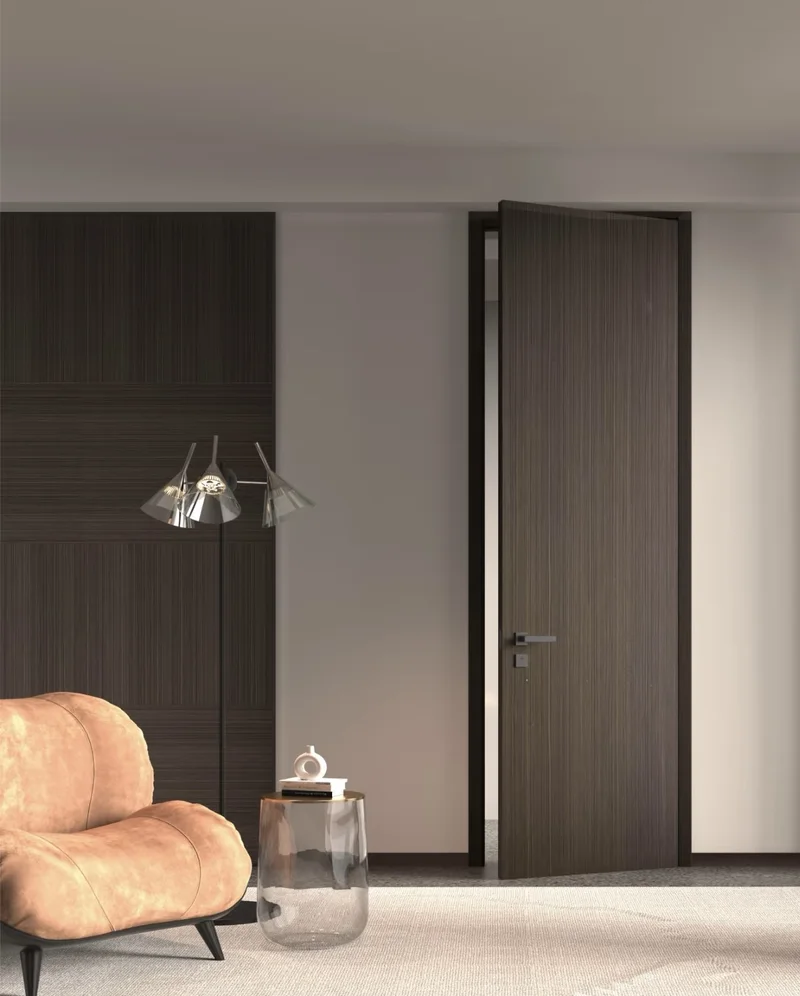
- Moisture Management: All wood components are kiln-dried to ≤ 10% moisture content. Factory-applied, multi-coat finishing systems (UV-cured polyurethane, polyester) provide a continuous, low-permeability barrier. For high-humidity zones, doors utilize WPC (Wood Plastic Composite) or stabilized MDF substrates with moisture absorption rates below 8%.
- Fire Performance: Doors can be manufactured to meet certified fire ratings (e.g., 30/60/90 minutes). This involves the integration of non-combustible mineral cores, certified intumescent seals, and specialized hardware. All fire door assemblies are supplied with evidence of certification to EN 1634-1 or equivalent.
- Formaldehyde & VOC Emissions: All composite materials (panels, cores, adhesives) comply with stringent E1 (≤ 0.1 ppm) or CARB Phase 2 emission standards, ensuring indoor air quality and compliance with green building programs.
- Surface Durability: High-pressure laminate (HPL) and thermofoil finishes offer exceptional resistance to abrasion, impact, and cleaning chemicals, with scratch resistance exceeding Shore D 75.
Build Trust with Nationwide Delivery and Support: Reliable Logistics, Installation Guidance, and Quality Assurance
Nationwide Delivery & Technical Support Framework
Our logistics network is engineered for precision, not just transportation. We guarantee on-site delivery of defect-free products through a system built on palletized, climate-controlled transport and real-time GPS tracking for all national shipments. Each door is crated with engineered corner protection and desiccant packs to maintain specified moisture content (typically 6-8% for interior, 9-12% for exterior grades) during transit, preventing warping or checking.
Core Functional Advantages of Our Support System:
- Predictable Logistics: Consolidated shipments with advanced shipment notifications (ASNs), bill of lading detail, and scheduled delivery windows to align with your project critical path.
- Pre-Installation Guidance: Access to detailed technical submittals, including material datasheets, ASTM E84 / EN 13501-1 fire performance ratings, and CAD details for proper rough-opening preparation and flashing integration.
- Post-Delivery Assurance: A structured quality assurance protocol includes batch-specific documentation and a direct line to our engineering team for technical consultation on-site adjustments or performance validation.
Technical Performance & Compliance Assurance
Every door system is accompanied by a comprehensive performance dossier. This is not merely a warranty; it is a verification of conformance to the engineered specifications agreed upon during procurement.
| Parameter | Test Standard | Typical Performance Range | Importance for Installation & Longevity |
|---|---|---|---|
| Dimensional Stability (Swelling Rate) | ASTM D1037 | ≤ 0.3% (24h water immersion) | Ensures consistent fit within frame; critical for humidity-controlled and exterior applications. |
| Sound Transmission Class (STC) | ASTM E90 | 26-32 dB (core & seal dependent) | Verifies acoustic performance for multi-family residential and commercial partitions. |
| Formaldehyde Emission | EN 16516 / ASTM E1333 | E0 (<0.05 ppm) or E1 (<0.1 ppm) | Confirms indoor air quality compliance for healthcare, education, and residential projects. |
| Surface Hardness | ASTM D2240 (Shore D) | 75-82 (for finished surfaces) | Indicates resistance to impact and abrasion during handling and in service. |
| Thermal Insulation (U-Factor) | ASTM C1363 | 0.20 – 0.35 Btu/(ft²·°F·hr) | Validates energy code compliance for exterior door assemblies. |
Our quality management system, certified to ISO 9001:2015, governs material sourcing, manufacturing, and final inspection. This ensures traceability from forest to job site, with core materials like LVL (Laminated Veneer Lumber) verified for uniform density (≥ 40 pcf) and void-free construction to guarantee screw-holding power and hinge longevity. For composite elements, we strictly control the wood-PVC ratio and WPC (Wood Plastic Composite) density (≥ 1.3 g/cm³) to optimize durability and moisture resistance without sacrificing machinability.
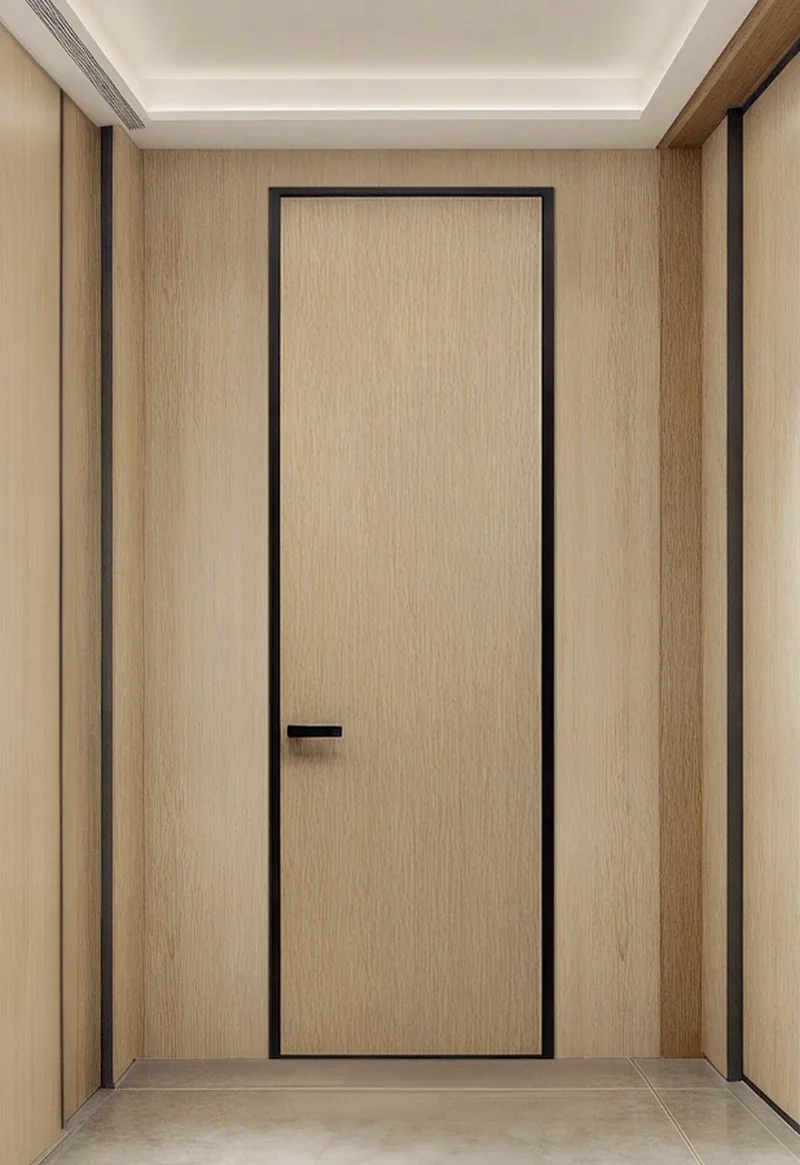
Final pre-shipment inspection includes checks for:
- Laminate adhesion strength (≥ 4.5 N/mm² per EN 438).
- Hardware preparation alignment (± 0.8mm tolerance).
- Finish integrity and color consistency (ΔE < 1.5 under controlled lighting).
Frequently Asked Questions
What are your solid wood doors’ moisture expansion control measures?
Our doors use kiln-dried timber (8-12% moisture content) with integrated LVL core stabilization. The multi-layer UV-cured coating provides a 60-micron moisture barrier. This engineering limits expansion to ≤0.3%, ensuring dimensional stability in humidity fluctuations from 30% to 70% RH, preventing binding or gaps.
How do your doors comply with international formaldehyde emission standards?
We exclusively use E0-grade (<0.05 ppm) adhesives and finishes, certified to EN 717-1 standards. Our WPC composite components have near-zero inherent emissions. Each batch undergoes chamber testing, with documentation provided for LEED or BREEAM compliance, ensuring indoor air quality safety.
What is the thermal insulation performance of your engineered wood doors?
Our doors achieve a U-value of ≤1.2 W/m²K. This is accomplished through a cellular WPC core (density ≥650 kg/m³) and optional polyurethane foam infill. The thermally broken frame design and magnetic sealing gaskets eliminate cold bridging, significantly reducing energy transfer.
What structural reinforcements prevent long-term warping or sagging?
We employ a 3-ply cross-laminated LVL (Laminated Veneer Lumber) core with a modulus of elasticity >10,000 MPa. This is paired with full-height stainless steel hinge reinforcement plates and a rigid WPC sub-frame. This system resists torsional stress, guaranteeing alignment under loads up to 120kg.
Can you detail the impact resistance and surface durability?
Surfaces feature a 0.5mm PVC laminate or 8-layer catalyzed lacquer finish with a 3H+ pencil hardness rating. The high-density core withstands impacts up to 100 Joules without denting. This is suitable for high-traffic commercial applications, maintaining aesthetics through rigorous cleaning cycles.
What sound insulation levels do your solid wood doors provide?
Our acoustic series doors achieve STC 32-38 dB. This performance comes from a mass-loaded core, asymmetric panel construction, and perimeter compression seals with a minimum 5mm gap coverage. This effectively attenuates speech and ambient noise for private or demanding environments.
Is national delivery and logistics for large wholesale quantities managed in-house?
Yes. We operate a dedicated logistics division with climate-controlled transport. For orders exceeding 50 units, we implement a just-in-time delivery schedule using GPS-tracked vehicles. This includes professional job-site unloading and staging to prevent on-site damage and streamline your project timeline.