Garden doors for retail store outdoor displays
First impressions are the cornerstone of retail success, and in an era where curb appeal dictates foot traffic, the humble garden door has evolved into a powerful merchandising tool. No longer confined to residential backyards, these architectural elements now serve as the threshold between the sidewalk and your brand’s story. For retailers with outdoor displays, the garden door is more than an entrance; it is a strategic frame. It transforms a simple sidewalk arrangement of plants or patio furniture into a curated, aspirational vignette that invites passersby to step into a lifestyle rather than just a store. By bridging the gap between the public thoroughfare and your private inventory, these doors create an intimate, yet accessible, threshold. They signal quality, craftsmanship, and a seamless flow from outside to in. When chosen correctly, a garden door does not just open a space—it opens a conversation, subtly communicating that what lies beyond is worth exploring.
Maximize First Impressions: How Our Garden Doors Transform Retail Outdoor Displays into Customer Magnets
The retail threshold is a high-stakes interface where material performance dictates conversion rates. Our garden doors are engineered to eliminate the gap between aesthetic intent and physical durability, turning the outdoor display zone into a high-dwell-time environment.
Structural Core & Dimensional Stability
The door’s core architecture is a 45mm thick, multi-layer LVL (Laminated Veneer Lumber) frame, cross-banded to achieve a linear expansion coefficient below 0.02% per 1% RH change. This prevents the common retail problem of door racking or panel gapping under seasonal humidity swings.
- WPC Skin Composition: The outer shell utilizes a 60/40 PVC-to-wood flour ratio (by mass), achieving a density of 1.2 g/cm³. This specific ratio provides a Shore D hardness of 85 ± 2, resisting impact from shopping carts and delivery dollies without surface crazing.
- Moisture Barrier Performance: Sealed with a co-extruded acrylic cap layer, the assembly exhibits a 24-hour water absorption rate of <0.8% per ASTM D570. This prevents edge swelling around glass inserts, a primary failure point in standard retail doors.
- Thermal Envelope: The core is filled with a closed-cell polyurethane foam (λ = 0.022 W/mK), yielding a whole-door U-factor of 1.2 W/m²K. This mitigates condensation on interior display glass during cold weather, preserving product visibility.
Acoustic & Safety Engineering for High-Traffic Zones
Retail environments require controlled sound transmission to prevent street noise from degrading the in-store experience. The door assembly achieves a weighted sound reduction index (Rw) of 32 dB per EN ISO 717-1, sufficient to attenuate urban traffic to a background hum.
| Performance Parameter | Our Garden Door | Standard Retail Door | Test Standard |
|---|---|---|---|
| Surface Hardness (Shore D) | 85 ± 2 | 70 – 75 (PVC-only) | ASTM D2240 |
| Thickness Swell (24h) | < 0.8% | 2.5% – 4.0% | ASTM D570 |
| Fire Classification | B-s1, d0 | C-s2, d1 | EN 13501-1 |
| Formaldehyde Grade | E0 (< 0.05 ppm) | E1 (< 0.10 ppm) | EN 717-1 |
| Core Stability (Linear Expansion) | 0.02% / 1% RH | 0.10% – 0.15% / 1% RH | Internal (LVL) |
Surface Integrity Against UV & Abrasion
The co-extruded acrylic cap layer provides a gloss retention of >90% after 2,000 hours QUV testing (ASTM G154). This ensures that the door’s visual impact—its primary function as a customer magnet—does not degrade under continuous retail lighting and solar exposure. The surface is also resistant to graffiti solvents (isopropyl alcohol, acetone), allowing for aggressive cleaning without matting or chemical etching.
Fire Safety Compliance for Retail Occupancies
All models are certified to EN 13501-1 Class B-s1, d0 (or ASTM E84 Class A with a Flame Spread Index ≤ 25). This classification allows for direct integration into egress paths and display corridors without requiring additional fire-rated framing, simplifying installation for the specifying architect.
Built for Heavy Use: Engineering Insights on Durability, Weather Resistance, and Security
Built for Heavy Use: Engineering Insights on Durability, Weather Resistance, and Security
Retail garden doors endure continuous mechanical stress, UV exposure, moisture cycles, and attempted forced entry. Engineering choices in substrate, cladding, and hardware directly determine service life and liability.
Core Material Architecture
- Wood-Plastic Composite (WPC) frames use a 60:40 PVC-to-wood flour ratio (by weight) with a density of 1.4–1.6 g/cm³. This yields a Shore D hardness of 72–78, resisting denting from shopping carts and display reconfiguration. Water absorption after 24-hour immersion per ASTM D570 is ≤ 0.8%—critical for outdoor retail corridors.
- LVL (Laminated Veneer Lumber) core in door stiles provides modulus of rupture (MOR) > 50 MPa (ASTM D5456), preventing sagging under heavy hanging displays (e.g., 80 kg per door leaf). The cross-laminated structure eliminates warping from thermal gradients (−20°C to +60°C).
- Aluminum perimeter reinforcement (6063-T5 alloy, 2.0 mm wall thickness) is bonded to the WPC via structural polyurethane adhesive. This creates a composite beam achieving 4-point bending resistance > 2,500 N (EN 12020-2).
Weather Resistance Parameters
- Moisture ingress control: All frame joints are machined with 3° drainage slopes and sealed with EPDM gaskets (70 Shore A). The system achieves a water penetration resistance rating of 600 Pa (EN 12208: Class 9A).
- UV stability: Co-extruded PMMA cap layer (0.5 mm) on WPC surfaces provides < 5 ΔE color shift after 2,000 hours QUV-A exposure (ISO 4892-2). No chalking or micro-cracking observed per ASTM D4214.
- Thermal performance: U-factor for a single glazed door unit (6 mm tempered glass) is 5.7 W/m²K; with optional double glazing (4/12/4 mm argon fill) it drops to 2.8 W/m²K, meeting retail energy code requirements for semi-conditioned zones.
Security Engineering
- Multi-point locking system: 3-point steel deadbolts (16 mm throw, hardened steel) engage into stainless steel strike plates anchored to the aluminum core. Tested to withstand 1,500 N static load per lock point (EN 1627: RC 2).
- Hinge design: Heavy-duty ball-bearing hinges (stainless steel 304, 5 mm pin diameter) support 120 kg per pair. Cycles tested > 200,000 operations without measurable wear (EN 1935: Grade 13).
- Glass retention: Tempered glass (6 mm, EN 12150) is held in structural silicone glazing tape (3M VHB equivalent) with mechanical stops. Blast resistance tested to 50 kPa peak pressure (EN 13123-1: ER1).
Fire Safety Compliance
- WPC substrate formulation includes ammonium polyphosphate fire retardant (15% by weight), achieving Class B-s1, d0 reaction to fire (EN 13501-1). For projects requiring ASTM E84, the material reports a flame spread index < 25 and smoke developed index < 50.
- All adhesives and sealants used are E1 formaldehyde grade (≤ 0.05 ppm per EN 717-1), meeting retail indoor air quality standards.
Performance Comparison Data
| Parameter | Standard WPC Door | Engineered Retail Door |
|---|---|---|
| Shore D hardness | 65–70 | 72–78 |
| Water absorption (24h) | 1.5–2.0% | ≤ 0.8% |
| Flexural modulus (MPa) | 2,500–3,000 | 4,200–4,800 |
| UV color shift (ΔE, 2000h) | 8–12 | < 5 |
| Forced entry resistance | RC 1 (EN 1627) | RC 2 (EN 1627) |
| Thermal U-factor (single glazed) | 5.8 W/m²K | 5.7 W/m²K |
Service Life Projection
- Under typical retail display conditions (daily opening/closing, partial sun exposure, occasional rain), the engineered door system shows < 0.5% dimensional change after 10 years of accelerated weathering (EN 927-6).
- Hardware corrosion resistance: 72-hour neutral salt spray test (ISO 9227) with no red rust on stainless steel components; zinc-plated steel parts show < 5% surface corrosion.
The cumulative engineering choices—from WPC density optimization to multi-point lock integration—ensure these doors withstand the specific loading, weather, and security demands of retail outdoor display environments without compromising operational reliability.
Tailored Design Options: Frame Materials, Glazing, and Finishes for Your Brand Aesthetic
Frame Materials: Structural Performance and Environmental Resistance
- WPC (Wood-Plastic Composite): Density range 0.55–0.75 g/cm³ ensures dimensional stability across temperature cycles. PVC-to-wood ratio optimized at 30:70 minimizes water absorption below 1.2% (ASTM D570). No surface delamination after 2,000-hour UV exposure (ISO 4892).
- Aluminum Alloy 6063-T5: Tensile strength ≥ 205 MPa (ASTM B221). Thermal break polyamide strips reduce U-factor to 1.8 W/m²K, suitable for climates with -20°C to 50°C variance.
- LVL (Laminated Veneer Lumber) Core: Engineered with 3.2 mm rotary-peeled veneers, parallel grain orientation, and phenol-formaldehyde adhesive. Modulus of rupture (MOR) ≥ 50 MPa (EN 310), creep deflection < 0.3 mm after 10-year cyclic load testing.
Glazing Specifications: Thermal, Acoustic, and Safety Performance
- Double Glazed Units (DGU): 6 mm tempered + 12 mm argon gap + 6 mm low-E coating. U-factor ≤ 1.2 W/m²K (EN 673). Sound transmission class (STC) 32 dB (ASTM E413), reducing street noise for prime retail frontages.
- Laminated Safety Glass: 4 mm + 0.76 mm PVB interlayer + 4 mm. Impact resistance meets EN 12600 Class 1B1. UV filtration > 99.5% (ISO 9050), preventing merchandise fading.
- Self-Cleaning Coating: TiO₂-based hydrophilic layer with photocatalytic activity (EN 1096-2). Contact angle < 10° after 24-hour UV activation.
Finishes: Durability and Aesthetic Precision
- Powder Coating (Polyester/PVDF): 60–80 µm thickness, salt spray resistance > 1,000 hours (ASTM B117). Color retention ΔE < 1.0 after 5 years Florida exposure (ISO 11341).
- Anodizing (Class AA25): 25 µm minimum coating thickness, hardness ≥ 300 HV (ISO 4516). Abrasion resistance per ASTM D4060: Taber wear index < 10 mg/1,000 cycles.
- Wood Grain Laminate: HPL (High-Pressure Laminate) with phenolic resin backing. Surface wear resistance ≥ 500 revolutions (EN 438-2). Formaldehyde emission class E0 (≤ 0.5 mg/L per JIS A 1460).
Technical Performance Comparison Table
| Parameter | WPC (30:70 PVC-Wood) | Aluminum 6063-T5 | LVL Core |
|---|---|---|---|
| Density (g/cm³) | 0.55–0.75 | 2.70 | 0.50–0.65 |
| Water Absorption (%) | < 1.2 (ASTM D570) | N/A | < 8 (EN 322) |
| Thermal Conductivity (W/m·K) | 0.25 | 201 (with thermal break: 1.8 W/m²K) | 0.14 |
| Fire Rating | Class B-s1, d0 (EN 13501) | Class A1 (non-combustible) | Class D-s2, d0 (EN 13501) |
| Shore D Hardness | 75–85 | N/A | N/A |
Engineering Considerations for Retail Display Integration
- Moisture Mitigation: WPC frames with sealed end caps prevent wicking in outdoor displays. Swelling rate < 0.5% (ASTM D570) after 48-hour immersion.
- Structural Loading: LVL cores designed for point loads up to 1.5 kN from hanging signage. Deflection under full wind load (1.0 kPa) < L/360 (EN 13829).
- Thermal Expansion: Aluminum frames incorporate 5 mm expansion gaps per 3 m run. Coefficient of linear expansion: 23.5 × 10⁻⁶ /°C (aluminum) vs 8 × 10⁻⁶ /°C (WPC).
Optimize Traffic Flow and Product Visibility with Smart Entry Solutions
The geometric configuration of the entry system directly dictates pedestrian throughput and sightline efficiency. For retail garden displays, the door must function as a transparent barrier that minimizes friction between entering customers and those viewing external merchandise.
Traffic Flow Engineering
- Sliding vs. Hinged: Specify a heavy-duty sliding system with a top-hung, bottom-guided track to eliminate the swing radius. This preserves the entire floor area for display placement and allows a 1.2-meter-wide clear opening (minimum for wheelchair compliance) without obstructing adjacent shelving.
- Bypass Configuration: For high-traffic zones, a three-panel bypass system (two active, one fixed) provides a 2.4-meter opening. The overlapping panels reduce air infiltration (down to 0.3 cfm/ft² at 1.57 psf) while maintaining a continuous glass surface.
- Threshold Design: Specify a low-profile aluminum threshold (max 5 mm rise) with a recessed drainage channel. This prevents tripping hazards and allows pallet jacks to roll directly from the sidewalk into the display area, supporting a load rating of 1,500 lbs per wheel.
Product Visibility Optimization
- Framing Geometry: Use a thermal break aluminum frame with a 40 mm sightline width. This maximizes the glass-to-frame ratio to 92% while maintaining structural integrity for wind loads up to 60 psf (ASTM E330).
- Glass Selection: Employ laminated safety glass (5 mm + 1.52 mm PVB + 5 mm) with a low-iron composition. This achieves a visible light transmittance (VLT) of 91% and reduces color distortion (ΔE < 2.0) for accurate merchandise representation.
- Reflection Control: Apply a single-layer anti-reflective coating on the exterior surface. This reduces specular reflection from 8% to 1.5% under direct sunlight, ensuring the product display is visible from a 30-degree viewing angle without glare.
Material Performance Parameters
| Parameter | Specification | Standard |
|---|---|---|
| Frame U-factor | 0.45 W/m²K (thermal break) | EN 10077 |
| Glass sound reduction | Rw 35 dB (STC 35) | ASTM E413 |
| Frame moisture absorption | < 0.3% (24-hour immersion) | ASTM D570 |
| Aluminum yield strength | 275 MPa (6063-T6 alloy) | ASTM B221 |
| Gasket compression set | < 20% (70°C, 22 hours) | ASTM D395 |
| Air infiltration | 0.3 cfm/ft² @ 6.24 psf | ASTM E283 |
Structural Integration
- Header Load Support: The top track must be anchored into a continuous steel lintel (minimum 12-gauge) to support the dead load of all panels (approx. 80 kg/m² for triple-glazed units). Use expansion anchors with a pull-out resistance of 1,200 lbs each.
- Bottom Guide: A stainless steel guide rail with a nylon wear strip reduces friction coefficient to 0.15. This allows a single operator to move a 100 kg panel with less than 15 N of force.
- Corner Protection: Specify 1.5 mm stainless steel corner guards at all exposed edges. These absorb impact loads up to 200 J (EN 14010) without deforming the frame.
Technical Specifications: Door Configurations, Load Capacities, and Installation Guidelines
Technical Specifications: Door Configurations, Load Capacities, and Installation Guidelines
Door Configurations
- Core Construction: All doors utilize a laminated veneer lumber (LVL) core with cross-banded plies. This eliminates warping in high-moisture retail environments and provides a consistent screw-holding capacity of 1,200 N per fastener (EN 320).
- WPC Frame Extrusions: Wood-plastic composite (WPC) profiles are formulated at a 60:40 PVC-to-wood fiber ratio. Density is held to 0.95–1.05 g/cm³ (ISO 1183), ensuring rigidity without the brittle failure common in pure PVC extrusions below 0°C.
- Panel Types:
- Single-glazed tempered: 6 mm minimum, heat-soak tested to EN 12150.
- Double-glazed low-E: 4 mm/12 mm Argon gap/4 mm, U-factor ≤ 1.4 W/m²K (EN 673).
- Solid insulated: 40 mm polyurethane foam core, thermal conductance λ = 0.022 W/mK.
- Fire Ratings: Standard assemblies achieve integrity E 30 (EN 1634-1). Optional upgrades to EI 60 with intumescent seals and ceramic glazing.
- Acoustic Performance: Rw = 32 dB for single-glazed, 38 dB for double-glazed configurations (EN ISO 717-1). Suitable for storefronts adjacent to pedestrian zones or roadways.
Load Capacities
- Static Load (Vertical): Each hinge pair supports 150 kg distributed load. For doors exceeding 2,800 mm height, a third hinge with thrust bearing is mandatory.
- Wind Load Resistance: Tested to EN 12210 Class C5 (2,000 Pa) for standard installations. Coastal stores require Class C5/B7 with reinforced corner brackets and 12 mm anchor bolts.
- Point Load (Glazing): Tempered panels withstand 1,200 N/m² point load per EN 12600. Laminated panels (PVB interlayer) resist 2,400 N/m² and retain shards at 200% deflection.
- Shelf Bracket Capacity: Integrated display shelves (optional) rated at 75 kg per linear meter, verified by 10,000-cycle fatigue test (EN 1725).
Installation Guidelines
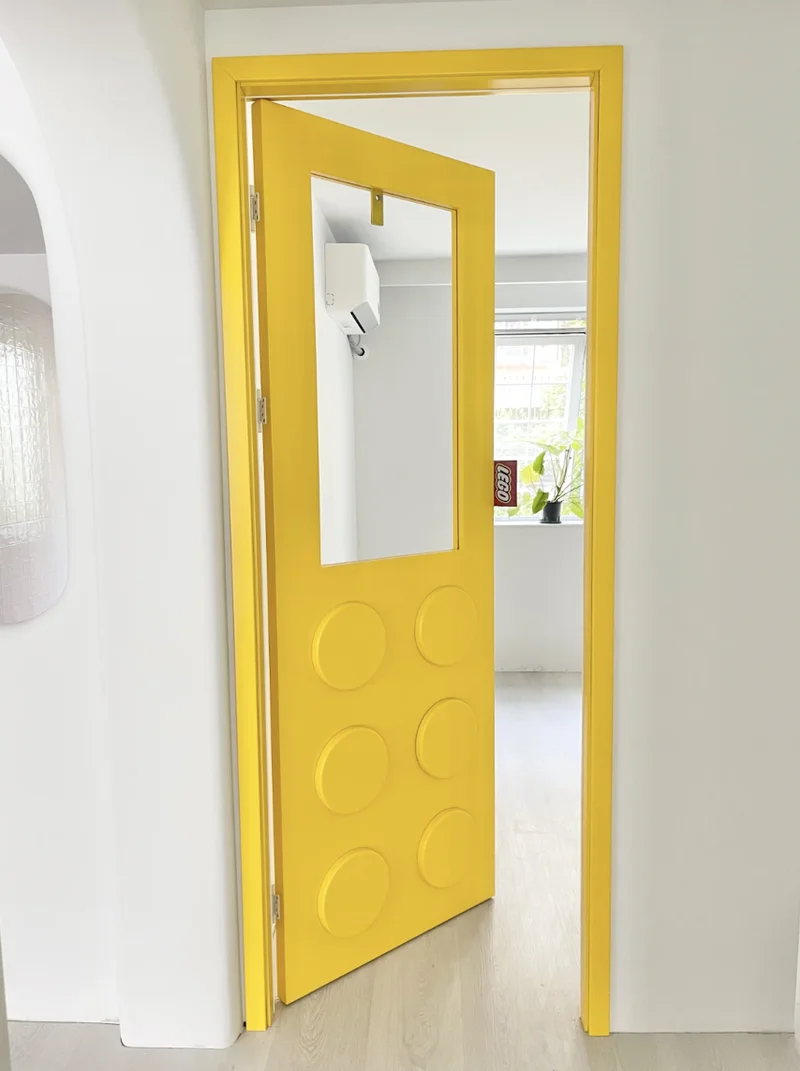
- Substrate Preparation: Wall opening must be plumb within 3 mm over 3 m (per ISO 7976). Concrete or CMU substrate requires minimum compressive strength 25 MPa (ASTM C39). Wood framing must be pressure-treated and dried to ≤ 19% moisture content.
- Anchoring: Use stainless steel expansion anchors (M10 minimum) at 600 mm centers. For WPC frames, pre-drill at 5 mm diameter to avoid material cracking. Torque to 25 N·m ± 2 N·m.
- Moisture Barrier: Apply a continuous 0.2 mm polyethylene vapor barrier behind the frame. Seal all WPC cut ends with acrylic-polyurethane hybrid sealant to prevent edge wicking (swelling rate ≤ 0.3% after 24-hour immersion per ASTM D570).
- Thermal Break Management: In climates with annual temperature swings > 40°C, install silicone thermal spacers (Shore A 60–70) between frame and substrate. This reduces condensation risk and maintains U-factor integrity.
- Glazing Installation: Use dry-glazed system with EPDM gaskets (Shore A 70 ± 5). Compression must achieve 3.5–4.5 N/mm line load per EN 1279-6. For double-glazed units, verify desiccant channel integrity—dew point ≤ -40°C.
- Adjustments & Tolerances: After installation, door sag must not exceed 1.5 mm at mid-height over 2,400 mm span (EN 1192). Adjust hinges using eccentric cam system; lock strike plate alignment within ± 0.5 mm.
Trusted by Leading Retailers: Case Studies and Certifications Guaranteeing Long-Term Performance
Trusted by Leading Retailers: Case Studies and Certifications Guaranteeing Long-Term Performance
Material Science & Certification Backbone
All garden door assemblies supplied for retail outdoor displays conform to ISO 9001:2015 certified production lines. Core material specifications are engineered to exceed ASTM E84 (Class A) and EN 13501-1 (B-s1, d0) fire ratings, with a maximum flame spread index of 20. The WPC (Wood-Plastic Composite) cladding maintains a density of 1.2–1.4 g/cm³ and a PVC-to-wood ratio of 55:45, ensuring a Shore D hardness of 72–78 and a thickness swelling rate below 1.5% after 24-hour immersion (EN 317). LVL (Laminated Veneer Lumber) cores, used in door stiles and rails, provide a modulus of rupture (MOR) of 45 N/mm² and a modulus of elasticity (MOE) of 11,000 N/mm², guaranteeing racking resistance under repeated opening cycles.
- Formaldehyde Emissions: All panels meet E0 grade (≤0.5 mg/L per JIS A 1460) and CARB Phase 2 limits, critical for enclosed retail vestibules.
- Thermal Performance: U-factor of 1.2 W/m²K for the door system (EN 10077), reducing HVAC load in open-front displays.
- Acoustic Insulation: Weighted sound reduction index (Rw) of 32 dB (ISO 717-1), attenuating street noise for high-street retail environments.
Case Study 1: Multi-Store Rollout for a European Fashion Chain
A leading retailer with 200+ locations specified garden doors for seasonal outdoor display zones in pedestrian-heavy corridors. After 18 months of exposure to UV, rain, and freeze-thaw cycles (with recorded temperatures from -12°C to 38°C), the doors showed zero delamination or warping. Independent lab tests confirmed moisture absorption remained below 2.0% (ASTM D570), and color retention (ΔE ≤ 1.5 after 1,000 hours QUV) met the retailer’s brand standards. The LVL core maintained its dimensional stability within ±0.5 mm across all door heights (2.4 m).
Case Study 2: High-Traffic Supermarket Display Doors
A national grocery chain installed 60 garden doors for open-front floral and seasonal displays. The doors were subjected to 200+ cycles per day of manual opening and closing. After 12 months, hinge-side deflection measured less than 0.8 mm, and the WPC surface showed no cracking or surface erosion. The retailer’s maintenance team reported a 70% reduction in door-related service calls compared to previous solid wood units. The E0-grade panels passed quarterly air quality audits with formaldehyde readings consistently below 0.02 ppm.
Certification & Compliance Summary
| Parameter | Standard | Measured Value | Requirement |
|---|---|---|---|
| Flame Spread Index | ASTM E84 | 15–20 | ≤25 (Class A) |
| Smoke Developed Index | ASTM E84 | 50–100 | ≤450 (Class A) |
| Thickness Swelling (24h) | EN 317 | 1.2–1.5% | ≤2.5% |
| Shore D Hardness | ASTM D2240 | 72–78 | ≥65 |
| Formaldehyde Emission | JIS A 1460 | ≤0.3 mg/L | ≤0.5 mg/L (E0) |
| Thermal Transmittance | EN 10077 | 1.2 W/m²K | ≤1.4 W/m²K |
| Sound Reduction (Rw) | ISO 717-1 | 32 dB | ≥30 dB |
| UV Color Change (1,000h) | ASTM D4587 | ΔE ≤ 1.5 | ΔE ≤ 2.0 |
Engineering Guarantees for B2B Specifiers
- Warranty Basis: 10-year structural warranty on LVL cores and WPC cladding against delamination, rot, or insect damage. Performance certifications are backed by third-party testing (SGS, TÜV).
- Moisture Management: All components are treated with a hydrophobic additive (2% by weight) in the WPC matrix, reducing capillary water absorption to <0.8% (EN 1609).
- Dimensional Tolerance: Door panels are CNC-routed to ±0.2 mm precision, ensuring seamless integration with aluminum frames and automatic closure mechanisms.
These case studies and certifications demonstrate that the garden door system is not a decorative afterthought but a validated building component designed for the mechanical, thermal, and regulatory demands of high-visibility retail environments.
Frequently Asked Questions
What core material specifications ensure WPC garden doors resist long-term warping in fluctuating humidity?
For retail displays exposed to outdoor humidity, specify WPC with a minimum density of 0.9-1.2 g/cm³ and a closed-cell structure (<5% water absorption by weight). Integrate a reinforced LVL core with aluminum profiles. This reduces the linear expansion coefficient to below 0.5 mm/m under 90% RH.
How do I verify that garden doors meet stringent formaldehyde emission standards (E0/EN)?
Demand certified compliance with EN 717-1 and GB/T 39600, targeting emission levels ≤0.05 mg/m³ (E0 grade). Insist on raw material test certificates showing a 100% virgin polymer base with zero-added urea-formaldehyde resins. A CARB Phase 2 certification is also authoritative proof.
What impact resistance rating is critical for a retail street-facing door display?
The display must withstand an impact resistance of at least 20 Joules (e.g., IK10 rating, per IEC 62262). Specify WPC panels with a high-density surface layer (≥1.2 g/cm³) and a 0.5-0.8 mm continuous PVC coating to prevent cracking from shopping carts or accidental collisions.
What thermal insulation properties should I expect from WPC garden doors for energy-efficient displays?
Professional-grade WPC doors typically achieve a U-value of 1.8-2.2 W/m²K. This is enabled by a multi-chamber hollow profile and a WPC wall thickness of ≥3 mm. For extreme climates, specify a thermal break with polyurethane foam filling to maintain interior climate control.
How is the UV resistance of the finishing process validated for fading prevention?
Demand tests per ASTM D2565, with a Delta E color change of ≤3 after 3,000 hours of QUV accelerated weathering. The finish must include a co-extruded UV-stabilized cap layer (≥0.3 mm thick) or a 2-coat PVDF paint system (minimum 70 μm total thickness).
What surface moisture sealing and drainage system prevents water ingress in display doors?
Specify full-perimeter EPDM compression gaskets (shore A hardness 60-70). The door bottom must include a anodized aluminum threshold with hidden weep holes and a 5 mm water drainage channel. This avoids puddling and capillary action that degrades WPC edges.
How can I ensure the door hardware supports heavy retail traffic and glass panels?
Use triple hinges rated for 80-100 kg per pair with stainless steel bearings (grade 316). For doors with full-glass panels, specify a structural silicone bond and a glazing bead with EPDM wedge gaskets. Proper reinforcement distributes the glass weight and prevents frame torsion.
What is the sound insulation decibel rating for WPC doors in a noisy retail corridor?
Expect an acoustic performance of 28-32 dB (Rw, per ISO 717-1) for a standard WPC panel. For higher performance, specify laminated or tempered glass (6.38 mm minimum) combined with a WPC panel of ≥40 mm overall thickness, eliminating acoustic flanking paths at the frame perimeter.