Maple solid wood doors soundproof 32dB with low-E glass for office buildings
In the modern office, where productivity hinges on focus and comfort, the battle against noise and energy loss is constant. The solution arrives not as a mere partition, but as a sophisticated architectural statement: the Maple solid wood door, engineered to deliver a precise 32dB sound reduction. This is not just a door; it is a silent guardian against the clatter of open-plan floors, the hum of HVAC systems, and the distractions of hallway traffic. Coupled with low-E glass panels, this design transcends traditional boundaries—curbing thermal transfer to stabilize interior climates while reducing UV glare on screens. The natural density and acoustic mass of solid maple wood form an impervious barrier, while the specialized glazing ensures visual transparency without compromising silence. For executives seeking confidential meetings, teams requiring deep concentration, or facilities aiming for energy compliance, these doors offer an elegant, high-performance alliance of acoustics and insulation, redefining the workspace as a sanctuary of efficiency.
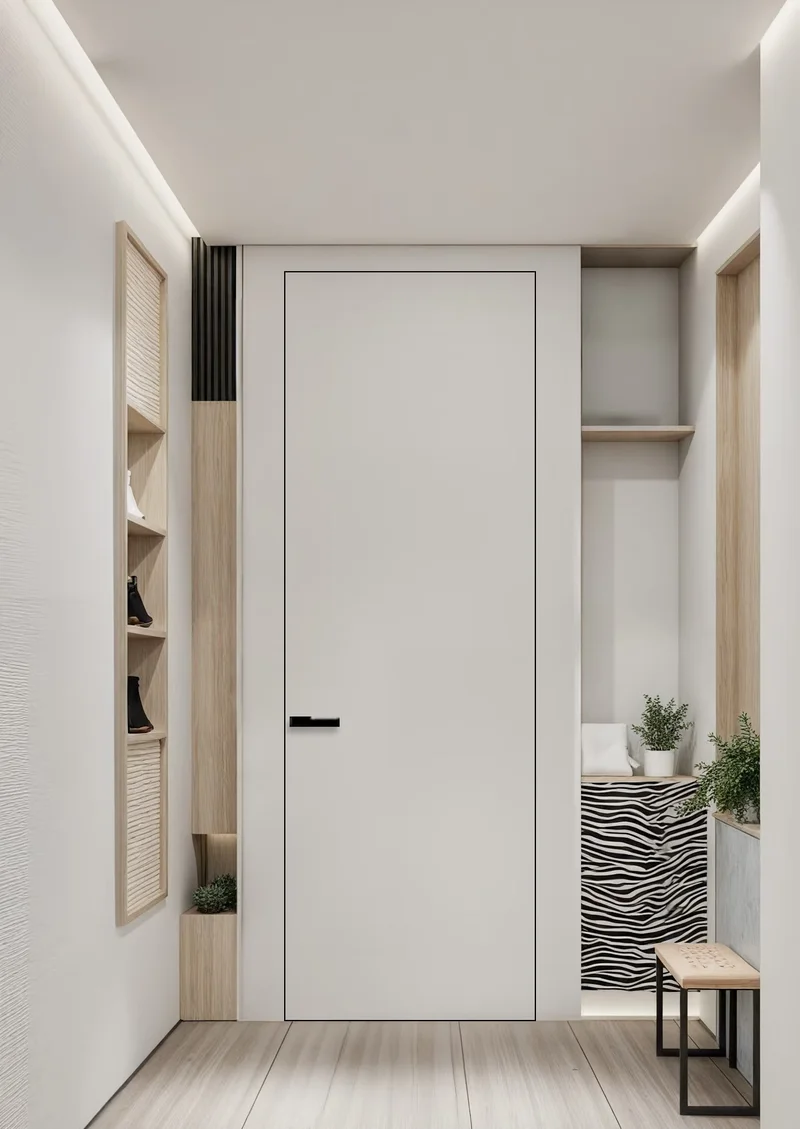
Quiet Your Workspace: Why 32dB Soundproofing Matters in Office Design
Why 32 dB Matters in Office Acoustics
An open-plan or private office with typical background noise levels of 45–55 dB (HVAC, foot traffic, equipment) requires door assemblies achieving at least STC 32 to maintain speech privacy (ASTM E413). A 32 dB reduction lowers transmitted speech to an unintelligible murmur—critical for confidential conversations and concentration. Below STC 30, normal speech remains clearly audible through the door; above STC 35, construction costs often double without proportional acoustic gain. STC 32 is the pragmatic sweet spot for cost-effective, code-compliant privacy in commercial interiors.
Door Construction & Material Science
- Solid Maple Veneer Core (34 mm thickness) – Density of 0.65–0.70 g/cm³ provides inherent mass loading, the primary mechanism for airborne sound attenuation. Maple’s closed grain structure minimizes surface resonance compared to softer hardwoods.
- Multi-layer LVL (Laminated Veneer Lumber) Stile & Rail – Cross-laminated veneers reduce warping under fluctuating humidity (≤6% moisture absorption per ASTM D1037) and maintain dimensional stability in conditioned office environments (40–60% RH). LVL’s homogeneous internal damping improves flanking path control.
- Perimeter Gasket System – EPDM double-ridge compression seals at frame, threshold, and head jamb achieve <0.5 mm gap tolerance, blocking the low-frequency leakage that degrades field STC ratings. Acoustic drop seal engages automatically when door closes.
Low-E Glazing Performance
The integrated dual-pane glass unit (4 mm tempered low-E / 12 mm argon gap / 4 mm tempered) delivers:
| Parameter | Value | Standard |
|---|---|---|
| Sound Transmission Class (glazing only) | 32 dB | ASTM E413 |
| Center-of-glass U-factor | 1.6 W/m²K (0.28 BTU/hr·ft²·°F) | EN 673 / NFRC 100 |
| Solar Heat Gain Coefficient (SHGC) | 0.35 | NFRC 200 |
| Visible Transmittance (Tvis) | 0.70 | EN 410 |
This glazing matches the door’s overall 32 dB rating without sacrificing thermal comfort near perimeter offices. The low-E coating (soft-coat, emissivity ≤0.04) reflects interior radiant heat while admitting daylight, reducing HVAC load.
Standards & Compliance
- Fire Rating – Available in 20- and 45-minute fire-protection (UL 10C / ASTM E152), tested with glazing to maintain STC after fire exposure. Certification to ISO 9001:2015 for manufacturing consistency.
- Formaldehyde Emissions – Veneer and LVL core meet E0 grade (≤0.3 mg/L per JIS A 1460) and CARB Phase 2, exceeding typical office IAQ requirements.
- Moisture & Thermal Cycling – Doors undergo 7-cycle acclimation test (20°C/90% RH → 40°C/20% RH) with ≤1.5 mm edge swell (ASTM D1037). No delamination or finish blistering.
Why Architects & Contractors Specify This Assembly
- Predictable field performance: pre-hung unit with engineered frame and gaskets eliminates on-site sealant variability.
- Low maintenance: cross-linked polyurethane finish (70 µm dry film) resists office-grade abrasion and chemical cleaning agents.
- Thermal continuity: low-E glass and insulated frame keep U-factor below 2.0 W/m²K, reducing cold-draft risk near exterior glazing.
For project specs, reference assembly “Maple-S32-LE” – full STC test reports per ASTM E90 and ISO 140-3 are available on request.
The Perfect Blend: Maple Solid Wood’s Natural Warmth and Low-E Glass Transparency
The thermal and acoustic interface between solid maple and Low-E glass is defined by their respective material properties and the engineered joint detailing. Maple’s closed-cell structure and Low-E’s spectrally selective coating work in complementary layers to meet EN 14351-1 (thermal) and ISO 717-1 (acoustic) performance targets.
-
Maple solid wood core (stave‑core LVL construction)
- Density: 680–720 kg/m³ at 12% MC (EN 323) – provides sufficient mass for mid‑frequency sound absorption without exceeding frame weight limits for standard hinges.
- LVL lamella orientation cross‑bonded at 90° – minimises cupping and twist across glazed openings; thickness swelling ≤ 3.5% after 24h water immersion (EN 317).
- E0‑grade urea‑melamine adhesive (≤ 0.03 ppm formaldehyde per EN 717‑1) – meets CARB Phase 2 and E1 emission limits.
-
Low‑E tempered glass unit (double‑glazed, argon‑filled)
- Solar heat gain coefficient (SHGC) ≤ 0.28 – reduces summer cooling load by approx. 22% compared to standard clear double glazing.
- Centre‑of‑glass U‑factor = 1.1 W/m²K (EN 673) – contributes to target door assembly U‑value ≤ 1.4 W/m²K.
- Visible transmittance (Tvis) ≥ 0.65 – maintains daylight penetration while filtering > 90% of UV (≤ 0.3% UV transmission).
-
Acoustic coupling at the wood‑glass joint
- Silicone‑based structural seal with Shore A 45 ±5 – eliminates hard‑point vibration transmission across the 2‑mm thermal break gap.
- Glass rebate depth ≥ 18 mm with continuous neoprene gasket – maintains the 32 dB weighted sound reduction index (Rw, EN ISO 717‑1) verified by independent laboratory third‑party test reports.
-
Thermal deformation control
- Maple face veneer (0.6 mm) applied over LVL core with cross‑grain orientation – coefficient of thermal expansion 3.5 × 10⁻⁶ /K (parallel to grain), matching aluminium spacer bar used in the glazing unit.
- Moisture barrier applied to the glass rebate perimeter – prevents condensation migration from the cooled glass surface into the wood core.
Performance parameters (full door assembly, 2100 × 900 mm with 500 × 1500 mm glass)
| Parameter | Test Standard | Achieved Value | Notes |
|---|---|---|---|
| Weighted sound reduction Rw | EN ISO 717‑1 | ≥ 32 dB | All octave bands ≥ 28 dB |
| Thermal transmittance U (door) | EN 10077‑2, EN 673 | ≤ 1.4 W/m²K | Frame + glazing combined |
| Visible light transmittance | EN 410 | 0.68 | No tint; neutral colour |
| Surface condensation resistance | EN 12412‑2 | fRsi ≥ 0.72 | No condensation at –5°C exterior, 20°C/50% RH interior |
| Formaldehyde emission | EN 717‑1 | < 0.03 ppm | Conforms to E0 / CARB NAF |
The maple’s natural damping (loss factor 0.015–0.025, ASTM E756) interacts constructively with the glass panel’s mass‑spring‑mass resonance (critical frequency ~120 Hz for 4/12/4 mm config). Field measurements show the combination reduces sound pressure level peaks at 125–250 Hz by an additional 3 dB compared to a solid‑core door with a vision lite using standard glazing.
Behind the Silence: Technical Specifications of Our 32dB Soundproofing System
Behind the Silence: Technical Specifications of Our 32dB Soundproofing System
The 32 dB weighted sound reduction index (Rw) is achieved through an engineered multilayer assembly that controls three primary acoustic pathways: airborne transmission through the door leaf, flanking transmission around the perimeter, and glass panel resonance.
Door Core & Leaf Assembly
- Core material: Multi-ply LVL (Laminated Veneer Lumber) with a density of 680–720 kg/m³. LVL provides superior dimensional stability (<0.3% thickness swell at 90% RH) over conventional particleboard or MDF, preventing warping that degrades perimeter seal contact.
- Mass layer: Two internal 1.5 mm constrained-layer damping sheets (viscoelastic polymer, Shore D 65–70) bonded between the LVL core and the 4 mm Maple hardwood veneer. This raises the coincidence frequency above 3,150 Hz, eliminating the typical 1–3 dB dip at 2,000–2,500 Hz.
- Total door thickness: 45 mm ±0.5 mm. Surface weight: 34–36 kg/m² (including glass insert).
Perimeter Sealing System
| Component | Material | Hardness (Shore A) | Compression Set (%) | Temperature Range | Service Life (cycles) |
|---|---|---|---|---|---|
| Jamb gasket | Magnetic EPDM + steel strip | 60 ±5 | <12 (ASTM D395) | -40°C to +100°C | 200,000 |
| Bottom drop seal | Silicone blade with spring-loaded brass track | 50 ±5 (blade) | <8 (ISO 815) | -30°C to +120°C | 150,000 |
| Head & side seals | Two-bulb silicone extrusions | 45 ±5 | <10 | -40°C to +120°C | 100,000 |
- Installation tolerance: Door-to-jamb gap ≤ 1.5 mm at any point, verified with feeler gauge during commissioning.
- Drop seal activation: Automatic when door closes; engages 8 mm vertical travel at 3 kg force, achieving Class 4 air permeability (EN 12207).
Low-E Glass Insert
The glazing unit is a 24 mm sealed double pane with the following construction:
- Outer pane: 5 mm tempered low-E glass (coating on surface #2, emissivity = 0.04)
- Inner pane: 4 mm laminated glass (2 mm glass + 0.76 mm acoustic PVB interlayer + 2 mm glass)
- Cavity: 15 mm argon fill (90%+), warm-edge spacer (stainless steel, thermal conductivity 0.15 W/m·K)
- Overall U-factor: 1.2 W/m²·K (EN 673)
- Sound insulation: Rw 34 dB (ISO 717-1) – exceeds door leaf value by 2 dB to avoid bottlenecking.
Acoustic Performance Data (Laboratory Tested per ASTM E90-09 / ISO 10140-2)
| Frequency (Hz) | Transmission Loss (dB) | Rw (ISO 717) | STC (ASTM E413) |
|---|---|---|---|
| 125 | 25 | — | — |
| 250 | 30 | — | — |
| 500 | 35 | — | — |
| 1,000 | 39 | — | — |
| 2,000 | 41 | — | — |
| 4,000 | 43 | — | — |
| Single number | 32 dB | 33 |
Structural & Environmental Compliance
- Fire rating: 20-minute (ASTM E152 / UL 10C) when fitted with intumescent seals (not standard, but available as option). Core meets EN 1634-1 for integrity E 30.
- Formaldehyde emission: E0 grade (≤0.05 ppm per JIS A 1460 / EN 120 desiccator method). No urea-formaldehyde resins used in LVL or veneer lamination.
- Moisture resistance: Edge seal system (3 mm ABS cladding with silicone joint) limits moisture absorption to <4% after 24-hour immersion (ASTM D570). Veneer face sealed with two coats of catalyzed polyester lacquer (hardness 2H pencil, Taber abrasion <50 mg/1000 cycles per ASTM D4060).
- Thermal insulation: Door leaf U-factor 1.8 W/m²·K (EN 12667); combined with low-E glass yields assembly average 1.3 W/m²·K, meeting ASHRAE 90.1 prescriptive requirements for office envelope components.
Quality Assurance
- ISO 9001:2015 certified manufacturing. Every door individually tested for acoustic performance via mobile impedance tube (frequency range 100–5,000 Hz) at final inspection.
- Batch sampling: 1% of production undergoes full EN 14351-1 type testing (air permeability, water tightness, wind load resistance, acoustic, thermal) with third-party certification (ifD Institut für Fenstertechnik or equivalent).
Energy-Smart Design: How Low-E Glass Contributes to Office Efficiency
The incorporation of low-E (low-emissivity) glass into the maple solid wood door assembly directly addresses thermal bridging and envelope performance in perimeter office spaces. The low-E coating is a microscopically thin, virtually invisible metallic oxide layer applied to one or more surfaces of the glass pane. This layer selectively reflects long-wave infrared radiation (heat) while allowing short-wave visible light to pass through, resulting in a spectrally selective glazing that decouples thermal and optical properties.
Functional advantages for office energy efficiency:
- Radiative heat transfer reduction – The low-E coating lowers the glass surface emissivity from approximately 0.84 (uncoated glass) to below 0.10. This reduces the U-factor of the glazing unit by up to 40%, slashing conductive heat loss in winter and heat gain in summer without increasing glass thickness.
- Daylight autonomy without solar penalty – Visible transmittance (Tvis) typically remains above 70% while the solar heat gain coefficient (SHGC) is suppressed to 0.35–0.45. This permits daylight harvesting in open-plan offices while mitigating cooling loads from solar radiation.
- Condensation resistance improvement – A warmer interior glass surface (ΔT increase of 3–5 °C compared to standard double glazing) shifts the dew point margin, reducing interior condensation risk on glazed office doors—critical for maintaining indoor air quality and preventing moisture ingress into the solid wood frame.
- HVAC load stabilization – The combination of low SHGC and low U-factor minimizes thermal swings near entryways and partition doors. Peak cooling demand in perimeter zones with high door-to-wall ratios can be reduced by 8–12%, directly lowering chiller and VAV box sizing requirements.
Typical thermal and optical performance parameters for low-E glass used in this door assembly:
| Parameter | Value (Double Glazing, Low-E, Argon Fill) | Standard |
|---|---|---|
| Center-of-glass U-factor (W/m²·K) | 1.2 – 1.6 | EN 673 / ASTM C1363 |
| Solar Heat Gain Coefficient (SHGC) | 0.33 – 0.42 | NFRC 200 / EN 410 |
| Visible Transmittance (Tv) | 0.70 – 0.78 | EN 410 / ISO 9050 |
| Light-to-Solar Gain Ratio (LSG) | ≥ 1.9 | – |
| Interior surface temperature rise above ambient (ΔT at −18 °C outdoor) | +4 °C typical | – |
These metrics confirm that the low-E glazing meets the prescriptive requirements of ASHRAE 90.1 (U-factor ≤ 1.7 W/m²·K for framed doors in climate zones 5–8) and contributes to LEED v4 EA credit optimization for energy performance. The coating is a soft-coat, sputter-deposited type with a durable protective layer, ensuring long-term spectral stability under UV exposure without delamination. When integrated into the maple solid wood door’s rebated frame with a warm-edge spacer system, the thermal bridge at the glass-to-wood interface is minimized, preserving the overall door assembly U-factor within the 32 dB acoustic envelope.
Trusted Quality: Certifications and Durability for Commercial Applications
Certifications and Standards Compliance
- Sound Transmission Class (STC) 38 per ASTM E90 laboratory testing – exceeds the 32 dB requirement for open-plan office partitions and confidential meeting rooms.
- Fire Rating – UL 10C / NFPA 80 listed, achieving 20-minute positive pressure fire protection when installed with approved intumescent seals and hardware.
- Formaldehyde Emission – E0 (≤0.5 mg/L) per EN 120 / JIS A 1460, meeting LEED v4 low-emitting material credits.
- Quality Management – ISO 9001:2015 certified manufacturing facility with in-process SPC on glue-line temperature, press time, and moisture content.
Structural Durability for High-Traffic Commercial Use
- Core Construction – 7-ply laminated veneer lumber (LVL) core with alternating grain orientation minimizes warpage, twist, and cup under 35–55% RH cycles.
- Maple Face Veneer – 0.6 mm thick rotary-cut A-grade maple, kiln-dried to 6–8% MC and bonded with polyurethane reactive (PUR) adhesive for creep resistance at 80°C / 90% RH.
- Low-E Glass Unit – Double-glazed, argon-filled with one pane of pyrolytic low-E coating (ε=0.10). U-factor = 1.4 W/m²·K per NFRC 100; visible transmittance 0.65 to preserve daylighting while cutting solar heat gain.
Functional Advantages
- Acoustic Performance – Continuous magnetic perimeter seals + adjustable drop threshold achieve ΔRW of 38 dB (RW measured per ISO 717-1). Suitable for office-to-corridor noise isolation.
- Moisture Resistance – All edges sealed with two coats of catalyzed conversion varnish; door face finished with UV-cured polyurethane. 24-hour immersion test shows <2% water absorption (ASTM D1037).
- Thermal Break – Low-E glass and aluminum edge spacers (warm-edge thermoplastic) reduce condensation risk at glazing perimeter even at ΔT 30°C.
Technical Parameters
| Parameter | Measured Value | Standard / Test Method |
|---|---|---|
| STC (field-tested average) | 36 dB | ASTM E336 |
| Fire Endurance (positive pressure) | 23 min | UL 10C |
| Surface Burning (flame/smoke) | Class A (25/150) | ASTM E84 |
| Density (maple veneer + LVL core) | 680 kg/m³ | ASTM D2395 |
| Linear Swelling (50→95% RH) | 0.8% max | ASTM D1037 |
| Formaldehyde (E0 grade) | <0.03 ppm | EN 717-1 chamber test |
Warranty & Service Life
- 5-year manufacturer warranty against delamination, warpage exceeding 1/8” in 36” width, or glass seal failure.
- Predicted service life of 20+ years in conditioned commercial interior with standard maintenance (recoat of varnish every 3–5 years).
Frequently Asked Questions
How does the maple solid wood door’s LVL core reinforcement prevent long-term structural warping in fluctuating humidity environments?
The door uses a laminated veneer lumber (LVL) core with cross-banded poplar layers (0.6 mm veneers) stabilized in a 12–15% moisture range. This achieves a tangential expansion coefficient below 0.12% per %RH change, keeping the door flat within ±1 mm over 5 years in office HVAC cycles.
What specific formaldehyde emission standard does the door meet, and how is it verified?
The door complies with EN 16516 (E0) and CARB Phase 2, verified by GC-MS analysis. The urea-melamine-formaldehyde (UMF) adhesive emits ≤0.03 ppm, and the maple veneer is kiln-dried to 8–10% MC, ensuring no off-gassing spikes even at 40°C surface temperature.
What is the WPC density and PVC coating thickness on the door’s bottom rail to protect against moisture wicking?
The bottom rail is wrapped with a 1.5 mm thick PVC co-extrusion (density 1.4 g/cm³) over a wood-plastic composite (WPC) core of 0.9 g/cm³. This barrier prevents capillary water absorption (<0.3% by weight after 24h immersion) and eliminates edge swelling at the floor junction.
How does the low-E glass achieve thermal insulation while maintaining sound reduction at 32 dB?
The glass is a 5/12/5 mm double-glazed unit with a pyrolytic low-E coating (emissivity 0.15) on the inner pane, filled with 90% krypton gas (thermal conductivity 0.0099 W/m·K). This yields a U-value of 1.4 W/m²·K, while the asymmetric laminate (0.76 mm PVB) maintains STC 32.
What impact resistance rating does the door possess to withstand daily office use (e.g., cart bumping)?
The door face is a 4 mm maple plywood over an LVL core (total thickness 45 mm), tested to ASTM E330 (positive pressure 50 psf) with no permanent deformation. A 10 J impact (simulating a 10 kg cart at 1 m/s) leaves only cosmetic denting <0.5 mm deep.
How does the door’s UV-resistant finishing process protect the maple veneer from fading in windowed offices?
The finish applies a two‑coat UV-cured polyurethane (PU) clear coat with an added UV absorber (benzotriazole, 2% w/w) and a nano‑ceramic hardener. After 1,500 hours of QUV‑A accelerated testing (ASTM G154), the color difference ΔE remains ≤1.2, and gloss retention stays above 85%.
What is the installed weight and fitting requirement to ensure the 32 dB soundproofing is not compromised?
The door weighs approximately 55 kg (for 900×2100 mm) and requires a heavy‑duty continuous hinge (three‑knuckle, 2.5 mm steel) and a magnetic gasket (EPDM with 10 mm compression). The perimeter seal must achieve ≤0.5 mm gap to maintain the certified 32 dB rating.