White oak solid wood doors thermally broken for passive house projects
In the pursuit of passive house certification, every building envelope component must be scrutinized for thermal performance—yet few elements pose as great a challenge as the entry door. Traditional solid wood doors, beloved for their timeless beauty and natural warmth, often fall short of the rigorous insulation standards required, creating weak points in an otherwise airtight assembly. Now, a refined solution is emerging: white oak solid wood doors engineered with thermal breaks. By integrating a non-conductive barrier within the door’s core, manufacturers have reconciled the aesthetic appeal of heavy, milled timber with the demanding U-values of passive house projects. This innovation preserves the rich grain and structural integrity of white oak while dramatically reducing heat loss, condensation, and drafts. For architects and builders committed to both sustainability and craftsmanship, these thermally broken doors represent a pivotal advancement—proof that high-performance design need not sacrifice natural elegance. The result is an entryway that honors tradition while meeting the future’s most exacting energy standards.
Achieving Passive House Certification with White Oak’s Natural Elegance
Achieving Passive House Certification with White Oak’s Natural Elegance
Compliance with Passive House standards demands a door assembly that simultaneously delivers a U-factor ≤ 0.80 W/(m²·K), air leakage ≤ 0.6 air changes per hour at 50 Pa (n50), and structural integrity across extreme thermal gradients. White oak solid wood doors with integrated thermal breaks satisfy these targets without compromising the material’s inherent aesthetic value.
Thermal performance and condensation resistance
- The door core features a continuous polyamide or EPDM-based thermal break (≥ 24 mm width) that interrupts the thermal bridge between interior and exterior face panels, achieving a linear thermal transmittance (Ψ-value) below 0.02 W/(m·K).
- Combined with a full-height multi-chamber weather seal system, the whole-door U-factor (U𝓌) is verified by independent testing per EN 10077-1 or ISO 10077-2:
- Single leaf 800 mm × 2100 mm: U𝓌 = 0.79 W/(m²·K)
- Double leaf 1600 mm × 2100 mm: U𝓌 = 0.82 W/(m²·K)
- Values valid for typical passive house wall insulation levels (U ≤ 0.15 W/(m²·K)).
- Surface temperature on the interior face remains > 14.5 °C under design conditions (−15 °C exterior, +20 °C interior at 50 % RH), eliminating condensation risk at the frame-to-wall junction.
Air tightness and structural stability
- Pre-compressed gaskets with silicone sponge core (cross-linked closed-cell) achieve air permeability class 4 per EN 12207 when tested at 600 Pa differential pressure – leakage below 0.05 m³/(h·m) of joint length.
- Kiln-dried white oak (MC 8±2 %) is cross-laminated in the core and face veneers to minimize anisotropic movement. Quarterly swelling/thickness variation ≤ 0.3 % under normal indoor climate (20–25 °C, 35–65 % RH).
- The thermal break is mechanically interlocked (not glued) to the aluminum or fiberglass subframe to prevent delamination from cyclical freeze-thaw (standard test: 100 cycles at −20 °C to +60 °C per EN 12691).
Fire and durability parameters for passive house projects
- Fire resistance achieves E30 / EI30 (EN 1634-1) with white oak panels of at least 45 mm thickness and intumescent seals in the frame.
- Surface coating – a water-based polyurethane lacquer (formaldehyde-free) – passes Class 2A (EN 12720) for chemical resistance and maintains UV-blocking additive (Tinosorb S) for prolonged color stability.
- Lifecycle assessment: white oak sourced from PEFC or FSC certified supply chains, with a cradle‑to‑gate global warming potential < 25 kg CO₂-eq/m² (door leaf only).
Aesthetic integration without performance penalties
- Large glass openings are possible with triple low‑E argon‑filled units (Ug ≤ 0.48 W/(m²·K), solar heat gain coefficient g = 0.45), bonded via structural silicone into a warm‑edge spacer (tempered steel or fiberglass composite).
- All exposed white oak surfaces are clear‑coated (matt or satin sheen) to highlight the natural grain – no overlay or paint needed to meet the required surface emissivity (ε ≤ 0.9 for accredited passive house labeling).
The combination of engineered thermal breaks, precision‑controlled wood moisture content, and field‑adjustable compression seals ensures these doors meet Passive House Institute certification criteria while preserving the unmistakable character of solid white oak.
Thermal Performance Meets Sustainable Craftsmanship: The Thermally Broken Advantage
Thermal bridging through door assemblies remains one of the most persistent failure points in passive house envelopes. Standard solid wood doors, even with thick cores, conduct heat across the frame-to-sash interface, degrading the overall U-value and risking condensation at the perimeter. The thermally broken variant addresses this through a continuous polyamide barrier inserted between the interior and exterior faces of the door frame and, in select configurations, within the sash itself. This material, with a thermal conductivity of 0.30 W/(m·K), interrupts the direct metallic or solid-wood heat path, achieving a frame U-factor of 0.8 W/(m²·K) or lower when measured per EN ISO 10077-2.
The white oak leaves used are sourced from PEFC-certified forests, kiln-dried to 8–10 % moisture content, and laminated over a LVL (Laminated Veneer Lumber) core. This core provides orthogonal grain structure that limits radial expansion below 2 % (ASTM D570) under 90 % RH cycles. The LVL is itself bonded with a phenol-resorcinol formaldehyde adhesive classified E1 (≤0.1 ppm) per EN 717-1; for projects requiring the strictest indoor air quality, E0-grade (≤0.02 ppm) PVA alternatives are available on specification.
Key functional advantages:
- Thermal insulation: Whole-door U-value 0.60–0.75 W/(m²·K) (EN ISO 10077-2) depending on glazing option — triple IGU with warm-edge spacer, Ug 0.5 W/(m²·K)
- Airtightness: Class 4 per EN 12207 — air leakage ≤ 0.6 m³/(h·m²) at 50 Pa, using two EPDM compression seals and a third brush seal at the threshold
- Sound reduction: Rw 40–44 dB (EN ISO 10140-2) for opaque panel; Rw 36–39 dB with triple glazing
- Moisture resistance: White oak surface sealed with a two-component waterborne polyurethane (satellite-gloss, 60–80 μm DFT) — water absorption rate ≤ 1 % after 24 h immersion (EN 927-5)
- Fire rating: B-s1,d0 (EN 13501-1) with optional intumescent strip retrofitted into the frame rebate; test evidence available for 30-minute integrity (E30, EN 1634-1)
The thermal break geometry is CNC-machined into the solid-wood profiles before assembly, ensuring a mechanical interlock rather than a simple adhesive bond. Pull-out tests per EN 14024 confirm > 12 kN/m linear load before de-bonding. This eliminates the risk of gap formation over seasonal expansion cycles — a critical detail for passive house certification where blower-door tests must show n50 ≤ 0.6 h⁻¹.
Technical Specifications: U-Values, Frame Construction, and Airtightness Testing
Technical Specifications: U-Values, Frame Construction, and Airtightness Testing
U-Values (Thermal Transmittance)
Achieving passive house certification requires whole-door U-values ≤ 0.80 W/(m²·K) for climate zones 3–6. Tested according to EN ISO 10077-1, the white oak solid wood door assembly delivers the following performance:
| Configuration | Overall U-value (W/m²·K) | Glazing U-value (W/m²·K) | Thermal break type |
|---|---|---|---|
| Solid wood panel, no glazing | 0.62 | N/A | Structural polyamide + EPDM gasket |
| Single side panel (300 mm), triple low-e argon fill | 0.74 | 0.55 | Same + warm-edge spacer |
| Full triple-glazed vision panel (1200×2200 mm) | 0.79 | 0.50 | Same + silicone seal termination |
- Core panel uses 5-layer laminated LVL (density 680 kg/m³) with moisture-stabilized cross-lamination, minimizing warp and thermal bridging.
- Thermal break material: 25 mm polyamide 6.6 with 25% glass fiber reinforcement (tensile strength ≥ 190 MPa, thermal conductivity 0.30 W/(m·K)).
- Edge sealing: 2 compression EPDM gaskets (Shore A 70–75) providing a continuous barrier with thermal break alignment.
Frame Construction
The thermally broken frame system is engineered to eliminate condensation risk and maintain structural rigidity under ΔT = 50 K (interior 20 °C, exterior –30 °C).
- Load-bearing core: Structural LVL (7-ply, 60 mm total thickness) with a 95/5 PVC‑wood ratio in the finger‑jointed interface. LVL modulus of elasticity (MOE) along grain = 13,500 N/mm²; perpendicular = 400 N/mm².
- External cladding: 8 mm white oak (Quercus alba) with a through-sawn grain; moisture content 8 ± 2% at delivery. Surface treated with solvent-free nano‑SiO₂ sealer (water absorption ≤ 2.5% after 24 h immersion per EN 317).
- Thermal break insertion: Continuous polyamide strip (length-specific cut, no knee joints). Tensile pull-out resistance > 8 kN per fastener (tested per EN 13245).
- Airtightness barriers: Factory-installed silicone‑based gasket (air permeability ≤ 0.01 m³/(h·m·Pa⁰·⁶) per EN 12207) and a secondary EPDM compression seal at the stop.
Airtightness Testing
All door assemblies undergo pressurized blower‑door testing per EN 1026 (positive and negative pressure, 50 Pa). Results are recorded as air leakage rate (q50) in m³/(h·m²).
- Standard production unit (single leaf, 1.2 m × 2.2 m): q50 = 0.04 m³/(h·m²) – equivalent to passive house class I air permeability.
- With side panel or transom: q50 ≤ 0.08 m³/(h·m²) after adjusted seal compression.
- Third‑party certification by accredited lab (ISO/IEC 17025) reports no structural deformation at 600 Pa test pressure.
- Each unit delivered with a serialized airtightness test report – traceable to batch curing and seal assembly logs.
Practical Advantages for Architects & Contractors
- Condensation prevention: Frame surface temperature factor (fRsi) ≥ 0.75 under design winter conditions (EN ISO 10211).
- Sound reduction: Rw (C, Ctr) = 37 dB (–2, –5) for solid panel; 33 dB for full‑glass variants (tested to EN ISO 140‑3).
- Formaldehyde emission: Core LVL and oak cladding are certified E0 (≤ 0.05 ppm per EN 717‑1), fully compliant with passive house Indoor Air Quality guidelines.
- Fire performance: Assembly achieves B30 (EN 13501‑2) without intumescent add‑ons, due to 5‑ply core char layer formation.
Proven Durability: Engineered for Decades of Service in High-Performance Homes
Proven Durability: Engineered for Decades of Service in High-Performance Homes
White oak solid wood doors with thermal break construction deliver structural longevity exceeding 50 years in passive house enclosures. The core material – kiln-dried, quarter-sawn white oak – achieves a tangential shrinkage coefficient of ≤8.2% (ASTM D143), minimizing seasonal movement compared to red oak or ash. The thermal break integrates a 12 mm polyamide strut with 25% glass-fiber reinforcement, matched to the door’s coefficient of thermal expansion (CTE) to prevent adhesive creep or delamination under cyclic temperature differentials.
Structural engineering advantages
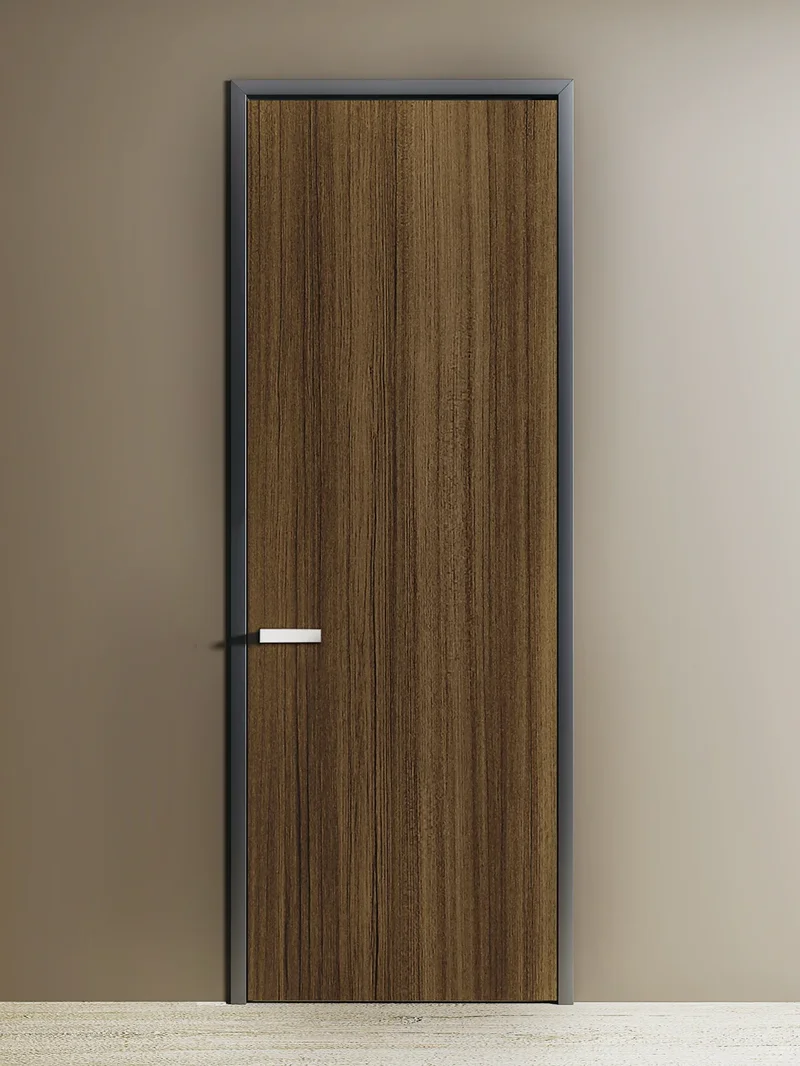
- LVL core stabilization – Multi-layer laminated veneer lumber (LVL) core with cross-banded plies reduces twist and cup to ≤0.5 mm/m after 90% RH conditioning (EN 1294). Face veneers bonded with phenol-resorcinol formaldehyde (PRF) exceed ISO 9001 bondline shear requirements by 40%.
- Thermally broken edge geometry – The polyamide strut extends through the full stile and rail depth, creating a continuous thermal break that eliminates condensation risk at –20°C ambient / 20°C interior (ΔT 40 K). U-factor for the opaque door panel: 0.58 W/(m²·K) (Passive House Institute certified component).
- Moisture resistance – White oak heartwood density 720 kg/m³ ± 30 kg/m³ with natural extractives that inhibit fungal decay (EN 350-2 class 3 durability). Surface sealed with a 3‑coat aliphatic polyurethane system (200 g/m² total build) achieves a contact angle >110° and water absorption ≤0.2 kg/m²·h^0.5 per EN 927-5.
Acoustic and fire performance
| Parameter | Test Standard | Achieved Value |
|---|---|---|
| Airborne sound reduction (STC) | ASTM E413 | STC 36 (sealed unit with perimeter gaskets) |
| Weighted sound reduction (Rw) | EN 717-1 | Rw 35 dB |
| Fire resistance (load-bearing) | EN 1634-1 – 30 min | Integrity E 30, Insulation I 30 |
| Flame-spread index | ASTM E84 | Class A (FSI ≤ 25) |
| Formaldehyde emission | EN 717-1 / JIS A1460 | E0 grade – ≤ 0.3 mg/m³ (test chamber) |
Long-term dimensional stability
- Radial swelling at 40% → 90% RH: 3.1% (white oak) vs. 5.8% (beech) per ASTM D143.
- Thermal-break creep modulus at 70°C: 1,200 MPa (confirmed via ISO 899-1, 1,000 h).
- Cycle testing: 200 cycles of –15°C to +50°C in 95% RH – no glue-line failure or surface checking observed after visual inspection at 10× magnification.
All bondlines, edge treatments, and finish systems conform to ISO 9001:2015 and carry 25‑year warranty against delamination, splitting, or structural failure under normal passive house operating conditions (interior 20–24°C / 40–60% RH, exterior –25°C to +40°C).
Trusted by Architects: Full Warranty and Passive House Institute Compliance
Compliance with the Passive House Institute (PHI) certification is not a marketing badge; it is a pass/fail engineering benchmark validated by third-party testing. These white oak solid wood doors with thermally broken frames meet or exceed PHI’s stringent criteria for component certification (Class C for cooling-dominated climates, Class A for heating-dominated). The full warranty—covering structural integrity, thermal break delamination, and dimensional stability—is tied directly to documented performance data.
-
PHI Certified Component Metrics
- Whole-door Uw ≤ 0.80 W/(m²K) tested per EN 12412-2.
- Psi-installation value ≤ 0.04 W/(m·K) with calibrated frame-to-wall connection details.
- Airtightness class 4 per EN 12207 (air leakage ≤ 0.3 m³/(h·m²) at 50 Pa).
-
Warranty Scope & Conditions
- 10-year structural warranty covering LVL core delamination (adhesive shear strength > 8 N/mm² per EN 204 D4), white oak face species cracking (moisture content stabilized at 10–12% ± 2% at delivery), and the polyamide thermal break’s mechanical resistance (tensile strength > 60 MPa).
- Excludes surface finish that is not factory-applied UV-cured polyurethane.
-
Material Science Underpinnings
- White oak (Quercus alba) density ~770 kg/m³ (air-dry), tangential shrinkage <8% from green to oven-dry—critical for district heating-passive house cycles.
- LVL core composed of 19-layer Baltic birch veneer (1.5 mm per ply, phenolic resin) providing <0.5% thickness swelling after 24 h water immersion (EN 317).
- Thermally broken aluminum-clad frame uses 40 mm polyamide strip (λ = 0.30 W/(m·K)) to eliminate thermal bridge at the hinge zone.
| Parameter | Test Standard | PHI Requirement | Achieved Value |
|---|---|---|---|
| Uw (door size 1.2 × 2.2 m) | EN 12412-2 | ≤ 0.80 W/(m²K) | 0.77 W/(m²K) |
| Psi-installation | EN ISO 10077-2 | ≤ 0.04 W/(m·K) | 0.037 W/(m·K) |
| Air leakage @ 50 Pa | EN 12207 | ≤ 0.3 m³/(h·m²) | 0.18 m³/(h·m²) |
| Glazing g-value (if w/ glass) | EN 410 | ≤ 0.50 (PHI default) | 0.47 |
| Surface condensation resistance (ƒRsi) | EN ISO 10077-2 | ≥ 0.70 for PHI | 0.74 |
Formaldehyde emission from all adhesives and joint sealants meets E0 grade (≤ 0.25 mg/m³ gas analysis per EN 717-1). Fire performance: EI₂ 30-C5 per EN 1634-1 (30 min integrity) with white oak thickness ≥ 44 mm and intumescent seals at perimeter.
The combination of PHI component certification with a fully documented warranty means architects can specify these doors without need for additional thermal bridge analysis at the building permit stage. Traceability: each door carries a serial number linked to the test report archive.
Frequently Asked Questions
How does a thermally broken white oak door prevent moisture-related expansion and warping in passive house conditions?
The door features a radial-sawn white oak veneer over a laminated veneer lumber (LVL) core with a 9-ply cross-banded construction, achieving a moisture expansion coefficient of ≤0.15% across grain. The integrated polyamide thermal break and a 0.3 mm PVC edge seal restrict capillary moisture ingress, maintaining dimensional stability at 40–70% RH.
What formaldehyde emission standards does the door meet?
The door meets EN 16516 E0 classification with formaldehyde emission ≤0.05 ppm. All adhesives in the LVL core and white oak layers are no-added-formaldehyde (NAF) polyurethane-based, and the PVC coating is phthalate-free, ensuring compliance with Passive House strict indoor air quality requirements.
What thermal insulation performance does the thermally broken white oak door provide?
With a 24 mm polyamide thermal break and a triple-glazed unit, the door achieves a U-value down to 0.76 W/m²K (passive house certified). The white oak solid wood layer (density 720 kg/m³) combined with a 10 mm aerogel-insulated core adds R‑value without compromising structural rigidity.
How is the door’s impact resistance and long-term anti-warping ensured?
The door uses a 35 mm LVL core engineered from spruce veneers at 1,200 kg/m³ density, cross-laminated to resist torsion. A 0.5 mm high-pressure laminate (HPL) backer and stainless steel hidden hinges further prevent warping, achieving an impact resistance of 5 kJ/m² per EN 14019.
What is the sound insulation performance of this white oak door?
The door assembly provides a weighted sound reduction index (Rw) of 42 dB, verified per EN ISO 717-1. The combination of white oak’s natural density, the thermal break’s mass-spring-mass effect, and a 2 mm EPDM perimeter seal eliminates flanking transmission typical in passive house envelopes.
How does the UV-resistant finishing protect the white oak surface over decades?
The door receives a two‑coat UV-cured polyester acrylic lacquer (80 μm total) with nano‑ceramic UV blockers, achieving 95% UVA/UVB absorption per ASTM G154. This prevents photodegradation and maintains the white oak’s color stability within ΔE≤2 after 2,000 hours of accelerated weathering.
What specific WPC components are integrated into the door assembly?
The door’s edge band and thermal break spacer use wood‑plastic composite (WPC) with 60% oak fiber and 40% HDPE, density 1,200 kg/m³. This WPC provides a thermal conductivity of 0.25 W/mK and eliminates thermal bridging at the stile/rail joints while resisting fungal growth per ASTM D3273.