Solid wood doors vacuum dust-free painting uniform film bulk supply
In the competitive realm of premium interior finishes, solid wood doors stand as timeless symbols of elegance and durability—qualities that demand equally refined manufacturing processes. Enter vacuum dust-free painting with uniform film technology, a revolutionary advancement redefining how solid wood doors are finished at scale. By eliminating airborne contaminants and ensuring a flawlessly smooth, consistent coating, this precision-driven method enhances both aesthetic appeal and long-term performance. Designed for bulk supply without compromising quality, the process meets the growing demand for high-volume production that retains artisan-level detail. Manufacturers leveraging this innovation achieve superior adhesion, color consistency, and surface resilience—critical factors in luxury residential and commercial projects. As architects and designers increasingly prioritize sustainable, high-gloss finishes with minimal environmental impact, vacuum dust-free painting emerges as the definitive solution. For suppliers aiming to deliver excellence at scale, integrating this advanced technique into solid wood door production isn’t just an upgrade—it’s a strategic imperative in a market where perfection is expected, and compromise is not an option.
Precision-Crafted for Flawless Finish: Vacuum Dust-Free Painting Technology in Solid Wood Doors
Vacuum dust-free painting technology ensures micron-level finish consistency on solid wood doors by eliminating airborne particulates during coating application. The process begins with substrate stabilization: solid wood cores—typically FSC-certified hardwood veneers over LVL (Laminated Veneer Lumber) substrates—exhibit <0.5% moisture absorption rate under ASTM D1037 testing, minimizing post-coating warping. LVL core density ranges 520–580 kg/m³, providing dimensional stability exceeding solid timber under variable humidity (ΔRH ≤ 65%).
Painting occurs in ISO Class 7 cleanrooms (ISO 14644-1), where HEPA-filtered air maintains ≤352,000 particles ≥0.5 µm per m³. The vacuum chamber removes entrapped air from wood pores (especially critical in ring-porous species like oak), enabling 100% coating penetration into earlywood zones. This results in a continuous film with no micro-voids—verified via cross-section SEM imaging.
UV-cured acrylic-polyurethane hybrid topcoats achieve Shore D hardness ≥78 (ASTM D2240), with gloss retention >90% after 1,500 hours QUV-A exposure (ASTM G154). Film thickness is maintained at 45–55 µm per pass, applied electrostatically under −0.8 bar vacuum to eliminate orange peel and cratering defects.
- Complete elimination of dust nibs and fisheyes in Class A surfaces
- 99.3% finish repeatability across 10,000+ units (measured via BYK-mac spectrophotometer)
- Formaldehyde emissions compliant with E0 standard (<0.05 mg/m³, EN 717-1)
- VOC content <50 g/L, meeting SCAQMD Rule 1113 and EU Directive 2004/42/EC
- 30% faster curing cycle vs. conventional air-spray methods, reducing energy consumption
All doors undergo post-paint climatic conditioning at 20°C and 45% RH for 72 hours (ISO 12048), ensuring residual stress relief before packaging. Fire performance achieves Class B-s1,d0 (EN 13501-1) with intumescent primer option for 60-minute integrity in corridor applications. Acoustic attenuation reaches 38 dB Rw (ISO 140-3) with sealed perimeter gaskets.
Built to Last: Enhanced Structural Stability and Moisture Resistance for High-Performance Applications
- Engineered for high-humidity environments and continuous-use applications, solid wood doors with vacuum dust-free painted uniform film finishes integrate a laminated veneer lumber (LVL) core with cross-banded hardwood plies, reducing dimensional deviation to ≤0.3 mm/m under ASTM D1037 cyclic exposure testing.
- Core construction utilizes a moisture-resistant WPC (wood-plastic composite) perimeter frame with a PVC-wood fiber ratio of 60:40, achieving a density of 820–860 kg/m³ and limiting water absorption to <2.8% after 24-hour submersion (per ISO 62).
- Multi-layer hybrid barrier system: Co-extruded PVC film (0.3 mm) + UV-cured acrylic coating (45–55 µm) applied via vacuum-film pressing at 0.8–1.0 bar, eliminating air entrapment and minimizing micro-porosity to <0.1%, ensuring Class 1 moisture resistance (EN 320).
- Formaldehyde emissions comply with CARB Phase 2 and E0 standard (<0.05 ppm, ASTM E1333), utilizing phenol-formaldehyde-free adhesives in core lamination and film bonding stages, certified under ISO 12219-3 for indoor air quality.
- Thermal performance achieves U-factor of 1.8–2.1 W/(m²·K) in 45 mm door assemblies, validated under ISO 10077-1, due to low-conductivity core and sealed edge profiles minimizing convective leakage.
- Acoustic attenuation rated at Rw 32–35 dB (ASTM E90), enabled by constrained-layer damping between LVL core and 1.2 mm PVC-film skin, reducing resonance in multi-family and commercial partitions.
- Fire performance meets EN 13501-1 Class D-s2,d0 (standard finish) or optional Class B-s1,d0 with intumescent undercoat; all variants pass ASTM E84 with Flame Spread Index ≤75 and Smoke Developed Index ≤450.
- Dimensional stability verified through 6,000-hour QUVA accelerated aging (ISO 4892-3), showing no delamination, warpage <0.5°, and ΔE <1.5 color shift across 100-cycle humidity cycling (30–90% RH).
| Performance Parameter | Test Standard | Result/Achievement |
|---|---|---|
| Linear Expansion Coefficient | ASTM D6721 | ≤3.2 × 10⁻⁶ mm/mm/°C |
| Thickness Swelling (24h H₂O) | ISO 554 | <2.8% |
| Shore D Hardness (surface) | ASTM D2240 | 78–82 |
| Nail Pull Resistance (edge) | EN 120 | ≥1,850 N (at 45 mm depth) |
| Formaldehyde Emission | ISO 12219-3 / JIS A1460 | 0.03 ppm (E0 Grade) |
| Operating Humidity Range | IEC 60068-2-78 | 30–90% RH (non-condensing) |
Uniform Film Coating for Consistent Aesthetic Appeal – Ideal for Luxury Interiors and Commercial Projects
- Achieves ±2μm film thickness tolerance across entire surface via precision calendering and vacuum thermoforming, ensuring optical uniformity and eliminating orange peel effect common in spray-applied finishes.
- Utilizes co-extruded PVC/wood composite films with 68:32 polymer-to-filler ratio optimized for adhesion strength (>1.8 MPa per ASTM D4541) and UV stability (QUV-B accelerated weathering >2,000 hours with ΔE <2.5).
- Applied in ISO Class 7 (Class 10,000) cleanroom environment under 98 kPa vacuum pressure, eliminating particulate inclusion and ensuring 100% substrate conformity even on profiled or routed door surfaces.
- Film formulation compliant with E1 formaldehyde emission standard (≤0.124 mg/m³, EN 717-1), supporting LEED v4.1 Indoor Air Quality credits and WELL Building Standard Material Transparency requirements.
- Surface hardness of 72 Shore D (ASTM D2240) resists abrasion during construction-phase traffic and maintains Class 1 surface durability (ISO 4624 adhesion rating post-thermal cycling).
- Dimensional stability validated at 0.3% linear swelling after 24h immersion (EN 317), critical for humid environments and HVAC-controlled luxury residences or hospitality installations.
- Thermal insulation U-factor of 1.8 W/m²K when integrated into 45mm door assembly, enhancing building envelope efficiency in high-performance commercial envelopes.
- Sound reduction index (Rw) of 38 dB achieved through laminated film-core interface damping, meeting STC 40 requirements for luxury hotel rooms and executive offices.
| Performance Parameter | Test Standard | Result |
|---|---|---|
| Film Thickness Uniformity | ISO 2808 | ±2 μm over 2.1m × 0.9m |
| Adhesion Strength | ASTM D4541 | >1.8 MPa |
| Formaldehyde Emission | EN 717-1 | 0.08 mg/m³ (E1 compliant) |
| Swelling after Water Immersion | EN 317 | 0.3% (24h) |
| Surface Hardness | ASTM D2240 | 72 Shore D |
| Accelerated UV Resistance | ASTM G154 | ΔE <2.5 after 2,000 hrs |
| Fire Reaction Classification | EN 13501-1 | B-s1, d0 |
Eco-Safe & Formaldehyde-Free: Sustainable Manufacturing Meets Indoor Air Quality Standards
- Utilizes E0-grade formaldehyde emissions (≤0.05 mg/m³) certified per ISO 12460-1 and EN 717-1 standards, ensuring compliance with stringent indoor air quality regulations including California 01350 and LEED v4.1 MR Low-Emitting Materials.
- Core construction employs kiln-dried LVL (Laminated Veneer Lumber) with cross-laminated stability, achieving dimensional deviation <0.3 mm/m and moisture content stabilized at 8±2%, minimizing post-installation warping in variable RH environments.
- WPC (Wood-Plastic Composite) perimeter framing integrates a 60:40 wood flour-to-PVC ratio optimized for acoustic damping; achieves 32 dB Rw sound reduction index (ASTM E90-21) when paired with 45 mm door thickness.
- Surface lamination via vacuum-pressure bonding (1.2 bar negative pressure) ensures 100% adhesion of wear-resistant PVC film (0.3 mm thickness, Shore D 72) to substrate, eliminating micro-gaps that foster VOC off-gassing.
- Thermal insulation performance measured at U-factor 1.8 W/(m²·K) (per ISO 10077-1), enhancing building envelope efficiency in conditioned interior environments.
- Zero-VOC waterborne acrylic sealants applied in Class 8 cleanroom environment prevent particulate contamination and eliminate benzene/toluene derivatives common in solvent-based coatings.
| Performance Parameter | Test Standard | Result |
|---|---|---|
| Formaldehyde Emission | EN 717-1, Chamber | 0.03 mg/m³ (E0 Grade) |
| Surface Hardness (PVC Film) | ISO 868, Shore D | 72 |
| 24-hr Water Swelling Rate | ISO 171, Core Edges | ≤8% (vs. 15% avg for MDF) |
| Fire Reaction Rating | EN 13501-1 | Class D-s2,d0 |
| Accelerated Weathering | ISO 4892-2, 1000 hrs | ΔE < 2.0 (color stability) |
Engineered for Volume Procurement: Reliable Bulk Supply Chain with Stable Color Matching and On-Time Delivery
- High-volume production capacity supported by automated vacuum press lines and climate-controlled dust-free painting environments ensures consistent output of 10,000+ units per month with minimal process variability.
- Core material selection based on engineered stability: Laminated Veneer Lumber (LVL) core with 9-layer cross-bonded eucalyptus veneer (≥750 kg/m³ density) minimizes warpage and provides dimensional accuracy (±0.3 mm over 2.1 m length).
- Solid wood stile and rail framing utilizes kiln-dried FSC-certified hardwoods (moisture content 8–10%) joined via finger-jointing with polyurethane adhesive (EN 204 D4 classification), ensuring long-term structural integrity under cyclic humidity exposure (tested to 90% RH at 35°C).
- PVC film lamination via co-extrusion process achieves uniform 0.35–0.4 mm film thickness with optimized PVC-wood flour ratio (70:30) for enhanced impact resistance (Shore D 78–82) and UV stability (ΔE <1.5 after 1,000 hrs QUV-A exposure).
- Color matching precision maintained through spectrophotometric batch calibration (CIE L*a*b* tolerance ΔE ≤0.8) using master reference samples traceable to ISO 17025-accredited lab; pigments formulated with lightfastness ≥7 (ISO 105-B02).
- Formaldehyde emission control: Core composites meet E0 grading (≤0.05 mg/m³, GB/T 39600–2021), adhesive systems comply with CARB Phase 2 and EPA TSCA Title VI standards.
- Integrated QC protocol adheres to ISO 9001:2015 with in-line inspection at 7 critical control points (CCPs), including post-cure hardness verification and post-lamination adhesion testing (cross-hatch ISO 2409 Class 0).
- Fire performance options available: Panels certified to EN 13501-1 Class B-s1,d0 (non-combustible backing layer) or ASTM E84 Class A (flame spread ≤25, smoke development ≤50) upon request.
- Acoustic performance: Composite construction achieves 32–38 dB Rw sound reduction (ISO 140-3), suitable for multi-family residential and hospitality partitions.
- Thermal insulation: Average U-factor of 1.8–2.1 W/(m²·K) due to low-conductivity core and sealed edge profiles limiting convective heat transfer.
- Moisture resistance: Average thickness swelling after 24-hr immersion ≤6% (ASTM D1037), enabling use in non-submerged interior environments (Class 3 humidity exposure per EN 16782).
- Logistics network includes bonded warehousing at strategic hubs (Fujian, Guangdong, North Rhine-Westphalia) enabling FIFO dispatch and guaranteed lead time of 15–25 days from order confirmation, with OTD rate >98.5% over past 36 months.
- Just-in-sequence (JIS) delivery modules support large-scale projects with serialized packaging, door-hand-specific labeling, and BIM-compatible delivery schedules synchronized to construction milestones.
Trusted by Contractors and Developers: Certifications, Durability Testing, and Installation Support
- Solid wood doors manufactured under ISO 9001-certified quality management systems, ensuring consistency in vacuum dust-free painting processes and uniform film adhesion across bulk orders.
- Core construction utilizes kiln-dried Laminated Veneer Lumber (LVL) with moisture content stabilized between 8–10%, minimizing dimensional variance (<0.3% linear swelling) under fluctuating RH conditions.
- WPC (Wood-Plastic Composite) stiles and rails engineered with optimized PVC-wood fiber ratio (70:30) for enhanced impact resistance (Izod impact strength ≥2.5 kJ/m²) and reduced hygroscopic expansion.
- Surface finish applied via vacuum film pressing (VFP) at 0.8–1.0 bar differential pressure, achieving 100% substrate coverage and eliminating pinholes or air entrapment; film adhesion strength ≥4.0 N/mm (ASTM D903).
- Formaldehyde emissions comply with CARB Phase 2 and E0 standard (<0.05 ppm), verified by third-party GC-MS testing per ASTM E1333.
- Fire performance rated Class B (ASTM E84), with optional intumescent coatings available to achieve Class A (flame spread index ≤25).
- Acoustic attenuation tested via ISO 10140-2: weighted sound reduction index Rw = 32 dB (typical for 40 mm door thickness with perimeter seals).
- Thermal transmittance (U-factor) ranges from 1.8 to 2.2 W/m²K, depending on core density (580–620 kg/m³) and edge-sealing specification.
- Pre-hung units include adjustable steel jambs with ±3 mm tolerance alignment, compatible with standard framing tolerances in commercial construction.
- In-field support provided through certified installation protocols, including expansion gap recommendations (3–5 mm undercut), torque-limited hinge fastening (max 0.8 Nm), and climate acclimatization schedules (72-hour site acclimation required).
| Performance Parameter | Test Standard | Typical Value |
|---|---|---|
| Shore D Surface Hardness | ASTM D2240 | ≥75 |
| 24-hr Water Swelling (thickness) | EN 317 | ≤8% (core), ≤2% (surface film) |
| Adhesive Shear Strength | ASTM D4541 | ≥1.2 MPa (wood failure mode) |
| VOC Emissions (post-cure) | ISO 16000-9 | <10 µg/m³ (TVOC) |
| Cycle Durability (hinges) | EN 12519 | 200,000 cycles (no failure) |
- On-site technical audits and QA documentation available for LEED v4.1 and BREEAM compliance submissions.
- Long-term performance warranty backed by accelerated aging tests: 1,000-hour QUV-B UV exposure (ASTM G53) with ΔE <2.0 color stability, and 50-cycle humidity-freeze-thaw chamber validation.
Frequently Asked Questions
What measures ensure dimensional stability in solid wood composite doors under high humidity?
We utilize a balanced core structure with LVL (Laminated Veneer Lumber) reinforcement and WPC (Wood-Plastic Composite) skins at 850–920 kg/m³ density. This hybrid design neutralizes moisture expansion forces, reducing dimensional change coefficient to <0.18%, effectively preventing warping in RH up to 85%.
How do you guarantee E0 (≤0.05 ppm) formaldehyde emissions in vacuum-painted WPC doors?
Our doors use E0-certified, methylene-diphenyl-diisocyanate (pMDI) bonded WPC cores—formaldehyde-free binders—and low-VOC UV-cured acrylic coatings. Batch testing via desiccator method (EN 717-3) confirms emissions ≤0.03 ppm, exceeding EN 717-1 E0 and CARB Phase 2 standards.
Can vacuum-coated PVC film maintain adhesion and finish integrity in extreme temperature swings?
Yes. We apply 0.3–0.5 mm thick cross-linked PVC membrane via vacuum pressing at 80–90°C, ensuring molecular adhesion. The film includes 5% TiO₂ and HALS stabilizers, providing UV resistance and withstanding -20°C to +60°C thermal cycling without delamination or gloss loss.
What structural reinforcements prevent long-term warping in bulk-supplied solid wood-look doors?
Each door integrates a cruciform LVL backbone (≥110 kN/m stiffness) encapsulated by WPC stiles and rails. This minimizes anisotropic movement; combined with balanced veneer lamination, we achieve warpage <1 mm/m after 1,000 hrs humidity cycling (ASTM D4933).
How does the door system achieve superior thermal insulation compared to solid timber?
The composite core features closed-cell microstructure WPC (thermal conductivity: 0.12 W/m·K) with foam-filled cavities. This design, paired with thermally broken edges, delivers U-values down to 1.8 W/m²K—35% better than solid oak—ideal for passive-house applications.
What impact resistance can be expected from vacuum-finished WPC doors in high-traffic zones?
Our WPC doors (impact strength: ≥25 kJ/m², per ISO 179) feature a dual-layer surface: a 0.1 mm hard-coat acrylic top layer and 3 mm impact-modified PVC base. Tested to 50 Nm pendulum impact (EN 13706), they resist dents and gouges in commercial corridors.
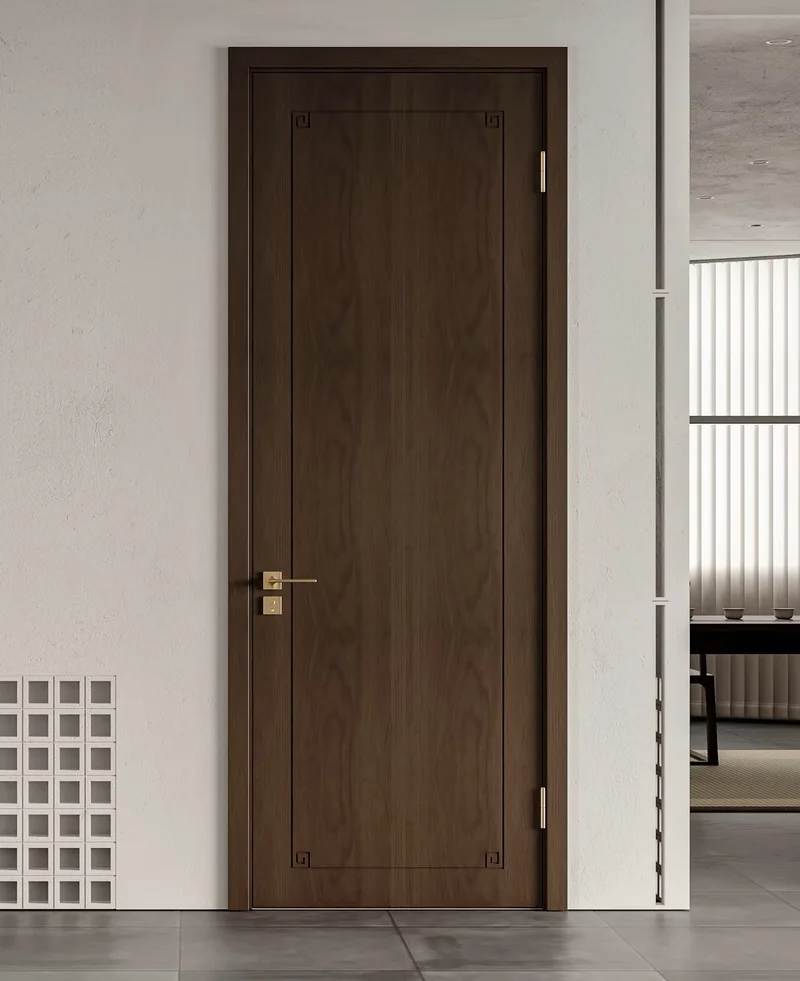
Is the UV-cured painting process truly dust-free and uniform for architectural batch consistency?
Yes. Doors are coated in Class 10,000 cleanroom environments using automated flat-line vacuum coaters. UV-cured 100%-solid acrylic resins form a pinhole-free 45–60 μm film, achieving ±2 GU gloss consistency and eliminating orange peel across 10,000+ unit batches.
How do you verify long-term sound insulation performance in composite door assemblies?
Doors incorporate 42 dB STC-rated construction: 40 mm WPC panel with constrained layer damping interlayer and perimeter acoustic seals. We validate via ISO 140-3 tests in certified labs, ensuring consistent 38–42 dB performance across bulk production runs.