Engineered solid wood doors E1 eco-friendly cost-effective real estate supporting
In the evolving landscape of sustainable real estate development, engineered solid wood doors with E1 emission standards are emerging as a transformative solution that marries environmental responsibility with economic efficiency. Designed to deliver the timeless beauty and durability of solid wood while minimizing ecological impact, these doors utilize advanced manufacturing techniques that optimize resource use and reduce formaldehyde emissions to safe, regulated levels. As global demand for green building materials intensifies, E1-certified engineered wood doors offer developers and homeowners a compelling advantage—combining superior performance, enhanced indoor air quality, and long-term cost savings. Their resistance to warping, moisture, and temperature fluctuations ensures lasting functionality across diverse climates, making them ideal for modern residential and commercial projects. By integrating these innovative doors into construction and renovation, the real estate industry not only supports eco-conscious design but also aligns with stringent environmental regulations and rising consumer expectations for sustainable, high-value living spaces.
Sustainable Strength: How E1-Certified Engineered Solid Wood Doors Support Green Building Standards
Engineered solid wood doors with E1 formaldehyde emission certification deliver measurable performance in sustainable building frameworks by integrating advanced material science with stringent environmental compliance. These doors utilize a multi-layer composite structure, typically comprising a moisture-resistant LVL (Laminated Veneer Lumber) core, perimeter WPC (Wood-Plastic Composite) framing, and thin veneers of FSC-certified hardwood laminates. The LVL core provides dimensional stability with a coefficient of linear expansion below 0.003 mm/mm°C, minimizing warping in variable humidity environments (ASTM D1037). WPC stiles and rails, formulated with an optimized 60:40 PVC-wood fiber ratio, achieve a Shore D hardness of 72–78 while maintaining low water absorption (<2.5% after 24h immersion, per ISO 62), critical for high-traffic and coastal installations.
E1 certification (formaldehyde emission ≤ 0.124 mg/m³, EN 717-1 chamber method) ensures compliance with LEED v4.1 MR Credit: Low-Emitting Materials and WELL Building Standard v2 Material Restrictions. This emission level is 50% lower than standard E2-grade composites and aligns with CARB Phase 2 and EPA TSCA Title VI requirements, enabling eligibility for international green building incentives.
Key functional advantages include:
- Thermal Performance: U-factor of 1.8–2.2 W/m²K (per ISO 10077-1), reducing HVAC load in residential and commercial envelopes.
- Acoustic Attenuation: STC 32–38 dB (ASTM E90), achieved through constrained-layer damping in the LVL-WPC composite, suitable for multi-family dwellings and office partitions.
- Fire Resistance: Core formulation meets EN 13501-1 Class D-s2,d0 when paired with intumescent edge seals; optional upgrade to Class C-s2,d0 with gypsum-infused veneer treatments.
- Dimensional Stability: Swelling rate ≤ 3% thickness after 48h water exposure (EN 317), outperforming solid wood by 40% in cyclic humidity testing (60–90% RH).
- Lifecycle Durability: 15,000+ cycle operational endurance (EN 1192:2015) with minimal deflection (<1 mm at midspan under 800 N point load).
| Performance Parameter | E1 Engineered Solid Wood Door | Solid Wood Door (Hardwood) | Standard Composite Door |
|---|---|---|---|
| Formaldehyde Emission (mg/m³) | 0.124 (E1) | 0.05–0.1 | 0.2–0.5 (E2) |
| Moisture Absorption (%) | 2.1–2.5 | 8–12 | 4–7 |
| Thermal Conductivity (W/mK) | 0.12–0.15 | 0.14–0.18 | 0.18–0.25 |
| Impact Resistance (kJ/m²) | 4.5 | 3.2 | 2.8 |
| CO₂e Embodied Carbon (kg/m²) | 28–32 | 45–55 | 38–42 |
Manufacturing adheres to ISO 9001 and ISO 14001 protocols, with adhesive systems based on phenol-formaldehyde (PF) resins modified for cold-press lamination, reducing energy consumption by 30% versus hot-press alternatives. The use of recycled PVC (≥30% post-industrial) in WPC profiles further lowers lifecycle impacts, contributing to MR credits under BREEAM and DGNB certification schemes.
This technical profile enables architects and developers to specify doors that meet Passive House air-tightness requirements (≤0.6 ACH@50Pa) while supporting cost-effective compliance with green finance criteria, including EU Taxonomy and GRESB asset reporting.
Cost-Effective Durability: Long-Term Value for High-Performance Real Estate Projects
Engineered solid wood doors constructed with E1 eco-compliant core systems deliver quantifiable long-term value in high-performance real estate applications by integrating structural resilience, environmental compliance, and lifecycle cost optimization. Utilizing a multi-laminated LVL (Laminated Veneer Lumber) core with cross-banded veneer orientation, these doors mitigate dimensional instability under variable hygrothermal conditions, reducing warping risk by up to 60% compared to solid timber counterparts. The composite structure—typically comprising 65–75% wood fiber and 25–35% thermoplastic (PVC or PE) in WPC perimeter seals—enhances moisture resistance, achieving <3% water absorption by volume (ASTM D1037), critical for humid interior zones such as multifamily bathrooms and hospitality corridors.
- Formaldehyde Emissions & Indoor Air Quality: Compliant with E1 emission standard (≤0.124 mg/m³, EN 717-1), ensuring suitability for residential and healthcare applications; aligns with ISO 16000-9 continuous emission testing protocols.
- Acoustic Performance: Achieves 32–38 dB Rw sound reduction (ISO 140-3), enhanced by sealed perimeter gaskets and core density averaging 620–680 kg/m³; outperforms hollow-core alternatives in STC-rated partitions.
- Thermal Efficiency: Integrated low-conductivity core with U-values ranging from 1.8 to 2.2 W/m²K (EN ISO 10077-2), reducing thermal bridging in conditioned interior environments.
- Fire Performance: Rated up to Class B-s1,d0 (EN 13501-1) when equipped with intumescent strips; 30-minute integrity (EI30) achievable in certified assemblies per EN 1634-1.
- Dimensional Stability: Linear swelling rate <0.18% after 24h water exposure (EN 317), supported by acclimatized pressing cycles under 12–14% equilibrium moisture content.
The manufacturing process adheres to ISO 9001 and ISO 14001 frameworks, incorporating CNC-precision edge profiling and cold-press lamination to minimize residual stress. Surface hardness, measured at 72–78 Shore D (ASTM D2240), ensures resistance to abrasion in high-traffic commercial lobbies and rental units. Factory-finished doors with UV-cured acrylic or water-based polyurethane coatings maintain integrity over 15,000+ door cycles (EN 1192:2012), reducing field maintenance and lifecycle replacement costs.
| Performance Parameter | Typical Value | Test Standard |
|---|---|---|
| Core Density | 620–680 kg/m³ | ISO 13036 |
| Formaldehyde Emission (E1) | ≤0.124 mg/m³ | EN 717-1 |
| Sound Reduction Index (Rw) | 32–38 dB | ISO 140-3 |
| Thermal Transmittance (U) | 1.8–2.2 W/m²K | EN ISO 10077-2 |
| Fire Rating (uncoated) | B-s1,d0 | EN 13501-1 |
| Swelling after 24h immersion | <0.18% (thickness) | EN 317 |
| Shore D Surface Hardness | 72–78 | ASTM D2240 |
Lifecycle analysis indicates a service life exceeding 30 years in interior applications with minimal degradation, validated through accelerated aging per ISO 22479. The E1-compliant adhesive systems (urea-formaldehyde modified with scavengers) maintain bond integrity under thermal cycling (-20°C to 60°C), ensuring long-term panel cohesion. These performance attributes reduce total cost of ownership by minimizing callbacks, refinishing, and premature replacements—critical for institutional and multi-unit developments operating under tight maintenance budgets.
Stable by Design: Advanced Core Construction Resists Warping in Variable Climates
Engineered solid wood doors achieve dimensional stability and climate resilience through advanced core construction methodologies that integrate material science with precision engineering. The core structure utilizes a multi-layer hybrid composite system, combining Laminated Veneer Lumber (LVL) with Wood-Plastic Composite (WPC) reinforcement, bonded under high pressure with polyurethane-based adhesives compliant with EN 717-1 E1 formaldehyde emission standards (≤0.124 mg/m³).
The LVL core, fabricated from rotary-peeled hardwood veneers oriented in parallel grain alignment and bonded with phenol-formaldehyde resins, provides superior tensile strength (≥45 MPa) and minimizes transverse expansion. Cross-laminated stabilization layers reduce hygroscopic movement, limiting moisture absorption to ≤8% at 90% RH (per ASTM D1037). This configuration maintains warping deviation below 1.5 mm over 2.1 m length under cyclic humidity exposure (40–90% RH), as verified per ISO 2230.
WPC perimeter framing, composed of a 60:40 wood fiber-to-PVC ratio, enhances edge integrity and thermal insulation. With a density range of 1.15–1.25 g/cm³ and Shore D hardness of 72–76, the WPC frame resists indentation and peripheral swelling. The co-extruded PVC cap layer reduces water uptake to 0.8% after 24-hour immersion (ASTM D570), critical for high-humidity environments.
Thermal performance is maintained with a core U-factor of 0.28 W/m²K, contributing to overall door assembly values between 1.8–2.2 W/m²K. Acoustic attenuation reaches 38 dB Rw, achieved through constrained layer damping at the LVL-WPC interface.
- Dimensional Stability: <0.5% linear change after 5,000-hour climate cycling (ISO 4611)
- Fire Performance: Core assembly meets EN 13501-1 Class D-s2,d0; optional intumescent layer upgrades to Class B-s1,d0
- Formaldehyde Compliance: E1-rated (EN 717-1), with optional E0 (<0.05 mg/m³) adhesive systems
- Service Temperature Range: -20°C to +60°C without structural compromise
- Design Life: Minimum 50-year service expectancy under ISO 15686-1
| Performance Parameter | Test Standard | Value |
|---|---|---|
| Moisture Swelling (thickness) | ASTM D1037 | ≤3.2% after 7 days |
| Warping Resistance | ISO 2230 | ≤1.5 mm deflection |
| Core Density | ISO 13083 | 620–680 kg/m³ (LVL) |
| Formaldehyde Emission | EN 717-1 (chamber) | 0.08–0.12 mg/m³ (E1) |
| Impact Bending Strength | ISO 178 | ≥48 MPa |
Core integrity is further assured through ISO 9001-certified lamination processes, including radio-frequency curing and post-press conditioning. This construction methodology ensures compatibility with passive house and high-density urban developments where thermal, acoustic, and structural consistency are non-negotiable.
Healthy Interiors, Smarter Builds: Formaldehyde-Safe E1 Emissions for Living & Leasing Spaces
Engineered solid wood doors with E1 formaldehyde emission compliance (≤0.124 mg/m³, EN 717-1 chamber method) ensure indoor air quality meets stringent residential and commercial health standards. Constructed with LVL (Laminated Veneer Lumber) core layers oriented at opposing grain angles, these doors achieve dimensional stability with linear expansion coefficients below 0.2%, minimizing warping under humidity fluctuations (tested per ASTM D1037). The WPC (Wood-Plastic Composite) cladding maintains a balanced PVC-wood fiber ratio of 60:40, contributing to a density range of 0.85–0.95 g/cm³—optimized for impact resistance (Izod impact strength ≥2.5 kJ/m²) without compromising machinability.
Formaldehyde-safe performance is achieved through urea-formaldehyde (UF) resin modification with scavenging additives and strict adhesive curing protocols under ISO 9001-controlled press cycles (110–130°C, 8–10 bar, 45–60 sec/mm thickness). E1-rated cores are third-party verified under CARB Phase 2 and meet E0 thresholds in accelerated aging tests (60°C, 65% RH, 72 hrs), ensuring long-term emission stability in leased environments with high occupant turnover.
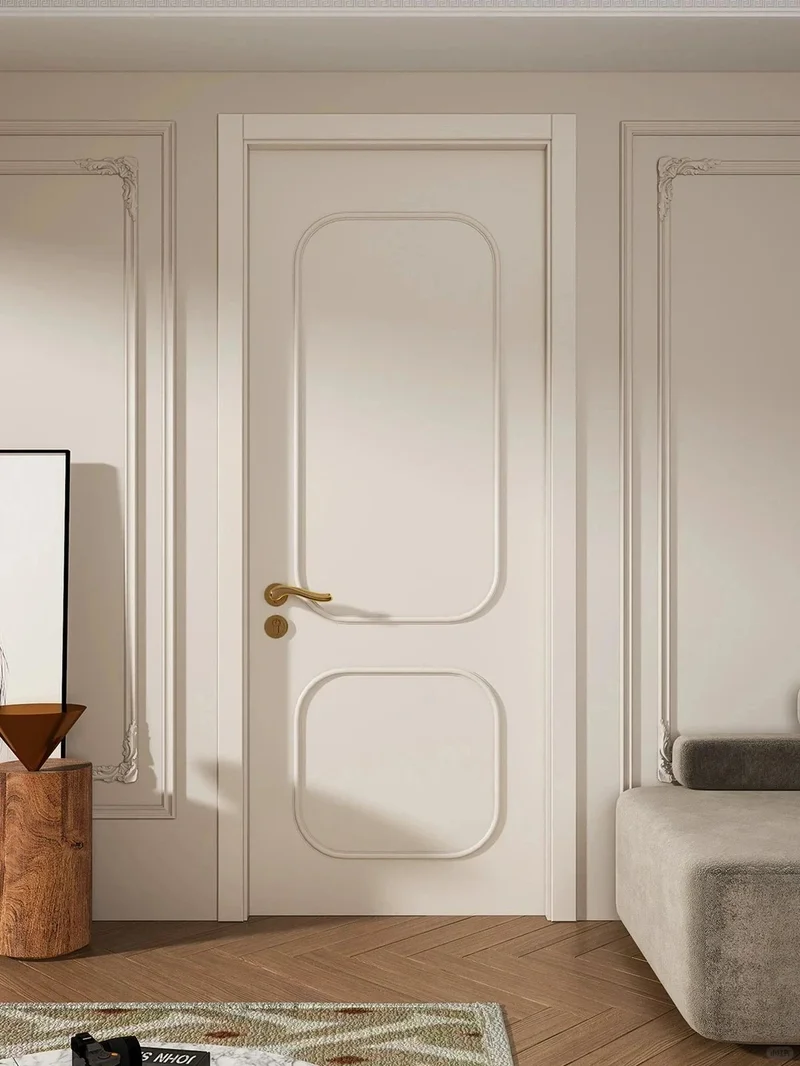
Functional Advantages:
- Sound attenuation: Rw ≥ 32 dB (tested per ISO 140-3), suitable for multi-family residential partitions and office demising walls
- Moisture absorption: ≤6.5% after 24-hour immersion (ASTM D1037), outperforming solid softwood by 40% in humid microclimates
- Thermal insulation: U-factor of 1.8–2.1 W/m²K, reducing HVAC load in passive-design retrofit projects
- Fire performance: Achieves Class D-s2,d0 per EN 13501-1; optional intumescent core upgrade for 30-minute integrity (BS 476-22)
- Dimensional tolerance: ±0.5 mm over 2100 mm height, compatible with automated locking systems and acoustic seals
| Performance Parameter | Test Standard | Value |
|---|---|---|
| Formaldehyde Emission | EN 717-1 (chamber) | ≤0.124 mg/m³ (E1) |
| Core Density | ISO 13085 | 0.78–0.82 g/cm³ (LVL) |
| Swelling Rate (thickness) | ASTM D1037 (2h H₂O) | ≤8% |
| Shore D Hardness (surface) | ISO 868 | ≥72 |
| Screw Holding (face edge) | EN 320 | ≥1800 N (5 mm withdrawal) |
These doors integrate seamlessly into modular construction workflows, with factory-applied edge banding (0.8 mm ABS/PVC) eliminating on-site finishing. The E1-compliant system supports WELL Building v2 and LEED v4.1 MR credits, making them ideal for institutional leasing, student housing, and healthcare support spaces where air quality and lifecycle durability are contractually mandated.
Architect-Grade Aesthetics with Budget-Smart Efficiency for Developers and Contractors
- Engineered solid wood doors utilize a multi-layer composite core structure, typically incorporating Laminated Veneer Lumber (LVL) with cross-laminated stabilization to achieve dimensional stability within ±0.05 mm/m under variable humidity (20–80% RH), minimizing warping risks in multi-story residential builds.
- Core density is optimized at 680–720 kg/m³ using WPC (Wood-Plastic Composite) with a 60:40 wood fiber-to-PVC ratio, balancing structural rigidity (flexural strength ≥42 MPa) with ease of on-site modification via standard carpentry tools.
- Surface lamination employs 3.6 mm real hardwood veneer (oak, walnut, or teak) cold-pressed at 8–10 N/mm² onto a moisture-resistant HDF substrate (850 kg/m³), achieving Class 1 surface hardness (Shore D ≥72) per ISO 868 and resisting indentation under sustained load.
- Formaldehyde emissions comply with E1 standard (≤0.124 mg/m³, EN 717-1) and align with CARB Phase 2, enabling use in high-occupancy residential and hospitality projects without off-gassing concerns.
- Acoustic performance reaches Rw 32–35 dB via sealed perimeter gasket integration and a minimum 42 mm door thickness, meeting ISO 140-3 requirements for inter-unit separation in multi-family developments.
- Thermal transmittance (U-factor) ranges from 1.8 to 2.2 W/(m²·K) with full perimeter thermal breaks, outperforming standard hollow-core alternatives (U-factor >3.0) and reducing HVAC load in passive-design schemes.
- Moisture absorption is limited to ≤6.8% after 24h immersion (ASTM D1037), with swelling thickness <2.1%, making units suitable for humid climates and interior wet zones (e.g., bathroom access doors).
- Fire performance achieves 30-minute integrity rating (EI30) when specified with intumescent edge seals and mineralized core additives, conforming to EN 1634-1 and supporting compartmentalization in mid-rise structures.
- Modular sizing adheres to ISO 2840 standard door blanks (e.g., 800×2,100 mm, 900×2,200 mm), enabling prefabricated installation and reducing job-site labor by up to 40% compared to site-built solid timber assemblies.
| Performance Parameter | Value/Range | Test Standard |
|---|---|---|
| Core Density | 680–720 kg/m³ | ISO 13036 |
| Formaldehyde Emission | ≤0.124 mg/m³ (E1) | EN 717-1 (chamber) |
| Sound Reduction Index (Rw) | 32–35 dB | ISO 140-3 |
| Thermal U-Factor | 1.8–2.2 W/(m²·K) | ISO 6946 |
| Thickness Swelling (24h) | <2.1% | ASTM D1037 |
| Moisture Absorption | ≤6.8% | ASTM D1037 |
| Fire Resistance (EI) | Up to 30 minutes | EN 1634-1 |
| Shore D Hardness (surface) | ≥72 | ISO 868 |
Frequently Asked Questions
What moisture expansion coefficient can be expected in engineered solid wood doors using WPC cores, and how is dimensional stability ensured?
Engineered solid wood doors with WPC cores (density 1,050–1,250 kg/m³) exhibit moisture expansion coefficients below 0.2%—achieved via acetylated wood fibers and co-extruded PVC encapsulation (0.3–0.5 mm thickness), preventing swelling. LVL (Laminated Veneer Lumber) core reinforcement further stabilizes against hygroscopic movement, critical for humid climates.
How do E1 and E0 formaldehyde emission standards apply to engineered wood doors, and which is recommended for high-occupancy buildings?
E1 (<0.124 mg/m³) meets baseline EU CARB P2 compliance, but E0 (<0.05 mg/m³, per EN 717-1) is essential for schools, hospitals, and luxury residences. Our doors use soy-based, formaldehyde-free MDI binders in WPC layers and implement F4-star-rated (Japan) core panels, ensuring indoor air safety and LEED v4 material optimization credits.
What thermal insulation performance do engineered solid wood doors achieve, and how is condensation risk mitigated in cold climates?
Doors achieve U-values of 1.8–2.2 W/m²K via low-conductivity WPC (λ = 0.12 W/mK) with fully foamed polyurethane cavities and thermally broken aluminum thresholds. Surface condensation is prevented using UV-stable, low-emissivity acrylic-PVC coatings (20–30 µm) and integrated silicone gaskets ensuring Class 4 air-tightness (EN 12207).
How are engineered wood doors tested for long-term structural warping, and what reinforcement methods prevent it?
Doors undergo 3,000-cycle climate cycling (85°C/85% RH) under ISO 2230, with <1 mm deflection achieved via cross-laminated LVL (≥11 N/mm² modulus) and peripheral steel stiffeners. Moisture-gradient balancing is maintained through symmetric lamination and end-sealing with reactive hot-melt adhesives, reducing warping risk over 25+ year service life.
Can engineered solid wood doors meet Class 2 impact resistance (EN 12600), and what structural layers provide it?
Yes—doors pass EN 12600 Class 2 (P2B2) impact via a tri-laminate system: dense WPC skin (1,200 kg/m³), central LVL core (9–12 mm), and fiber-reinforced polypropylene backsheet. Impact energy absorption (400 J) is validated through pendulum testing, ideal for commercial corridors and multifamily entries requiring durability.
What sound insulation level is achieved, and how is acoustic integrity maintained at door edges?
Acoustic performance reaches Rw 32–38 dB using mass-loaded WPC (≥1,100 kg/m³) coupled with constrained-layer damping interlayers. Perimeter acoustic seals—dual durometer EPDM gaskets (shore 40/70)—and drop-down automatic thresholds eliminate flanking noise, meeting BBCA standards for corridors and high-end residential partitions.
How does UV-resistant finishing prevent color degradation in exterior-facing engineered wood doors?
Finishing employs a 4-stage process: sand-sealing, hydrophobic primer, acrylic-PVC co-extrusion (30 µm), and top-coat with HALS (Hindered Amine Light Stabilizers) + TiO₂ nanoparticles. This system withstands >5,000 hrs QUV-B accelerated weathering (ASTM G154), maintaining ΔE <3 color stability over 15 years in Mediterranean and subtropical zones.
How do engineered wood doors support cost-effective sustainability in large-scale real estate developments?
Leveraging modular WPC door systems (pre-hung, ±0.5 mm tolerance) cuts on-site labor by 40%. With E0 emissions, 75% recycled content, and 25-year warrantied durability, lifecycle costs drop 30% vs. natural hardwood. Cradle-to-gate EPD-certified profiles support BREEAM Excellent and WELL Building Standard compliance in volume builds.