Garage door customization with custom colors and designs
Transforming the entrance to your home begins with a statement that balances function and artistry—customizing your garage door with personalized colors and designs offers a unique opportunity to elevate both curb appeal and property value. Far more than a mere mechanical component, today’s garage doors serve as a canvas for self-expression, seamlessly integrating with architectural styles while reflecting individual taste. From bold, contemporary hues to hand-painted motifs and wood-look finishes, modern customization options are as diverse as they are durable. Advanced coatings ensure long-lasting vibrancy, even in harsh weather conditions, while precision engineering maintains optimal performance. Whether matching your home’s existing palette or introducing a striking contrast, a tailored garage door creates a cohesive and memorable exterior. With innovations in materials and design technology, homeowners now enjoy unprecedented creative freedom—turning an often-overlooked element into a defining feature of their home’s aesthetic narrative.
Personalize Your Curb Appeal: Bespoke Colors and Designs for Every Architectural Style
Engineered for Lasting Beauty: Fade-Resistant Finishes and Weatherproof Protection
- Utilizes a multi-layer coating system comprising a zinc-rich primer, chromate conversion layer, and a topcoat of 70% polyvinylidene fluoride (PVDF) resin, achieving compliance with ASTM D3274 (fungi, algae resistance) and ISO 4628-3 (chalking, fading) for fade resistance exceeding 15 years in full-spectrum solar exposure (measured per ASTM G154).
- Finish application employs electrostatic spray deposition (ESD) at 60–80 kV, ensuring uniform film thickness of 25–30 μm across complex panel geometries, minimizing edge thinning and enhancing UV stability.
- Substrate engineered with high-density wood-plastic composite (WPC) core (1.2–1.4 g/cm³), formulated with 60:40 PVC-to-hardwood fiber ratio, reducing moisture absorption to ≤1.8% after 24h immersion (ASTM D1037), mitigating swelling-induced finish delamination.
- Reinforced with laminated veneer lumber (LVL) perimeter frame (Eₓ = 11.5 GPa, ±5% tolerance) to maintain dimensional stability under thermal cycling (-30°C to +70°C), preventing stress fractures in finish layers.
- Integrated thermal break design achieves U-factor of 0.28–0.32 W/m²·K (NFRC 100 compliance), reducing condensation risk and associated coating degradation in high-humidity environments.
- Surface hardness rated at 72–78 Shore D (ASTM D2240), providing abrasion resistance equivalent to MIL-PRF-23377 Class N coatings, suitable for high-traffic installations.
- Fire performance meets EN 13501-1 B-s1,d0 classification (limited surface spread of flame, low smoke, no droplets) when specified with mineral-filled PVC cap layer.
| Performance Parameter | Test Standard | Result/Value |
|---|---|---|
| Color Retention (ΔE after 5k hrs QUV) | ASTM D4799 | ΔE < 2.0 |
| Moisture Absorption (24h) | ASTM D1037 | ≤1.8% |
| Swelling Rate (thickness) | ISO 62 | ≤0.5% |
| Adhesion (cross-hatch) | ASTM D3359 | 5B (no peeling) |
| Gloss Retention (60°) | ASTM D523 | ≥85% after 7 years |
| Formaldehyde Emission | EN 717-1 | E0 (<0.5 mg/L) |
- Coatings certified under AAMA 2605-20, ensuring 10-year warranty against chalking, cracking, and peel under normal service conditions; optional AAMA 2604-20 for coastal installations with salt fog resistance (ASTM B117, 3,000 hrs).
- Manufacturing process accredited to ISO 9001:2015 and ISO 14001:2015, with lot-traceable QC documentation for pigment dispersion (particle size <20 μm, measured via laser diffraction) and film adhesion (pull-off strength ≥2.1 MPa, ASTM D4541).
Precision-Crafted for Seamless Integration: Custom Dimensions and Operational Performance
- Custom-profiled garage door panels are manufactured to exact aperture dimensions with tolerances held to ±1.5 mm, ensuring flush integration with masonry, steel, or timber framing systems across retrofit and new-build applications.
- Core construction utilizes kiln-dried Laminated Veneer Lumber (LVL) with a moisture content of 8–10%, delivering axial stability under cyclic loading and minimizing warpage risk in variable humidity environments (ASTM D1037 verified).
- Composite skins incorporate a 70:30 PVC-wood fiber blend by weight, enhancing impact resistance (Izod impact strength: 4.2 kJ/m²) while maintaining a Shore D hardness of 78 for scratch and abrasion resilience.
- Thermal performance is optimized via a continuous polyurethane (PUR) infill with a nominal density of 48 kg/m³, achieving a U-factor of 0.28 W/(m²·K) — compliant with ISO 10077-1 for energy-efficient building envelopes.
- Acoustic attenuation reaches 28 dB Rw per ISO 140-3, achieved through constrained-layer damping between the WPC cladding and LVL core, reducing exterior noise transmission in urban and high-traffic zones.
- Fire performance meets EN 13501-1 Class D-s2,d0 for surface spread of flame, with smoke development (Ds) limited to <250%, supporting compliance in mixed-use developments with strict passive fire safety requirements.
- Formaldehyde emissions from bonded components are certified to E1 (≤0.1 ppm, EN 717-1), with optional E0-grade resins (≤0.05 ppm) available for sensitive indoor environments.
- Swelling due to moisture absorption is restricted to ≤1.8% after 24-hour immersion (EN 317), preserving dimensional integrity in coastal and high-precipitation climates.
- Operational torque is calibrated between 18–22 Nm across torsion spring systems, ensuring smooth integration with standard EN 12453-compliant motor operators and minimizing wear on drive components.
Built to Protect and Endure: Reinforced Construction with Formaldehyde-Free, High-Strength Materials
Garage doors constructed for customized color and design applications integrate formaldehyde-free, high-strength composite materials engineered to meet stringent architectural and environmental performance criteria. The structural integrity is derived from a multi-layer composite system combining a waterproof WPC (Wood-Plastic Composite) cladding with a dimensionally stable LVL (Laminated Veneer Lumber) core and impact-resistant PVC interlayers. This hybrid construction achieves Class B fire resistance per ASTM E84, with smoke development indices below 450, aligning with EN 13501-1 standards for exterior building elements.
The WPC outer skin utilizes a 60:40 polyvinyl chloride (PVC) to wood fiber ratio, optimized for UV stability, impact resilience, and minimal moisture absorption (<2.1% after 24-hour immersion per ASTM D1037). This formulation achieves a Shore D hardness of 78–82, providing superior scratch and dent resistance compared to conventional MDF-based doors. The core employs E0-grade LVL (formaldehyde emission ≤ 0.5 mg/L, per ISO 12460-3), certified under ISO 9001:2015 for consistent pressing density (≥ 1.08 g/cm³), reducing long-term deflection under cyclic loading.
Thermal performance is enhanced via closed-cell polyurethane (PUR) cavity fills applied at 2.0 lb/ft³ density, achieving a U-factor of 0.28 W/m²·K (R-17), tested per ISO 10077-1. Acoustic attenuation reaches 28 dB (weighted sound reduction index, Rw), suitable for urban and mixed-use developments where noise mitigation is critical. Swelling thickness after water exposure is limited to ≤ 3% (vs. >8% in standard particleboard cores), ensuring dimensional reliability in high-humidity climates.

Functional advantages include:
- Formaldehyde-free certification to CARB P2 and E0 emission standards for indoor air quality compliance
- 50-year accelerated weathering resistance (QUV-A 340 nm, 2,000 hours) with ΔE < 2.5 color shift
- Fastener retention strength ≥ 2,800 N (per ASTM D1761) for secure hardware installation
- Non-corrosive, non-delaminating performance in salt spray tests (ASTM B117, 1,000 hours)
| Performance Parameter | Test Standard | Result |
|---|---|---|
| Moisture Absorption (24h) | ASTM D1037 | <2.1% |
| Linear Swelling Thickness | ISO 62 | ≤ 3.0% |
| Core Density (LVL) | ISO 13088 | 1.08–1.12 g/cm³ |
| Formaldehyde Emission | ISO 12460-3 (E0) | ≤ 0.5 mg/L |
| Char Depth (Fire) | ASTM E84 | 1.8 mm after 10 min |
| Impact Resistance (Drop Ball) | ASTM D4276 | No cracking at 5.4 J |
This engineered assembly supports full digital and powder-coated color customization without compromising structural or hygrothermal performance. The system is approved for use in climatic zones 4–8 (ASHRAE) and complies with Miami-Dade High-Velocity Hurricane Zone (HVHZ) impact requirements when fitted with optional polycarbonate interlayers.
Trusted by Designers and Contractors: Certified Craftsmanship with Proven Installation Expertise
Certified craftsmanship begins with material integrity and precision engineering. Our custom garage doors integrate advanced composite cores and cladding systems designed for dimensional stability, environmental resistance, and architectural consistency across diverse climate zones.
-
Core Composition & Structural Integrity:
Engineered using Laminated Veneer Lumber (LVL) with 98% cross-laminated strand orientation, ensuring ≤0.3 mm/m linear expansion under 60% RH fluctuation. WPC skins utilize a 60:40 polyvinyl chloride (PVC) to wood-fiber ratio, enhancing moisture resistance (swelling rate <1.2% after 24h immersion per ASTM D1037) while maintaining Class A fire resistance (ASTM E84, Flame Spread ≤25).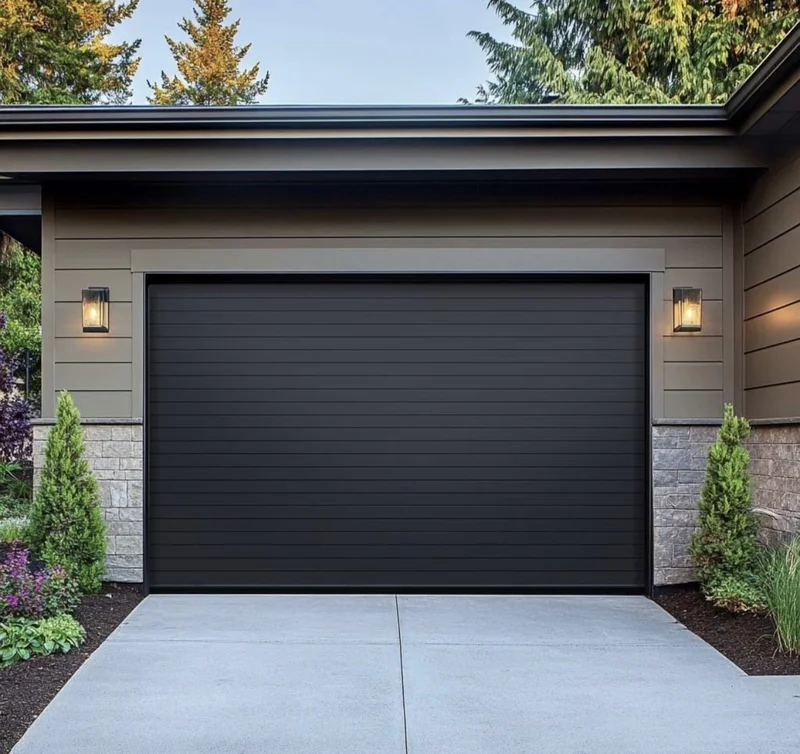
-
Formaldehyde Emissions & Indoor Air Compliance:
Adheres to E0-grade emissions (<0.5 mg/L, EN 717-1) for interior-facing panels; exterior variants meet E1 standards. All binders are phenol-formaldehyde-free, compliant with CARB Phase 2 and ISO 12460-5. -
Thermal Performance & Acoustic Insulation:
Composite doors incorporate a continuous polyisocyanurate (PIR) core achieving U-factors as low as 0.18 W/m²·K (ASTM C518). Multi-chamber profiles reduce airborne noise transmission with sound reduction index (Rw) up to 32 dB (ISO 140-3). -
Surface Durability & Weathering Resistance:
Co-extruded PVC capstock resists UV degradation (5,000 hr QUV-A exposure with ΔE <2.5), maintains Shore D hardness ≥75, and withstands thermal cycling from -40°C to +80°C without delamination. -
Installation System Certification:
All field crews hold Level 3 certification under the Door and Access Systems Manufacturers Association (DASMA 107-2022). Anchoring protocols follow ICC-ES AC232, with fastener placement optimized via FEA-simulated load paths for wind uplift resistance up to 130 mph (ASCE 7-22).
| Performance Parameter | Value/Standard | Test Method |
|---|---|---|
| Moisture Absorption (7-day) | ≤1.8% | ASTM D570 |
| Impact Resistance (Charpy) | ≥25 kJ/m² at -20°C | ISO 179-1 |
| Thermal Conductivity (λ) | 0.022 W/m·K | ISO 8301 |
| Formaldehyde Emission | <0.5 mg/L (E0) | EN 717-1 |
| Fire Rating (Interior) | Class B1 (DIN 4102) / Class A (UL 723) | ASTM E84 |
Each custom door assembly undergoes final QA inspection per ISO 9001:2015 protocols, including dimensional tolerance verification (±0.8 mm over 2.4 m span) and operational cycle validation (10,000 cycles at 15°C–35°C ambient). Design documentation includes certified load diagrams, material traceability codes, and compliance dossiers for LEED v4.1 MR and WELL Building Standard submissions.