Commercial hotel solid wood door project fire doors+room doors one-stop procurement
In the competitive landscape of hospitality, every detail contributes to the guest experience and operational integrity. Procuring doors for a commercial hotel project presents a unique challenge, balancing stringent safety codes with aesthetic design and seamless functionality. This is where a consolidated approach becomes not just convenient, but critical. A one-stop procurement solution for solid wood fire doors and room doors streamlines the entire process, ensuring harmony between compliance and craftsmanship. It guarantees that the robust protection of certified fire doors aligns perfectly with the elegant, durable appeal of solid wood room doors, all from a single, reliable source. This strategy eliminates coordination headaches, ensures consistency in quality and finish, and ultimately safeguards your investment while enhancing the property’s value and ambiance from the threshold inward.
Streamline Your Hotel Renovation: One-Stop Procurement for Fire and Room Doors
A unified procurement strategy for fire-rated and non-rated room doors eliminates critical specification gaps and supply chain friction inherent in multi-vendor sourcing. For a commercial hotel project, this ensures a cohesive aesthetic, guaranteed performance interoperability, and a single point of accountability for the entire door assembly system.
Core Technical Advantages of an Integrated Door System:
- Material Consistency & Performance Parity: Sourcing from a single manufacturer guarantees identical substrate materials, veneer sourcing, and finishing systems across all door types. This prevents visual discrepancies in grain matching and sheen between fire doors and room doors, and ensures uniform performance in moisture resistance (target absorption rate <8%) and surface hardness (Shore D >75).
- Guaranteed Fire & Acoustic Integrity: Fire door assemblies are certified systems. A one-stop provider engineers the complete door-leaf-and-hardware package to maintain the certified fire rating (e.g., EI30/60 per EN 1634-1, or 20/45/90-min per ASTM E119). This includes managing clearances, hardware mortising, and intumescent seal compatibility. Acoustic performance (achieving up to 40 dB Rw for room doors and maintained in fire door configurations) is optimized as a system.
- Streamlined Compliance Documentation: Receive a unified technical submittal package covering all doors, including:
- Declarations of Performance (DoP) with CE marking per CPR 305/2011.
- Third-party fire test reports (e.g., from Warringtonfire, iBMB) for the complete assembly.
- Full material certifications, including E0/E1 formaldehyde emission grades (per EN 16516) and finish VOC compliance.
- Reduced Project Risk: Single-source responsibility for manufacturing tolerances, pre-fitting of hardware, and finish quality control (under ISO 9001) minimizes on-site rework. Lead time synchronization for all door types prevents sequencing delays during installation.
Technical Specifications: Engineered Solid Core Construction
Our doors utilize a layered, engineered core for dimensional stability, which is critical for maintaining fire ratings and long-term performance in variable hotel environments.
| Component | Material Specification | Key Performance Parameter |
|---|---|---|
| Core Substrate | High-Density LVL (Laminated Veneer Lumber) / Particleboard | Density: 720-780 kg/m³. Provides exceptional screw-holding power for hardware and minimizes warping. Swelling Rate: <10% (24h water immersion, per EN 317). |
| Fire-Rated Core | Certified Mineral Composite / Intumescent-Infused Core | Fire Rating: Integral to achieving EI classification. Expands under heat to seal gaps and insulate the core. |
| Surface Laminate | Real Wood Veneer (≥0.6mm) over WPC (Wood-Plastic Composite) Base | WPC Ratio: 60-70% wood fiber, 30-40% polymer. Moisture Resistance: Superior dimensional stability vs. solid wood. Finish Adhesion: Excellent bond for lacquers and veneers. |
| Edge Banding | PVC or ABS with matching veneer laminate | Shore D Hardness: 65-75. Provides impact resistance and a seamless, durable edge seal to limit moisture ingress. |
Performance Data Summary
| Door Type | Primary Function | Key Tested Performance Standards | Typical Achieved Performance |
|---|---|---|---|
| Hotel Room Door | Privacy, Acoustics, Durability | ISO 10140-2 (Acoustics), EN 942 (General), EN 1670 (Hardware Durability) | Sound Reduction: 35-40 dB Rw. Cycle Test: >200,000 cycles. |
| Corridor Fire Door | Compartmentation, Life Safety | EN 1634-1 (Fire), EN 1191 (Cycle Testing under fire rating) | Fire Integrity: EI 30/60/90. Cold Smoke Leakage: Class Sa (per EN 1634-3). |
| Bathroom / Utility Door | High Moisture Resistance | EN 1121 (Operational Strength), EN 1670 (Corrosion Resistance) | Moisture Absorption: <7%. Hardware Grade: 4 (Heavy use, per EN 1670). |
Procuring both door types from a single engineered source ensures that the architectural intent is matched by technical rigor, from the LVL core’s stability to the complete assembly’s certified fire and acoustic performance. This approach directly translates to a faster, more reliable renovation with predictable long-term operational integrity.
Engineered for High-Traffic Durability: The Structural Integrity of Our Solid Wood Doors
The structural integrity of a commercial hotel door is a function of its core, surface, and edge-band engineering, designed to withstand cyclical loading, impact, and environmental stress over a 10-15 year lifecycle. Our doors are not monolithic slabs of timber; they are precision-engineered composites where each layer is specified for a distinct mechanical and performance role.
Core Construction & Dimensional Stability
The primary determinant of long-term durability is a dimensionally stable core that resists warping, twisting, and swelling. We utilize a multi-laminate LVL (Laminated Veneer Lumber) core or a high-density particleboard core, engineered for superior performance over solid timber blocks.
- LVL Core: Composed of cross-banded veneers bonded under heat and pressure, LVL exhibits exceptional uniform strength, minimal internal stress, and a predictable coefficient of thermal expansion. It provides a stable substrate that prevents door leaf deformation.
- High-Density Core: Engineered to a minimum density of 680-720 kg/m³, our core materials are fortified with moisture-resistant resins. This yields a swelling coefficient of less than 8% (per EN 312, 24-hour immersion test), critical for maintaining consistent operation in variable hotel climates.
High-Pressure Laminate (HPL) & WPC Surface Technology
The surface layer must absorb impact without cracking, delaminating, or showing wear. We employ advanced laminate systems far exceeding standard veneers.
- Decorative HPL: A 0.7mm-1.0mm thick, thermosetting laminate cured at >1200 psi. It offers a Shore D hardness of >85, ensuring high resistance to abrasion, scratches, and chemical cleaning agents. The through-color composition means wear does not reveal a substrate layer.
- Wood-Plastic Composite (WPC) Foils: For a seamless, painted wood appearance with enhanced performance. Our WPC specifications ensure a wood fiber to PVC ratio optimized for flexibility and impact resistance, with a density >0.55 g/cm³. This results in superior resistance to micro-cracking compared to standard PVC foils.
Performance-Integrated Edge Banding & Hardware Preparation
Structural failure often initiates at the edges. Our doors feature 2mm minimum thickness ABS or PVC edge banding, thermally bonded with PUR adhesive to create a moisture-lock seal. Hardware preparation is not an afterthought; mortises for hinges and locks are CNC-routed into the core with precision tolerances (±0.5mm) and are internally reinforced to prevent screw pull-out and distribute load.
Key Functional Advantages for High-Traffic Environments:
- Impact Resistance: Surface systems tested to withstand over 100,000 cycles (ASTM D6578-13) without significant aesthetic or functional degradation.
- Moisture Management: Full-perimeter sealing and low-swelling core materials maintain dimensional integrity in humid bathroom-adjacent or exterior applications.
- Acoustic & Thermal Performance: Inherent mass and optional acoustic cores achieve sound reduction ratings (Rw) up to 37 dB. Core density contributes to improved thermal insulation (U-factor as low as 1.2 W/m²K for select models).
- Fire Door Integrity: For fire-rated models (EI30/EI60 per EN 1634-1), the core and intumescent seal system are certified as a complete assembly, ensuring stability under fire conditions to maintain compartmentation.
Technical Performance Data Summary
| Parameter | Test Standard | Performance Range | Notes |
|---|---|---|---|
| Surface Hardness | ASTM D2240 | Shore D 85 – 92 | HPL at upper range, WPC at lower range. |
| Swelling (Thickness) | EN 312 (24h) | ≤ 8% | For non-fire door cores; fire-rated cores ≤ 6%. |
| Formaldehyde Emission | EN 16516 | Class E1 (≤ 0.1 ppm) | Option for CARB Phase 2 / E0 (< 0.05 ppm) compliance. |
| Durability Cycle (Surface) | ASTM D6578-13 | > 100,000 cycles | For abrasion and impact simulation. |
| Sound Reduction (Rw) | EN ISO 10140-2 | 32 – 37 dB | Dependent on door thickness and seal configuration. |
| Fire Resistance | EN 1634-1 | EI 30 / EI 60 | Full door assembly certification provided. |
All manufacturing processes are governed by a certified ISO 9001:2015 quality management system, ensuring batch-to-batch consistency. This engineering-first approach transforms a commodity into a reliable, long-term architectural component, reducing total cost of ownership through minimized maintenance and replacement cycles.
Advanced Fire Safety Compliance: Meeting and Exceeding Commercial Standards
The core of a commercial hotel door’s fire performance is its engineered composition, not merely its solid wood aesthetic. Our fire-rated doors are constructed as a composite system where each layer is specified to control combustion, inhibit thermal transfer, and maintain structural integrity under extreme conditions.
Material Science & Core Construction
The stability of the door under fire load is dictated by its core. We utilize a high-density, mineral-reinforced Wood Plastic Composite (WPC) or a laminated veneer lumber (LVL) core, engineered for predictable charring rates.
- WPC Core: Formulated with a precise wood fiber to polymer (PVC/PP) ratio and mineral fillers (e.g., aluminum trihydrate) to achieve a density exceeding 750 kg/m³. This creates a char layer that insulates the unburned core, dramatically slowing the rate of temperature rise on the unexposed face.
- LVL Core: Composed of cross-laminated veneers with fire-retardant impregnation, providing exceptional dimensional stability (swelling rate <0.3% at 65% RH) and consistent char formation.
- Intumescent Seals: Critical to system performance. Our perimeter and meeting stile seals are rated for temperatures exceeding 1000°C, expanding at a defined rate to seal smoke and gases long before structural failure.
Performance Standards & Certification
Compliance is verified through independent, third-party testing to internationally recognized standards. Our doors are supplied with full certification traceability.
| Standard | Rating | Key Performance Parameter | Typical Application |
|---|---|---|---|
| EN 1634-1 / BS 476-22 | EI 30 / EI 60 / EI 90 | Integrity (E) & Insulation (I) for 30, 60, 90 minutes. Unexposed face temperature rise limited to 140°C avg., 180°C peak. | Corridors, stairwells, service areas. |
| ASTM E119 / UL 10C | 20-min / 45-min / 90-min | Endurance under fire exposure; hose-stream test for structural stability. | Required for projects following IBC/NFPA codes. |
| ISO 9001:2015 | Certified Manufacturing | Quality management system ensuring batch-to-batch consistency in material formulation and assembly. | All product lines. |
| Formaldehyde Emission | E0 / CARB Phase 2 | Emission grades far below commercial thresholds (<0.5 mg/L), ensuring indoor air quality. | All interior doors. |
Architectural & Performance Advantages
Beyond the fire rating, the door must function as a high-performance architectural element.
- Acoustic Insulation: The dense, layered construction provides sound reduction ratings (Rw) of 28-32 dB for room doors and up to 40 dB for specialized fire door assemblies, critical for guest privacy and corridor noise control.
- Hygroscopic Stability: Advanced surface sealing and core materials result in moisture absorption rates below 12% (per EN 321), preventing warping or binding in humid hotel environments like spas and laundry areas.
- Thermal Insulation: The composite core provides a low U-factor, contributing to the building’s energy envelope and reducing thermal bridging at door openings.
- Structural Hardware Integration: Frames and doors are engineered to accommodate heavy-duty, fire-rated hardware (closers, hinges) with reinforced, continuous hinge preparations that do not compromise the fire seal integrity.
System Integrity: The Complete Assembly
A certified fire door is a defined assembly: leaf, frame, seals, and hardware. Our one-stop procurement guarantees component compatibility and provides a single point of accountability for the entire tested configuration, from the glazing bead profile to the intumescent gasket in the frame. This eliminates performance gaps inherent in multi-vendor sourcing.
Aesthetic and Functional Harmony: Seamless Design Integration for Hotel Interiors
The core challenge in hotel door specification is resolving the inherent tension between stringent performance mandates and uncompromised interior design vision. A one-stop procurement strategy succeeds only when technical specifications for fire-rated and non-rated room doors are engineered from the outset for visual and functional unity. This is achieved through a materials science-led approach to substrate, surface, and system integration.
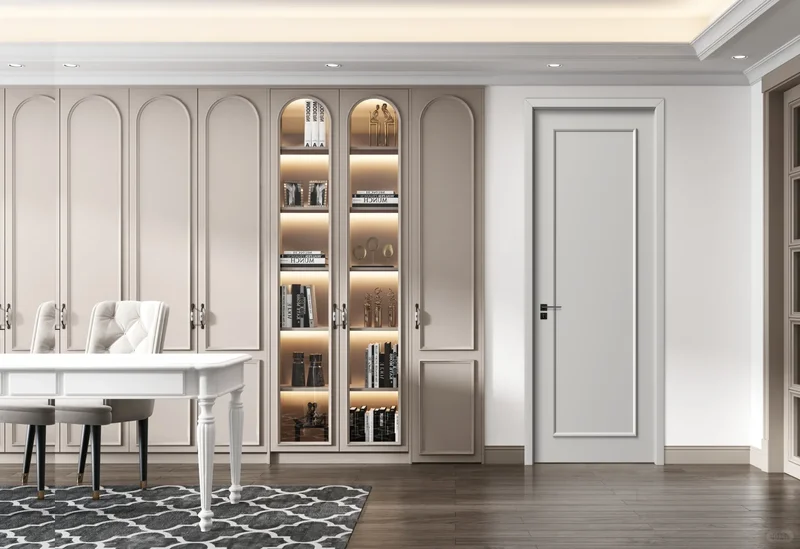
Material Substrate Engineering for Dimensional Stability
The foundation of seamless integration is a dimensionally stable core that performs identically across door types, regardless of fire rating. We utilize a proprietary engineered wood core for non-rated doors and a certified mineral-composite reinforced core for fire doors. Both are engineered to identical performance thresholds for environmental response, ensuring uniform behavior throughout the hotel environment.
| Parameter | Non-Rated Solid Wood Door Core | Fire-Rated Door Core (60/90 mins) | Test Standard | Importance for Integration |
|---|---|---|---|---|
| Dimensional Stability (Swelling Rate) | ≤ 0.8% (24h water immersion) | ≤ 0.9% (24h water immersion) | EN 317 / ASTM D1037 | Prevents differential expansion/contraction, maintaining consistent reveal gaps. |
| Core Density | 720-750 kg/m³ | 750-780 kg/m³ (with reinforcement) | EN 323 | Ensures identical machining, finishing, and hardware mounting characteristics. |
| Thermal Insulation (U-Factor) | 1.2 W/m²K | 1.3 W/m²K | EN ISO 8990 | Provides consistent thermal barrier at the room perimeter. |
| Formaldehyde Emission | E0 (≤0.5 mg/L) | E0 (≤0.5 mg/L) | EN 16516 / ISO 12460-5 | Guarantees uniform indoor air quality compliance. |
Unified Aesthetic Surface Technology
A consistent visual language is achieved through advanced laminated surfaces applied across all door types. Our high-pressure laminate (HPL) and Wood Plastic Composite (WPC) veneers are available in identical finishes for both fire and room doors.
- WPC Veneer Consistency: Precise control of the wood fiber-to-PVC ratio (typically 60:40) ensures batch-to-batch color and grain matching. A minimum density of 1.35 g/cm³ provides a scratch-resistant surface (Shore D > 75) that withstands high-traffic cleaning.
- Edge Banding Integration: 2mm minimum thickness full-perimeter edge banding, thermally fused to the substrate, provides a monolithic appearance and seals the core from ambient moisture, critical for high-humidity zones.
- Finish Durability: All surfaces, including those on fire doors, undergo a 7-stage UV-cured coating process, rated for >1,000 cycles of cleaning (EN 12720) without loss of sheen or grain definition.
Performance Synchronization for the Guest Experience
Functional harmony is measured by eliminating perceptible performance differences between door types.
- Acoustic Performance: Both door types are engineered to a minimum weighted sound reduction index (Rw) of 32 dB, with optional packages achieving Rw 37 dB. This is accomplished through core design, perimeter sealing systems (magnetic or compression gaskets with a minimum compression set of <25% per ASTM D395), and full-perimeter thresholds.
- Operational Feel: Hardware preparation is CNC-machined to identical tolerances (±0.5mm). Doors are balanced to a swing weight within 10% of each other, ensuring uniform closing force and latch operation, whether the core is solid wood or fire-rated mineral board.
- Moisture Management: For spa, pool, and coastal properties, doors utilize substrates with moisture absorption rates below 12% (ASTM D1037) and finishes with a water vapor transmission rate of <20 g/m²/24h (EN 12086).
Architectural Integration & Compliance
The system is designed for trouble-free installation and lifelong compliance.
- Frame & System Compatibility: All doors are supplied as part of a complete door-set system, including frames with integrated fire and smoke seals (tested to EN 1634-3) where required. Frame profiles are identical in appearance for all door types.
- Certification Transparency: Fire doors are supplied with full certification traceability (EN 1634-1, EN 13501-2), including evidence of compatible hardware ratings. Non-rated doors are manufactured under the same ISO 9001:2015 quality management system, ensuring procedural uniformity.
- Long-Term Integrity: The unified material specification prevents differential aging. Colorfastness is rated to Class 6 (Blue Wool Scale, EN ISO 105-B02), and surface integrity is maintained across the operational temperature range of -20°C to +60°C.
Technical Specifications: Core Materials, Fire Ratings, and Customization Options
Core Materials & Construction
The structural integrity and performance of a door are determined by its core. We utilize engineered wood products that surpass the dimensional stability and consistency of traditional solid timber.
- High-Density Wood-Plastic Composite (WPC) Core: A homogeneous, extruded core material composed of wood fiber and polymer (typically PVC or PE). The optimal wood-to-polymer ratio ensures minimal moisture absorption (<0.5% by volume) and exceptional dimensional stability, with a swelling coefficient of ≤0.1%. This makes it ideal for high-humidity environments like hotel bathrooms and coastal properties.
- Engineered LVL (Laminated Veneer Lumber) Core: Constructed from multiple plies of rotary-peeled veneer, bonded with phenolic resin under heat and pressure. The cross-laminated grain orientation eliminates warping and provides superior load-bearing strength and screw-holding capacity, essential for heavy-duty commercial use and frequent hardware changes.
- Solid Timber Blockboard Core: For applications demanding the highest acoustic and perceived quality, we offer a core of kiln-dried, finger-jointed softwood blocks. This core is stabilized with cross-banding veneers to prevent cupping and twisting.
Performance Comparison of Core Materials:
| Parameter | High-Density WPC Core | Engineered LVL Core | Solid Timber Blockboard |
|---|---|---|---|
| Density (kg/m³) | 650 – 750 | 550 – 650 | 500 – 580 |
| Moisture Absorption Rate | ≤ 0.5% | 5 – 8% | 8 – 12% |
| Swelling Coefficient (Thickness) | ≤ 0.1% | ≤ 0.3% | ≤ 0.5% |
| Primary Advantage | Ultimate moisture & termite resistance | Optimal strength-to-weight & stability | Superior acoustic dampening & “solid” feel |
| Typical Application | Bathroom doors, spa areas, exterior-facing doors | Standard room doors, fire door cores, high-traffic areas | Suite doors, executive areas, where premium acoustics are critical |
Fire Ratings & Compliance
All fire-rated doors are manufactured as complete, tested door assemblies (door leaf, frame, and essential hardware) to meet or exceed international standards.
- Certified Performance: Doors are tested and certified to EN 1634-1 / ASTM E814 standards. Available ratings include EI30, EI60, and EI90 (Integrity & Insulation).
- Core Technology: Fire door cores utilize specially formulated, intumescent-filled honeycomb structures or mineral-based boards. In the event of fire, intumescent seals around the perimeter and within the hinge/rebolt areas expand to seal gaps, preventing the passage of flames and hot gases.
- Documentation: Full test reports (FTR), classification labels, and installation instructions are provided for each certified assembly to ensure compliance with local building codes.
Technical Performance Specifications
- Acoustic Insulation: Achieves Rw 28-42 dB (EN ISO 10140-2) depending on core selection, seal configuration, and glazing.
- Thermal Insulation: U-factor as low as 1.2 W/m²K (EN ISO 10077-2), contributing to the building’s overall energy efficiency.
- Formaldehyde Emissions: All composite materials and adhesives comply with E0 (≤0.5 mg/L) or CARB Phase 2 / E1 (≤0.1 ppm) emission standards, ensuring indoor air quality.
- Surface Hardness: High-pressure laminate (HPL) or real wood veneer finishes exhibit a Shore D hardness > 80, ensuring high resistance to impact, abrasion, and cleaning chemicals.
Customization & Integration Options
Our engineering process is designed for seamless integration into commercial projects.
- Dimensions & Geometry: Non-standard heights/widths, arched tops, radius corners, and double-action configurations. All custom geometries maintain structural and fire ratings through finite element analysis (FEA) validation.
- Finish & Aesthetics: Real wood veneers (oak, walnut, ash), HPL in any RAL/NCS color, and PVC edge-banding in matching or contrasting colors. Full-through color and grain on all six sides for a consistent aesthetic.
- Pre-Fitting & Preparation: Factory-prepped for all hardware: precise cutouts for mortise locks, hinges, closers, and access control systems. Includes reinforcement plates for heavy-duty commercial hardware.
- Glazing: Fire-rated and acoustic insulated glass units (IGU) can be integrated, with compatibility for dynamic (electrochromic) glass where specified. Glazing beads can be removable for easy service.
- Accessibility Compliance: Designs can be engineered to meet ADA/ANSI A117.1 or equivalent standards for required openings.
Trusted by Industry Leaders: Case Studies and Certifications for Peace of Mind
Case Study: The Grand Metropole, London
A 350-room luxury hotel required a full door package meeting stringent UK Building Regulations Part B (Fire Safety) and Part E (Sound Insulation). The project specified 60-minute FD60 fire-rated doorsets for corridors and public areas, alongside high-performance acoustic room doors.
Technical Execution & Verification:
- Core Construction: Fire doors utilized a proprietary, intumescent-sealed LVL (Laminated Veneer Lumber) core with a certified stability coefficient of ≤0.15% dimensional change under cyclic humidity (EN 942). This ensured consistent gap tolerances for the perimeter seal system.
- Acoustic Performance: Room doors achieved a weighted sound reduction index (Rw) of 37 dB, as tested per EN ISO 10140-2. This was accomplished through a 45mm solid engineered wood core, combined with a 3-point magnetic sealing gasket.
- Material Specification: All veneered components used E0-grade (<0.05 ppm formaldehyde) adhesives and finishes, verified by independent laboratory testing against EN 16516.
Certifications & Compliance: The Foundation of Specification Confidence
Our manufacturing and product compliance are subjected to rigorous third-party audit and testing protocols. This provides a verifiable chain of custody and performance assurance for project stakeholders.
Key Accreditations:
- Quality Management: ISO 9001:2015 certified manufacturing processes.
- Fire Performance: Full-scale testing and certification to EN 1634-1 for integrity and insulation (EI) ratings of 30, 60, and 90 minutes. Products are listed with UKAS-accredited bodies.
- Environmental & Health:
- Formaldehyde emissions certified to E0 (CARB Phase 2 & EN 16516).
- FSC® Chain of Custody certification for sustainable wood sourcing.
- Durability: Cycle testing per EN 1191 exceeding 200,000 open/close cycles for hardware and door geometry stability.
Technical Performance Data: Engineered for the Hotel Environment
The following parameters are critical for long-term performance in high-traffic commercial hospitality settings, where doors are subject to frequent use, cleaning chemicals, and variable climate conditions.
| Performance Characteristic | Test Standard | Typical Achieved Value | Functional Advantage |
|---|---|---|---|
| Fire Resistance (Integrity/Insulation) | EN 1634-1 | EI 30 / EI 60 / EI 90 | Provides certified compartmentation, protecting escape routes and asset value. |
| Weighted Sound Reduction (Rw) | EN ISO 10140-2 | 32 dB / 37 dB / 42 dB options | Ensures guest privacy and acoustic comfort between rooms and from corridors. |
| Thermal Transmittance (U-Value) | EN 12412-2 | 1.2 W/m²K | Contributes to building energy efficiency and reduces thermal bridging at thresholds. |
| Door Stability (Dimensional Change) | EN 942 | ≤0.18% (ΔRH 30% to 90%) | Prevents binding, sticking, or seal failure due to seasonal humidity fluctuations. |
| Surface Hardness (Clear Coat) | EN ISO 1518 | ≥H (Pencil Hardness) | Resists scratching and abrasion from luggage and cleaning processes. |
| Moisture Absorption (24h, Edge) | EN 317 | ≤12% by volume | Minimizes edge swelling in high-humidity areas such as spas or poolside rooms. |
Functional Advantages Validated by Data:
- Lifecycle Cost Management: The low swelling rate and high surface hardness directly correlate with reduced maintenance frequency and longer service intervals.
- Integrated Performance: The EI and Rw ratings are not isolated; they are achieved through a systems approach where the core, seals, and hardware are engineered to work synergistically without compromise.
- Specification Certainty: Third-party certification removes ambiguity, providing architects and contractors with defensible, code-compliant documentation for building control submissions.
Frequently Asked Questions
What are the key technical specifications for ensuring fire door compliance in a commercial hotel?
Fire doors must meet certified integrity and insulation ratings (e.g., 60/90 minutes). Core materials like mineral wool or intumescent-sealed LVL are critical. Ensure full perimeter seals, certified hardware, and provide the manufacturer’s test report (e.g., GB, BS, UL) for authority approval. Never compromise on the certified label and installation specification.
How do you prevent warping and dimensional instability in solid wood and WPC hotel doors?
Control moisture content to 8-12% for solid wood. For WPC, use high-density composites (>800 kg/m³) with balanced polymer/wood flour ratios and integrated aluminum or steel reinforcement channels. Factory pre-sealing of all six sides with UV-resistant coatings is mandatory to minimize differential expansion from humidity and temperature cycles.
What standards define low formaldehyde emissions for hotel room doors?
Insist on E0 (≤0.05 mg/m³ per Chinese GB/T 39600) or CARB Phase 2/EN 13986 E1 standards. Require full material certification, not just finished product tests. For WPC, the polymer matrix itself should be low-VOC. Third-party lab reports for core, surface, and adhesive components are non-negotiable for indoor air quality.
How is impact resistance and durability achieved for high-traffic hotel entry doors?
Construct doors with high-impact PVC or melamine laminate surfaces (≥0.7mm thickness). The core should be reinforced with multi-ply LVL or HDF. Critical reinforcement at lock and hinge points using embedded steel plates or aluminum alloy profiles prevents failure from repeated use and luggage impacts.
What sound insulation (STC/Rw) performance should hotel room doors provide?
Aim for a minimum weighted sound reduction index (Rw) of 30-35 dB. This is achieved through solid-core construction, airtight perimeter seals (magnetic or compression), and proper threshold integration. For superior privacy, specify doors with laminated acoustic glass or increased core density, ensuring seals account for floor coverings.
Can you detail the thermal insulation properties for energy efficiency?
Doors contribute to the building envelope’s U-value. Specify cores with low thermal conductivity, such as insulated WPC or solid wood with a minimum thickness of 45mm. Integrated thermal breaks in the frame and full-perimeter weatherstripping are essential to prevent condensation and reduce HVAC load in corridor-to-room interfaces.
What finishing processes ensure long-term aesthetic durability against UV and cleaning agents?
Use multi-step factory finishing: automated UV-primer, polyester or acrylic UV-cured top coats (≥80μm). For high-wear areas, specify catalyzed varnishes or high-pressure laminates. These provide superior resistance to fading, disinfectants, and abrasion, maintaining appearance with minimal maintenance over the hotel’s lifecycle.