Solid wood door project cooperation scheme design installation guidance after-sales maintenance
In the realm of architectural finishes, few elements command presence and enduring value like a meticulously crafted solid wood door. This comprehensive guide delves into the critical pathway for successful project integration, from initial partnership frameworks to long-term performance. We will explore how a strategic cooperation scheme aligns client vision with manufacturing excellence, ensuring material integrity and design coherence. The journey continues with precise installation protocols, a phase where expert guidance safeguards against common pitfalls and guarantees flawless operation. Finally, we underscore the indispensable role of a robust after-sales maintenance program, the cornerstone of preserving the door’s natural beauty, structural integrity, and functionality for decades to come, transforming a simple installation into a lasting investment.
Achieve Seamless Project Integration: Our Comprehensive Solid Wood Door Cooperation Scheme
Technical Collaboration Framework
Our scheme is built on a foundation of engineered wood technology and precision manufacturing to ensure structural integrity and performance consistency across large-scale projects. The core principle is the integration of material specifications, fabrication tolerances, and logistical planning into a single, managed workflow.
Core Material & Construction Specifications:
- Engineered Core Stability: We utilize Laminated Veneer Lumber (LVL) or cross-laminated solid wood block cores. LVL cores provide superior dimensional stability (<0.1% linear expansion under standard RH cycles) and resistance to warping, critical for maintaining alignment in multi-story installations.
- Advanced Surface Laminate Options: Beyond traditional veneers, we offer high-pressure laminates (HPL) and Wood-Plastic Composite (WPC) cladding.
- WPC Cladding: Engineered with a controlled wood fiber to polymer (typically PVC) ratio (e.g., 60:40) and density (>1.1 g/cm³) for optimal impact resistance (Shore D >75) and moisture impermeability (water absorption <3% per 24h).
- HPL Options: Provide Class 1 (EN 13501-1) or Class A (ASTM E84) fire-rated surfaces with abrasion resistance exceeding AC4 (EN 13329).
- Performance-Grade Finishes: All finishes are applied in controlled environments. Polyurethane or catalyzed varnish systems achieve a film thickness of 120-150 microns, ensuring consistent UVA resistance and wear performance. Formaldehyde emissions are strictly controlled to E0 (≤0.5 mg/L, JIS F****/EN 13986) or E1 (≤1.5 mg/L) standards.
Functional Advantages for Project Integration:
- Predictable Acoustic Performance: Standard solid-core constructions achieve a Sound Transmission Class (STC) rating of 30-35 dB. For enhanced requirements, integrated acoustic seals and specialized core designs can achieve STC 40+.
- Controlled Thermal Bridging: Doors with insulated cores and thermally broken thresholds contribute to improved U-factors, supporting overall building envelope energy efficiency targets.
- Hygroscopic Stability: Engineered components exhibit low moisture absorption rates (<7% by weight, per EN 322), minimizing dimensional change in variable humidity environments common during construction.
- Precision Pre-Hanging: Doors are supplied pre-hung in factory-trued frames with a 3-axis adjustment system (±5mm vertical/horizontal, ±3mm in/out), reducing on-site fitting time and ensuring perfect alignment.
Technical Parameters for Specification:
| Parameter Category | Standard Product Specification | Enhanced Performance Option | Test Standard |
|---|---|---|---|
| Core Density | ≥650 kg/m³ | ≥750 kg/m³ (High-Density Composite) | EN 323 |
| Fire Resistance | FD30 / 20-min (Typical) | FD60 / 60-min (Labeled) | EN 1634-1 / ASTM E119 |
| Formaldehyde Emission | E1 Grade (≤1.5 mg/L) | E0 Grade (≤0.5 mg/L) | EN 13986 / JIS A 1460 |
| Surface Hardness | ≥HB (Pencil Hardness) | ≥2H (Pencil Hardness) | ASTM D3363 |
| Dimensional Stability (Swelling) | ≤12% (24h water immersion, thickness) | ≤8% (24h water immersion, thickness) | EN 317 |
| Operational Cycle Life | 200,000 cycles (Grade 4) | 500,000 cycles (Grade 6) | EN 1191 |
Integration Protocol:
- Pre-Construction Phase: Joint review of architectural drawings for tolerance coordination, specification of hardware preps (hinge bore depth, lock chassis cutouts) to ANSI/BHMA A156.115 standards, and confirmation of site storage and handling protocols.
- Manufacturing & Logistics: Batch production under ISO 9001:2015 quality management. Each unit is crated with protective wrapping and tagged with unique project ID and location data for sequenced delivery, synchronized with the construction schedule.
- Installation Support: Provision of detailed installation manuals with torque specifications for hardware and clearances (typically 3mm perimeter, 5mm floor). On-site technical supervision is available for complex installations or to train contractor teams.
- Commissioning Documentation: Handover includes material certifications, test reports for fire and emissions, and a full set of as-installed data for facility management systems.
Optimize Installation Efficiency: Expert Guidance for Flawless Door System Implementation
Pre-Installation: Site & Component Verification
A flawless installation begins with rigorous verification. The following pre-installation checks are non-negotiable for system integrity.
Site Condition Compliance:
- Ambient Environment: The installation space must be climate-stabilized for a minimum of 48 hours prior. Maintain temperature between 15°C–25°C and relative humidity between 45%–55% to match factory conditioning of solid wood/WPC components, preventing immediate dimensional stress.
- Opening Tolerances: Verify rough openings are plumb, level, and square. Tolerances must not exceed ±2mm over 1m height/width and 3mm in diagonal. Openings must be structurally sound, clean, and free of moisture ingress.
Material & Hardware Inspection:
- Door Leaf & Frame: Conduct a visual and tactile inspection for conformity to order specifications. Cross-check core material certification (e.g., LVL core stability report, WPC density ≥ 0.75 g/cm³). Confirm fire rating labels (e.g., EN 1634-1, ASTM E84) and formaldehyde emission class (E0/E1 per ISO 12460-3) are present.
- Hardware Pre-fit: Test-fit all supplied hardware—hinges, multi-point locks, closers—to pre-machined mortises and bores before installation to ensure perfect alignment and function.
Installation Process: Precision Methodology
Adherence to a sequenced, precision-driven methodology is critical for long-term performance.
1. Frame Assembly & Positioning
- Assemble the door frame on a protected, level surface. Use only manufacturer-supplied connectors.
- Shim the frame into the rough opening using non-compressible, moisture-resistant shims (e.g., polymer composite). Begin shimming at hinge and lock locations, extending support at 300mm intervals along the jambs.
- Check for plumb and level continuously. Fasten the frame through the shims into the structural surround, avoiding distortion of the jamb profile.
2. Door Leaf Hanging & Alignment
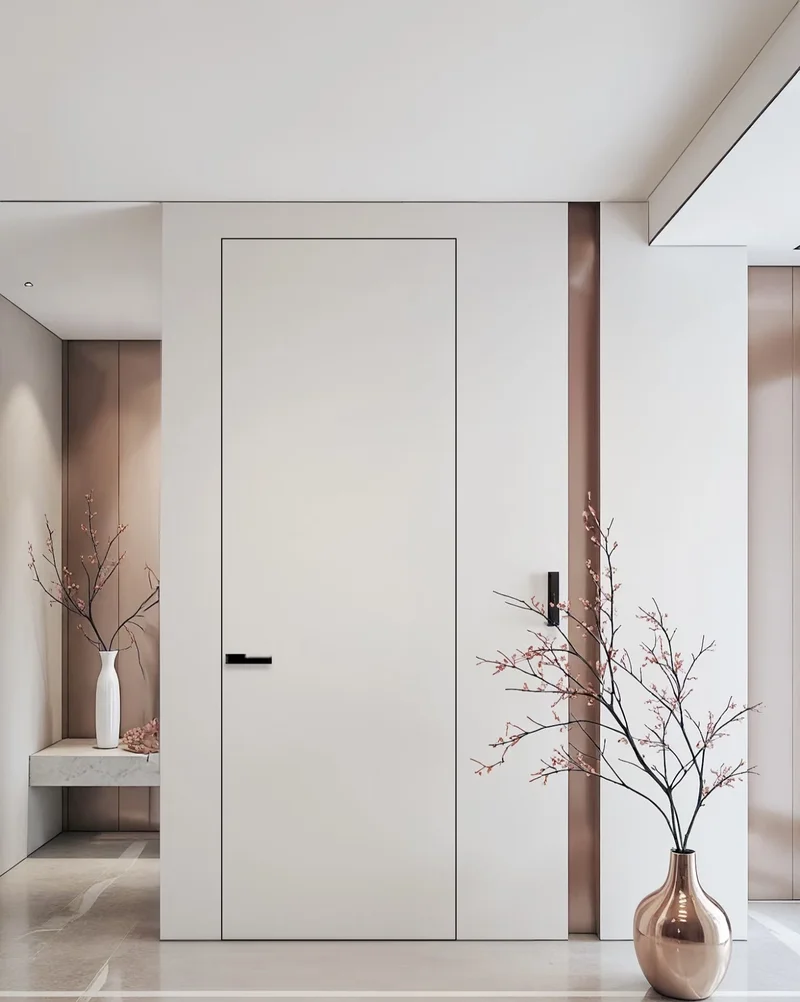
- Mount hinges to the door leaf first, using all provided screw points. For heavy-duty doors (>60kg), specify and use ball-bearing hinges with a minimum load rating of 80kg per pair.
- Hang the leaf on the installed frame. The target reveal gap is a consistent 3mm (±0.5mm) across the head and along the lock stile.
- Critical Adjustment: Adjust hinge screws to achieve perfect planar alignment and free swing without binding. The door must remain in any static position without movement.
3. Sealing & Threshold Integration
- Apply intumescent fire and smoke seal strips (where specified) into pre-machined grooves. Ensure continuous, unbroken runs with mitred corners.
- Install the threshold or sill, ensuring a positive seal with the door bottom. The compression seal must engage uniformly across the full width. For acoustic-rated systems (e.g., Rw ≥ 37 dB), verify the integrity of all perimeter seals.
4. Hardware Finalization & Functional Testing
- Install the lock mechanism, strike plates, and any ancillary hardware (closers, floor springs). Adjust striker alignment to ensure smooth, single-motion engagement without forcing the door.
- Conduct a full operational test: 1) Smooth opening/closing through full arc, 2) Positive latching and locking at all points, 3) Automatic closer function (if applicable), 4) Verification of any integrated seals under closed compression.
Performance Validation & Handover Protocol
Post-installation validation formally documents the system’s conformance to technical specifications.
Technical Performance Checklist:
- Operational Integrity: Door swings freely and closes securely from any position. Latch engagement is silent and positive.
- Aesthetic & Dimensional Tolerance: Visual inspection confirms no surface damage, consistent reveals, and flush alignment.
- Seal Integrity: Visual and tactile check confirms full perimeter contact of gaskets and seals.
Handover Documentation:
Provide the client with a complete dossier including:
- Installation record sheet, signed by the supervising engineer.
- Manufacturer’s warranty certificates and material safety data sheets (MSDS).
- Technical data sheets for all components, specifying:
- Core material stability (LVL modulus of elasticity)
- Surface material properties (PVC-wood composite ratio, Shore D hardness > 65)
- Performance ratings (U-factor for thermal insulation ≤ 1.2 W/m²K, moisture absorption rate < 12% per EN 317)
Post-Installation Monitoring:
Advise the facility manager to monitor door operation during the first full seasonal cycle. A minor adjustment of hardware may be required after 6-12 months as the building and materials fully acclimate.
Ensure Long-Term Performance: Advanced Structural Stability and Durability Features
The long-term performance of a solid wood door system is a function of engineered material selection, structural design, and controlled manufacturing processes. This section details the critical features that prevent warping, cracking, and performance degradation over decades of service.
Core Structural Integrity
The stability of the door slab is paramount. We utilize a multi-layered, cross-grain construction principle to counteract wood’s natural movement.
- Engineered Core: The primary substrate is a kiln-dried, finger-jointed LVL (Laminated Veneer Lumber) core. Its cross-laminated structure provides dimensional stability far superior to solid timber, with a typical moisture content maintained at 8±2% to match interior environments, drastically reducing internal stress.
- Balanced Construction: The core is symmetrically skinned with selected solid wood veneers or high-density WPC (Wood-Plastic Composite) panels. This balanced sandwich construction ensures uniform moisture absorption and release, preventing cupping or bowing. WPC components, with a density exceeding 1.2 g/cm³ and a controlled wood-to-polymer ratio, offer exceptional resistance to moisture ingress and biological attack.
- Reinforced Jointery: All stile-and-rail joints employ mortise-and-tenon or double-dowel pin construction, bonded with D4-grade (EN 204) polyurethane adhesives. Critical stress points, such as lock blocks and hinge areas, are reinforced with engineered hardwood or composite inserts, providing a stable substrate for hardware that exceeds 500,000-cycle durability testing.
Advanced Material Performance Specifications
Doors are specified according to quantifiable performance benchmarks relevant to the project environment.
| Feature | Technical Parameter | Standard / Grade | Performance Implication |
|---|---|---|---|
| Formaldehyde Emission | ≤ 0.5 mg/L (3.5 mg/m²·h) | EN 16516 / E0 Grade | Ensures indoor air quality compliance for sensitive environments. |
| Fire Resistance | Integrity & Insulation: 30/60/90 mins | EN 1634-1 / ASTM E119 | Certified performance for compartmentation and escape route design. |
| Sound Insulation | Weighted Sound Reduction (Rw) 32-42 dB | EN ISO 10140-2 | Achieves specified acoustic privacy between rooms or from exterior noise. |
| Moisture Stability | Thickness Swelling Rate ≤ 8% (24h immersion) | EN 317 (modified) | Predicts performance in high-humidity areas (e.g., hotel bathrooms). |
| Surface Hardness | ≥ 80 Shore D (for finished surface) | ASTM D2240 | Resists indentation and abrasion from impact in high-traffic corridors. |
| Thermal Insulation | U-factor as low as 1.2 W/(m²·K) | EN ISO 8990 | Contributes to building envelope energy efficiency targets. |
Durability-Enhancing Features
- Integrated Moisture Management: All six sides of the door slab receive a full-seal, multi-coat finish. Edges and bottom rails are treated with specialized hydrophobic sealants. For extreme environments, optional stainless steel or anodized aluminum bottom edge caps provide a physical barrier against capillary moisture.
- Hardware Compatibility Engineering: Hinge and lock preparation is CNC-machined to a tolerance of ±0.5mm. Reinforcement plates are pre-installed to distribute load and prevent screw pull-out. This ensures consistent alignment and smooth operation, eliminating stress on the door leaf that leads to premature failure.
- Finish System Resilience: The multi-stage finish (primer, basecoat, topcoat) utilizes catalyzed polyurethane or UV-cured acrylic systems with a dry film thickness of ≥120 microns. This provides a Class 1 (EN 12720) resistance to chemicals, stains, and cleaning agents, while maintaining colorfastness under prolonged UV exposure.
Maintain Aesthetic and Functional Integrity: Waterproof and Formaldehyde-Free Material Assurance
Material Assurance: Core Principles for Longevity and Safety
The long-term performance of a solid wood door system is fundamentally determined by the integrity of its constituent materials. This section details the engineered solutions for mitigating the two primary threats to that integrity: moisture ingress and volatile organic compound (VOC) emission. Our assurance is rooted in a multi-layered material strategy, not a singular coating.
Engineered Waterproofing: A Systems Approach
True waterproofing extends beyond surface sealants to encompass the entire door assembly—core, substrate, and skin. The objective is to achieve a moisture absorption rate below 8% (per 24h immersion, ASTM D570) and dimensional stability with a thickness swelling rate of less than 5% (after 24h water immersion, EN 317).
-
Advanced Composite Skins & Substrates: The primary defense is the use of high-density Wood-Plastic Composite (WPC) or laminated polymer panels. Key performance metrics include:
- Density: WPC panels are engineered to a minimum density of 1.25 g/cm³, providing a rigid, non-porous barrier that resists capillary water absorption.
- Polymer Matrix: A optimized PVC-to-wood flour ratio (typically ≥ 7:3) ensures the plastic matrix fully encapsulates organic particles, preventing swelling.
- Integrated Sealing: These panels are co-extruded or laminated with a homogeneous, non-porous surface, eliminating the edge-band sealing failure common to traditional veneers.
-
Stabilized Core Construction: The core must resist internal vapor pressure and hysteresis. Our specification utilizes:
- LVL (Laminated Veneer Lumber) Core: Precision-engineered LVL offers superior dimensional stability (<1% linear expansion with 30-70% RH change) compared to solid timber blocks, mitigating warping and stress on joints.
- Honeycomb or Particleboard Core (for specific models): When used, these are exclusively specified with phenolic resin binders and certified to EN 312 P7 or P5 standards for high moisture resistance.
-
Performance Data: Critical Waterproofing Parameters
| Component | Test Standard | Performance Parameter | Target Value | Benefit |
|---|---|---|---|---|
| WPC Skin/Frame | ASTM D570 | Water Absorption (24h) | ≤ 3% | Prevents bloating, maintains dimensional integrity. |
| LVL Core | EN 318 | Dimensional Stability (ΔL with RH) | ≤ 0.9% | Eliminates core-induced warping. |
| Overall Door Slab | EN 1128 | Thickness Swelling (24h immersion) | ≤ 4.5% | Guarantees fit within frame under humid conditions. |
| Surface Hardness | ASTM D2240 | Shore D Hardness | ≥ 75 | Resists impact and abrasion damage that compromises seals. |
Formaldehyde-Free Assurance: Health and Compliance
Indoor air quality is non-negotiable. Our material specification mandates the total elimination of added urea-formaldehyde resins in all laminates, composites, and adhesives.
-
Binding Chemistry: We utilize alternative binding systems:
- Polyurethane (PUR) Adhesives: For lamination and edge-bonding, providing superior moisture resistance and zero formaldehyde emission.
- Isocyanate (pMDI) Binders: For composite core materials, meeting the strictest emission standards.
- Thermoplastic Polymers: In WPC/PVC profiles, where the polymer itself acts as the binder, requiring no added formaldehyde.
-
Certification and Verification: Compliance is verified through a chain of custody and third-party testing.
- Emission Standards: All materials comply with CARB NAF (No Added Formaldehyde) and EPA TSCA Title VI requirements, surpassing E0 (≤ 0.05 mg/m³, JIS A 1460) and E1 (≤ 0.124 mg/m³, EN 16516) thresholds.
- Quality Management: Sourcing and manufacturing processes are governed under ISO 9001 and ISO 14001 frameworks, with batch-level test certificates available.
Integrated Functional Advantages
This material science foundation delivers measurable architectural performance:
- Enhanced Acoustic Insulation: The high-density, damped composite structure achieves a weighted sound reduction index (Rw) of up to 38 dB, contingent on full perimeter sealing.
- Improved Thermal Insulation: The stable, low-conductivity core and sealed skin contribute to a superior thermal transmittance (U-factor) typically below 1.2 W/m²K.
- Fire Safety: Components can be specified to meet EN 13501-1 Class B-s1, d0 or ASTM E84 Class A, utilizing non-combustible mineral cores and flame-retardant additives where required.
- Maintenance Reduction: The inert, non-porous surface resists staining, requires no periodic sealing or varnishing, and is cleanable with mild detergents without degradation.
Streamline Post-Installation Support: Dedicated After-Sales Maintenance and Service Protocols
Dedicated After-Sales Maintenance and Service Protocols
A structured after-sales protocol is a critical engineering component, ensuring long-term performance and protecting the investment in solid wood door systems. This protocol is based on material behavior, environmental interaction, and documented performance standards.
Core Service Framework & Response Tiers
Our service structure is segmented into three tiers to provide efficient, targeted support.
-
Tier 1: Proactive Maintenance & Advisory Support
- Provision of material-specific maintenance schedules, detailing cleaning agent pH tolerances and recommended finishes based on the door’s topcoat system (e.g., acid-catalyzed varnish vs. UV-cured polyurethane).
- Environmental advisory: Guidance on maintaining optimal ambient conditions (recommended 30-50% RH, 18-24°C) to minimize dimensional change in solid wood and engineered cores.
- Digital access to as-built specifications, including fire rating certificates (EN 1634 / ASTM E84), acoustic test reports (dB reduction values), and formaldehyde emission classifications (E0 / E1 / CARB Phase 2).
-
Tier 2: Scheduled Inspection & Corrective Maintenance
- Annual or bi-annual technical inspections by certified engineers. The inspection checklist includes:
- Verification of hardware integration and hinge load distribution.
- Assessment of seal integrity and compression set.
- Measurement of door leaf flatness and reveal consistency to detect any warping or swelling.
- On-site corrective actions for minor issues: adjustment of hardware, re-sealing of perimeter joints, and localized refinishing using manufacturer-matched materials.
- Annual or bi-annual technical inspections by certified engineers. The inspection checklist includes:
-
Tier 3: Technical Intervention & Component Replacement
- Activation for significant performance failures, such as structural issues, delamination, or failure to meet rated performance (fire, acoustic, thermal).
- Root-cause analysis conducted, often involving material sampling (e.g., testing core moisture content or finish adhesion).
- Managed replacement of door leaves or complete assemblies from pre-qualified production batches to ensure visual and technical consistency.
Technical Parameters for Performance Verification & Troubleshooting
Post-installation issues are diagnosed against baseline performance data. The following table outlines key parameters for common solid wood and engineered door constructions.
| Performance Aspect | Test Standard / Metric | Typical Specification Range (Solid Wood / Engineered Composite) | Common Failure Mode & Diagnostic Check |
|---|---|---|---|
| Dimensional Stability | Swelling Coefficient (24h water immersion) | Solid Wood: ≤ 12% (tangential) LVL Core: ≤ 8% HDF/WPC Core: ≤ 5% |
Excessive gap variation or binding. Measure moisture content (MC) of door vs. ambient RH. MC > 12% in service indicates environmental control failure. |
| Surface Durability | Hardness (Shore D) / Abrasion Resistance (Taber) | Clear Coat: Shore D 70-85 / ≥ 500 cycles (CS-10 wheel, 1kg) | Scratches, wear patterns. Verify cleaning protocols; use pH-neutral cleaners (< pH 10). |
| Acoustic Insulation | Weighted Sound Reduction (Rw) | 28 dB (Single leaf, standard) to 40+ dB (Specialized acoustic design) | Audible leakage. Inspect perimeter seals (magnetic or compression) for full compression and continuity; check for undercuts exceeding 6mm. |
| Thermal Insulation | U-Factor (Thermal Transmittance) | 1.8 – 2.5 W/m²K (dependent on core and glazing) | Condensation or thermal bridging. Thermographic survey to identify cold spots, often at core joints or metal reinforcements. |
| Fire Integrity | Fire Resistance Rating | EI 30 / EI 60 (EN 13501-2) or 20/45/90 min (ASTM E84) | Intumescent seal deployment check post-exposure (if applicable); inspection of char line on door edge. |
Material-Specific Maintenance Protocols
- Solid Wood & Veneered Doors: Focus on humidity control. Seasonal movement is expected; adjustments to hinges and strikes are part of normal maintenance. Use only recommended oil or wax-based cleaners for veneers to prevent grain raising.
- Engineered Core Doors (LVL, HDF, WPC): Superior dimensional stability reduces seasonal adjustments. Surface maintenance is paramount. Avoid high-pressure washing. For WPC-based doors, confirm cleaning agents do not contain solvents that affect the polymer-wood matrix.
- Glazed Units: Clean with soft cloth and non-abrasive, ammonia-free solutions. Inspect glazing bead integrity and sealant condition annually to prevent moisture ingress into the insulated glass unit (IGU) cavity.
Documentation & Warranty Validation
All after-sales actions are logged against the project’s unique identifier. Warranty claims require validation against:
- Installation records confirming adherence to specified clearances and fixing methods.
- Environmental condition logs demonstrating operation within agreed parameters.
- Maintenance history proving use of approved procedures and materials.
This data-driven approach ensures objective fault analysis and upholds the integrity of the product warranty.
Leverage Technical Specifications for Informed Decision-Making: Detailed Product Data and Compliance
Core Material Specifications & Performance Data
Selection hinges on quantifiable material properties and verified performance against international standards. The following data is critical for specification sheets and compliance documentation.
Material Composition & Structural Integrity
- Solid Wood Core (LVL/Plywood): Engineered wood cores must specify layer count, adhesive type (PUR, MUF), and compliance with EN 13986 (wood-based panels for construction) or ASTM D5456 (structural composite lumber). Key metrics include:
- Density: ≥ 550 kg/m³ for dimensional stability.
- Moisture Content (MC): 8% ± 2% at delivery, per EN 942.
- Formaldehyde Emission: Certified E0 (≤0.5 mg/L) per EN 16516 or CARB Phase 2.
- Surface Veneers & Solid Wood Stiles/Rails: Specify species, cut (plain sliced, quartered), thickness (typically 0.6mm – 6mm), and grading rules (NHLA for hardwoods). Moisture absorption rate should be < 10% after 24-hour immersion per ISO 62.
- Composite Components (WPC/PVC): Used in moisture-resistant applications. Specifications must detail:
- WPC Density: 1.2 – 1.4 g/cm³ for optimal strength-to-weight.
- PVC-Wood Flour Ratio: e.g., 60:40, defining flexibility and surface hardness (Shore D > 75).
Performance Benchmarks & Testing Standards
All performance claims must be substantiated by accredited laboratory test reports.
| Performance Category | Key Metric | Standard Test Method | Benchmark for Specification Grade |
|---|---|---|---|
| Structural & Durability | Bending Strength | EN 12354-3, ASTM E72 | ≥ 25 MPa (Modulus of Rupture) |
| Swelling Rate (Thickness) | EN 317, ASTM D1037 | ≤ 12% after 24h water immersion | |
| Fire Safety | Fire Resistance Integrity | EN 1634-1, ASTM E119 | EI 30 / EI 60 (Certified by notified body) |
| Surface Spread of Flame | EN 13501-1 | Class B-s1, d0 or better | |
| Acoustic Insulation | Weighted Sound Reduction (Rw) | EN ISO 10140-2, ASTM E90 | Rw ≥ 28 dB (Single door, sealed) |
| Thermal Insulation | Thermal Transmittance (U-value) | EN 12412-2, ISO 8990 | U ≤ 1.8 W/(m²·K) (Core-dependent) |
| Environmental | Formaldehyde Emission | EN 16516, ASTM E1333 | E0 Grade (≤0.5 mg/m³h) |
| VOC Emissions | ISO 16000-6, AgBB Scheme | Compliant with indoor air quality protocols |
Architectural & Functional Advantages
- Acoustic Performance: Achieved through core density (>650 kg/m³), perimeter sealing systems (magnetic or compression gaskets per EN 1935), and optional acoustic laminates. Specified Rw (C; Ctr) values are critical for healthcare and education projects.
- Thermal & Energy Efficiency: The U-factor is a function of core material thermal conductivity and door thickness. Insulated cores with polyurethane foam can achieve U-values below 1.5 W/(m²·K), contributing to building energy models (LEED, BREEAM).
- Moisture & Dimensional Stability: For high-humidity zones, specify doors with ≤8% swelling rate (24h immersion) and components treated with micro-porous, vapor-permeable finishes that meet EN 927-3 for exterior wood coatings.
Compliance & Certification Framework
Project specifications must mandate third-party certification, not just manufacturer self-declaration. Essential certifications include:
- Quality Management: ISO 9001 certification of the manufacturing plant.
- Product Standards: CE Marking under Construction Products Regulation (EU) 305/2011, citing the relevant System of Assessment and Verification of Constancy of Performance (AVCP).
- Sustainability: FSC/PEFC Chain of Custody for wood sourcing, and EPDs (Environmental Product Declarations) per EN 15804.
- Fire Performance: Official test reports from a notified body (e.g., Warringtonfire, MPA Braunschweig) for fire-rated assemblies, including hardware compatibility.
Frequently Asked Questions
What are the critical technical specifications for solid wood doors in high-humidity environments?
Prioritize doors with a moisture content of 8-12% and a stable LVL core. The finishing system must include a full-perimeter seal and UV-cured coatings. For WPC components, ensure a density >650 kg/m³ and a low thermal expansion coefficient to prevent swelling and warping under humidity fluctuations.
How do you ensure compliance with international formaldehyde emission standards?
Specify materials certified to E0 (≤0.5 mg/L) or ENF (≤0.025 mg/m³) standards. Require full-chain documentation from core adhesives to surface finishes. On-site, use sealed installation methods and recommend post-installation ventilation protocols to guarantee indoor air quality meets stringent health and safety regulations.
What structural design prevents long-term warping and sagging?
Utilize a multi-layer LVL (Laminated Veneer Lumber) core with cross-grain lamination, paired with reinforced steel or aluminum alloy hinges. The door must be factory-balanced and acclimatized on-site for 48 hours before installation to equalize internal stresses and prevent deformation.
How is sound insulation performance quantified and achieved in solid wood doors?
Target a weighted sound reduction index (Rw) of ≥28 dB. Achieve this through a solid core density >45 kg/m², integrated magnetic seals, and a three-point locking system. For critical areas, specify doors with a composite structure incorporating acoustic damping layers.
What defines the impact resistance and durability of the door surface?
Require a minimum surface hardness of ≥2H (pencil hardness test) and a high-pressure laminate or PVC coating thickness of ≥0.5mm. The finishing process should include anti-scratch UV topcoats and thorough edge banding to protect against daily abrasion and impact damage.
What are the key thermal insulation properties for energy-efficient applications?
Focus on the door’s U-value, aiming for <1.5 W/(m²·K). This is achieved through a solid, non-bridging core, full-perimeter thermal-break seals, and optionally, an insulated core material. Proper installation to eliminate air gaps is critical to realizing the designed thermal performance.
What is the comprehensive after-sales maintenance protocol?
Provide a maintenance kit with pH-neutral cleaner and matching touch-up materials. Schedule a post-installation inspection at 6 and 12 months to check seal integrity and hardware operation. Long-term, recommend re-tightening hardware and reapplying sealant to hinges and edges every 2-3 years.