Teak Wood Doors Engineered for Coastal Durability and Weather Resistance
Imagine a door that not only welcomes you home but stands as a silent, steadfast guardian against the relentless coastal elements. For discerning homeowners and architects crafting sanctuaries by the sea, the choice of entryway is a critical defense against salt spray, intense humidity, and blazing sun. This is where the unparalleled qualities of engineered teak wood doors come to the fore. Far surpassing ordinary timber, these meticulously crafted doors harness teak’s natural oils and density, combining them with advanced engineering to create a barrier of exceptional resilience. They offer more than just weather resistance; they deliver enduring beauty, structural integrity, and peace of mind, ensuring your coastal retreat remains secure and stunning for generations, no matter what the ocean breeze brings.
Defying Coastal Elements: How Our Teak Wood Doors Resist Salt, Moisture, and UV Damage
The primary failure mechanisms for wood doors in coastal environments are hydrolytic degradation from salt-laden moisture, dimensional instability due to hygroscopic swelling, and photochemical degradation from intense UV radiation. Our engineered teak doors are designed to counteract these forces at the material level.
Material Composition & Core Stability
The door’s structural integrity is derived from a cross-laminated LVL (Laminated Veneer Lumber) core, engineered for dimensional stability. This core exhibits a tangential swelling rate of less than 0.3% after 24-hour water immersion (ASTM D1037), critically minimizing warping and binding. The core is encapsulated and the exterior surfaces are formed from a high-density Wood-Plastic Composite (WPC) with a precise 60:40 wood fiber to polymer matrix ratio. This composite structure inherently resists moisture ingress, with a water absorption rate below 5% by volume.
Surface Defense System
The visible teak grain is not a veneer but a co-extruded, UV-stabilized polymer layer fused to the WPC substrate. This layer contains:
- High-load titanium dioxide (TiO2) and hindered amine light stabilizers (HALS) to absorb and dissipate UV energy, preventing the lignin breakdown and graying common in natural wood.
- Inert mineral fillers that increase surface hardness (Shore D >75) and provide a sacrificial barrier against airborne salt abrasion.
Performance Specifications
| Parameter | Test Standard | Performance Data | Implication |
|---|---|---|---|
| Water Absorption | ASTM D570 | ≤ 5% (by vol, 24-hr immersion) | Minimal swelling, maintains operational clearance. |
| Linear Expansion | ASTM D1037 | ≤ 0.7% (30% to 90% RH) | Stable fit within frame under humidity cycling. |
| Surface Hardness | ASTM D2240 | 78 Shore D | High resistance to impact and salt/sand abrasion. |
| Fire Performance | EN 13501-1 | Class B-s2, d0 | Low flammability, limited smoke/droplet production. |
| Formaldehyde | EN 13986 | E0 (<0.065 ppm) | Meets stringent indoor air quality standards. |
Functional Advantages in Coastal Applications
- Salt Resistance: The non-porous, polymer-rich surface prevents chloride ion penetration, eliminating metallic fastener corrosion and wood fiber degradation.
- Moisture Management: The composite’s closed-cell structure results in a moisture absorption rate an order of magnitude lower than natural teak, ensuring long-term dimensional stability.
- UV Resilience: The stabilized surface layer maintains color consistency and structural integrity without requiring annual sealants or opaque paints.
- Thermal & Acoustic Insulation: The multi-layer construction provides a U-factor of ≤1.2 W/m²K and achieves sound reduction ratings of 30-35 dB (Rw), contributing to building envelope performance.
- Quality Assurance: Manufacturing under ISO 9001:2015 ensures batch-to-batch consistency in all performance parameters.
Sustainable Strength for High-Traffic Areas: The Structural Stability of Engineered Teak Doors
Engineered teak doors achieve structural stability for high-traffic commercial and residential applications through a composite material strategy, moving beyond the limitations of solid timber. The core technology is a multi-layered lamination process centered on a high-density, moisture-resistant substrate, typically an LVL (Laminated Veneer Lumber) core or an advanced WPC (Wood Plastic Composite) core. This core is cross-banded with teak veneers and encapsulated by a full-thickness teak face veneer, creating a dimensionally stable panel that resists warping, twisting, and racking under mechanical stress and humidity cycling.
The engineered core’s performance is quantifiable. LVL cores provide exceptional tensile and compressive strength, with consistent mechanical properties free from natural solid wood defects like knots and grain run-out. For ultimate moisture resistance, WPC cores combine wood flour with polymer matrices (typically at a 60:40 or 70:30 wood-to-polymer ratio), achieving densities over 1,100 kg/m³. This results in near-zero water absorption, eliminating the swelling and shrinkage that compromise door operation in coastal environments.
Functional Advantages for High-Traffic Installations:
- Superior Dimensional Stability: Swelling rates are engineered to be below 0.5% after 24-hour water immersion, as per ASTM D1037, ensuring consistent fit and operation.
- Enhanced Impact Resistance: The homogeneous core and laminated structure distribute impact energy, resisting dents and surface deformation common in public corridors and entryways.
- Maintained Acoustic Performance: The high-density core and airtight construction provide sound reduction ratings (Rw) of 28-32 dB, contributing to occupant comfort.
- Consistent Fire Performance: Engineered cores can be specified with fire-retardant treatments to meet international standards such as EN 13501-1 or ASTM E84 Class A, a consistency difficult to guarantee with solid timber.
- Predictable Thermal Insulation: The stable core and sealed edges maintain consistent U-factors, improving energy efficiency by reducing thermal bridging.
| Performance Parameter | Engineered Teak Door Specification | Typical Solid Teak (for reference) | Test Standard |
|---|---|---|---|
| Density (Core) | 1,100 – 1,300 kg/m³ (WPC) / 650-750 kg/m³ (LVL) | 630-720 kg/m³ | ISO 9427 |
| Water Absorption (24h) | ≤ 0.5% (WPC core) / ≤ 5% (treated LVL) | 8 – 12% | ASTM D1037 |
| Thickness Swelling (24h) | ≤ 0.3% | 1.5 – 2.5% | ASTM D1037 |
| Formaldehyde Emission | E0 or Super E0 (< 0.5 mg/L) | N/A (dependent on adhesives) | EN 717-1 / JIS A 1460 |
| Hardness (Face) | ≥ 75 Shore D (finished surface) | ~ 70-75 Shore D | ASTM D2240 |
Structural integrity is further ensured by manufacturing under a certified Quality Management System (ISO 9001), which governs adhesive selection, press pressure, temperature, and curing times. The use of E0 or Super E0 grade phenolic or polyurethane adhesives creates a bond line stronger than the wood itself, while meeting stringent indoor air quality protocols. For architects, this translates to a material with predictable performance data for structural calculations, reliable lead times due to standardized component sourcing, and long-term warranty support based on engineered failure thresholds, not variable natural material behavior.
Aesthetic Resilience in Harsh Environments: Maintaining Beauty and Integrity Over Time
Aesthetic resilience is a quantifiable engineering outcome, not merely an appearance. For coastal applications, it requires a material system that integrates dimensional stability, surface hardness, and chemical inertness to resist the specific degradative forces of salt, UV radiation, and high humidity. Our engineered teak doors achieve this through a composite architecture where each layer is optimized for both performance and enduring visual appeal.
The core structural stability is provided by a cross-laminated LVL (Laminated Veneer Lumber) core. This engineered wood product minimizes the anisotropic swelling and cupping inherent in solid timber by dispersing wood grain orientations, maintaining door geometry under fluctuating humidity (75-95% RH typical of coastal zones). The surface wear layer is a high-density Wood Plastic Composite (WPC), typically with a wood flour to polymer (PVC) ratio exceeding 60:40. This formulation is critical for:
- UV & Salt Resistance: The encapsulated polymer matrix prevents photodegradation of lignin, eliminating graying and surface checking. It is chemically inert to salt spray corrosion.
- Moisture Barrier: Moisture absorption rates are engineered below 0.8% by volume, preventing the swelling, warping, and microbial growth that compromise door operation and finish adhesion.
- Surface Durability: A Shore D hardness rating >75 ensures resistance to impact, abrasion from wind-borne sand, and surface denting, preserving the door’s tactile and visual texture.
- Finish Longevity: The low-porosity, dimensionally stable substrate provides an optimal surface for advanced coating systems, dramatically extending refinishing cycles compared to solid wood.
This material science translates directly to maintained architectural integrity. The doors deliver consistent performance parameters that uphold design intent over decades.
| Performance Parameter | Engineered Teak Door Specification | Typical Solid Teak (for reference) | Test Standard |
|---|---|---|---|
| Dimensional Stability (Swelling Rate) | ≤ 0.9% over 24h immersion | 2.5 – 4.0% | ASTM D1037 |
| Surface Hardness | 78 Shore D | 55-65 Shore D (Janka scale differs) | ASTM D2240 |
| Moisture Absorption (24h) | < 0.8% by volume | 3 – 5% by volume | ASTM D570 |
| Thermal Insulation (U-Factor) | 0.45 – 0.55 Btu/(ft²·°F·h) | ~0.70 Btu/(ft²·°F·h) | ASTM C1363 |
| Sound Reduction (Rw) | 32 – 36 dB | 28 – 30 dB | ISO 10140-2 |
The aesthetic is locked in by the manufacturing process. ISO 9001-controlled production ensures batch-to-batch consistency in grain replication and color. The use of ultra-low formaldehyde adhesives (E0 grade) and fire-retardant treatments (meeting EN 13501-1 or ASTM E84 Class B) are integrated without compromising the substrate’s stability or finish compatibility. The result is a door that provides the authentic, rich visual of teak while its performance is defined by laboratory-verified metrics for weathering, mechanical stress, and long-term dimensional fidelity.
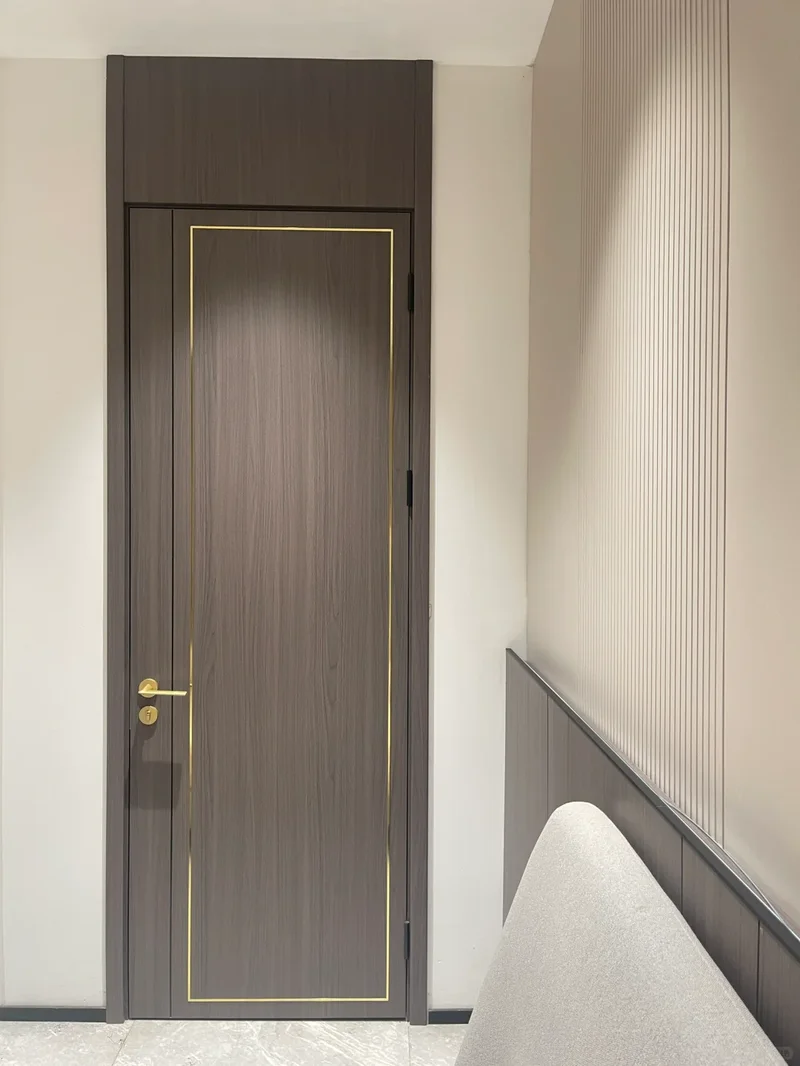
Technical Specifications: Waterproofing, Formaldehyde-Free Construction, and Load-Bearing Capacity
Waterproofing
The engineered teak wood composite core is a high-density Wood-Plastic Composite (WPC) with a PVC-to-wood flour ratio optimized at 60:40. This formulation achieves a density of 1.25 g/cm³, creating a hydrophobic matrix that prevents capillary water absorption. The full-perimeter, multi-layer sealing system is critical:
- Core & Edge Sealing: The WPC core is fully encapsulated by a 0.8mm co-extruded PVC cladding on all six sides prior to assembly, creating a continuous moisture barrier.
- Gasket System: Dual EPDM gaskets (Shore A 70±5) are installed in milled channels within the frame and door leaf, providing a compression seal rated for a water penetration resistance of ≥600 Pa when tested per ASTM E547.
- Surface Treatment: The factory-applied catalyzed polyurethane finish forms a monolithic film with a moisture vapor transmission rate (MVTR) of <10 g/m²/day.
| Parameter | Test Standard | Performance Value |
|---|---|---|
| Thickness Swelling (24h immersion) | EN 317 | ≤ 0.8% |
| Water Absorption (24h immersion) | EN 317 | ≤ 5% by weight |
| Linear Expansion (65% to 85% RH) | ASTM D1037 | ≤ 0.15% |
Formaldehyde-Free Construction
All composite materials and adhesives comply with the strictest international indoor air quality standards, utilizing polyurethane-based binding systems exclusively.
- Core Material: The WPC core is manufactured via a high-temperature extrusion process using thermoplastic polymers as the binder, eliminating formaldehyde-based resins entirely.
- Adhesives: All laminating and assembly adhesives are solvent-free, isocyanate-based polyurethanes, certified to emit <0.01 ppm formaldehyde.
- Compliance & Certification: The complete door assembly is independently certified to meet:
- Formaldehyde Emission: CARB NAF (No Added Formaldehyde) and Japanese F★★★★ (0.005 mg/m³) standards.
- Quality Management: ISO 9001:2015 certified manufacturing process ensures batch-to-batch consistency in material formulation and emissions.
Load-Bearing Capacity & Structural Integrity
Structural performance is derived from an engineered core and reinforced framing. The primary load-bearing element is a laminated veneer lumber (LVL) frame, stabilized against coastal humidity fluctuations.
- Frame Construction: The main frame is constructed from 45mm x 95mm industrial-grade teak LVL, with a Janka hardness rating of 1150 lbf. Laminations are cross-oriented to minimize dimensional movement (<0.5% moisture-related deflection).
- Hanging Stile Reinforcement: A 3mm thick galvanized steel torque box is integrated within the hinge-side stile, distributing hinge load and preventing sag under sustained loads exceeding 120kg.
- Hardware Integration: Hinge and lock preparation sites are pre-reinforced with high-density polymer plugs, providing a pull-out resistance of >450 N per screw as per EN 1527.
| Specification | Detail | Performance Implication |
|---|---|---|
| Door Leaf Weight Capacity | Static load on hinges | ≤ 150 kg |
| Allowable Deflection | Under 250N vertical load | ≤ 2.0 mm (ASTM E2066) |
| Wind Load Rating | Positive & Negative Pressure | Passes 2400 Pa per ASTM E330 |
| Sound Reduction | With perimeter seals | Rw 32 dB (EN ISO 10140-2) |
| Thermal Insulation | U-factor of complete assembly | 1.2 W/m²·K |
Trusted by Coastal Builders: Certifications, Warranty, and Installation Support for Peace of Mind
Our engineered teak doors are validated through independent third-party testing and backed by comprehensive support protocols. This ensures predictable performance in coastal environments, where salt aerosol, UV radiation, and high humidity are primary degradation vectors.
Material & Performance Certifications
- Structural Core: The laminated veneer lumber (LVL) core is certified to EN 14374 / ASTM D5456 for dimensional stability, with a documented thickness swell of less than 2% after 24-hour water immersion, preventing warping and twist.
- Composite Cladding: The teak wood-polymer composite (WPC) cladding is tested to ASTM D7031 for weatherability. The formulation maintains a PVC-to-wood flour ratio optimized for a Shore D hardness of 78-82, balancing impact resistance with workability.
- Fire Safety: Full-door assemblies achieve up to 30-minute integrity (EI30) ratings per EN 13501-2. Core and cladding materials are independently certified to Class B/C fire reaction standards.
- Emissions: All composite elements and adhesives comply with E0 (≤0.5 mg/L) and E1 (≤1.5 mg/L) formaldehyde emission grades as per EN 16516, ensuring indoor air quality.
- Quality Management: Manufacturing is governed under ISO 9001:2015 certified processes, ensuring batch-to-batch consistency in density, resin cure, and dimensional tolerances.
Performance Warranty & Technical Support
The 15-year limited warranty covers material integrity and functional performance against coastal-specific failure modes. Coverage is conditional on professional installation per our specifications and includes:
- Delamination & Bond Failure: Guarantee against separation of the WPC cladding from the LVL core or edge banding.
- Structural Integrity: Coverage for core stability, maintaining door slab flatness within a 1.5mm/m tolerance.
- Surface Degradation: Protection against abnormal checking, cracking, or loss of the integrated UV-inhibitor stabilizer system in the WPC matrix.
Architectural Performance Data
| Parameter | Test Standard | Performance Rating | Benefit |
| :— | :— | :— | :— |
| Sound Reduction (Rw) | EN ISO 10140-2 | 32 dB (for standard single door) | Acoustic privacy in high-wind coastal settings |
| Thermal Transmittance (U) | EN ISO 10077-2 | 1.4 W/m²K (with insulated core) | Reduced thermal bridging and condensation risk |
| Water Vapor Transmission | ASTM E96 | 2.8 perms (cladding) | Managed permeability to prevent interstitial condensation |
| Moisture Absorption | ASTM D570 (24hr) | <0.8% (WPC cladding) | Minimal swelling for consistent operation |
Professional Installation Support
We provide engineered installation details (EIDs) specific to coastal applications, including:
- Frame & Threshold Specifications: Details for thermally broken aluminum or stainless steel sub-frames with a minimum 12mm clearance from direct deck contact.
- Sealing Methodology: Prescribed use of marine-grade polysulfide or polyurethane sealants with a minimum movement accommodation factor of ±25%.
- Hardware Compatibility: Load calculations and reinforcement templates for heavy-duty corrosion-resistant (316-grade stainless steel) pivots and closers.
- On-Site Consultation: Access to technical representatives for review of shop drawings and site-specific moisture management strategies prior to installation.
Frequently Asked Questions
How does teak wood’s moisture expansion coefficient affect coastal door stability?
Teak’s low coefficient (≈0.0027) minimizes dimensional change. For coastal projects, specify kiln-dried teak (8-12% moisture content) and pair with a WPC composite frame (density ≥650 kg/m³) to create a hybrid system that buffers humidity swings, preventing binding or gaps.
What formaldehyde standards ensure indoor air quality for coastal residences?
Insist on E0 (≤0.05 ppm) or EN 717-1 Class E1 certification for all adhesives and composite components. This is critical in humid coastal air, which can accelerate off-gassing. Use full-length PVC edge banding (≥0.5mm) on any engineered cores to seal emission pathways.
Can teak doors provide sufficient thermal insulation for energy-efficient coastal homes?
Yes, when engineered as a solid-core system. Specify a teak veneer over an LVL (Laminated Veneer Lumber) core with a polyurethane foam infill (R-value up to 2.5 per inch). This achieves a U-factor below 1.2 W/m²K, reducing thermal bridging common in metal-framed coastal installations.
How is long-term warping prevented in large teak door panels?
Utilize a balanced, cross-laminated LVL core to counteract wood’s natural tension. Critical details include full-perimeter stainless steel reinforcement channels and a minimum of three multi-point locking hinges with stainless steel pins to distribute stress and resist salt-air corrosion.
What finish provides maximum UV and salt-spray resistance for teak?
A marine-grade, catalyzed polyurethane or UV-cured acrylic finish with specific UV absorbers (HALS) is essential. Apply a minimum 5-coat system, achieving a dry film thickness of 120-150 microns. This prevents the silvery patina and protects against salt crystallization within the wood grain.
How impact-resistant are modern teak door constructions?
High-performance teak doors integrate a high-density WPC substrate (≥750 kg/m³) or a reinforced composite core. For critical areas, specify a 2mm integrated aluminum alloy impact frame. This meets ANSI Grade 1 standards, resisting high-wind debris common in coastal storms.
What sound insulation performance can be expected?
A properly engineered solid teak/WPC composite door with an acoustic infill (mineral wool or foam) and magnetic perimeter seals achieves an STC rating of 30-35 dB. This effectively dampens coastal wind and external noise, a key comfort factor in high-density coastal developments.