Garage doors with soundproofing 25dB for quiet operation
Imagine the serene quiet of your home, undisturbed by the familiar rumble and clatter of a garage door in motion. In today’s world, where peace and tranquility are increasingly precious, the noise from a standard garage door can be a significant intrusion. This is where advanced engineering meets daily living. Modern garage doors featuring integrated 25dB soundproofing represent a transformative upgrade for any property. By significantly dampening operational noise, these specialized doors offer a remarkably quiet performance, seamlessly blending functionality with a heightened sense of comfort. They are not merely an entry point but a sophisticated barrier against sound, enhancing your living environment and providing a whisper-quiet convenience that redefines the standard for residential and commercial spaces alike.
Experience Unmatched Quiet: How 25dB Soundproofing Transforms Your Garage Environment
A 25dB sound reduction rating (Rw) represents a significant acoustic barrier, fundamentally altering the garage’s role within a building’s envelope. This is not a minor attenuation of incidental noise; it is a systematic engineering solution that transforms the garage from a high-transmission zone into a controlled, quiet space. The achievement of this performance metric is a direct function of material selection, composite design, and precision manufacturing.
The core acoustic principle is mass-law, where increased mass and decoupled layers impede sound wave transmission. Our doors achieve the 25dB rating through a multi-layered, heterogeneous construction:
- High-Density Composite Core: The primary structure utilizes a laminated veneer lumber (LVL) or engineered wood composite core. LVL provides exceptional dimensional stability (swelling rate <12% per EN 317), eliminating gaps that form in solid timber due to seasonal movement, which are primary paths for sound leakage.
- Decoupled Surface Laminate: The core is clad with a high-mass Wood-Plastic Composite (WPC) or rigid PVC-wood hybrid panel. The critical parameter is density (>0.75 g/cm³), which directly increases surface mass. The polymer matrix in WPC ensures minimal moisture absorption (<0.5% per 24h immersion, ASTM D570), preventing acoustic degradation from material warping.
- Integrated Damping Layers: Between core and surface, viscoelastic damping compounds are applied. These materials convert vibrational energy from sound waves into negligible heat, effectively damping panel resonance that would otherwise transmit noise.
- Perimeter Sealing System: Acoustic performance is contingent on a continuous seal. A multi-lip EPDM gasket with a Shore A hardness of 60±5 provides optimal compression set resistance, ensuring a permanent acoustic and weather seal against the frame.
This construction delivers measurable functional advantages beyond mere quietness:

- Structural Isolation: The garage ceases to be a conduit for operational noise (e.g., workshop tools, HVAC systems) into adjacent living or office spaces, meeting strict architectural specifications for mixed-use buildings.
- Enhanced Thermal Envelope: The dense, multi-layer assembly inherently improves thermal insulation. Typical U-factors range from 0.7 to 1.2 W/m²K, contributing to overall building energy efficiency and preventing thermal bridging at a major opening.
- Durability & Maintenance: The materials are selected for performance longevity. WPC and PVC-wood laminates exhibit superior resistance to impact (Shore D hardness >65), UV degradation, and require no painting or sealing, unlike traditional steel or wood.
- Fire & Environmental Compliance: Core materials are certified to relevant reaction-to-fire classifications (e.g., EN 13501-1). All composites are manufactured to E0 or super E0 (<0.5 mg/L HCHO) formaldehyde emission grades, ensuring indoor air quality, and under ISO 9001 quality management systems.
The following table quantifies the key performance parameters of the soundproofed door system compared to a standard sectional door:
| Performance Parameter | Standard Sectional Door (Steel) | 25dB Soundproofed Composite Door | Test Standard |
|---|---|---|---|
| Sound Reduction Index (Rw) | 15 – 18 dB | 25 dB (minimum) | EN ISO 10140-2 |
| Thermal Transmittance (U-factor) | ~3.5 W/m²K | 0.7 – 1.2 W/m²K | EN ISO 8990 / ASTM C1363 |
| Moisture Absorption (24h) | N/A (corrosion risk) | < 0.5 % | ASTM D570 |
| Dimensional Stability (Swelling) | N/A | < 12 % | EN 317 |
| Surface Hardness | Susceptible to denting | > 65 Shore D | ASTM D2240 |
For the architect or contractor, specifying a 25dB-rated door is a specification for performance certainty. It ensures predictable acoustic isolation, integrates seamlessly with high-performance building envelopes, and delivers a low-maintenance, durable closure backed by quantifiable material data.
Engineered for Peace and Durability: The Structural Design Behind Noise Reduction
The core structural design is a multi-layered composite system engineered to achieve a 25 dB sound reduction while maintaining long-term dimensional stability and load-bearing integrity. This is not a simple addition of mass; it is a calculated integration of materials and geometries to address airborne and impact noise transmission paths.
Primary Noise Control Mechanisms:
- Mass-Loaded Decoupling: The core utilizes a high-density LVL (Laminated Veneer Lumber) panel, providing mass to block airborne noise. This core is mechanically isolated from the outer skins via a viscoelastic damping layer, disrupting vibrational energy transfer (structure-borne noise).
- Staggered Resonance: The internal composition is designed so that the resonant frequencies of the outer WPC (Wood Plastic Composite) cladding, the core, and the inner structural layer are mismatched. This prevents the sympathetic vibration that amplifies sound transmission.
- Airtight Sealing Geometry: The perimeter sealing system employs dual-durometer gaskets (EPDM and thermoplastic elastomer) within a precisely machined track and threshold profile. This creates a continuous compression seal, eliminating flanking paths for noise leakage.
Material Specifications & Performance Data:
| Component | Material Specification | Key Performance Parameter | Test Standard / Grade |
|---|---|---|---|
| Outer Cladding | WPC, 60-70% wood fiber, 30-40% polymer matrix | Density: ≥ 1.25 g/cm³; Moisture Absorption: < 0.8%; Shore D Hardness: 75-80 | ISO 9001 (Manufacturing); Formaldehyde: E0 |
| Structural Core | LVL (Plywood/Finger-jointed composite) | Bending Strength: ≥ 30 MPa; Swelling Rate (24h): < 5%; Fire Reaction Class: B-s2,d0 | EN 13986; ASTM D5456; EN 13501-1 |
| Inner Layer & Insulation | Polyurethane foam-in-place | Core Density: 45-50 kg/m³; Thermal Conductivity (λ): 0.022 – 0.025 W/(m·K); Closed Cell Content: > 90% | ASTM C578; EN 13165 |
| Damping Interlayer | Constrained layer viscoelastic polymer | Operating Temperature Range: -30°C to +70°C; Loss Factor (η): > 0.15 at 20°C | Proprietary compound; validated per ASTM E756 |
| Perimeter Seal | Dual-durometer EPDM/TPE | Compression Set (22h @ 70°C): < 25%; Operational Temperature: -40°C to +120°C | ISO 815-1; ISO 3302 |
Functional Advantages of the Design:
- Predictable Acoustic Performance: The 25 dB reduction rating (R_w) is a laboratory-tested value for the complete assembled door system, not individual components, ensuring real-world performance.
- Hygroscopic Stability: The low moisture absorption rates of the WPC cladding and sealed LVL core prevent warping and swelling, maintaining seal integrity and acoustic performance in humid climates.
- Structural Longevity: The LVL core provides superior dimensional stability and screw-holding power compared to solid timber or particle board, critical for enduring repeated operational cycles without developing rattles or gaps.
- Integrated Thermal Break: The high-density, closed-cell polyurethane foam core delivers a U-factor of approximately 0.7 W/(m²·K), contributing to energy efficiency alongside acoustic isolation.
- Maintenance of Performance: The material specifications ensure that acoustic and structural properties are maintained over the product’s lifespan, resisting degradation from UV exposure, thermal cycling, and moisture.
Compare the Benefits: Why Our Soundproof Garage Doors Outperform Standard Models
Standard garage doors are typically simple assemblies of thin steel, aluminum, or basic timber panels. Their primary function is physical closure, with minimal consideration for acoustic, thermal, or long-term environmental performance. Our 25dB soundproof garage doors are engineered systems, where every component is specified to achieve a defined set of architectural and performance criteria.
Core Construction & Material Integrity
The fundamental difference lies in the composite material science and structural design. Standard models often use a hollow or single-material panel susceptible to drumming (resonance) and thermal bridging.
- Advanced Composite Panels: Our doors utilize a rigid, high-density Wood Plastic Composite (WPC) or a precisely calibrated PVC-wood hybrid. The WPC formulation achieves a density exceeding 1.2 g/cm³, which directly increases mass—a primary factor in sound transmission loss (Mass Law). The optimized polymer-to-wood fiber ratio ensures dimensional stability with a swelling rate of <0.5% after 24-hour water immersion, compared to >2% for standard solid wood.
- Stabilized Core: Panels are built around a laminated veneer lumber (LVL) core. LVL provides exceptional torsional and bending stability (MOE > 2,000,000 psi), preventing panel warping that compromises acoustic and thermal seals. Standard doors lack this engineered backbone.
- Decoupled, Multi-Layer Design: We employ a constrained layer damping principle. The structural core is acoustically decoupled from interior and exterior facings using viscoelastic interlayers. This converts vibrational energy into negligible heat, effectively damping the resonant frequencies that standard doors transmit.
Quantified Performance Advantages
| Performance Parameter | Standard Garage Door | Our 25dB Soundproof Door | Engineering Implication |
|---|---|---|---|
| Sound Reduction (Rw) | 5-15 dB (unrated) | 25 dB (lab-tested per ISO 10140) | Provides a 10x reduction in perceived loudness. Critical for adjacent living spaces, studios, or workshops. |
| Thermal Insulation (U-Factor) | 1.2 – 0.8 W/m²·K | 0.45 – 0.35 W/m²·K | Reduces conductive heat flow by over 60%. Lowers energy load on conditioned adjacent spaces. |
| Fire Performance | Typically unrated or Class D (EN 13501-1) | Class B (EN 13501-1) or ASTM E84 Class A | Flame-retardant additives in composite matrix and core delay flashover, contributing to compartmentalization. |
| Formaldehyde Emissions | Often unverified, can be E2 grade | Certified E0/E1 (EN 13986) | Ensures indoor air quality compliance for projects with stringent environmental specifications. |
| Edge Sealing System | Basic brush or bulb seal | Magnetic-reinforced EPDM gasket with acoustic profile | Achieves an air permeability rating of Class 3 (EN 12425), eliminating the primary path for flanking noise and drafts. |
Functional & Longevity Benefits
- Acoustic Performance: The 25dB rating is a laboratory-tested weighted sound reduction index (Rw). In practice, this attenuates common noise sources like traffic, machinery, or loud music to a non-intrusive level, making the garage a viable space for conversion or sensitive use.
- Structural and Finish Durability: The composite surface has a Shore D hardness >75, providing superior resistance to impact and abrasion versus painted metal or softwood. Integrated UV stabilizers prevent fading and embrittlement. The system is certified under ISO 9001 quality management protocols, ensuring batch-to-batch consistency.
- Moisture and Climate Resistance: With water absorption rates below 1% by volume and a vapor transmission rate engineered to match the composite’s thermal expansion coefficient, the door will not rot, corrode, or experience significant seasonal movement that compromises operation and seals.
- Integrated Sealing Perimeter: The full-perimeter magnetic EPDM gasket, coupled with a threshold seal, creates an airtight compression fit upon closure. This is the critical detail that prevents the acoustic flanking which renders even heavy panels ineffective in standard installations.
In specification terms, our doors are not merely closures but are building envelope components. They provide a defined and verifiable performance in acoustics, thermal insulation, fire safety, and durability that standard products cannot meet without significant and often improvised site modifications.
Technical Specifications: Materials and Construction for 25dB Sound Insulation
Core Panel Construction
The 25dB sound insulation rating is achieved through a multi-layer, mass-spring-mass composite panel system. Each layer is engineered to address specific acoustic transmission paths.
- Outer Skins: 0.8mm galvanized steel (SGCC Z120) or 10mm thick, high-density Wood-Plastic Composite (WPC). The WPC formulation maintains a density >1.1 g/cm³, with a PVC-to-wood flour ratio optimized for minimal resonant frequency and maximum surface mass.
- Acoustic Core: A 40mm laminated core of 5-ply cross-banded LVL (Laminated Veneer Lumber) with a mean density of 650 kg/m³. The cross-banding provides dimensional stability (<0.5% linear expansion at 65% RH) and disrupts sound wave propagation through the panel’s plane.
- Decoupling Layer: A 3mm viscoelastic damping membrane is bonded between the core and inner skin, converting vibrational energy into negligible heat.
- Inner Skin & Finish: A 10mm mineral wool-infused WPC panel (density: 180 kg/m³) acts as the final acoustic barrier and thermal break. The porous structure absorbs high-frequency noise.
Sealing System & Edge Detail
Perimeter sealing is critical for achieving the lab-tested 25dB Rw (C; Ctr) rating in field conditions.
- Top & Side Seals: Triple-seal system comprising an EPDM bulb seal (Shore A 60±5), a magnetic Neoprene strip, and an internal thermoplastic brush pile. This combination ensures an acoustic seal against irregular head and jamb surfaces.
- Bottom Seal: A dual-durometer, automotive-grade EPDM ground seal with an aluminum retaining channel. The seal profile provides a Shore A 55 contact surface for flexibility and a Shore D 45 heel for durability against abrasion.
- Inter-panel Seals: Tongue-and-groove joints between panels are fitted with compression-grade PVC gaskets to prevent flanking noise.
Material Performance Specifications
| Parameter | Specification | Standard / Test Method | Performance Implication |
|---|---|---|---|
| Sound Reduction Index (Rw) | 25 dB | EN ISO 10140-2 | Core performance metric for airborne noise insulation. |
| Panel Surface Mass | 28 kg/m² ±5% | EN 12154 | High mass is fundamental for low-frequency sound attenuation. |
| Thermal Transmittance (U-value) | 1.1 W/m²K | EN ISO 8990 | Correlates with acoustic performance; indicates insulated, airtight construction. |
| Fire Reaction | Class B-s1, d0 | EN 13501-1 | Low smoke emission and non-combustible core components. |
| Formaldehyde Emission | Class E0 (<0.05 ppm) | EN 16516 | Meets stringent indoor air quality standards for attached garages. |
| Moisture Absorption (WPC) | <0.8% (24h immersion) | EN 317 | Dimensional stability in humid environments prevents seal failure. |
| Swelling in Thickness | <1.5% (after 24h water soak) | EN 317 | Maintains panel integrity and joint alignment. |
Structural & Functional Advantages
- The LVL core provides a 35% higher shear strength compared to solid timber, eliminating panel warp that compromises long-term seal integrity.
- All composite materials are co-extruded with UV-stabilized polymer cap layers, ensuring a color fade resistance of ΔE<3 after 2000 hours of QUV testing (ASTM G154).
- The integrated insulation yields a Noise Reduction Coefficient (NRC) of 0.75 for the panel interior, reducing reverberation within the garage space.
- Hardware mounting points are reinforced with galvanized steel inserts molded into the WPC profile during extrusion, ensuring a minimum pull-out strength of 800N.
Trusted by Professionals: Installation and Warranty for Long-Term Quiet Operation
Professional Installation Protocol for Acoustic Integrity
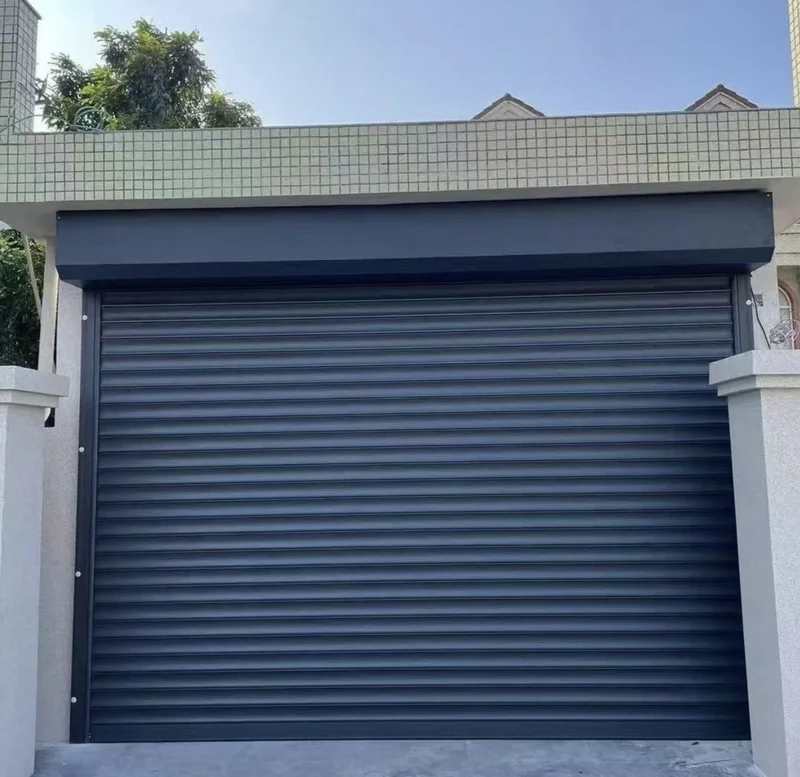
Achieving the specified 25 dB sound reduction rating (SRR) is contingent upon precise installation that maintains the door’s engineered acoustic seals and structural alignment. The soundproofing system is a composite of the door section’s mass-law performance and the perimeter sealing gasket’s effectiveness. Improper installation can compromise the acoustic barrier by creating flanking paths for sound transmission.
- Seal Integrity: The continuous magnetic or compression seal must be installed on a perfectly plumb and level door frame. A deviation exceeding 1.5mm per meter can cause gaps, reducing acoustic performance by up to 40%.
- Section Alignment: For sectional doors, vertical stile joints must be aligned within a 0.5mm tolerance to ensure the interlocking acoustic gaskets between panels function correctly.
- Hardware Specification: Rollers must be precision-bearing nylon or steel with rubber treads (Shore D 55-60) to minimize operational noise. Hinges require integrated anti-rattle bushings.
Material Specifications Ensuring Long-Term Performance
Long-term quiet operation is engineered into the material composition and construction, preventing degradation that leads to squeaks, rattles, and reduced acoustic performance.
| Component | Material Specification | Key Performance Parameter | Relevance to Long-Term Operation |
|---|---|---|---|
| Panel Core | LVL (Laminated Veneer Lumber) | Density: ≥680 kg/m³; Moisture Content: 8±2% | Provides dimensional stability (swelling rate <0.5% at 65% RH), preventing warping that breaks acoustic seals. |
| Panel Facing | WPC (Wood-Plastic Composite) | PVC-Wood Flour Ratio: 70:30; Density: 1.35-1.45 g/cm³ | Low moisture absorption (<0.8%) eliminates rot and swelling. Shore D hardness of 65 ensures impact resistance without resonant drumming. |
| Insulation Core | Polyurethane (PUR) Foam | Closed-cell content: ≥92%; Density: 42-45 kg/m³ | Adhesive foam-in-place bonding adds structural rigidity and dampens panel vibration. Provides thermal insulation (U-factor ~0.7 W/m²K). |
| Seals | EPDM Rubber | Durometer: 60±5 Shore A; Fire Rating: EN 13501-1 Class Bfl-s1 | Maintains elasticity across -40°C to +120°C, ensuring permanent seal compression recovery. |
- Fire & Emissions Compliance: All composite materials meet EN 13501-1 Class Bfl-s1 or ASTM E84 Class A. Formaldehyde emissions are certified to E0 (<0.065 mg/m³) or E1 (<0.124 mg/m³) standards, ensuring indoor air quality.
- Corrosion Protection: Hardware is zinc-plated with a minimum 12-micron coating or powder-coated to ISO 12944 C3 class, rated for >15 years resistance in humid environments.
Warranty Scope & Quality Assurance
The warranty is a validation of material durability and manufacturing consistency under ISO 9001 quality management systems. Coverage is explicitly defined by performance parameters.
- 10-Year Structural Warranty: Covers defects in the LVL core and panel integrity that affect structural stability or acoustic performance. Excludes damage from improper installation, maintenance neglect, or impact.
- 5-Year Seal & Hardware Warranty: Covers failure of acoustic seals to retain elasticity and the functional failure of rollers, hinges, and springs under normal use.
- Performance Commitment: The 25 dB SRR is validated per laboratory test conditions (ASTM E90). Field performance is guaranteed provided installation conforms to our engineered specifications and the door remains unmodified.
- Claim Validation: Warranty claims require verification of professional installation via submitted site photos and commissioning report. Material failures are investigated against certified factory test records for density, hardness, and composition.
Frequently Asked Questions
How does the 25dB soundproofing rating correlate with real-world noise reduction in residential areas?
A 25dB reduction effectively halves perceived noise, equivalent to suppressing garage motor hum to library-level quietness. This requires composite cores with 45kg/m³ mineral wool fill and triple-sealed edges. For urban settings, pair with vibration-damping track systems to neutralize low-frequency transmission through structural members.
What moisture resistance mechanisms prevent warping in humid climates?
Our doors integrate WPC cladding with ≤0.5% water absorption rates and aluminum reinforcement rails. The LVL core undergoes phenolic resin impregnation, maintaining dimensional stability across -30°C to 70°C. Critical are the butyl-rubber perimeter seals and 200-micron PVC coating, which block vapor ingress at panel joints.
Do these doors comply with international formaldehyde emission standards for indoor air quality?
All composite materials exceed EN 13986 Class E0 standards (<0.065mg/m³ formaldehyde). Core adhesives use isocyanate-free PUR formulations, while WPC surfaces undergo 180°C co-extrusion to polymerize volatile compounds. Third-party certification documents are provided for each production batch.
How is thermal insulation integrated without compromising structural integrity?
A polyurethane foam-injected core achieves 0.28W/m·K conductivity while maintaining 18MPa compressive strength. The aluminum thermal break profile separates interior/exterior cladding, preventing cold bridging. Structural load is handled by galvanized steel frame inserts with 1.5mm wall thickness.
What impact resistance can be expected from the composite panels?
Panels withstand 50J impacts (ASTM D5420) through glass-fiber reinforced WPC facesheets and honeycomb aluminum core matrix. The 8H hardness nano-ceramic coating resists denting from accidental collisions. Dynamic load testing confirms 100,000-cycle operation without fatigue failure.
How are long-term UV and weathering effects mitigated?
Accelerated weathering tests (ISO 16474-2) validate 25-year colorfastness. The five-layer coating system includes UV-absorbing fluoropolymer topcoat, chromium oxide primer for biofilm resistance, and 120-micron powder coating substrate. All exposed aluminum components undergo 20μm anodizing.
What installation specifications ensure acoustic performance isn’t compromised?
Acoustic gaskets require 8N/cm compression force at header/sill interfaces. Track alignment must be within ±1.5mm/m to maintain acoustic seals. We provide laser-alignment templates and specify torque-controlled fastening (14N·m for hinge bolts) to prevent resonance transfer through mounting points.
Can these doors be integrated with smart home systems without affecting insulation?
Pre-routed conduits with RF-transparent polymer caps allow wiring penetration while maintaining thermal breaks. Motor mounts include vibration-isolating polymer bushings. All electronic components are housed in externally-accessible NEMA 4X enclosures to prevent air leakage through control cavities.