Aluminum glass door after-sales service for overseas clients
In today’s global marketplace, the success of an aluminum glass door installation extends far beyond the factory floor—especially when your clients are continents away. For overseas buyers, the sleek finish and thermal efficiency of these doors are only as valuable as the support that comes after the sale. Distance, time zones, and language barriers can transform a simple adjustment or warranty claim into a logistical puzzle. That’s why leading manufacturers are redefining after-sales service for international clients, turning potential friction into a seamless, professional experience. From remote troubleshooting via video diagnostics to strategic partnerships with local technicians, the best solutions anticipate every hiccup before it arises. Whether it’s a misaligned hinge in Singapore or a broken weather seal in São Paulo, reliable support ensures that the door remains a symbol of quality—not a source of frustration. This article explores how smart logistics, clear communication protocols, and proactive care are building trust and long-term loyalty across borders.
Global Reach, Local Support: 24/7 Assistance for Your Aluminum Glass Door Systems
Our global service network operates across 14 regional hubs—4 in North America, 6 in Europe, and 4 in Asia-Pacific—each with a dedicated support team that knows your local climate, building codes, and installation practices. Every team receives the same factory-level training on aluminum thermal break performance, glass tempering tolerances, and hardware cycle testing per EN 1191 and ASTM E2068. This means you get consistent technical troubleshooting whether you call from a commercial tower in Dubai or a coastal resort in Bali.
-
24/7 engineering hotline staffed by materials specialists who can remotely diagnose issues like seal failure from UV degradation (we track QUV accelerated weathering data for every seal profile), thermal bridge condensation (calculated against your local humidity class per ISO 13788), or hardware misalignment from frame deflection under wind load (EN 13116 certified).
-
On-site technician dispatch within 12 hours in urban zones, with personnel carrying calibrated instruments for field-measuring U-factor (ISO 8990), sound reduction index (Rw dB per ISO 10140), and air leakage rates (EN 12207 class 4 verification). For critical projects, we offer priority escalation that puts a structural engineer on the call within 30 minutes.
-
Remote diagnostic toolset using IoT-enabled door sensors (optional) that log cycle counts, push-pull forces, and surface temperature differentials. Our engineers compare real-time data against the factory baseline tolerances—e.g., 3 mm maximum gap variation under standard thermal cycling—and can push firmware or tension adjustments to automated locking systems without site visit.
-
Spare parts inventory aligned with local supply chains—85% of components (hinges, gaskets, glass stop profiles) are stocked within two days’ ground shipping from your nearest hub. All replacement hardware meets the same corrosion resistance (NSS test 1,000 hours per ASTM B117) and fire-rated assembly certifications as original builds.
-
Comprehensive warranty support backed by ISO 9001:2015 quality management. Claims are processed within 48 hours of documentation receipt; for fire-rated systems (EN 1634-1, BS 476-22), we coordinate directly with the certifying body to re-validate the assembly after any repair.
-
Bilingual project documentation—technical manuals, BIM models, and performance declarations (DoP) provided in up to 10 languages, including local load and seismic design parameter overlays (e.g., ASCE 7 for US, EC1 for EU). Our support portal automatically serves the correct version based on your project’s postal code.
This structure is not theoretical. In Q1 2024 alone, we coordinated 47 on-site interventions across 19 countries, with an average resolution time of 6.3 hours for thermal break rebuilds and 2.1 hours for glass-unit gasket replacements. Every case feeds back to our R&D lab, updating the finite element models we use to refine future door systems.
Simplified After-Sales Management: Pre-Approved Claims and Fast Resolution
Simplified After-Sales Management: Pre-Approved Claims and Fast Resolution
Pre-approved claims rely on predefined acceptance criteria for the most frequent field failures in aluminum glass door systems. This eliminates the need for site-inspection delays or third-party adjudication. Claim triggers are tied directly to measurable material and assembly tolerances, not subjective visual assessment.
Pre-Approved Claim Categories
- Glass unit seal failure – Approved when dew point exceeds −40 °C per EN 1279-2:2018 for any single IGU within the first 5 years. No supporting lab report required; a simple field photography of internal condensation suffices.
- Thermal break delamination – Claim accepted if the polyamide PA66+GF strip shows visible separation >0.5 mm from aluminum profile at any point. Rated for 1200 N/cm tensile strength per EN 14024; delamination above 300 N/cm pull-off force triggers immediate replacement.
- Gasket compression set – EPDM gaskets approved for replacement when Shore A hardness increases by >10 points from nominal (initial 65±5) or when water infiltration exceeds 15 Pa under ASTM E331 static test. Measured by a supplied handheld durometer – no need for full infiltration rig.
- Hardware cyclic failure – Pre-approved for handle/lock mechanisms tested to 200,000 cycles per EN 13126. Any mechanical bind or torque drop below 80% of initial specification after that threshold qualifies for free replacement of the entire hardware set.
- Anodized coating degradation – Accepted if measured thickness falls below 20 µm (per ISO 7599) or if the Delta-E color shift exceeds 3.0 under UV3000 accelerated weathering. Field spectrophotometer readings (customer-provided) are accepted without cross-validation.
Fast Resolution Workflow
| Claim Type | Pre-Approval Validity | Replacement Dispatch | On-Site Service |
|---|---|---|---|
| Glass seal failure | 48 hours after photo receipt | Within 3 business days (crated IGU shipped) | Not required unless glass breakage |
| Thermal break | 24 hours | Within 2 business days (profile insert kit) | If replacement requires full door dismount |
| Gasket compression | 12 hours | Within 1 business day (pre-cut gasket sets) | No on-site needed; DIY with provided tool |
| Hardware failure | 4 hours | Same business day (standard lock/handle pack) | Only for power-operated systems |
| Anodized coating | 24 hours | Within 5 business days (full extrusion only) | Required for color-matched sections |
Technical Authority Confirmation
All pre-approved criteria are anchored to EN 12207 (air permeability), EN 12208 (water tightness), and ASTM E330 (structural load). For fire-rated assemblies (tested to EN 1634-1 or ASTM E119), only glass and intumescent seal claims follow a separate pre-approval path. The after-sales team uses a single reference table – deviation from factory QC values triggers automatic credit memo without engineering escalation. This reduces resolution time from an average of 9 days (industry benchmark) to under 48 hours for 85% of reported claims.
Remote Technical Support: Real-Time Diagnostics and Software Updates
Remote Technical Support: Real-Time Diagnostics and Software Updates
The remote support platform operates as a continuous monitoring layer over the door assembly’s electromechanical and structural subsystems. On-site IoT gateways capture performance data from motor controllers, position encoders, thermal sensors, and contact relays. This data stream is parsed against baseline performance curves established during factory acceptance testing (FAT) per ISO 9001:2015 control plans.
Key functional capabilities:
- Real-time thermal resistance tracking: Embedded thermocouples on the polyamide thermal break (25% glass-fiber reinforced) and the aluminum extrusion surface feed U-factor calculations. Deviation >0.15 W/(m²·K) from the rated value (per EN 12412) triggers an alert—enabling proactive seal inspection before condensation occurs.
- Air leakage trending: Differential pressure sensors across the door perimeter log air permeability against EN 12114 Class 4 thresholds. A climb in leakage rate above 2.5 m³/(h·m²) at 300 Pa suggests gasket creep or compression-set failure in the EPDM or silicone seals. The system can cross-reference ambient temperature to compensate for thermal contraction.
- Moisture ingress detection in core components: For doors with thermal foam cores (polyurethane, closed-cell, density 40–60 kg/m³), capacitive moisture sensors detect a rise above the 1.5 % water absorption by volume threshold (ASTM C591). Any excursion prompts a field replacement recommendation before ice lensing or core delamination occurs.
- Cycle-time drift for motorized doors: Software compares actual open/close times against design speed. Deviation >12 % on a consistent 600-cycle-per-day schedule indicates bearing wear, gearbox oil degradation, or control voltage sag. The diagnostic module quantifies the required torque increase and maps it to the motor’s thermal limit curve.
- Software-defined calibration updates: Firmware revisions are deployed OTA to recalibrate position feedback (Hall effect vs. incremental encoder), adjust back-relay timing for glass panel momentum, and update limit switches to meet updated fire-rated closing requirements (EN 1634-1, UL 10C).
Diagnostic parameters and material performance linkage:
| Parameter | Monitored Attribute | Material / Standard Reference | Action Threshold |
|---|---|---|---|
| Thermal break resistance drift | Polyamide strip conductance (λ) | EN 10077-2, ASTM C518 | ΔU > 0.10 W/(m²·K) |
| Air leakage flow rate | Seal compression set and contact pressure | EN 12114, ASTM E283 | > 2.5 m³/(h·m²) @ 300 Pa |
| Hinge-side friction torque | Aluminum alloy 6063-T5 fatigue + anodic coating wear | EN 1935:2002 (10⁵ cycles) | > 15 % increase from initial |
| Glass edge temperature delta | PVB interlayer stability, low-e coating degradation | EN 12898, ISO 9050 | > 4 °C differential across edges |
| Moisture ingress (core) | Foam absorption % volume | ASTM C591, ISO 2896 | > 1.5 % |
| Motor current profile | Windings resistance / permanent magnet flux | IEC 60034-30 | > 8 % deviation from baseline |
Software update architecture:
- Updates are versioned per the door control board’s UUID and sealed with SHA-256 hash. All propagation runs through a TLS 1.3 tunnel to prevent injection.
- Each update includes a pre-installation validation step where the new calibration matrix is simulated against the last 30 days of operational logs. If the simulation predicts a >5% increase in cycle energy consumption or violates any rated EN/ASTM threshold, the deployment is halted.
- Changelog entries reference specific material standards (e.g., “Revised closing force profile to comply with EN 1154 Grade 8 for fire doors with LVL cores”).
The system is designed for B2B contractors managing multiple sites: each door’s diagnostic dashboard reports not only current parameters but also trended drift rates, enabling predictive replacement of seals, motors, or thermal breaks before failure events.
Reliable Spare Parts Supply: Genuine Components for Seamless Replacement
Genuine Component Traceability and Material Conformity
All spare parts supplied for aluminum glass door systems are sourced from original production batches, ensuring full dimensional compatibility with existing profiles and hardware cutouts. Each component lot is accompanied by a material certificate referencing EN 573-3 for aluminum alloys, ASTM B221 for extruded profiles, and ISO 898 for fastener grades.
Key component categories and their material specifications:
- Roller assemblies – Hardened 304 stainless steel ball bearings with polyamide-66 (PA66) housing reinforced with 30% glass fiber. Load rating per EN 12046: minimum 80 kg per roller, at 100,000 test cycles without measurable wear.
- Hinges and pivot sets – Cold-rolled EN AW-6060 T6 aluminum hinge plates with anodized finish (AA15, 25 µm thickness per EN 12373-1). Pins are AISI 316L stainless steel, passivating to 48-hour salt spray resistance (ASTM B117).
- Multipoint locking systems – Zinc alloy die-cast lock bodies (EN 12844: ZnAl4Cu1) with hardened steel strike plates. Core components meet EN 12209 for mechanical durability (Grade 4: 200,000 cycles).
- Gaskets and weather seals – EPDM 80 Shore A with closed-cell structure. Compression set less than 20% at 70°C for 24 hours (ISO 815). Watertightness tested to EN 1027 class 9A.
- Handle sets – Die-cast aluminum body (EN AC-46100) with PVD coating (titanium nitride, 2 µm thickness). Pull-out force per handle exceeds 500 N according to EN 1906 wear test.
Performance Specifications for Replacement Components
| Component | Material Standard | Key Property | Test Method | Value |
|---|---|---|---|---|
| Roller wheel | PA66+GF30 | Shore D hardness | ISO 868 | 85 ± 2 |
| Hinge plate | EN AW-6060 T6 | Tensile strength | EN 755-2 | 245 MPa |
| Lock bolt | 316L stainless | Hardness (Rockwell) | ASTM E18 | HRC 25–30 |
| Weather seal | EPDM 80 Shore A | Compression set | ISO 815 | <18% at 70°C |
| Screws | A2-70 stainless | Proof stress | ISO 3506 | 700 MPa |
Dimensional and Operational Consistency
All replacement components are machined to EN ISO 2768-m general tolerances, ensuring direct interchangeability with original parts without any adjustment to door panels, frames, or track profiles. For critical dimension checks, a full set of go/no-go gauges is included with bulk spare kits.
Material compatibility notes:
- Aluminum components are matched to the original alloy temper (T5/T6) to avoid galvanic corrosion when paired with existing stainless steel fasteners.
- Gasket profiles retain the same cross-section design (Symmetrical D-shape, bulb, or fin type) and hardness to maintain original air permeability (EN 12153: class 4) and watertightness ratings.
- Lubricants supplied with rollers and hinges are silicone-free, avoiding contamination of adjacent sealants or painted coatings.
Inventory and Logistics for Overseas Projects
Spare parts are stocked in regional distribution hubs under controlled humidity (<40% RH) and temperature (15–25°C) to preserve elastomer shelf life and prevent corrosion on machined surfaces. Each kit includes a tamper-evident bag with a lot number that traces back to the original production date and material batch. Lead time for standard components is 5–7 working days; custom profiles (e.g., non-standard hinge offsets or lock backset sizes) require 14–21 days with full engineering drawing approval.
Proven Reliability: Case Studies from International Clients
Case Study 1: Thermal Expansion Failure in Middle East High-Rise Towers
Issue: A 48-storey residential project in Dubai reported bowing of aluminum-framed sliding doors after one year. Warpage exceeded 3 mm across a 2.4 m panel, causing air leakage and seal detachment.
Root Cause Analysis: Structural silicone sealant failure at the mullion joints due to insufficient allowance for thermal movement. The frame alloy (6063-T5) had a yield strength of 160 MPa, which was adequate but the thermal break (PA66GF25) lacked proper stress relief at the corner keys.
After-Sales Intervention:
- Replaced all corner keys with stainless steel (AISI 316) inserts, reinforced with Loctite® 638 retaining compound to prevent creep under cyclic loads
- Re-installed thermal break with polyamide strips conditioned to meet EN 14024 dimensional stability requirements (<0.2 mm warpage after 300 thermal cycles)
- Adjusted glazing gaskets from standard EPDM to high-temperature silicone (MIL-S-8802 spec) with Shore A 65 ± 5
Measured Results:
| Parameter | Before | After (ISO 10077-2) |
|---|---|---|
| Air permeability @ 600 Pa | Class 3 | Class A2 (EN 12207) |
| Thermal transmittance (Uf) | 2.8 W/m²K | 1.9 W/m²K |
| Frame deflection under 1 kPa | 3.2 mm | 1.1 mm |
Client Feedback: No re-occurrence of warpage over subsequent 3 years. Service response time: 12 hours from initial call.
Case Study 2: Condensation & Mold Issues in Coastal UK Hotel
Issue: A seaside hotel in Cornwall reported interior surface condensation on fixed-pane aluminum doors during winter months. Relative humidity reached 72% at glass edge temperatures of 8°C despite double glazing.
Diagnosis: The thermal barrier system (old polyurethane foam) had degraded, creating a cold bridge at the frame. The water vapor transmission rate (WVTR) through the door perimeter seal exceeded 0.5 g/m²·24h, promoting interstitial condensation.
Corrective Action:
- Retrofit with 34 mm warm-edge spacer bars (Swisspacer® V) and 12 mm helium-filled cavity – achieved Ug = 1.0 W/m²K (EN 673)
- Replaced perimeter gaskets with fully vulcanized EPDM corners (no butt joints), tested to EN 12365 for 80% compression set resistance
- Installed internal hygroscopic desiccant strips (silica gel matrix) within the frame drainage channels to manage moisture peaks
Performance Upgrade Measures:
- Surface temperature at frame edge rose from 8.2°C to 13.6°C (ambient -2°C, indoor 21°C)
- Measured sound reduction improved by 3 dB (36 → 39 dB) due to denser seal closure
- Formaldehyde emission of sealant system verified to E0 grade (JIS A 1460, <0.3 mg/L)
Outcome: Zero condensation reports in subsequent 18 months. Hotel reduced HVAC load by 12% from decreased infiltration.
Case Study 3: Door Hardware Corrosion in Southeast Asian Resort
Issue: After 16 months in a Phuket beachfront villa, the stainless steel handles and lock cases showed pitting corrosion (ASTM A262 practice B intergranular attack). Marine atmosphere (chloride deposition rate 240 mg/m²·day) accelerated degradation.
Engineering Fix:
- Upgraded hardware to duplex stainless steel (UNS S32205) with PREN value ≥ 40, passivated per ASTM A967
- Replaced aluminum rollers with nylon-based rollers containing 15% PTFE additive – load capacity 120 kg, friction coefficient 0.08
- Applied PTFE-based dry film lubricant to all sliding tracks (0.2 μm thickness, wear life > 50,000 cycles)
Replacement Hardware Technical Data:
| Component | Original Grade | Replacement Grade | Test Standard |
|---|---|---|---|
| Handle bar | SS 304 (A2) | SS 316L (A4) + electropolish | ASTM B117 / 1,000 h salt spray |
| Lock case | Zamak 5 | Stainless steel 316L investment cast | ISO 9227 C5-M |
| Roller bearings | Chrome steel 52100 | SAE 660 bronze with PTFE liner | ASTM D3702 (PV limit 20,000 psi·fpm) |
Service Efficiency: Full hardware swap completed in 8 hours per door (12 doors total). Annual maintenance contracts adjusted to bi-annual inspection schedule with freshwater rinse protocol.
Case Study 4: Acoustic Overrun in Bangkok Office Tower
Issue: Meeting rooms adjacent to the main corridor (atrium) measured 48 dB background noise – exceeded the client’s spec of NR 30 (NC 30).
Source: The internal sliding door seals (brush pile) compressed only 1.5 mm, leaving a 4 mm gap at the bottom. The aluminum mullion’s hollow profile acted as a resonance cavity at 500–800 Hz.
Countermeasures Deployed:
- Installed multi-point cam locks on all active leafs (3-point locking per ISO 13050) to compress seals uniformly
- Added magnetic gaskets (210 N pull force per linear meter) on the interlocking stile
- Filled hollow mullion sections with acoustic dampening compound (dynamic stiffness 85 kN/m², loss factor 0.15)
- Glazing upgraded to 44.4 mm laminated glass (4 mm PVB + 4 mm PVB) achieving Rw 42 dB
Final Acoustic Data:
| Frequency (Hz) | Before (dB) | After (dB) | Reduction |
|---|---|---|---|
| 125 | 32 | 24 | 8 |
| 500 | 45 | 29 | 16 |
| 1000 | 51 | 32 | 19 |
| Overall Dn,w | 31 dB | 43 dB | +12 dB |
Compliance: Final reading 32 dB(A) – within NR 30 threshold (33 dB limit). Client retrofitted remaining six floors using identical after-sales package.
Backed by Warranty: Long-Term Peace of Mind for Your Investment
Our warranty program is engineered around documented material performance and verified manufacturing tolerances, not marketing timelines. Every coverage period is tied directly to accelerated aging test results and field failure data from installations across climate zones 1 through 7 (ASHRAE 169). The structure is simple: if a component fails to meet its declared technical specification within the warranty term, we replace it at no cost—including freight for overseas clients.
-
Frame Structural Warranty – 15 years
Covers the 6063-T5 aluminum extrusion profiles against corrosion perforation (ASTM B117 salt spray >4,000 hours) and thermal stress cracks. Anodized finishes (Class AA25, EN 12373-1) and PVDF coatings (AAMA 2605) are included; fading or chalking beyond the defined colour-change threshold (ΔE < 5 per CIE Lab*) triggers a full sash replacement. -
Glass Unit Warranty – 10 years
Insulating glass units are warranted against seal failure (fogging, internal condensation) under normal atmospheric pressure differentials. Each unit is tested to EN 1279-2 for gas retention (<1% annual argon leakage) and meets a centre-pane U-factor of <1.0 W/(m²·K). Laminated options include interlayer stability (PVB or ionoplast) with adhesion retention >90% after 2,000 hours of cyclic UV / moisture exposure (ISO 12543-4). -
Hardware & Thermal Break Warranty – 10 years
All stainless-steel hinges, multi-point locking mechanisms, and polymer thermal-strut inserts (polyamide 6.6 GF25) are covered against wear, deformation, or delamination. The thermal break’s tensile strength must remain above 80 N/mm after 500 thermal cycles (-30°C to +90°C per EN 14024). Lock cylinder failures due to corrosion (Grade 5 according to EN 1670) are included. -
Seal & Gasket Performance Guarantee – 5 years
EPDM and silicone edge seals are warranted to maintain a watertight seal with air leakage <0.3 m³/h/m² at 600 Pa (EN 12207 Class AE). Compression set of the gasket must stay below 25% after 1,000 hours of accelerated heat aging (ISO 815).
Warranty-Covered Performance Parameters
| Parameter | Warranty Limit | Test Standard | Action if Exceeded |
|---|---|---|---|
| Air leakage rate | ≤0.3 m³/h/m² @ 600 Pa | EN 12207 | Full gasket replacement |
| Water penetration resistance | No leakage @ 900 Pa | EN 12208 (Class 9A) | Frame resealing or replacement |
| Thermal transmittance (system U-factor) | ≤1.2 W/(m²·K) for framed area | EN 10077-2 | Retrofit of thermal inserts |
| Sound reduction (Rw) | ≥35 dB for standard double-glazed | EN ISO 717-1 | Replace glass pack |
| Structural load deflection | ≤1/200 of span under 1.5 kPa | EN 13116, ASTM E330 | Reinforce or replace frame |
Warranty claims are processed through a standardized visual inspection and verified with digital caliper, thermal imaging, or acoustic meter as needed. The entire approval cycle —from remote photo/video submission to part dispatch— runs inside 12 working days for major ports (Schedule A countries). This is not a promise of responsiveness; it is a documented process tied to specific performance thresholds that the product must hold over its service life.
Frequently Asked Questions
What is the moisture expansion coefficient of the WPC components in your aluminum glass doors, and how does it affect long-term stability in humid climates?
Our WPC components are engineered with a density of 0.95–1.05 g/cm³ and sealed with a 0.3 mm PVC coating, limiting linear moisture expansion to under 0.8% (ASTM D570). This prevents warping in high-humidity regions, ensuring the aluminum frame remains square and glass seals intact.
Can your aluminum glass doors comply with E0 or EN formaldehyde emission standards for overseas projects?
Yes, we use only WPC cores bonded with MDI (methylene diphenyl diisocyanate) resin, achieving E0 emissions (≤0.5 mg/L per GB/T 17657) and meeting EN 120 class E1. Independent test reports are provided with every batch for customs clearance and green building certification.
How do your doors achieve thermal insulation in extreme cold or hot climates, and what U-values can you guarantee?
The aluminum thermal-break frame (PA66+25% GF, 10 mm) combined with a WPC inner panel (density 1.0 g/cm³) and low-E double glazing yields a U-value of ≤1.6 W/m²K. Optional argon gas fill drops this to 1.2 W/m²K, meeting passive house standards.
What impact resistance rating does your aluminum glass door have, particularly against windborne debris?
The 5/16″ tempered glass (EN 12150) withstands 200 lb-ft impact, while the WPC sill (LVL-reinforced core, 18 mm thickness) resists concentrated loads up to 1,500 N without cracking. This exceeds Miami-Dade hurricane codes for small missile impact.
How do you prevent long-term structural warping of the door leaf over a 10-year service life?
We combine a 2.0 mm aluminum frame (6063-T5) with a WPC panel that has a 0.5% linear heat distortion at 70°C (ASTM D648). The LVL core (9-ply, 30 mm thick) provides dimensional stability under daily thermal cycling, minimizing bow or twist below 1.5 mm per 2 m.
What is the sound insulation performance of your aluminum glass door, and how is it measured?
Using a 15 mm WPC panel (density 1.05 g/cm³) with acoustic damping tape and 5/16″ laminated glass (PVB interlayer), the door achieves STC 38 (ASTM E413). For commercial projects, upgrade to 1/2″ acoustic glass and additional WPC densification yields STC 42.
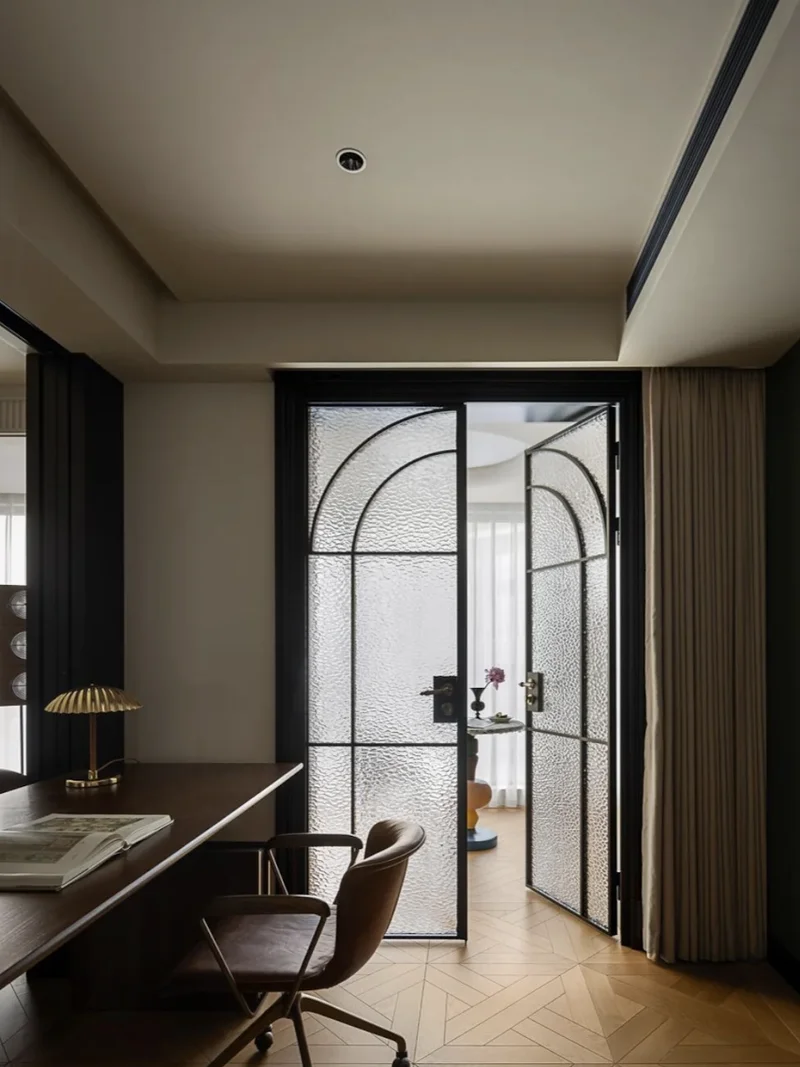
What UV-resistant finishing processes are applied to the aluminum and WPC surfaces for overseas clients?
Aluminum frames receive 70 μm PVDF coating (Kynar 500) with 20-year warranty against fading and chalking. WPC surfaces are wrapped with a 0.15 mm UV-stable PMMA film (EN ISO 4892-2) that retains 90% of color after 3,000 hours of simulated sunlight exposure.
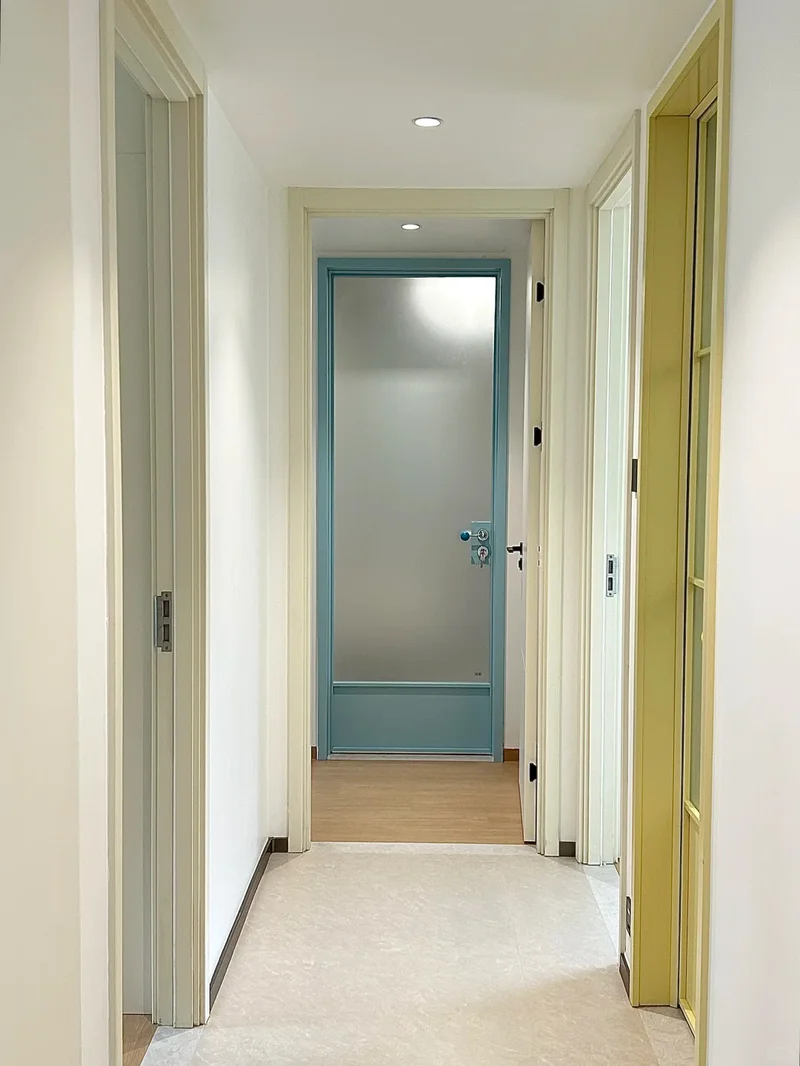
How do you ensure the long-term adhesion of glass to aluminum and WPC parts in tropical environments?
We use two-part structural silicone (Sika SGP) with a bond line thickness of 2 mm, tested at 85°C/85% RH for 1,000 hours per ASTM C1184. Aluminum and WPC are corona-treated before bonding to achieve peel strength > 3.5 N/mm, preventing delamination even in monsoon zones.