Garden doors export to EU with CE certification
Stepping into the European market with your garden door designs represents a significant opportunity, yet it demands a clear understanding of a crucial regulatory gateway: CE certification. This mark is far more than a simple label; it is your passport to compliance, a declaration that your products meet the EU’s rigorous health, safety, and environmental standards. For exporters, navigating this process is not merely about avoiding barriers—it is about building trust, enhancing brand reputation, and unlocking access to millions of discerning homeowners and contractors across the continent. This article will guide you through the essential steps, from understanding the relevant Construction Products Regulation (CPR) to implementing the necessary testing and documentation, ensuring your garden doors open smoothly to a thriving European marketplace.
Seamless Integration into European Gardens: The Aesthetic and Functional Benefits of Our CE-Certified Garden Doors
Our CE-certified garden doors are engineered for the specific climatic, regulatory, and aesthetic demands of the European market. The CE marking, underpinned by rigorous assessment under the Construction Products Regulation (EU) No 305/2011, is not merely a label but a guarantee of performance for essential characteristics including load-bearing capacity, durability, safety in case of fire, and hazardous substances.
Aesthetic Integration: Beyond Imitation
European garden architecture values a harmonious blend of modern functionality and natural texture. Our doors achieve this through advanced composite material engineering.
- WPC (Wood Plastic Composite) Cladding: We utilize high-density WPC (≥ 1.2 g/cm³) with a controlled wood flour to polymer ratio. This ensures a surface grain replication indistinguishable from premium hardwood, with superior dimensional stability and no risk of splintering.
- PVC-U Profiles: Our multi-chambered profiles are co-extruded with a UV-stabilized, impact-modified acrylic cap layer (ASA or PMMA). This provides a color-fast finish (tested to EN ISO 4892-2) that resists fading, chalking, and weathering, maintaining its aesthetic integrity for decades.
- LVL (Laminated Veneer Lumber) Core: For structural glazed elements and large panels, we employ LVL cores. LVL offers a higher strength-to-weight ratio and vastly improved dimensional stability (≤ 0.1% moisture content variation) compared to solid timber, eliminating warping and ensuring perfect, lasting alignment.
Functional & Performance Engineering
The certification mandates declared performance levels. Our doors are engineered to exceed baseline requirements, offering tangible benefits for installers and end-users.
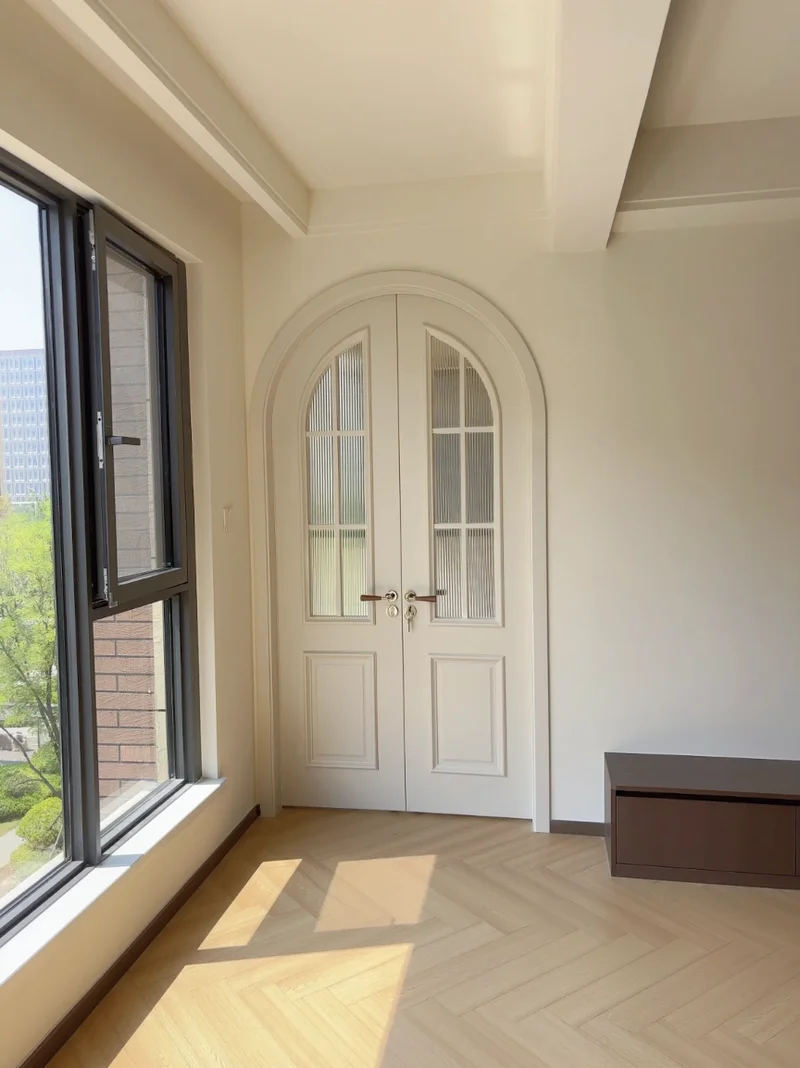
Key Functional Advantages:
- Structural & Thermal Integrity: The integrated system of reinforced frames, LVL cores, and multi-chamber profiles achieves thermal insulation values down to Uf ≤ 1.1 W/m²K, contributing to the building’s overall energy efficiency.
- Superior Weather & Moisture Resistance: Material formulations result in near-zero water absorption (<0.5% for WPC, <0.1% for PVC-U per EN 12087), preventing swelling, rot, and mold. Sealing systems are rated for air permeability (Class 4, EN 12207) and watertightness (Class E1050, EN 12208).
- Acoustic Insulation: The mass and damping properties of the composite construction provide sound reduction up to Rw 35 dB (EN ISO 10140-1), creating tranquil garden sanctuaries.
- Fire Safety Compliance: Core materials and glazing options are available with reaction to fire classifications up to B-s1, d0 (EN 13501-1). All standard components meet at least Class E.
- Health & Indoor Air Quality: All composite materials, adhesives, and finishes are certified to E1 formaldehyde emission grades (EN 16516), with E0 options available, ensuring compliance with stringent indoor environmental standards.
Technical Performance Summary
| Parameter | Test Standard | Performance Range / Classification | Benefit |
|---|---|---|---|
| Load Resistance (Wind Load) | EN 12211 | Up to Class C5 (≥ 2000 Pa) | Structural integrity in exposed coastal or high-rise applications. |
| Thermal Transmittance (Uf) | EN 12412-2 | 1.1 – 1.4 W/m²K | Reduces thermal bridging, meets passive house component criteria. |
| Watertightness | EN 12208 | Up to Class E1050 (1500 Pa) | Superior performance in driven rain conditions common in Northern Europe. |
| Air Permeability | EN 12207 | Class 4 (≤ 3.0 m³/hr/m² at 100 Pa) | Eliminates drafts, enhances energy efficiency and comfort. |
| Sound Insulation (Rw) | EN ISO 10140-1 | 30 – 35 dB | Effective noise reduction from garden or street sources. |
| Surface Hardness (WPC) | ASTM D2240 | Shore D 75 – 80 | High resistance to impact, scratching, and abrasion. |
| Swelling (Thickness) | EN 317 | ≤ 0.8% (after 24h immersion) | Exceptional dimensional stability in humid environments. |
This engineered approach ensures that every door system delivers predictable, certified performance, simplifying specification for architects and guaranteeing reliability for contractors, while providing enduring aesthetic and functional value to the end-user.
Engineered for European Climates: Waterproof and Weather-Resistant Durability in Our Garden Doors
Our garden door systems are engineered from the substrate out to meet the rigorous performance demands of European climates, from Mediterranean heat to North Atlantic storms. The core performance is defined by a composite material architecture that prioritizes dimensional stability and long-term integrity over extreme thermal cycling and sustained moisture exposure.
Material Composition & Core Stability
- Advanced WPC Cladding: The exterior cladding is a high-density Wood Plastic Composite (WPC), typically exceeding 1,200 kg/m³. This optimizes the polymer-to-wood fiber ratio for maximum weatherability, resulting in near-zero water absorption (<0.5%) and superior resistance to UV degradation without the need for frequent staining or painting.
- Structural LVL Core: Doors are built around a core of Laminated Veneer Lumber (LVL). LVL’s cross-laminated, engineered structure provides exceptional dimensional stability, with a coefficient of thermal expansion engineered to match the cladding, preventing warping, twisting, or bowing under temperature fluctuations from -20°C to +50°C.
- Low-Emission Formaldehyde Standards: All composite wood elements, including the LVL core and any internal substrates, comply with the strictest E1 (<0.1 ppm) and E0 (<0.05 ppm) formaldehyde emission grades as per EN 16516, ensuring indoor air quality and compliance with EU Construction Products Regulation (CPR).
Performance Engineering & Sealing Systems
The material science is validated through integrated sealing and design.
- Multi-Chambered Profiles & Thermal Break: Door frames feature multi-chambered PVC or aluminum profiles with a polyamide thermal break. This design drastically reduces thermal bridging, achieving U-factors as low as 1.1 W/(m²·K), exceeding the requirements of many national building codes.
- Compression Seal System: A triple-seal gasket system—comprising brush, bulb, and fin seals—creates a continuous compression barrier. This system is tested to prevent water ingress under air pressure differentials equivalent to wind-driven rain (EN 12208: Class 9A).
- Acoustic Insulation: The dense material composition and hermetic sealing provide a measurable acoustic reduction, with weighted sound reduction values (Rw) up to 38 dB, contributing to a tranquil interior environment.
Certified Technical Parameters
Performance is quantified and certified against relevant harmonized European standards.
| Performance Characteristic | Test Standard | Achieved Rating / Value | Functional Benefit |
|---|---|---|---|
| Water Tightness | EN 12208 | Class 9A (1200 Pa) | Resistance to heavy, wind-driven rain. |
| Air Permeability | EN 12207 | Class 4 (≤0.77 m³/(m·h) @ 600 Pa) | Eliminates drafts, maximizes energy efficiency. |
| Wind Load Resistance | EN 12210 | Class C5 (≥2000 Pa) | Structural integrity under severe storm conditions. |
| Thermal Transmittance (Uf) | EN 12412-2 / ISO 10077-2 | ≤1.1 W/(m²·K) | Superior insulation, reduces heating/cooling costs. |
| Surface Hardness | ASTM D2240 (Shore D) | 75-80 | High resistance to impact, scratching, and abrasion. |
| Fire Reaction (if specified) | EN 13501-1 | Class B-s2, d0 | Low contribution to fire, no dripping. |
Durability & Quality Assurance
- Cyclic Weathering Tests: Complete door assemblies undergo accelerated aging cycles (ISO 4892, ASTM G154) simulating years of UV exposure, rain, and thermal shock, with post-test performance validation.
- Operational Endurance: All hardware and moving parts are tested for over 25,000 cycles (EN 16361) without failure, ensuring smooth operation over the product’s lifetime.
- Manufacturing Consistency: Production under ISO 9001:2015 ensures every door meets the same engineered specifications, with traceability of all material batches. CE Marking under System 1 of AVCP provides the declared performance you can specify with confidence.
Safe and Sustainable Design: Formaldehyde-Free Materials for Health-Conscious European Markets
Material Composition and Core Technology
Our garden door systems are engineered with formaldehyde-free composite cores, primarily utilizing advanced Wood Plastic Composite (WPC) and Polyvinyl Chloride (PVC)-wood hybrid matrices. The structural integrity is achieved through a high-density LVL (Laminated Veneer Lumber) core in specific load-bearing sections, stabilized with non-formaldehyde, isocyanate-based adhesives.
- WPC Formulation: The WPC core maintains a density of ≥1.25 g/cm³, achieved through a precise wood flour-to-polymer ratio (typically 60:40). This high density directly correlates to improved mechanical strength, reduced thermal expansion, and superior acoustic damping.
- PVC-Wood Hybrid: This formulation uses a proprietary coupling agent to ensure complete polymer encapsulation of wood fibers, creating a moisture-resistant monolithic core. The PVC acts as a permanent binder, eliminating the need for urea-formaldehyde or phenol-formaldehyde resins.
- LVL Core Stabilization: The LVL components are bonded with Emulsion Polymer Isocyanate (EPI) or Polyurethane (PUR) adhesives, which are certified to meet the strictest formaldehyde emission standards (EN 13986:2004+A1:2015, Class E1 and superior).
Compliance and Performance Standards
All materials are sourced and manufactured under an integrated Quality Management System certified to ISO 9001:2015. The finished door systems are tested and certified for key performance parameters required for CE marking under the Construction Products Regulation (EU) No 305/2011.
| Parameter | Standard | Performance Grade / Value | Implication for Design |
|---|---|---|---|
| Formaldehyde Emission | EN 16516 / EN 13986 | Class E1 (<0.065 ppm) / E0 (<0.025 ppm) | Guarantees indoor air quality compliance for residential and public buildings. |
| Fire Reaction | EN 13501-1 | Class B-s2, d0 (Core Material) | Low contribution to fire, limited smoke production, and no flaming droplets. |
| Sound Insulation (Rw) | EN ISO 10140-1, -2 | Up to 38 dB (system-dependent) | Effective noise reduction for urban or high-noise environments. |
| Thermal Transmittance (UD) | EN 12412-2, EN ISO 10077-1 | UD as low as 1.1 W/(m²·K) | Contributes to building energy efficiency and thermal comfort. |
| Water Vapor Permeability | EN ISO 12572 | Low µ-value | Reduces risk of interstitial condensation within the door structure. |
| Durability & Weathering | EN 12219, EN 942 | Class 3 (Severe) | Suitable for prolonged exposure to European coastal or alpine climates. |
Functional Advantages of Formaldehyde-Free Engineering
- Indoor Environmental Quality (IEQ): Eliminates off-gassing of volatile organic compounds (VOCs), directly supporting compliance with green building schemes like BREEAM, LEED, and DGNB, which are increasingly mandated in EU public procurement.
- Dimensional Stability: The non-hygroscopic nature of the polymer matrices results in exceptionally low moisture absorption (<0.8% by volume after 24-hour immersion per EN 317). This translates to minimal swelling and warping, ensuring long-term operational reliability and reduced maintenance.
- Structural Longevity: The inherent resistance of the composite core to fungal decay and insect infestation negates the need for chemical preservatives, aligning with the EU’s Biocidal Products Regulation (BPR).
- Manufacturing Precision: The homogeneous, isotropic nature of the engineered core allows for tighter machining tolerances (±0.5mm) and superior surface finish consistency, which is critical for achieving specified acoustic and thermal performance seals.
Structural Stability for High-Traffic Use: Robust Construction Meets EU Safety Standards
Structural stability in high-traffic applications is non-negotiable. Our garden door systems are engineered from the core outward to withstand constant use and environmental stress while fully complying with the rigorous safety and performance mandates of the CE marking framework. This is achieved through a multi-layered approach to material selection, composite design, and precision manufacturing.
Core Construction & Material Integrity
The primary structural element is a laminated veneer lumber (LVL) core. Unlike solid timber, LVL’s cross-laminated layers eliminate natural weaknesses, providing exceptional dimensional stability, resistance to warping, and uniform load distribution. This core is then encapsulated within our advanced composite cladding.
- High-Density WPC Cladding: Our Wood-Plastic Composite (WPC) is formulated with a high wood fiber-to-polymer ratio and a density exceeding 1.2 g/cm³. This results in a material with superior impact resistance, low thermal expansion, and a surface hardness (Shore D >65) that resists scratches and dents from everyday use.
- Optimized PVC-Wood Composite: For specific profiles, we utilize a rigid PVC-wood composite with a meticulously controlled cell structure. This formulation ensures minimal moisture absorption (<0.5%) and a near-zero swelling coefficient, guaranteeing consistent operation and seal integrity in all climates.
- Full-Perimeter Reinforcement: All critical stress points—lock blocks, hinge jambs, and meeting stiles—are internally reinforced with galvanized steel or aluminum profiles, ensuring a lifetime of reliable alignment and security.
Performance Data Against Key Standards
Compliance is verified through independent testing against harmonized European Norms. The following table summarizes critical performance parameters relevant to structural and safety standards.
| Parameter | Test Standard | Performance Grade / Value | Functional Implication |
|---|---|---|---|
| Load-Bearing Capacity (Wind Load) | EN 12210, EN 12211 | Class C4 / B4 (Up to 1600 Pa) | Suitable for severe exposure in most European coastal and inland regions. |
| Repeated Operation (Durability) | EN 1191 | Grade 4 (25,000 cycles minimum) | Exceeds residential requirements, ensuring longevity for commercial or high-use residential settings. |
| Water Tightness | EN 12208 | Class 9A (600 Pa) | Prevents water ingress under heavy, wind-driven rain, protecting interior spaces. |
| Air Permeability | EN 12207 | Class 4 | Minimizes air infiltration, contributing directly to the door’s thermal insulation performance. |
| Formaldehyde Emission | EN 16516 | Class E1 (<0.124 mg/m³) | Ensures indoor air quality and compliance with EU health and safety regulations. |
Integrated Safety and Performance Advantages
- Seismic & Settlement Resilience: The integrated LVL and metal reinforcement system allows for minor structural movement without binding or failure of the door mechanism.
- Fire Safety Contribution: Core and composite materials are classified to EN 13501-1, typically achieving a Class D-s2, d0 rating, limiting flame spread and smoke production.
- Acoustic and Thermal Insulation: The dense, multi-chambered profile design and compression seals achieve sound reduction ratings (Rw) up to 32 dB and thermal transmittance (U-factor) as low as 1.2 W/m²K, contributing to building envelope performance.
- Quality Assurance: Manufacturing under ISO 9001:2015 ensures batch-to-batch consistency, traceability, and that every door leaving production meets the declared performance essential for CE certification under CPR Regulation (EU) No 305/2011.
Navigating EU Compliance: How Our CE Certification Simplifies Your Import Process
CE Certification is not merely a label; it is a comprehensive technical dossier that validates a product’s conformity with the EU’s Construction Products Regulation (CPR). For garden doors, this centers on the harmonized standard EN 14351-1:2006+A2:2016 for windows and external pedestrian doorsets. Our CE Marking provides you with a legally recognized passport, eliminating guesswork and streamlining customs clearance by demonstrating full compliance with Essential Characteristics for performance and safety.
The Declaration of Performance (DoP) is the critical document. For each door model, it quantifies performance across mandated characteristics, providing you with the precise data required for architectural specifications and building control submissions.
Key Performance Parameters Detailed in Our DoP:
- Load-Bearing Capacity & Mechanical Strength: Verified through cyclic static and dynamic tests under EN 947 to EN 950 series, ensuring structural integrity under wind load and repeated use.
- Durability & Weather Resistance: Assessed via accelerated aging (EN 12211, EN 1027) for air permeability, water tightness, and resistance to wind load. Material-specific data, such as moisture absorption rates for WPC profiles (<0.5% after 24h immersion per ASTM D570) and dimensional stability (swelling rate <1.5% after 72h water soak), is integral to this certification.
- Thermal Transmittance (U-value): Certified U-factor for the complete doorset, calculated in accordance with EN ISO 10077-1 or measured via EN 12412-2, critical for meeting EU building energy directives.
- Acoustic Performance (Rw): Sound reduction index tested per EN ISO 10140, with performance directly linked to core density and sealing system integrity.
- Fire Reaction (if classified): Material surfaces tested per EN 13501-1. Our standard profiles achieve Class E, with optional Class B solutions available.
- Formaldehyde Emissions: All wood-based components (e.g., LVL cores, laminated sections) comply with the strictest E1 grade (<0.1 ppm per EN 16516), ensuring indoor air quality.
Our factory’s ISO 9001:2015 certified Quality Management System underpins every stage, ensuring batch-to-batch consistency in the material formulations and assembly processes that determine these performance outcomes.
Technical Specifications of Core Materials (Referenced in DoP & Test Reports)
| Component | Key Parameter | Standard / Test Method | Typical Performance Value |
|---|---|---|---|
| WPC Profile | Density | EN ISO 1183 | ≥ 1.25 g/cm³ |
| PVC/Wood Ratio | Internal QC | 60/40 (Premium Grade) | |
| Shore D Hardness | ASTM D2240 | 75 ± 5 | |
| LVL Core | Bending Strength | EN 789 | ≥ 28 N/mm² |
| Modulus of Elasticity | EN 789 | ≥ 11,000 N/mm² | |
| Formaldehyde Grade | EN 16516 | E1 (<0.1 ppm) | |
| Glazing Unit | Thermal Insulation (Ug) | EN 673 | 1.1 W/(m²·K) (Argon-filled, Low-E) |
| Seal System | Compression Set | ISO 815 | < 25% (after 22h @ 70°C) |
Functional Advantages for Your Import Process:
- Unambiguous Technical Documentation: The DoP and test reports provide all necessary evidence of conformity for customs authorities and building inspectors.
- Risk Mitigation: Eliminates the risk of non-compliance penalties, shipment rejections, or costly retrofitting upon arrival in the EU.
- Streamlined Specification: Provides architects and engineers with certified, comparable performance data for seamless integration into project plans.
- Supply Chain Confidence: The traceability mandated by CE and ISO 9001 ensures product consistency, protecting your project timelines and quality standards.
By specifying our CE-certified garden doors, you are not just importing a product; you are importing a verified system with guaranteed performance, reducing your administrative burden and technical liability.
Customizable Solutions for Diverse European Applications: Tailoring Garden Doors to Your Specifications
Customizable garden door systems for the European market are engineered to meet precise technical and regulatory requirements, with core modifications possible across material composition, structural performance, and integrated architectural features.
Core Material Engineering & Customization
The performance envelope is defined by the composite material formulation. Key adjustable parameters include:
- WPC (Wood Plastic Composite) Density & Ratio: Density can be specified from 1.1 g/cm³ to 1.4 g/cm³. Higher density improves mechanical strength and screw-holding power but may marginally impact thermal expansion. The wood flour to polymer (typically PVC or PE) ratio is calibrated for optimal dimensional stability (low water absorption <0.8%) and Shore D surface hardness (≥75).
- LVL (Laminated Veneer Lumber) Core: For flush door constructions, LVL core stability is critical. Customization involves specifying the wood species, veneer orientation, and adhesive type (E0 or E1 formaldehyde emission per EN 13986) to achieve target stiffness (MOE) and resistance to warping under varying climatic loads (EN 942).
- Glass & Glazing Specifications: Insulated glass units (IGUs) are tailored for thermal (U-factor ≤1.1 W/m²K) and acoustic performance (Rw up to 45 dB). Options include laminated safety glass (EN 12600), low-E coatings, argon fill, and integrated blinds.
Performance Specifications & Compliance
Doors are configured to meet specific performance classes as per harmonized European standards.
- Structural & Environmental: Custom load-bearing capacity (EN 14351-1 for wind load, class 1-5), watertightness (class 1A-9A), and air permeability (class 1-4).
- Fire Safety: For applicable installations, material systems can be engineered to achieve defined reaction-to-fire classifications (Euroclass B-s1,d0 to D-s2,d2 per EN 13501-1) and, where required, integrity ratings (EI30/EI60).
- Thermal & Acoustic: U-factors are calculated per EN ISO 10077-1. Sound reduction indices (Rw) are validated per EN ISO 10140, with seal configuration and core density being primary adjustment variables.
Technical Configuration Table: Standard Performance Ranges
The following table outlines key customizable performance parameters for specification.
| Parameter | Standard Range | Test Method / Standard | Primary Customization Driver |
|---|---|---|---|
| Thermal Transmittance (U-factor) | 1.0 – 1.6 W/m²·K | EN ISO 10077-1 | IGU configuration (low-E, gas fill), thermal break profile design |
| Sound Reduction Index (Rw) | 30 – 45 dB | EN ISO 10140-2 | Glass thickness/lamination, core material density, sealing system |
| Water Absorption (24h) | < 0.8% (WPC) | ASTM D570 (analogous) | Polymer ratio and additive package in WPC formulation |
| Air Permeability | Class 4 (≥600 Pa) | EN 1026:2016 | Gasket geometry and compression, frame tolerances |
| Wind Load Resistance | Class 3 – 5 (1200-2000 Pa) | EN 12211:2016 | Frame reinforcement (steel/ALU), hinge specification, profile wall thickness |
Architectural & Functional Integration
Customization extends to functional hardware and aesthetic integration.
- Hardware & Security: Hinge types (butt, flag, adjustable), multi-point locking systems meeting EN 1627 RC2 or RC3, and threshold profiles are selected for traffic frequency and security requirements.
- Finish & Color: Full-through, co-extruded color layers or premium foil finishes (EN 13659) with specified UV resistance (QUV testing). Custom RAL or NCS color matching is standard.
- Dimensional Flexibility: Non-standard sizes, sidelight configurations, and transom arrangements are engineered with necessary structural reinforcements to maintain declared performance ratings.
All custom configurations are validated through our ISO 9001-certified quality management system, with CE Marking under System 1 (EN 14351-1) or 3, supported by a full Declaration of Performance (DoP) for each project-specific specification.
Frequently Asked Questions
What are the critical material standards for garden door CE certification in the EU?
For CE marking under EN 14351-1, doors must meet strict performance requirements. Key standards include EN 942 for timber, with WPC density exceeding 600 kg/m³ for stability. Formaldehyde emissions must be ≤0.062 mg/m³ (EN 16516, E1 class). Ensure your supplier provides valid test reports from a notified body for all declared characteristics.
How do we prevent long-term warping and structural failure in humid European climates?
Utilize engineered composites like LVL (Laminated Veneer Lumber) cores with balanced construction to counteract stress. Critical specifications include a moisture expansion coefficient below 0.15% and integrated PVC or ASA co-extruded coatings (≥0.5mm thickness) to seal the substrate. This ensures dimensional stability against thermal cycling and precipitation.
What thermal insulation performance (U-value) is required for EU market acceptance?
For energy-efficient buildings, target a U-value ≤1.3 W/(m²K). Achieve this with polyurethane foam-injected cores or insulated WPC profiles with thermal breaks. The CE DoP must declare the U-value per EN 10077-2. Superior insulation often integrates dual seals and low-emissivity glazing for full door assemblies.
Which impact resistance and security standards must garden doors satisfy?
Doors must comply with security class RC2 or RC3 per EN 1627. Specify reinforced locking points, multi-point locking systems, and impact-resistant glazing (P6A/B per EN 356). For material integrity, WPC formulations should include high-impact modifiers, and profiles should pass cyclic test EN 1630 for operational durability.
How are formaldehyde emissions regulated, and what does E0/EN certification mean?
The EU mandates EN 16516 testing, aligning with the E1 emission limit (≤0.062 mg/m³). “E0” is a market term for even lower emissions; insist on the official test report. Use WPC with formaldehyde-free resins or solid wood/laminate cores certified to E1. This is critical for indoor air quality and mandatory for CE marking.
What finishing processes ensure color stability and durability against UV exposure?
Demand full-profile, co-extruded acrylic or PVDF-based cap-stock finishes, not surface laminates. This provides integral UV resistance, preventing fading and chalking. The finish should withstand ≥1500 hours of QUV testing per EN 927-6. For painted doors, specify catalyzed polyester or polyurethane paints with a minimum dry film thickness of 80μm.
What sound insulation performance should a high-end garden door provide?
For residential comfort, target a weighted sound reduction index (Rw) of ≥32 dB as per EN 14351-1. Achieve this with laminated glass (e.g., 6.4mm/16mm argon/6.4mm), compressed sealant gaskets, and airtight multi-chamber profiles. The Declaration of Performance must state the acoustics class (e.g., RC3/Rw 32 dB).