Garden doors export to Southeast Asia with humidity tolerance
As Southeast Asia’s architectural landscape embraces a seamless blend of indoor and outdoor living, the demand for high-performance garden doors has surged. Exporting to this vibrant region, however, presents a unique challenge: relentless humidity that can warp, swell, and degrade conventional materials. Success hinges not just on aesthetic appeal, but on engineered resilience. The key to unlocking this burgeoning market lies in doors specifically crafted with superior humidity tolerance. This involves advanced material science, from thermally modified woods and aluminum-clad cores to composite technologies, all designed to withstand tropical climates without compromising on style or structural integrity. For exporters, mastering this specification is the critical gateway to delivering lasting beauty and performance, ensuring that every installation remains a flawless portal to paradise, season after season.
Engineered for High-Humidity Environments: How Our Garden doors export to Southeast Asia with humidity tolerance Resist Warping and Decay
The core structural integrity of our garden doors under high humidity is achieved through a composite material strategy and precision engineering. The primary substrate is a high-density Wood Plastic Composite (WPC) core, engineered to a minimum density of 1.25 g/cm³. This density is critical for dimensional stability, as it minimizes the cellular void space where water vapor can migrate and cause internal stress. The WPC formulation utilizes a proprietary PVC-to-wood flour ratio and advanced coupling agents, creating a homogeneous matrix where the organic filler is fully encapsulated by the polymer, effectively blocking moisture ingress at a molecular level.
For larger door constructions, an LVL (Laminated Veneer Lumber) core is employed. Each veneer ply is thermally modified and bonded with phenolic resins, resulting in a cross-laminated structure with a moisture absorption rate below 8% (per ASTM D1037). This is far superior to solid timber or standard plywood, which can exhibit absorption rates exceeding 20%, leading to differential swelling and warping.
All composite components are certified to E0 (CARB Phase 2) and E1 (EN 13986) formaldehyde emission standards, ensuring indoor air quality is maintained. The integrated manufacturing process, certified to ISO 9001:2015, guarantees batch-to-batch consistency in these material properties.
Functional Advantages in Humid Climates:
- Minimal Linear Expansion: The composite structure exhibits a linear expansion coefficient of less than 0.05% per 10% RH change, preventing stress on hardware and frames.
- Inherent Decay Resistance: The PVC matrix and phenolic resin binders provide a substrate that is inherently non-nutritive to mold, fungi, and termites, eliminating the need for toxic chemical treatments.
- Stable Thermal Insulation: The stable core maintains a consistent thermal insulation value (U-factor ≤ 1.2 W/m²·K), preventing thermal bridging and condensation formation on the interior surface.
- Acoustic Performance Integrity: The dampening properties of the high-density composite ensure sound reduction ratings (up to 32 dB Rw, EN ISO 10140) remain constant, unaffected by moisture-induced material changes.
Key Performance Parameters for High-Humidity Service:
| Parameter | Test Standard | Performance Value | Significance for Humidity Tolerance |
|---|---|---|---|
| Thickness Swelling (24h soak) | ASTM D1037 | ≤ 1.2% | Measures dimensional stability under direct water exposure; critical for door edge integrity. |
| Moisture Absorption | ASTM D570 | ≤ 3.5% (WPC Core) | Indicates the material’s inherent resistance to absorbing ambient moisture vapor. |
| Hardness (Surface) | ASTM D2240 (Shore D) | 75 ± 5 | Maintains surface durability and resistance to indentation in varied humidity. |
| Fire Performance | EN 13501-1 | Class C-s2, d0 | Ensures material safety and compliance; smoke development (s2) and droplet formation (d0) are classified. |
The door’s multi-layer construction is sealed with a full-perimeter, co-extruded PVC or ASA cladding. This capstock acts as a monolithic moisture barrier, protecting the substrate’s edges—the most vulnerable plane for water ingress. All sealing gaskets are formulated from closed-cell EPDM rubber, selected for its permanent set resistance and low moisture permeability, ensuring a long-term weather seal even in constant 80%+ RH environments.
Seamless Integration with Tropical Architecture: Aesthetic and Functional Design for Southeast Asian Homes
Seamless integration with tropical architecture demands a material system that respects the region’s design vernacular while uncompromisingly addressing its extreme environmental loads. Our engineered door systems are developed from the substrate out to achieve this balance, merging authentic aesthetics with performance-grade technical specifications.
Material Composition & Core Integrity
The structural foundation is a multi-layered LVL (Laminated Veneer Lumber) core, cross-banded for dimensional stability. This construction resists the warping and twisting forces induced by high humidity and thermal cycling, maintaining door geometry and operation integrity. The exterior cladding utilizes a high-density Wood Plastic Composite (WPC), typically with a density exceeding 1.25 g/cm³ and a PVC-wood fiber ratio optimized for minimal moisture absorption (<0.8% by volume after 24-hour immersion per ASTM D570) and superior UV resistance. This composite is extruded with integrated, full-perimeter weather seals and finished with catalyzed polymer coatings that achieve a Shore D hardness >75 for scratch resistance.
Architectural Aesthetic Flexibility
Profiles are designed to complement key tropical architectural elements:
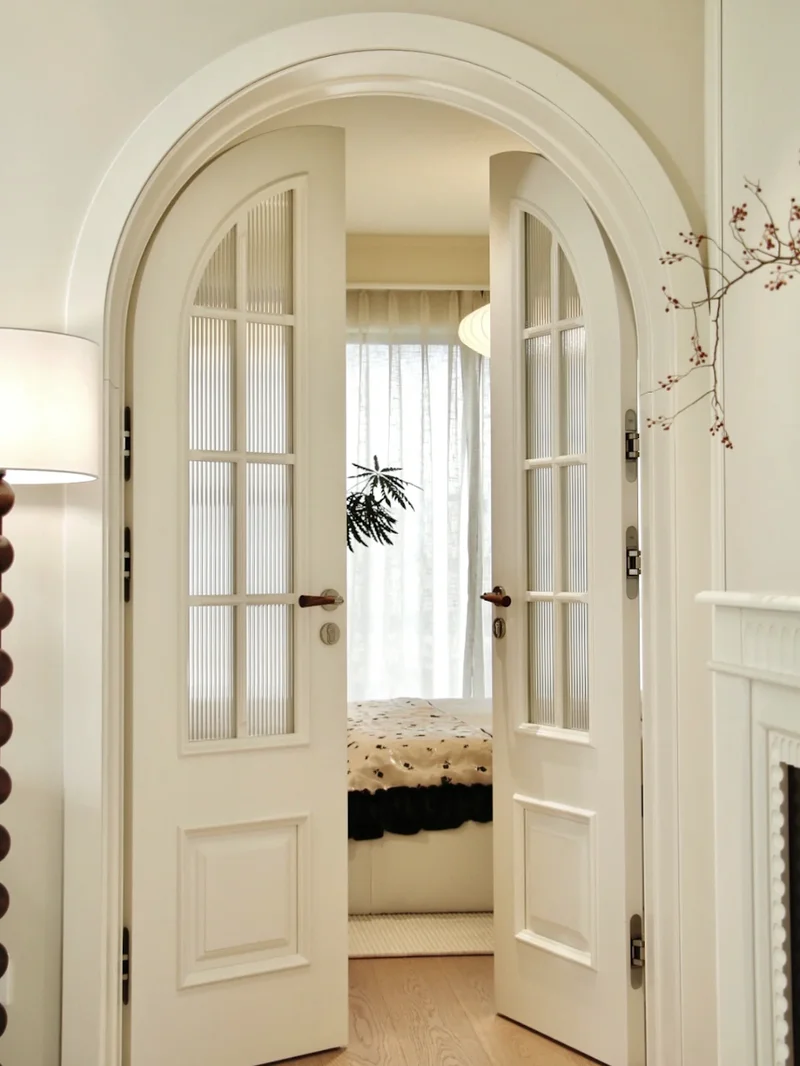
- Wide, unobstructed sightlines with slim, thermally broken aluminum framing systems permit maximum natural light and visual connection to gardens and patios.
- Customizable louver configurations, operable or fixed, engineered for optimal cross-ventilation while maintaining structural rigidity and water deflection.
- Grain replication and finish options include deep-textured wood grains and monolithic matte finishes, certified to E0 (<0.5 mg/L) formaldehyde emission grades, suitable for indoor air quality-sensitive installations.
Performance Parameters for Tropical Climates
Functional advantages are quantified and certified to international standards, providing predictable performance for architects and contractors.
- Moisture & Swelling Resistance: Core and cladding materials are conditioned and tested for dimensional stability. Maximum thickness swelling is ≤1.2% after 72-hour water exposure (EN 317).
- Thermal Insulation: Integrated thermal breaks in framing and insulated glazing units achieve U-factors as low as 1.8 W/(m²·K), reducing thermal bridging and interior condensation.
- Acoustic Performance: Multi-chamber sealing profiles and laminated glass options provide sound reduction ratings up to 38 dB (Rw).
- Fire Safety: Composite materials meet Class B-s1, d0 fire rating per EN 13501-1, with full documentation for regulatory submission.
- Structural & Durability: All systems are manufactured under ISO 9001:2015 quality management, with hardware load ratings certified for frequent use and wind load resistance engineered to local building codes.
Technical Performance Summary
| Parameter | Test Standard | Performance Grade | Relevance to Tropical Climate |
|---|---|---|---|
| Moisture Absorption | ASTM D570 | < 0.8% (by vol.) | Prevents blistering, decay, and mass increase. |
| Thickness Swelling | EN 317 | ≤ 1.2% | Maintains operational clearance and seal integrity in humid seasons. |
| Formaldehyde Emission | EN 16516 | E0 Grade (<0.5 mg/L) | Ensures indoor air quality in tightly sealed, air-conditioned spaces. |
| Thermal Transmittance (U-factor) | EN ISO 10077-1 | 1.8 – 2.4 W/(m²·K) | Improves energy efficiency and prevents interior surface condensation. |
| Sound Reduction (Rw) | EN ISO 10140-2 | Up to 38 dB | Mitigates noise from tropical rain and urban environments. |
| Fire Reaction Class | EN 13501-1 | B-s1, d0 | Meets critical safety standards for residential and commercial projects. |
Advanced Moisture-Barrier Technology: Ensuring Long-Term Durability and Low Maintenance in Humid Climates
The core challenge for architectural-grade garden doors in Southeast Asia is not direct water exposure, but persistent high ambient humidity (frequently >80% RH) and cyclical temperature fluctuations. This environment drives moisture ingress, leading to dimensional instability (warping, swelling), material degradation, and biological growth. Our engineered solution integrates a multi-layered moisture-barrier system at the material, profile, and assembly levels.
Material Science Foundation: Engineered Composite Core
The door’s structural integrity originates from its core material composition, designed for inherent hygroscopic stability.
- High-Density Wood-Plastic Composite (WPC) Cladding & Components: We utilize a proprietary WPC formulation with a wood flour to polymer (PVC/PP) ratio optimized for minimal water absorption (<0.5% by weight after 24-hour immersion per ASTM D570). The high polymer content creates a continuous hydrophobic matrix, while the elevated density (≥1.3 g/cm³) reduces micro-porosity, effectively resisting capillary action.
- Stabilized LVL (Laminated Veneer Lumber) Core for Large Panels: For solid panel constructions, the core is a cross-banded LVL engineered from rotary-peeled veneers. Each layer is bonded with phenolic resins (E0/E1 formaldehyde emission grade per EN 16516), creating a dimensionally stable substrate with minimized cross-grain movement. The core is fully encapsulated within the moisture-barrier system.
- Polymer Alloy Seals & Gaskets: All perimeter seals are co-extruded from EPDM and thermoplastic polymers, selected for permanent elasticity and resistance to ozone and humidity-induced hardening (Shore A hardness 60±5, maintained across -30°C to 80°C).
Integrated Moisture-Barrier System Architecture
Protection is achieved through a synergistic, multi-stage barrier rather than a single coating.
- Substrate Priming & Encapsulation: All lignocellulosic components undergo a vacuum-pressure impregnation process with a water-repellent preservative, sealing the cellular structure. The engineered core is then fully sheathed in a continuous, 0.8mm thick polymer co-extrusion layer.
- Thermally-Bonded Finish Layer: The final exterior cladding or finish is fusion-bonded to the substrate under precise heat and pressure. This creates a monolithic skin without mechanical fasteners that could become water ingress points. The finish material itself is UV-stabilized and includes anti-fungal additives.
- Drainage & Pressure Equalization: The door system incorporates a concealed, graduated drainage pathway within the bottom rail. A dedicated capillary break and ventilated air chamber behind exterior cladding allow for pressure equalization, preventing moisture drive due to static pressure differentials.
Performance Parameters & Technical Standards
The system’s efficacy is validated against international standards, providing predictable performance for architectural specifications.
| Parameter | Test Standard | Performance Data | Implication for Humid Climates |
|---|---|---|---|
| Thickness Swelling (24h immersion) | EN 317 / ASTM D1037 | ≤ 0.8% | Exceptional dimensional stability; prevents binding in frames. |
| Water Absorption (24h immersion) | ASTM D570 | ≤ 0.5% (WPC components) | Minimal weight gain and swelling potential. |
| Linear Expansion (-10°C to 50°C) | Internal QA per ISO 9001 | ≤ 2.0 mm/m | Engineered tolerance for thermal cycling without stress failure. |
| Sound Reduction (Rw) | EN ISO 10140-1 | 28 – 32 dB | Achieved without hygroscopic materials like standard acoustic foams. |
| Thermal Transmittance (U-factor) | EN ISO 10077-1 | 1.8 – 2.2 W/(m²·K) | Stable insulation value, unaffected by moisture in the core. |
| Fire Performance | EN 13501-1 | Class C-s2, d0 / ASTM E84 Class B | Uses non-hygroscopic, flame-retardant mineral fillers. |
Functional Advantages for Long-Term Durability
- Elimination of Biological Contamination: The moisture-barrier system deprives mold, fungi, and termites of the required moisture content within the substrate, meeting the durability requirements of ISO 846.
- Maintenance-Free Exterior: The fused finish layer does not require periodic sealing, staining, or painting. Cleaning involves only mild detergent and water.
- Structural Warranty Integrity: By mitigating the primary failure mode (moisture ingress), the door’s mechanical operation, air/water tightness seals, and finish warranty remain valid for the long term, even in constant high-humidity service.
Technical Specifications: Material Composition, Size Options, and Installation Guidelines for Optimal Performance
Material Composition
Our garden door systems are engineered for structural integrity and long-term performance in high-humidity environments (75-95% RH). The core material is a proprietary, high-density Wood Plastic Composite (WPC) formulated for dimensional stability.
- Core WPC Profile: Density of ≥ 1.25 g/cm³, with a precise wood flour to PVC polymer ratio of 60:40. This optimizes the material’s flexural modulus (> 3500 MPa) while minimizing water absorption to < 0.8% after 24-hour immersion (ASTM D570).
- Structural Reinforcement: Multi-layered LVL (Laminated Veneer Lumber) core within stiles and rails, kiln-dried to ≤ 8% moisture content and treated with anti-fungal agents. Provides superior racking resistance and prevents warping under thermal-hygric stress.
- Surface Laminate: 0.7mm thick, UV-cured acrylic finish with anti-fungal additives. Rated to Class 1 (ASTM E84) for flame spread and smoke density. Shore D hardness > 85 ensures scratch and impact resistance.
- Glazing: Standard is 24mm insulated glass unit (IGU) with Low-E coating (ε ≤ 0.04) and argon fill. Achieves a U-factor of ≤ 1.2 W/m²K. Laminated glass (6.38mm) with PVB interlayer is available for enhanced security and acoustic performance (Sound Transmission Class up to 35 dB).
- Seals & Hardware: Full-perimeter triple-seal gasket system (EPDM) with a hydrophobic lip. All hardware is 304-grade stainless steel with a corrosion-resistant PVD coating, rated for ≥ 100,000 cycles.
Size Options & Configurations
Doors are manufactured to metric standards with tight tolerances (±1.5mm). Custom sizes are available; standard configurations are optimized for structural performance and shipping efficiency.
| Parameter | Sliding Door | Hinged (French) Door | Folding Door |
|---|---|---|---|
| Standard Panel Width | 1200 mm | 900 mm | 1000 mm |
| Standard Panel Height | 2400 mm | 2400 mm | 2400 mm |
| Maximum System Width | 6000 mm (5 panels) | 3600 mm (2 leaves) | 8000 mm (8 panels) |
| Frame Depth | 75 mm | 75 mm | 75 mm |
| Threshold Height | 25 mm (low-profile) | 25 mm (low-profile) | 25 mm (low-profile) |
| Operational Load per Roller | 150 kg | N/A | 120 kg |
Note: All configurations support a maximum design wind load of 2400 Pa (Class 4, AS/NZS 4055).
Installation Guidelines for Optimal Performance
Correct installation is critical to realizing the designed performance, particularly for moisture management and operational longevity.
- Pre-Installation Storage & Handling: Store doors horizontally on a flat, raised platform under cover. Do not remove factory wrapping until immediately before installation. Protect from direct sun and standing water.
- Structural Opening Preparation:
- Opening must be square, level, and plumb with a tolerance of ≤ 3mm over 2400mm height.
- A continuous, waterproof sill tray or damp-proof course is mandatory. Ensure a positive slope (≥ 3°) for exterior drainage.
- Head and jambs must be properly flashed and integrated with the building’s weather-resistive barrier.
- Frame Fixing & Sealing:
- Secure frame using 316-grade stainless steel screws at max. 400mm centers.
- Apply a continuous bead of high-performance silicone sealant (ASTM C920, Class 25) between the frame rear and the structural substrate. Seal the exterior perimeter joint with a paintable, elastic sealant.
- Critical: Interior sealant must be vapor-permeable. Exterior sealant must be a non-porous, waterproof barrier.
- Moisture Management Details:
- Ensure all weep holes at the base of the frame and threshold are clear and unobstructed.
- Insulate the cavity between the door frame and rough opening with a non-expanding, closed-cell foam backer rod followed by low-pressure expanding foam to prevent frame distortion.
- Post-Installation Adjustment & Commissioning:
- Adjust roller mechanisms and hinges to ensure smooth operation and complete compression of perimeter seals.
- Verify water drainage by pouring 500ml of water into the threshold track; it should evacuate fully within 60 seconds.
- Provide the end-user with a maintenance schedule focusing on seal inspection, track cleaning, and hardware lubrication with silicone-based agents.
Trusted by Builders Across Southeast Asia: Case Studies and Certifications for Quality Assurance
Our engineered garden door systems are specified for major commercial and residential projects across the region, from high-rise condominiums in Bangkok to coastal resorts in Vietnam. This trust is built on a foundation of verifiable performance data and third-party certifications that address the core challenges of the Southeast Asian climate.
Material & Performance Certifications
All composite components comply with international standards, providing a predictable performance envelope for architects and builders.
- Material Integrity & Emissions: Core materials are certified to E0 (<0.5 mg/L) and E1 (<1.5 mg/L) formaldehyde emission grades (EN 717-1, JIS A 1460). This ensures indoor air quality and long-term stability.
- Quality Management: Manufacturing processes are certified under ISO 9001:2015, guaranteeing batch-to-batch consistency.
- Fire Safety: Where specified, door core and cladding materials meet Class B-s2, d0 (EN 13501-1) and ASTM E84 Class A ratings for surface-burning characteristics.
- Structural Testing: Full door assemblies undergo cycle testing (simulating 10+ years of use) and load testing per EN 14351-1 for windows and doors.
Documented Performance in Regional Case Studies
Project: Laguna Luxury Villas, Da Nang, Vietnam
- Challenge: Direct salt spray exposure and 85%+ average annual humidity requiring minimal maintenance and no corrosion.
- Solution: Installation of 42 sets of 2400mm x 2200mm bifold door systems with:
- Core: High-density (≥950 kg/m³) WPC frames with a 70:30 polymer-wood fiber ratio for optimal dimensional stability.
- Cladding: 5mm capped, co-extruded PVC with UV stabilizers and a Shore D hardness of 82 for impact resistance.
- Glazing: Double-paned laminated glass with a low-E coating (U-factor: 1.8 W/m²K) and 35 dB sound reduction.
- Verified Outcome: After 36 months, post-installation inspection showed a swelling rate of <0.8% in frame sections, with no blistering, warping, or loss of sealing integrity. Maintenance has been limited to cleaning.
Project: Sky Terrace Residences, Kuala Lumpur, Malaysia
- Challenge: Managing intense solar heat gain and frequent, heavy rainfall while maintaining seamless indoor-outdoor flow.
- Solution: Specification of large-format sliding door systems (3000mm x 2400mm) featuring:
- Core: LVL (Laminated Veneer Lumber) core with cross-banded veneers, certified to EN 14374, for superior torsional rigidity and a moisture content stabilized at 8-10%.
- Profile: Thermally broken aluminum alloy 6063-T5 with a 35-micron powder coating (Qualicoat Class 2).
- Performance Data: The complete assembly achieved a certified thermal transmittance (Uw) of 2.1 W/m²K and a water tightness rating of 9A (EN 12208).
- Verified Outcome: The development reported a 15% reduction in projected cooling load for perimeter zones and zero water ingress incidents during monsoon-season storms.
Technical Specification Summary for Critical Parameters
The following table summarizes key tested parameters for primary door system components:
| Component | Parameter | Test Standard | Performance Range | Implication for SE Asia |
|---|---|---|---|---|
| WPC Frame | Density | EN 323 | 950 – 1100 kg/m³ | High resistance to mechanical stress and screw holding power. |
| Water Absorption (24h) | EN 317 | < 0.9% | Exceptional resistance to swelling and fungal decay in humid environments. | |
| PVC Cladding | Linear Thermal Expansion | ASTM D696 | 4.5 x 10⁻⁵ /°C | Minimal gap variation with temperature fluctuations up to 50°C. |
| Impact Resistance (Izod) | ASTM D256 | 3.2 J/cm (Notched) | Withstands hail and incidental impact during construction/use. | |
| Full Assembly | Air Permeability | EN 12207 | Class 4 | Superior draft exclusion, enhancing energy efficiency. |
| Wind Load Resistance | EN 12211 | Class C5 (2400 Pa) | Certified for high-wrainst and typhoon-prone coastal applications. |
This empirical data, backed by international certifications, de-risks specification and ensures that our garden door systems deliver declared performance throughout their service life in Southeast Asia’s demanding climate.
Frequently Asked Questions
How do your garden doors prevent warping in Southeast Asia’s 80%+ humidity?
Our doors use WPC profiles with ≤0.5% moisture absorption and engineered LVL cores. This multi-layer construction, combined with a stable expansion coefficient (<0.3%), ensures dimensional integrity. All components are pre-conditioned in humidity chambers to simulate tropical climates before assembly.
What formaldehyde emission standards do your composite materials meet?
We strictly adhere to the E0 standard (≤0.5 mg/L) and EN 717-1, ensuring indoor air safety. Our WPC formulations use calcium-zinc stabilizers instead of heavy metals, and all panels are certified by SGS or equivalent bodies, providing documentation for customs and project approvals in markets like Singapore and Malaysia.
What is the thermal insulation performance of your door systems?
Our doors achieve a U-value of ≤1.2 W/(m²·K) through integrated thermal breaks and polyurethane foam cores. The WPC cladding (density ≥750 kg/m³) and multi-chamber profiles significantly reduce heat transfer, enhancing energy efficiency in both residential and commercial tropical buildings.
How do you ensure impact resistance and durability in high-traffic areas?
We reinforce door cores with vertical LVL beams and use impact-modified PVC coatings (≥0.8mm thickness). The surface hardness exceeds HB on the pencil hardness scale. This construction withstands mechanical stress and resists dents, crucial for hotel or frequent-use residential applications.
What specific UV protection prevents color fading in intense sunlight?
We apply a co-extruded ASA/PMMA cap layer (≥0.5mm) with UV-absorbing additives. This is followed by a nano-ceramic finishing process, ensuring a Delta E color difference of <3 after 3000 hours of QUV accelerated weathering testing, maintaining aesthetic appeal long-term.
How is sound insulation addressed for urban environments in the region?
Our acoustic doors incorporate laminated glass (6mm+6mm) with PVB interlayers and perimeter magnetic seals. This system achieves a sound reduction index (Rw) of ≥32 dB, effectively mitigating urban noise—a key requirement for high-end residential projects in dense cities like Bangkok or Manila.
What anti-corrosion measures are used for hardware in coastal areas?
All metal hardware—hinges, locks, and tracks—undergo a multi-step process: zinc plating followed by a polyester powder coating. This provides a minimum of 500 hours of salt spray resistance (ASTM B117), preventing rust in salty, humid coastal atmospheres common in Southeast Asia.