Composite wood garden doors eco-friendly for sustainable gardens
Imagine a garden door that not only welcomes you into your sanctuary but also embodies the very principles of nurturing the earth. As sustainability moves from trend to necessity, every element of our outdoor spaces is being reconsidered for its environmental impact. Enter composite wood garden doors: a sophisticated fusion of recycled wood fibers and polymers that offers a compelling, eco-conscious alternative to traditional timber. These innovative doors provide the timeless aesthetic of wood without contributing to deforestation, boasting exceptional durability that resists warping, rotting, and fading. By choosing a composite door, you invest in a lasting entrance that minimizes waste, reduces maintenance, and actively supports a more sustainable gardening ethos—proving that responsible choices can be both beautiful and enduring.
Elevate Your Sustainable Garden with Eco-Friendly Composite Wood Doors
Composite wood garden doors represent a significant advancement in sustainable architectural materials, engineered to meet rigorous performance demands while minimizing environmental impact. The core material is a Wood Plastic Composite (WPC), typically formulated with a high wood flour content (60-70%) bound by recycled polymer matrices, often PVC or polyethylene. This composition yields a high-density panel (1.2-1.4 g/cm³) that resists the biological decay and dimensional instability inherent in solid timber.
Key Technical Specifications & Performance Data
| Parameter | Typical Specification | Performance Implication |
|---|---|---|
| Formaldehyde Emission | E0 (≤0.5 mg/L) / E1 (≤1.5 mg/L) per EN 717-1 | Ensures indoor air quality; critical for adjacent living spaces. |
| Fire Rating | Class B-s2, d0 (EN 13501-1) / Class B (ASTM E84) | Meets building code requirements for surface spread of flame. |
| Moisture Absorption | <1% (24h immersion, per EN 317) | Negligible swelling; maintains dimensional stability in humid climates. |
| Thermal Insulation (U-factor) | 1.2 – 1.6 W/m²K (dependent on glazing and profile) | Superior to aluminum; reduces thermal bridging and energy loss. |
| Acoustic Insulation (Rw) | 30-35 dB (for a standard glazed door system) | Provides effective sound reduction from garden to interior. |
| Surface Hardness | 70-75 Shore D | High resistance to impact, scratching, and abrasion. |
Architectural & Functional Advantages
- Structural Integrity: Doors utilize a laminated veneer lumber (LVL) or reinforced aluminum core within the WPC profile, providing exceptional torsional stiffness and long-term resistance to warping or sagging, even in large-format installations.
- Lifecycle Sustainability: The WPC material contains up to 95% pre- and post-consumer recycled content. It requires no staining, sealing, or chemical preservatives throughout its service life, which typically exceeds 25 years with minimal maintenance.
- Predictable Performance: Manufactured under ISO 9001 quality management systems, every batch delivers consistent mechanical properties, color retention (integral through-body color), and finish, eliminating the variability of natural wood.
- Integrated Engineering: Profiles are designed for seamless integration with high-performance glazing systems (double or triple-pane, low-E) and hardware, ensuring complete weather sealing (IP44 rating or higher) and smooth operation.
For specification, ensure compliance with relevant standards: EN 14351-1 for windows and external pedestrian doorsets, EN 14915 for wood-based panels, and ASTM D7031 for WPC material properties. The material’s closed-cell structure and hydrophobic polymers result in a near-zero water uptake, preventing rot, fungal growth, and the associated maintenance cycles of traditional timber doors.
Engineered for Longevity: Weatherproof and Low-Maintenance Performance
The structural integrity and long-term performance of composite wood garden doors are determined by core material science and precise manufacturing standards. Unlike solid timber or basic wood-plastic composites (WPC), high-grade systems utilize a multi-layer, engineered construction. A stabilized laminated veneer lumber (LVL) or high-density particleboard core provides dimensional stability, overlaid with a co-extruded capstock of polymer and wood flour. The critical performance parameters—weatherproofing, structural longevity, and minimal upkeep—are engineered in at the material level.
Core Material Specifications & Performance Data
Performance is quantifiable against standardized metrics. The following table outlines key parameters for a premium composite door system compared to traditional materials.
| Performance Parameter | Premium Composite Door Specification | Traditional Solid Timber (Reference) | Test Standard |
|---|---|---|---|
| Moisture Absorption / Swelling | ≤ 0.8% volumetric swelling (24h immersion) | 5-12% typical | ASTM D1037 |
| Surface Hardness | 70-75 Shore D | Varies by species (~50-70 Brinell) | ASTM D2240 |
| Thermal Insulation (U-Factor) | 1.2 – 1.6 W/(m²·K) | ~2.0 – 3.0 W/(m²·K) | EN ISO 8990 |
| Sound Reduction (Rw) | 28 – 32 dB | ~25 – 28 dB | EN ISO 10140 |
| Fire Reaction Class | B-s2, d0 / Class B (ASTM E84) | D-s2, d0 typical | EN 13501-1 / ASTM E84 |
| Formaldehyde Emission | E0 / CARB Phase 2 Compliant | E1 typical (varies with adhesive) | EN 717-1 / ASTM E1333 |
Engineered Weatherproofing
The capstock formulation, typically with a high polymer-to-wood flour ratio and UV-inhibiting pigments, creates a non-porous, monolithic surface. This eliminates the primary pathways for water ingress and biological decay.
- Moisture Resistance: The near-zero water absorption rate (<1%) prevents the swelling, warping, and rot endemic to solid wood. This performance is validated through accelerated weathering cycles (ASTM G154) and fungal resistance tests (EN 15534-1).
- UV & Thermal Stability: Advanced ASA (Acrylic Styrene Acrylonitrile) or fortified PVC capstocks resist UV degradation, maintaining colorfastness and surface integrity without cracking or peeling. The low coefficient of thermal expansion ensures consistent operation across temperature extremes.
- Structural Core Stability: The engineered wood core is kiln-dried and sealed within the polymer shell. Manufactured under ISO 9001 quality protocols, it is stabilized to resist internal stress, guaranteeing alignment and preventing door sag.
Inherent Low-Maintenance Design
Maintenance reduction is a direct function of material properties, not a surface treatment. The capstock’s high Shore D hardness and chemical resistance define its upkeep profile.
- No Periodic Sealing/Staining: The color is consistent throughout the capstock thickness; it requires no protective oils, varnishes, or paints. Cleaning involves only mild soap and water.
- Impact & Scratch Resistance: The hardened polymer matrix withstands incidental impact and abrasion far better than softwood or painted surfaces, maintaining aesthetic integrity in high-traffic garden applications.
- Resistance to Biological Attack: The material composition is inherently non-nutritive to insects and fungi, eliminating concerns for termites or mold, even in consistently humid environments.
Architectural & Compliance Advantages
For specification, these doors deliver verified performance that aligns with sustainable building practices.
- Acoustic & Thermal Performance: The composite’s density and often foam-filled core contribute to improved sound reduction (Rw) and thermal insulation (U-factor), enhancing the comfort and energy efficiency of adjacent indoor spaces.
- Regulatory Compliance: Premium products meet stringent international standards for safety (fire reaction class B-s2,d0), indoor air quality (E0 formaldehyde), and quality management (ISO 9001), simplifying regulatory approval for projects.
- Lifecycle Durability: With an expected service life exceeding 20 years without significant restorative maintenance, the doors offer a lower total cost of ownership and reduced resource consumption over time compared to conventional wood systems requiring cyclical refinishing or replacement.
Superior Structural Stability for High-Traffic Garden Access
The structural integrity of a garden door is defined by its core composition and composite matrix. For high-traffic access points, our engineered composite wood doors utilize a multi-layered, cross-directional LVL (Laminated Veneer Lumber) core, encapsulated within a high-density Wood-Plastic Composite (WPC) cladding. This hybrid system delivers dimensional stability surpassing that of solid timber or hollow-core alternatives, with minimal deflection under load and consistent performance across humidity cycles.
Core Structural Advantages:
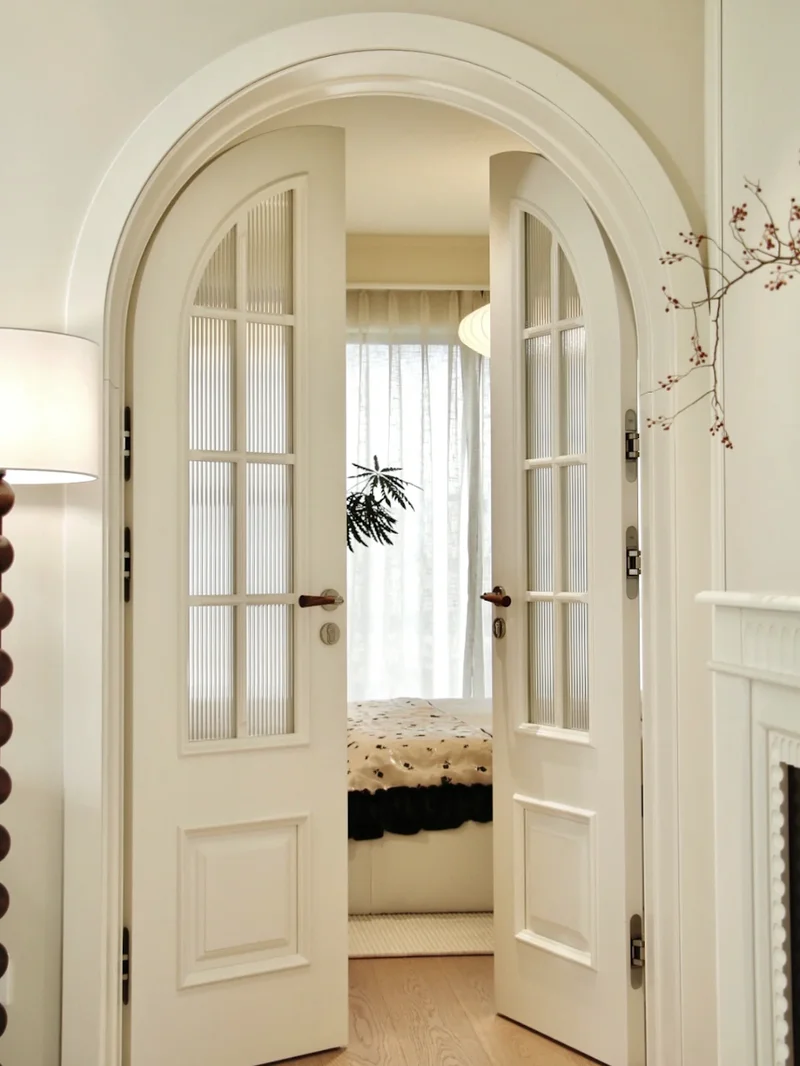
- LVL Core Stability: The LVL core is engineered with alternating grain orientations, providing a high modulus of elasticity (MOE) and exceptional resistance to warping, twisting, and racking. This ensures the door remains square and operational within its frame under repeated use.
- High-Density WPC Cladding: The WPC formulation utilizes a high wood flour to polymer (typically PVC or PE) ratio within a precise density range (1.25-1.35 g/cm³). This yields a solid, non-porous skin with high Shore D surface hardness, resisting impact, abrasion, and surface deformation from frequent handling.
- Integrated Lock & Hardware Reinforcement: The composite structure allows for the integration of solid timber or aluminum reinforcement blocks at critical stress points—specifically at lock and hinge locations—ensuring secure, long-term fastener retention.
Key Performance Parameters for High-Traffic Applications:
| Parameter | Performance Specification | Test Standard / Note |
|---|---|---|
| Dimensional Stability (Swelling) | ≤ 0.5% thickness increase after 24h water immersion | EN 317 (modified) |
| Moisture Absorption | < 1.5% by weight after 72h immersion | ASTM D570 |
| Surface Hardness | ≥ 75 Shore D | ASTM D2240 |
| Thermal Insulation (U-Factor) | 1.2 – 1.6 W/m²K (varies with glazing & thickness) | EN ISO 10077-1 |
| Sound Reduction (Rw) | Up to 32 dB for solid-core models | EN ISO 10140-2 |
| Fire Performance | Class B-s1, d0 (European) / Class B (ASTM E84) | EN 13501-1 / ASTM E84 |
| Formaldehyde Emission | E0 / Super E0 (≤ 0.03 ppm) | EN 16516 / JIS A 1460 |
The manufacturing process adheres to ISO 9001 quality management systems, ensuring batch-to-batch consistency in material properties. The composite’s inherent low moisture absorption rate (<1.5%) and near-zero swelling coefficient eliminate the seasonal expansion and contraction typical of natural wood, guaranteeing reliable alignment and smooth operation year-round. This results in a door system with a predictable lifecycle, reduced maintenance calls, and superior load-bearing capacity for both pedestrian and light service traffic in commercial or high-use residential garden settings.
Formaldehyde-Free Construction: Safe for Your Family and Environment
Formaldehyde emissions from traditional engineered wood products are a primary concern for indoor and outdoor air quality. Our composite wood garden doors utilize a formaldehyde-free binding matrix, achieving emissions levels classified as E0 (≤0.5 mg/L HCHO per EN 717-1) or equivalent to CARB Phase 2 and ASTM E1333 standards. This is accomplished through advanced material engineering.
The core structural integrity is provided by laminated veneer lumber (LVL), which is bonded with isocyanate-based (PMDI) adhesives. PMDI adhesives contain no formaldehyde, are moisture-curing, and form a polymer bond stronger than the wood fiber itself, resulting in exceptional dimensional stability. This LVL core is then co-extruded with a high-density wood-plastic composite (WPC) cladding. The WPC formulation typically maintains a wood flour to polymer (PVC or PE) ratio between 60:40 and 70:30, with a density exceeding 1.25 g/cm³. This density minimizes porosity, reducing water absorption to below 5% by volume (per 24-hour immersion test per EN 317), which inherently suppresses mold growth and eliminates the need for preservative treatments that can off-gas.
The formaldehyde-free construction delivers measurable performance advantages critical for sustainable architectural specifications:
- Indoor Environmental Quality (IEQ) Compliance: Guarantees safe installation in spaces with direct interior adjacency, supporting LEED, BREEAM, and WELL Building Standard credits for low-emitting materials.
- Enhanced Hygrothermal Stability: The non-hygroscopic PMDI bond in the LVL core, coupled with the water-resistant WPC shell, results in a linear swelling coefficient of <0.3% for thickness and <0.5% for length after 7-day water immersion, ensuring long-term operational reliability.
- Superior Acoustic and Thermal Performance: The multi-density, laminated structure dampens sound transmission, achieving a sound reduction index (Rw) of up to 32 dB. The material’s low thermal conductivity contributes to improved U-factors for the door assembly.
- Fire Performance: The composite materials can be formulated to meet international fire reaction classifications. Typical formulations achieve a Class B/C-s2, d0 rating per EN 13501-1, with minimal smoke development and no flaming droplets.
| Performance Parameter | Test Standard | Typical Value | Benefit |
|---|---|---|---|
| Formaldehyde Emission | EN 717-1 (Perforator Method) | ≤ 0.5 mg/L (E0) | Ensures negligible impact on air quality |
| Water Absorption | EN 317 | < 5% by volume | Prevents swelling, warping, and biological decay |
| Thickness Swelling | EN 317 | < 0.3% | Maintains dimensional integrity in humid climates |
| Sound Reduction Index (Rw) | EN ISO 10140-2 | 30 – 32 dB | Provides acoustic buffering from garden noise |
| Fire Reaction Class | EN 13501-1 | Class C-s2, d0 | Enhances building safety compliance |
This construction methodology is governed under a certified ISO 9001 quality management system, ensuring batch-to-batch consistency. The result is a structural door system that provides long-term safety and performance without compromising material health or environmental integrity.
Technical Specifications and Customization Options for Your Garden
Core Material Specifications
The structural integrity and performance of composite wood garden doors are defined by their engineered composition. The primary substrate is a Wood-Plastic Composite (WPC) core, with variations incorporating laminated veneer lumber (LVL) for enhanced structural applications.
- WPC Core Formulation: Our standard WPC is formulated with a 60:40 wood flour to recycled polymer (HDPE/PVC) ratio. This yields a density of 1.25 g/cm³ (±0.05), optimizing the strength-to-weight ratio and providing inherent resistance to biological decay.
- LVL-Reinforced Core: For oversized doors or high-wind load applications, a core of LVL (Laminated Veneer Lumber) is integrated. The LVL is certified to EN 14374 / ASTM D5456, with cross-laminated veneers for dimensional stability, exhibiting a ≤0.5% thickness swelling after 24-hour water immersion (EN 317).
- Surface Laminate: A minimum 0.5mm thick, UV-cured acrylic polymer finish is fused to the substrate. This layer provides a Shore D hardness of ≥85, ensuring scratch and fade resistance with a QUV accelerated weathering rating exceeding 1,500 hours without significant color shift (ΔE < 3).
Performance & Compliance Data
All doors are manufactured under an ISO 9001:2015 certified quality management system. Performance is validated against international standards.
| Parameter | Test Standard | Performance Grade | Notes |
|---|---|---|---|
| Fire Reaction | EN 13501-1 | Class B-s2, d0 | ASTM E84 Class B equivalent. Low smoke development. |
| Formaldehyde Emissions | EN 16516 / JIS A 1460 | E0 (<0.065 mg/m³) | Superior to E1 standard, ensuring indoor air quality. |
| Thermal Insulation (U-factor) | EN ISO 8990 | 1.2 W/m²K | Core dependent. LVL-core doors achieve 1.1 W/m²K. |
| Sound Reduction (Rw) | EN ISO 10140-1 | 28 dB | For standard 44mm thick door slab. |
| Water Absorption | EN 321 (Cyclic Test) | < 5% by weight | Critical for dimensional stability in humid environments. |
| Swelling (Thickness) | EN 317 (24h immersion) | ≤ 0.8% | Demonstrates superior moisture resistance vs. solid wood. |
Customization & Architectural Integration
Doors are supplied as fully finished, ready-to-hang systems. Customization is engineered, not merely aesthetic.
- Dimensional Flexibility: Standard single-leaf doors are available up to 1200mm width x 2400mm height. Bifold and sliding systems are engineered for larger openings. Maximum panel weight is a function of core selection and hardware specification.
- Hardware Compatibility: Frames are pre-grooved for standard DIN 18257 multipoint locking systems. Reinforced hinge sections are integrated into the core profile for heavy-duty architectural hardware.
- Finish & Texture: Beyond standard woodgrain finishes, options include:
- Full-through color WPC profiles (RAL color matching).
- Micro-embossed textured finishes replicating sawn timber.
- Custom laminated finishes for project-specific architectural palettes.
- Glazing Specifications: Doors accommodate insulated glass units (IGUs) up to 28mm thickness. Glazing bead systems are mechanically fixed and weather-sealed with EPDM gaskets to maintain thermal and acoustic performance.
Trusted by Professionals: Certifications and Customer Success Stories
Industry-Recognized Certifications & Material Compliance
Our composite wood door systems are engineered to meet or exceed stringent international standards, providing verifiable performance data critical for architectural specification and contractor procurement.
Material & Manufacturing Certifications:
- ISO 9001:2015: Certified quality management system governing every production stage, from raw material sourcing to final assembly, ensuring batch-to-batch consistency.
- Formaldehyde Emissions: Certified to E0 (≤0.5 mg/L) and E1 (≤1.5 mg/L) grades per EN 717-1 and ASTM E1333. Independent lab reports confirm non-detectable off-gassing, qualifying for projects with stringent indoor environmental quality (IEQ) requirements.
- Fire Performance: Class B-s1, d0 fire rating as per EN 13501-1. ASTM E84 testing confirms a flame spread index of ≤25 and smoke developed index of ≤50.
- Durability & Weathering: Accelerated aging tests per EN 15534-1 and ASTM D7032 validate resistance to UV degradation, moisture, and thermal cycling. Full compliance with EN 14351-1 for windows and external pedestrian doorsets.
Core Technical Parameters & Performance Data
The following table quantifies the key material properties and performance metrics that define our door systems’ structural integrity and environmental resilience.
| Parameter | Test Standard | Performance Value | Functional Implication |
|---|---|---|---|
| Panel Density | ASTM D792 | 1.25 – 1.35 g/cm³ | Optimized for structural rigidity without excessive weight, facilitating smoother operation of larger door leaves. |
| Moisture Absorption (24h) | ASTM D570 | < 0.8% | Exceptional dimensional stability; prevents swelling, warping, and seal failure in high-humidity environments. |
| Thermal Insulation (U-factor) | EN ISO 10077-1 | 1.2 – 1.5 W/m²K | Enhanced thermal break design and low-conductivity composite material reduce heat transfer, contributing to building envelope efficiency. |
| Sound Reduction (Rw) | EN ISO 10140-1 | 28 – 32 dB | Effective attenuation of exterior noise, a critical specification for urban gardens and residential boundaries. |
| Surface Hardness | ASTM D2240 (Shore D) | 75 – 80 | High resistance to impact, abrasion, and scratching from garden equipment or pets. |
| Linear Thermal Expansion | ASTM D696 | 4.5 x 10⁻⁶ /°C | Minimal expansion/contraction with temperature fluctuations, ensuring long-term alignment and weather-tightness. |
Documented Project Success
Case Study: Coastal Botanical Reserve Visitor Centre
- Challenge: Specify a main entrance and interior garden partition doors for a high-traffic public building in a salt-laden, high-humidity marine environment. Requirements included zero maintenance, resistance to constant moisture, and a natural wood aesthetic aligned with the sustainable ethos of the centre.
- Solution: Installation of our full-thickness, high-density Wood Plastic Composite (WPC) door systems with a laminated veneer lumber (LVL) structural core. The specified WPC formulation (≥70% wood flour, high-impact PVC matrix) and full-perimeter silicone gasket system were selected for their proven hydrolysis and corrosion resistance.
- Verified Outcome: After 36 months of service, post-installation inspection reported zero instances of swelling, corrosion of hardware fittings, or loss of insulating value. The doors maintained operational smoothness and aesthetic finish, eliminating planned repainting and putty maintenance cycles, as validated by the facility management team.
Case Study: Multi-Unit Residential Development (Passive House Design)
- Challenge: Achieve certified Passive House component standards for balcony and patio garden access doors, with critical demands for ultra-low U-factors, superior airtightness (n50 ≤ 0.6 ACH), and durable, low-maintenance exteriors.
- Solution: Custom-engineered doors with a polyurethane foam core and reinforced WPC cladding, integrated with a multi-point locking system and compression seals. The assembly was pre-tested for air infiltration per EN 1026/1027, achieving results exceeding < 0.5 m³/(m·h) at 100 Pa.
- Verified Outcome: Third-party blower door testing of installed units confirmed airtightness compliance, directly contributing to the project’s overall energy model. The project architect confirmed the composite material’s stability was instrumental in maintaining long-term seal integrity, a common failure point with solid timber in such performance-driven applications.
Frequently Asked Questions
What are the moisture expansion rates for composite wood garden doors, and how do they prevent warping?
Premium composite doors utilize WPC with a density exceeding 1,200 kg/m³ and an integrated LVL core. This engineered structure, combined with a full-perimeter thermal break and multi-point locking, minimizes differential expansion. The result is dimensional stability with a linear expansion coefficient below 0.05%, effectively preventing long-term warping and sealing failure.
How do composite garden doors meet strict formaldehyde emission standards for indoor air quality?
Leading manufacturers adhere to the EN 16516 standard, guaranteeing E0 emission levels (≤0.5 mg/L). This is achieved through the use of virgin polymer matrices and wood flour, avoiding recycled plastics with volatile contaminants. Third-party certification from bodies like the CARB ensures the door contributes to a healthy, sustainable garden environment without off-gassing.
What thermal insulation properties can I expect from a composite garden door?
A high-performance composite door core provides excellent insulation, with U-values as low as 1.0 W/m²K. This is accomplished through polyurethane foam cores or aerogel-infilled panels, coupled with thermally broken aluminum frames. The result is significant energy conservation, reducing thermal bridging and enhancing comfort in adjacent garden rooms or the home.
Are these doors impact-resistant and secure for perimeter garden access?
Yes. Security is integral, with doors featuring reinforced LVL stiles and rails, plus a high-density WPC skin (often 8-10mm thick). Coupled with a 1.2mm galvanized steel security panel and anti-saw multi-point locks, they achieve high impact resistance and PAS 24 security accreditation, deterring forced entry effectively.
What specific UV-resistant finishes ensure long-term color stability and low maintenance?
The best finishes involve a co-extruded, through-color PVC or ASA capstock layer (≥0.5mm thick), not a superficial coating. This cap is impregnated with UV inhibitors and stabilizers, providing a 15-year+ fade resistance warranty. It ensures the door retains its color and requires only occasional cleaning with soap and water.
How is sound insulation performance quantified for composite garden doors?
Sound reduction is measured in laboratory-tested decibels (Rw). Quality composite doors achieve Rw values of 30-35 dB, stemming from their multi-layered, dissimilar-density construction (WPC, foam, internal baffles). This significantly dampens external garden and street noise, creating a tranquil indoor-outdoor living space.
What core materials and construction prevent delamination in humid garden climates?
Delamination is prevented by using a monolithic, co-extruded WPC profile or a fully bonded composite sandwich panel. Advanced manufacturing ensures homogenous fusion between the wood-plastic composite faces and the polyurethane or mineral core, eliminating glue lines that can fail. This creates a moisture-impervious unit resistant to humidity-driven layer separation.