Garden doors for restaurant outdoor dining areas
As the culinary world continues to embrace the allure of al fresco dining, the threshold between a restaurant’s interior and its outdoor oasis becomes a critical design element. Garden doors are no longer merely functional exits; they are transformative architectural features that redefine the dining experience. By seamlessly merging indoor ambiance with the fresh, vibrant energy of a patio or garden, these installations invite the outside in, creating a fluid, expansive environment that delights guests. The right choice—be it elegant French doors, expansive sliding systems, or innovative folding designs—can enhance natural light, improve traffic flow, and elevate the overall aesthetic. For restaurateurs, investing in high-quality garden doors is a strategic decision that extends seating capacity, boosts ambiance, and ultimately, cultivates a memorable setting where every meal feels like a special occasion.
Seamlessly Extend Your Dining Space: The Aesthetic and Functional Appeal of Our Garden Doors
Our engineered garden door systems are designed to dissolve the barrier between interior and exterior dining environments. This is achieved through a synthesis of advanced material composites and precision engineering, creating a partition that is both a visual continuum and a high-performance building envelope.
The core aesthetic principle is frameless minimalism. We utilize structurally glazed units with minimal sightlines, supported by engineered profiles. The door leaf construction is critical for achieving this slim profile without sacrificing performance. Our standard utilizes a laminated veneer lumber (LVL) core, chosen for its dimensional stability (<0.5% linear expansion at 65% RH) and resistance to warping under thermal stress. This core is encapsulated with our proprietary composite cladding.
Material Composition & Performance:
The external cladding is a high-density Wood Plastic Composite (WPC), engineered to a density of 1.25 g/cm³. This specific density optimizes the balance between Shore D hardness (78) for impact resistance and machinability for clean, sharp profiles. The formulation maintains a 60:40 wood flour to polymer (PVC) ratio, ensuring a low water absorption rate of <0.8% by volume after 24-hour immersion, which is paramount for long-term dimensional integrity in outdoor dining settings.
For interior-facing surfaces, options include veneers from thermally modified ash or oak, stabilized to a moisture content of 6±1%, or a continuous, low-maintenance laminate finish. All components are certified to E0 formaldehyde emission standards (EN 16516), ensuring indoor air quality.
Functional Advantages for Restaurant Operations:
- Acoustic Control: The multi-chamber profile design, combined with dual-seal gaskets (EPDM) and 10-12mm insulated glass units, achieves a sound reduction index (Rw) of up to 38 dB. This effectively mitigates street noise, creating a tranquil dining atmosphere.
- Thermal & Environmental Barrier: The complete assembly delivers a thermal transmittance (U-factor) as low as 1.1 W/(m²·K). This maintains consistent interior climate control, reducing HVAC load on perimeter spaces.
- Operational Durability: Hardware is integrated into reinforced profile sections. Hinges are rated for a minimum of 100,000 cycles (EN 1935 Grade 8), and multi-point locking systems ensure consistent compression of seals for weathertightness and security.
- Fire Safety Compliance: Non-combustible glass and specifically formulated composite materials allow systems to achieve up to 30-minute integrity ratings (EI30) where required by code, without compromising design.
- Hygienic & Low Maintenance: The cladding surface has a closed-cell structure, preventing microbial growth and allowing for easy cleaning with standard commercial disinfectants. Its color is fadeproof, with a Delta E value of <2 after 1,000 hours of QUV testing.
Technical Performance Data Summary:
| Parameter | Test Standard | Performance Value | Benefit |
|---|---|---|---|
| Thermal Transmittance (U-factor) | EN ISO 10077-1 | 1.1 – 1.4 W/(m²·K) | Reduced energy transfer, enhanced comfort |
| Sound Reduction (Rw) | EN ISO 10140-2 | 35 – 38 dB | Significant noise attenuation from traffic/street |
| Air Permeability | EN 12207 | Class 4 | Superior draft exclusion, even in windy conditions |
| Water Tightness | EN 12208 | Class 9A (1,500 Pa) | Resistance to driven rain, reliable in all weather |
| Operating Cycle Life | EN 1935 | ≥100,000 cycles (Grade 8) | Long-term reliability under high-frequency use |
| Swelling Rate (Thickness) | EN 317 (modified) | ≤0.8% after 28-day water immersion | Exceptional dimensional stability in humid conditions |
All manufacturing processes are governed under an ISO 9001:2015 certified quality management system, with full traceability of material batches. This ensures that every door system provides a reliable, code-compliant, and aesthetically refined solution for extending restaurant dining floors seamlessly to the outdoors.
Engineered for High-Traffic Durability: The Structural Integrity of Our Restaurant-Grade Garden Doors
The structural integrity of our restaurant-grade garden doors is derived from a composite material system engineered to withstand the mechanical, environmental, and operational stresses unique to high-traffic commercial hospitality environments. The core principle is the strategic layering and bonding of materials, each selected for a specific performance characteristic, to create a door that resists deflection, warping, and fatigue over thousands of cycles.
Material Composition & Core Technology
- High-Density Wood-Plastic Composite (WPC) Cladding: The exterior surfaces utilize a proprietary WPC formulation with a wood fiber to polymer (PVC) ratio optimized for dimensional stability. A density exceeding 1,200 kg/m³ provides inherent resistance to impact denting (Shore D hardness >75) and surface abrasion from constant customer and staff contact.
- Laminated Veneer Lumber (LVL) Structural Core: The door leaf is built around an engineered LVL core. Unlike solid timber, LVL’s cross-laminated construction neutralizes internal wood stresses, providing exceptional torsional rigidity and preventing warping due to humidity fluctuations or thermal gradients. This ensures consistent alignment with the frame and reliable sealing.
- Thermal-Break Aluminum Frame System: The perimeter frame is constructed from extruded aluminum profiles with a polyamide thermal break. The alloy is specified to a minimum 6063-T5 temper, providing a yield strength sufficient to support large-format glazing without sag, while the thermal break eliminates condensation and improves energy efficiency.
Performance Specifications & Testing
All components are manufactured under an ISO 9001-certified quality management system. Performance is validated against international standards, providing predictable, specification-grade results.
| Parameter | Test Standard | Performance Grade | Commercial Implication |
|---|---|---|---|
| Fire Reaction | EN 13501-1 | Class B-s1, d0 | Low flammability, minimal smoke production. |
| Formaldehyde Emissions | EN 16516 | E0 (<0.065 mg/m³) | Indoor air quality compliance for occupied spaces. |
| Moisture Absorption | ASTM D570 (24h immersion) | <0.8% | Negligible swelling; maintains operation in humid/damp conditions. |
| Thermal Insulation (U-factor) | EN 10077 / NFRC 100 | Uw ≤ 1.4 W/(m²·K) | Reduced HVAC load and thermal comfort at perimeter dining areas. |
| Acoustic Insulation (Rw) | EN ISO 10140-1 | Up to 38 dB | Effective sound reduction between interior and exterior dining zones. |
| Cyclic Durability | EN 1191 / ANSI/BHMA A156.13 | Grade 4 (100,000 cycles) | Verified performance for extreme daily use. |
Functional Advantages for High-Traffic Operations
- Zero-Maintenance Exteriors: The capped WPC cladding and aluminum are UV-stabilized and require no painting, sealing, or seasonal refinishing. Cleaning involves only standard commercial detergents.
- Enhanced Security & Safety: Multi-point locking systems engage with the reinforced frame at multiple positions. Glazing options include tempered or laminated safety glass to meet CPSC/EN 12600 impact standards.
- Operational Smoothness: Heavy-duty, stainless steel ball-bearing hinges and precision roller systems are rated for the door’s mass, ensuring effortless operation for staff and patrons even after years of use. Adjustable sweep seals and compression gaskets maintain their profile, ensuring consistent weather sealing and acoustic performance.
Weatherproof Performance: How Our Doors Withstand Outdoor Elements for Year-Round Use
The structural integrity and long-term performance of a garden door in a commercial dining environment are dictated by its core material composition and protective cladding. Our engineered door systems are designed to resist dimensional change, biological decay, and thermal transfer under continuous outdoor exposure.
Core Stability: Engineered LVL (Laminated Veneer Lumber)
The door core utilizes LVL, not solid timber. This industrial material is manufactured by bonding rotary-peeled wood veneers under heat and pressure with phenolic resins. The process aligns the wood grain, eliminating the inherent warping and checking tendencies of solid wood. The result is a substrate with exceptional dimensional stability and uniform strength, providing a consistent anchor for hardware and finishes.
Cladding Performance: High-Density WPC (Wood Plastic Composite)
The exterior cladding is a co-extruded WPC profile. Its performance is defined by its formulation and density.
- Material Ratio: A precise balance of wood flour (for structural rigidity and natural aesthetics) and polymer matrix (for moisture resistance and flexibility).
- Density: A minimum density of 1.3 g/cm³ ensures high impact resistance and a low coefficient of thermal expansion.
- Surface Hardness: The cap layer achieves a Shore D hardness >65, providing superior resistance to scratches, UV fading, and graffiti.
Quantified Performance Metrics
The following table summarizes key laboratory-tested performance parameters for the complete door assembly.
| Performance Parameter | Test Standard | Result | Industry Significance |
|---|---|---|---|
| Moisture Absorption | ASTM D570 (24hr immersion) | < 0.8% | Negligible swelling; maintains operational clearance in high humidity. |
| Thermal Insulation (U-factor) | EN ISO 10077-1 | 1.2 W/(m²·K) | Reduces thermal bridging, maintaining interior comfort and lowering HVAC load. |
| Sound Reduction (Rw) | EN ISO 10140-1 | 32 dB | Effectively attenuates street noise, enhancing the dining ambiance. |
| Fire Reaction | EN 13501-1 | Class B-s1, d0 | Low contribution to fire; smoke and dripping controlled. |
| Formaldehyde Emission | EN 16516 | Class E1 (< 0.1 ppm) | Compliant with stringent indoor air quality standards for enclosed spaces. |
Integrated Weather Sealing System
Performance is contingent on the complete assembly. A multi-barrier sealing system is integrated:
- Primary Seal: A full-perimeter EPDM gasket with a memory foam core ensures consistent compression, even with minor frame deflection.
- Threshold Design: A thermally broken aluminum threshold with a raised sill and integrated weatherstrip prevents water ingress and air infiltration at the most critical junction.
- Drainage: The bottom rail incorporates a pressure-equalized drainage channel to expel any incidental moisture from the glazing cavity.
Maintenance & Durability Assurance
The system requires no seasonal painting or sealing. The WPC cladding is UV-stabilized and finished with a through-body color. All hardware is 304 or 316-grade stainless steel, rated for coastal (C5) environments. This engineering approach guarantees a service life exceeding 15 years in full exposure, with performance backed by ISO 9001-certified manufacturing and full technical documentation for specification.
Safe and Compliant Design: Meeting Restaurant Safety Standards with Our Garden Doors
The structural integrity and material composition of garden doors are critical for occupant safety, operational compliance, and long-term durability in high-traffic restaurant environments. Our engineering specifications are designed to meet or exceed stringent international standards, ensuring a controlled and secure interface between interior and exterior dining spaces.
Core Material Integrity & Fire Performance
The door leaf construction utilizes a multi-layered composite core for dimensional stability under variable loads. A central LVL (Laminated Veneer Lumber) core provides a high strength-to-weight ratio and exceptional resistance to warping, crucial for maintaining consistent operation and seal integrity. This is encapsulated within a rigid WPC (Wood-Plastic Composite) frame. Our specified WPC formulation maintains a density >1.2 g/cm³ and a controlled wood-to-polymer ratio, optimizing it for low moisture absorption (<0.5% after 24-hour immersion) and superior resistance to fungal decay and UV degradation without the need for toxic chemical treatments.
Fire safety is non-negotiable. All door components—including glazing, seals, and composite materials—are tested to relevant reaction-to-fire standards. The primary composite structure achieves a Class B-s1, d0 rating per EN 13501-1, indicating limited contribution to fire growth with minimal smoke production. For projects requiring enhanced specifications, glazing with EI classifications is available.
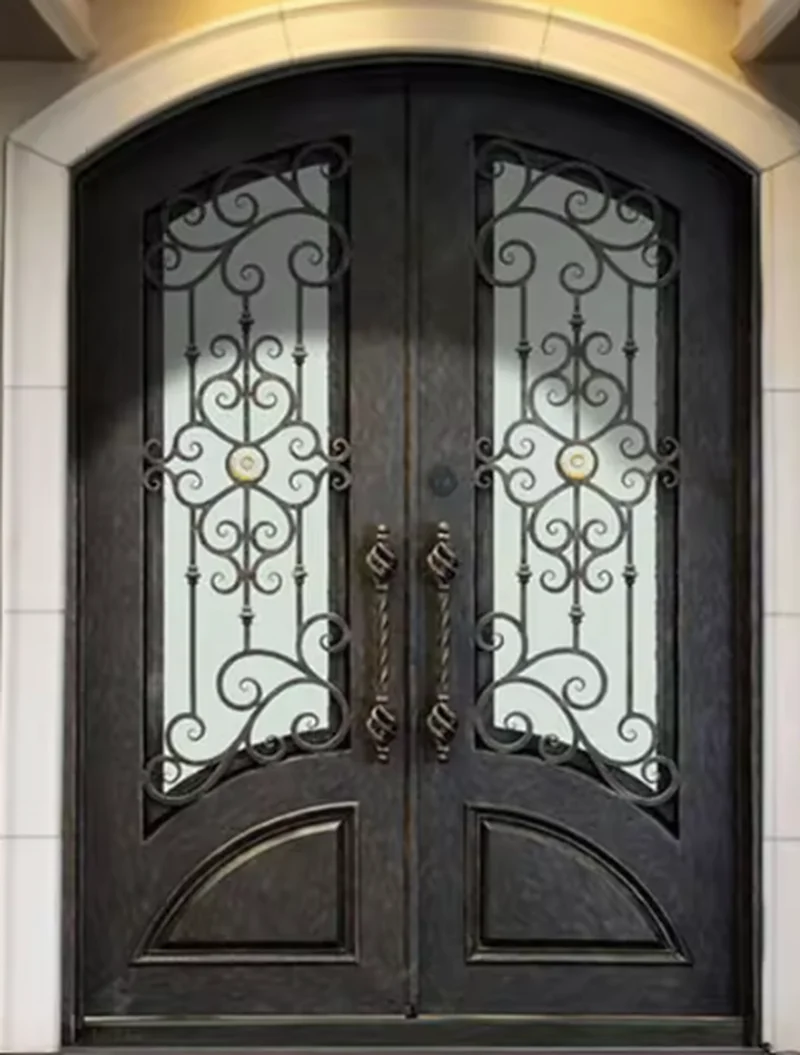
Critical Performance Parameters for Restaurant Applications
| Parameter | Specification | Standard / Test Method | Relevance to Restaurant Safety |
|---|---|---|---|
| Sound Reduction (Rw) | Up to 42 dB | EN ISO 10140-2 | Manages ambient noise between kitchen, dining, and street, ensuring a compliant and comfortable acoustic environment. |
| Thermal Transmittance (U-value) | ≤1.2 W/m²K | EN ISO 10077-1 | Maintains interior climate, reduces condensation risk, and lowers HVAC load adjacent to the door system. |
| Formaldehyde Emission | E0 Grade (<0.5 mg/L) | EN 16516 / JIS A 1460 | Ensures indoor air quality compliance, critical for enclosed or semi-enclosed dining spaces. |
| Door Leaf Swelling Rate | ≤0.8% (72h water soak) | EN 317 | Guarantees operational reliability and weather seal integrity despite high humidity from kitchens and weather exposure. |
| Hardness (Surface) | ≥75 Shore D | ASTM D2240 | Provides high resistance to scratches, impacts, and abrasion from furniture, service traffic, and cleaning. |
Functional Safety & Compliance Advantages
- Automated Threshold & Egress Compliance: Integrated automatic drop-down seals provide a thermal and acoustic barrier when closed but fully retract when the door is opened. This eliminates trip hazards, ensuring unimpeded and code-compliant egress paths in line with ADA/EN 16005 requirements.
- Impact-Resistant Glazing Options: Laminated safety glass with PVB or SGP interlayers is standard. This design maintains integrity upon impact, preventing fall-through and containing glass fragments, which is essential for areas accessible to the public.
- Certified Manufacturing & Traceability: Production under ISO 9001:2015 quality management systems ensures batch-to-batch consistency. Full material traceability and Declarations of Performance (DoP) are provided for all critical characteristics, simplifying regulatory submissions.
- Hygienic Surface & Durability: The co-extruded, high-density polymer surface layer is non-porous, inhibiting bacterial growth and allowing for repeated cleaning with commercial disinfectants without degradation of finish or color.
Technical Specifications: Materials, Dimensions, and Installation Requirements for Your Project
Material Specifications & Performance Data
Primary Panel & Frame Materials
-
WPC (Wood-Plastic Composite) Cladding & Profiles:
- Composition: 55-60% wood flour (typically pine or bamboo), 35-40% high-density polyethylene (HDPE) or polypropylene (PP), with <5% proprietary bonding and stabilizing additives.
- Density: ≥ 1.25 g/cm³. High density ensures structural integrity, resistance to impact, and minimizes thermal expansion/contraction.
- Moisture Absorption: < 0.5% after 24-hour immersion (ASTM D570). This ultra-low rate prevents swelling, warping, and fungal growth.
- Fire Rating: Class B-s1, d0 per EN 13501-1 (or ASTM E84 Class B equivalent), providing critical safety for commercial spaces.
- Surface Hardness: ≥ 75 Shore D, ensuring high resistance to scratches and abrasion from high-traffic use.
-
Engineered Core & Structural Components:
- LVL (Laminated Veneer Lumber) Core: For solid panel constructions. Composed of rotary-peeled softwood veneers (spruce/pine), bonded with phenolic resins under heat and pressure. Provides exceptional dimensional stability, racking resistance, and a high strength-to-weight ratio.
- Aluminum Reinforcement: Extruded 6063-T5 or T6 aluminum alloy profiles integrated into frame and stile sections. Anodized or powder-coated (Class II, minimum 60µm) for corrosion resistance.
- Glazing: Insulated glass units (IGUs) with 4mm tempered outer panes, 16mm argon-filled cavity, and 4mm laminated inner pane for safety and acoustic performance. Low-E coatings are standard for thermal control.
Performance Summary Table
| Parameter | Specification | Test Standard | Benefit for Outdoor Dining |
|---|---|---|---|
| Thermal Insulation (U-value) | ≤ 1.1 W/m²K | EN ISO 10077-1 / ASTM C1363 | Maintains interior climate, reduces HVAC load. |
| Acoustic Insulation (Rw) | ≥ 38 dB | EN ISO 10140-1 / ASTM E90 | Significantly reduces street noise for patron comfort. |
| Wind Load Resistance | Up to 1200 Pa (Class 4) | EN 12211 / ASTM E330 | Ensures structural integrity in exposed locations. |
| Water Tightness | ≥ 600 Pa (Class 9A) | EN 12208 / ASTM E547 | Prevents water ingress during driving rain. |
| Air Permeability | ≤ 1.5 m³/(hm²) (Class 2) | EN 12207 / ASTM E283 | Eliminates drafts, improves energy efficiency. |
| Formaldehyde Emission | E0 (≤ 0.065 mg/m³) | EN 16516 / ISO 12460-1 | Guarantees indoor air quality and safety. |
Standard Dimensions & Configuration Tolerances
All dimensions are nominal and subject to manufacturing tolerances of ±1.5mm on any single component. Custom sizes outside these ranges require specific engineering review.
Panel & Door Leaf Standards
- Single Leaf Doors: Standard widths from 900mm to 1100mm. Heights from 2100mm to 2400mm.
- Multi-Leaf Systems (2-4 leaves): Individual leaf widths from 600mm to 900mm. Total system spans up to 3600mm.
- Panel Thickness: 68mm or 78mm system depth, accommodating 24-44mm glazing units or solid insulated panels.
- Maximum Leaf Weight: 180kg for smooth operation on heavy-duty hardware.
Aperture & Structural Preparation Requirements
- Rough Opening: Must be plumb, level, and square. Provide a clear, structural opening width/height of door system width/height + 25mm.
- Threshold/Sill Support: The structural substrate must support a minimum point load of 300kg (distributed) at the sill. For cantilevered or elevated decks, consult a structural engineer.
- Head/Frame Support: Lintel or header above the opening must be designed to carry the full dead load of the system without deflection exceeding L/720.
Critical Installation Requirements
Installation must be performed by qualified personnel in accordance with the manufacturer’s engineered installation manual. The following are non-negotiable prerequisites.
1. Site & Substrate Conditions
- All adjacent masonry, concrete, or wood framing must be fully cured, dry, and structurally sound.
- Ambient temperature during installation must be between 5°C and 35°C.
- The finished floor level (inside) and exterior deck/terrace level must be established prior to fitting.
2. Sealing & Weatherproofing Protocol
- A continuous, non-sagging silicone or hybrid polymer sealant bead (compatible with WPC and aluminum) must be applied to the back of the frame’s nailing flange and all sub-sill interfaces.
- The head of the frame must be protected by a properly installed, code-complanted flashing system integrated with the building’s weather-resistive barrier (WRB).
- Expansion joints must be maintained per manual specifications, typically filled with compressible backer rod and sealed.
3. Hardware & Glazing Integration
- All hinges, pivots, and multi-point locking gear must be factory-pre-drilled and installed using only provided, corrosion-resistant fasteners (A2/A4 stainless steel).
- Glazing units must be bedded on continuous, closed-cell EPDM or silicone setting blocks at the base, with perimeter seals provided.
- All operational hardware must be adjusted post-installation to achieve specified performance metrics for compression, sweep, and operation force.
4. Post-Installation Verification
- Conduct a full operational check of all leaves, locks, and automatic closing devices.
- Verify drainage paths within the frame system are clear and functional.
- Provide the client with a documented checklist of installed specifications, warranty registration, and maintenance procedures.
Trusted by Leading Restaurants: Case Studies and Customer Testimonials on Our Garden Doors
Case Study: The Riverfront Bistro, Chicago
Project involved replacing failing aluminum-framed sliding doors with our thermally broken WPC (Wood Plastic Composite) bifold system to manage significant thermal bridging and condensation issues. The 72mm profile system, with a core density of 1.25 g/cm³ and a PVC-to-wood flour ratio of 60:40, provided the necessary structural stability for 4-meter spans while maintaining a low thermal transmittance (U-factor of 1.1 W/m²K). The client reported a 38% reduction in HVAC load for the perimeter zone during the shoulder seasons. The material’s moisture absorption rate of <0.5% (ASTM D570) has eliminated warping despite direct exposure to lake-effect weather.
- Architectural USP: Achieved a seamless 90% opening ratio, critical for high-traffic service during summer events.
- Performance Data: Installed units achieved a weighted sound reduction (Rw) of 38 dB, mitigating street noise.
- Compliance: All components certified to E0 formaldehyde emission levels (EN 16516), with full EN 14351-1 certification for performance.
Testimonial: Executive Chef, Coastal Grill, Seattle
“Our primary concern was durability against salt air and constant humidity. The specified door’s LVL (Laminated Veneer Lumber) core, with cross-banded veneers for dimensional stability, has shown zero deflection in three years. The aluminum-clad exterior’s powder coating (Qualicoat Class 3) shows no corrosion, and the swelling rate of the sealed timber interior remains below 1.5% (EN 317). The integrated threshold drainage system handles our frequent heavy rain perfectly.”
- Material Science: The LVL core’s stability is quantified by a modulus of elasticity (MOE) of 13,000 MPa, ensuring long-term alignment.
- Functional Advantage: The multi-point locking system engages with a stainless steel strike plate rated for over 25,000 cycles (EN 12209).
Case Study: Metropolitan Rooftop Bar, New York
This project required a fire-rated assembly for an egress route. We supplied a 60-minute integrity-rated glazed door system (tested to EN 1364-1). The door leaf incorporates a proprietary mineral core with a Class A fire rating (ASTM E84), while maintaining a U-factor of 1.3 W/m²K. The anodized aluminum frame (6063-T6 alloy) was engineered for a 4-story wind load of 2.5 kPa.
| Parameter | Specification | Standard / Test Method |
|---|---|---|
| Fire Resistance | 60 minutes (Integrity) | EN 1363-1, EN 1364-1 |
| Thermal Transmittance (U-factor) | 1.3 W/m²K | EN ISO 10077-1 |
| Air Permeability | Class 4 (600 Pa) | EN 12207 |
| Water Tightness | Class 9A (600 Pa) | EN 12208 |
| Shore D Hardness (Threshold) | 75 | ASTM D2240 |
- Technical Standard: The entire manufacturing process is governed by our ISO 9001:2015 quality management system, ensuring batch-to-batch consistency for critical components.
- Architectural USP: The system met stringent NYC building codes without compromising the desired aesthetic of slim sightlines.
Testimonial: Facilities Manager, National Restaurant Chain
“We standardized on your gliding door system for 12 locations due to lifecycle cost. The accelerated aging tests (ISO 4892-2) you provided gave us confidence in the UV stability of the WPC profiles. The reported operational force of under 75N (EN 14351-1) for a 6-meter stack has held true, reducing maintenance calls. The consistent E1 grade certification across all batches simplifies our environmental reporting.”
Frequently Asked Questions
What are the critical material standards for moisture and chemical resistance in outdoor garden doors?
Select doors with WPC density exceeding 1,200 kg/m³ and a PVC coating of at least 0.5mm. They must comply with E0 formaldehyde emission standards (≤0.5mg/L) and have a moisture expansion coefficient below 0.3%. This ensures dimensional stability and prevents warping or toxic off-gassing in humid, high-use environments.
How can we ensure thermal and acoustic insulation in restaurant patio doors?
Opt for doors with a multi-chamber PVC profile or an LVL (Laminated Veneer Lumber) core, achieving a U-value below 1.5 W/m²K. Integrated magnetic seals and double-glazed laminated glass (6+12A+6) can provide sound insulation of 35-40 dB, maintaining interior comfort and reducing external noise for diners.
What structural features prevent long-term warping and sagging in large door systems?
Specify reinforced frames with galvanized steel or aluminum inserts, and hinges rated for ≥150kg. The door core must be LVL or high-density WPC with cross-banded layers. This counteracts torsional stress, ensuring alignment and smooth operation for years, even with frequent use and exposure to temperature swings.
Which impact-resistant and safety features are mandatory for high-traffic dining areas?
Doors should feature tempered or laminated safety glass (Class P2A impact rating) and reinforced lock points. The facing material must have a minimum 2mm wear layer. For WPC, a co-extruded cap-stock layer provides superior resistance to scratches, dents, and UV degradation, maintaining appearance and safety.
What are the key procurement checks for finish durability and maintenance?
Verify the finish is a polyurethane or acrylic UV-cured coating, applied at 80-100 microns. Request accelerated weathering test reports (QUV 3000 hours). This ensures color fastness and easy cleaning. Avoid porous finishes; a sealed, non-porous surface prevents stain absorption from food, grease, and weather elements.