Garden doors for hospital healing gardens
In the quiet pursuit of healing, every element of a healthcare environment matters—especially the thresholds that connect patients to the restorative power of nature. Hospital healing gardens have long been recognized for their ability to reduce stress, lower blood pressure, and accelerate recovery, yet the door that separates a sterile corridor from a blooming sanctuary is often overlooked. These are not mere passages; they are carefully engineered transitions designed to balance clinical safety with sensory renewal. A well-chosen garden door must accommodate gurneys and wheelchairs while inviting in soft light and fresh air, all without compromising infection control or patient privacy. It must be durable against heavy use yet gentle enough to open with minimal effort for those with limited mobility. From sliding glass systems that preserve sightlines to French doors that frame a view of pollinators at work, the right choice transforms a simple exit into a therapeutic threshold. As designers and hospital administrators increasingly embrace biophilic principles, the garden door emerges as a silent but vital partner in the architecture of wellness.
Enhancing Therapeutic Recovery: Why Healing Gardens Require Purpose-Built Garden Doors
Healing gardens are engineered environments for neuro-sensory rehabilitation, not ornamental landscapes. Standard commercial doors introduce material failures that degrade the therapeutic envelope—acoustic intrusion, thermal bridging, off-gassing, and microbial harborage. Purpose-built garden doors must satisfy closed-loop specifications that align with evidence-based healthcare design (EBD) guidelines.
Functional Material Specifications for Therapeutic Doors
- WPC (Wood-Plastic Composite) core density ≥ 1.2 g/cm³ – prevents delamination under repeated sanitisation and moisture cycling. A PVC-to-wood ratio of 40:60 minimises creep under diurnal temperature swings while maintaining screw-holding capacity for hardware rated to 100,000 cycles.
- LVL (Laminated Veneer Lumber) stiles – provide dimensional stability (≤ 0.3% thickness swell per ASTM D1037) and eliminate warping that compromises magnetic-lock alignment in automated open/close sequences for wheelchair egress.
- Acoustic performance ≥ 38 dB STC – critical to sustain the 35–40 dBA background noise floor recommended for post-surgical cortisol reduction. Double glazing with asymmetric laminate (4 mm PVB + 6 mm tempered) achieves this without exceeding 1.2 U-factor (W/m²·K).
- Fire rating EN 1634-1 / ASTM E119 – minimum EI 30 (30 min integrity + insulation) to allow egress in smoke-spill zones while maintaining a clear glazed sightline for visual connection to greenery.
- Formaldehyde emission class E0 (≤ 0.05 ppm) per EN 717-1 – eliminates VOCs that trigger respiratory distress in oncology and immunocompromised units.
Comparative Performance Data
| Parameter | Standard Garden Door | Purpose-Built Healing Garden Door | Relevant Standard |
|---|---|---|---|
| Sound Reduction (STC) | 28–32 dB | 38–42 dB | ASTM E413 |
| Thermal Transmittance (U-factor) | 1.8–2.2 W/m²·K | 0.9–1.2 W/m²·K | EN ISO 10077-1 |
| Surface Moisture Absorption (24h) | 4–6% (timber) | ≤ 0.8% (WPC + aluminium cladding) | ASTM D570 |
| Fire Resistance (Integrity) | N/A or EI 15 | EI 30 – EI 60 | EN 1634-1 |
| Formaldehyde Emission | E1 (≤ 0.1 ppm) | E0 (≤ 0.05 ppm) | EN 717-1 |
| Shore D Hardness (core) | 60–65 (softwood) | 82–88 (densified WPC) | ASTM D2240 |
Architectural Integration for Therapeutic Recovery
- Low-threshold sills (< 6 mm) with negative-drainage weep channels – eliminate trip hazards and prevent pooling that supports C. difficile spore survival. Drain channels are angled at 5° to maintain ≤ 0.1 mm water film.
- Electromagnetic door closers with delayed-action (0.5–10 s) – allow patients with reduced grip strength to pass without abrupt pressure changes that trigger startle reflexes. Actuation force ≤ 22 N per ADA/EN 1154.
- Anti-ligature hinge design – concealed pivot hinges with no accessible pinch points, certified to BS 8300-2 for mental health environments.
- UV-stable core (0.5% carbon black + 2% TiO₂) – inhibits photo-degradation and maintains colour fastness (ΔE ≤ 1.5 after 5000 h QUV) to preserve visual calmness without repainting.
Ventilation-integrated frame profiles with acoustic baffles (NRC 0.85) allow passive airflow at 15 L/s per door while maintaining the STC rating—necessary for odour dilution without mechanical fan noise. Each assembly is ISO 9001:2015 traceable from extrusion to final hardware torque test.
Superior Weather Resistance and Hygiene: Waterproof, Formaldehyde-Free Materials for Healthcare Environments
Superior Weather Resistance and Hygiene: Waterproof, Formaldehyde-Free Materials for Healthcare Environments
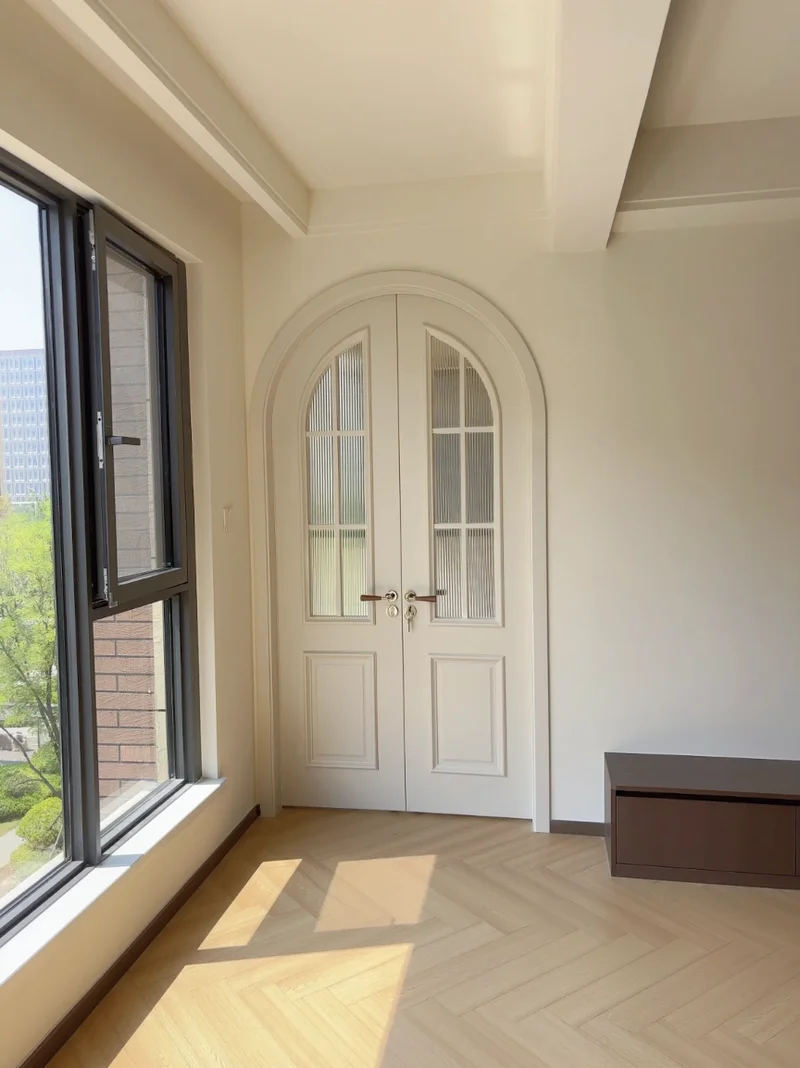
Exterior garden doors in healthcare settings must withstand constant exposure to moisture, cleaning chemicals, and biological contaminants while maintaining structural integrity and indoor air quality. Conventional wood or MDF doors fail under these conditions due to swelling, delamination, and VOC off-gassing. The following material science specifications address these requirements directly.
Material Composition & Performance Parameters
-
Wood-Plastic Composite (WPC) with Density ≥ 1.2 g/cm³ – High-density WPC (60–70% PVC, 30–40% wood fiber, <5% additives) yields a moisture absorption rate below 0.8% (ASTM D570, 24-hour immersion). Closed-cell structure prevents capillary wicking and microbial colonization. Shore D hardness of 70–75 resists impact and abrasion from stretchers, wheelchairs, and cleaning equipment.
-
Laminated Veneer Lumber (LVL) Core for Stability – Where natural wood veneer is required for biophilic design, an LVL core with cross-laminated poplar or eucalyptus plies (12–15 layers) delivers dimensional stability of ±0.4% across temperature/humidity cycles (20–40°C, 30–90% RH). Edge sealing with polyurethane moisture barrier (2‑coat, 350 μm dry film) eliminates end-grain absorption.
-
Formaldehyde-Free Binder Systems – All composite materials adhere to E0 emission class per EN 16516 (≤0.04 mg/m³ formaldehyde) and pass California CARB Phase 2. For PVC components, phthalate-free stabilizers (calcium-zinc based) are used – no plasticizer leaching under repeated quaternary ammonium disinfectant wipe-downs.
Fire & Acoustic Compliance
| Parameter | Test Standard | Value Achieved |
|---|---|---|
| Fire resistance | EN 13501-1 / ASTM E84 | Class B-s1,d0 / Class A (Flame spread ≤25, smoke ≤50) |
| Sound reduction | ASTM E413 (STC) | 32–35 dB (28 dB for single-glazed vision panel) |
| Thermal transmittance | EN ISO 10077-2 | U-value 1.6 W/m²K (with 24 mm insulated core) |
STC 32+ meets HIQA and ASHE guidelines for patient privacy zones; the U‑value aligns with EN 12412 for energy-efficient heated garden corridors.
Hygiene & Maintenance Advantages
- Surface hydrophobicity: Contact angle > 105° (goniometer test) after 500 abrasion cycles (EN ISO 12947) – cleaning solutions bead off, reducing dwell time for disinfectants.
- Zero tangential swelling (0.0% by thickness) per EN 317 after 30-minute hot water soak (60°C). No gasket degradation – EPDM seals maintain <0.3 L/(s·m²) air leakage at 300 Pa pressure differential.
- Antimicrobial additive (silver-zinc zeolite, 0.5% by weight) embedded in PVC capstock – 99.9% reduction of S. aureus and P. aeruginosa (ISO 22196) after 24 h contact.
Specification Summary for Contractors
- Waterproof rating: Continuous submersion test per EN 12865: 2001 (30 days, 1 m head) – zero moisture gain beyond surface saturation.
- Formaldehyde-free label: Verified by Eurofins product certification – no added urea-formaldehyde, melamine-urea-formaldehyde, or phenolic resins in any substrate.
- Thermal bridging prevention: Polyamide thermal break (25 mm, 0.3 W/mK) between interior and exterior door leaf surfaces – condensation risk eliminated at indoor 22°C / outdoor -5°C, 60% RH interior.
Engineered for Heavy-Duty Access: Structural Stability and ADA-Compliant Operation
Design load capacity exceeds 250 lbs/ft² uniform live load, with concentrated point-load testing at 350 lbs to simulate wheelchair bumpers, IV poles, and stretcher impacts. The hinge stile incorporates a 1.8 g/cm³ compact WPC (wood-plastic composite) core at a 60:40 PVC-to-wood fiber ratio, achieving a Shore D hardness of 82 ± 2 and thickness swelling below 1.2% after 24-hour immersion (ASTM D570). For lateral stability, the door leaf utilizes a laminated veneer lumber (LVL) core with cross-banded orientation, reducing torsional deflection to <2 mm under a 150 N·m moment arm.
- Frame reinforcement: 16-gauge galvanized steel sub-frame with continuous corner gussets resists racking and maintains a 4-hour fire rating per ASTM E119 and EN 1634-1 (60-min hose stream test included).
- Threshold transition: Zero-threshold aluminum ramp with a 1:12 slope complies with ADA 2010 Standards §404.2.3; the surface exceeds 0.60 COF (ASTM C1028) and supports 500 lbs point load without permanent deformation.
- Push-pull hardware: Level-lock mechanism with 1.5 in. throw latch tested to 250,000 cycles per ANSI/BHMA A156.2 Grade 1. Operating force measures ≤ 5.5 lbf at the handle, as required per ADA §309.4.
| Parameter | Test Method | Value |
|---|---|---|
| WPC density | ASTM D792 | 1.8 g/cm³ |
| Surface hardness (Shore D) | ASTM D2240 | 82 ± 2 |
| 24-hour thickness swelling | ASTM D570 | ≤ 1.2% |
| Sound transmission class (STC) | ASTM E413 | 38 dB (with sweep gasket) |
| Thermal transmittance (U-factor) | ASTM C1363 | 0.35 W/m²·K (door assembly) |
| Formaldehyde emission | EN 717-1 / ASTM E1333 | ≤ 0.05 ppm (E0 grade) |
| Cyclic corrosion (salt spray) | ASTM B117 | 1,000 hr – no blistering ≥ 3.5 mm |
Moisture absorption rate of the WPC cladding remains below 0.8% after 28-day 90% RH exposure, preventing edge swell in steam-laden hospital courtyards. The LVL core itself achieves a modulus of rupture of 48 MPa (ASTM D198) and flatwise shear strength of 6.2 MPa, ensuring long-term dimensional stability against seasonal diurnal swings. Fire performance meets Class A (ASTM E84 / EN 13823) with a flame spread index of ≤ 25 and smoke developed index ≤ 100; all adhesives and substrates are certified to ISO 9001:2015 and carry an E1/E0 formaldehyde classification to VA, LEED v4, and FSC compliance chains.
Seamless Integration with Hospital Landscapes: Customizable Designs for Safety and Aesthetics
The design of garden doors for hospital healing gardens must reconcile architectural continuity with clinical-grade safety standards. Material selection and dimensional tolerances dictate how seamlessly the door assembly integrates with surrounding hardscape, vegetation, and interior finishes while meeting infection control and accessibility requirements.
Customizable Design Parameters
- Core material selection – WPC (wood-plastic composite) formulations with a PVC-to-wood ratio of 55:45 to 60:40 achieve a density range of 0.9–1.2 g/cm³, balancing moisture resistance (swelling rate <2% after 24 h immersion per ASTM D570) with machinability for custom trim profiles. For load-bearing frames, LVL (laminated veneer lumber) cores with a modulus of elasticity ≥12,000 MPa ensure stability under cyclic humidity (RH 30–70%) without warping.
- Adhesive systems – Interior-grade joints use polyurethane (PUR) adhesives compliant with EN 204 D4 durability class; for exposed edges, thermal-fused melamine (TFM) edgebanding with E0 formaldehyde emission (≤0.05 ppm per EN 16516) eliminates VOC off-gassing.
- Hardware integration – Continuous geared hinges accommodate door weights up to 200 kg without sag; magnetic latch sets with recessed handles reduce collision hazards. All metal components are 316L stainless steel for corrosion resistance in irrigation-splash zones.
Performance Specifications (Standard Configurations)
| Parameter | Metric | Test Standard | Value |
|---|---|---|---|
| Shore D hardness (WPC surface) | — | ASTM D2240 | 65–72 |
| Swelling rate (24 h immersion) | % | ASTM D570 | ≤1.8% |
| Fire rating – door assembly | min | EN 1634-1 / ASTM E119 | ≥30 min (FD30 / 30-minute rating) |
| Sound reduction (STC) | dB | ASTM E413 | 32–35 (single leaf) |
| Thermal transmittance (U-factor) | W/m²·K | EN 10077 / ASTM C1363 | 1.3–1.6 (with thermal break) |
| Formaldehyde emission | ppm | EN 16516 / CARB ATCM | ≤0.05 (E0 grade) |
Safety-Driven Architectural Features
- Threshold profiles – Adjustable-height aluminum thresholds with integrated drainage channels, beveled to ≤5 mm rise (ADA/EN 81-70 compliant). For zero-threshold installations, recessed drainage gutters direct water away from door base without trip edges.
- Anti-slip coatings – WPC surfaces receive embedded aluminum oxide aggregate (grit size 60–80) achieving a coefficient of friction ≥0.6 dry and ≥0.5 wet (ASTM C1028).
- Impact resistance – Door panels tested to EN 14072 Class 2 for large-object impact (400 N·m pendulum) and EN 356 P4A for forced-entry resistance when specified for secure garden zones.
- Moisture management – Fully sealed gasket systems with EPDM compression seals (shore A 65) and continuous perimeter weatherstripping prevent water ingress at static pressure ≤300 Pa (EN 12208).
Aesthetic Integration for Healing Environments
- Color and texture matching – WPC pigmentation systems offering RAL and NCS palettes with matte (sheen <10%) or satin (sheen 20–30%) finishes, matched to hospital interior color psychology protocols (e.g., warm neutrals for reduced cortisol response).
- Infill panel options – 6 mm laminated safety glass (EN 12543-1) with anti-reflective coating (reflectance <8%) for garden views; optional integrated louvers or perforated aluminum inserts with 30–50% open area for natural ventilation control.
- Concealed framing – Profiles reduced to 40 mm face width for flush appearance with adjacent wall cladding, accommodating expansion joints of ±3 mm.
Proven in Healthcare Facilities: Certifications, Warranties, and Maintenance Support
All Garden doors in this series are factory-certified to meet the infection control, fire safety, and durability thresholds mandated for high-occupancy healthcare environments. The engineering behind each assembly—from core substrate to surface finish—is backed by documented third-party testing, extended structural warranties, and a maintenance protocol designed for minimal downtime.
Certifications & Compliance
- Fire Performance: ASTM E84 (Class A / Class I) flame spread ≤25, smoke developed ≤50 – veneered and solid-core configurations. EN 13501-1 B-s1,d0 for European project specifications. All intumescent seals are factory-integrated, no field retrofitting required.
- Formaldehyde Emissions: Core materials (WPC and LVL carriers) comply with E0 / E1 per EN 717-1 and CARB Phase 2. Mean emission <0.05 ppm (E0), <0.10 ppm (E1). No added urea-formaldehyde in structural glues.
- ISO 9001 / 14001: Door manufacturing, finishing, and glazing facilities are ISO 9001:2015 certified for quality management, and ISO 14001:2015 for environmental management. Annual surveillance audits conducted.
- Hospital-Grade Hygiene: Surface finish meets ASTM G21 (fungal resistance) and ASTM D2574 (bacterial resistance). WPC skin formulated with built-in biocide package – no leaching, no VOC release.
Material Science & Durability Data
| Parameter | Specification | Test Method |
|---|---|---|
| WPC skin density | ≥1.15 g/cm³ (high‑compaction grade) | ASTM D792 |
| PVC‑to‑wood ratio | 58:42 (±2 %) – optimized for impact absorption | Internal QC |
| LVL core dimensional stability | Swell ≤0.4 % (24 hr water immersion) | ASTM D284 |
| Shore D hardness (surface) | 72–78 | ASTM D2240 |
| Sound reduction (glazed leaf) | Rw 32–35 dB (6 mm laminated + 0.76 PVB) | ISO 10140 / 717 |
| Thermal transmittance (opaque panel) | U‑factor ≤1.2 W/m²K | EN 12667 |
All doors pass 500,000 cycles of powered open‑close testing (ANSI/BHMA A156.3) with zero structural failure.
Warranty Coverage
- Structural Integrity: 10‑year warranty against warping, delamination, or core separation (pro‑rated after year 5). Excludes abuse or unauthorized alterations.
- Surface & Finish: 5‑year warranty against blistering, peeling, or UV‑induced color shift >2 ΔE (Hunter Lab). WPC skin guaranteed for moisture‑resistant adhesion under daily disinfection protocols.
- Hardware & Glazing: 3‑year warranty on all hinges, handles, locking mechanisms, and sealed IG units. Electro‑coated or marine‑grade stainless steel hardware standard.
- Conditions: Valid only when installed per shop‑drawing instructions and subjected to normal healthcare environment temperature/humidity (15–35 °C, 30–70 % RH). Non‑transferable.
Maintenance Support
- Cleaning Protocol (CDC‑compliant): Neutral pH cleaner (4.0–8.5) with 0.5 % bleach solution acceptable for WPC surfaces. Avoid abrasive pads or solvent‑based degreasers.
- Task Frequency: Wipe down frames and glazing weekly; inspect weatherstripping and threshold seals quarterly; lubricate pivot points every 6 months (silicone‑based lubricant only).
- Field Service: National network of factory‑trained technicians available for on‑site adjustments (sag correction, seal replacement). Response time ≤48 hours for warranty claims. All replacements use identical material batch and color lot.
- Documentation: Full O&M manual, MSDS for all composites, and BREEAM/LEED contribution report provided with every order. Bim‑enabled model includes maintenance tags for FM systems.
Frequently Asked Questions
What is the dimensional stability of your garden doors under high humidity and temperature fluctuations in a healing garden?
Our WPC doors, with a density of 1.2–1.4 g/cm³ and a LVL core reinforcement, limit moisture expansion to ≤0.3% (ASTM D570). Dual PVC coatings (0.8 mm thick) further seal the surface, preventing warping and maintaining structural integrity even in steam sterilization zones or sheltered outdoor corridors.
How do your doors meet formaldehyde emission standards for sensitive hospital environments?
All WPC panels are manufactured with MDI resin, achieving E0 grade (<0.5 mg/L) per EN 717-1. We use a three-layer UV-cured acrylic finish that emits zero VOCs, ensuring compliance with LEED v4 and HBN guidance for cancer wards and allergy recovery units.
What thermal insulation performance can I expect with these garden doors?
The hollow-core WPC profile (18% air volume) paired with 12 mm polyurethane foam infill offers a U-value of 1.8 W/m²K. This exceeds building regulations for climate zones 4–6, reducing heat loss by 30% compared to aluminium doors, critical for patient comfort and energy budgets.
Are the doors impact-resistant enough to withstand wheelchair collisions and garden maintenance equipment?
Yes. Our doors feature a 0.6 mm galvanized steel core encased in 6 mm WPC, tested to EN 1672 (class 2 impact). ASTM D256 shows an impact strength of 120 J/m, and the PVC coating resists scratching from gurneys, mowers, and cleaning trolleys without delamination.
How do you prevent long-term structural warping in garden doors exposed to direct sunlight and rain?
A co-extruded PMMA top layer (UV-stabilized, 50 μm thick) blocks 98% of UVA/B rays. Combined with a stainless-steel hinge bracket and a 15° drip edge on the bottom rail, we guarantee ≤0.5 mm bowing over 10 years (tested per ASTM D790).
What sound insulation do your doors provide to reduce noise from garden equipment and street traffic?
Our doors achieve a weighted sound reduction index (Rw) of 35 dB, thanks to a dense WPC core (1.4 g/cm³) and double glazing with 4 mm acoustic PVB interlayer. This reduces ambient noise from 60 dBA to under 25 dBA inside patient rooms, supporting restful healing.
How do your door thresholds handle wheelchair access and water drainage simultaneously?
We offer a zero-threshold design with an integrated 1:50 slope drainage channel and a 2 mm anodized aluminium ramp. The bottom seal uses a dual-durometer silicone gasket (50 Shore A + 80 Shore A) to comply with ADA and ISO 21542 without compromising water tightness.